INTRODUCTION
Toddlers who are late talkers comprise approximately 15% of the toddler population and are characterized by slow expressive language development in the absence of cognitive, hearing, social, and physical disorders (Rescorla, Reference Rescorla1989). Toddlers who are late talkers are at risk for lasting difficulties with language and some late talkers are subsequently diagnosed with Specific Language Impairment (SLI) (e.g. Bavin & Bertherton, Reference Bavin, Bretherton, Rescorla and Dale2013; Leonard, Reference Leonard1998; Paul, Reference Paul1993). Attention allocation skills have been correlated with language abilities in typically developing infants and toddlers (e.g. Dixon & Shore, Reference Dixon and Shore1997; Dixon & Smith, Reference Dixon and Smith2000; Kannass & Oakes, Reference Kannass and Oakes2008; Yu & Smith, Reference Yu and Smith2011). It is possible that differences in attention allocation are also present in toddlers who are identified as late talkers, contributing to their lexical delay. The present study examined the influence of attention allocation on lexical acquisition in two-year-olds identified as late talkers.
Word learning in typically developing toddlers
Learning a new word requires toddlers to map lexical information to its referent by attending to phonetic and semantic details. In order to know the referent for a novel word, toddlers must learn statistical regularities of the co-occurrence of words and their meaning – otherwise known as associative learning (Smith & Yu, Reference Smith and Yu2008; also see Plunkett, Reference Plunkett1997, for a review) – while inhibiting responses to distracting stimuli. Word learning also requires social–cognitive skills; specifically, toddlers can also demonstrate joint attention between an adult and an object, or action in order to follow the speakers' eye-gaze to determine the referent of the novel word (Carpenter, Nagell & Tomasello, Reference Carpenter, Nagell and Tomasello1998; Tomasello, Reference Tomasello, Moore and Dunham1995; Yu & Smith, Reference Yu and Smith2012).
Yu and Ballard (Reference Yu and Ballard2007) present a model of early word learning that accounts for both statistical cues and social–cognitive cues. They used a computational approach to code videos of mother–infant interactions, in order to understand how infants map words to their referents. Results showed that statistical regularities were used to compute the word–meaning pairs, consistent with an associative learning account. That is, toddlers learned the meanings of words when the labels occurred frequently, while in the presence of the referents (see also Smith & Yu, Reference Smith and Yu2008). They also found that social interaction cues were necessary to highlight the word–referent relationships. Mothers synchronize their verbal references (naming) with their eye-gaze and gesture (e.g. pointing to the referent) while infants are looking at, touching, and manipulating objects (see also Yu & Smith, Reference Yu and Smith2011, Reference Yu and Smith2012). Joint attention, in addition to statistical learning, is used to link the word to the object the speaker is referring to.
Word learning in toddlers who are late talkers
Toddlers who are late talkers are late in saying their first words, are slow to add additional words to their repertoires, and show delays in productive syntax (e.g. Rescorla, Reference Rescorla1989, Reference Rescorla2009). When presented with a word-learning task, late talkers have difficulty fast mapping new words (measured by both comprehension and naming), as compared with their age-matched peers (Ellis Weismer & Evans, Reference Ellis Weismer and Evans2002). Early expressive language delays in late talkers are not attributed to hearing, cognitive, or neurological factors. In some late talkers, temperament has been identified as a foundation for early language delay (Irwin, Carter & Briggs-Gowan, Reference Irwin, Carter and Briggs-Gowan2002). Phonological factors have also been suggested as a contributing factor to early and continued vocabulary delays (e.g. Leonard, Schwartz, Swanson & Frome Loeb, Reference Leonard, Schwartz, Swanson and Frome Loeb1987; MacRoy-Higgins, Schwartz, Shafer & Marton, Reference MacRoy-Higgins, Schwartz, Shafer and Marton2013; Oller, Eilers, Neal & Schwartz, Reference Oller, Eilers, Neal and Schwartz1999). For instance, toddlers who are late talkers show delays in the onset of canonical babbling (Oller et al., Reference Oller, Eilers, Neal and Schwartz1999); and less complex babble as compared to their peers (Fasolo, Majorano & D'Odorico, Reference Fasolo, Majorano and D'Odorico2008). These differences in early phonological development are noteworthy because there is a strong positive correlation between the onset and quality of babbling and lexical growth (Stoel-Gammon, Reference Stoel-Gammon2011). However, there could be a number of reasons why toddlers who are late talkers demonstrate slow expressive language development.
Influences of attention on word learning
A positive correlational relationship between attention measures and expressive and receptive language is observed (Dixon & Shore, Reference Dixon and Shore1997; Dixon & Smith, Reference Dixon and Smith2000; Kannass & Oakes, Reference Kannass and Oakes2008; Mundy, Delgado, Block, Pomares, VanHecke & Parlade, Reference Mundy, Delgado, Block, Pomares, VanHecke and Parlade2007; Mundy, Fox & Card, Reference Mundy, Fox and Card2003; Yu & Smith, Reference Yu and Smith2011). One measure of attention, the duration of looking at pictures or objects, has been shown to predict language learning in typically developing children. Kannass and Oakes (Reference Kannass and Oakes2008) observed the attention allocation (measured by looking duration to age appropriate toys) of 9- and 31-month-olds. They found attention allocation at 9 and 31 months was correlated to receptive vocabulary. That is, 9-month-olds who had longer looking durations at toys had larger vocabularies at 31 months as compared with 9-month-olds who had shorter looking durations to toys. Similarly, Yu and Smith (Reference Yu and Smith2011) found a direct relationship between attention allocation and word learning in typically developing toddlers. They presented new words to toddlers and measured their word comprehension using eye-tracking. Toddlers who acquired more words showed longer attention towards the target object whereas those who acquired significantly fewer words showed shorter attention, as observed by more attention switches (attention frequently changed from target to foil image).
Using a looking while listening (LWL) paradigm, Fernald and colleagues have demonstrated that vocabulary scores predict how quickly and accurately typically developing children look at pictures of objects that they know (e.g. Borovsky, Elman & Fernald, Reference Borovsky, Elman and Fernald2012; Fernald, Perfors & Marchman, Reference Fernald, Perfors and Marchman2006). Typically developing children with lower vocabulary scores are less efficient in looking at referents while hearing their labels. These studies suggest that in typically developing children, early attention allocation may predict receptive language development.
Two studies by Dixon and colleagues observed the influence of attention manipulation on word learning in toddlers (Dixon & Salley, Reference Dixon and Salley2007; Dixon, Salley & Clements, Reference Dixon, Salley and Clements2006). In both studies, typically developing toddlers (21–22-month-olds) were exposed to novel words via a fast-mapping procedure while attention allocation was manipulated through social and cognitive distractions. The social distracter involved an adult entering the room and reading a story either in English (Dixon & Salley, Reference Dixon and Salley2007) or in a language that the toddler was not familiar with (Dixon et al., Reference Dixon, Salley and Clements2006). For the cognitive distracter condition, one additional known object (Dixon et al., Reference Dixon, Salley and Clements2006) or two additional known objects (Dixon & Salley, Reference Dixon and Salley2007) were included during the fast-mapping task, thus increasing the complexity of the stimulus array. Attention allocation measures included the intensity of facial interest upon display of the objects, the duration of looking at the objects (in seconds), and the duration of object manipulation (in seconds). The main finding from both studies was that word learning, measured by comprehension, was affected when both social and cognitive distractions were introduced as compared with word learning with no distractions. More interestingly, the authors noted the toddlers' patterns of attention allocation (based on a parent questionnaire that asked questions such as “When engaged in play with his/her favorite toy, how often did your child play for more than 10 minutes?”) were also directly related to word learning. Those toddlers with higher attentional focus were less affected by environmental distracters when learning new words as compared with toddlers with lower attentional focus (Dixon et al., Reference Dixon, Salley and Clements2006). This suggests that toddlers who exhibit longer periods of attention allocation are able to block out unrelated stimuli (distractions) and subsequently learn more words than toddlers who exhibit shorter periods of attention allocation.
Attention and word learning in toddlers who are late talkers
There is some evidence that toddlers who are late talkers show differences in joint attention skills (Paul & Shiffer, Reference Paul and Shiffer1991; Wetherby, Yonclas & Bryan, Reference Wetherby, Yonclas and Bryan1989). Paul and Shiffer (Reference Paul and Shiffer1991) found that toddlers who were late talkers produced fewer joint attention initiations as compared with age-matched controls. Similarly, Wetherby and colleagues (1989) observed low rates of joint attentional behavior in language-impaired preschool children, as compared to age-matched peers.
A recent study examined the relationship between joint attention, receptive language, and expressive language in 26-month-old toddlers who were late talkers as compared to language-matched peers who were six months younger while engaged with age-appropriate toys with their caregivers (Vuksanovic & Bjekic, Reference Vuksanovic and Bjekic2013). Joint attention (both initiating and responding to joint attention), receptive language, and expressive language were measured at the beginning of the study and then five and ten months later. At each point in time, both groups exhibited the same number of joint attention bids. However, a different pattern of joint attention, receptive, and expressive language was observed between groups. The number of joint attention bids predicted expressive and receptive vocabulary 5 and 10 months later for the typically developing toddlers. In contrast, the number of joint attention bids did not predict receptive and expressive language for the toddlers who were late talkers. What is unknown is the duration of the bids (attention allocation). That is, when exposed to new objects with novel labels, are differences present in attention allocation between late talking and typically developing toddlers, and, if yes, what influence do these differences have on acquiring their labels?
Purpose of present investigation
To date, there has been little research focused on the role of attention allocation on word-learning in toddlers who are late talkers. Therefore, the purpose of this study was to examine attention allocation in late talkers and their age-matched, typically developing peers while actively engaged in a word-learning task in order to determine if any group differences exist; and, if present, whether differences in attention allocation partially contribute to word learning. Specifically, we were interested in determining whether attention allocation is a stronger predictor of word learning than other general language or cognition measures. We taught toddlers who were late talkers novel words over a period of ten training sessions, which allowed us to examine differences in attention allocation over time. Our word-learning design was consistent with previous studies examining lexical acquisition in young children with early expressive language delay (e.g. Leonard et al., Reference Leonard, Schwartz, Swanson and Frome Loeb1987; MacRoy-Higgins et al., Reference MacRoy-Higgins, Schwartz, Shafer and Marton2013). We used a focused stimulation approach where a target set of words was named by the experimenter, while toddlers engaged with the objects in a play-like setting; the toddlers were not asked to name the words. These word-learning procedures were similar to how toddlers are exposed to and learn words in their everyday (natural) environments. We then conducted comprehension probes to determine which words were acquired.
We expected late talkers to show less attention allocation to the objects as compared with age-matched peers, because Yu and Smith (Reference Yu and Smith2011) found that toddlers who demonstrate less sustained attention to target words subsequently learn fewer words. In addition, we expected that attention allocation would influence the toddlers' abilities to acquire the novel words. That is, we expected toddlers (both late talkers and typically developing peers) to more easily acquire the labels for objects that they allocated more attention to, because Dixon et al. (Reference Dixon, Salley and Clements2006) found low attention focus toddlers to have more difficulty with word-learning tasks as compared with the high attention focus toddlers.
METHODS
Participants
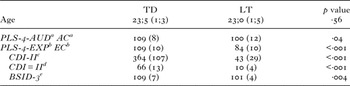
Twenty-two toddlers (mean age = 1;11, SD = 0;1, range = 1;9–2;1) participated in this study. Half of the toddlers (9 males, 2 females) were identified as late talkers (LT), as defined below, and the other half (10 males, 1 female) served as age and typical language development (TD) controls. All participants came from monolingual English-speaking homes; the caregivers of the participants completed a socioeconomic status (SES) questionnaire as well as a case history questionnaire. All participants completed a series of standardized language tests and were participants in a larger study examining lexical acquisition in toddlers. Table 1 presents participant information.
Participant information, average reported expressive vocabulary words with percentile ranks, and average standard scores on language and cognitive measures. Standard deviations are presented in parentheses.

notes: PLS-4 = Preschool Language Scale, 4th ed. (Zimmerman, Steiner & Pond, Reference Zimmerman, Steiner and Pond2002); CDI-II = MacArthur-Bates Communicative Development Inventories, 2nd ed., Words and Sentences (Fenson et al., Reference Fenson, Marchman, Thal, Dale, Reznick and Bates2007); BSID-3 = Bayley Scales of Infant Development, 3rd ed., Mental Scale (Bayley, Reference Bayley2006).
a PLS-4-AUD = auditory comprehension standard score.
b PLS-4-EXP = expressive communication standard score.
c CDI-II = number of expressive vocabulary words reported.
d CDI-II = percentile rank.
e BSID-3 = Mental Scale standard score.
Toddlers identified as LT scored at or below the 15th percentile on the MacArthur-Bates Communicative Development Inventories: Words and Sentences, (CDI: W & S; Fenson, Marchman, Thal, Dale, Reznick & Bates, 2007) and did not produce word combinations, according to parent report. Note that a 24-month-old toddler who reportedly says fifty words performs at the 15th percentile on the CDI: W & S. The use of percentile ranks to identify toddlers as LT, rather than the traditional criteria (24-month-old who says fewer than 50 words and does not combine words), allowed us to include toddlers slightly older than and younger than 24 months. Standard scores on the expressive portion of the Preschool Language Scale, 4th edition (PLS-4; Zimmerman, Steiner & Pond, Reference Zimmerman, Steiner and Pond2002) were below average (<1 standard deviation from the mean). All LT participants' standard scores on the Auditory Comprehension subtest of the PLS-4 and on the Bayley mental scale (Bayley, Reference Bayley2006) were within one standard deviation from the mean.
TD controls scored within the average range on the Bayley mental scale and on the Auditory Comprehension and Expressive Communication subtests of the PLS-4. They scored at or above the 35th percentile on the CDI: W & S. Unpaired t-tests were used to compare LT and TD toddlers' scores on language and cognitive measures; Table 1 reports p values. Note that despite scoring in the average range on the Auditory Comprehension subtest of the PLS-4 and the Bayley mental scale, toddlers who were LT scored significantly lower than controls on these measures.
TD participants were similar to LT participants in age, SES, and maternal education. Socioeconomic status of the participants was matched; one LT and one TD toddler was middle class, six LT and six TD toddlers were upper-middle class, and four LT and four TD toddlers were upper class. Maternal education was similar among all participants; all mothers obtained a 4-year college degree or higher. Mothers of six LT toddlers and six TD toddlers obtained Master degrees. An unpaired t-test revealed no difference between the ages in TD and LT groups (see Table 1). All LT and TD participants passed hearing screenings at 20 dBHL at 1000 Hz, 2000 Hz, and 4000 Hz using visual reinforcement audiometry (VRA) in a sound-treated booth. No participant (LT or TD) had a history of hearing, cognitive, emotional, and social disorders or delays as reported on the case history questionnaire.
Stimuli
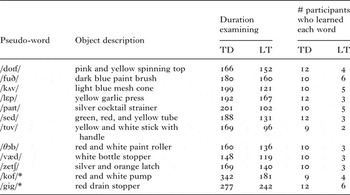
Twelve consonant–vowel–consonant (CVC) pseudo-word forms (e.g. /gig/) were created to serve as the experimental stimuli. A small, unfamiliar, toy-like object (e.g. a small juicer, a drain stopper, a small air pump) was chosen as the referent for each of the novel pseudo-words. The objects varied in color and each object could be manipulated by the toddlers (e.g. open, close, squeeze, twist, roll). The pseudo-words contained tense vowels, lax vowels, and diphthongs, and a number of consonant classes, as shown in Table 2.
Average duration examining values in seconds for each novel object for typical language development (TD) and late talking (LT) groups. Object descriptions are provided and the number of participants who learned each word is reported.

note: * = duration examining values for /kof/ and /gig/ were significantly greater than other objects (p < ·05) for both LT and TD groups.
Procedures
Training sessions
The twelve pseudo-words were presented to the toddlers over ten training sessions. Each training session was audio- and video-recorded using a Sony Handycam DCR-DVD408 with an external Sony ECM-WH1R wireless microphone, which the experimenter wore. Training sessions were scheduled twice a week for five weeks in the toddler's home. All training sessions were conducted by the first author.
Word-learning procedures were similar to previous studies examining word learning in young children with language delay (e.g. MacRoy-Higgins et al., Reference MacRoy-Higgins, Schwartz, Shafer and Marton2013; Schwartz & Leonard, Reference Schwartz and Leonard1985). The experimenter sat on the floor with the toddler and randomly pulled an object from a large bag. The object's label was produced in the sentence-final position (e.g. “Wow, here's a /gig/!”) and then placed on the floor. This procedure was repeated for each object until all twelve objects were placed on the floor. The toddlers were able to freely manipulate and play with the objects. Each object was labeled four additional times during free play with the objects. In total, each novel pseudo-word was presented five times. The word-learning task lasted approximately 6 minutes (average session duration: LT = 339·38 s, SD = 34·6 s; TD = 350·91 s, SD = 55·5 s). An unpaired t-test revealed no difference between session duration for LT and TD groups (p = ·53).
An additional researcher, blind to the language status of the participants, watched 20% of the training sessions in order to verify that the experimenter produced each novel pseudo-word five times per training session.
Word learning measures
At the end of the final (tenth) training session, the toddler's word learning was tested with comprehension and naming tasks. In the comprehension task, practice trials with real objects (spoon, cup, car, and ball) were used to familiarize the toddler with the procedures. The toddler was asked to point to each of the four objects using the prompt “Where's the [target word]?” The experimental trials began after the toddler achieved 100% on four consecutive practice trials. The twelve objects were presented randomly in groups of four; the toddler was asked to point to an object in the group after the prompt “Where's the ____ ?” After each trial, the object the toddler pointed to was taken away, and he/she was presented with four more of the objects, randomly selected, and was then asked to point to another object. These procedures were repeated until all twelve novel objects were tested. The experimenter scored each response on-line as correct (1) or incorrect (0).
In the naming task, as with the comprehension task, practice trials were used with real objects to familiarize the toddler with the task. Each toddler was asked to name the spoon, cup, car, and ball, after the prompt “What's this?” The experimental trials began after the toddler named at least one real object correctly. Toddlers were then asked to name each of the twelve experimental items after the prompt “What's this?” For a response to be considered correct, the toddlers had to produce two out of the three phonemes, consistent with Storkel (Reference Storkel2001). Due to the young age of the participants, developmental sound substitutions were accepted. On average, TD toddlers named 7·4 words (SD = 3·2); no LT toddler named an object according to our scoring criterion. Therefore, we were not able to conduct group comparisons on the naming task. Note that we tested comprehension prior to naming because pilot testing revealed that the toddlers who were late talkers had difficulty with the naming task. Presentation of the words in the comprehension task first allowed the toddler to hear the words produced by the experimenter, which we hoped would facilitate the naming task.
Attention measures
Similar to previous studies (e.g. Kannass & Oakes, Reference Kannass and Oakes2008; Oakes, Madole & Cohen, Reference Oakes, Madole and Cohen1991), each toddler's attention allocation was extracted from his/her looking and manipulating behaviors as observed in the video-recordings of the training sessions. A trained experimenter (the second author), blind to the language status of the toddler, viewed the video recordings of the training sessions and measured the duration examining for the stimuli – the duration of time in seconds the toddler engaged in clearly focused looking at the object. Duration examining occurred in either the presence or absence of object manipulation, such as holding, mouthing, or touching (Ruff, Reference Ruff1986). Duration examining was coded separately for each of the twelve objects.
An additional experimenter, blind to the language status of the participants, independently scored 20% of the sample. Reliability for the duration examining measures was determined by correlating values (in seconds) obtained for each object during each session for coder 1 and coder 2. The two coders measured very similar duration examining values (r = ·98). On average, the duration examining values obtained from the two coders were within one second (M = 0·12 sec, SD = 0·59 sec.).
RESULTS
Attention during word learning
For each participant, duration examining (in seconds) for each object was summed for each training session. The first set of analyses examined group differences of attention allocation to the twelve objects over the ten training sessions.
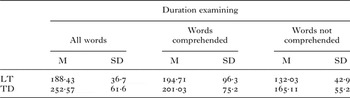
A mixed-model ANOVA with repeated measures examined the effect of Group (TD vs. LT) as the between-subjects variable and Training Session (1–10) as the within-subjects variable. The total duration examining for each training session served as the dependent variables. A significant main effect of Group was observed (F(1,20) = 8·7980, p = ·008, η p 2 = ·306). In all training sessions, the duration examining was longer for the TD group as compared to the LT group. Table 3 displays average duration examining values for LT and TD groups.
Attention allocation: average duration examining in seconds, for all words, words that were comprehended, and words not comprehended, for toddlers who were late talkers (LT) and who had typical language development (TD).

A significant main effect of Training Session was observed (F(9,180) = 2·5705, p = ·008, η p 2 = ·114). Post-hoc Fisher LSD testing revealed the nature of this main effect; for the LT group, duration examining was significantly shorter (p < ·01) for sessions 9 and 10 as compared with earlier sessions (1–8). For the TD group, session 10 duration examining was significantly shorter (p < ·01) than all other sessions. This is visible in Figure 1. No interactions were significant. The LT and TD groups showed similar patterns of attention over time; however, the LT toddlers consistently demonstrated shorter duration examining.
Attention allocation for toddlers who were late talkers (LT) and toddlers with typical language development (TD) over ten training sessions. Vertical lines represent error bars.

Item analysis and attention allocation
The next analysis examined whether the LT toddlers attended to certain objects for less time than their TD peers, or if they attended to all objects for an overall less amount of time than their TD peers. For each participant, duration examining was summed across all ten sessions for each of the twelve novel objects individually to determine the total duration of time spent looking at and examining each item.
A mixed-model ANOVA with repeated measures examined the effect of Group (TD vs. LT) as the between-subjects variable and Novel Object (each of the 12 objects) as the within-subjects variable. The total duration examining for each object served as the dependent variable. A significant main effect of Group was observed (F(1,20) = 8·7980, p = ·007, η p 2 = ·155). For all twelve objects, the duration examining value was longer for TD as compared with LT toddlers. The average duration examining values for each of the twelve objects for LT and TD groups is displayed in Table 2. A main effect of Novel Object was observed (F(11,220) = 3·793, p = ·00005, η p 2 = ·159). Post-hoc Fisher LSD testing revealed the nature of this main effect; for both LT and TD groups, duration examining values were significantly longer (p < ·05) for two objects: /kof/ and /gig/. The Group by Novel Object interaction was not significant.
Word learning
Word learning was measured using the comprehension task. All participants (LT and TD) completed all practice trials and all experimental trials for the comprehension task. An ANOVA with repeated measures examined Group (LT vs. TD) differences with the total number of correct responses as the dependent variable. A main effect of Group was observed (F(1,19) = 6·087, p = ·02, η p 2 = ·243).
TD participants comprehended significantly more words than the LT participants (TD: M = 10·4, SD = 1·7, median = 11; LT: M = 4·8, SD = 4·5, median = 4). All TD toddlers comprehended more than half of the words (range: 7–12 correct) and three of the eleven TD toddlers performed at ceiling; that is they pointed to all (12) objects. The LT toddlers demonstrated a larger range of performance (range: 0–10 correct). Four LT toddlers comprehended more than half of the words (range: 9–11 correct) and four performed at floor; that is, they did not point to any (0) objects. The remaining three LT toddlers comprehended some words (range: 3–6 correct). The total number of LT and TD participants who learned the label for each word is shown in Table 3. No particular pattern of word learning was observed in terms of the object labels. For the LT group, the number of participants who learned each word ranged from three to six; for the TD group, the number of participants who learned each word ranged from nine to twelve.
Relationship between word learning and attention allocation
The final analyses examined the relationship between word learning and attention allocation. An average duration examining value (in seconds) was created for the words that each participant comprehended and the words that he/she did not comprehend.
A mixed-model ANOVA with repeated measures examined the effect of Group (TD vs. LT) as the between-subjects variable and Words (words comprehended vs. words not comprehended) as the within-subjects variable. The average duration examining value for the Words served as the dependent variables. A significant main effect of Words was observed (F(1,12) = 6·52, p = ·025, η p 2 = ·352). No main effect of Group and no Group by Word interaction was observed (p > ·05). On average, toddlers in both LT and TD groups attended longer to words that they comprehended as compared to words they did not comprehend. The average duration examining values for words participants comprehended versus did not comprehend are shown in Table 2.
Although toddlers who were LT performed in the average range on language comprehension (measured by the Auditory Comprehension subtest of the PLS-4 and cognitive testing (measured by the Bayley mental scale-3), they scored significantly lower than their TD peers. In order to understand the influence of language comprehension, cognition, and attention allocation on word learning, multiple regression analysis was performed. The total number of correct responses from the word-learning (comprehension) task was the dependent variable. Raw scores from the Auditory Comprehension subtest of the PLS-4, raw scores from the Bayley mental scale, and the average duration examining value (in seconds) for the words that each participant comprehended were entered as predictor variables. Duration examining significantly predicted word-learning (comprehension) scores (p = ·03). Auditory comprehension and cognitive scores were not significant predictors of word learning. Table 4 reports F and p values and effect sizes.
Predictors of word learning

note: * = attention allocation (measured by duration examining) significantly predicted participants' word learning.
Summary of results
Overall, the LT group showed less attention allocation to all objects during the word-learning sessions, measured by duration examining, as compared to the TD group; and both LT and TD toddlers showed decreased attention to all objects over time. After ten training sessions, the LT group comprehended significantly fewer words than the TD group. Attention allocation was related to word comprehension. Both LT and TD toddlers spent more time looking at and manipulating the objects that they pointed to during the comprehension task, as compared to the objects they did not point to. Attention allocation was found to be a stronger predictor of word learning than cognitive scores and auditory comprehension scores.
DISCUSSION
The purpose of this study was to examine the relationship between attention allocation and lexical acquisition in toddlers with typical language and those who were late talkers. Our results revealed that, as predicted, toddlers who were late talkers showed differences in attention allocation as compared to their peers, and in both groups attention allocation influenced word learning. Thus we found some support to suggest that attention allocation may partially contribute to the lexical delay observed in toddlers who are late talkers.
Attention measures
The first main finding was, overall, that toddlers who were LT showed decreased attention to all novel objects during a word-learning task as compared with toddlers with typical language development. Lexical acquisition is known to be challenging for toddlers who are LT (e.g. Ellis Weismer & Evans, Reference Ellis Weismer and Evans2002), and therefore the reduced attention to the objects may reflect toddlers' difficulty focusing on the objects while hearing their labels. It would be interesting to observe if toddlers who are LT also show differences in attention allocation in other contexts (e.g. meal times, dressing, bathing), in addition to when engaged with age-appropriate toys as in the present investigation. Dixon and colleagues (2006) observed that typically developing children with high attentional focus learned both new words and new non-linguistic tasks (e.g. “make-a-rattle”) better than typically developing children with low attentional focus. It is possible that toddlers who are LT are similar to children with low attentional focus and therefore may have difficulty learning new words and other new (non-linguistic) skills.
Yu and Ballard's (Reference Yu and Ballard2007) model of word learning suggests that joint attention, in addition to statistical learning, is used to link the word to the object the speaker is referring to. In the present investigation, the toddlers heard the labels for the novel objects the same number of times, controlling for statistical learning. Previous research observed differences in joint attention in toddlers who were LT as compared to their typically developing peers (Paul & Shiffer, Reference Paul and Shiffer1991; Vuksanovic & Bjekic, Reference Vuksanovic and Bjekic2013; Wetherby et al., Reference Wetherby, Yonclas and Bryan1989). In the present study, we observe differences in attention allocation in toddlers who are LT. Therefore, it seems that both joint attention and attention allocation contribute to word learning. That is, in order to learn a new word toddlers need to follow the speaker's eye-gaze to determine the word's referent (Tomasello, Reference Tomasello, Moore and Dunham1995), and they need to attend to the object (looking and manipulating) for a particular duration of time. Future studies could examine the characteristics of joint attention and attention allocation in late talkers, which may help us to understand their word-learning challenges.
Even though the LT group comprehended fewer words than the TD group, both groups showed decreased overall attention allocation over time. Specifically, attention allocation to the objects decreased during sessions 9 and 10. We interpret this result to suggest that LT and TD toddlers no longer found the objects novel after four weeks. Comprehension probes after early, middle, and late training sessions (e.g. sessions 1, 4, 7, and 10) would have allowed us to more closely examine the relationship between attention allocation and word comprehension over the ten training sessions.
Relationship between word learning and attention allocation
We were not surprised that toddlers who were LT demonstrated poorer word learning, measured by comprehension, as compared with their peers. Our results are consistent with previous studies showing toddlers who were LT to be not as efficient in word learning as age-matched peers (Ellis Weismer & Evans, Reference Ellis Weismer and Evans2002; MacRoy-Higgins et al., Reference MacRoy-Higgins, Schwartz, Shafer and Marton2013).
We found LT and TD toddlers' attention allocation contributed to word learning over and above cognitive and auditory comprehension abilities. For both groups, duration examining values were longer for words that were comprehended, as compared to words that were not comprehended. The present finding is consistent with Dixon et al., (Reference Dixon, Salley and Clements2006), who observed toddlers with high attentional focus to be more successful with word learning as compared with toddlers with low attentional focus. This pattern was observed regardless of a toddler's language status. Although the toddlers who were LT scored significantly lower on receptive language and cognitive measures, as compared with their peers, these differences did not influence word learning. Instead, attention allocation was a significant predictor of word learning, indicating that looking at and examining novel objects while hearing their labels is important for the acquisition of new words. The looking behaviors observed in the present study are consistent with results from Fernald and Marchman (Reference Fernald and Marchman2012). Using a LWL paradigm, they found LT toddlers who looked longer at known pictures while hearing their labels were likely to experience a larger vocabulary growth over time as compared to LT toddlers who looked at target pictures for a shorter duration. Toddlers' looking behavior at pictures or objects is important for adding lexical items to their repertoire.
The number of words used in this study (12 novel words) may have taxed the LT toddlers' processing capabilities, thus providing them with fewer attentional resources with which to acquire words. It is possible that fewer novel words might increase attention allocation resources and facilitate language learning. Alternatively, the LT toddlers in the present study may have been able to comprehend the same number of words as their peers if given additional training sessions.
Although differences were observed between overall attention allocation and word learning in late talkers, the relationship cannot be assumed. That is, we cannot be sure that decreased attention allocation negatively influenced word learning in the LT toddlers. It is possible that reduced language skills in LT toddlers negatively influenced attention. Specifically, LT toddlers with limited expressive vocabularies may find word-learning tasks challenging, and therefore leave them unable to attend to novel objects in the same manner as toddlers with larger expressive vocabularies. Future studies examining the relationship between attention measures and vocabulary development in young children will advance our knowledge on this topic. Other methodologies, such as looking while listening, eye-tracking, or electrophysiology that measure time-locked, automatic responses may help us to understand how toddlers process information as it is presented auditorily.
Clinical implications
Results from this study may help speech–language pathologists when working with young children with early expressive language delay. When teaching a LT toddler a new word, the duration for which the toddler looks at and manipulates objects could be considered in therapy, in addition to the number of times they hear the label. Clinicians might consider giving LT toddlers additional exposures to words and extended time to play with and explore their referents. Therefore, intervention with this population could focus on attention allocation.
Conclusion
In our study, toddlers who were late talkers showed differences in attention allocation while engaged in a word-learning task, as compared to toddlers with typical language development. Similar to their peers, LT toddlers acquired new words when they devoted necessary attentional resources to them. However, they did not learn the same number of words as their TD peers over several training sessions. Delay or impairment in attention allocation may have contributed to the toddlers' initial and continued language delay.