The National Center for Disaster Medicine and Public Health (NCDMPH) in collaboration with over 20 subject matter experts, created a competency-based curriculum titled Caring for Older Adults in Disasters: A Curriculum for Health Professionals. The target audience for this curriculum is educators and trainers working with health professionals who may care for older adults before, during, and after a disaster. The curriculum is freely available on the website of the NCDMPH at http://ncdmph.usuhs.edu.
The curriculum is designed to be used by educators and trainers in a wide range of settings such as classroom-based instruction, continuing professional education, preparedness training within organizations, and other flexible teaching settings. The curriculum is divided into modules and lessons that allow trainers to select topics of particular relevance to their learners and organizational context. The lessons contain outlines of material to be taught, allowing trainers flexibility in their teaching style and setting.
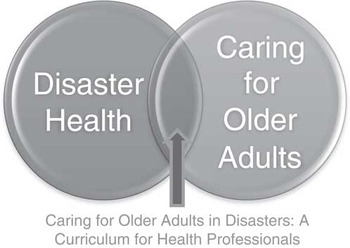
Figure 1 illustrates the focus of the curriculum on the intersection of disaster health and caring for older adults. Learners are assumed to be competent health professionals in their own role and scope of practice and to have general awareness of the care of patients in disasters. For those trainers or learners who need more information about general disaster health topics, please visit the NCDMPH website for additional resources. This curriculum highlights particular issues and considerations for caring for older adults before, during, and after disasters.
Venn diagram describing the content focus of Older Adults in Disasters: A Curriculum for Health Professionals.

BACKGROUND AND PROCESS
People 65 years of age and older represent approximately 14.1% of the population in the United States as of 2013. 1 According to the US Census, between 2012 and 2050, the United States will experience considerable growth in its older population,Reference Jenkins, Levy and Rutkow 2 which is expected to grow to represent 21.7% of the total population by 2040. 1 Following disasters, older adults are vulnerable to disproportionately higher morbidity. 1 Numerous studies demonstrate that disasters impact older adults more than other portions of the population.Reference Ortman, Velkoff and Hogan 3 - 10 With these statistics in mind, education and training for health professionals to care for older adults is important. 11 Moreover, the Institute of Medicine’s report, Retooling for an Aging America: Building the Health Care Workforce, reinforces that “the education and training of the entire health care workforce with respect to the range of needs of older adults remains woefully inadequate.” 12
In response to a request from the US Department of Veterans Affairs, the NCDMPH initiated the development of this curriculum. A key guiding document in the initial identification of curriculum topics was the Curriculum Recommendations for Disaster Health Professionals: The Geriatric Population. Reference Johnson, McBee and Ling 13 A curriculum topic outline was developed with input from subject matter experts. Subject matter experts were then invited to author one or more lessons from this topical outline. The lessons contain common elements based on a lesson template provided by NCDMPH. A peer review process was a key component of lesson development. Multiple authors and additional expert reviewers provided feedback on the lessons. Authors incorporated feedback and completed lessons for the final curriculum.
ELEMENTS OF THE LESSONS
For consistency and ease of use, the lessons contain the following curricular elements:
-
∙ Mapping content to core competencies for disaster medicine and public health.Reference Walsh, Subbarao and Gebbie 14
-
∙ Learning objectives to specify the aims of the content provided.
-
∙ Estimated time to complete, ranging from 30 to 120 minutes.
-
∙ Detailed content outline, containing points to be made and issues to convey in teaching the lesson.
-
∙ Suggested learner activities for use in and beyond the classroom.
-
∙ Readings and resources for learners and educators.
-
∙ Learner assessment strategies: ideas for gauging student learning.
CONTENT COVERED IN THE CURRICULUM
Table 1 outlines the modules and lessons within this curriculum. The first module introduces the curriculum and provides background on the older adult population. The second module describes conditions present in the older adult population that impact their disaster preparedness, response, and recovery. The focus then shifts to how older adults are affected by particular types of disasters in module three. Module four provides an in-depth treatment of the issues health professionals should consider when caring for older adults before, during, and after disasters. The focus of module five turns toward specific considerations for particular settings in which older adults live and receive care. Module six outlines ethical and legal considerations when caring for older adults in disasters. The curriculum concludes in module seven with a capstone activity described further below.
List of Modules and Lessons in Caring for Older Adults in Disasters: A Curriculum for Health Professionals

HOW THE CURRICULUM CAN BE USED
This curriculum is designed to be used in a variety of settings such as in classroom teaching for health professionals, for continuing professional education, or for preparedness training within organizations. Educators and trainers may elect to use the curriculum in whole or in part based on the needs of their learners and organization and the time available. Educators can customize the curriculum by selecting lessons, or parts of lessons, to teach; by adapting activities as needed; or by adding additional content appropriate for their setting. Content can be taught to learners of one health profession or in interprofessional settings. The lessons include content outlines, which allow trainers flexibility in their teaching style to include lectures, discussions, readings, case vignettes, and other teaching methods.
For those educators using a competency-based approach, the competency mapping within the lessons can be utilized within various professional development settings to enhance learner competence in disaster health. The lessons include learner assessment strategies, which educators and trainers can use to gauge acquisition of learner knowledge, skill, and attitudes. In designing the curriculum, we were cognizant of the need for breadth of content and for flexibility for use in a wide range of environments with a variety of resources and time constraints.
CAPSTONE EXCERPT
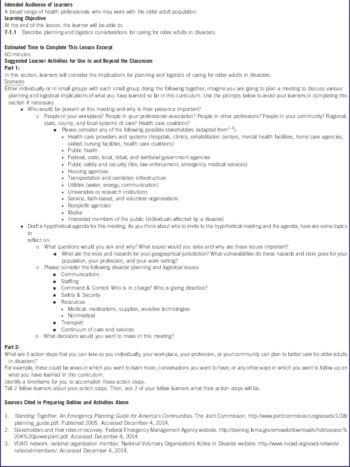
An excerpt of the final capstone activity in the curriculum is included in Box 1. This activity can be used by learners as part of the curriculum or as a stand-alone training tool. Trainers can adapt the content as necessary for their learners, organizational setting, time available, and training needs.
LESSON 7-1. CAPSTONE ACTIVITY EXCERPT

NEXT STEPS AND FUTURE DIRECTIONS
To access and utilize the entire curriculum or parts of the curriculum, please visit the NCDMPH website at http://ncdmph.usuhs.edu. The curriculum is available at no cost and with no required registration. In the future, we intend to add supplementary resources for educators and trainers that are associated with individual lessons. A pilot process for the curriculum is currently under way. We hope that this curriculum and its use will enhance the care of older adults in future disasters.
Acknowledgments
We gratefully acknowledge the contributions of the authors and reviewers on Caring for Older Adults in Disasters: A Curriculum for Health Professionals. For a full list of all authors and reviewers, please go to the curriculum introduction at http://ncdmph.usuhs.edu/Documents/OAC/Introduction_OAC.pdf.
Funding
The Henry M. Jackson Foundation for the Advancement of Military Medicine, Inc, supports the National Center for Disaster Medicine and Public Health through a grant sponsored by the Uniformed Services University of the Health Sciences.
Disclaimer
The views expressed here are those of the authors and do not reflect the official policy or position of the Uniformed Services University of the Health Sciences, the US Department of Defense, or the US Government.