


%20--%3e%3c!DOCTYPE%20svg%20PUBLIC%20'-//W3C//DTD%20SVG%201.0//EN'%20'http://www.w3.org/TR/2001/REC-SVG-20010904/DTD/svg10.dtd'%3e%3csvg%20version='1.0'%20id='Layer_1'%20xmlns='http://www.w3.org/2000/svg'%20xmlns:xlink='http://www.w3.org/1999/xlink'%20x='0px'%20y='0px'%20width='64px'%20height='64px'%20viewBox='5.5%20-3.5%2064%2064'%20enable-background='new%205.5%20-3.5%2064%2064'%20xml:space='preserve'%3e%3cg%3e%3ccircle%20fill='%23FFFFFF'%20fill-opacity='0'%20cx='37.785'%20cy='28.501'%20r='28.836'/%3e%3cpath%20fill='%23595959'%20d='M37.441-3.5c8.951,0,16.572,3.125,22.857,9.372c3.008,3.009,5.295,6.448,6.857,10.314%20c1.561,3.867,2.344,7.971,2.344,12.314c0,4.381-0.773,8.486-2.314,12.313c-1.543,3.828-3.82,7.21-6.828,10.143%20c-3.123,3.085-6.666,5.448-10.629,7.086c-3.961,1.638-8.057,2.457-12.285,2.457s-8.276-0.808-12.143-2.429%20c-3.866-1.618-7.333-3.961-10.4-7.027c-3.067-3.066-5.4-6.524-7-10.372S5.5,32.767,5.5,28.5c0-4.229,0.809-8.295,2.428-12.2%20c1.619-3.905,3.972-7.4,7.057-10.486C21.08-0.394,28.565-3.5,37.441-3.5z%20M37.557,2.272c-7.314,0-13.467,2.553-18.458,7.657%20c-2.515,2.553-4.448,5.419-5.8,8.6c-1.354,3.181-2.029,6.505-2.029,9.972c0,3.429,0.675,6.734,2.029,9.913%20c1.353,3.183,3.285,6.021,5.8,8.516c2.514,2.496,5.351,4.399,8.515,5.715c3.161,1.314,6.476,1.971,9.943,1.971%20c3.428,0,6.75-0.665,9.973-1.999c3.219-1.335,6.121-3.257,8.713-5.771c4.99-4.876,7.484-10.99,7.484-18.344%20c0-3.543-0.648-6.895-1.943-10.057c-1.293-3.162-3.18-5.98-5.654-8.458C50.984,4.844,44.795,2.272,37.557,2.272z%20M37.156,23.187%20l-4.287,2.229c-0.458-0.951-1.019-1.619-1.685-2c-0.667-0.38-1.286-0.571-1.858-0.571c-2.856,0-4.286,1.885-4.286,5.657%20c0,1.714,0.362,3.084,1.085,4.113c0.724,1.029,1.791,1.544,3.201,1.544c1.867,0,3.181-0.915,3.944-2.743l3.942,2%20c-0.838,1.563-2,2.791-3.486,3.686c-1.484,0.896-3.123,1.343-4.914,1.343c-2.857,0-5.163-0.875-6.915-2.629%20c-1.752-1.752-2.628-4.19-2.628-7.313c0-3.048,0.886-5.466,2.657-7.257c1.771-1.79,4.009-2.686,6.715-2.686%20C32.604,18.558,35.441,20.101,37.156,23.187z%20M55.613,23.187l-4.229,2.229c-0.457-0.951-1.02-1.619-1.686-2%20c-0.668-0.38-1.307-0.571-1.914-0.571c-2.857,0-4.287,1.885-4.287,5.657c0,1.714,0.363,3.084,1.086,4.113%20c0.723,1.029,1.789,1.544,3.201,1.544c1.865,0,3.18-0.915,3.941-2.743l4,2c-0.875,1.563-2.057,2.791-3.541,3.686%20c-1.486,0.896-3.105,1.343-4.857,1.343c-2.896,0-5.209-0.875-6.941-2.629c-1.736-1.752-2.602-4.19-2.602-7.313%20c0-3.048,0.885-5.466,2.658-7.257c1.77-1.79,4.008-2.686,6.713-2.686C51.117,18.558,53.938,20.101,55.613,23.187z'/%3e%3c/g%3e%3c/svg%3e)
%20--%3e%3c!DOCTYPE%20svg%20PUBLIC%20'-//W3C//DTD%20SVG%201.0//EN'%20'http://www.w3.org/TR/2001/REC-SVG-20010904/DTD/svg10.dtd'%3e%3csvg%20version='1.0'%20id='Layer_1'%20xmlns='http://www.w3.org/2000/svg'%20xmlns:xlink='http://www.w3.org/1999/xlink'%20x='0px'%20y='0px'%20width='64px'%20height='64px'%20viewBox='5.5%20-3.5%2064%2064'%20enable-background='new%205.5%20-3.5%2064%2064'%20xml:space='preserve'%3e%3cg%3e%3ccircle%20fill='%23FFFFFF'%20fill-opacity='0'%20cx='37.637'%20cy='28.806'%20r='28.276'/%3e%3cg%3e%3cpath%20fill='%23595959'%20d='M37.443-3.5c8.988,0,16.57,3.085,22.742,9.257C66.393,11.967,69.5,19.548,69.5,28.5c0,8.991-3.049,16.476-9.145,22.456%20C53.879,57.319,46.242,60.5,37.443,60.5c-8.649,0-16.153-3.144-22.514-9.43C8.644,44.784,5.5,37.262,5.5,28.5%20c0-8.761,3.144-16.342,9.429-22.742C21.101-0.415,28.604-3.5,37.443-3.5z%20M37.557,2.272c-7.276,0-13.428,2.553-18.457,7.657%20c-5.22,5.334-7.829,11.525-7.829,18.572c0,7.086,2.59,13.22,7.77,18.398c5.181,5.182,11.352,7.771,18.514,7.771%20c7.123,0,13.334-2.607,18.629-7.828c5.029-4.838,7.543-10.952,7.543-18.343c0-7.276-2.553-13.465-7.656-18.571%20C50.967,4.824,44.795,2.272,37.557,2.272z%20M46.129,20.557v13.085h-3.656v15.542h-9.944V33.643h-3.656V20.557%20c0-0.572,0.2-1.057,0.599-1.457c0.401-0.399,0.887-0.6,1.457-0.6h13.144c0.533,0,1.01,0.2,1.428,0.6%20C45.918,19.5,46.129,19.986,46.129,20.557z%20M33.042,12.329c0-3.008,1.485-4.514,4.458-4.514s4.457,1.504,4.457,4.514%20c0,2.971-1.486,4.457-4.457,4.457S33.042,15.3,33.042,12.329z'/%3e%3c/g%3e%3c/g%3e%3c/svg%3e)
Introduction
Ventilator-associated pneumonia (VAP) remains a major cause of morbidity and mortality among critically ill patients.Reference Papazian, Klompas and Luyt1 Among the causative pathogens, methicillin-resistant Staphylococcus aureus (MRSA) accounts for approximately 10% of cases.Reference Colaneri, Di Carlo and Amatu2,Reference Moro, Aoki and Matsumoto3 Current guidelines for hospital-acquired pneumonia (HAP) and VAP do not recommend empirical anti-MRSA therapy for all patients with VAP.Reference Kalil, Metersky and Klompas4 However, empirical administration of anti-MRSA agents is advised for patients with risk factors for antimicrobial resistance, such as prior antibiotic exposure within the preceding 90 days, or for those treated in units where more than 10%–20% of S. aureus isolates are MRSA or where the prevalence of MRSA is unknown.Reference Kalil, Metersky and Klompas4 Nevertheless, it remains uncertain whether empirical anti-MRSA therapy based on these criteria improves clinical outcomes. Moreover, unnecessary use of anti-MRSA agents may increase the risk of adverse events, including nephrotoxicity, underscoring the need for appropriate antimicrobial selection.
The GRACE-VAP trial demonstrated that a treatment strategy guided by Gram staining of endotracheal aspirates resulted in no significant differences in clinical outcomes or adverse events compared with empirical antibiotic therapy.Reference Yoshimura, Yamakawa and Ohta5 However, that study did not specifically evaluate the impact of anti-MRSA therapy according to the presence or absence of gram-positive cocci (GPC) clusters on Gram stain findings. In contrast, previous studies have suggested that discontinuing vancomycin therapy based on nasal MRSA screening or culture results may reduce the incidence of nephrotoxicity.Reference Kaylor, Caminiti, Harbrecht, McPheeters and Scherrer6,Reference Gibbs, Jackson and Runjaic7 Although several studies have identified risk factors for MRSA infection in patients with HAP or VAP,Reference Shorr, Myers, Huang, Nathanson, Emons and Kollef8,Reference Jones, Ying and Stevens9 the validity of using these factors to determine the indication for anti-MRSA therapy has not been clearly established.
Therefore, this study—a post hoc subgroup analysis of the GRACE-VAP trial—aim to investigate the association between anti-MRSA therapy and clinical outcomes in patients with VAP without GPC on Gram stain, with the goal of providing evidence to support more rational antibiotic selection and reduce adverse events.
Method
Study design
This study was a post hoc analysis of the GRACE-VAP trial, a multicenter, open-label, randomized clinical trial conducted between April 2018 and May 2020 in the intensive care units (ICU) at 12 tertiary referral hospitals in Japan.
In the original GRACE-VAP trial, patients were randomized to either a Gram stain–guided therapy group or a guideline-based empirical therapy group. In the Gram stain–guided group, Gram staining of endotracheal aspirates was performed on Day 1 prior to the initiation of antimicrobial therapy and antimicrobial selection was determined according to the staining results using a predefined algorithm. In contrast, in the guideline-based group, patients received empirical combination therapy including anti-MRSA agents regardless of Gram stain findings. In both groups, sputum cultures were obtained before treatment initiation, and subsequent modification or discontinuation of antimicrobial therapy was left to the discretion of the treating physicians based on culture results and clinical judgment.
The detailed design and primary results of the original trial have been published previously.Reference Yoshimura, Yamakawa and Ohta5,Reference Yoshimura, Yamakawa, Kinoshita, Ohta and Morimoto10 This post hoc analysis was approved by the Institutional Review Board of Osaka Medical and Pharmaceutical University and conducted in accordance with the principles of the Declaration of Helsinki and the Ethical Guidelines for Medical and Health Research Involving Human Subjects in Japan.
Patients
Patients were drawn from the GRACE-VAP trial cohort. The inclusion criteria for the original GRACE-VAP trial were as follows: patients aged ≥15 years, receiving mechanical ventilation for at least 48 hours, and diagnosed with VAP defined by a modified Clinical Pulmonary Infection Score (mCPIS) of ≥5 (range, 0–10). Patients were excluded from the original trial if they had known allergies to study antibiotics, were pregnant, had been discharged from the ICU, had hypoxemia attributed to atelectasis or cardiac failure, had received antimicrobial therapy for more than 24 hours before meeting the inclusion criteria, had limitations of life-sustaining therapy, were deemed ineligible by the attending physician, or were diagnosed with coronavirus disease 2019 after February 2020.
For this subanalysis, we included patients who met the following additional criterion:
Gram staining of endotracheal aspirates showed no GPC in clusters.
We excluded:
-
1. Patients with no visible organisms on Gram stain (Gram-negative results), because the validity of Gram stain–guided therapy could not be evaluated.
-
2. Patients who did not receive interventions strictly according to the GRACE-VAP protocol—that is, those in the Gram stain–guided group who received empirical anti-MRSA therapy or those in the guideline-based group who did not receive empirical anti-MRSA therapy.
The primary exposure of interest was the empirical use of anti-MRSA agents. Among patients whose Gram stain of endotracheal aspirates showed no GPC clusters, those who received empirical anti-MRSA therapy were classified as the anti-MRSA therapy group, and those who did not were classified as the no anti-MRSA therapy group. This classification matched the original treatment groups: patients in the Gram stain–guided group did not receive anti-MRSA therapy, whereas those in the guideline-based group received empirical anti-MRSA therapy.
Outcomes
The primary outcome was the clinical response rate on day 7 after the completion of antibiotic therapy, defined as fulfillment of all the following criteria:
-
1. completion of antibiotic treatment within 14 days;
-
2. improvement or no worsening of initial radiographic findings;
-
3. resolution of signs and symptoms of pneumonia; and
-
4. no requirement for additional antibiotic therapy.
This definition was consistent with that used in the original GRACE-VAP trial.Reference Yoshimura, Yamakawa and Ohta5
Secondary outcomes included 28-day all-cause mortality, ventilator-free days within 28 days, and ICU-free days within 28 days, which were compared between the two groups.
Safety outcomes included adverse events such as kidney impairment (defined as an increase in serum creatinine ≥1.5-fold from baseline [day 1 value] within 7 d after the completion of therapy), thrombocytopenia (defined as a ≥30% decrease in platelet count from baseline, classified as moderate [30%–49%] or severe [≥50%] reduction), diarrhea, Clostridioides difficile infection, rash, and seizures.
Statistical analysis
Baseline characteristics—including age, sex, mCPIS, Acute Physiology and Chronic Health Evaluation II (APACHE II) score, Sequential Organ Failure Assessment (SOFA) score, PaO2/FiO2 (P/F) ratio, presence of sepsis or septic shock, acute kidney injury, comorbidities (diabetes mellitus, chronic heart failure, chronic lung disease, dialysis, cirrhosis, and immunocompromised status), prior antibiotic exposure, days in the ICU before randomization, and use of anti-pseudomonal or non-anti-pseudomonal β-lactams—were compared between the anti-MRSA therapy group and the no anti-MRSA therapy group. Categorical variables were analyzed using the χ2 test or Fisher’s exact test, as appropriate, and continuous variables were analyzed using the t-test or the Mann–Whitney U test, depending on distribution. Certain characteristics, such as the specific type of anti-MRSA agent used and the de-escalation of anti-MRSA therapy, were applicable only to the Gram stain group or were otherwise not subject to comparison and were therefore summarized descriptively without statistical testing.
For the primary outcome, clinical response, univariable logistic regression analysis was first performed to estimate the crude association between empirical anti-MRSA therapy and clinical response. Empirical anti-MRSA therapy was defined as the exposure variable, and patients who did not receive anti-MRSA therapy served as the reference group. Results are expressed as odds ratios (ORs) with 95% confidence intervals (CIs).
The primary analysis was conducted using multivariable logistic regression to evaluate the association between empirical anti-MRSA therapy and clinical response after adjustment for prespecified covariates. Empirical anti-MRSA therapy was treated as the exposure variable. Covariates included age, SOFA score on day 1, and prior antibiotic therapy. Results are reported as adjusted ORs with 95% CIs.
Secondary outcomes were analyzed according to outcome type: binary outcomes were analyzed using a univariable logistic regression model, and continuous non-normally distributed outcomes were analyzed using the Mann–Whitney U test.
Safety outcomes were compared between groups using the χ2 test or Fisher’s exact test, as appropriate.
As a sensitivity analysis, we evaluated the association between empirical anti-MRSA therapy and clinical response in the overall GRACE-VAP cohort regardless of Gram stain findings using the same multivariable logistic regression model.
All statistical analyses were performed using EZR (Saitama Medical Center, Jichi Medical University, Saitama, Japan), a graphical user interface for R (The R Foundation for Statistical Computing, Vienna, Austria). A two-sided P value of < .05 was considered statistically significant.
Results
Among the 206 patients enrolled in the GRACE-VAP trial, 89 patients without GPC clusters on endotracheal aspirate Gram stain were identified. Of these, 12 patients were excluded because no organisms were visible on Gram stain. Among the remaining 77 patients, three were further excluded because they received antibiotic therapy inconsistent with the trial protocol. Finally, 74 patients were included in the analysis—37 in the no anti-MRSA therapy group and 37 in the anti-MRSA therapy group (Figure 1).
Flow diagram of patient selection.

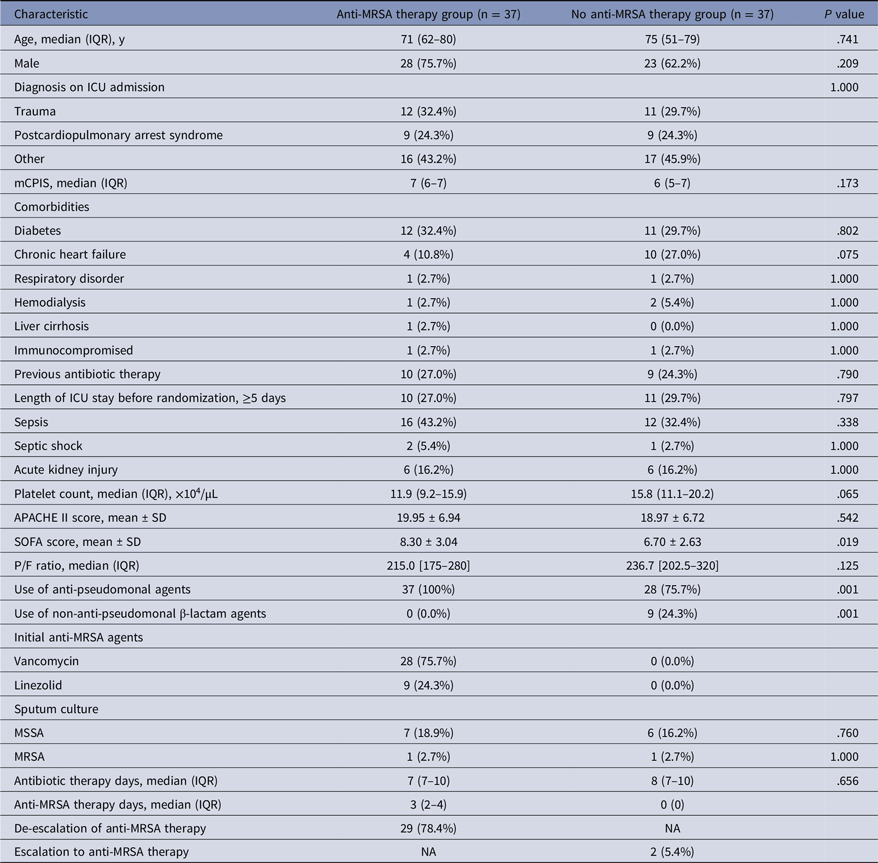
Baseline characteristics are summarized in Table 1. Significant differences were observed in SOFA score on day 1, the use of anti-pseudomonal agents, and the use of non-anti-pseudomonal β-lactam agents. In the anti-MRSA therapy group, the empirical agents administered were vancomycin in 28 patients (75.7%) and linezolid in 9 patients (24.3%). MRSA was isolated from sputum cultures in only one patient (2.7%) in each group. There was no significant difference in antibiotic treatment duration between the groups. Details of the Gram stain findings, causative pathogens identified in sputum cultures, and antibiotics actually administered are provided in Supplementary Tables S1–S3.
Baseline characteristics of the study population

Table 1. Long description
A table comparing baseline characteristics of the anti-MRSA therapy group and the no anti-MRSA therapy group. The table has 37 rows and 4 columns. Column headers are Characteristic, Anti-MRSA therapy group (n = 37), No anti-MRSA therapy group (n = 37), and P value. Row labels include Age, Male, Diagnosis on ICU admission, Trauma, Postcardiopulmonary arrest syndrome, Other, mCPIS, Comorbidities, Diabetes, Chronic heart failure, Respiratory disorder, Hemodialysis, Liver cirrhosis, Immunocompromised, Previous antibiotic therapy, Length of ICU stay before randomization, Sepsis, Septic shock, Acute kidney injury, Platelet count, APACHE II score, SOFA score, P/F ratio, Use of anti-pseudomonal agents, Use of non-anti-pseudomonal β-lactam agents, Initial anti-MRSA agents, Sputum culture, Antibiotic therapy days, Anti-MRSA therapy days, De-escalation of anti-MRSA therapy, and Escalation to anti-MRSA therapy. Each row provides specific values for each group and the corresponding P value. Notable trends include differences in SOFA score, use of anti-pseudomonal agents, and use of non-anti-pseudomonal β-lactam agents.
IQR, interquartile range; ICU, intensive care unit; mCPIS, modified Clinical Pulmonary Infection Score; APACHE, Acute Physiology and Chronic Health Evaluation; SOFA, Sequential Organ Failure Assessment; P/F ratio, PaO2/FiO2 ratio; MRSA, methicillin-resistant Staphylococcus aureus; MSSA, methicillin-susceptible Staphylococcus aureus; NA, not applicable.
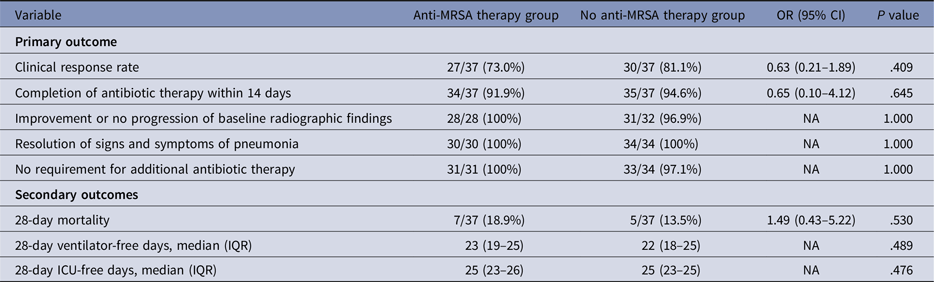
Crude comparisons showed no significant difference in clinical response between the no anti-MRSA therapy group and the anti-MRSA therapy group (Table 2).
Primary and secondary outcomes

Table 2. Long description
The table compares primary and secondary outcomes between the anti-MRSA therapy group and the no anti-MRSA therapy group. It has 11 rows and 5 columns. The columns are labeled Variable, Anti-MRSA therapy group, No anti-MRSA therapy group, OR (95 percent CI), and P value. The rows are grouped into Primary outcome and Secondary outcomes. Primary outcome includes Clinical response rate, Completion of antibiotic therapy within 14 days, Improvement or no progression of baseline radiographic findings, Resolution of signs and symptoms of pneumonia, and No requirement for additional antibiotic therapy. Secondary outcomes include 28-day mortality, 28-day ventilator-free days median (IQR), and 28-day ICU-free days median (IQR). Each row provides specific data for both groups, including percentages, odds ratios with confidence intervals, and P values.
IQR, interquartile range; ICU, intensive care unit; OR, odd ratio; CI, confidence interval; NA, not applicable.
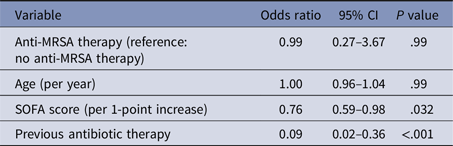
In the primary multivariable analysis, empirical anti-MRSA therapy was not significantly associated with clinical response (adjusted OR, 0.99; 95% CI, 0.27–3.67; P = .99) (Table 3). In the same model, prior antibiotic therapy was independently associated with a lower likelihood of clinical response (adjusted OR, 0.09; 95% CI, 0.02–0.36).
Multivariable analysis of clinical response

Table 3. Long description
A table with four rows and four columns. The columns are labeled Variable, Odds ratio, 95% CI, and P value. The rows are labeled Anti-MRSA therapy (reference: no anti-MRSA therapy), Age (per year), SOFA score (per 1-point increase), and Previous antibiotic therapy. The values in the table are as follows: Row 1: Anti-MRSA therapy (reference: no anti-MRSA therapy), 0.99, 0.27-3.67, 0.99. Row 2: Age (per year), 1.00, 0.96-1.04, 0.99. Row 3: SOFA score (per 1-point increase), 0.76, 0.59-0.98, 0.032. Row 4: Previous antibiotic therapy, 0.09, 0.02-0.36, <0.001.
CI, confidence interval; SOFA, Sequential Organ Failure Assessment. Odds ratios indicate the odds of clinical response. Age and SOFA score were analyzed as continuous variables (per 1-unit increase).
Regarding secondary outcomes, 28-day mortality, 28-day ventilator-free days, and 28-day ICU-free days were comparable between the groups (Table 2).
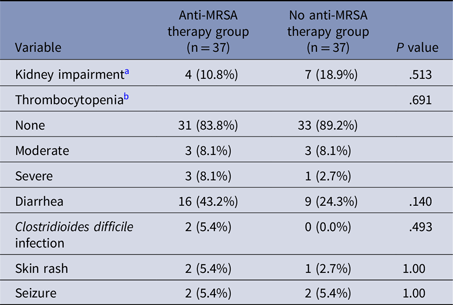
Safety outcomes also showed broadly similar patterns (Table 4). Although diarrhea tended to occur more frequently in the anti-MRSA therapy group, the difference was modest and uncertain given the limited sample size (P = .140).
Safety outcomes

Table 4. Long description
The table compares safety outcomes between the anti-MRSA therapy group and the no anti-MRSA therapy group, each consisting of 37 participants. The table has 7 rows and 4 columns. The columns are labeled Variable, Anti-MRSA therapy group (n = 37), No anti-MRSA therapy group (n = 37), and P value. The rows are labeled Kidney impairment, Thrombocytopenia, Diarrhea, Clostridioides difficile infection, Skin rash, and Seizure. For Kidney impairment, 4 (10.8 percent) in the anti-MRSA therapy group and 7 (18.9 percent) in the no anti-MRSA therapy group. For Thrombocytopenia, None: 31 (83.8 percent) in the anti-MRSA therapy group and 33 (89.2 percent) in the no anti-MRSA therapy group; Moderate: 3 (8.1 percent) in both groups; Severe: 3 (8.1 percent) in the anti-MRSA therapy group and 1 (2.7 percent) in the no anti-MRSA therapy group. For Diarrhea, 16 (43.2 percent) in the anti-MRSA therapy group and 9 (24.3 percent) in the no anti-MRSA therapy group. For Clostridioides difficile infection, 2 (5.4 percent) in the anti-MRSA therapy group and 0 (0.0 percent) in the no anti-MRSA therapy group. For Skin rash, 2 (5.4 percent) in the anti-MRSA therapy group and 1 (2.7 percent) in the no anti-MRSA therapy group. For Seizure, 2 (5.4 percent) in both groups.
a Kidney impairment was defined as an increase in serum creatinine ≥1.5-fold from baseline (day 1 value) within 7 days after completion of therapy.
b Thrombocytopenia was defined relative to the baseline platelet count on day 1: moderate, 30– <50% decrease; severe, ≥50% decrease within 7 days after treatment completion.
As a sensitivity analysis, we evaluated the overall GRACE-VAP cohort, including 206 patients, of whom 166 received empirical anti-MRSA therapy and 40 did not. Empirical anti-MRSA therapy was not significantly associated with clinical response after adjustment for age, SOFA score on day 1, and prior antibiotic therapy (Supplementary Table S4).
Discussion
In this post hoc analysis, the multivariable analysis demonstrated that among patients with VAP without GPC clusters on Gram staining of airway specimens, the use of empirical anti-MRSA therapy was not associated with additional clinical benefit. No significant differences were observed in 28-day mortality, 28-day ventilator-free days, or 28-day ICU-free days. Similarly, no between-group differences were observed in safety outcomes, including kidney impairment, thrombocytopenia, diarrhea, rash, and seizures. These findings suggest that the decision to administer empirical anti-MRSA therapy in VAP can potentially be guided by the presence or absence of GPC clusters on Gram staining of airway secretions. A key strength of this study is that, unlike prior research focusing solely on the diagnostic accuracy of Gram staining for S. aureus, it evaluated a clinically meaningful end point—clinical cure rate—in relation to the use of empirical anti-MRSA therapy under Gram stain–guided versus guideline-based empirical treatment strategies. Although Gram staining is not specifically designed to identify MRSA, it appears sufficient to exclude patients unlikely to require anti-MRSA therapy, thereby minimizing unnecessary exposure to such agents.
In this study, no significant differences in adverse events were observed between the groups, including kidney impairment. Although kidney impairment was numerically less frequent in the anti-MRSA therapy group, this finding should be interpreted with caution. The number of events was small, resulting in low statistical power, and nearly one quarter of patients in the anti-MRSA therapy group received linezolid, which is not associated with nephrotoxicity. In addition, data on vancomycin dosing, therapeutic drug monitoring (TDM), and concurrent use of nephrotoxic agents were unavailable, potentially confounding the results. A previous study in trauma patients with VAP found that discontinuing vancomycin based on bronchoalveolar lavage results reduced the incidence of acute kidney injury.Reference Kaylor, Caminiti, Harbrecht, McPheeters and Scherrer6 Differences in study populations (trauma-only in the previous study) and definitions of acute kidney injury, together with our small sample size, make direct comparison difficult. Therefore, larger prospective studies with adequate power and standardized exposure definitions are warranted to clarify the renal safety of anti-MRSA therapy, particularly vancomycin.
Nasal swab polymerase chain reaction testing for Staphylococcus aureus has been proposed as a method to predict MRSA pneumonia and demonstrates an excellent negative predictive value (NPV) of 99.2%.Reference Dangerfield, Chung, Webb and Seville11 However, its use is limited by availability and relatively high cost, reported to be several tens of U.S. dollars per sample.Reference Facer, Aldewereld, Green and Smith12 Alternatively, nasal swab culture is widely available but requires several days to yield results. In contrast, sputum Gram staining is rapid, inexpensive (less than 1 U.S. dollar per sample), and can be performed before antibiotic initiation.Reference Bjedov, Schuler, Kahl, Kampmeier and Schaumburg13 A meta-analysis of Gram staining reported a sensitivity of 68% and specificity of 95% for diagnosing S. aureus VAP, corresponding to an expected NPV of approximately 95% when S. aureus accounts for 5%–20% of cases.Reference Ranzani, Motos and Chiurazzi14 In the GRACE-VAP cohort, the sensitivity, specificity, and NPV of Gram staining for detecting S. aureus were 83.5%, 75.7%, and 82.1%, respectively (data not shown), which are comparable to previously reported values.
This study has several limitations. First, although the original trial was randomized, this subgroup analysis included only patients without GPC clusters on Gram stain; therefore, the groups compared here were no longer randomized, and imbalances in patient characteristics may have introduced residual confounding. Second, statistical power based on sample size was not predefined, which limited the ability to detect small differences in effect. Third, both vancomycin and linezolid were included as anti-MRSA agents, and detailed data on vancomycin dosing and TDM were unavailable, making agent-specific safety assessment difficult. Fourth, rapid Gram stain evaluation may not be available in all institutions. In addition, accurate Gram stain interpretation requires technical expertise and experience. Therefore, the applicability of this strategy may vary across institutions and healthcare systems. Finally, the generalizability of these findings may vary across institutions with different MRSA prevalence. Although the overall MRSA detection rate in respiratory samples in the GRACE-VAP cohort was 10.7%,Reference Yoshimura, Yamakawa and Ohta5 S. aureus was subsequently detected in respiratory cultures in approximately 20% of patients in the present cohort, reflecting the imperfect sensitivity of Gram stain. However, only 2 patients (2.7%) had MRSA, whereas most cases represented MSSA, which was likely covered by beta-lactam therapy. Nonetheless, caution is warranted when extrapolating these findings to settings with substantially higher MRSA prevalence.
Conclusion
In this post hoc subgroup analysis of patients with VAP without GPC clusters on Gram staining, the use of empirical anti-MRSA therapy was not associated with differences in clinical outcomes or adverse events.
Supplementary material
The supplementary material for this article can be found at https://doi.org/10.1017/ash.2026.10783.
Data availability statement
The data that support the findings of this study are available from the corresponding author upon reasonable request, subject to institutional and ethical restrictions.
Acknowledgements
We would like to thank Editage (www.editage.jp) for English language editing.
Author contribution
Shogo Shirota: Conceptualization, Methodology, Formal analysis, Data curation, Writing—review and editing, Writing—original draft. Kazuma Yamakawa: Investigation, Conceptualization, Methodology, Writing—review and editing, Supervision. Jumpei Yoshimura: Investigation, Writing—review and editing. Yoshinori Ohta: Investigation, Writing—review and editing. Yuriko Takeda: Writing—review and editing. Kensuke Nakamura: Investigation, Writing—review and editing. Hideki Hashimoto: Investigation, Conceptualization, Methodology, Writing—review and editing. Kyohei Miyamoto: Investigation, Conceptualization, Methodology, Writing—review and editing. Takeshi Morimoto: Methodology, Formal analysis, Writing—review and editing, Supervision.
Financial support
This research did not receive any specific grant from funding agencies in the public, commercial, or not-for-profit sectors.
Competing interests
The authors declare no conflicts of interest.
Ethical standard
This study was approved by the Institutional Review Board of Osaka Medical and Pharmaceutical University and conducted in accordance with the principles of the Declaration of Helsinki and the Ethical Guidelines for Medical and Health Research Involving Human Subjects in Japan. Written informed consent was obtained from all patients or their legal representatives before inclusion in the study.
Use of AI tools
The authors used ChatGPT (OpenAI, San Francisco, CA, USA) to assist with English-language editing, translation, and technical guidance related to statistical analyses during manuscript preparation. All final interpretations, analyses, and manuscript content were reviewed and approved by the authors.


 Open access

