Introduction
Protracted development of object realization has been reported in bilingual children acquiring different language combinations. Accounts vary from cross-linguistic influence (CLI) (Müller & Hulk, Reference Müller and Hulk2001) to bilingual effects (Pirvulescu, Pérez-Leroux, Roberge, Strik & Thomas, Reference Pirvulescu, Pérez-Leroux, Roberge, Strik and Thomas2014). To shed more light on the issue of CLI in bilingual object realization, we examined an under-investigated language pair, English and Cantonese, which differ in the set of discourse/pragmatic constraints on object realization. On the one hand, Cantonese allows topic-related null objects but English does not; on the other hand, overt third-person object pronouns are unmarked in English pronominal contexts but they are grammatically constrained in Cantonese. Bilingual children have to cope with the dual input in achieving successful mapping between discourse pragmatics and language-specific syntactic rules. In this study, we present and discuss new data from an elicited production task in relation to CLI in Cantonese–English bilingual children's object realization.
CLI happens conditionally. When ambiguity arises as to the grammatical analysis of a given construction in one target language, CLI takes place as a relief strategy (Müller, Reference Müller1998). This has been known as the “input ambiguity” account (Hulk and Müller, Reference Hulk and Müller2000; Yip & Matthews, Reference Yip and Matthews2007) and adopted in the hypothesis of CLI proposed by Hulk and Müller (Reference Hulk and Müller2000), who took structural overlap and involvement of interface conditions between syntax and pragmatics as significant factors in opening the door for CLI. They hypothesized that CLI is induced by structural overlap and “the mapping of universal principles onto language specific principles” (Hulk, Reference Hulk, Blom, Cornips and Schaeffer2017, p. 16). It was assumed that children begin with a minimal default grammar in which universal strategies such as licensing of dropped constituents via discourse must be mapped onto language-specific syntactic rules (Müller & Hulk, Reference Müller and Hulk2001). An important prediction of this hypothesis is that CLI is unidirectional, going from the language that provides unambiguous evidence for the universal discourse strategy to the language that allows two potential grammatical analyses of the given construction.
CLI can result in qualitative or quantitative differences between bilingual and monolingual language development (Serratrice, Reference Serratrice2013), the former referring to grammatical properties carried over from one language to the other in bilingual acquisition and resulting in bilingual patterns unattested in monolingual acquisition of that language, and the latter reinforcement of crosslinguistically corresponding structures in the bilinguals. We are concerned with both quantitative and qualitative differences. Below we will present a contrastive analysis of English and Cantonese object realization, focusing on third-person canonical direct objects of transitive verbs, which is the locus where English and Cantonese differ most significantly. We will return to input ambiguity in object realization in Cantonese–English bilingual children.
Object expression and omission in English
Direct objects of transitive verbs are typically overt in English and are usually realized overtly in pronominal contexts, whether the verb is two-place (henceforth, TWO) or three-place (henceforth, THR), as in (1a-b).
(1) What did Mary do with the cake?
a. She took/ate *(it).
b. She gave *(it) to John.
In non-pronominal contexts, the obligatoriness of a direct object in English varies depending on the degree of transitivity of the verb. A small set of activity verbs like eat may appear with or without an overt object as in (2a-b), which we refer to as optionally transitive verbs (henceforth, OPT), whereas verbs such as those imposing few selectional requirements on their objects and change-of-state verbs cannot appear without an overt object (Pérez-Leroux, Pirvulescu & Roberge, Reference Pérez-Leroux, Pirvulescu and Roberge2018), as in (2c), except for special contexts such as generic statements (see Goldberg, Reference Goldberg2001, for discussion). These are referred to as obligatorily transitive verbs (henceforth, OBL).
(2) What did Mary do?
a. She ate an apple.
b. She ate.
c. She took/broke *(a vase).
When an OPT verb is used intransitively, the unrealized object is semantically recoverable from the verb (Cummins & Roberge, Reference Cummins and Roberge2005; Pérez-Leroux et al., Reference Pérez-Leroux, Pirvulescu and Roberge2018). Take (3) for example. The unrealized object of eat can be interpreted as food including but not exclusive to mushroom, a saliently present object in the previous clause.
(3) Whenever Sally cooks mushrooms, John eats like a pig.
Note that the interpretation that John eats the mushrooms is not semantically derived but a result of pragmatic influence. This is borne out by the fact that such interpretation is ruled out when the verb is negated, as in (4) (infelicity indicated by “#”).
(4) #Whenever Sally cooks mushrooms, John never eats. Instead, he eats pasta with tomato sauce. (Martí, Reference Martí2006, p. 154)
Placed in the scope of negation, the unrealized object of eat in (4) is “equivalent to a variable bound by an existential operator, with negation taking scope over it” (Pérez-Leroux et al., Reference Pérez-Leroux, Pirvulescu and Roberge2018, p.137). It can only be indefinite non-specific, i.e., interpreted as food in general. In this article, following Givón (Reference Givón and Greenberg1978), we take definiteness as a discourse-pragmatic notion referring to whether the object is assumed by the speaker to be known or identifiable to the hearer (definite), or unknown or unidentifiable (indefinite), and specificity as whether the object is characterized by unique individuation and differentiation from other entities (Chen, Reference Chen2009).
In sum, direct objects of English transitive verbs are typically overt, though the obligatoriness of a direct object may vary depending on the lexical transitivity and the context. Omissible objects (of OPT verbs) are semantically recoverable from the selecting verb and are indefinite nonspecific particularly under the scope of negation.
Null and overt objects in Cantonese
Null object in Cantonese involves discourse-drop. For example, the object ni1 gin6 saam1 (“this dress”) in (5) has been explicitly mentioned, making it a discourse topic naturally omissible in speaker B's reply.

Objects may also be null when the referent is not explicitly mentioned in the prior discourse but salient in the pragmatic context and identifiable by the addressee, as in (6).

When the direct object is neither recoverable from the preceding linguistic discourse nor identifiable from the pragmatic context, it must be lexically realized as in (7).

In Mandarin Chinese, a null object co-refers with a null topic implied in the discourse context in the same way that a missing object refers to an overt sentence topic (Huang, Reference Huang1984). This can be done in Cantonese (8a-b).

Compared to null objects, overt post-verbal pronouns are less frequent. Cantonese uses keoi5 to refer to third-person singular animate entities and singular/plural inanimate entities in pronominal contexts. Importantly, when post-verbal keoi5 refers to inanimate entities (henceforth, KEOI), it is constrained by boundedness of the verbal predicate, i.e., KEOI appears in verbal predicates expressing a temporally bounded disposal event, similar to the BA-constructions that are frequently used to describe disposal events in Mandarin Chinese (Man, Reference Man and Matthews1998; Zhou, Mai & Yip, Reference Zhou, Mai and Yip2016). A verbal predicate is bounded when the event being described is telic (i.e., the event structure of the predicate including aspect markers, if any, has an inherent final endpoint) and not presented in such a way that an imperfective reading obtains, or when an atelic event is externally delimited and hence temporally measurable (Liu, Reference Liu1997).
Most bare verbs in Chinese do not denote bounded events, and neither do [bare V-O] structures, as illustrated in (9), where [bare V-O] cannot be modified by adverbials meaning “completing something in X” in Chinese (Liu, Reference Liu1997).

Consequently, an idiomatic use of KEOI usually requires delimiting elements (Cheung, Reference Cheung1992; Matthews & Yip, Reference Matthews and Yip2011), as in (10), where insertion of the perfective marker zo2 renders the sentence grammatical.

Verbal particles signalling a change of state of a non-agent may also serve as the delimiting element in Cantonese, such as the resultative particle that indicates a change of state in the object, the quantifying particle saai3 ‘all’ that quantifies the object, and directional particles that denote motion of the object and evoke a change of state (see Man, Reference Man and Matthews1998, for relevant discussion).
In sum, Cantonese object realization differs from English in that null objects are topic-related and the post-verbal pronoun KEOI is constrained by the boundedness requirement.
Acquiring object realization in Cantonese and English
Cantonese–English bilingual children have to tackle several learning tasks in order to acquire object omission in both languages. They include (a) acquiring the syntactic conditions under which direct objects may be syntactically represented as a null object in Cantonese but not in English; and (b) acquiring the discourse pragmatic constraints that omissible objects are topic-related in Cantonese but indefinite non-specific in English. In this sense, they need to coordinate the syntax and pragmatic information efficiently during processing. Regarding the acquisition of pronouns, particularly KEOI in Cantonese, the bilingual child needs to acquire the boundedness requirement and apply it efficiently during processing.
The differences between Cantonese and English give rise to the question of how bilingual children's object realization in one language would be influenced by the other in the acquisition process. On the one hand, English presents ambiguity regarding the grammatical analysis of missing objects. That is, when the child hears sentences containing a semantically transitive verb without an overt object as in (3), ambiguity arises as to whether the missing object should be interpreted as indefinite non-specific (e.g., food) or refer to a particular object salient in the discourse context (e.g., the mushroom). Between the two interpretations, the latter, rather than the former, is enhanced by the exclusively discourse-linked null objects in Cantonese, opening the window for CLI from Cantonese to English in object omission and interpretation.
On the other hand, with overt objects, English is less restricted than Cantonese in the use of object pronouns, as post-verbal third-person pronouns for inanimate reference are obligatorily associated with boundedness in Cantonese but not in English. Since the post-verbal pronoun keoi5 can be used for animate or inanimate reference, the child will hear keoi5 in bounded verbal predicates and unbounded ones in Cantonese. The resulting variability in the input might mask the boundedness requirement of KEOI-clauses and be reinforced by English, attracting CLI from English to Cantonese in the acquisition of KEOI.
Object realization in bilingual children
Whether bilingual children would display protracted delay in the development of object realization and whether the delay could be attributed to CLI has been studied in the literature. Serratrice et al. (Serratrice, Sorace & Paoli, Reference Serratrice, Sorace and Paoli2004) examined object omission in an Italian–English bilingual child (1;10–4;6) and found the child realized objects in an adult-like manner at the early stage of development, producing very low rates of non-target-like null objects in both languages. However, Müller and Hulk (Reference Müller and Hulk2001) reported that bilingual Dutch–French (2;3–3;10, n = 1), German–Italian (1;10–2;11, n = 1) and German–French (2;4-3;5, n = 1) children exhibited more target-deviant object omissions than their monolingual peers in French/Italian, while they behaved similarly to monolingual children in German/Dutch. The differences were attributed to CLI from German/Dutch. It was suggested that French and Italian present evidence for more than two grammatical analyses from the child's perspective, whereas German and Dutch provided substantial evidence for the validity of (universal) discourse licensing of object omission. The structural overlap between these languages led to reinforcement of the non-target discourse licensing of object omission in French/Italian, resulting in a longer retention of the minimal default grammar in the bilingual children than in their monolingual peers.
With Cantonese–English bilinguals, Yip and Matthews (Reference Yip, Matthews, Cohen, McAlister, Rolstad and MacSwan2005, Reference Yip and Matthews2007) found that null object rates with five transitive verbs (i.e., get, want, like, put, take) in the bilingual children (1;3–4;6, n = 6) were much higher than those of their English monolingual peers, especially with the THR verb put, among the five verbs. Object omission in Cantonese, by contrast, was similar between the bilingual children and the Cantonese monolingual children. The authors attributed the differences between the bilingual children and the English monolingual children to influence of the Cantonese null-topic analysis (8b). Simultaneous acquisition of English and Cantonese adds to input ambiguity and poses a greater challenge for the bilingual children than their English monolingual peers.
In an elicited production experiment on English–French bilingual children (3;1–6;1, n = 50), Pirvulescu et al. (Reference Pirvulescu, Pérez-Leroux, Roberge, Strik and Thomas2014) found that the English–French bilingual children omitted a large proportion of pronominal objects in both languages. The differences were attributed to ambiguity in the English and French input, as well as insufficient input due to bilingualism per se (“bilingual effects” in Pirvulescu et al.'s term). They assumed that children have two competing grammars (referential vs. non-referential null object) available for analysis and the referential null object grammar will be demoted only when the implied reference is incompatible with the discourse contexts. Object realization is challenging for acquisition because scenarios disconfirming the non-target analysis are infrequent in the input, and particularly so in the case of bilingual children.
A recent experimental study by Mykhaylyk and Ytterstad (Reference Mykhaylyk and Ytterstad2017) on object realization in Ukrainian–English bilingual children (3;11–6;11, n = 20) reported findings both similar to and different from those of the above studies: the null object rates were higher in the bilingual children than in the English monolingual children, while the object omission rates in Ukrainian pronominal contexts were similar between the bilingual and monolingual children, except for the six-year-old bilinguals who omitted more objects than the monolingual peers.
Possibly the inconsistent findings on bilingual object realization are partially due to the different methods used, the languages tested and the bilingual children's diverse language learning backgrounds and proficiency levels. For object omission in Cantonese–English bilingual children, it remains unclear whether evidence of CLI found in longitudinal research (e.g., Yip & Matthews, Reference Yip and Matthews2007) can be obtained in experimental settings and in older bilingual children. While spontaneous data were informative, the studies exerted limited control over factors such as the type of verbs and the discourse context in which object omission occurs.
Ingham (Reference Ingham1993/1994) showed that object omission with individual verbs in young English monolingual children (corpus: 1;8-1;11, n = 1; experiment: 4-year-olds, n = 36) was positively and highly correlated with the specific patterns of verb use in the input. However, O'Grady et al. (O'Grady, Yamashita & Cho, Reference O'Grady, Yamashita and Cho2008) reported that Japanese monolingual children (1;6-2;0, n = 4) showed adult-like sensitivity to the discourse constraints on object omission in Japanese but there were numerous differences between the child and the mother regarding object omission of individual verbs in spontaneous speech. These studies leave open the question whether bilingual children acquiring typologically different languages such as English and Cantonese are lexically conservative in omitting objects. Particularly, do Cantonese–English bilingual children omit more objects with OPT verbs than with OBL verbs in English, or do they simply rely on discourse pragmatics in realizing objects in both languages? Another concern is the difference between TWO and THR verbs in object omission. Yip and Matthews (Reference Yip and Matthews2007) reported higher object omission rate with the THR verb put than TWO verbs and postulated that the higher omission rate is attributed to greater processing demand of THR verbs than TWO verbs, which warrants further investigation in a controlled setting.
As for context, none of the above studies examined its role in object omission except Mykhaylyk and Ytterstad (Reference Mykhaylyk and Ytterstad2017), which found context effects in Ukrainian but not in English in the Ukrainian–English bilingual children. It is unclear whether Cantonese–English bilingual children make a contextual distinction regarding object omission in English and Cantonese, i.e., in pronominal contexts an overt object is required for transitive verbs in English but optional in Cantonese, whereas in non-pronominal contexts the object may be lexically unrealized for an activity reading of the OPT verbs in English but obligatorily overt in Cantonese.
Additionally, most of the studies above focused on object omissions, and rarely discussed the use of overt object pronouns, except for Zhou et al. (Reference Zhou, Mai and Yip2016), which examined the use of third-person object pronoun KEOI by Cantonese-speaking children. Their corpus-based study found that the Cantonese–English bilingual children violated the boundedness requirement whereas their Cantonese monolingual peers did not, indicating influence of English. Replicating Zhou et al.'s corpus results through an experimental design is another motivation of this study, which investigates object realization in Cantonese–English bilingual children, controlling for verb type and context.
Research questions and hypotheses
This study targets three- to seven-year-old sequential bilingual children, who constitute the majority of Cantonese–English bilingual children in Hong Kong (Li, Reference Li2017). Cantonese is their first and home language, whereas English is learned as an additional language outside the home through attending English-medium schools. Our research questions are:
1. Can the Cantonese–English bilingual children match discourse-pragmatic principles with language-specific rules in their choice of direct object types?
2. Do bilingual children differ quantitatively and/or qualitatively from monolingual peers in object realization?
3. Is there CLI in bilingual child language development with respect to object realization? If so, what is the directionality of CLI?
Answers to these questions will help to address a number of theoretical issues central to the study of bilingual language acquisition. Object omission in Cantonese and English meets the conditions for occurrence of CLI as proposed in Hulk and Müller (Reference Hulk and Müller2000). That is, null objects in Cantonese are licensed as empty discourse topics, converging with universal discourse strategies and sharing structural overlap with lexically unrealized objects in English. Under this hypothesis, CLI is expected to be unidirectional from Cantonese to English. Specifically, the Cantonese–English bilingual children, under the influence of Cantonese null objects, will produce more non-target-like null objects in English pronominal contexts than the English monolingual children, but their Cantonese should not be affected by the grammar of English objects, and thus the bilinguals should display similar object omission rates to their Cantonese monolingual peers.
As for the use of KEOI in Cantonese, no quantitative difference is expected between the bilingual and monolingual children since using an overt pronoun in pronominal contexts does not converge with the minimal default grammar assumed by Hulk and Müller (Reference Hulk and Müller2000) (i.e., object drop is a simpler means of marking discourse topic than an overt pronoun). Nevertheless, Zhou et al. (Reference Zhou, Mai and Yip2016) found simultaneous Cantonese–English bilinguals produced non-target KEOI-clauses that violate the boundedness requirement more often than their Cantonese monolingual peers. Note that, in subject realization, Serratrice et al. (Reference Serratrice, Sorace and Paoli2004) also reported, in children who are simultaneously acquiring a non-null-subject language (English) and a null-subject language (Italian), overuse of overt subject pronouns in the null-subject language. They hypothesized that sustained exposure to a non-null-subject language might lead to bleaching of the features that constrain subject realization in the null-subject language being acquired, and hence the overuse of overt subject pronouns. Extending their hypothesis to object realization in sequential bilinguals, we expect the bilingual children in this study to violate the boundedness requirement of KEOI-clauses to a greater extent than their monolingual peers due to influence of English which weakens the obligatory association between boundedness and the pronoun KEOI.
Method
Participants
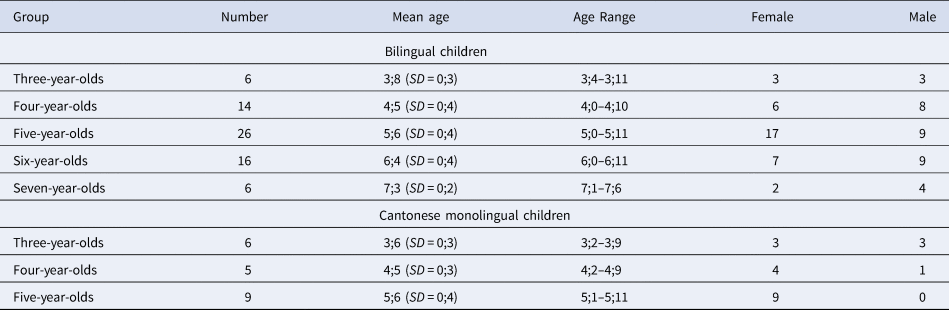
The participants were sixty-eight Cantonese–English bilingual children in Hong Kong (3;4–7;6). They had been exposed to Cantonese in the family and the community since birth. Before age three, some children attended Cantonese or English daycares, and others both. From age three, all of them attended preschools and kindergartens where they received regular English input from native-speaking English teachers for approximately 2 hours per day for five days a week. Twenty Cantonese monolingual children (3;2–5;11), recruited from a local kindergarten and a community service centre in Hong Kong, served as the Cantonese monolingual baseline in this study. Table 1 summarizes the child participants’ information.
Information of the child participants

We also recruited twelve English native speakers (five females, seven males, aged 19–34, M age = 23, SD = 4.7) and thirty-six Cantonese native speakers (twenty-three females, thirteen males, aged 18–28, M age = 21, SD = 2.5) as adult controls. They were university students and received monetary compensation for participation.
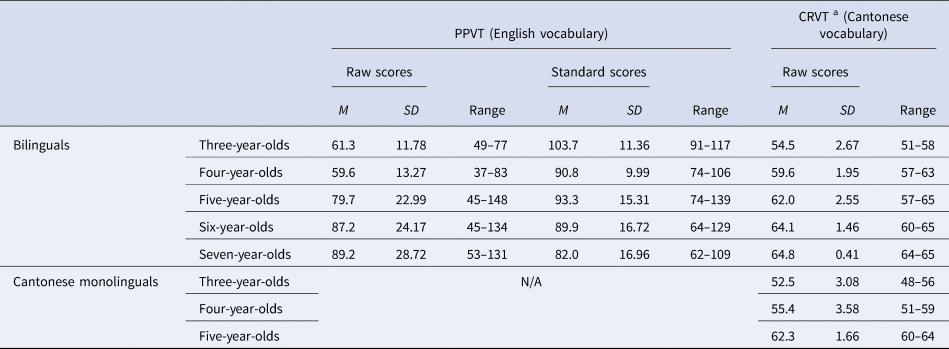
Numerous studies have shown that vocabulary size significantly predicts language skills (Stæhr, Reference Stæhr2008; Duff, Reen, Plunkett & Nation, Reference Duff, Reen, Plunkett and Nation2015). To factor in language proficiency, we administered the Cantonese Receptive Vocabulary Test (CRVT; Cheung, Lee & Lee, Reference Cheung, Lee and Lee1997) with the monolingual children, and the Peabody Picture Vocabulary Test (PPVT-4; Dunn & Dunn, Reference Dunn and Dunn2007) and CRVT with the bilingual children. PPVT and CRVT are normed with monolingual English speakers (aged 2;6 to over 90) in the U.S. and Cantonese monolingual children (two- to six-year-old) in Hong Kong respectively. In both tests, each child was shown four pictures at a time and asked to point to a picture representing the word spoken by the researcher. Table 2 shows the results.
Results of the Peabody Picture Vocabulary Test (PPVT-4; Dunn & Dunn, Reference Dunn and Dunn2007) and/or the Cantonese Receptive Vocabulary Test (CRVT, Cheung et al., Reference Cheung, Lee and Lee1997) by the bilingual (n = 68) and Cantonese monolingual (n = 20) children

Note. a CRVT does not provide standard scores.
A standard score over 100 on the PPVT-4 scale indicates that an examinee's raw score is above the average for the monolingual reference group of the same age in the normative sample. As shown by the standard scores in Table 2, our three-year-old bilinguals scored comparably to their English monolingual age peers, while the scores of the four- to seven-year-olds were generally behind the average for their monolingual age peers. Regarding Cantonese, the three-, four-, and five-year-old bilinguals behaved similarly to the aged-matched monolingual peers, as shown by the raw scores of CRVT in Table 2 (the six- and seven-year-olds performed at ceiling). The results show that our bilingual children were more advanced in Cantonese than in English.
Materials and procedures
An elicited production task modelled on Schaeffer (Reference Schaeffer2000) and subsequent work (e.g., Pérez-Leroux, Pirvulescu & Roberge, Reference Pérez-Leroux, Pirvulescu and Roberge2008) was administered. English and Cantonese versions were created for the task, each containing two experimental conditions testing the participants’ sensitivity to discourse context and differing in whether the object is mentioned in the immediately preceding discourse:
a) Object Specified in Prompt Question Condition (O-Spec): the object is available through visual context and prior discourse, and specified in the prompt question;
b) Object Not Specified in Prompt Question Condition (O-NSpec): the object is available through visual context and further prior discourse, but unmentioned in the prompt question.
The participants watched a short narrated movie with Mickey Mouse (11a, 12a; illustrated in Figures S1-S2, supplementary material), who misunderstood the movie (11b, 12b), and they should help Mickey make sense of the story by answering a yes/no question (11c, 12c) and a wh-question (11d and 12d, the prompt question intended to elicit the target structure) asked by him. The task had 24 movies featuring different cartoon characters engaged in different action events, with each condition being tested in 12 of the movies.
Possible responses are given in (11e-k) and (12e-k), with the direct object in italic. In the O-Spec condition, since the object is mentioned in the prompt question (e.g., What did Daddy Pig do with the sock? as in 11d), both overt objects (e.g., NPs and pronouns in 11e-f) and null object (11h) are natural in Cantonese, on the condition that when the pronoun KEOI is used, the boundedness requirement has to be respected, hence the ungrammaticality of (11g). English allows overt objects in NP or pronominal forms (11i-j) and disallows a null object like (11k) in this context. In the O-NSpec condition, however, since the object is unmentioned in the prompts and is being questioned (e.g., What did Daddy Pig do? as in 12d), it is infelicitous to refer to it using a pronominal or null form in either language (12f-h, j-k), while the pronoun KEOI with an unbounded verbal predicate in Cantonese (12g) and null object in English (12k) are ungrammatical. Only the NP form (12e, 12i) is allowed in both languages when a specific object referent is intended in the response in this condition.

Based on Zhou et al. (Zhou, Mai & Yip, Reference Zhou, Mai and Yip2015), which identified a list of English verbs whose objects are frequently omitted by Cantonese–English bilingual children, we chose twelve transitive verbs to construct the English materials, including 8 TWO verbs with two levels of transitivity (OBL: break, open, pick, wash; OPT: cook, drink, eat, paint) and 4 THR verbs (give, pass, put, send). These verbs were kept constant between the experimental conditions. Their direct objects were inanimate and varied across items. The Cantonese version was created based on the translation equivalents of the English materials, which also included 8 TWO and 4 THR verbs. All the tested TWO verbs (including lexical equivalents expressing similar meaning and having the same argument structure) in Cantonese denote unbounded activities with or without a specific object, except for zing2laan6 ‘break’ and daa2hoi1 ‘open’, which are resultative verb compounds. The verb in the prompt question eliciting the target structure in Cantonese is invariably a bare verb zou6 ‘do’ without aspect markers (11d, 12d). Thus, the participants needed to add delimiting elements to the unbounded verbal predicates when using KEOI as the direct object in their response. (The verb-object pairs tested are in Table S1, supplementary material.)
The aural stimuli were pre-recorded by two female native speakers of American English and Cantonese respectively. The participants were tested individually in a quiet room. They sat with a researcher in front of a computer, watched the movies and answered the questions orally. The 24 movies were presented in a pseudo-randomized order. The bilingual children completed both versions of the task, with at least a one-week interval, and the order was randomized. The monolingual children and the adult controls completed the task in their respective native language.
Data coding
The participants’ responses were audio-recorded and transcribed by the first author, a bilingual speaker of Cantonese and English. Only responses using the target verb or a lexical equivalent were coded and the direct objects were placed into four categories: i) NP (e.g., saam1 “shirt”), ii) pronoun (e.g., KEOI “it”), iii) null, and iv) other, where overt objects are “displaced” and appear in positions other than the direct object position (e.g., the object appearing before the main verb in a zoeng1-construction, being topicalized, or being right-dislocated and preceded by a sentence particle or a pause).
Results
The bilingual children produced 1,583 valid responses in Cantonese and 1,468 in English (out of 1,632, 97% and 90% respectively). The other responses were invalid as they did not contain the target verbs (especially the English verbs send and pass). The Cantonese monolingual children provided 458 valid responses (out of 480, 95%). The adult native controls produced higher rates of valid responses (English controls: 284 out of 288, 99%; Cantonese controls: 856 out of 864, 99%). In what follows, in addition to reporting the descriptive statistics, we used the R package lme4 (Bates, Maechler, Bolker & Walker, Reference Bates, Maechler, Bolker and Walker2015) in the statistical program R (version 3.5.1, R Core Team, 2018) to fit a series of generalized mixed effects logistic regression models including crossed random effects for participants and items. To reduce the probability of Type I errors, random slopes were included if they significantly improved model fit as measured by AIC, following the recommendation by Matuschek et al. (Matuschek, Kliegl, Vasishth, Baayen & Bates, Reference Matuschek, Kliegl, Vasishth, Baayen and Bates2017).
Object realization in English
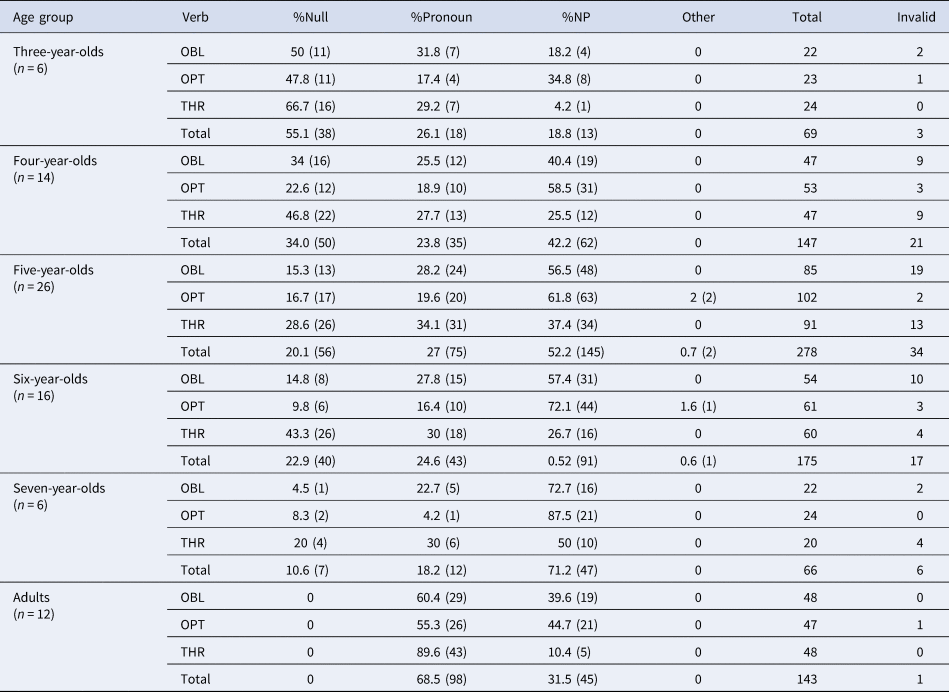
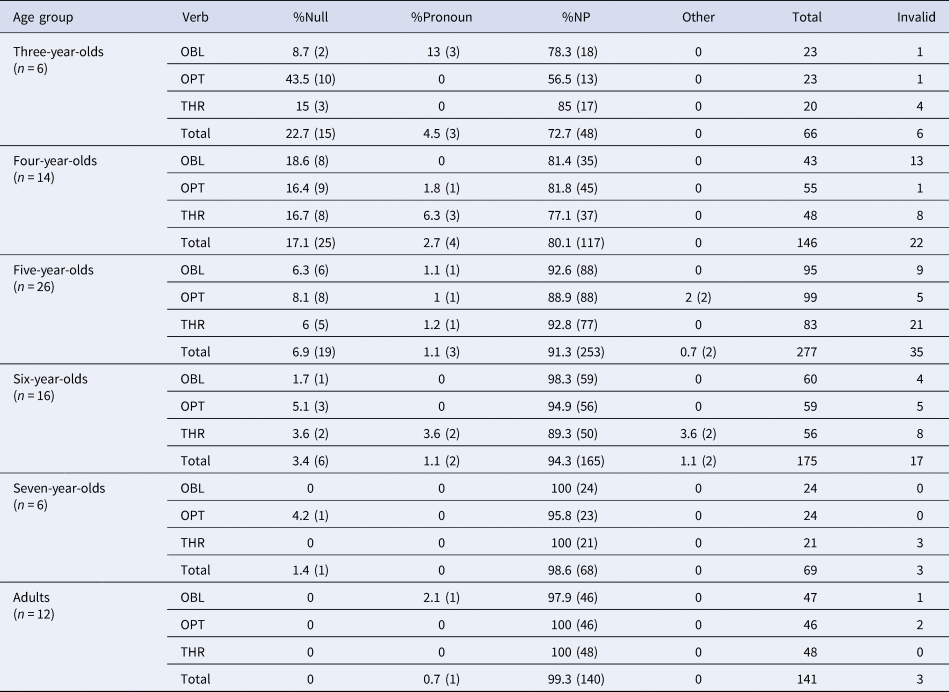
Percentages and counts of direct object types in English are given in Tables 3-4. The adult controls did not produce null object. They produced large proportions of pronouns in O-Spec contexts (68.5%) and predominantly NPs in O-NSpec contexts (99.3%). The bilingual children, especially the younger groups, produced high rates of null objects in O-Spec contexts (55.1% in the three-year-olds and 34% in the four-year-olds). While object omission rates decreased in the older children (20.1%, 22.9% and 10.6% in five-, six-, and seven-year-olds), omission of specified objects was still common with THR verbs (20–66.7%). In the O-NSpec condition, although NPs constituted the majority of the bilingual children's object types (above 70%), a fairly high rate of objects (22.7% and 17.1%) were omitted by the three- and four-year-olds. The omission rates dropped below 10% in the older children.
Direct object types in English object-specified contexts, %(N)

Direct object types in English object-unspecified contexts, %(N)

In the mixed-effects regressions, the bilingual children's choice of null vs. overt objects in English was treated as a binomial dependent variable. The fixed effects included: (i) Context as a two-level factor (O-Spec, O-NSpec); (ii) Verb as a three-level factor (OBL, OPT, THR); (iii) the continuous predictors Age (in months) and Vocabulary (PPVT scores); (iv) every interaction among the predictors. Age and Vocabulary were mean-centred, Context sum-coded (i.e., −0.5 and 0.5), and Verb assigned reverse Helmert contrasts, comparing OPT to OBL verbs, and THR verbs to the mean of OBL and OPT verbs (i.e., THR vs. TWO). All possible random structures of the predictors and their interaction were assessed. The best model contained a by-participant Verb slope. Table S2 in the supplementary material shows the results.
Significant main effects were obtained for Context (b = −2.065, SE = 0.429, z = −4.814, p < .001) and Age (b = −0.086, SE = 0.021, z = −4.013, p < .001), suggesting that the bilingual children produced more null objects when the intended object was specified in the immediately preceding discourse than when it was not, and object omission decreased as age increased. There was a borderline significant Context-Verb (THR vs. TWO) interaction (b = −1.639, SE = 0.899, z = −1.822, p = .068). Follow-up analyses showed that the likelihood of omitting specified objects was higher with THR verbs (b = −0.620, SE = 0.525, z = −1.180, p = .238) than with TWO verbs, which comprised OBL (b = −2.366, SE = 0.613, z = −3.861, p < .001) and OPT verbs (b = −2.320, SE = 0.540, z = −4.294, p <.001), whereas omission of unspecified objects was below chance (i.e., 50%) regardless of the verb type (OBL: b = −4.507, SE = 0.776, z = −5.810, p < .001; OPT: b = −3.220, SE = 0.588, z = −5.474, p < .001; THR: b = −3.708, SE = 0.644, z = −5.762, p < .001). (These follow-up analyses were computed by refitting the model with Context and Verb being dummy-coded; analyses of interactions below were computed in an analogous manner.) There was significant Context-Verb (OBL vs. OPT)-Vocabulary interaction (b = −0.096, SE = 0.046, z = −2.082, p = .037). Follow-up analyses revealed non-significant effects of Vocabulary on object omission with OBL or OPT verbs in either contextual condition, though the two verb types exhibited different trends concerning the probability of null object along the Vocabulary scale (illustrated in Figure S3, supplementary material): as vocabulary increased, the probability of null object seemed to be increasing with OPT verbs (b = 0.031, SE = 0.024, z = 1.323, p = .186) but slightly decreasing with OBL verbs (b = −0.019, SE = 0.031, z = −0.620, p = .536) in O-Spec contexts, and it remained constantly low throughout the Vocabulary scale in O-NSpec contexts (OBL: b = 0.045, SE = 0.040, z = 1.110, p = .267; OPT: b = 0.001, SE = 0.026, z = 0.043, p = .966).
Object realization in Cantonese
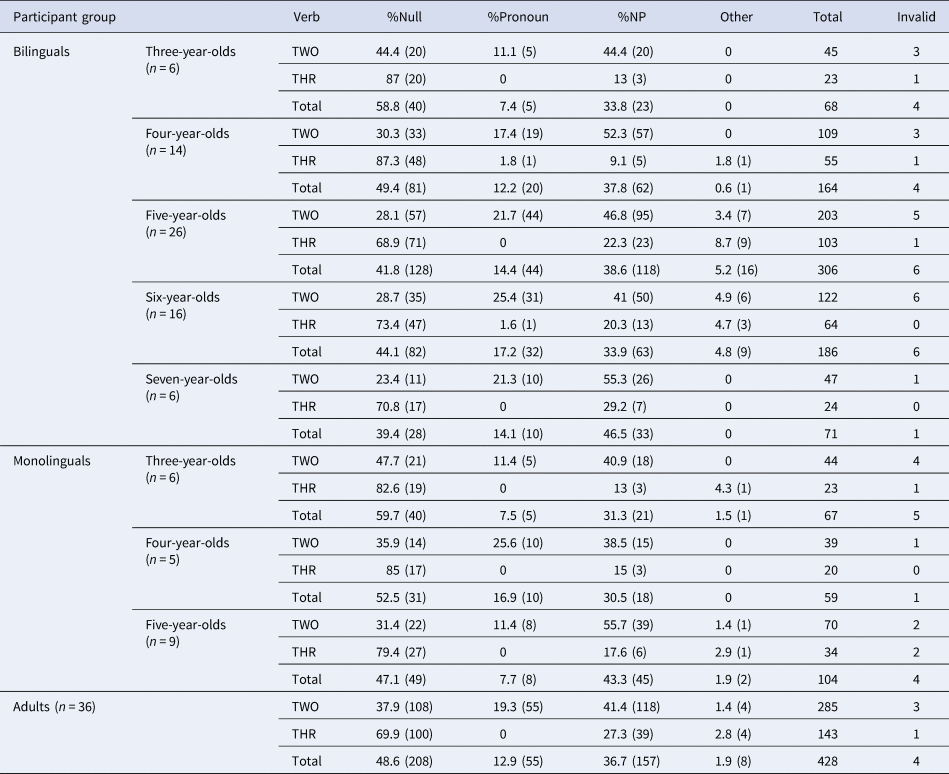
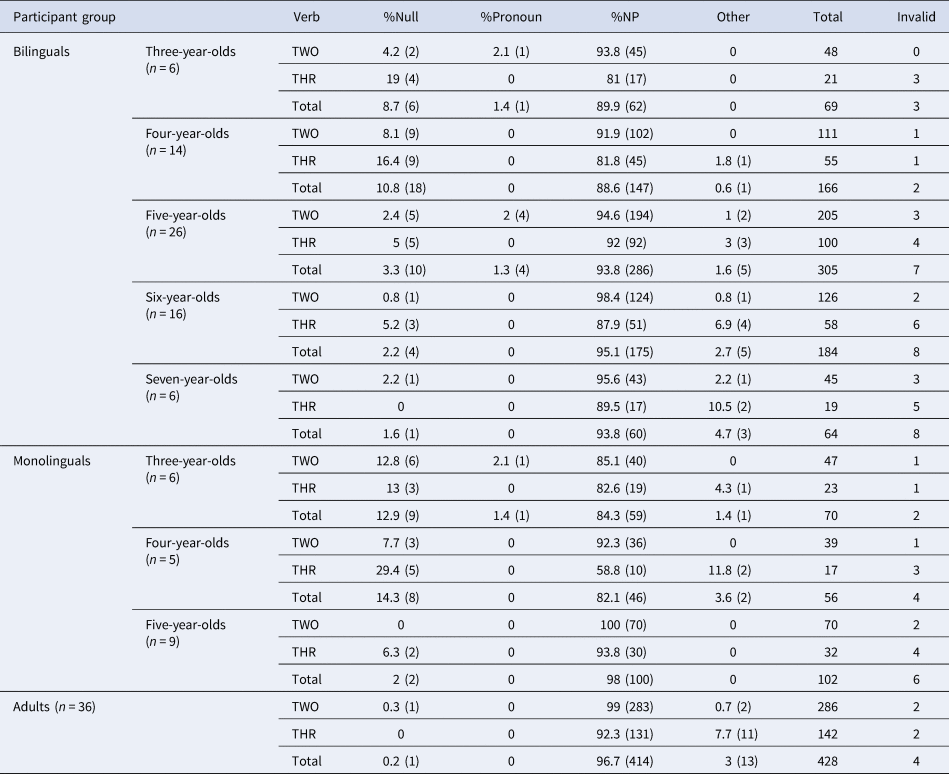
The distribution of responses in Cantonese is given in Tables 5–6. In O-Spec contexts, the bilingual children omitted 23–44% objects of TWO verbs and 68–87% objects of THR verbs, similar to the Cantonese monolingual children (TWO 30–40%, THR around 80%) and the adults (TWO 37.9%, THR 69.9%). In O-NSpec contexts, the bilingual children omitted smaller percentages of objects in total, with higher omission rates in the three- and four-year-olds (8.7% and 10.8%) than in the older children (below 4%). The monolingual children also omitted objects, i.e., 12.9% and 14.3% in the three- and four-year-olds and 2% in the five-year-olds, whereas the adults hardly used null object at all.
Distribution of direct object types in Cantonese object-specified contexts, %(N)

Distribution of direct object types in Cantonese object-unspecified contexts, %(N)

As in English, we generated mixed models for the children's choice of null object in Cantonese. The predictors were similar to those in the English model except that Verb was a two-level factor (TWO, THR) as Cantonese does not distinguish between OBL and OPT verbs, and Vocabulary was the CRVT scores. All categorical variables were sum-coded and the continuous variables mean-centred. Tables S3-S4 in the supplementary material show the results for the bilingual and monolingual Cantonese-speaking children respectively.
The best model for the bilingual children contained a by-participant Verb slope. They omitted objects significantly more often in O-Spec contexts than in O-NSpec contexts (b = −4.874, SE = 0.607, z = −8.031, p < .001) and their odds of object omission were significantly higher with THR verbs than with TWO verbs (b = −2.324, SE = 0.622, z = −3.738, p < .001). Age and Vocabulary were non-significant predictors (ps > .4), suggesting object omission in Cantonese did not change as a function of age or vocabulary. The best model for the Cantonese monolingual children did not contain random slopes for lack of improvement of the model fit. A similar pattern of significance was obtained. They exhibited significant main effects of Context (b = −4.568, SE = 1.124, z = −4.066, p < .001) and Verb (b = −3.022, SE = 1.118, z = −2.702, p = .007), and no main effect of Age or Vocabulary (ps > .2) in object omission.
We compared age-matched bilingual and monolingual children (i.e., three- to five-year-olds) to identify group differences, with Group (bilingual, monolingual) as a sum-coded predictor, in addition to those in the previous model, and all interactions. The best model contained a by-participant Verb slope. No significant difference was found between the monolingual and bilingual children regarding object omission in Cantonese (p = .672); nor was there significant interaction between Group and the other predictors (ps > .1).
Finally, as shown in Tables 5-6, the adults produced fewer pronoun objects (19.3% and 0) than NP objects (41.4% and 27.3%) for TWO and THR verbs in O-Spec contexts, as did the Cantonese monolingual children (NPs 13% to 55.7%, pronouns 0% to 25.6%) and the bilingual children (NPs 9.1% to 29.2%, pronouns 0 to 25.4%). They barely produced pronouns in O-NSpec contexts. Separate mixed models were generated for the bilingual and monolingual children, with the choice of pronoun vs. other object types as a binomial dependent variable and the fixed effects including Context (O-Spec, O-NSpec), Age (in months), and Vocabulary (CRVT scores). Context was sum-coded, and Age and Vocabulary mean-centred. Random slopes and interactions were not included as the former did not improve the model fit and the latter reduced it. Both the bilingual children (b = −3.847, SE = 0.951, z = −4.046, p < .001) and the monolingual children (b = −3.423, SE = 1.131, z = −3.025, p = .002) produced less pronouns in O-NSpec contexts than in O-Spec contexts. There were no other significant effects (ps > .6).
We further compared age-matched bilingual and monolingual children, with Group (bilingual, monolingual) as a sum-coded predictor in addition to Context (sum-coded), Age and Vocabulary (mean-centred), and its interaction with these predictors. Random slopes did not improve the model fit and were not included. Only the effect of Context was significant (b = −3.390, SE = 1.004, z = −3.378, p = .001). Group difference (p = .332) was non-significant, suggesting that the bilingual and Cantonese monolingual children behaved similarly in their production of object pronouns in Cantonese. However, qualitative analysis found eleven tokens of non-target use of KEOI (with unbounded verbal predicates including hoi1 ‘open’, zyu2 ‘cook’, zaak6 ‘pick’ and sai2 ‘wash’) in O-Spec contexts in nine of the bilinguals (e.g., 15–16). No such non-target use of KEOI was observed in the Cantonese monolingual children or the adult controls. In other words, the bilingual children were less adult-like than the Cantonese monolingual children regarding the boundedness requirement of KEOI.
Discussion
Summary of findings
One of the goals of this study is to investigate whether the coordination between discourse-pragmatic principles and language-specific syntactic rules is particularly vulnerable in bilingual development. We found significant context effects on our bilingual children's object omission in both languages: more objects are omitted when they have been specified in the immediately preceding context than when they are not. These results suggest that the bilingual children were sensitive to the discourse-pragmatic notion of givenness and shared knowledge, though they were not yet able to apply it to the appropriate contexts consistently, particularly in English.
Comparing bilingual children and their monolingual peers, our results showed that the bilingual and Cantonese monolingual children both showed significant effects of Context and Verb and they omitted objects equally frequently in Cantonese. In terms of pronoun use in Cantonese, they did not differ in frequency, but nine of the bilingual children produced eleven non-target-like KEOI-clauses violating the boundedness requirement while none of the Cantonese monolingual children did, which is a qualitative difference between the two groups. For English, we compared non-target-like object omission rates in our bilingual children with those of age-matched English monolingual children in Pirvulescu et al. (Reference Pirvulescu, Pérez-Leroux, Roberge, Strik and Thomas2014), which tested omission of specified objects of OPT verbs using a similar experimental design. In our three-, four- and five-year-old bilingual children, the null object rates of OPT verbs in the O-Spec condition were 47.8%, 22.6% and 16.7% respectively, whereas, in their study, the corresponding percentages were 12%, 13%, and 14%. Clearly our Cantonese–English bilingual children used more null objects in O-Spec contexts than age-matched English monolingual children typically do.
CLI from Cantonese to English
Our finding that three- and four-year-old Cantonese–English sequential bilinguals produced non-target-like null objects more often than English monolingual peers but behaved similarly to Cantonese monolingual counterparts in object omission converges with patterns of simultaneous Cantonese–English bilingual children in the corpora (Yip & Matthews, Reference Yip, Matthews, Cohen, McAlister, Rolstad and MacSwan2005, Reference Yip and Matthews2007). It also confirms the prediction that Cantonese influences English in object omission, but not the other way around, supporting Hulk and Müller (Reference Hulk and Müller2000). Previous studies with bilingual children acquiring two languages that disallow null objects found either low object omission rates (e.g., Serratrice et al., Reference Serratrice, Sorace and Paoli2004) or high object omission rates (e.g., Pirvulescu et al., Reference Pirvulescu, Pérez-Leroux, Roberge, Strik and Thomas2014) in both languages. The Cantonese/English asymmetry displayed by our Cantonese–English bilingual children reveals that the acquisition of object realization is shaped by the specific language pair being acquired, among other factors. Note that our study did not constitute direct evidence for/against the bilingual effect hypothesis proposed by Pirvulescu et al. (Reference Pirvulescu, Pérez-Leroux, Roberge, Strik and Thomas2014) because with the asymmetric language combination under investigation, input ambiguity across languages is involved. Nonetheless, the overall reduced input of English and the input ambiguity within English might have contributed to the prolonged retention of non-target null object representation in the English grammar in our Cantonese–English bilinguals, who lived in a Cantonese-dominant environment. The linguistic evidence relevant for selecting the Cantonese grammar over the English grammar was robust and abundant in the input, and might have reinforced the referential null object representation.
Additionally, we have found evidence showing qualitative influence of Cantonese on English object omission. A case in point is the use of null object in prepositional datives as shown in (13), which resembles the Cantonese counterpart in (14).

While verbs like give, pass, and send may appear in double-object datives (e.g., she gave Daddy a cake) or prepositional datives (e.g., she gave a cake to Daddy) in English, their Cantonese translation equivalents (e.g., dai6 “pass” and gei3 “send”) are more common in prepositional datives, or “serial dative” in Matthews's (Reference Matthews, Aikhenvald and Dixon2006) terms. In fact, the verb bei2 “give” is the only Cantonese verb tested that can appear in double-object datives. In a full prepositional dative in Cantonese, the theme (T) follows the main verb, while the recipient (R) is introduced by the dative marker bei2 “give” (Matthews, Reference Martí2006), rendering a [V-T-bei2-R] structure. The full datives produced by the bilingual children in Cantonese, except those with the dative verb bei2 “give”, were invariably prepositional datives (the dative verb bei2 appeared in the [bei2-T-bei2-R] structure 39.3% of the time, N = 24). Moreover, in the O-Spec condition, 81% (N = 85) of the bilingual children's Cantonese prepositional datives were without an overt direct object as (14) shows. Considering that under the same condition, 30.4% (N = 45) of their English prepositional datives were without overt direct objects in a [V-to-R] structure, as in (13), we infer the influence of Cantonese in this pattern.
To evaluate this possibility, we extracted utterances containing give, send, and pass in nine Cantonese–English bilingual children (1;3–4;6) from the Hong Kong Bilingual Child Language Corpus (Yip & Matthews, Reference Yip and Matthews2007) and three English monolingual children (1;9-5;2) including Adam (Brown, Reference Brown1973), Peter (Bloom, Hood & Lightbown, Reference Bloom, Hood and Lightbown1974) and Trevor (Demetras, Reference Demetras1989). The corpus search identified no [V-to-R] instance of the dative verbs in the English monolingual children, but 8 such cases in three of the Cantonese–English bilingual children, consistent with our experimental finding that the [V-to-R] structures in the bilingual children's English were likely to be an instance of CLI from Cantonese.
Overall, our bilingual children producing higher rates of pronominal object omission and Cantonese-style dative constructions in their English adds experimental evidence to Yip and Matthews's (Reference Yip, Matthews, Cohen, McAlister, Rolstad and MacSwan2005, Reference Yip and Matthews2007) corpus-based observation that the influence of Cantonese on English object omission is both quantitative and qualitative.
CLI from English to Cantonese
In the eleven non-target-like KEOI-clauses produced by our bilingual children, bare verbs such as zyu2 ‘cook’ in (15) and sai2 ‘wash’ in (16) are atelic and do not denote bounded events in Cantonese despite the presence of a specific object, thus violating the boundedness requirement of KEOI-clauses which requires that the predicate should denote a temporally measurable event.

The target-deviant use of KEOI in the bilingual children as opposed to the adult-like performance of the monolingual children shows that CLI may occur even when realization of the target structure does not converge with universal discourse strategies, challenging Hulk and Müller's (Reference Hulk and Müller2000) conditions for CLI. The bilingual children's less restricted use of KEOI may be attributed to influence from the English equivalent it, which is indifferent to event boundedness as a direct object, and might have bleached the boundedness feature of KEOI or weakened the obligatory association between KEOI and the semantic notion of boundedness in the bilingual child's Cantonese grammar (cf. Serratrice et al., Reference Serratrice, Sorace and Paoli2004). This mental mapping between V-KEOI in Cantonese and V-it in English is supported by independent evidence in Zhou et al. (Reference Zhou, Mai and Yip2016), who found that Cantonese–English bilingual children produced KEOI and it interchangeably in code-mixed utterances in naturalistic settings. Since both this study and Zhou et al. (Reference Zhou, Mai and Yip2016) draw upon production data, whether the nature of this less restricted use of KEOI observed in our study is truly a qualitative difference at the representational level as proposed above needs to be verified in an acceptability judgement or comprehension task, as in Kupisch, Belikova, Özçelik, Stangen and White (Reference Kupisch, Belikova, Özçelik, Stangen and White2017).
Possible causes of CLI
Our results implicate bidirectional CLI in Cantonese–English bilingual children's object realization. Regarding CLI in object omission, input ambiguity resulting from ambiguous grammatical analysis of omitted objects, in the sense of Yip and Matthews (Reference Yip and Matthews2007), may have played a role. From a child's perspective, the intransitive sense of verbs like eat may seem compatible with both the English-type analysis, which leads to a generic interpretation of the missing object, and the Chinese-type analysis, which results in the missing object referring back to the discourse topic. Additionally, a small set of English verbs (e.g., show) may appear without a clausal complement provided that the complement is recoverable from the discourse context, which may add to the ambiguity and reinforce the null-topic analysis.
Note that the CLI observed in the current study is not necessarily “a relief strategy” (Hulk & Müller, Reference Hulk and Müller2000) that copes with input ambiguity. Our findings are consistent with what the shared syntax model (Hartsuiker, Pickering & Veltkamp, Reference Hartsuiker, Pickering and Veltkamp2004; Schoonbaert, Hartsuiker & Pickering, Reference Schoonbaert, Hartsuiker and Pickering2007) predicts in the cross-linguistic priming (CLP) framework. In this model, the lemmas of the bilingual's two languages (in this case Cantonese and English) are connected to the same category node (e.g., VERB) and to the same combinatorial nodes (encoding structural information). Activation of the lemma and one of the combinatorial nodes results in activating a grammatical structure, unspecified for language. Syntactic priming has been shown to be cumulative and relatively long-lasting, reflecting adaptation of the linguistic representations through implicit learning (see van Gompel & Arai, Reference van Gompel and Arai2018, for a review). Following this, in our case, daily processing of high-frequency null object constructions in Cantonese, and the shared syntactic representation, together with the ambiguity in the English input, might have reinforced the entrenchment of the combinatorial node with a null object and led to CLI of Cantonese. Nonetheless, since our study set out to test predictions under CLI at the representational level rather than CLP, it does not provide direct evidence for/against CLP. Future studies should test real-time processing within the CLP framework to ascertain the role of CLP in bilingual children's realization of objects.
Recall that the bilingual children in the current study were sequential bilinguals immersed in a Cantonese-dominant environment. They have probably developed knowledge of null object in Cantonese before the acquisition of English. This developmental asynchrony in addition to the dominance in Cantonese might also contribute to the influence of Cantonese on English object omission, as suggested by Yip and Matthews (Reference Yip and Matthews2007). In their study, Cantonese-dominant bilinguals omitted more objects than the non-Cantonese-dominant counterparts in English and the former still produced non-target-like null objects at the age of six. Although the current study did not examine non-Cantonese-dominant bilingual children, the results were consistent with Yip and Matthews (Reference Yip and Matthews2007) in showing strong influence of Cantonese in bilingual children who were dominant in Cantonese: high rates of non-target-like object omission were observed and persisted in the older children; and increases in vocabulary knowledge did not seem to predict decreases in object omission. Exactly how language dominance and developmental asynchrony interact in determining CLI warrants further investigation.
The CLI of English on Cantonese, which is not predicted by Hulk and Müller's (Reference Hulk and Müller2000) CLI hypothesis, might also be explained by CLP. The boundedness feature of KEOI is likely underspecified at the representational level as a result of the shared grammatical representations in the bilingual mind. In speaking Cantonese, the bilingual child activates the lemma of KEOI via the conceptual node, which then activates the lemma of the English pronoun it and/or them. In cases where the bilingual is engaged in extensive processing of third-person object pronouns in English, KEOI is very likely to be processed in the same way as it and/or them without conforming to the boundedness requirement in Cantonese. Moreover, KEOI as a direct object is infrequent in the Cantonese input. Analysis of the parental utterances in the Hong Kong Bilingual Child Language Corpus (Yip & Matthews, Reference Yip and Matthews2007) and the Hong Kong Cantonese Child Language Corpus (Lee, Wong, Leung, Man, Cheung, Szeto & Wong, Reference Lee, Wong, Leung, Man, Cheung, Szeto and Wong1996) showed that KEOI only occurred in 0.7% (N = 82 and N = 135, respectively) of the parental utterances in both corpora. The low frequency of KEOI in the Cantonese input, as opposed to the obligatoriness of overt object pronouns in the same contexts in the English input, might have rendered the bilingual children's acquisition of KEOI susceptible to influence of English. If our speculations are on the right track, it follows that language dominance plays a role in determining CLI in the acquisition of KEOI by Cantonese–English bilingual children and that recent and extensive use of the English pronouns in post-verbal positions will increase the ungrammatical use of KEOI in Cantonese. We will leave them for future research. For now, our results suggest that CLI may occur from a weaker language to a stronger language.
Our findings are notably in line with previous research that shows structural vulnerability varies within the same linguistic domain (e.g., Yuan, Reference Yuan2010; Zhao, Reference Zhao2012). For example, specified objects of THR verbs were omitted in a non-target-like manner more often than those of TWO verbs in English in our bilingual children, which converges with Yip and Matthews (Reference Yip and Matthews2007) in that object omission is more likely for structurally more complex verbal predicates. Even our six- and seven-year-old bilinguals omitted a high rate of objects of THR verbs when their object omission rates of TWO verbs were very low in O-Spec contexts (see Table 3). Since a stronger Verb effect was present in Cantonese object omission, an explanation of the difference between THR and TWO verbs in the bilingual children's English object omission is that THR verbs bear a greater processing demand than TWO verbs, and consequently are more susceptible to CLI of Cantonese in the O-Spec condition, which gives rise to input ambiguity and encourages CLI. Hence, varying degrees of CLI were found within the domain of object realization.
Finally, recall that, as English vocabulary grows, the probability of producing null object in O-Spec contexts decreased with OBL verbs but increased with OPT verbs in our bilingual children. These results suggest that acquiring object omission of OPT verbs might be more challenging than OBL verbs, particularly in O-Spec contexts. This is plausible since ambiguity in the analysis of unrealized objects in English largely arises with OPT verbs in contexts that meet the discourse conditions for the Chinese null-topic analysis. The results are consistent with Zhou et al. (Reference Zhou, Mai and Yip2015) that showed Cantonese-dominant children (mean length of utterance above 3.5) still omitted a high percentage of objects of OPT verbs incorrectly when their object omission rate of OBL verbs was low in English. Note that our regression analyses showed no significant difference between OBL and OPT verbs in object omission. It could be that their difference was subtle and had been overridden by the CLI of Cantonese, which was most evident in the O-Spec context. Exactly how transitivity of TWO verbs affects acquisition of object omission warrants further investigation.
Conclusion
This study contributes to the understanding of CLI in bilingual children acquiring typologically different languages. The quantitative and qualitative evidence presented in this study confirms Yip and Matthews's (Reference Yip and Matthews2007) observation of direct CLI from Cantonese to English and extends this observation to CLI from English to Cantonese. While results of the quantitative analyses were in line with the predictions of Hulk and Müller's (Reference Hulk and Müller2000) hypothesis, our finding that Cantonese–English bilingual children produced non-target pronominal KEOI in Cantonese posed a challenge to their formulation of conditions for CLI. The CLI observed in the current study may be viewed as a result of shared syntax in the sense of Hartsuiker et al. (Reference Hartsuiker, Pickering and Veltkamp2004). Since our bilingual children were Cantonese-dominant, the bidirectional CLI suggests that CLI may occur from a stronger language to a weaker language, and vice versa. Finally, our results suggest that structural vulnerability depends on interactions between various factors including CLI, amount of language exposure, the frequency of a structure in the input, and other linguistic elements involved in the interface relation (e.g., verb type). Systematic studies comparing children with an array of language dominance profiles through multiple methods are needed to reveal the nature of CLI and its interaction with the above-mentioned factors.
Acknowledgements
We are grateful to the anonymous reviewers for their valuable comments and suggestions. We would like to thank Jieyu Zhou, Scarlet Li, Tracy Au, Phoebe Ma, Yujing Fan, Yuqi Wu, Yanxin Zhu, Hannah Lam and Cindy Lau for their assistance with the study. We also gratefully acknowledge our participants. We have benefited from discussion with a number of friends and colleagues: Stephen Matthews, Elaine Lau, Haoyan Ge, Xiangjun Deng, Szeto Pui Yiu, Yanhui Zhang, and Qiao Zhang. This research is supported by a General Research Fund project funded by the Hong Kong Research Grants Council (Project no. 146632016) and funding for the University of Cambridge-CUHK Joint Laboratory for Bilingualism, the CUHK-Peking University-University System of Taiwan Joint Research Centre for Language and Human Complexity, and the Childhood Bilingualism Research Centre.
Supplementary Material
For supplementary material accompanying this paper, visit https://doi.org/10.1017/S1366728920000231