

I. INTRODUCTION
The growing importance attributed to the Walrasian theory is a striking feature of the history of contemporary macroeconomics. This is particularly paradoxical as far as Keynesian theory is concerned. John Maynard Keynes was trained as a Marshallian economist and, except for its general equilibrium perspective, the model of his 1936 General Theory had nothing to do with Léon Walras’s work. Yet, a few years after the publication of Keynes’s book, a number of economists began to present his model, identified with IS-LM, as a particular case of the Walrasian model. This idea appeared in Franco Modigliani in Reference Modigliani1944 and in Lawrence Klein in 1947. A perfect illustration of this position appears in Don Patinkin’s entry on Keynes for the New Palgrave Dictionary of economics. There, he wrote:
Thus a basic contribution of the General Theory is that it is in effect the first practical application of the Walrasian theory of general equilibrium: ‘practical’, not in the sense of empirical … but in the sense of reducing Walras’s formal model of n simultaneous equations in n unknowns to a manageable model from which implications for the real world could be drawn. (Patinkin Reference Patinkin, Eatwell, Milgate and Newman1991, p. 27)
This view of IS-LM, endorsed by defenders, critics, and historians alike, has often been rationalized by the following syllogism: IS-LM was invented by John Hicks, Hicks was a Walrasian, hence IS-LM was Walrasian. Alessandro Vercelli (Reference Vercelli1999) offers a good example of the standard story:
As is well known, the first prototype of IS-LM model was introduced by Hicks (Reference Hicks1937) as an hermeneutic device for clarifying the relationship between Keynes’s General Theory (from now on GT) and General Equilibrium (from now on GE) classical theory in a language that could be understood also by the emerging group of econometrists and mathematical economists (Hicks, 1982, p. 100). At that time Hicks was busy in writing Value and Capital (Reference Hicks1939) meant to clarify the foundations of Walrasian GE theory in order to build on them more manageable models for economic analysis and policy. Therefore it came natural to him to represent the bulk of GT in a small-scale semi-aggregate GE model and compare it with an analogous GE model of Walrasian inspiration in order to isolate and discuss the differences between them. (Vercelli Reference Vercelli1999, pp. 201–202). Footnote 1
In a well-known paper published in the Journal of Post-Keynesian Economics, Hicks himself seemed to accept this view:
IS-LM was in fact a translation of Keynes’s non-flexprice model into my terms.... It will readily be understood, in the light of what I have been saying, that the idea of the IS-LM diagram came to me as a result of the work I had been doing on three-way exchange, conceived in a Walrasian manner. (Hicks Reference Hicks1980, p. 51)
But, as some historians of macroeconomics have shown, the basic syllogism is false. The usual story has been disputed by Ingo Barens (Reference Barens1999), Barens and Volker Caspari (Reference Barens and Caspari1999), Alain Béraud (2012), Michel De Vroey (Reference De Vroey2004a), Robert Dimand (Reference Dimand2007), Warren Young (Reference Young1987), and William Darity and Young (Reference Darity and Young1995). In a few words, Hicks did not invent IS-LM and the original IS-LM models were not Walrasian. A confusion has plagued the most common understanding of IS-LM.
This confusion has played a decisive role in the history of macroeconomics. For instance, one may argue that it was at the origin of the disequilibrium theories of Jean-Pascal Benassy, Jacques Dreze, and Edmond Malinvaud. As argued by De Vroey (2004) and Goulven Rubin (Reference Rubin2012), these theories descended from the work of Patinkin (Reference Patinkin1956) and were an attempt to incorporate involuntary unemployment in the Walrasian framework. Footnote 2 On the other side of the battlefield, it may also be said that the confusion played a role in the genesis of Robert Lucas’s Walrasian macroeconomics. For, as he explained in 2003, he was much inspired by Don Patinkin’s attempt to combine IS-LM macroeconomics with a Walrasian approach in Money, Interest and Prices. Footnote 3 Whether this confusion was a bad or a good thing is a question that we will leave open. It may have hampered the development of a truly Keynesian macroeconomics but it also stimulated a variety of research programs.
Considering the confusion surrounding IS-LM as an established fact, this article offers to probe into its origins: how and why did IS-LM come to be considered as Walrasian? We will also take stock on the literature concerning the nature of Keynesian models and add some arguments to dispel the usual confusion.
The standard view took its roots in “The Rate of Interest and the Optimum Propensity to Consume,” a paper published by Oskar Lange in 1938. Lange asserted that IS-LM was a simplified Walrasian model. According to him there was a continuity between the two models. With the benefit of hindsight we will show that this presentation was inconsistent with the reality of his own version of IS-LM. Actually, the 1938 article illustrated the incompatibility between Keynes’s theory and Walras’s theory of prices. The discovery of this incompatibility led to the mutation that macroeconomics experienced during the 1970s.
Sections II and III explain why it is incorrect to say that Hicks invented IS-LM and why nobody considered it to be Walrasian before Lange; that is, between 1933 and 1938. Section IV presents Lange’s Reference Lange1938 continuity claim and the reason why it is false. This leaves us with a last question. If Lange was the first to say that IS-LM was Walrasian, it does not prove that he was the one responsible for the establishment of this view. Hence, section IV discusses the influence of Lange’s article on the young American economists who developed the neoclassical synthesis.
II. THE ORIGINS OF IS-LM
To the incorrect syllogism introduced above, we would like to substitute the following claims. Keynes was a Marshallian. He invented IS-LM. Hence IS-LM cannot be Walrasian. This section substantiates this reasoning using the existing literature, which, we will argue, has reached a surprisingly high degree of consensus on these controversial issues.
Two Prominent Economic Traditions
Different economic traditions interacted during the thirties: the Austrian, the institutionalist, the Marshallian, the Swedish, and the Walrasian, to name only the most prominent (David Laidler 1999). Among them, two are particularly important for our story: the Marshallian and the Walrasian. Contrary to what is often said, these two traditions offered competing, not complementary, representations of the functioning of a market economy. This point has been recognized by a number of economists and historians of economic thought, notably Axel Leijonhufvud (2006) and De Vroey (Reference De Vroey1999a). This means that a model built in one tradition, say the Marshallian, could not be characterized as part of the other tradition, say Walrasian.
Keynes as a Marshallian
As many argued before, Keynes was brought up in the Marshallian tradition. Peter Groenewegen (Reference Groenewegen, Cottrell and Lawlor1995) has insisted on the depth of the relation between Keynes and Alfred Marshall and identified three periods during which Keynes was the “pupil of the master.” Footnote 4 He, like Kevin Hoover (Reference Hoover, Backhouse and Bateman2006), noted the closeness between Keynes’s methodology and the methodology of Marshall. Footnote 5 As far as economic theory is concerned, the secondary literature usually presents the young Keynes as a Marshallian economist participating in the elaboration of the Marshallian theories of money and business fluctuations (Bridel 1987, p. 89; Laidler 1999, p. 106). The case becomes more controversial when it comes to the General Theory, the result of “a long struggle of escape,” as is well known. Yet, today, Keynes scholars seem to admit that it is difficult to understand the content of the General Theory if one ignores the Marshallian background of Keynes. Joan Robinson was probably one of the first to stress the Marshallian roots of the book: “Keynes’ General Theory of Employment is an application to output as a whole of the analysis developed by Marshall of the short-period equilibrium of a particular industry” (Robinson [Reference Robinson1954] 1982, p. 69).
The idea that the principle of effective demand resulted from modifications of Marshall’s theory of the market has been taken up by a long list of commentators since then. Footnote 6 If the General Theory attempted to escape the limitations of Marshallian theories, it was a struggle fought within the Marshallian tradition. Footnote 7 Keynes did not try to switch from Marshall to Walras, as this quotation, taken from a letter to Hicks, illustrates: “All the same, I shall hope to convince you some day that Walras’ theory and all the others along those lines are little better than nonsense!” (Letter from Keynes to Hicks, 9 December Reference Hicks1934). Footnote 8
Keynes’s Invention of IS-LM
Ironically enough, the first IS-LM model was developed by Keynes himself, who used it when presenting his new theory to his students in December 1933.
As noted by Warren Young (1987, pp. 12–13) and Robert Dimand (Reference Dimand2007), the lecture notes assembled by Thomas K. Rymes (Reference Rymes1989) document this fact. In the notes taken during the final lecture of the Michaelmas term, given December 4, we find the following set of equations:
 $$M = A(W,\,\rho )$$
 $$Y = C + I$$
 $$C = {\varphi _1}(W,\,Y)$$
 $$I = {\varphi _2}(W,\,\rho )$$
A was the “state of the liquidity preference,” W “the state of the news,” and ρ the rate of interest. Y was the income of the community. Its measure was not indicated in the notes for December 4, but on November 6, Lorie Tarshis noted that output could be valued in terms of money or in terms of employment (1989, p. 103). These equations were used by Keynes to summarize the “relevant forces” that he had “isolated” and show how they determined the level of employment.
IS-LM Taken up by Keynes’s Students and Two Members of the Circus
The model of IS-LM was taken up after the publication of The General Theory. But the first who brought it to the fore, David G. Champernowne, Brian Reddaway, James Meade, and Roy Harrod, were young Marshallians who had little knowledge of Walrasian economics. Actually, their models came from their readings of The General Theory or from Keynes’s lectures and the ideas that circulated at Cambridge during the elaboration of the book (Dimand Reference Dimand2007, p. 82; Young Reference Young1987, pp. 33 and 60).
The first versions came from Champernowne and Reddaway, both undergraduates at Kings College and supervision pupils of Keynes’s at Kings. Reddaway’s contribution came out of his reading of a copy of the General Theory he had been given by Keynes himself and that he had brought with him on the boat taking him to Melbourne. As he told in his interview with Young: “I wanted to make sure that the thing was the right number of equations for the right number of unknowns and so I scribbled this thing down” (Young Reference Young1987, p. 76). In an interview by Young, Champernowne explained that he read the General Theory having in mind the debates between the main figures of the Marshallian school: Marshall, Arthur Cecil Pigou, and Dennis Robertson (Young Reference Young1987, p. 85). James Meade and Roy Harrod, both active members of the circus, the small group of young economists discussing Keynes’s ideas on the road from the Treatise to the General Theory, can also be shown to have had a Marshallian education. For these economists, it would probably have been strange to see the IS-LM framework presented as belonging to the Walrasian approach.
The Disappearance of IS-LM in The General Theory: Cause and Consequences
Having been conceived within the Marshallian tradition, IS-LM could not be a Walrasian model. Footnote 9 If one admits this claim, it becomes difficult to understand how this model came to be seen as Walrasian. Of course, one may say that no theory of market interdependencies was developed in the Marshallian camp before the appearance of the General Theory (with the exception of the elusive note 21 in the mathematical appendix of the Principles). As a consequence, most economists tended to equate general equilibrium systems with Walrasian systems.
This confusion has certainly played an important role. But another reason has to do with Keynes’s version of the Marshallian methodology (Hoover Reference Hoover, Backhouse and Bateman2006). Marshallians consider that theory must be “purpose built.” In other words, the elaboration of a price theory explaining the functioning of an entire market system cannot be a preliminary step. Such an undertaking would be sterile because the economy is too complex to be captured this way. The economist must elaborate theoretical tools adapted to the particular problems he wishes to study. The partial equilibrium scheme is the most obvious illustration of this approach. Hoover (Reference Hoover, Backhouse and Bateman2006) explains how Keynes developed the concept of “causal nexus” as a particular version of this Marshallian methodology. The model of the General Theory aimed to isolate the part of the economic mechanism relevant to explain unemployment. This means that the principle of effective demand and the liquidity preference theory of the rate of interest are only parts of a larger economic system, a system too complex to be captured in its entirety. This methodological trait of the General Theory clarifies the nature of IS-LM.
Because of his methodological stance, in his 1936 book, Keynes refused to lay down the mathematical model that would have synthesized his theory. Unlike in the lectures given in 1933, he scattered his equations in the different chapters without any attempt to homogenize the mathematical notations. Finally, in a famous paragraph of chapter 21 he warned against the dangers of “pseudo-mathematical methods of formalizing a system of economic analysis” (Keynes Reference Keynes1936, p. 297). As a result, the young readers of the General Theory were left on their own to reconstruct Keynes’s model. In the process, the Marshallian microfoundations present in the General Theory got lost.
For the General Theory was not devoid of microfoundations (Dos Santos Ferreira Reference Dos Santos Ferreira, Béraud and Faccarello2000; Hoover Reference Hoover, Garcia Duarte and Tadeu Lima2012). The most obvious instance is chapter 3 and the analysis of the goods market, as mentioned above. The liquidity preference function is also clearly defined, starting from the choice of individual agents (Cartelier Reference Cartelier1995). But, in keeping with his conception of a good theory, Keynes did not try to relate his analysis to a systematic theory of prices that is a Keynesian theory of the market system. Such a theory did not exist and he did not try to build it. For him, probably, such an undertaking would have led to losing “sight of the complexities and interdependencies of the real world in a maze of pretentious and unhelpful symbols” (Keynes Reference Keynes1936, p. 298). As a result, the elements of microfoundations in the General Theory remained unsystematic and difficult to grasp for the uninformed reader. This explains what happened to Keynes’s theory in the hands of the young economists looking for the central message of his book. These readers tried to gather the main elements of the theory, what Carlo Benetti (Reference Benetti1998) called the “logical structure of the General Theory.” As a result they produced a model that was quite agnostic with regards to price theory and microfoundations. Though, as we will stress again in the case of Hicks, the structure of the model bore a number of traces of its Marshallian origins.
III. JOHN R. HICKS AND THE NATURE OF IS-LM
During the 1930s, Hicks wrote Value and Capital (Reference Hicks1939), a book that is said to have introduced the Walrasian theory in the Anglo-Saxon world. So, the story runs, when he conceived his IS-LM model, Hicks simply translated Keynes’s theory in the language of Walras. But, as a number of historians before us have realized, this interpretation of Hicks’s contribution does not stand up to scrutiny. The main reason, documented in the previous sections of this paper, and first uncovered by Young (Reference Young1987), is that Hicks did not invent the model he presented in 1937. Footnote 10 Young proved, in particular, that before writing “Mr Keynes and the Classics,” Hicks had seen the models of Harrod and Meade.
Hicks on the Marshallian Origins of IS-LM
As a matter of fact, there was no reference to Walras or to the Lausanne school in “Mr Keynes and the Classics.” Hicks mentioned Knut Wicksell, a reader of Walras, but only to remark that the IS-LM framework could account for cumulative inflation when the IS and LM curves were both horizontal. The paper explicitly located the IS-LM apparatus and Keynes’s theory within the Marshallian tradition. Hicks’s paper compared Keynes’s model to a Classical model. The latter was said to descend from “Ricardo and Marshall” and was the result of further qualifications by the “successors of Marshall.” But Keynes’s model itself was only a qualified version of the Classical model (1937, p. 150). In Hicks’s terms:
With this revision [the introduction income of in the liquidity preference function], Mr. Keynes takes a big step back to Marshallian orthodoxy, and his theory becomes hard to distinguish from the revised and qualified Marshallian theories, which, as we have seen, are not new. (1937, p. 153)
Hicks maintained this position in A Contribution to the Theory of the Trade Cycle (Reference Hicks1950):
[O]ne must never forget that the General Theory is in essentials a formalization (and sometimes over-formalization) of the great Cambridge tradition in monetary economics, which descends from Marshall to Keynes, not without significant contributions from Pigou and Lavington, Robertson and Kahn. (1950, p. 4)
Furthermore, in different writings after 1937 and even in interviews, Hicks explicitly dissociated the work presented in 1937 from the research leading to Value and Capital. Footnote 11 Here is, for instance, what he wrote in The Crisis of Keynesian Economics:
But it [SI-LL] was never intended as more than a representation of what appeared to be a central part of the Keynes theory. As such, I think it is still defensible. But I have never regarded it as complete in itself. In fact, only two years later, in Value and Capital (1939), I myself put forward what is surely a very different formulation. This also has had much effect; the version of Keynes that is put forward in many modern writings (especially, perhaps, those descended from Patinkin) looks to me more like the Value and Capital formulation than like Keynes’ own. (Hicks Reference Hicks1974, pp. 6–7)
Here, Hicks insists on the fact that the aim of his 1937 paper was to present Keynes’s model and not to translate it in Walrasian language. He also stresses the distance between the result of this approach and the result of his more Walrasian analysis of Keynes in Value and Capital.
Analytical Basis for the Distinction between SI-LL and a Walrasian Model
To complete the demonstration we need to consider the content of Hicks’s SI-LL model and explain why it was not a translation of Keynes in Walrasian terms. Footnote 12
I propose to begin with the following question: If Hicks had used the concepts and the method he used in his Walrasian works during the 1930s, would he have presented the theory of Keynes in the form of his SI-LL model? I think the answer is no. During the 1930s Hicks built two macro-models in line with the general equilibrium approach that he presented in Value and Capital. The first one appeared in a paper published in 1935 entitled “Wage and Interest: The Dynamic Problem,” and the second was presented in chapter 22 of Value and Capital. Both models differed markedly from the SI-LL model.
Two characteristics of the SI-LL models developed by Hicks illustrate their Keynesian origin and locate them in the Marshallian approach. To begin with, these models offer an asymmetric and recursive representation of markets. In a Walrasian perspective each supply and each demand depend on all the prices of the system so that interdependency and symmetry are the rule. In the SI-LL models each market has its specificities and the systems are recursive. In all models, the labor market is characterized by rigid wages, whereas prices in other markets are flexible. Besides, labor demands depend on real wages only and not on the rate of interest. In Hicks’s classical model, for instance, money demand depends on income only, so that causality runs from the money market, on which money income is determined, to the saving-investment equation, that determines the rate of interest, to the supply side equation and the labor demand functions allowing the determination of the levels of employment in each sector of the economy. Even in the last model presented by Hicks, in which money demand, savings, and investment depend symmetrically on income and the rate of interest, money income and the rate of interest are determined before the level of employment and the price levels. A second characteristic of Hicks’s Reference Hicks1937 models that shows their Keynesian origin is the presence of money income instead of real income as an argument of behavior functions. This way of writing behavior functions is obviously at odds with an analysis of choice, starting from the budget constraints characteristic of the Walrasian approach. It is more in line with a Marshallian tradition using representations of agents’ behaviors often detached from strict optimization assumptions. And it was used by Keynes in the General Theory as a way to dodge aggregation problems. Footnote 13
Turning to the macro-models that Hicks analyzed in 1935 and 1939, one can see that in contrast with the approach of “Mr Keynes and the Classics,” he took very seriously the symmetry issue and the issue of the relation between aggregate behavior functions and the choice of rational agents.
In “Wage and Interest: The Dynamic Problem” (Reference Hicks1935), Hicks analyzed a temporary equilibrium model comprising three goods: labor, bread, and equipment (capital). This economy contained three agents: a representative laborer, a representative entrepreneur, and a representative rentier. In order to define the supplies and the demands on each market, Hicks analyzed the intertemporal optimization problems of agents. He obtained demand and supply functions that all depended symmetrically on the two prices of the system: the real wage and the rate of interest. In this context, behavior functions could hardly depend on money income since money was assumed away. The structure of the model was clearly Walrasian and very different from the structure of the 1937 models.
In chapter 22 of Value and Capital (Reference Hicks1939), Hicks attempted to summarize the “laws of working” of his temporary equilibrium system. At this stage, he reduced his system to a three-goods economy that is a macro-model comprising commodities, securities, and money. He analyzed the behavior of the system when faced with shifts in demands from one good to another. In contrast with the IS-LM approach, Hicks did not specify aggregate behavior functions from which all conclusions could be mechanically drawn. Rather, he used the concepts and the methods developed in the microeconomic part of Value and Capital. Shifts in demands led to price changes that entailed substitution and income effects, the nature of which depended upon the relation of substitutability and complementarity between the three goods of the economy. That being said, Hicks proceeded with a systematic examination of the consequences of various “demand shifts.” He first assumed inelastic expectations, after which he superimposed the consequences of elastic expectations. Nowhere did the aggregate money income enter the picture; behavior depended only on prices and the rate of interest. The effects of wage rigidity were discussed but their introduction in the discussion was curiously abrupt since Hicks started without mentioning the existence of a labor market. Again we are far from the approach of the 1937 paper. Footnote 14
It is impossible to close this discussion without considering the content of the text published by Hicks in 1980 in which he claimed that “IS-LM was in fact a translation of Keynes’s non-flexprice model into my terms.” In this paper Hicks offered to show how an IS-LM model could be derived from a Walrasian system. But, as noted by Barens (1999, pp. 105–106), the model obtained by Hicks was not the model of 1937. Whereas the first contained four goods and three markets, the latter comprised five goods and four markets (two markets for commodities, consumer goods and investment goods). Whereas the first assumed fixed wages and fixed prices, the latter assumed only fixed wages. Whereas adjustment depended on real income in 1980, it depended on money income in 1937. Paradoxically, what Hicks showed in 1980 was precisely that his SI-LL model could not be derived from a Walrasian model. Footnote 15
IV. OSKAR LANGE AND THE CONTINUITY VIEWPOINT
Oskar Lange was the first to present an IS-LM model as the simplified version of a Walrasian general equilibrium model in “The Rate of Interest and the Optimum Propensity to Consume,” a paper published in 1938 in Economica. The object of this section is to explain how and why he introduced this interpretation.
Lange’s Model
The point on which I will insist is only a small part of Lange’s article and not its main argument. Lange began his paper by a presentation of his version of IS-LM. First, he said very clearly that he owed his framework to Keynes: “By introducing liquidity preference into the theory of interest Mr. Keynes has provided us with an analytical apparatus of great power to attack problems which hitherto have successfully resisted the intrusion of the economic theorist” (Lange Reference Lange1938, p. 12).
Lange’s version of IS-LM resembles the fixed-price version of textbooks. It differed from Hicks’s version on several scores. First, all magnitudes were measured in wage-units: that is, in real terms. Footnote 16 Second, the investment function depended on consumption. Footnote 17 Third, the IS condition was considered to be an identity and not an equilibrium relation. Finally, Lange’s model possessed no supply side. The equations were the following:
 $$M = L(i,\,Y)$$
 $$C = \varphi (Y,\,i)$$
 $$I = F(i,\,C)$$
 $$Y \equiv C + I$$
 $$Q = wM$$
The symbols used by Lange, distinct from Hicks’s notations, were to become the standard ones except for M, which was the real supply of money, and Q, the nominal quantity of money. Everything being measured in wage-units, M was the quantity of money Q divided by the money wage w.
In order to clarify the functioning of his model, Lange detailed the “process of determination of the rate of interest” that it implied. Given a real income, the liquidity preference equation determined an equilibrium rate of interest. This rate of interest and the initial income then determined consumption, hence investment. Equation (4) then defined a new real income. If it was different from the initial income, the “process of mutual adjustment” would go on “until equilibrium is attained” (1938, p. 17). This analysis appeared like the continuation of the experiment sketched in chapter 18 of the General Theory. But the ease with which Lange proceeded was probably the consequence of his acquaintance with Walras’s tâtonnement. Footnote 18
Lange used his model to answer two different questions. First, just like Hicks (Reference Hicks1937), he discussed the nature of Keynes’s message, starting from the analysis of a rise in the marginal efficiency of investment. In the general case, a rise in investment would raise the equilibrium rate of interest and a decline of the propensity to consume (a rise of savings) would lower that rate. Then he introduced Mr. Keynes’s theory and the traditional theory by comparing equations (1a) and (1b):
 $$M = L(\,i)$$
 $$M = L(Y)$$
 $$\left( {or\,M = kY} \right)$$
Equation (1a) captured the Keynesian case in which variations of I and S had no effect on i, hence equilibrium was obtained through variations of Y alone. The reverse was the case with the “traditional theory.” Just like Hicks, Lange concluded: “Thus both the Keynesian and the traditional theory of interest are but two limiting cases of what may be regarded to be the general theory of interest” (Lange Reference Lange1938, p. 20). But “Mr. Keynes’s theory” was more general than the “Keynesian case.” Keynes assumed that money demand depended on income, hence his theory was well represented by equations (1) to (5). The key assumption then was that “the interest-elasticity of the demand for liquidity is infinite” (1938, p. 19).
The second aim of the paper was to show the existence of an optimum propensity to consume. “Optimum” here meant only “leading to the maximum level of investment.” The differentiation of the equations of the model allowed Lange to define a mathematical condition defining the optimum propensity to consume. This condition was unrelated to the choices of agents. Hence the conclusion of the paper: “In a society where the propensity to save is determined by the individuals there are no forces at work which keep it automatically at its optimum and it is well possible, as the underconsumption theorists maintain, that there is a tendency to exceed it” (1938, p. 32).
The existence of an optimum level of consumption implied that consumption could be either too high or too low. The first case corresponded to the traditional theory where more saving led to more investment. The second case showed the validity of the underconsumption theories of Thomas Robert Malthus or Rosa Luxembourg and proved to be particularly relevant under the assumption of the Keynesian case. Here, more consumption led to more investment and a higher level of income.
The above account shows that a reference to the Walrasian theory of prices was not necessary to Lange’s presentation. Lange borrowed the apparatus of the General Theory, introduced modifications like the accelerator effect, and used the resulting model to show that a capitalist system was prone to underaccumulation, a claim that, as we will show later, belonged to his own agenda. Yet, the Walrasian benchmark played an important role in Lange’s interpretation of IS-LM.
IS-LM as a Simplified Version of the Walrasian Model
According to Lange, the IS-LM model and the Walrasian model were in a relation of continuity. I will document this continuity viewpoint before turning to its assessment.
Lange first suggested that IS-LM could be obtained by aggregation of a Walrasian system of equations. In other words, there was a relation of correspondence between the IS-LM model and an underlying “Walrasian system.” This idea appeared as Lange tried to clarify his notion of real magnitudes. Income and cash balances could be measured in terms of wage units or in terms of any other numéraire. According to Lange:
This presupposes, of course, that the ratio of the price of each commodity or service to the price of the commodity or service which is chosen as the numéraire is given. These ratios may be thought of as determined by the Walrasian or Paretian system of equation of general equilibrium. Thus index numbers are not involved in this procedure. (1938, p. 13)
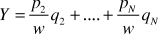
Suppose that the underlying “Walrasian or Paretian system” contains N commodities or services and that the first one is labor, if Y is the real income in terms of wage units, in accordance with the preceding quotation it can be defined by the following equation:
 $$Y = {{{p_2}} \over w}{q_2} + .... + {{{p_N}} \over w}{q_N}$$
As long as the ratios p 2 /w,…, p N /w are given, a variation of Y reflects a variation of the quantities q. Of course, it is difficult to see how quantities can vary independently from relative prices in a Walrasian setting. Anyhow, Lange used the assumption of an underlying Walrasian system to define the aggregate magnitudes of his IS-LM model. This Walrasian system’s equilibrium provided a vector of “given” relative prices.
Later in the paper, Lange introduced the claim that the main ingredients of IS-LM had been previously discovered by Walras: “It is a feature of great historical interest that the essentials of this general theory are contained already in the work of Walras” (Lange Reference Lange1938, p. 20). This contention was argued with precise references to the Etudes d’économie politique appliqué (1898) and to two editions of the Eléments d’économie politique pure (1874, 1900). Walras had already pointed out the relation between the demand for money and the rate of interest. He also had a saving function and an investment function, depending on the rate of interest. This left Lange with three issues that needed to be clarified in order to clinch his argument.
The first issue was one that would not prove important today. Until the forties at least, many readers of Keynes considered that the IS relation was an identity and not an equilibrium relation. Footnote 19 This was the case with Lange. According to him, unlike in the General Theory, in Walras the IS equation appeared as an equilibrium condition. But though this difference was “important,” Keynes’s approach was presented as a betterment of the theory “recognized by many economists before” him (1938, p. 22n3) and (seemingly) of little consequence as far as the relation between the Walrasian and the Keynesian frameworks were concerned. Lange went on to claim that the identity between investment and savings could be obtained by aggregation of “the budget equations in the Walrasian system” (1938, p. 23). Footnote 20 In other words, equation 4 could be derived from the underlying Walrasian system.
A more central issue was the role that aggregate income played in the Keynesian framework and its apparent absence in the theory of Walras. Lange noticed that Walras omitted income in his money demand function, but this was an error without consequences: “But whatever the shortcomings of his presentation, the liquidity preference function has been indicated clearly by Walras” (1938, p. 21). Lange’s general answer to the problem raised by the insertion of aggregate income in Walrasian behavior functions was revealed on the following pages. If income did not appear as an argument of these functions in Walras’s presentation, it was only because “by introducing the prices of all commodities he [brought] income indirectly into the propensity to save” (1938, p. 22). The same argument was used at a higher level concerning the role of aggregate income as an adjustment variable of the economic system. Lange considered the fact that income appeared as an adjustment variable in the IS-LM framework as an advantage over the Walrasian presentation. Indeed, Walras’s equilibrium condition on the capital market (IS relation) “[did] not show how total income changes so as to bring saving actually performed always into equality with investment” (1938, p. 22). But, according to Lange, “in the process of tâtonnements described by Walras all the prices change and thus total income changes, too” (Lange Reference Lange1938, p. 22n4). In other words, the variations of aggregate income in the IS-LM model reflected the variations of commodity prices in the Walrasian model. Aggregate income was the substitute for the price vector in the aggregate behavioral functions: “by introducing the prices of all commodities [Walras] brings income indirectly into the equation expressing the propensity to save” (1938, pp. 21–22). In the end, this led Lange to consider the IS-LM model as a valuable simplification of the Walrasian framework: “Thus Mr Keynes’ apparatus involved a considerable simplification of the theory” (1938, p. 23). Without knowing it, Keynes had devised a Walrasian model. But, in offering a theory of income determination, this model was able to deal with issues that remained intractable with the complex version of the theory. It was thus a very important contribution.
A third stumbling block in his attempt to bridge Keynes and Walras was considered, albeit implicitly, by Lange. Keynes’s theory aimed to show the possible coexistence of equilibrium and involuntary unemployment. If involuntary unemployment is defined as a situation of excess supply, as it generally is, it is barely compatible with the occurrence of a Walrasian general equilibrium in which all markets must be cleared. But Lange was not inconsistent on this score. On the last page of his article, he offered a definition of involuntary unemployment compatible with labor market clearing: “If involuntary unemployment of a factor is defined by its supply being elastic, it is absent whenever the elasticity of supply if finite” (1938, p. 31). Lange assumed that the labor supply curve was horizontal for a certain level of wages and up to a certain level of employment. As long as the labor demand curve cut the supply curve on its horizontal portion, there was involuntary unemployment. This meant that involuntary unemployment coincided with market clearing. Hence it was compatible with a state of general equilibrium in the Walrasian meaning. But this general equilibrium was not optimal in the sense that employment and real income were not at their maxima. Footnote 21 Lange’s assumption with respect to the labor supply curve allowed him to consider Keynes’s underemployment equilibrium as a particular case of Walrasian equilibrium. This is what I call the “continuity viewpoint.”
Inconsistency between Lange’s Model and the Way Lange Presented It
With the benefit of hindsight, one realizes that what Lange said about his model was not consistent with its actual content.
First of all, the way Lange reconciled the presence of aggregate income among the arguments of Keynesian behavior functions and its absence in Walras’s behavior functions was too superficial. It is not possible to say that, in general, there is a mechanism of income adjustment in a Walrasian setting just like in IS-LM. As Robert Clower (Reference Clower, Hahn and Bretchling1965) would point out, there is a difference of nature between the two frameworks on this score. The role played by income as an adjustment variable in the Keynesian models implies that income is given when households make their decisions. But in a Walrasian setting, income is a dependent variable. Households decide their supply of labor on the basis of the price vector of the economy. As a result, relative prices, not income, should appear in the behavior functions of agents, unlike in the IS-LM framework. One may even say that the concept of income is not necessary to a Walrasian theory. But, indeed, a surprisingly long span of time elapsed before macroeconomists understood this issue. Footnote 22
Lange’s assumption concerning the form of the labor supply curve offered a better, yet implicit, rationalization of his contentions concerning the possibility of an aggregate income adjustment mechanism in a Walrasian setting. Lange remained ambiguous with regards to the nature of his horizontal supply curve assumption. Did it imply a fixed money wage or a fixed real wage? This was not clarified in 1938. In a latter text, Lange repeated his interpretation of Keynes’s involuntary concept and mentioned money wages:
‘Involuntary unemployment’ in the Keynesian sense is not an excess supply of labor but an equilibrium position obtained by intersection of a demand and a supply curve, the supply curve of labor, however, being infinitely elastic over a wide range with respect to money wages.... (Lange Reference Lange1945, p. 6)
On the basis of this quotation, let us say that Lange assumed money wages to be fixed for low levels of employment. In this context, suppose the demand for certain goods increases in the Walrasian framework. This will raise their prices and reduce real wages. The producers will demand more labor in order to increase output. The fact that the labor supply curve is horizontal implies that the level of employment is determined by the choice of firms. Employment and aggregate income appear as independent variables to households, just like in a standard IS-LM model. Finally, a new equilibrium will be reached with a higher level of employment but the same money wage. In terms of IS-LM, the rise of prices increases Y; w remains even but the p i and the q i increase in equation (6) above. Consumption increases but not as much as Y. M or Q/w was constant and the rate of interest increases. One sees how a certain level of consistency between an IS-LM and a Walrasian model can be achieved along these lines.
The problem with this rationalization is that it refers to ingredients that are absent from Lange’s system of equations: the supply side of the model. If the model combined “rigid” wages and flexible prices, it should have featured an aggregate supply function depending on the price level until the “full employment” level was reached. Moreover, Lange’s arguments concerning the link between IS-LM and a Walrasian system and his definition of involuntary unemployment implied the assumption that prices were flexible. But the equations of his model and his contention that “the ratio of the price of each commodity or service to the price of the commodity or service which is chosen as the numéraire is given” seemed to imply that prices were fixed. Since the numéraire was labor and since its price was constant (in the underemployment zone at least), all other prices should also be constant. Footnote 23 Finally, even if we interpret Lange as saying that money and not real wages are fixed, we are bound to come up against the gap between his IS-LM model and the way he presented it.
In addition, there is the puzzle of Lange’s definition of equation (4) as the sum of “budget equations.” This statement was based on the definition of budget constraints as the equality between “individuals’ incomes” and “the sum of expenditure on consumption and investment.” But in a Keynesian economy, like in a Walrasian economy, the budget constraint should include incomes derived from property shares and bond holdings and expenditures on bonds and cash balances. As a result, the sum of budget constraints should give Walras’s law. What happened to the excess demands for labor, bonds, and money? Finally, in spite of his horizontal supply curve of labor assumption, Lange’s overall interpretation of IS-LM was marred by a number of inconsistencies.
Why Lange Referred to Walras or the Foundational Issue
If Lange asserted the existence of a theoretical continuity between the Keynesian and the Walrasian models, this assertion was unwarranted. Besides, it was introduced as an anecdotal aside not necessary to the main line of the article. So, why did Lange insist on the relation between IS-LM and the Walrasian framework?
The most obvious reason why he could have had the idea of comparing Keynes’s Reference Keynes1936 theory and the theory of Walras is the fact that both developed an approach of economics centered on markets’ interdependencies. As shown by Emeric Lendjel (Reference Lendjel2001), in early works, Lange (Reference Lange1932) opposed the approach of Walras and Vilfredo Pareto, presented as those who had been “the first to show the methodological consequences of the fact of the general interdependency between all economic goods,” Footnote 24 to the approach of Marshall identified with the “method of isolation.” Since the General Theory dealt with the interaction between the goods and the money markets and since there was no Marshallian general equilibrium theory, Lange could have thought that it had to be related to the theories of Walras and Pareto. Moreover, like Hicks, Lange believed that the theories of Marshall and Walras were complementary and could be integrated in a grand synthesis (Lendjel Reference Lendjel2001). But these ideas are in the nature of necessary conditions. They are not sufficient for they do not tell us why Lange felt that he needed to point out the connection between Keynes and Walras in his 1938 article.
We may answer this question by studying the context of Lange’s reference to Walras in his article. This suggests that Lange used the reference to the Walrasian model in order to clarify the foundations of his IS-LM model. We have seen in the first section that the lack of explicit foundations is a defining trait of IS-LM and a consequence of its origins. For Lange this would have been a shortcoming, which he tried to solve by referring to the Walrasian framework. As we have seen above, he first used the Walrasian reference to clarify the definition of aggregate magnitudes supposedly built upon the relative prices of “a Walrasian or Paretian system.” He used it also to clarify the nature of the IS relation oddly considered as the aggregation of budget constraints. Then he used it to clarify the nature of the adjustment mechanism at work in the model. The fact that Y could be seen as an adjustment variable (in Keynes’s theory) was justified with reference to the adjustment of relative prices and individual incomes in a general equilibrium system. Finally, referring to a general equilibrium system helped him interpret the nature of the equilibrium state reached in Keynes’s model. This equilibrium was simply a Walrasian equilibrium with underemployment due to the form of the labor supply curve.
A last motivation behind Lange’s parallel may have had to do with his famous fight for socialism. Footnote 25 Presenting IS-LM as a kind of Walrasian system meant that it depicted an ideal capitalist economy. This gave a special meaning to the conclusions derived in the 1938 paper. It implied that Keynes’s apparatus allowed the demonstration that two flaws of the capitalist system—namely, the tendency towards underaccumulation and underemployment—were part and parcel of its ideal version and not only the result of the distance between the actual and a perfectly competitive economy, as Lange had argued in other occasions (Breit and Lange Reference Breit, Lange and Toporowski1934; Lange Reference Lange1937). In a way, this was again a matter of foundations. To say that a Walrasian general equilibrium model lay at the foundation of the IS-LM model clarified the significance of its properties and gave more weight to the Keynesians’ conclusions.
To conclude, I want to insist on the implications of Lange’s continuity viewpoint. Lange referred to Walras to clarify the foundations of IS-LM. But at the same time, since, for him, IS-LM was a Walrasian model, the bridge with a more complex system was not a problem. The continuity viewpoint amounted to asserting that there was nothing more to say on what would come to be called “microfoundations of macroeconomics.” One may say that Lange planted the seeds of the microfoundation research program but seeds that would have to wait for a critical reader to pick them up.
V. IMMEDIATE INFLUENCE OF LANGE’S 1938 PAPER
Oskar Lange (Reference Lange1938) was influential, probably as influential as Hicks (Reference Hicks1937), during the takeoff of the Keynesian revolution. A beta-search on JSTOR for the period from 1938 to 1950 gave us sixteen citations for “Mr Keynes and the Classics a Suggested Interpretation,” against twenty-five for “The Rate of Interest and the Optimum Propensity to Consume.” Lange’s influence was not universal, though. Many economists, like Alvin Hansen, ignored the idea of a relation between Walras’s theory and the IS-LM framework. Indeed, this idea was unnecessary to the elaboration of the hydraulic Keynesianism and the derivation of its various multipliers. This section tries to document the immediate influence of Lange’s Reference Lange1938 paper on the early writings of Klein, Modigliani, Patinkin, and Samuelson. The attention that the first three gave to Lange’s Walrasian interpretation of IS-LM was probably an exception in the 1940s. But these economists happened to be the founders of the Neoclassical Synthesis and their works had a tremendous impact. We begin with the ambiguous case of Samuelson because of his prominent role in the birth of the New Economics. Footnote 26
Samuelson
Lange (Reference Lange1938) was certainly an important paper for Paul Anthony Samuelson. He adopted his argument about the tendency towards underaccumulation (Samuelson [Reference Samuelson and Stiglitz1942] 1966, p. 1162) in his analysis of “Fiscal Policy and Income Determination” and in a critical review of Pigou’s Employment and Policy ([1941] 1966, p. 1187). In a famous paper, Samuelson (1946, p. 146) explained that no one in Cambridge, Massachusetts, could understand Keynes’s General Theory before the appearance of IS-LM. At that point, he put on an equal footing the mathematical models of Meade, Harrod, Hicks, and Lange. This was already the case in his 1941 paper, “The Stability of Equilibrium: Comparative Statics and Dynamics,” in which he analyzed the “simple Keynesian model as outlined in the General Theory” (1941, p. 113), explaining that “various writers, such has Meade, Hicks, and Lange, have developed explicitly in mathematical form the meaning of the Keynesian system” (ibid.). This text was taken up in the second part of the Foundations of Economic Analysis (1947). As a matter of fact, the model analyzed by Samuelson was closer to Lange’s version than to any other. This may explain his reference to the “Keynes–Lange system” (1947, p. 354) in the conclusion of the Foundations. Footnote 27
If Samuelson was clearly influenced by Lange’s Reference Lange1938 article, he never wrote explicitly that IS-LM was a version of the general equilibrium model of Walras and Pareto. Footnote 28 He may have perceived the difficulty associated with Lange’s position and decided to adopt a more cautious approach (see King Reference King2011, p. 86). This could also mean that he accepted implicitly Lange’s continuity viewpoint. As a matter of fact, in the Foundations of Economic Analysis he presented the general equilibrium framework and the Keynesian framework side by side without mentioning any problem of compatibility. For De Vroey (Reference De Vroey2009) and De Vroey and Pedro Garcia Duarte (Reference De Vroey and Garcia Duarte2013), Samuelson considered that Walras’s theory described the long-run position of the economy. The Keynesian theory in turn captured the disequilibrium states of the system moving towards its long-run position, a vision different from Lange’s viewpoint.
Modigliani
In Reference Modigliani1944, Modigliani published a paper entitled “Liquidity Preference and the Rate of Interest,” originally a PhD thesis submitted at the New School for Social Research. This discussion of the IS-LM model became a landmark in the development of old Keynesian macroeconomics. On the first pages of his article, Modigliani indicated that his system of equations was “partly taken from earlier writings on the subject,” among which he referred only to Hicks (Reference Hicks1937) and Lange (Reference Lange1938). But Lange’s works were particularly important for Modigliani, to the point that he can be presented as a proponent of the continuity viewpoint, as the following quotation illustrates:
As a first step in the analysis, we must set up a system of equations describing the relation between the variables to be analyzed. In doing this we are at once confronted with a difficult choice between rigor and convenience; the only rigorous procedure is to set up a complete ‘Walrasian’ system and to determine the equilibrium prices and quantities of each good: but this system is cumbersome and not well suited to an essentially literary exposition such as we intend to develop here. The alternative is to work with a reduced system: we must then be satisfied with the rather vague notions of ‘physical output’, ‘investment’, ‘price level’, etc. In what follows we have chosen, in principle, the second alternative, but we shall check our conclusions with a more general system whenever necessary. (1944, p. 46)
Like Lange, Modigliani presented the IS-LM framework as a “reduced” or simplified version of the more complex Walrasian system. The assumed continuity between the two models appeared in the idea that one could check some of his macro-conclusions in the “general system.” Besides, like Lange, Modigliani claimed that Keynes assumed a horizontal supply curve of labor. In accordance with Lange’s optimism, he did not study seriously the relation between his macro-framework and the Walrasian model.
Klein
In 1947, Lawrence Klein published The Keynesian Revolution, a book based on a 1944 dissertation supervised by Samuelson. Like Modigliani and Samuelson, Klein read the General Theory through the lenses of an IS-LM model. But his “Keynes model” seemed so obvious to him that he did not admit a debt towards those who had extracted the model from Keynes’s book. Footnote 29 So neither Hicks nor Lange received credit for their contributions to the development of the neo-Keynesian framework. But Lange’s Reference Lange1938 article was quoted, among others.
To some extent, Klein can also be presented as a proponent of the continuity viewpoint. In the chapter of The Keynesian Revolution presenting the new Keynesian theory, Klein started from the microfoundation problem:
A problem that has never been adequately considered by Keynesians is the derivation of a theory in terms of communities of individuals and groups of commodities from a basic theory in terms of individuals and single commodities. In modern economic terminology this is the problem of passing from micro to macroeconomics, i.e. aggregation. (1947, p. 56)
Note that Klein reduced the foundation issue to one of aggregation at this stage. Now, what followed made clear that the microeconomic framework was the Walrasian one:
The theories of individual behavior provide a complete set of inter-relationships within the economy; e.g., they give us the demand-and-supply relationships of every commodity in the system. This is the famous Walrasian system of general equilibrium. A mathematical representation of this system would probably involve several million equations in several million unknowns, and incomprehensible maze. To make any useful economic judgments, one must simplify this system into a manageable number of relationships among aggregates of the fundamental prices and quantities. (1947, p. 57)
In the end, the Keynesian macro model was presented as an aggregate version of the Walrasian model, just like in Lange. It is particularly striking to see how Klein derived the Keynesian consumption function from the standard microeconomic theory of the consumer in his technical appendix.
In The Keynesian Revolution, Klein asserted explicitly that Keynes assumed a horizontal supply curve of labor with respect to money wages. Starting from this point, he wrote that Keynesians had to face the challenge of obtaining Keynesian results in a Walrasian framework: “In a perfect Walrasian equilibrium where the classical [labor] supply curve is used, can one get the result of under-employment equilibrium with the Keynesian system?” (1947, p. 75). Klein proposed to abandon temporarily Keynes’s special assumption and see what happened if the labor supply function depended on real wages. He then argued that, in this context, Keynes’s results were based on an interest-inelastic investment function. This investment function led to the possibility that a full employment equilibrium did not exist. To obtain an (unemployment) equilibrium it was necessary to reintroduce the supposedly Keynesian assumption concerning the labor supply curve. Footnote 30 In the end, we are back to Lange’s continuity viewpoint.
Klein, Modigliani, and Samuelson never pointed out the difference in the nature of the microeconomic foundations of a Walrasian and a Keynesian economy. A relation of continuity was assumed though they omitted the examination of its reality. Under the influence of Lange, they probably considered this to be a benign neglect.
Patinkin and the Birth of a Discontinuity Viewpoint
In 1947 Patinkin submitted a PhD thesis containing a discussion of the integration of money to general equilibrium systems and an aborted theory of involuntary unemployment, which he would publish in a deeply rewritten form as Money, Interest and Prices, his magnum opus, in 1956. Patinkin’s contributions were also very important in the stabilization of the neoclassical synthesis (Antoine d’Autume 2000; De Vroey Reference De Vroey2009; Rubin Reference Rubin2004). Patinkin was a student of Lange’s at the University of Chicago in 1944 and 1945. In his autobiography, he explained that, in his course on business cycles, Lange offered a “detailed presentation of Keynes’ General Theory (based on Lange’s own interpretation in his ‘Rate of interest and the optimum propensity to consume, 1938)” (1995, p. 371). Though neither Lange (Reference Lange1938) nor Hicks (Reference Hicks1937) appeared in the bibliography of Patinkin’s PhD thesis, the influence of Lange was visible in the text. Footnote 31
On the surface, Patinkin could appear as a promoter of the continuity viewpoint along with Klein and Modigliani. Our quotation in the introduction illustrates this fact. Patinkin (Reference Patinkin, Eatwell, Milgate and Newman1991) did write that IS-LM was a “reduced” version of Walras’s system of equations. But if one looks carefully at Patinkin’s Reference Patinkin1947 PhD thesis, a different picture emerges. The true “heir” of Lange, as Robert Solow (Reference Solow, Arrow, Debreu and Solow1991) called him, departed markedly from his teacher, though, like Modigliani and Klein, he was still deeply influenced by Lange’s Reference Lange1938 position. In other words, in 1947 Patinkin inaugurated a “discontinuity viewpoint” with respect to the relation between the theory of Walras and IS-LM. Since I have elaborated this view elsewhere (Rubin Reference Rubin2012), my argumentation will be brief.
From Lange (Reference Lange1938), Patinkin took two fundamental ideas. First, he adopted Lange’s interpretation of the General Theory in terms of IS-LM. Second, he considered, like Lange, that in order to clarify the foundations of the Keynesian macro model, one had to start from the Walrasian model. But Patinkin broke with Lange’s definition of involuntary unemployment based on the horizontal supply curve of labor. According to Patinkin, involuntary unemployment implied that some workers (at least) could not satisfy their desire to work. This was not compatible with a representation in which the labor market cleared. To express the involuntarity of unemployment, workers had to be “off their labor curve.” The situation should be one of excess supply. This criticism led Patinkin to realize that a theory of involuntary unemployment presupposed a choice theory allowing for such a possibility, a theory incorporating “additional restraints.” Moreover, in order to explain how these “additional restraints” appeared, he was led to develop new assumptions regarding market adjustment mechanisms. At this point, a clear discontinuity appeared between the Walrasian model and the Keynesian model. The latter was not a straightforward simplification of the former. The Walrasian model was still the benchmark of the Keynesian model. But what Patinkin proposed to do was to reconstruct the Keynesian model by modifying the microeconomics of the Walrasian framework. As I explained in Rubin (Reference Rubin2012), the result was not totally satisfactory, to say the least. This led Patinkin to abandon his attempt at formalizing mathematically the Keynesian model in chapters 13 and 14 of Money, Interest and Prices. As a consequence, the idea of a discontinuity between the Walrasian and the Keynesian theories receded into the background. But it was still there. In a famous footnote, Patinkin stressed in particular the difficulty in formalizing the behavior of firms in a disequilibrium context and the incompatibility between the assumptions of the standard theory and the behavior implied by his interpretation of the Keynesian theory. Torn between his insights and the requirements of rigorous theorizing, he adopted a conservative and somewhat ambiguous attitude reflected by the quotation offered in the introduction of the present paper. But Patinkin’s insights finally opened the way to the contribution of Clower (Reference Clower, Hahn and Bretchling1965) and to the disequilibrium theories of Jacques Drèze and Jean-Pascal Bénassy in the 1970s.
VI. Conclusion
Our study of the secondary literature about the relation between Marshall, Walras, Keynes, and the IS-LM model shows that on several points there should be a consensus today. The Marshallian and the Walrasian traditions offered competing and not complementary representations of the market economy. The IS-LM model was developed by economists trained in the Marshallian tradition. Actually, it was devised by Keynes himself in order to summarize his new theory. As a consequence, this model should not have been considered as a Walrasian framework. As noted by some historians, “Mr Keynes and the Classics” was not the origin of the confusion that developed from the 1940s onward. Hicks wrote explicitly that IS-LM was a “formalization of the great tradition of Cambridge monetary economics” and something distinct from the line he was pursuing in Value and Capital. If he had attempted to translate Keynes into his own terms, in the language of Value and Capital, he would have come up with a different model.
But, as suggested in our second section, the genealogy of IS-LM itself explains how the confusion could spread. Because of his commitment to the methodology of Marshall, in 1936 Keynes carefully avoided reducing his theory to a set of simultaneous equations. The task of gathering the equations scattered in the book was left to his young followers. In the process they left aside the sophisticated but unsystematic foundations of the General Theory. The result was a mathematical framework whose relation to microeconomics was left hanging in the air.
This may be the key to understanding Lange’s Reference Lange1938 contention about the relation between IS-LM and the theory of Walras. Lange was clearly the first among Keynes’s interpreters to claim that such a relation existed. He did not explain why he needed to put this claim forward but a careful reading of his text led us to the conclusion that he did so in order to clarify the foundations of the model and the scope of its predictions. Lange’s position in this respect was quite extreme. According to him, IS-LM was the simplified version of a Walrasian model. Interpreting involuntary unemployment as the result of a horizontal labor supply curve, he considered Keynes’s underemployment equilibrium a kind of Walrasian equilibrium.
There is a paradox here. If Lange’s contention concerning the nature of IS-LM was probably motivated by an attempt to clarify its foundations, his continuity viewpoint implied that the relation between Keynes’s aggregate model and Walras’s model was obvious and did not require further research. Yet, as we have shown above, Lange’s viewpoint did not hold water. His equations were deprived of any supply side and required fixed prices, all things incompatible with his main claim.
Finally, we have shown how, during the forties, Lange’s IS-LM article influenced four among the main architects of the neoclassical synthesis. Samuelson, Klein, and Modigliani propagated the idea that general equilibrium theory and Keynesian macroeconomics could live in harmony. Samuelson abstained from raising any question concerning microfoundations. Klein and Modigliani, on their side, endorsed the claim that a bridge could be built between the Walrasian and the Keynesian models, so much so that the exact nature of the bridge need not be clarified. Patinkin’s attitude was somewhat different. Starting from an internal criticism of Lange’s views, he realized that building a Keynesian model on Walrasian foundations required substantial modifications of Walrasian microeconomics. But this discontinuity viewpoint bore fruit only twenty years later with the works of disequilibrium theorists.


