Introduction
Infertility – the inability of a couple to conceive, carry or deliver a child despite unprotected intercourse – affects many couples, and their marital stability, around the world. Studies suggest that 49–72 million couples worldwide struggle with infertility (Rutstein & Shah, Reference Rutstein and Shah2004; Boivin et al., Reference Boivin, Bunting, Collins and Nygren2007; Mascarenhas et al., Reference Mascarenhas, Flaxman, Boerma, Vanderpoel and Stevens2012). Fertility assessments for a society can be made along with the infertility experience, labelled a ‘global health problem’ by the World Health Organization (WHO, 2001), since infertility affects the overall fertility rate as well as the population growth rate. Infertility can be assessed within the context of family planning and maternal care (Pennings et al., Reference Pennings, de Wert, Shenfield, Cohen, Tarlatzis and Devroey2009). As a social phenomenon, infertility means not only difficulty in getting pregnant but also failure of achieving parenthood, a violation of personal goals and exposure to stigma in many societies. Furthermore, serious impacts on social well-being, personal expectations and motivations, not to mention the distress and anxiety of individuals, families and societies, are linked to infertility. The concept of infertility is associated with continuity of family, self-fulfilment, femininity and masculinity within the cultural and social beliefs framework. However, infertility affects women more intensively in terms of social suffering, especially in developing countries (Inhorn, Reference Inhorn1996). Within this context, a number of theories have been used to understand infertility as a medical, behavioural and social construct (Blenner, Reference Blenner1990; Pasch & Dunkel-Schetter, Reference Pasch and Dunkel-Schetter1997; Bliss, Reference Bliss1999; Gerrity, Reference Gerrity2001; Greil et al., Reference Greil, McQuillan and Slauson‐Blevins2011).
The problems stemming from infertility lead couples to seek medical treatment at fertility specialist medical centres, as the accessibility and availability of the services increase and social taboos towards infertility and its treatment decline. A sizeable population applies for treatments in many parts of the world, despite the attitude towards infertility, which varies among couples according to their motivation to have children and their ability to cope with the problem. A strong desire for parenthood has an impact on the demand for treatment services and in vitro fertilization (IVF), with its social, religious and resource considerations (Inhorn & Gurtin, Reference Inhorn and Gurtin2012). Studies conducted in the Middle East region especially have suggested that couples diagnosed with infertility seek treatment to cope with and overcome its burden. Turkey is one of the countries in which Assisted Reproductive Technology (ART) have been used increasingly in recent years. The IVF industry received considerable support in 2005 due to the funding of two treatment cycles by social insurance institutions. This can be characterized as a sign of a decline in social taboos towards the concept of infertility and its treatment, with the acceptance of infertility in Turkey (Inhorn & Gurtin, Reference Inhorn and Gurtin2012). Seeking infertility treatment is highly correlated with accessibility of, and eligibility for, IVF and other technologies. Assisted reproductive technology and its legal regulation have changed since 1987 in Turkey. As of 2010, updated amendments to regulations have mainly focused on the licensing and opening of private IVF clinics, funding and eligibility for treatment, gamete and embryo donations and the number of embryos allowed to be transferred. The study by Urman and Yakin (Reference Urman and Yakin2010) found that more than a third of couples suffering from infertility became eligible for government funding with the new legislation.
Turkey places special emphasis on the issue of infertility, especially after the dramatic decline in fertility in the country over the last decades. Within this context, this study aimed to understand the changes in the prevalence of infertility in Turkey using three different approaches: the DHS Approach, which estimates infertility prevalence among women who have been married for at least 5 years; the Constructed Approach, which estimates infertility within the 12 months before the survey date; and the Current Duration Approach, which focuses on the time from when a couple starts to attempt pregnancy until the pregnancy occurs, generally in the first 12 months of the attempt. Furthermore, the elevated risk factors of infertility, derived from the Constructed Approach, were also investigated using four different logistic regression models.
Methods
Data source
The main source of data for this study was the 2013 Turkey Demographic and Health Survey (TDHS-2013), conducted in Turkey under the supervision of the international DHS programme. The 1993, 1998, 2003 and 2008 TDHSs were also utilized to determine the trends in infertility over the last 20 years. Only reproductive age women (aged 15–49) were eligible for interview and constituted the main sample units of the surveys. Turkey’s Demographic and Health Surveys collect detailed and country-wide representative data on women’s reproductive health as well as their background characteristics. All the data sets are comparable due to the similarity in questionnaire and sampling designs. Reproductive health characteristics were collected in the form of event histories using the monthly calendar module. This comprised information on marital status, pregnancies, live births, terminations and contraceptive use for approximately five years prior to the month of the interview. Thus, the necessary information for both descriptive and multivariate analyses was incorporated into the women’s data set.
Ethical approval
The Ethics Committee of Hacettepe University approved the questionnaires and data collection procedures of the TDHSs just before the initiation of the data collection phases. Furthermore, during the data collection phases of the TDHSs, each respondent gave informed consent for study participation at first contact.
Infertility definitions
It is known that infertility-related assessments vary according to the criteria that are used in infertility definitions (Marchbanks et al., Reference Marchbanks, Peterson, Rubin and Wingo1989). The definition used to estimate infertility levels should be considered broadly, along with the socio-demographic structure of the society under examination, to make accurate interpretations of the infertility experience. Durations of time spent on fertility-related events affect infertility prevalence and its interpretation as much as other criteria of the definition. Basically, three analytical approaches were used to estimate the infertility level in Turkey and to follow the trends within the 1993–2013 period. Specifically, one of the approaches, namely the Constructed Approach, was used to understand and evaluate the predictors behind infertility.
The DHS-type infertility measure was used to calculate primary infertility, which can be defined as the percentage of women who have been married for at least five years, have not used any birth control methods during that time, and have not given birth (Rutstein & Shah, Reference Rutstein and Shah2004). The Constructed Approach, which is widely accepted, especially in the Western biomedical context, estimates the incidence of infertility based on marriage, contraceptive use and pregnancy information within the last 12 months before the time of the interview (Greil et al., Reference Greil, Slauson‐Blevins and McQuillan2010; Thoma et al., Reference Thoma, McLain, Louis, King, Trumble, Sundaram and Louis2013). Women who have been married for at least one year, have not used any contraception during the last year and who have not become pregnant in the last year are considered infertile based on the Constructed Approach to infertility (Thoma et al., Reference Thoma, McLain, Louis, King, Trumble, Sundaram and Louis2013).
Finally, the ‘time to pregnancy’ (TTP) estimation, based the Current Duration Approach, focuses on the time span from when a couple starts to attempt pregnancy until the pregnancy occurs (Thoma et al., Reference Thoma, McLain, Louis, King, Trumble, Sundaram and Louis2013). According to the definition, a woman who is at risk of pregnancy is defined as one who was not using any birth control method at the time of the interview, has not used the injection contraceptive method in the last 9 months, has been married for at least 2 months and is living with her husband, was not pregnant at the time of the interview, has not given birth in the last 3 months, is aged between 18 and 44, has not undergone a hysterectomy operation, was not in her menopausal period and has regular menstruation (Cox et al., Reference Cox, Polis, Tuncalp, McLain and Thoma2016). In accordance with the Current Duration Approach, women who were at risk of pregnancy for the first 12 months of the 5-year calendar were followed.
In this study, infertility levels in Turkey according to the DHS, Constructed and Current Duration Approaches for the 1993–2013 period were calculated. Furthermore, several sensitivity analyses for the prevalence of infertility were conducted on the basis of the Constructed Approach, which was used for both descriptive and multivariate analyses. A description of the sensitivity analyses is given in the section ‘Sensitivity analysis’.
Covariates for descriptive and multivariate analyses
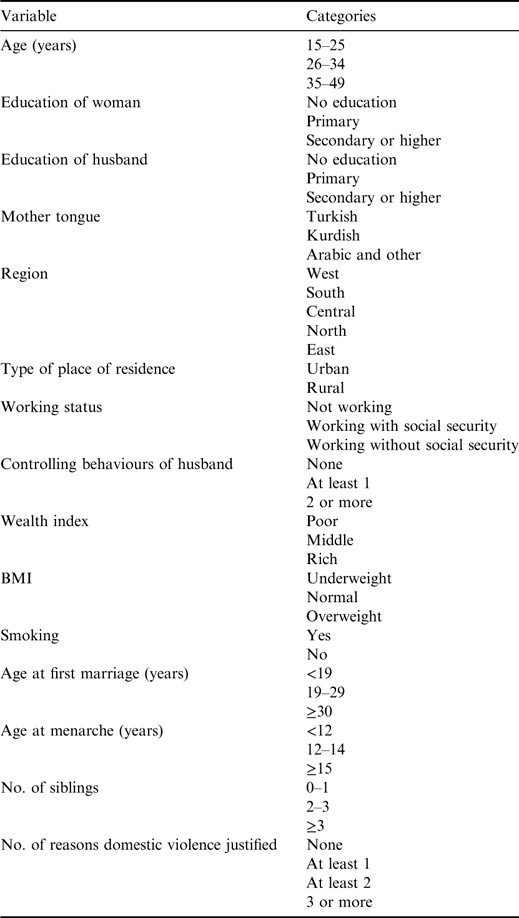
The demographic and background characteristics of the women were taken from the TDHS-2013 based on the Constructed Approach to infertility. This may be helpful to determine specific groups of women that are more prone to experiencing infertility and to develop a policy for these groups. Moreover, multivariate analyses aimed at determining the factors behind infertility were conducted based on covariates describing the women’s background characteristics. Table 1 illustrates the variables that were utilized for both the descriptive and multivariate analyses associated with infertility. For the selection of the covariates, variables used frequently in the literature as non-clinical risk factors of infertility were considered (Terävä et al., Reference Terävä, Gissler, Hemminki and Luoto2008; Unisa, Reference Unisa2010; Adamson et al., Reference Adamson, Krupp, Freeman, Klausner, Reingold and Madhivanan2011; Chen et al., Reference Chen, Zhong, Liang, Yang, Zhang, Gao and Miao2015). Most of the variables used in the descriptive and multivariate analyses are self-explanatory. Therefore, only those included in the recoding process are explained here.
Covariates of women’s background characteristics used in the descriptive and multivariate analyses, TDHS-2013

The variable ‘region’ refers to the demographic region classification of Turkey: ‘West’ and ‘Central’, the most developed; ‘South’ and ‘North’, known as the moderately developed regions; and ‘East’, the least developed. ‘Type of settlement’ is categorized as: settlements with a population of 10,000 or more (urban); and settlements with a population of less than 10,000 (rural). ‘Working status of women’ refers to the current working status of women, defined by their accessibility to social security, categorized as ‘not working’, ‘working with social security’ and ‘working without social security’. Body mass index (BMI) was categorized as ‘underweight’, ‘normal’ and ‘overweight’ according to the WHO definitions of <18.5, 18.5–24.9 and ≥25, respectively.
Furthermore, some indexes related to the husband’s controlling behaviours and domestic violence were generated to assess their effects on infertility. ‘Number of reasons for which domestic violence is justified’ refers to an index of opinions on domestic violence. The index was generated based on the women’s statements that justify beating, such as ‘wife goes out without telling husband’, ‘wife neglects the children’, ‘wife argues with husband’, ‘wife refuses to have sex with husband’ and ‘wife burns the food’. The index was recoded on a scale of 0–3, with 0 being ‘no reason’, 1 ‘at least one reason’, 2 being ‘at least 2 reasons’ and 3 being ‘3 or more reasons’, considering the number of cases for each category. The other index ‘controlling behaviours of husband’ includes the husband’s behaviours like ‘preventing wife from seeing female friends’, ‘limiting wife’s contact with her family’, ‘insisting on knowing where wife is’, ‘distrusting wife with money’ and ‘accusing wife of being unfaithful’. The index was categorized on a scale of 0–2, with 0 being ‘no controlling behaviours’, 1 ‘at least one controlling behaviour’ and 2 ‘2 and more controlling behaviours’ on the basis of the number of cases in each category.
Statistical analyses
Descriptive analyses were conducted in addition to multivariate analyses. In the multivariate analysis phases, binary logistic regression analysis was conducted in order to assess the incidence of infertility in Turkey using the definition of the Constructed Approach. Logistic regression analysis was based on the maximum likelihood estimation process, which helps to determine infertility incidence probabilities, or odd ratios.
A relationship between a binary variable ‘infertile or not’ and a set of covariates (described in Table 1) was considered. The basic dependent variable for the logistic regression models was as follows:
 $$f_{1} \,{\equals}\,\left\{ {\matrix{ {1,\quad if\,women\,defined\,as\,{\rm infertile}} \hfill \cr {0,\quad if\,otherwise} \hfill \cr } } \right.$$
The dichotomous dependent variables for the sensitive analyses were as follows:
 $$\eqalignno{ & f_{2} \,{\equals}\,\left\{ \vskip3pt{\matrix{ {1, \quad if\, women\, defined \,as\, {\rm infertile} \rsquo \,{\rm and }\,{\rm living}\,{\rm with}\,{\rm their}\,{\rm husbands}} \hfill \cr {0,\quad if\, otherwise} \hfill \cr } } \right. \cr & f_{3} \,{\equals}\,\left\{ {\matrix{ {1,} \hfill & \vskip 10pt \matrix{ if\,women\,defined\,as\,{\rm infertile}\,{\rm and}\,{\rm living}\,{\rm with}\,{\rm their}\,{\rm husbands} \hfill \cr \quad {\rm and}\,{\rm declared}\,{\rm themselves}\,{\rm as}\,{\rm infecund} \hfill \cr} \hfill \cr {0,} \hfill & {if\,otherwise} \hfill \cr } } \right. \cr & f_{4} \,{\equals}\,\left\{ {\matrix{ \vskip 1pt {1,} \hfill & \vskip 12pt \matrix{ if\,women\, defined\, as\, {\rm infertile}\,{\rm and }\,{\rm living }\,{\rm with}\,{\rm their}\,{\rm husbands}\,{\rm and} \hfill \cr \quad {\rm declared}\,{\rm themselves}\,{\rm as}\,{\rm infecund}\,{\rm and}\,{\rm having}\,{\rm used}\,{\rm ART} \hfill \cr} \hfill \cr {0,} \hfill & { if\,otherwise} \hfill \cr } } \right. $$
The reasons for using the Constructed Approach to evaluate infertility in the descriptive and multivariate analyses were as follows. i) The Constructed Approach infertility measure is based on the women’s marriage, contraceptive use and pregnancy information for the 12 months prior to the interview month. As opposed to other approaches, this takes into consideration the current infertility status of women. ii) The number of observations is much greater than with other approaches when assessing the infertility level and pattern. iii) The Constructed Approach is much more sensitive in terms of capturing women who declared themselves as infecund and having used ART.
Sensitivity analysis
A methodological consideration associated with the definition of infertile individuals may come up as a result of the definitions used to determine infertility level in a society. As Greil et al. (Reference Greil, Slauson‐Blevins and McQuillan2010) mentioned in their study, infertile women may be a much more diverse group than just clinical patients and treatment seekers. Greil et al. discussed in detail the issue of how to classify women as infertile, and criticized the Western biomedical definition, e.g. the Constructed Approach, which neglects a large portion of women who see themselves as infertile, especially in developing countries. In line with this argument, a study by Sundby (Reference Sundby2002) pointed out that infertility may be a vague event that women experience as an ordinary reproductive behaviour rather than as a problem.
As Bos et al. (Reference Bos, van Balen and Visser2005) pointed out, researching infertility in developing countries needs to be more sensitive to the socio-cultural structure of countries compared with those conducted in developed societies. The demand for infertility treatment and its availability can be discussed mainly within the social role of couples in a society. Similarly, the socio-cultural context of the societies may have an influence on couples in defining themselves as infertile. Thus, Greil and McQuillan (Reference Greil and McQuillan2004) presented some women from the USA who were not classified as infertile by the Western biomedical definition, but who saw themselves as infecund. In contrast, definition-based infertile women living in Cameroon did not see themselves as infecund (Gerrits, Reference Gerrits1997).
Another consideration associated with defining infertile women is whether they are living with their husband or not. Western biomedical definitions do not consider this issue due to the fact that their main focus is on the contraceptive method used, pregnancies and live births, and marriages. The example of a Chadian woman who was not living with her husband, and so had not had regular intercourse with him, shows the importance of living with a husband in order to correctly define this woman as infertile (Leonard, Reference Leonard2002).
In this study, infertility levels were determined mainly based on the Constructed Approach. This approach does not generally take into consideration women who live with their husbands, women who see themselves as infecund, and, lastly, women who have used ART. For this study, however, these categories of women were included in the infertility definition of the Constructed Approach. This sensitive concern was applied to both the descriptive analyses when presenting the infertility prevalence and the multivariate analyses when defining the infertile women as a dependent binary variable. In this way, all possible measures were considered: whether living with husband or not, women declaring themselves as infecund and women admitting to the use of ART. The first model focuses on the determinants of infertility as defined by the original Constructed Approach; the second model excludes the women not living with their husbands from the original definition; the third model includes women who declared themselves as infecund into the equation; and last model also covers the women who have used ART.
Results
Results of the descriptive analysis
This section provides information on the trends in the prevalence of infertility using the three different approaches for the time span 1993–2013, and the prevalence of infertility and ever-use of ART on the basis of the covariates and profile of the infertile women for 2013. The reason for restricting the analysis to the TDHS-2013 data sets was to determine the covariates of infertility for the most recent data sets, and then to use these in the multivariate analysis.
Trends in the prevalence of infertility
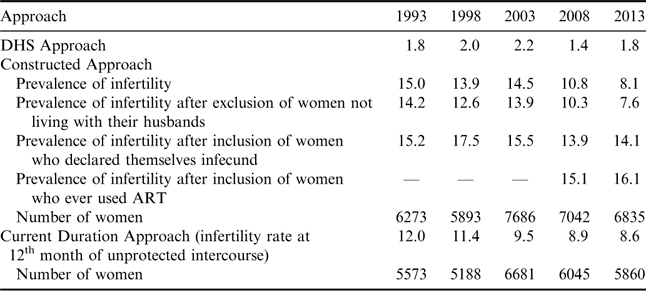
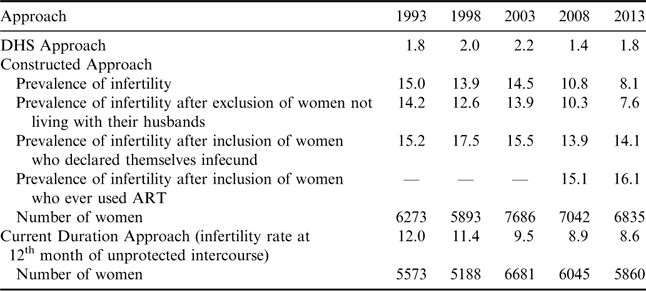
The level of primary fertility in the DHS Approach remained stable at around 2% in the 1993–2013 surveys. When the Constructed Approach was used for the definition of infertility, a declining trend in infertility was observed – from 15.0% in 1993 to 8.1% in 2013. The exclusion of women who were not exposed to the risk of pregnancy due to not living with their husbands had a slightly decreasing impact in all the survey years. On the other hand, as a result of including the women who reported themselves as infecund and women having infertility treatment into the Constructed Approach infertility definition, a significant increase in the prevalence of infertility was observed. The prevalence of infertility increased to 14.1% and 16.1% after the inclusion of the infecund women and women in infertility treatment, respectively. These results show that the Constructed Approach is not very sensitive to capturing women who define themselves as infecund and women who are undergoing infertility treatment. Approximately 47% and 52% of women defined as infertile by the Constructed Approach were matched with the women who defined themselves as infecund and those in treatment, respectively. Compared with the two previous approaches, the Current Duration Approach goes further and provides infertility rates on the basis of waiting time until pregnancy for women who are at risk of pregnancy. The 12-month infertility rates revealed that the prevalence of infertility showed a 28% decrease, from 12.0% to 8.6%, in the 1993–2013 period in Turkey (Table 2).
Prevalence of infertility in Turkey based on DHS and Constructed Approaches, 1993–2013
Prevalence of infertility on the basis of covariates
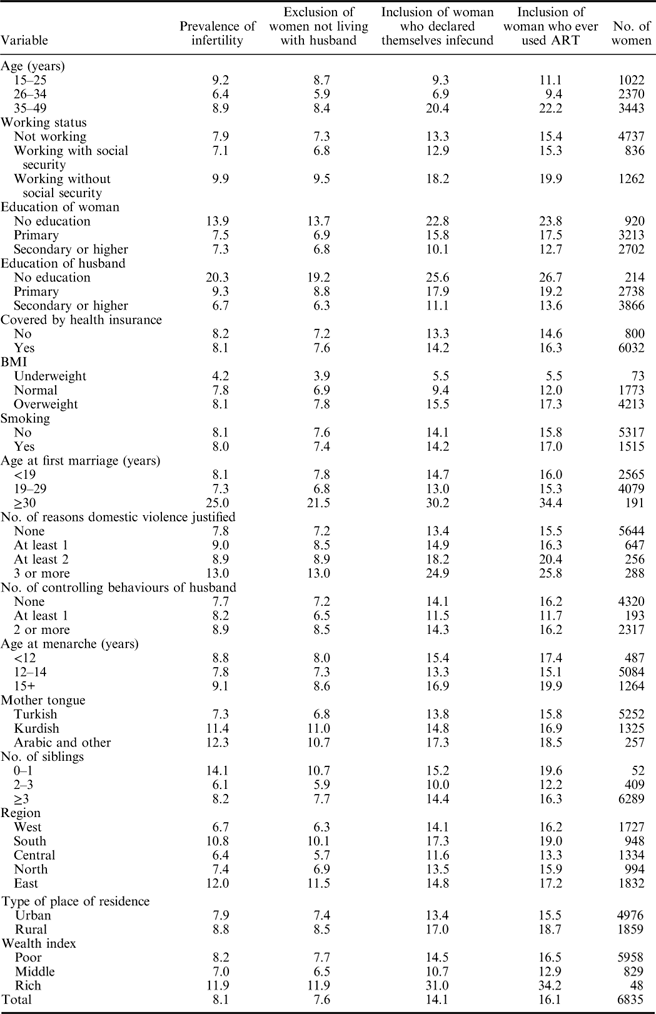
A descriptive analysis of the socio-demographic covariates of infertility using the TDHS-2013 data set provided important evidence for the multivariate analysis. A U-shaped relationship was observed between the age of women and the prevalence of infertility in all definitions. Infertility rates were higher among younger (18–24) and older (35–49) women as opposed to women in the middle age group (25–34). In the expanded definitions with the inclusion of infecund women and women in treatment, the infertility rates increased to over 20% among women aged 35–49. The infertility rates were higher among women who were not in the labour force or those working in the agricultural or informal sectors without social security when compared with salaried women with social security. Both education variables (women’s education and husband’s education) clearly indicate that uneducated segments of the population had a higher tendency to be infertile in all four definitions. For the women whose husbands were uneducated, the infertility rate rose above 25% in the last two definitions (Table 3).
Percentage of infertile women by different definitions of the Constructed Approach, 2013

The prevalence of infertility was almost identical for women with and without health insurance, even if infecund women and women having infertility treatment were included in the equations. Almost the same pattern was found for smoking and non-smoking women. Women defined as overweight on the basis of BMI were more likely to be classified as infertile as opposed to women defined as underweight or normal. The infertility rate increased to 15.5% and 17.3%, respectively, when the women who declared themselves as infecund and those who had had infertility treatment were added to the constructed infertility definition. A J-shaped relationship was observed between age at first marriage and the prevalence of infertility. Based on the Constructed Approach, slightly over 8% of the women who got married in the adolescent period were classified as infertile, and this increased to 25% among women who married after the age of 30. The inclusion of infecund women and those under treatment raised the level of infertility rates in all categories by keeping the same prevalence pattern as in the original definition. Women who justified domestic violence more were classified as infertile more often than women who justified domestic violent behaviour less according to all infertility definitions. In all definitions, the relationship between the number of the husband’s controlling behaviours and infertility seemed to be an inverted U-shape. Infertility rates were higher and identical among women whose husbands had no controlling behaviours and those whose husbands had two or more controlling behaviours, as opposed to women with husbands who had only one controlling behaviour. Descriptive analysis indicated a U-shaped relationship between age at first menstruation and infertility prevalence. Women experiencing first menstruation at early or late ages had a tendency to have higher infertility rates compared with women who menstruated for the first time in the 12–14 age group (Table 3).
The prevalence of infertility seemed to be lower among Turkish women than among Kurdish and Arab women. For Arab women, the infertility rate increased by 19% after the inclusion of both infecund women and women in infertility treatment. The prevalence of infertility decreased as the number of siblings increased. Women with 0 or 1 sibling had the highest infertility rates; the prevalence of infertility on the basis of the original definition was more than double for these women than that for women with three or more siblings. Women living in underdeveloped regions (the southern and eastern parts of the country) experienced higher infertility than women living in the other, more developed regions. The inclusion of women who defined themselves as infecund and women in treatment into the definition of infertility had an increasing impact on the infertility rates. In line with this finding, infertility appeared to be more prevalent among rural women compared with urban women. The prevalence of infertility was higher among women living in poor or rich households than in women in middle-income households, according to the original infertility definition of the Constructed Approach. It is worth noting that the inclusion in the definition of infecund women and women in treatment scaled up the level of infertility to 34.2% for women with high incomes (Table 3).
Profile of infertile women
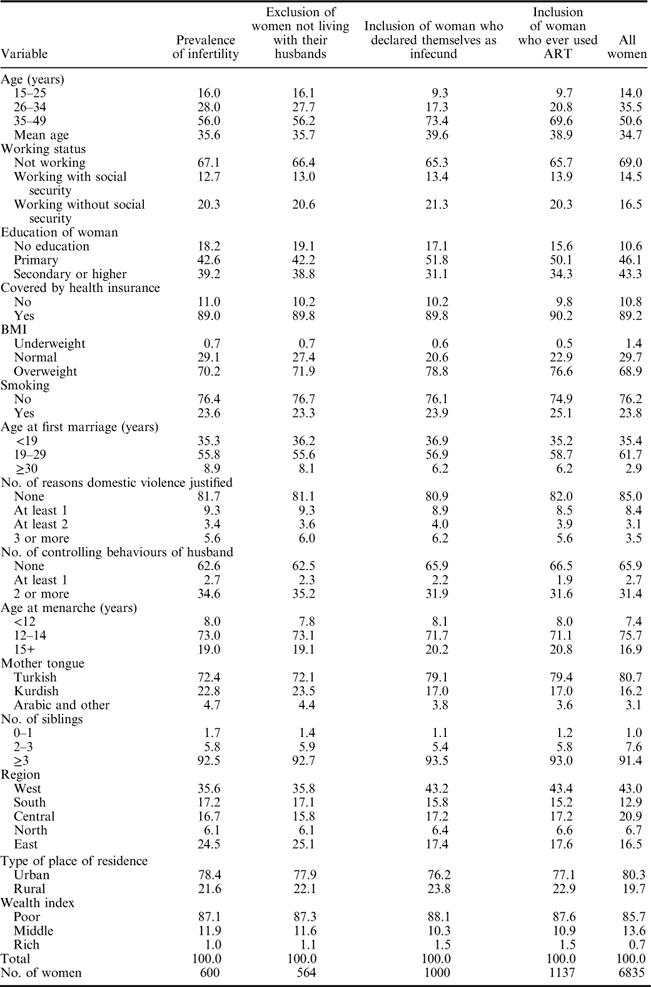
The profile of infertile women as determined by the Constructed Approach may provide much more ground for the multivariate analysis. Women defined as infertile were slightly older than all currently married women. As women in treatment, and especially infecund women, were included in the definition of infertility, the mean age of infertile women increased markedly, up to 40%, mainly due to the fact that these women were older than the other groups of women. More than a third of the infertile women were in the labour force, as was observed for all women. Approximately 60% of the women classified as infertile had primary school or lower educational attainment on the basis of all definitions. With regards to health insurance, a similar pattern was observed in both women classified as infertile and all women; approximately 90% of the women had health insurance coverage. Slightly over 70% of the infertile women were overweight on the basis of BMI. After the inclusion of the women who defined themselves as infecund and the women who had used ART into the infertility definition, the percentage of overweight women increased to 79% among infertile women, as opposed to 69% of all women. Only a quarter of the women in Turkey smoked, but there was no evidence of any difference between infertile and all women. Late marriage, over the age of 30, appeared to be much more frequent among women defined as infertile in Turkey. The women with infertility had a higher tendency to justify wife-beating. In line with this finding, the husbands of infertile women appeared to have many more controlling behaviours compared with those of all currently married women. Approximately 73% of the infertile women’s first menstruation was found to be in the age range of 12–14, as it was for women overall. The number of women with Kurdish and Arabic mother tongues was higher among the women classified as infertile (Table 4).
Socio-demographic profile of infertile women based on Constructed Approach, TDHS-2013

The percentage of women with 0 or 1 sibling was found to be slightly higher among women defined as infertile. When region was accounted for, infertile women were over-represented in the southern and eastern parts of the country. Consistent with this finding, the percentage of women living in rural settlements was higher among women classified as infertile. Finally, infertile women were over-represented in the poor and rich households compared with all currently married women (Table 4).
Results of the multivariate analysis
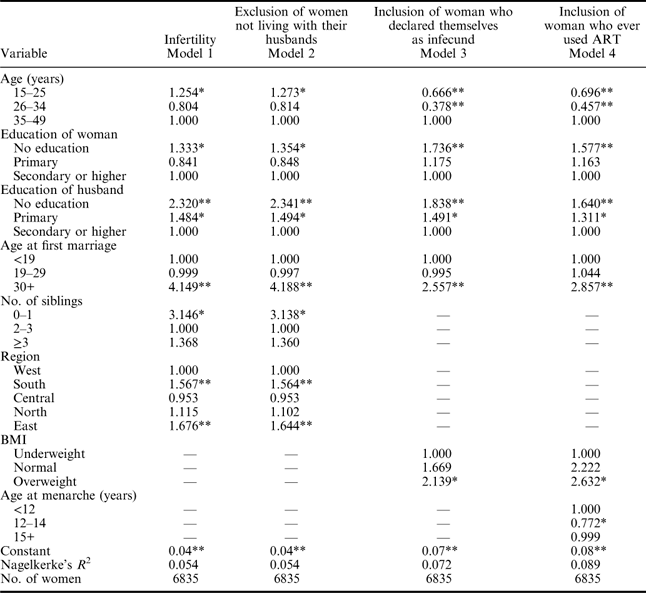
Four stepwise logistic regression models, on the basis of the Constructed Approach and its three different versions, were carried out (see Table 5). In all models, all the covariates used in the descriptive analysis were introduced into the models in order to determine the risk factors of infertility. In the first model (Model 1), the risk of infertility was found to be significantly higher among younger women, uneducated women, women who married late, women with fewer than 2 siblings and women residing in the southern and eastern parts of the country. The second model (Model 2), run after the exclusion of women not living with their husbands, provided almost identical results to the first model. After the inclusion of women who declared themselves as infecund and those in infertility treatment into the original definition of the Constructed Approach in Model 3 and Model 4, respectively, the variables on age, education and age at first marriage were still significant, while variables on the number of siblings and regions turned into statistically insignificant variables for the risk of infertility. Furthermore, in these phases the BMI variable became significant for Model 3 and age at first menstrual period for Model 4. In Models 3 and 4, the risk of infertility originating from women’s age changed significantly. In contrast to the first two models, older women were at elevated risk of infertility in Models 3 and 4, in line with the descriptive results. This may be attributable to the older age structure of the infecund women and women in ART treatment. In Models 3 and 4, uneducated women and women with uneducated husbands had a persistently higher risk of infertility than in the first two models. In the first two models, the risk of infertility was significantly higher among women who got married after age 30 as opposed to women who got married earlier in the last two models. This finding appears to be much more compatible with the higher risk of infertility among older women. The risks of infertility among women defined as overweight compared with women defined as underweight on the basis of BMI were 2.6 and 2.9 times higher, respectively, among women in Models 3 and 4. In the model that included women in ART treatment, the risk of infertility was found to be significantly higher for women who first menstruated earlier than age 12 as opposed to women who first menstruated later (Table 5).
Logistic regression models for the risk of infertility in Turkey, 2013

**p<0.01; *p<0.05.
When the models were assessed as a whole, all the constants were seen to be statistically significant, and Nagelkerke’s R 2 for the models increased from 5.4% to 8.9% with the incorporation of the different sensitivity versions. The overall assessment of the models puts forward the view that Model 4 is the most explanatory one and at the same time it fits the data better compared with the other models (Table 5).
Discussion
Although the overall worldwide prevalence of infertility seems to be stable at around 9–12% (Boivin et al., Reference Boivin, Bunting, Collins and Nygren2007; Mascarenhas et al., Reference Mascarenhas, Flaxman, Boerma, Vanderpoel and Stevens2012), it has been declining considerably over the last 20 years in Turkey. This study’s Constructed Approach showed that the infertility rate in Turkey has declined by 46%, from 15.0% in 1993 to 8.1% in 2013. Furthermore, almost all of the sensitivity analyses and trends in infertility derived from the Current Duration Approach verified the declining trends in the prevalence of infertility in Turkey. The declining trend presented in this study appears to be important since there have been no nationwide studies indicating both the national level of infertility, and, at the same time, a declining trend in infertility over the last 15–20 years. There have been some clinical-based studies on infertility at the local level in Turkey (Taşçı et al., Reference Taşçı, Bolsoy, Kavlak and Yüceso2008; Gokler et al., Reference Gokler, Unsal and Arslantas2014) and some international studies (HUIPS, 2004; Rutstein & Shah, Reference Rutstein and Shah2004) on childlessness and infertility at country level, giving the prevalence of infertility as 3–20%.
The current infertility rate implies that there are approximately 1.7 million infertile women in Turkey, a country that lays strong emphasis on the issue of infertility, especially after experiencing a dramatic fertility decline from 5.2 births per woman in the 1970s to 2.2 births per woman in the 2010s. Starting in 2005, an effort to decrease infertility rates has been accepted as one of the policy tools to keep the fertility level of the country above replacement level. As a result of this process, the use of ART is on the rise in Turkey. The percentage of women who have used ART at least once increased from 1.9% in 2008 to 4.2% in 2013. This corresponds to a more than doubling in the 5-year period. Gurtin (Reference Gurtin2011) emphasized that Turkey has become one of the countries in which ART have been used increasingly in recent years. The IVF industry was given considerable support in 2005 with the funding of two treatment cycles by social insurance institutions. Turkey was ranked as the ‘the world’s 7th biggest IVF market’ in 2008 with the growing number of treatment centres in both state and university hospitals and private clinics. The number of treatment centres increased from 66 to 120 in the 2005–2015 period in Turkey as a result of the high demand for a child or one more child by couples having difficulty in childbearing (Gurtin, Reference Gurtin2011; Inhorn & Gurtin, Reference Inhorn and Gurtin2012). This observed development in Turkey may be considered as a sign of a decline in the social taboos around infertility and its treatment, along with the acceptance of infertility.
The final model of the study’s logistic regression analysis indicates that the risk of infertility in Turkey is associated with the age of women, educational levels of couples, age at first marriage, age at first menstruation and the BMI of women. The age of women as a risk factor for infertility is well-documented, with the risk of infertility increasing as a woman’s age increases (Van Noord-Zaadstra et al., Reference van Noord-Zaadstra, Looman, Alsbach, Habbema, te Velde and Karbatt1991; Gougeon, Reference Gougeon2005; Swanton & Child, 2005; Romero et al., Reference Romero, Romero, Abortes and Medina2008; Terävä et al., Reference Terävä, Gissler, Hemminki and Luoto2008; Adamson et al., Reference Adamson, Krupp, Freeman, Klausner, Reingold and Madhivanan2011; Dhont et al., Reference Dhont, Luchters, Muvunyi, Vyankandondera, De Naeyer, Temmerman and van de Wijgert2011; Bushnik et al., Reference Bushnik, Cook, Yuzpe, Tough and Collins2012; Chowdhury et al., Reference Chowdhury, Haque, Chowdhury and Prodhania2014; Direkvand-Moghadam et al., Reference Direkvand-Moghadam, Delpisheh, Direkvand-Moghadam, Karzani, Saraee, Safaripour and Mir-Moghadam2015), and a similar result was found in the present study. The risk of infertility among women aged 35–39 was found to be higher by 30% compared with women aged 15–25. The risk of infertility has a significant negative relationship with the educational level of couples. Uneducated women or uneducated husbands appeared to have a 1.6 times higher risk of infertility than those with secondary and higher education. The relationship between educational level and infertility was also found by some other studies, such as Terävä et al. (Reference Terävä, Gissler, Hemminki and Luoto2008) in Finland, Unisia (2010) in India, Bushnik et al. (Reference Bushnik, Cook, Yuzpe, Tough and Collins2012) in Canada and Esmaeilzadeh et al. (Reference Esmaeilzadeh, Delavar, Zeinalzadeh and Mir2012) and Direkvand-Moghadam et al. (Reference Direkvand-Moghadam, Delpisheh, Direkvand-Moghadam, Karzani, Saraee, Safaripour and Mir-Moghadam2015) in Iran. The risk of infertility among women whose age at first marriage was over 30 was significantly (OR=2.86) higher than that for women who got married in the adolescent period. A similar result has been found in other studies in different social contexts (Romero et al., Reference Romero, Romero, Abortes and Medina2008; Unisa, Reference Unisa2010; Adamson et al., Reference Adamson, Krupp, Freeman, Klausner, Reingold and Madhivanan2011; Esmaeilzadeh et al., Reference Esmaeilzadeh, Delavar, Zeinalzadeh and Mir2012). The present study found no significant difference in the risk of infertility between women who married earlier than age 19 and those marrying at age 20–29. In addition to the known impact of education level and age at first marriage, factors such as obesity and smoking have been shown to adversely impact on the risk of infertility (Grodstein et al., Reference Grodstein, Goldman and Cramer1994; Goldman et al., Reference Goldman, Missmer and Barbieri2000; Kelly-Weeder & Cox, Reference Kelly-Weeder and Cox2006; Delpisheh et al., Reference Delpisheh, Brabin and Brabin2006; Pasquali et al., Reference Pasquali, Patton and Gambineri2007; Romero et al., Reference Romero, Romero, Abortes and Medina2008; Brassard et al., Reference Brassard, AinMelk and Baillargeon2008; Bhattacharya et al., Reference Bhattacharya, Porter, Amalraj, Templeton, Hamilton, Lee and Kurinczuk2009; Anderson et al., Reference Anderson, Nisenblat and Norman2010; Esmaeilzadeh et al., Reference Esmaeilzadeh, Delavar, Zeinalzadeh and Mir2012; Sundaram et al., Reference Sundaram, Mumford, Louis and Germaine2017). Although a variable on smoking behaviour of women was inserted into the model, it was not found to be significant. However, the multivariate results show the odds of infertility among women defined as overweight (BMI≥25.0) were 2.6 times higher than for women defined as underweight (BMI<18.5). Furthermore, women whose age at menarche was under 12 had a significantly higher risk of infertility than those whose age at menarche was 12 or over. Komura et al. (Reference Komura, Miyake, Chen, Tanizawa and Yoshikawa1992) and Chen et al. (Reference Chen, Zhong, Liang, Yang, Zhang, Gao and Miao2015) also proposed such a relationship between age at menarche and infertility in Japan and rural China, respectively.
The declining trend in the prevalence of infertility in Turkey appears to be one of the consequences of increased use of ART with the governmental incentives adopted after 2005, with increased intensive investment in reproductive health services in a lifelong perspective over the same period. Due to the high cultural premium placed on childbearing in Turkish culture, infertility often poses serious social problems for couples. However, women are often more severely affected than men, even when the infertility is due to male factors, often leading to divorce, financial difficulties, self-blame, social exclusion and sometimes the physical abuse of women. In certain areas where motherhood defines an individual woman’s social status, self-worth and treatment in the community, the inability to produce offspring means a woman is not regarded as a proper woman. For all of these reasons, in order to lower the infertility rate and decrease the demographic, social and economic burdens of infertility, the incentives provided by the Turkish government for the treatment of infertility should be continued as an important part of the country’s reproductive health programme, with a commitment to increasing the availability, accessibility and quality of reproductive health services.
This is the first nationwide study examining the prevalence of infertility and its socio-demographic risk factors in Turkey, a developing country. This is important because such relationships have so far mainly only been established for developed countries. This study calls for further quantitative and qualitative research specifically designed to identify the causes of declining infertility, the socio-demographic and medical factors contributing to infertility and the links between infertility and the use of ART in Turkey. Moreover, the results of this study suggest that the Constructed Approach should be used in further qualitative studies as its sensitivity level is much higher than that of other approaches, and it also reflects the current infertility prevalence of women.