If the law does not encourage rescue, it is sure to discourage it.Footnote 1
1. Introduction
For over a century, China has been described, quite literally, as a nation of bystanders. In 1894, American missionary Arthur Smith wrote that Chinese people were not inclined to help others “unless there is some special reason for doing so.”Footnote 2 Lu Xun ( ), dubbed “Father of Modern Chinese Literature,” was most famous for his vivid portrayals of the Chinese “spectators.” In What Happens after Nora Leaves Home (1923), he said:
The Masses, especially in China, are always spectators at a drama. If the victim on the stage acts heroically, they are watching a tragedy; if he shivers and shakes they are watching a comedy. Before the mutton shops in Beijing a few people often gather to gape, with evident enjoyment, at the skinning of the sheep. And this is all they get out of it if a man lays down his life.Footnote 3
After nearly a century, a hit-and-run accident in a humble alleyway finally made the whole nation pause for soul-searching. On 13 October 2011, a two-year-old girl, called Xiao Yue Yue ( ) by the media, was reportedly struck by two vehicles in the space of 17 minutes at a Guangdong backstreet.Footnote 4 For the whole time, a nearby surveillance camera captured the images of at least 18 people passing by when the infant was struggling for her life. An old woman eventually came to her aid, before she died a few days later. Her story went viral on Weibo—microbloggs dubbed China’s Twitter. By 21 October, Google had registered 8,260,000 links with the term “Xiao Yue Yue.”Footnote 5 Pictures of her grieving parents made headline news.Footnote 6 The rescuer became an instant heroine while everyone condemned the “callous” bystanders.Footnote 7 For days, “Xiao Yue Yue” gripped a nation that has prided itself over decades of economic growth and material progress.Footnote 8 Amid national soul-searching, many cited a notorious 2006 case, in which a Good Samaritan was widely believed to have been framed by the very person he helped, as a factor that deters one from helping a stranger on the street.Footnote 9 The so-called “Good Samaritan’s dilemma” has since become an indelible blot on China’s moral landscape.Footnote 10
Officials responded with a legal answer. A few provincial governments began drafting a law aimed at encouraging people to come to another’s aid. The so-called “Good Samaritan law” has a long history in the West.Footnote 11 Ranging from imposing a legal duty to rescue to giving legal protection for those who assisted others in emergency, the law has for more than a century been regarded as a solution to social apathy. The Chinese experiment began with the Shenzhen Special Economic Zone Good Samaritans’ Rights Protection Regulation ( ) which came into force on 1 August 2013.
Against this background, this article begins with an account of the social and cultural contexts surrounding China’s bystander problem. Its Confucian legacy and the practice of guanxi will be discussed. In light of diverse opinions over the pros and cons of Good Samaritan law, it then considers whether law should have a role to play in shaping moral behaviours such as altruism. Third, on the basis that Good Samaritan law has been on the books for as long as over a century in much of the Western world and parts of East Asia, this article explores how overseas experience may provide insights to China in its adaptation of Good Samaritan law. It concludes that, in China’s case, a non-punitive regime that seeks to protect and compensate Good Samaritans may help encourage the proverbial Chinese bystanders to be altruistic neighbours.
2. China’s Good Samaritan’s Dilemma
2.1 The “Good Samaritan’s New Troubles”
The term “Samaritan’s dilemma” was coined by American economist James Buchanan in 1975. It referred to the unwanted outcome of welfare dependency as a result of unconditional government handouts—a classic dilemma of the welfare state.Footnote 12 In contemporary Western societies, the phrase “Good Samaritan’s dilemma” refers to a similar kind of ambivalence albeit in a different context. It describes the hard choice one faces between not helping another in an emergency and bearing the risk of civil liabilities should things go wrong.Footnote 13 In China, such a dilemma comes with a twist.
Anthropologist Yunxiang Yan described what he called “extraordinary extortion” (as opposed to traditional cases of extortion)—a situation in which innocent people ended up being extorted by the very person they had helped—as the “Good Samaritan’s new trouble” in China.Footnote 14 Of the 38 people interviewed in his empirical study between 2006 and 2007, nearly 90% said they would never stop to help someone lying in the street after dark. As one recounted, the fear of extortion had made him walk past a drunken man on a cold night. Another said he had “debated with himself for a long time” and decided to assist a drunkard lying across the road only after securing a witness who agreed to testify for him.Footnote 15
What has made helping someone such a difficult decision? An explanation lies in the widespread social “disbelief in unselfish compassion.”Footnote 16 According to Yan, “the more assistance a helper offers to a victim, the more vulnerable the helper is in terms of defending her/his innocence.”Footnote 17 In 12 out of 26 reported cases of “extraordinary extortion” studied where an injured party demanded compensation from his rescuer, neither the police nor the court disputed the claimant’s argument: “Why did you help if you did not hurt me?”Footnote 18 In those cases, the rescuer was held responsible for producing evidence or a witness to prove his case while the accuser’s story was taken unchallenged. While many of such disputes were settled privately and their true number will never be known, the fact that those reported cases have gained tremendous media attention “is indicative of their perceived importance and gives them a much greater impact on the minds and behaviour of ordinary people.”Footnote 19
2.1.1 The “Peng Yu” Case
An infamous 2006 case epitomized the “disproportionate” impact of an otherwise minor personal dispute on society’s collective moral behaviours. According to the first-instance court judgment, on 20 November 2006, an elderly lady surnamed Xu was about to board a bus when she fell after clashing with a young man, Peng Yu.Footnote 20 Peng then accompanied Xu to hospital with her family and voluntarily settled her approximately 200-yuan medical bill. Xu later accused Peng of causing her fall while Peng insisted he was just helping her. In court, the sole witness testified that, while he saw Peng helping Xu, he could not tell who was at fault. Despite Xu’s failure to prove her case, the judge, instead of dismissing her claim,Footnote 21 resorted to “common sense” and “daily life experience” in holding Peng accountable. His reasoning: Peng’s behaviour was against “common sense” because, if he was innocent, he could have left the scene after Xu’s family arrived and should not have offered to pay Xu’s medical bill or at least should have sought reimbursement. Based on a “common sense assessment” that a mere bystander would not have gone as far in helping a stranger but for his personal responsibility, the judge imposed a degree of culpability on Peng and ordered him to shoulder 40% of Xu’s losses (45,876 yuan).Footnote 22
A media frenzy followed. In particular, a barrage of online reports, exaggerated publicity and sensational commentaries on Weibo gripped the public. Terms such as “ ” (“Peng Yu”) and “
 ” (“Nanjing’s old lady”) have become instant Internet hits. For example, an entry of the phrase “
 ” (“Peng Yu case”) on China’s popular search engine Baidu on 1 June 2008—nearly two years after the incident—registered 239,000 relevant websites. The term “Nanjing’s old lady” gained notoriety as the synonym of “returning kindness with ingratitude.”Footnote 23 Senior officials also joined the fray amid widespread public anger. For example, on 15 October 2007 during the 17th National People’s Congress, then CPC Jiangsu Provincial Party Secretary Li Yuanchao (now Vice President of the People’s Republic of China) reportedly raised the Peng Yu case in a discussion session.Footnote 24 In March 2008, just before Peng’s appeal trial, the President of Jiangsu Province’s Higher People’s Court told reporters that, after intense mediation assisted by judicial personnel, the parties had reached a confidential settlement. According to Chengdu Commercial News, Peng accepted 10% responsibility and paid Xu about 10,000 yuan in compensation.Footnote 25
2.1.2 A “Flawed” Judgment and the Ensuing “Social Disasters”
Whatever the true extent of Peng’s liability, the judgment has already done its damage to society. Many legal experts criticized its reasoning as being flawed and illogical.Footnote 26 First, it violated at least two provisions on civil procedures. According to Section 64 of the Code of Civil Procedure ( )Footnote 27 and Sections 1 and 2 of Some Provisions of the Supreme People’s Court on Evidence in Civil Procedures (
 ),Footnote 28 the burden of proof lies with the claimant, who bears the “adverse consequence” for failing to prove a claim or rebut a counterclaim. Second, the “common sense” assessment that “a mere bystander would not have gone as far in helping a stranger but for his personal responsibility” was problematic. Not only did it arbitrarily downplay Peng’s possible altruism, its underlying message was so negative it was contrary to popular moral demand.Footnote 29
While there is no evidence that Chinese judges habitually rule on “common sense,”Footnote 30 the Peng Yu case more or less reflected the questionable standards of China’s legal system. For example, a legal academic criticized the systemic defects in the legal education curriculum, especially the neglect of logical training.Footnote 31 He argued, under a lop-sided pedagogy, law teachers tend to focus on teaching legal texts rather than logical skills. Besides, the dominance of utilitarian thinking in society as well as on university campuses undervalues the humanities and social and natural sciences. Graduates produced by such a system may then lack competence in solving legal problems in a logical and reasonable manner. In any event, the fact that a single case could have yielded such widespread public outrage revealed deep distrust in the judicial system and its personnel.
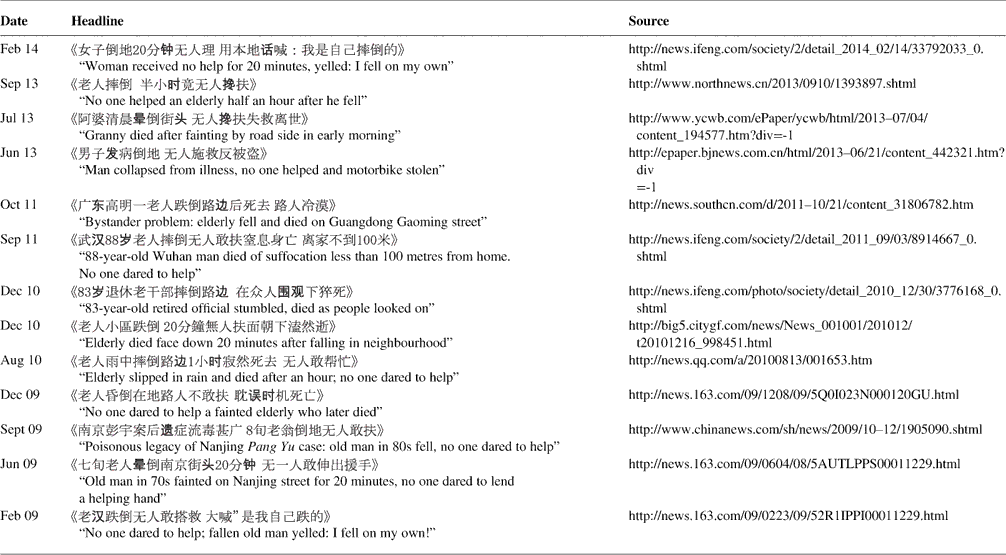
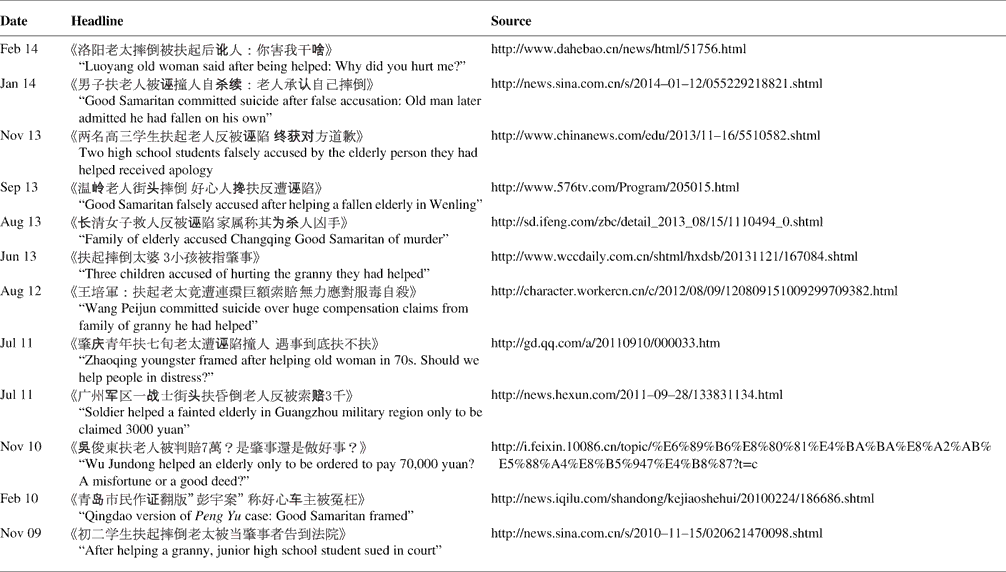
The media frenzy also fed into a common perception of a “system of lies” and deterred many from following the Good Samaritan example.Footnote 32 After Peng Yu, there have been numerous reported cases of an injured lying helpless in the street (see Table 1), or a Good Samaritan being accused of wrongdoings (see Table 2). All of these helped reinforce the Good Samaritan’s dilemma. The fear it generated was revealing. For example, in early 2009, a 75-year-old Nanjing man fell after alighting from a bus. No one came to his aid until after he yelled, “I fell on my own, you all do not need to worry, it had nothing to do with you all.”Footnote 33 And, in September 2011, an 88-year-old Wuhan man was left to die in a busy neighbourhood in broad daylight.Footnote 34 After the story was circulated on the Chinese Internet, scores of users voiced out for the bystanders. An online poll by the Party-run People’s Daily found that 80% of respondents say they would not help an elderly person lying in the street for fear of being framed.Footnote 35 Another poll on Sina Weibo, China’s leading microblogging site, yielded a similar result, with 43% saying “no,” 38% undecided, and only 20% saying they would “definitely” help.Footnote 36
Examples of Chinese media reports in which a victim received no help on the street

Examples of Chinese media reports in which the Good Samaritan was allegedly extorted
According to a critic, by telling the public “kindness is rare”—upon which Peng was held to be partially liable—the judgment helped discourage people from doing good deeds. With “why did you help if you were not liable” being seen as an easy argument for accident victims and their families to hold a Good Samaritan to account, helping a stranger has virtually become a risky business. The ensuing social impact was deemed “disastrous.”Footnote 37 For example, an entry of the Chinese phrase “ ” (“No one dared help a fallen elderly”) on Baidu on 22 April 2014, nearly 8 years after the Peng Yue case, registered 3,730,000 relevant websites. Many of them feature articles with sombre titles such as “The Sin of the Nanjing Judge: In China, No One Dared Help a Fallen Elderly,”Footnote 38 “No One Dared Help a Fallen 80-Year-Old Lady,”Footnote 39 “Collapsed Elderly Regrettably Died,”Footnote 40 and “With Our Kindness Abused, Can We Only Be Onlookers?”Footnote 41
2.2 A Relation-Based Society and Its Trust Deficit
2.2.1 Social Repercussions of the Peng Yu Case
Dubiously, the public were told a different story five years after the Peng Yu saga. Details of the 2007 confidential settlement showed that Peng was indeed responsible for Xu’s injury. In an interview with the influential Party-run news magazine Liaowang (Outlook Weekly) in January 2012, Nanjing Politics and Law Committee Secretary Liu Zhiwei urged people not to “misread” or “exaggerate” the facts of the Peng Yu case, or see it as a “landmark event” of moral decline.Footnote 42 But, as the whole saga has already been etched on the minds of the general public and become a classic case of China’s moral failings, the belated revelation only deepened suspicion against the judiciary and the media. People remained largely reluctant to help a stranger on the street.Footnote 43 As the title of an online commentary read, “It Is Too Late to Ask the Public Not to Misread the Peng Yu Case.”Footnote 44 Critics also came from within the Party. For example, the Internet “censor-in-chief” at Xi’an’s Propaganda Department openly challenged the timing of the disclosure at a time when society was reeling from the Xiao Yue Yue tragedy.Footnote 45 An editor at the Chongqing Business Daily aptly captured the popular sentiment. He wrote:
We should note that the reason people tend to believe that Peng Yu is innocent on this matter: it is inseparable from the poor reputation of society in general. The issue is how do we fix this problem systemically, not just control public opinion one-sidedly.Footnote 46
Regrettably, stories upon stories of victims dying in the street or Good Samaritans being driven to desperation continued to hit the headlines. For example, in October 2013, a woman had her neck stuck between the roadside railings in a busy Beijing street. As the security camera footage showed, for half an hour, over a dozen gawking bystanders did nothing other than taking photographs until someone called the police. The woman was later declared brain dead.Footnote 47 On 2 January 2014, a 46-year-old Good Samaritan in Guangdong, surname Wu, committed suicide having allegedly been extorted of a huge sum after helping an elderly on the street.Footnote 48 According to reports, while riding his motorbike on the New Year’s Eve, Wu came to the aid of an old man who had apparently been knocked over. He drove the man to a local clinic and helped him pay his 3,500 yuan medical fee, only to be accused of causing his injuries. Wu’s widow said the old man and his family had demanded a “compensation” of hundreds of thousands of yuan. Driven to desperation, Wu reportedly told his daughter he would rather die to prove his innocence. According to Xinhua, before ending his life, Wu had called a friend urging him not to do good deeds anymore.Footnote 49 Yet, the old man’s daughter insisted: “If he hadn’t hit my father with the motorbike, why would he be so kind as to bring my dad to the hospital and pay for his medical expenses himself?”Footnote 50
The trust deficit between people has grown to a point where many parents now discourage their children from helping the elderly unless witnesses are around.Footnote 51 On 15 June 2013, a 74-year-old woman accused three primary school boys for knocking her down in the street of Dazhou in Sichuan province.Footnote 52 The boys, however, insisted that they had actually come to her aid. According to Jiang, father of one of the boys, the woman asked them to pay her medical cost of around 20,000 yuan having initially demanded 200,000 yuan. Amid the impasse, on 16 November, the woman’s son carried her to Jiang’s home—where she stayed for two days—to press for payment. Having contacted Chengdu-based West China Metropolis Daily, Jiang reported to the police on 21 November. The next day, based on evidence from three witnesses, the police concluded that it was a case of extortion. It ordered a seven-day administrative detention against the woman but remitted it due to her old age, while detaining her son for 10 days with a 500 yuan fine. Yet, the dispute continued. On 23 November 2013, the lady swore to a journalist of Chengdu’s Economic Daily that she did not lie. Her family insisted on her innocence and considered applying for an administrative review of the case. On the other hand, one of the accused children told reporters that, from now on, he would first seek a witness before going to help a fallen elderly person.Footnote 53
Society saw growing suspicion towards elderly people as potential extortionists. Numerous stories of elderly victims suing Good Samaritans continued to reinforce the stereotype. For example, an entry of the phrase “ ” (“Helping a Fallen Elderly Only to Be Wrongly Accused”) on Baidu registered 2,760,000 related websites on 26 April 2014. According to an online survey in the wake of the above Dazhou saga in June 2013, only 14% of the respondents said they would help a senior citizen on the street.Footnote 54 In a similar survey by Sina Weibo, over 3,400 said they would not help, compared to 730 who would.Footnote 55 The national soul-searching in 2011 has regrettably given way to the fear of being extorted by society’s presumably most vulnerable members.
2.2.2 The Cultural Factors: Confucianism and the Predominance of Family
This state of affairs contrasts with a Confucian tradition steeped in altruism. The idea of ren, meaning humanity or human-heartedness,Footnote 56 permeates the Analects, dubbed the “Bible of Confucianism.”Footnote 57 Confucius’s golden rule “Do not impose upon others what you yourself do not desire” captures the essence of classic Confucian teachings.Footnote 58 Mencius, his disciple, famously said: “No man is devoid of a heart sensitive to the suffering of others.”Footnote 59 Known for his moral instructions to the ruling class, Mencius once advised the king:
Treat the aged of your own family in a manner befitting their venerable age and extend this treatment to the aged of other families; treat your own young in a manner befitting their tender age and extend this to the young of other families, and you can roll the empire on your palm.Footnote 60
Under classic Confucianism, benevolence was a shared norm in a society that accorded special attention to the old and young. This, however, does not sit comfortably with a contemporary China where stories of distressed elderly being ignored in the streets frequently made headline news.
This apparent contradiction can be seen in light of the idea of “filial piety.” Filial piety featured in Xiao Jing (The Classic of Filial Piety), a Confucian classic, as “the root of (all) virtue” and “(the stem) out of which grows (all moral) teaching.”Footnote 61 Equally central to classic Confucianism was the belief in everyone’s potential to master li, “the rules of propriety,”Footnote 62 and become junzi,Footnote 63 a virtuous man capable of fulfilling his roles within Five Cardinal Relationships, namely “parent and child, ruler and subject, husband and wife, old and young, and friend and friend.”Footnote 64 While three of those carried blood ties, the other two were accorded quasi-familial status as the “paternal” ruler and “brotherly” friend.Footnote 65 In Confucian times, social order revolved around these relationships from which human beings acquired dignity and brought honour to their family.Footnote 66 Besides, as a farming society, economic imperative led one “to live where one’s father or grandfather lived, and where one’s children will continue to live.” The predominance of the family and family-based relations had Fung Yu-Lan concluding that “The family system was the ‘social system of China’.”Footnote 67
Hence, while Confucius and Mencius espoused common humanity, they knew it was virtually impossible to practise “universal love.”Footnote 68 As much as he aspired to it, Confucius did not believe in identical treatment. It was because people did feel and behave differently towards different people in different relationships, just as one would observe three years of mourning exclusively for a deceased parent.Footnote 69 Mencius went one step further, criticizing the idea of “universal love” as a denial of “the special relationship between parents and children”—foremost among the Five Cardinal Relationships.Footnote 70 Despite its altruistic underpinnings, the Confucian worldview remains essentially hierarchal. An ethics that distinguishes people based on status and relationship can have a bearing on one’s attitude towards a stranger to whom one owes no moral obligations.
2.2.3 “Guanxi”: Cultural Practice or Instrumentalism?
At this juncture, the idea of guanxi (relationship) may help contextualize China’s bystander problem and its people’s presumed selfishness. Confucian ethics has continued to influence socialization in contemporary Chinese society. According to Fei Xiaotong, China’s preeminent sociologist and anthropologist, to understand the problem of “selfishness” one must look at the “pattern of the entire social structure.”Footnote 71 To him, unlike in the West where individuals formed themselves into organizations with agreed boundaries, the structure of Chinese society was akin to “the circles that appear on the surface of a lake when a rock is thrown into it.”Footnote 72 Each circle is interrelated as a person steps in and out of it at different points in time and place.Footnote 73 Accordingly, “[s]ocial relationships in China possess a self-centered quality. Like the ripples formed from a stone thrown into a lake, each circle spreading out from the center becomes more distant and at the same time more insignificant.”Footnote 74
This figurative account resonated with the Five Cardinal Relationships featured in the Book of Rites (Liji). Under this Confucian classic, everyone was expected to “stay in his place,” hence “fathers are differentiated from sons, those remote from those close, those who are intimate from those who are not.”Footnote 75 Society was made up of numerous circles each comprising a “self,” whose connections in turn formed a web of personal relations. One accorded a certain degree of treatment to another commensurate with their relationship, the so-called “difference between those who are close and those who are distant” ( ). Under this “egocentric” pattern, everything rested on “an ideology in which the self is central.”Footnote 76 According to Fei, the idea of “discrete centers fanning out into a weblike network” was the root of selfishness in Chinese society, where people would “sacrifice their families for their own self-interests, their party for their families’ interests, their country for their party’s interests, and the whole world for their country’s interests.”Footnote 77
This cultural discourse helps put China’s bystander problem into context. The idea of “difference between those who are close and those who are distant” resonates with that of guanxi—which literally means “relationship.” In practice, guanxi involves personal networks built on “pre-existing relationships of classmates, people from the same native-place, relatives, superior and subordinate in the same workplace, and so forth.”Footnote 78 Unlike blood relationships, such connections require careful initiation, preservation and renewal “through the giving and receiving of gifts, favors and dinners or banquets.”Footnote 79 From greasing the wheels of a snail-paced bureaucracy to securing a government contract, guanxi is what many Chinese rely on to “get things done” today.Footnote 80 But, whether guanxi is a means or an end in itself has been a subject of contention. In his paper on the guanxi culture in a North China village in the early 1990s, Yunxiang Yan noted the contemporary scholarly debate over guanxi.
The “instrumentalist” school saw guanxi as “a means of pursuing personal interests” against a unique historical backdrop.Footnote 81 Esteemed China observer Ezra F. Vogel, for example, argued that political realities under Mao Zedong’s socialist regime had necessitated the practice of guanxi.Footnote 82 In his seminal 1965 article, Vogel described how social values and behaviours changed after 1949.Footnote 83 Living under a dictatorship that kept track of any signs of ideological deviance, Chinese people profoundly changed the way they interacted. They tended to avoid contacts with strangers and foreigners “since one can never be sure what their standing with the régime might be.”Footnote 84 Gone were the days when friends could confide in each other in the comfort of their own homes, because “any information about dress or house furnishings or eating habits, no matter how innocuous it may seem to the reporter, might be taken to mean that a person is not truly a member of the peasant or proletariat class.”Footnote 85 Over time, they have “learnt to live with the risks of friendship” and to always err on the side of caution when dealing with one another.Footnote 86
Reflecting on Vogel’s account, Thomas B. Gold wrote in 1985 that “instrumentalism and commoditization” had replaced friendship and comradeship in defining social relations since the Cultural Revolution.Footnote 87 At a time when jobs and resources were limited and bureaucratically controlled, guanxi, based on reciprocity and thriving on power, came to shape social interactions. From obtaining scarce commodity items from a store clerk to obtaining the coveted Party membership through a cadre, people relied on guanxi to “get things done,” often with little regard to the law, regulations, or any “universal standards of law and morality.”Footnote 88 With guanxi being seen as “supreme law,” even young people learnt to cultivate good relations with whoever was in power so as to move up or avoid moving down the social ladder.Footnote 89 From this perspective, guanxi is merely “a strategically constructed network of personal connections” based on “instrumental exchanges of gifts and favours.”Footnote 90
Scholars such as Fei and Ambrose King, on the other hand, believed that guanxi was part of a “uniquely Chinese normative social order.”Footnote 91 Like Fei, King argued that Chinese society has always been organized around circles of relationships. “As a sociocultural concept kuan-hsi [guanxi] is deeply embedded in Confucian social theory and has its own logic that may be said to form and constitute the social structure of Chinese society.”Footnote 92 Confucian teachings have made no mention of the word guanxi. Its classical equivalent is lun, meaning “order or, more specifically ‘differentiated order’ among individuals.”Footnote 93 In a society structured by lun, the nature of personal ties defines the role of relations between two persons on the basis of “differentiation rather than homogeneity.”Footnote 94 Hence, compared to most Western societies, Chinese society is neither individual-based nor society-based, but “relation-based.”Footnote 95 As a Western observer put it, Westerners “tend to see people as individuals”; while they do make distinctions between strangers and acquaintances, they basically have “one code of manners for all.” Chinese, on the other hand:
instinctively divide people into those with whom they already have a fixed relationship, a connection, what the Chinese call guan-xi, and those they don’t. These connections operate like a series of invisible threads, tying Chinese to each other with far greater tensile strength than mere friendship in the West would do.Footnote 96
To their credit, both views respectively highlighted an essential part of guanxi. According to Alan Smart:
Clearly guanxi can be used for instrumental purposes, and this usage is recognized by members of the society. However, it is referred to as the art of guanxi, because the style of exchange and the appropriateness of the performance are critical to its effectiveness. The style and manner of gift exchange is not optional; rather, it is fundamental to its operation.Footnote 97
It is important to note that the difference between a guanxi-based material exchange and outright bribery hinges on the “relationship” of the parties in question. To keep guanxi alive and well, one needs to juggle his instrumental goals with the forms of exchange. The art of guanxi thus lies in skilfully applying moral and cultural rites such as “obligations and reciprocity in pursuit of both diffuse social ends and calculated instrumental ends.”Footnote 98
Despite its instrumentality, guanxi is essentially about relationships. A purely instrumentalist analysis, therefore, risks overlooking fundamental human institutions upon which all guanxi relations are based, namely “the family, kinship, neighbourhood and community.”Footnote 99 To thoroughly grasp the idea of guanxi, one should at least acknowledge both its instrumental and its relational aspects. According to Andrew Kipnis, “all practices of guanxi production either presumed or asserted an equivalence between material obligation (the obligation to assist with favors, labor, money, or other material goods at a future date) and human feeling (ganqing).”Footnote 100 Unlike contracts or briberies, practices of guanxi production belong to a realm where the depth of feeling determines the degree of material obligation.Footnote 101 “The more ganqing there is, the closer the guanxi. The closer the guanxi, the more it can be relied upon to bring economic, political, and social benefits. Such benefits in turn produce stronger ganqing.”Footnote 102 In guanxi, relation and instrumentality are two sides of the same coin.
It is perhaps no coincidence that two veteran China watchers—a Chinese anthropologist and a Western journalist—respectively used the term “magnetic field” to describe the workings of guanxi in Chinese society. In his influential book on Chinese culture, Sun Lung-kee wrote that Chinese people were born to a “magnetic field of human feelings” ( ) in which everyone seeks to be “looked after” by those regarded as being “one of us” (
 ).Footnote 103 Under this mentality, only when a guanxi connection was established would one begin a personal relationship with a new acquaintance. In the same vein, Fox Butterfield observed that “Guan-xi have created a social magnetic field in which all Chinese move, keenly aware of those people with whom they have connections and those they don’t.”Footnote 104
In a positive light, this “social magnetic field” helps glue people together as a community of mutual help. Yet, the absence of guanxi may be regarded as a justifiable reason for inaction in circumstances where altruism towards a stranger is called for. While research on how Chinese people socialize with strangers is scarce, the available empirical evidence did suggest they tended to “behave rationally when interacting with strangers.”Footnote 105 The assumption: in a relation-based society, everyone relies on and is satisfied with his established groups as the primary source of social support. Promoting relationships with those regarded as being “one of us” becomes a survival need. The case with a stranger is different. With neither ganqing nor guanxi, one tends to take a more calculative approach dealing with someone totally unknown.
A 1974 study helps shed some light on this point.Footnote 106 In this cross-cultural field research, researchers were out on the streets asking pedestrians to help mail a letter. A total of 130 adult Chinese from Taipei, Taiwan, and 115 adult Americans from Albuquerque, New Mexico, unknowingly took part in the exercise. The result showed that, compared to their American counterparts, the Chinese appeared to be less helpful towards strangers. Explaining their findings, the researchers wrote that “Chinese may be bound by the traditional family obligation to help aged relatives and others who need help in the large extended family structure, but are not necessarily more helpful toward strangers from the outside world.”Footnote 107 While this research is far from conclusive, this observation may help put China’s bystander problem into a cultural context.
As discussed, under Confucian ethics, one is expected to have a special sense of responsibility to his parents, families, superiors, and friends. The predominance of “clan-kin interests and ties” in a person’s life inevitably took its toll on his relationships with the wider world, especially with total strangers.Footnote 108 Similarly, in the world of guanxi, people rely on personal relationships to get things done. Relation, whether based on feeling or practicality, largely determines how individuals treat one another. In either case, one’s attitude with an unknown “other” becomes a matter of personal discretion. The absence of pre-existing obligations may sometimes discourage a person from intervening in an emergency concerning someone unrelated. It is especially the case when helping a stranger may spell trouble, as constantly publicized in the media in the aftermath of Peng Yu. It is against this social background that the Good Samaritan’s dilemma should perhaps be viewed and assessed.
3. The Emergence of Good Samaritan Law in China
Is law an appropriate answer? Extensive media reports of Good Samaritans getting framed and elderly victims dying on the street made society ponder. In a meeting on 18 October 2011, five days after the Xiao Yue Yue incident, the Guangdong Provincial Politics and Law Committee and the Social Work Committee joined ten other government departments condemning the indifferent bystanders as well as finding ways to promote altruism. The next day, the former through its Weibo asked the public to comment on various proposals.Footnote 109 By noon on 20 October, it had received 353 replies or related messages.Footnote 110 A related special report on the popular web portal qq.com attracted 28,276 views with nearly 6,000 comments.Footnote 111 The idea of Good Samaritan law has since become a matter of intense public interest in China.
A legal duty to rescue exists in various jurisdictions, including many European countriesFootnote 112, Australia,Footnote 113 Japan,Footnote 114 and, to a lesser extent, the US and Canada.Footnote 115 Despite being credited for providing a “moral compass,”Footnote 116 Good Samaritan law remains controversial particularly in the US.Footnote 117 Its major criticisms range from its coercive nature, to its questionable constitutional and theoretical grounds, and its weak enforceability.Footnote 118 Legislative models vary, from European interventionism to British minimalism with North America’s fault-based model in between—all of which will be discussed in the section below.
To put things in perspective, it pays to acknowledge that the jurisdictions under study are mostly liberal democracies with established discourse of human rights and rule of law. Hence, their experience in enacting and implementing Good Samaritan law largely reflects their respective history, politics, and ethos. Yet law is at the same time a universal phenomenon.Footnote 119 As a Shenzhen official acknowledged, overseas experience did help them draft China’s first Good Samaritan law.Footnote 120
3.1 International Perspectives: Good Samaritan Law in Europe, North America, and Asia Pacific
3.1.1 Europe
Portugal, in 1867, first imposed a legal duty to rescue.Footnote 121 That was followed by other European countries such as Italy, France, Germany, Poland, and Russia.Footnote 122 It remains in the penal codes of most civil law jurisdictions in Europe today.Footnote 123 For example, Article 223–6[2] of France’s Criminal Code states that any person “who wilfully abstains from rendering assistance to a person in peril when he or she could have rendered that assistance without risk to himself, herself, or others, either by acting personally or by calling for aid” is punishable with up to five years of imprisonment and a fine.Footnote 124 But, when it comes to defining when a person can be said to be “in peril,” interpretations vary. In Italy, Germany, and France, for example, a “danger to bodily integrity” is enough to create a duty to rescue. In the Netherlands, Norway, and Denmark, a bystander is required to help only when someone is facing a “danger to life.”Footnote 125
Another question is when it is “safe” for one to help. In Germany and Belgium, “a considerable danger” to the bystander will excuse him from intervening whereas, in France and the Netherlands, “a certain risk” to oneself will suffice. In Russia, under Article 127 of the 1960 Russian Criminal Code, one is obliged to act if he knows that “such aid could be given without serious danger to himself or other persons.”Footnote 126 The kind of assistance required of the rescuer in the circumstance also varies. In Belgium and the Netherlands, for example, a rescuer is required to personally intervene or seek help from others. In Italy, one needs only to notify the authorities without acting on his own.
Therefore, in Europe, a duty to rescue comes with different forms. The extent of one’s obligation is subject to the varying definitions about the circumstance that demands one’s interference as well as the standard of care required of the rescuer vis-à-vis the rescued.
3.1.2 United Kingdom
British common law does not recognize a duty to rescue. Lord Nicholls wrote, “The recognized legal position is that the bystander does not owe the drowning child or the heedless pedestrian a duty to take steps to save him.”Footnote 127 It follows that one’s inaction per se incurs no legal liabilities, unless the parties have come within certain recognized relationships for a duty to rescue to arise in tort or contract, such as that between parents and their children, carriers and passengers, and employers and employees.Footnote 128 Total strangers owe no duty to rescue each other even in emergencies. In a seminal British case on the law of negligence, Lord Reid aptly summarized the common law situation:
when a person has done nothing to put himself in any relationship with another person in distress or with his property mere accidental propinquity does not require him to go to that person’s assistance. There may be a moral duty to do so, but it is not practicable to make it a legal duty.Footnote 129
3.1.3 North America
North America presents a hybrid model. Like China, Good Samaritan law was largely a reaction to a series of cases involving a hapless victim amid indifferent bystanders.Footnote 130 Unlike the UK, some parts of the US and Canada require a bystander to rescue another, regardless of their relationship. Most notably, Good Samaritans are generally protected from lawsuits except in the case of gross negligence.
The American law differs from state to state. At least eight states impose a duty to rescue. In Vermont, Rhode Island, and Wisconsin, criminal law imposes an affirmative duty to assist someone in peril if doing so does not endanger the rescuer or compromise the duties he owes to others.Footnote 131 Minnesota imposes only civil liability for the same omission. In other states, such as Ohio, Florida, Massachusetts, and Washington, those failing to report the commission of criminal offences may face criminal penalties.Footnote 132
Vermont was the first state to pass a Good Samaritan law in 1967. The Duty to Aid the Endangered Act states that:
A person who knows that another is exposed to grave physical harm shall, to the extent that the same can be rendered without danger or peril to himself or without interference with important duties owed to others, give reasonable assistance to the exposed person unless that assistance or care is being provided by others.Footnote 133
At the same time, the law protects the rescuer from all civil liability unless “his acts constitute gross negligence or unless he will receive or expect to receive remuneration.”Footnote 134 This so-called “easy-rescue” model, under which a duty to rescue arises only when it poses no danger to oneself or others or when it does not affect the duties one owes to others, was followed by many other states.Footnote 135 For example, in Minnesota, the law requires a bystander, without danger to self or other people, to seek assistance from law enforcement agents or professionals rather than attempting the rescue himself.Footnote 136
The circumstance that triggers a duty to assist varies state by state. In Wisconsin, one is required to assist a victim of a “crime.” But the duty does not arise if others are already providing assistance or seeking help for the victim or have reported the crime to law enforcement personnel.Footnote 137 In Florida, the law is narrowly drawn to require reporting of “sexual battery” only.Footnote 138 The laws in Washington and Massachusetts mandate the reporting of all “violent crimes,”Footnote 139 while the California Penal Code (Section 152.3) requires a person “who reasonably believes that he or she has observed the commission” of certain stipulated offences against a child victim to notify the authorities.
For all their differences, the above state laws share some common features. First, they depart from the common law doctrine against imposing a duty to rescue.Footnote 140 Second, most states require citizens to report a crime instead of providing physical help to a victim. Except in Minnesota, Vermont, and Rhode Island, the law demands one to assist the victim and/or report to authorities in circumstances involving certain crimes. Third, the laws are unclear on the extent of the rescuer’s accountability by confining the duty to situations that it be discharged “without danger or peril to himself or without interference with important duties owed to others.”Footnote 141 The highly “qualified” duty to rescue and the rare occasions in which the laws had been enforced raised doubts as to whether Good Samaritan law is merely “effective symbolism.”Footnote 142
In summary, the American law aims at limiting the rescuers’ liabilities rather than imposing a duty. Hence, all 50 states provide immunity to those who have given emergency aid to another from tort liability except in the case of “gross negligence.”Footnote 143 Originally intended to cover medical personnel only, such laws now apply more generally in almost all circumstances.Footnote 144 In recent years, Good Samaritan legislation has also been used to address social problems. For example, in response to widespread drug overdose among young Americans, about a dozen states have enacted a so-called “911 Good Samaritan legislation” that provides immunity from drug possession charges to witnesses to an overdose who called the emergency 911 line for life-saving medical services.Footnote 145
Quebec is the only place in Canada that imposes a “constitutional” duty to rescue. According to its quasi-constitutional Bill of Rights, one’s constitutional right to emergency assistance forms the basis of another’s duty to rescue. Article 2 of Charte des droits et libertés de la personne (Quebec Charter of Human Rights and Freedoms) reads:
Every human being whose life is in peril has a right to assistance. Every person must come to the aid of anyone whose life is in peril, either personally or calling for aid, by giving him the necessary and immediate physical assistance, unless it involves danger to himself or a third person, or he has another valid reason.Footnote 146
Like their American counterparts, most Canadian provinces offer protection to those who have given emergency medical aid. With the exception of “gross negligence,” volunteers and medical personnel acting in emergency are largely exempted from civil lawsuits. Under Alberta’s Emergency Medical Aid Act, for example, “physicians,” “registered health discipline members,” “registered nurses,” and even ordinary citizens who have given gratuitous medical aid to anyone who was “ill, injured or unconscious as the result of an accident or other emergency” will not be liable for:
damages for injuries to or the death of that person alleged to have been caused by an act or omission on his or her part in rendering the medical services or first aid assistance, unless it is established that the injuries or death were caused by gross negligence on his or her part.Footnote 147
The province of Newfoundland and Labrador has a similar law.Footnote 148 Ontario’s Good Samaritan Act goes even further, allowing the gratuitous rescuer to receive “reasonable reimbursement” for expenses he has reasonably incurred in providing emergency assistance.Footnote 149
3.1.4 Australia
The sparsely populated Northern Territory is the only Australian jurisdiction that imposes a duty to assist, a departure from the common law’s “no duty to rescue” doctrine. It is codified in Section 155 of the Criminal Code that reads:
Any person, who being able to provide rescue, resuscitation, medical treatment, first aid or succor of any kind to a person urgently in need of it and whose life may be endangered if it is not provided, callously fails to do so is guilty of a crime and is liable to imprisonment for 7 years.Footnote 150
Elsewhere in Australia, the law focuses on protecting rescuers, especially medical professionals who provide emergency aid, from civil liabilities.Footnote 151 For example, Section 16 of Queensland’s Law Reform Act exempts a medical professional or any person from legal liabilities for any act or omission in the course of rendering emergency assistance to an injured person provided “the act is done or omitted in good faith and without gross negligence” and “the services are performed without fee or reward or expectation of fee or reward.”Footnote 152 In general, a Good Samaritan would not be liable for assisting in an emergency if he has exercised reasonable care and skill.
3.1.5 Asia
Compared to the West, Good Samaritan law is a recent phenomenon in Asia. Whether to legislate or not remains a subject of debate in countries such as IndiaFootnote 153 and Singapore.Footnote 154 At present, both Japan and South Korea impose a certain duty to rescue. Japan’s law is punitive in nature, where a person may be punished for failing to rescue another in peril. Article 293 of its penal code stipulates an imprisonment term for up to one year for those who abandoned a needy person “because of age, immaturity, deformity, injury or illness or for any other reason.” Under Article 296, tougher penalties apply to those whose violation of the above provision caused bodily harm to or endangered the life of another.
South Korea’s law is narrow in scope. It requires medical professionals to provide emergency aid on victims of sudden heart attacks when conditions allow.Footnote 155 Where an automatic external defibrillator (AED) is available in public areas such as airports, medical personnel, paramedics, and those trained to use an AED, where possible, are required to apply it to resuscitate a patient of sudden cardiac arrest. Failing to do so may result in a charge of refusal to act in an official capacity, omission of first aid, or even manslaughter. There is no law that immunes an AED user from legal liabilities. Article 63 of the Emergency Medical Service Act helps address this situation. Where a patient is injured or dies due to “unavoidable” emergency medical treatments by emergency medical personnel who were not at grave fault, punishment under the Criminal Act will not apply.Footnote 156
4. Chinese Models of Good Samaritan Law
Compared to the above jurisdictions, a legal duty to rescue is a foreign idea in China. Unlike in Europe, Chinese criminal law has never contemplated punishing people for failing to render emergency assistance. Without a Christian tradition as in many Western societies, the Chinese lexicon does not contain the biblical etymology of the “Good Samaritan.”Footnote 157 Yet, acts of bravery have always been recognized on the basis of traditional Confucian ethics. For example, many provincial governments have for years praised and rewarded citizens who have acted in a “jian yi yong wei” ( ) manner, meaning “see what is right and have the courage to do it.”Footnote 158 The idea originated from the Analects in which Confucius said, “To see what is right and not to do it is want of courage.”Footnote 159 In China, therefore, the notion of a “Good Samaritan” takes the form of “a person of courageous behaviour.” It reflects the subtle difference in the understanding of altruism between cultures. In the West, “Good Samaritan” often refers to altruism “out of the goodness of one’s heart”; in China, “jian yi yong wei” refers to “courageous behaviours” driven by one’s sense of justice or righteousness,Footnote 160 reflecting the image of junzi (a virtuous man) under Confucian teaching.
Today, the term “jian yi yong wei” is used to describe people who act courageously in emergency circumstances. It is also part of the title of a law giving spiritual and financial support to “good citizens of courageous behaviour.” For example, the term appears in similar laws in both Sichuan province and Beijing City. The Sichuan legislation is entitled “The Sichuan Provincial Regulation to Protect and Reward Persons of Courageous Behavior” ( ), while that of Beijing City is “The Beijing Municipal Regulation to Reward and Protect Persons of Courageous Behavior” (
 ). In both cases, “jian yi yong wei” refers to “persons of courageous behavior” who acted to:
protect national or collective interests or the physical safety or property of others, and in spite of the possible risk to his own personal safety, takes action to stop the occurrence of criminal activity, rescues persons, renders emergency aid, or delivers disaster relief.Footnote 161
For years, authorities have adopted a reward-based approach under which people with recognized heroism received monetary awards. For example, according to a 2007 report, Beijing and Shenyang in Liaoning province paid heroic individuals up to 200,000 yuan and 5,000 yuan, respectively.Footnote 162 Despite being criticized for demeaning the heroic spirit, the Guangdong provincial government in November 2007 raised the maximum reward for those who risked their lives to save others from 50,000 yuan to 300,000 yuan.Footnote 163 It also increased the payment to those who suffered disabilities or died as a result to 150,000 yuan.
This monetary model received state endorsement following the Xiao Yue Yue tragedy. In July 2012, China’s seven major ministries, including the Ministry of Education and Ministry of Finance, jointly issued a government guideline that required all departments and municipalities to address the potential hardships facing Good Samaritans.Footnote 164 That included offering them preferential treatment in terms of medical treatment, employment, education, and housing. In case of grave injuries or death, Good Samaritans or their families will receive compensation and benefits packages.
4.1 Reward-Based Model: Guangdong
Following state policy, more provinces have passed laws in favour of Good Samaritans.Footnote 165 For example, the Guangdong Province Regulation to Reward and Protect Persons of Courageous Behavior ( ) came into force on 1 January 2013.Footnote 166 The 35-article document features legislative goals, a verification procedure, and a reward regime. Article 17 sets out a four-level lump-sum award system for verified courageous deeds, respectively paying 1 million yuan, 800,000 yuan, 600,000 yuan, and 400,000 yuan to people (or their families) who suffered death, complete disabilities, severe disabilities, and partial disabilities. Good Samaritans who have difficulties finding jobs will receive priority for public posts (Article 23). For those who hailed from other provinces, they and their immediate families will get priority when applying for hukou, or permanent residency permits, giving them a package of social benefits exclusively for local residents (Article 27). Under Article 29, government will set up a fund to assist those who are liable for third-party property damage incurred as a result of their heroic acts.
Yet, not everyone was impressed. Critics said exchanging altruism with rewards distorts social values and shows a government lacking in “morals and talents.”Footnote 167 More importantly, the law failed to address the underlying Good Samaritan’s dilemma: helping a stranger and risking being sued.Footnote 168 Widespread cynicism has cast doubt on whether the law would be effective at all in encouraging good deeds.
4.2 Reward-Based Model: Shanghai
Despite being among the first to draft Good Samaritan legislation, Shanghai’s law remains in the pipeline. The city already has many regulations to award and protect Good Samaritans. According to the Shanghai Municipal government, a Good Samaritan can receive a one-off compensation up to 10,000 yuan, with the maximum amount being 500,000 yuan if he dies helping others. But critics said many regulations were either not properly enforced or the amount of assistance was insufficient.Footnote 169 The pending law, however, seems to follow the Guangdong model.
The Shanghai Politics and Law Commission commenced a two-year survey on the law in the wake of the Xiao Yue Yue tragedy in 2011. According to People’s Daily, the local People’s Congress has earlier included in its 2012 legislative plan a draft law, tentatively named “Shanghai Samaritan Protection and Incentives Ordinance,” for submission to the Standing Committee.Footnote 170 It favoured giving awards to altruistic rescuers and paying medical bills for those who sustained serious injuries as a result.Footnote 171 It sought to provide incentives to Shanghai’s large migrant population who are ineligible to receive most local benefits due to the lack of hukou. In this respect, the draft proposed that non-local residents with recognized “brave deeds” would earn extra points for their hukou application. In the long run, government would establish a charitable foundation in honour of those who sustained injuries saving others.Footnote 172 Yet, critics said this proposal still failed to tackle the biggest of the Good Samaritan’s dilemma.Footnote 173
4.3 Protection-Based Approach: Shenzhen
Unlike Shanghai, Shenzhen favoured North America’s protection-based model. The rich Southern city reacted quickly as the nation was reeling from the Xiao Yue Yue tragedy. In January 2013, the Shenzhen Municipal Office of Legislative Affairs launched a one-month public consultation on the proposed law. According to officials, the proposal was premised on two potential liabilities facing Good Samaritans. First, they can be blamed for causing the dangerous situation they are trying to alleviate; second, they may be accused of aggravating the damage or injuries of the rescued.Footnote 174 Designed to address these concerns, the Shenzhen Special Economic Zone Good Samaritans’ Right Protection Regulation ( ), dubbed “the Good Person’s Law,” came into force on 1 August 2013.Footnote 175 Being China’s first, it differs from all other similar laws in at least two aspects. Its Chinese title has no mention of “jian yi yong wei” while its official English translation bears the term “Good Samaritan.” Instead of giving awards to “persons of courageous behaviour,” Shenzhen’s new law emphasizes giving them legal protection.
Comprising ten short paragraphs, the law seeks to assist those who have given gratuitous emergency assistance to another in good faith (Section 2).Footnote 176 It does so by placing the burden of proof on the rescued. Hence, anyone who claims to have been hurt by the rescuer must give evidence or face “adverse consequence” (Sections 3 and 4). The law seeks to deter wrongful accusations by imposing both administrative and criminal penalties on those who are found to have fabricated a case (Section 6). Hence, under Sections 5 and 6, the Good Samaritan has the right to ask his accuser to apologize, reimburse, and compensate his losses including loss of reputation. Besides the above punitive measures, the law stipulates that those who have given testimony for Good Samaritans will be awarded by “relevant authorities” according to “relevant regulations” (Section 7). Where necessary, Good Samaritans will receive “official assistance” on legal advice (Section 8).
Compared to that of Guangdong and Shanghai, Shenzhen’s approach has struck a middle ground. Like North America and parts of Australia, it focuses on protecting the Good Samaritans under a taxing evidential regime. Unlike Japan and Europe, it does not punish people for failing to rescue, allaying fear that Good Samaritan law will be too onerous to ordinary citizens. When people’s fear of being extorted remains high, a law that encourages rather than coerces them to act seems to point in the right direction.
5. Should Society Use Law to Improve Morals?
5.1 Effectiveness of Shenzhen’s Law under Question
Efficacy aside, Shenzhen residents reportedly welcomed the new law. One said, “Finally, we are reassured to help others without taking a picture or shooting a video to record the scene first.”Footnote 177 This refers to an increasingly common practice where do-gooders would first secure a witness or proof of innocence before assisting a stranger on the street, dubbed “Good Samaritan, Chinese Style.”Footnote 178 Despite being an improvement from a purely monetary model, Shenzhen’s new law is not foolproof, however.Footnote 179 First, its language is too vague to have much legal force. For example, the law simply says those who accused a Good Samaritan of wrongdoings without evidence will face “adverse consequences.” Similarly, without specifications, the awards for those testifying for the latter are apparently at the discretion of the “relevant authorities” according to “relevant regulations.” The loose drafting does not help raise people’s confidence in the law. As a Shenzhen resident said: “It would be better for the law to detail punishments and rewards. Ambiguity means nothing.”Footnote 180 Second, critics doubted whether the law may be used as an excuse to escape responsibility. Hence, the same Shenzhen resident asked:
what if a driver, having hit a pedestrian, sends his victim to hospital and claims he rescued the injured person?... What would be even worse is if the injured person couldn’t provide any proof of the actual accident and there weren’t any witnesses.Footnote 181
Besides, in some circumstances, it may be unfair to impose the burden of proof on the rescued. As a Shenzhen lawyer asked, “If so-called helpers actually made a major mistake, and the victims cannot offer evidence, then can the helpers just go unpunished by law?”Footnote 182 This problem is exacerbated by the fact that elderly people are most vulnerable to falls as the major cause of injury and death—and hence need assistance the most.Footnote 183 In some cases, the elderly victims may simply be too confused or traumatized to be able to accurately recount the events that unfolded, leading to a distorted account of an accident.Footnote 184 All of these are legal (evidentiary and procedural) questions that in liberal democracies are addressed by an independent judicial system, which China does not have yet.
More regrettably, media frenzy in the aftermath of Peng Yu helped stigmatize the elderly and divert attention from the underlying social ills, such as the lack of affordable health care. Poor elderly who are injured in the street often have no one to turn to except those who have offered them help.Footnote 185 Sometimes, they may hold whoever they can find accountable for their injuries, especially when the person appears young and well-off.Footnote 186 As a police officer exclaimed, “What can you do when an old and poor lady tries to squeeze 200 or 300 yuan out of the pocket of a young man?”Footnote 187 To critics, a law that simply bends on punishing people without considering the victims’ situation will potentially, however inadvertently, worsen the plights of poor elderly in China.
The government has allegedly played its part in discouraging altruism too. In September 2011, the Ministry of Health issued a controversial document entitled “Technical Guidelines on Intervention When an Old Person Has Fallen Down.”Footnote 188 Otherwise a mundane set of instructions on how to assist an elderly after a fall, it raised eyebrows by advising: “Do not rush to help, but manage according to the situation.” This cautious tone prompted the influential Southern Metropolis Daily to criticize the guidelines as “pouring cold water on people’s desire to help.”Footnote 189
5.2 Public Opinions on Good Samaritan Law
5.2.1 The Proponents: Law Can Improve Morals
Society disagrees on whether China should use law to regulate morality. Those who support having a nationwide Good Samaritan law believe that it can help fix a vacuum which currently leaves do-gooders in a vulnerable position, both legally and financially.Footnote 190 Tan Fang, a Guangzhou academic, believes that a national law would make people more civilized.Footnote 191 Fang is the founder of Chinahaoren.cn ( , “China’s Good People Net”), the first charitable organization in China that offers legal and financial aid to Good Samaritans.Footnote 192 His view was shared by Yin Fu-jiang, one of a dozen lawyers who founded a group called “
 ” (“Stop Indifference Pro Bono Lawyers Alliance”) which provides Good Samaritans with free legal service.Footnote 193 According to Yin, the law should reflect a high standard of morality and not stifle human goodness. Hence, his group urged the public to shed their indifference and lead society to “the right path.”Footnote 194
In a similar vein, others emphasized law’s function in shaping human behaviour. Citing divorce laws in Germany and the Netherlands as an example, a legal scholar argued “raising the bar for divorce” had the effects of “lowering divorce rates and stabilising families.”Footnote 195 In the same way, offering tax concessions to those who have financially dependent elderly parents sends a positive message about filial piety. According to this view, legal and moral norms are in a “symbiotic relation.”Footnote 196 A person gets what is moral by observing what the authority enforces. Hence, offering emergency aid becomes a moral imperative under a duty-to-rescue law. Unlike criminal law, the social effects of such law may likely to be subtle, indirect, and long-term. Yet Mary Ann Glendon argued:
new and forceful legal statements of principle can enter slowly into the mores, reinforcing and valuing the conduct of those who already practice the ethic involved, while encouraging the broader development of behavior and attitudes that are conducive to ordering our lives together in society.Footnote 197
5.2.2 The Opponents: Law Cannot Solve Moral Problems
There are, however, many other reasons why law should not dictate one’s decision to rescue a stranger. For example, Zeng Dexiong, dean of the Institute of Philosophy and Culture at the Guangdong Academy of Social Sciences, believed that there is a line between law and morals.Footnote 198 Zeng said, while the two hit-and-run drivers who had struck Xiao Yue Yue committed a crime, the 18 bystanders merely made a moral decision. Using law to force people to interfere in a situation in which they have otherwise played no part, therefore, risks infringing individual freedom and autonomy.Footnote 199 As a commentator wrote, society should instead reflect upon why people lost their sense of compassion.Footnote 200 Public opinion seemed to support this view. Despite the outpouring of rage and sympathy following the Xiao Yue Yue tragedy, many Chinese—already subject to various kinds of state censorship—were wary of having another legal duty imposed.Footnote 201 According to an online poll, nearly 80% of respondents opposed imposing “a duty to rescue”—primarily because it is wrong to use law to enforce morality.Footnote 202
That begs the question of whether Good Samaritan law is the solution to a moral problem.Footnote 203 To its critics, law merely represents the “lowest common denominator.” Only morality can help set a higher standard of human behaviours. As an academic at China’s University of Politics and Law argued, law is only a minor part of human life.Footnote 204 It is impossible to codify all moral standards. Selective Codification may only lead to “shrinking” morality. Worse, legal coercion has an undesirable side effect of encouraging people to “avoid” situations where they may be required to render assistance. As a pedestrian said in a television documentary, nowadays, some Chinese people would look the other way when sensing someone lying in the street—for fear of being blamed for not helping.Footnote 205
How the law can be properly enforced also remains unclear. First, the series of Peng Yu-style cases illuminate the questionable quality of the Chinese judiciary and the low public trust it commands. Second, in practice, the line is not always clear between situations where one can safely offer help and those when it is unsafe to do so.Footnote 206 Since there are many factors behind one’s decision in a given circumstance, it is arguably unfair and infeasible to impose legal liabilities on people who failed to offer emergency assistance. As a scholar in Guangzhou’s Sun Yat-sen University argued, law is a “double-edged sword.” Although it can help fight crime, “it may also accuse the innocent by mistake.”Footnote 207 One needs to look no further than those high-profile cases where Good Samaritans were held liable for the injuries of the rescued. After all, reasonable people do disagree upon whether law, by its coercive nature, should be used to deprive people of their liberty in deciding whether or not to intervene in circumstances with which they have nothing to do.
5.3 Should Law Have a Role in Promoting Samaritanism?
5.3.1 The Debate
At this juncture, it pays to revisit the perennial debate over law and morality. Whether law should help enforce morals has been a contested subject in the West for more than a century.Footnote 208 A prominent example is the debate between British jurists H.L.A. Hart and Patrick Devlin in the late 1950s following the release of the Report of the Committee on Homosexual Offenses and Prostitution (the “Wolfenden Report”) on 12 August 1957.Footnote 209 In recommending the decriminalization of homosexuality between consenting adults, the Report famously proclaimed “there must remain a realm of private morality and immorality which is, in brief and crude terms, not the law’s business.”Footnote 210 Hart, in affirmation, cited John Stuart Mill in On Liberty where he wrote “[t]he only purpose for which power can rightfully be exercised over any member of a civilised community against his will is to prevent harm to others.”Footnote 211 Devlin, on the other hand, argued “it is not possible to settle in advance exceptions to the general rule or to define inflexibly areas of morality into which the law is in no circumstances to be allowed to enter.”Footnote 212 To him, if “exploitation” of prostitutes continued to justify the criminalization of brothel keeping, “there is virtually no field of morality which can be defined in such a way as to exclude the law.”Footnote 213
Although the Wolfenden Report has been synonymous with decriminalization of homosexuality, it has never rejected outright the law’s role in regulating morality. In fact, it affirmed the function of criminal law in denouncing private moral conduct contrary to “public good,” examples of which included preserving “public order and decency” and protecting the young and the weak from “exploitation and corruption.”Footnote 214 Similarly, Hart qualified his endorsement of Mill, saying “there may be grounds justifying the legal coercion of the individual other than the prevention of harm to others,”Footnote 215 although he stopped at naming what he had in mind.
Apparently, whether and when the law should enter the moral realm are questions over which even liberals may rightly differ.Footnote 216 For example, in arguing “no person is morally required to make large sacrifices to sustain the life of another who has no right to demand them,” Judith Thomson distinguished between the Good Samaritan and what she called “the Minimally Decent Samaritan.”Footnote 217 Citing the infamous Kitty Genovese murder case, she said that, while the 38 bystanders were not morally demanded to risk their lives to rush to save her, the fact that none bothered to call the police, as Minimally Decent Samaritanism “would call for doing at least that,” was “monstrous” in failing to meet a minimum standard of decency. Indeed, the case for legal intervention is particularly strong in the context of Good Samaritan law. Joel Feinberg, famous for his “offence principle,” made a similar argument. Considering the common law’s traditional aversion to imposing a duty to undertake even “easy rescues,” Feinberg wrote that “requiring people to help prevent harms is sometimes as reasonable a legal policy as preventing people, by threat of punishment, from actively causing harms.”Footnote 218
5.3.2 Do Good Samaritan Laws Work in Reality?
Even for liberals, therefore, Good Samaritan law is able to pass muster on the basis of harm prevention and minimal decency. Its case is particularly strong concerning “easy recues,” as in the US, where the law merely requires one to seek help or alert the authority rather than personally assisting in an emergency situation. Yet, critics challenged whether the “law in action” reflects the “law on the books.”Footnote 219 For example, Eugene Volokh explained why requiring people to report a crime may however create “anticooperative effects.”Footnote 220 First, the law would not matter to the “Good Samaritan” or the “Hopelessly Bad Samaritan”—the former will always do while the latter will not, with or without a law.Footnote 221 Although the “Legally Swayable Good Samaritan” would be swayed by the law’s “coercive or normative effect,” the “Delayed or Passive Samaritan,” who, for many reasons, baulked at helping but was then overcome by remorse, would be deterred from coming forward later for fear of prosecution.Footnote 222 Hence, Volokh concluded:
When a law turns people into outlaws, even only modestly punishable ones, it naturally makes them less likely to cooperate with the legal system that is threatening to prosecute them…This effect is an inevitable cost of using the threat of force to coerce people’s conduct; and while this cost may often have to be paid, it ought not be ignored, and for some laws, such as duty-to-rescue/report laws, it may be dispositive.Footnote 223
To many critics, the above helps explain the lax enforcement of easy-rescue laws particularly in the US since their existence in the 1960s. Daniel Yeager’s observation in his 1993 article in defence of Good Samaritan law shed some light on the “laws in action.” In a written reply to a questionnaire that he sent to 387 prosecutors in the eight states that required citizens to offer easy rescue or report serious crimes, namely Vermont, Rhode Island, Wisconsin, Minnesota, Florida, Massachusetts, Ohio, and Washington, none of the 139 respondents “could recall filling a complaint under the relevant statute.”Footnote 224 The lack of enforcement thus appeared common. “In Minnesota, there have been no known arrests or prosecutions under the provision since its inception in 1983, causing some to question its usefulness,” wrote a reporter in 1997.Footnote 225 In fact, the law was little known before the fatal 1997 accident that killed Princess Diana in France, which imposed a duty to rescue.Footnote 226 At the time, a Wisconsin reporter wrote that “[f]ew Wisconsin citizens … appear to have been prosecuted for violating a law now getting international attention because of the death of Princess Diana.”Footnote 227 Before the tragedy, even many French nationals were reportedly unaware of the existence of a duty to rescue.
Even in the few states that have enforced the law, the occasions were rare. For example, the Supreme Court of Vermont has interpreted Vermont’s statute only once.Footnote 228 In Wisconsin, where citizens are only required to assist the victim of a “crime,” the duty is so limited that a potential rescuer can be excused if (1) assistance may risk his own safety, (2) his other duties override that to the victim, or (3) others have already given help. As a result, the law was sparingly used. After the Wisconsin Court of Appeals affirmed it for the first time in 1996, it has since lain idle—a phenomenon commonly found in other states.Footnote 229 Similarly, a law that protects medical personnel from lawsuits after rendering emergency aid (which exists in all 50 states) has reportedly been largely redundant. More than two decades since the law was put in place, “there [was] no known case in the United States of a malpractice suit being brought against a doctor who responded to a roadside or other emergency outside his office.”Footnote 230 Hence, one might conclude that the law “had no effect on how physicians behave when they confront accident victims in need of emergency care.”Footnote 231
Yet, to its supporters, the fact that few have been or will be prosecuted for flouting the duty to rescue “does not alone provide a valid reason against adopting duty to act laws, as many laws currently in place go unenforced except for the most egregious cases.”Footnote 232 The value of the legal requirement for wearing seat belts, for example, lies in raising awareness rather than punishing people. Similarly, even a Good Samaritan law may not profoundly change a bystander’s behaviour; it is its long-term “normative” effect that counts.Footnote 233 According to studies, the law “would affect the way people perceive the legitimacy of the behavior in question.”Footnote 234 Even a mere law does not change people’s hearts; a publicized duty to help strangers “might enhance the perceived desirability of that behavior.”Footnote 235
What ultimately matters lies in social attitudes—a particular concern for China. In a society famous for its ill-treatment to those in peril, a Good Samaritan law may help boost “social morale” and “remove a tension between law and social belief and well might contribute to a suffusion of greater feelings of responsibility and trust across community strata and beyond the closer personal relationships.”Footnote 236 According to Christopher White, a legal regime that compensates altruistic rescuers for their consequential losses will enhance “social morale.” It will help “send a powerful message to others that such conduct is appreciated and valued,” thus giving “subtle motivation” for others to do the same when facing the same situation.Footnote 237
In this sense, law is not merely a set of formal rules, but “an expression of society’s values and concerns.”Footnote 238 As many have argued, it is a reflection of society’s ethos.Footnote 239 While the law has a rather limited role compared to other institutions that shape values and beliefs, such as families, schools, religion, and the media, it is “emblematic.”Footnote 240 Its biggest function lies in proclaiming the kind of behaviours it expects of society and producing decisions that “build ‘social capital’ or connections among citizens.”Footnote 241 For example, moral condemnation against racial segregation in the landmark decision of Brown v. Board of Education Footnote 242 not only helped boost a civil rights movement in American history, but also pointed out the direction in which society should go.Footnote 243
5.3.3 A “Chinese” Model of Good Samaritan Law?
Some observations can be drawn in light of overseas experience and discourse on Good Samaritan law. First, the European model may not suit China. As public trust in the Chinese legal system remains low, a punitive law can backfire.Footnote 244Peng Yu and its aftermath are reminders of a society that easily gets “hyped up” at a few “illogical” judgments. As a lawyer commented, until the court commands some public respect, imposing a legal duty to rescue may only do a disservice to promoting altruism.Footnote 245
Second, the law should be as “clear, specific, and detailed as possible to ensure its use.”Footnote 246 As discussed, despite being hailed as progress, Shenzhen’s Good Samaritan law is too vague and open-ended for people to put much faith in it. Amendment is needed for it to become a national model. A major problem lies in its loose drafting. Hence, details such as “how” and from “whom” a Good Samaritan can apply for assistance should be included. To alleviate the burden of proof on genuine victims who, for some reasons such as old age, are unable to provide evidence to prove their claims, the court should consider individual circumstances and apply the evidential rule on a case-by-case basis. After all, a certain level of trust in the judiciary is vital for the law to work.
Most importantly, the law should take into account China’s social realities. In this respect, North America’s protection-based approach—upon which Shenzhen’s law is modelled—seems to fit the bill. As discussed, except in Quebec and a few US states that imposed an affirmative duty to assist, the laws there predominantly concern giving legal immunity to Good Samaritans unless they were guilty of gross negligence. By focusing on protection rather than punishment, the law does not infringe personal liberties—a major concern for liberals.Footnote 247 Compensation is equally important, especially for those who sustained injuries or damages during the emergency rescue—a distinguishing feature of the law in some parts of Canada.Footnote 248
In criticizing America’s over-reliance on the fault-based tort system, White proposed a “public compensation fund” as well as a “rescue insurance regime.”Footnote 249 The former has already existed in California, which allows citizens to claim over injuries sustained while “preventing the commission of crimes against the person or property of others, or in apprehending criminals, or rescuing a person in immediate danger of injury or death as a result of fire, drowning, or other catastrophe.” In recognition of the public purposes that they served, the fund compensates each rescuer with up to US$10,000.Footnote 250
A similar regime exists in China through the work of Chinahaoren.cn, the country’s first voluntary organization to serve Good Samaritans (as noted above). The fund, devoted to offering legal aid and compensation to those facing charges after helping an elderly person, has reportedly received more than 40,000 yuan in donations and pledges of support from at least 60 lawyers six months into its operation.Footnote 251 Efforts like that can be antidotes to China’s reputation as a nation of bystanders. It also shows that, in the long run, civil society will play a pivotal role in promoting Samaritanism and fostering a culture of solidarity.
In the longer term, government may also consider a “mandatory insurance regime.” White suggested, in the American context, that a mandatory clause be added to all new or renewed household insurance policies that “will compensate policyholders for any loss suffered while attempting to save another person from physical harm,” regardless of whether the act was performed in the insured premises or not.Footnote 252 To cover the insurers’ increased costs, the additional coverage will be funded by a market-based premium increment. For low-income earners who cannot afford a household policy, they will be covered by a modest public fund administered by authorities currently overseeing government funds for crime victims.
A state-funded insurance scheme is a possible direction for China. In fact, a special insurance policy has already existed, at least in the capital. For example, after a state media report in 2013 that attributed an increasing number of extortion cases involving the elderly to inadequate medical care for them, the Beijing City government began working with a state-owned insurer to provide senior citizens with “an insurance policy covering accidents in public areas.”Footnote 253
Overall, a sustainable policy should be one that meets the goals of compensating injured rescuers and spreading “the costs for socially beneficial behavior across a large element of society.”Footnote 254 While the decision to assist in a circumstance depends on one’s moral judgment, “a system of compensating injured rescuers can gradually help shape the moral motivations of the community as a whole.”Footnote 255 It sends a powerful message that community does not “turn its back” on those who made a courageous decision to act.Footnote 256 “Compensating their efforts would promote feelings of community responsibility.”Footnote 257 On the contrary, compelling people to perform potentially risky acts against their will may create resentment and avoidance of the law. In the Chinese context, a system based on protection and compensation will be a good step in promoting “feelings of community responsibility.”
To ease concerns about personal safety and extortionist scams, Chinese authorities may encourage “easy rescues” as opposed to physical interventions. As discussed, even in those few US states that imposed a duty to rescue, their laws only require the rescuers to give “reasonable assistance” to a victim such as “obtaining or attempting aid from law enforcement or medical personnel.”Footnote 258 The law in the state of Washington, for example, only demands one to call the police for a crime victim.Footnote 259 Publicity on “easy rescues” will help send a positive message about helping others amid the widespread fear of extortion. It all comes down to human instincts.Footnote 260 As a Chinese Internet user said, even if he dared not help a stranger for fear of being extorted, he would “run to a public phone booth to call 120 (the emergency number in China) and ask for an ambulance.”Footnote 261 According to a television documentary, today, a Good Samaritan “with Chinese characteristics” would first take photographs and/or secure witnesses before helping a stranger—an approach a one-time elderly victim praised.Footnote 262 In this context, the promotion of “easy” and “Chinese-style” rescues may help rejuvenate the culture of altruism in China.
Above all, the law must be made known.Footnote 263 It demands efforts from the media as well as the government. As Zhou Chengxin, director of the Shenzhen Municipal Office of Legislative Affairs said, the media should help publicize this “innovative” legislation.Footnote 264 The “negative” publicity surrounding Peng Yu and its consequence speak volumes about the power the mass media yields in shaping public opinion and attitudes.Footnote 265 China’s Good Samaritan’s Dilemma will not change overnight. But media reports on voluntary efforts by, for example, Chinahaoren.cn and the “Stop Indifference, Pro Bono Lawyers Alliance” may help change public opinion over time.Footnote 266
6. Conclusion
Antony Honoré wrote:
If the law does not encourage rescue, it is sure to discourage it. If it does not compensate, it will indirectly penalize. If the rescuer who suffers injury or incurs expense or simply expends his skill goes without compensation, the law, so far as it influences conduct at all, is discouraging rescue.Footnote 267
As this article has argued, various reasons, both internal and external, influence one’s decision whether or not to assist a stranger in an emergency situation. The bystander problem is certainly not peculiar to China. For more than a century, many liberal democracies have used law to command or encourage people to attempt emergency rescues to various degrees of success. While the laws have proven to be largely idle, their symbolism is arguably a reason that justifies their place on statutory books.
China’s bystander problem perhaps evokes more subtleties than it does in the West. Confucian ethics and the guanxi practice, for example, set the stage for a society that places a high value on personal relations and moral obligations. The so-called “magnetic field of human feelings” may help foster a close-knit community. Yet it raises the question of whether a relation-based mentality would be a hindering factor for altruism. The discussion on China’s Good Samaritan’s Dilemma depicted a society rattled by a series of Peng Yu-style cases. With altruism having bad publicity, nowadays people would first seek a witness before helping an elderly person on the street, if at all. This adds to the complexity of China’s bystander problem. While it is too simplistic to attribute the matter to culture or social practice, a cultural analysis may help put the phenomenon into context.
How to address the Good Samaritan’s dilemma is another issue that this article has attempted to explore. Society is rightly divided on whether law is an answer for moral problems. But whether one agrees or not, law has long been intertwined with morals. Legal sanctions against incest, bigamy, and sexual intercourse with minors are just a few examples of law entering the moral realm—with majority support.Footnote 268 Whether or not law can successfully enforce morals, it remains, in most cases, society’s “moral compass.”Footnote 269
China is at the crossroads of many legal reforms. Good Samaritan law has come at a time when trust in the legal system is low. Shenzhen has apparently struck the right note in emphasizing incentive rather than penalty. Whether the law will have any positive effects remains to be seen. What China needs now is more trust in and respect for the entire social system. At the moment, a Good Samaritan law that can command a certain degree of faith may hopefully, to borrow White’s concluding remark, “create an environment where [Chinese people] are more likely to assist their fellow citizens in times of need.”Footnote 270
 ’ appears in the Analects 105 times, and fifty-eight of the 499 sections in the book are devoted to the discussion of the concept”, ibid., p. 27.
 ), Article 2, see Larson & Young, trans. (
 ).”
 )