BACKGROUND
To limit transmission in healthcare settings, patients with multidrug-resistant organisms (MDROs), including methicillin-resistant Staphylococcus aureus (MRSA) and vancomycin-resistant enterococci (VRE), have been placed on contact precautions (CPs). While CPs are thought to reduce hospital-acquired infections (HAIs), other aspects of patient care may be compromised. Studies have documented adverse consequences associated with CPs, including delays in care,Reference Mclemore, Bearman and Edmond 1 reduced visits by healthcare workers,Reference Harris, Pineles and Belton 2 safety issues,Reference Stelfox, Bates and Redelmeier 3 and patient dissatisfaction.Reference Stelfox, Bates and Redelmeier 3 Controlled studies of MRSA active detection and isolation cast doubt on the effectiveness of CPs for the control of endemic MRSA infections.Reference Fatkenheuer, Hirschel and Harbarth 4 We evaluated the impact of discontinuing CPs for patients with MRSA and VRE infection/colonization on device-associated HAIs.
METHODS
This quasi-experimental, before-and-after study of discontinuing CPs for MRSA or VRE colonized/infected patients was conducted in an 865-bed, safety-net, academic medical center. Device-related HAIs were detected by concurrent surveillance utilizing Centers for Disease Control and Prevention (CDC) National Healthcare Safety Network (NHSN) methodology. No changes in methods occurred during the 30-month period, with the exception of ventilator-associated pneumonia definitions as specified by the NHSN. Historically, all patients with MDROs were placed on CPs. Beginning April 2013, CPs were discontinued for patients infected or colonized with MRSA or VRE unless there was uncontained wound drainage within a dressing or uncontained respiratory secretions for MRSA patients. CPs were continued for C. difficile infected patients and Gram-negative MDRO infection/colonization. During the study, 3 horizontal interventions were continued: hand hygiene (HH), daily chlorhexidine bathing of all inpatients (except infants), and a recommendation of bare-below-the-elbows protocol for inpatient care. Compliance with HH and bare-below-the-elbows practices was recorded by trained observers. Horizontal interventions were not pathogen-specific and applied broadly to populations of patients.Reference Edmond and Wenzel 5 No active surveillance for MDROs was performed except for MRSA in the neonatal intensive care unit (NICU). A Z-test was used to compare infection rates between the respective 15-month periods before and after CP discontinuation.
RESULTS
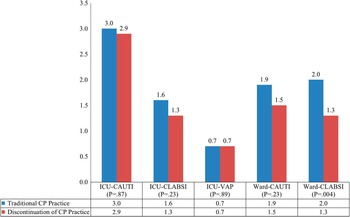
Comparing the before-and-after discontinuation of CP time periods, we found no change in the rates of MRSA or VRE device-associated infections in the ICUs, wards, or all inpatient settings combined (Figure 1). We also found no change in the rates of catheter-associated urinary tract infection (CAUTI), central-line-associated bloodstream infection (CLABSI), or ventilator-associated pneumonia (ie, possible/probable cases in the ventilator-associated event paradigm) due to all organisms, with the exception of a decrease in CLABSI in the ward setting after CPs were discontinued (Figure 2). Compliance was 90% for CPs and >85% for HH hospital-wide for 3 years prior to CP discontinuation. A 12-week prevalence survey demonstrated that the bare-below-the-elbows protocol was performed in 69% of >11,000 patient care episodes. Compliance with HH, CPs, and the bare-below-the-elbows protocol was unchanged after CP discontinuation. We did not measure compliance with chlorhexidine bathing.
MRSA and VRE device-associated infections before and after discontinuation of contact precautions. Parentheses indicate rate per 1,000 device days. The Y-axis represents the number of device-associated infections.

Impact of discontinuing contact precautions in ICU and ward units on device-associated infections due to all pathogens. The Y-axis represents the rate per 1,000 device days.

During the 15-month period prior to discontinuing CPs for MRSA and VRE, CPs were in place for 39,928 patient days. After the policy change, during the subsequent 15-month period, CPs were in place for 22,145 patient days, a 45% reduction in isolation days. Assuming that each isolation day costs $35 (supplies and healthcare worker timeReference VerLee, Berriel-Cass, Buck and Nguyen 6 ), the cost savings of the 17,783 less isolation days over 15 months is estimated to be $622,405 (or $497,924 annually).
DISCUSSION
We successfully discontinued CPs for patients colonized or infected with MRSA and VRE and observed no increase in device-associated infections. Additionally, the discontinuation of CPs resulted in an estimated annual savings of $500,000.
Our analysis is limited by its observational nature, performance in a single center, and no evaluation of the impact on colonization with MRSA or VRE. As this intervention was part of our infection prevention strategy, we did not calculate an a priori power analysis, and this study may have been underpowered to detect a difference in HAI rates. Other limitations include absence of observation of chlorhexidine bathing compliance and a potential Hawthorne effect when measuring HH, bare-below-the-elbows protocol, and CP compliance. However, a recent study of CP discontinuation using active surveillance found no increases in MRSA or VRE colonization or infection.Reference Gandra, Barysauskas, Mack, Barton, Finberg and Ellison 7
A framework for CP discontinuation for the control of endemic MRSA and VRE has been published.Reference Bearman and Stevens 8 Alternatives to CPs include maximizing horizontal infection prevention strategies (eg, HH, chlorhexidine bathing, bare-below-the-elbows protocol, head-of-bed elevation, central-line checklists, and device bundles) coupled with robust hospital-wide surveillance for HAIs. We conclude that CP discontinuation for MRSA and VRE resulted in no increase in device-associated HAIs, was well accepted by staff, and reduced costs. Hospitals with robust horizontal infection prevention programs may consider a similar approach.
Acknowledgments
Financial support: No financial support was provided relevant to this article.
Potential conflicts of interest: All authors report no conflicts of interest relevant to this article.