I. INTRODUCTION
Semiconductor chalcopyrite materials have attracted tremendous interest due to their technological and scientific importance. The scientific interest in these materials stems from the fact that they have used spintronics, nonlinear optics, photovoltaic cell application as well as electro-optic devices. As II–IV–V2 compounds have intriguing properties such as direct band gap characteristics, the use of these compounds has constantly increased. Recently, II–IV–V2 compounds have also been shown to be better replacers for III–V compounds because of their potential applications for photovoltaic applications such as very high optical absorption coefficient for visible light.Reference Shay and Wernick1–Reference Shi, Hu, Qin, Duan, Wu, Yang and Tang17
The general features of the electronic bands, charge densities, and bonding for the equilibrium crystal structure of some ABC2 type chalcopyrite semiconductors were reported using self-consistent band-structure methods.Reference Jaffe and Zunger4 Chiker et al.Reference Chiker, Kebbab, Miloua and Benramdane12 examined the linear optical properties for some II–IV–V2 compounds (where II = Mg, Zn, Cd; IV = Si, Ge, and V = P, As) by using the full potential linearized augmented plane wave method. They have also shown that the band structures of MgSiP2, MgGeP2, MgSiAs2 compounds have a pseudodirect band gap. Erwin et al.Reference Erwin and Zutic14 studied magnetic properties, the formation energy, and enthalpy of Mn-doped of II–IV–V2 chalcopyrite compounds, including Mg-based chalcopyrite compound. Shaposhnikov et al.Reference Shaposhnikov, Krivosheeva and Borisenko15 have studied the structural, electronic, and optical properties of II–IV–V2 (II = Be, Mg, Zn, Cd; IV = Si, Ge, Sn; V = P, As) chalcopyrite-type ternaries via ab-initio method. They have adjusted band gap error using the modified Becke–Johnson (mBJ) exchange-correlation potential and GW approximation in which the eigenvalues in the Green's function G and the screened interaction W are updated. More recently, S. Ullah et al.Reference Ullah, Murtaza, Khenata and Reshak16 have investigated physical properties of MgYZ2 (Y = Si, Ge; Z = N, P) chalcopyrite compounds using first-principles calculation within the WIEN2k code. And they also reported that the electronic band structure and optical results are suitable for photonics, optoelectronics and optics application. Shi et al.Reference Shi, Hu, Qin, Duan, Wu, Yang and Tang17 predicted structural, elastic and lattice dynamical properties of chalcopyrite BeSiV2 and MgSiV2 (V = P, As, Sb) within density functional theory (DFT) using norm conserving pseudopotentials and generalized-gradient approximation from the Cambridge Serial Total Energy Package (CASTEP) code. Their results indicated that the Si–V bonding is remarkably stronger than the Mg–V bonding in Mg-containing chalcopyrite semiconductors.
Ab-initio calculations predicted novel Mg–IV–(P, As, Sb)2 chalcopyrite compounds to be stable semiconductors having direct gaps and lattice parameters close to GaSb and InSb. Their reflectance and absorption spectra are comparable with those for widely used GaAs and CuInSe2 and supposed Mg-based materials to be good candidates to replace them for optoelectronics. The photovoltaic cells are very important due to their use as an alternate source of electricity.Reference Zunger, Wagner and Petroff18,Reference Krivosheeva, Shaposhnikov, D'Avitaya and Lazzari19
We have performed a comprehensive study of MgSnT2 (T = P, As, Sb) from first principle calculations. In this study, we present results of theoretical ab-initio simulation of structure, electronic, elastic, vibration, and optic properties of semiconductors which includes ternary MgSnT2 (T = P, As, Sb) compounds considering to be of practical interest. These compounds have not been experimentally synthesized yet their properties demonstrated below make them promising for efficient solar cells and infrared photodedector.Reference Krivosheeva, Shaposhnikov, D'Avitaya and Lazzari19 The role of exchange-correlation functionals is investigated at the level of DFT, both in the local-density (LDA) and generalized gradient approximations (GGAs) such as Perdew and Wang (PW91), Perdew–Burke and Ernzerhof (PBE), revised PBE (RPBE), modified Perdew–Burke–Ernherzof (PBEsol), and Armiento–Mattson 2005 (AM05). Although the structural and electronic band structure properties have been studied with theoretical calculations,Reference Jaffe and Zunger4,Reference Shaposhnikov, Krivosheeva and Borisenko15 very little information is known about the dielectric properties and the anisotropy of these compounds. Moreover, the mechanical properties of all investigated compounds are not still under investigation, as well as their thermodynamic properties. The paper is organized as follows. In Sec. 2, we describe the computational method. In Sec. 3, we present the results and discussion and give a brief summary in Sec. 4.
II. METHOD OF CALCULATIONS
All results presented in this study are carried out using the projector-augmented wave (PAW) implementation method,Reference Kresse and Joubert20 which are described interaction with the nuclei and the core electrons, as implemented in the Vienna ab initio simulation (VASP) code.Reference Kresse and Hafner21 Results issued from different kinds of exchange-correlation functionals such as the latest version of the VASP code called potpaw LDA52Reference Ceperley and Alder22 of Ceperley Alder (CA) scheme, GGA-PW91,Reference Perdew and Wang23 GGA-PBE,Reference Perdew, Burke and Ernzerhof24 GGA-RPBE,Reference Zhang and Yang25 GGA-AM05,Reference Armiento and Mattsson26−Reference Mattsson, Armiento, Paier, Kresse, Wills and Mattsson28 and GGA-PBEsolReference Perdew, Ruzsinszky, Csonka, Vydrov, Scuseria, Constantin, Zhou and Burke29 were compared. After careful tests, for all calculations, the kinetic-energy cut-off for the plane-wave expansion was 500 eV, the Brillouin zone sampled using a 9 × 9 × 5 special k-point grid and the convergence criteria for structural optimization was 10−7 eV. It is crucial to state properly energy cut-off and k-point densities for calculating electronic band structure and optical properties. Convergence test showed that the wave functions were expanded into plane waves up to 500 eV for the cutoff energy. It is observed that any significant changes are not found as the energy cut-off is increased and these settings were generally sufficient to ground state properties. The optimization of the structural parameters was carried out by full structure relaxation. For the calculation of the electronic density of states (DOS), charge density and optical quantities need a dense mesh and hence, the Brillouin zone was performed with a 17 × 17 × 10 k-point grid.
III. RESULTS AND DISCUSSION
A. The structural properties
Although MgSnT2 (T = P, As, Sb) has been not already synthesized, it is most commonly known that II–IV–V2 type compounds crystallize in a body centered tetragonal phase (space group no:122,  $I - \bar 42d$, D2d) and this structure is derived from the zinc blended binary semiconductors, but contain two different cations instead of one in binary.Reference Jaffe and Zunger4,Reference Sharma, Verma and Jindal8,Reference Sainia, Singh, Reshak and Kashyap9 Therefore, MgSnT2 (T = P, As, Sb) has been identified throughout this study as D2d space group with Mg atom at 4a (0 0 0), Sn atoms at 4c (0.0 0.0 0.5) and T atoms at 8d (u 0.25 0.125). The body centered tetragonal structure is simply defined by three lattice parameters: a and c and internal parameter u.
DFT is an extremely successful theoretical approach for the description of ground state properties of molecules and solids. DFT is formally exact, but in practice approximations are needed to define the unknown exchange-correlation functional. The choice of energy functional is an important consideration in DFT calculations. As mentioned in before, six different approximations for the exchange-correlation energy are used in this study. The LDA functional is based on accurate calculations of the exchange-correlation density in a homogeneous electron gas. Here, the implementation of LDA follows the Ceperley and Alder recipe.Reference Ceperley and Alder22 In addition, we use the PW91,Reference Perdew and Wang23 the PBE,Reference Perdew, Burke and Ernzerhof24 the GGA-RPE,Reference Zhang and Yang25 most recent GGA-AM05Reference Armiento and Mattsson26–Reference Mattsson, Armiento, Paier, Kresse, Wills and Mattsson28 and GGA-PBEsolReference Perdew, Ruzsinszky, Csonka, Vydrov, Scuseria, Constantin, Zhou and Burke29 gradient-corrected functionals. Both PW91 and PBE approximations are free of empirical input and satisfy sum rules and analytically known limits. Furthermore, PBE incorporates an accurate description of the linear response of the uniform electron gas, generates a smoother potential and has the correct behavior under uniform scaling. The pseudopotentials used in the calculations were constructed consistently by using the same approximation for the exchange-correlation energy in the generating scheme which has been found to be important in obtaining accurate geometries and energetics. Several attempts to improve current GGA functionals for solids, either through a reparameterization or a refinement of their mathematical expressions, have recently appeared in the literature. Perdew and co-workers reanalyzed the performance of the PBE functional and proposed a modification denoted as PBEsol.Reference Perdew, Ruzsinszky, Csonka, Vydrov, Scuseria, Constantin, Zhou and Burke29
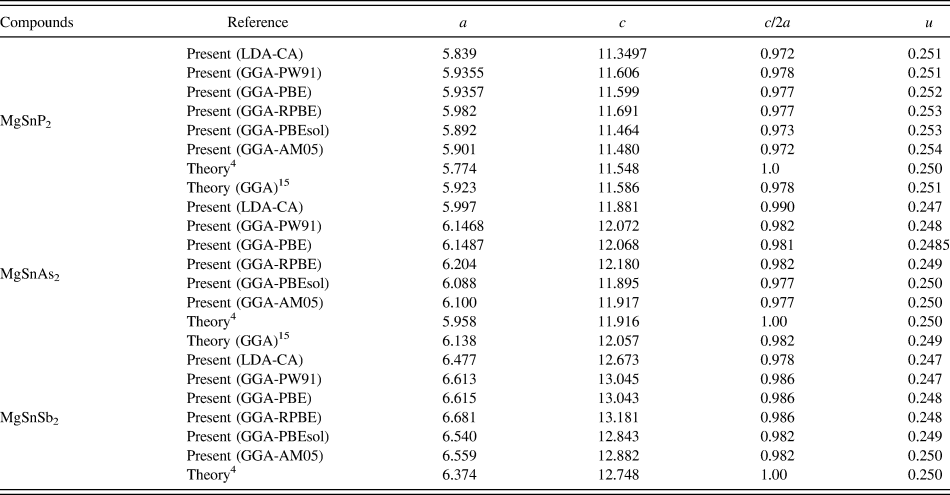
Due to the electronic, elastic, lattice dynamical properties based on a structural properties, accurate calculation of the structural properties of a material requires a precise reproduction of the lattice parameters using first-principles calculations. We, therefore, carried out detailed calculations for several exchange-correlation functionals for these compounds (see Table I). First of all, we computed the total energy versus lattice constant a for selected exchange-correlation functionals as shown in Fig. 1 It is clearly seen from Fig. 1 that the order of ground state energy from low to high is: LDA < PW91 <RPBE < PBE < PBEsol < AM05 for each compound. Obviously, the lattice parameters from LDA give a smaller value than the other considered functionals. The cell volume increases from the P to Sb compound as expected. All of the relevant equilibrium structural parameters and tetragonal distortion (n = c/2a) for all considered compounds are given in Table I, including other theoretical values.Reference Jaffe and Zunger4,Reference Shaposhnikov, Krivosheeva and Borisenko15 Our computed lattice parameters show excellent agreement, in particular compared with the results of Ref. Reference Jaffe and Zunger4 and also the agreement with values from other computationReference Shaposhnikov, Krivosheeva and Borisenko15 is found good. The order of lattice constant a from low to high is: LDA < PBEsol < AM05 < PW91 < PBE < RPBE for all considered compounds.
Calculated structural parameters of MgSnT2 (T = P, As, Sb). The lattice constants (a and c) are expressed in Å, the internal parameter (u) and c/2a are dimensionless.

Lattice constants a versus the ground state energy of MgSnT2 (T = P, As, Sb) compounds using different exchange correlation functionals.
B. Elastic properties
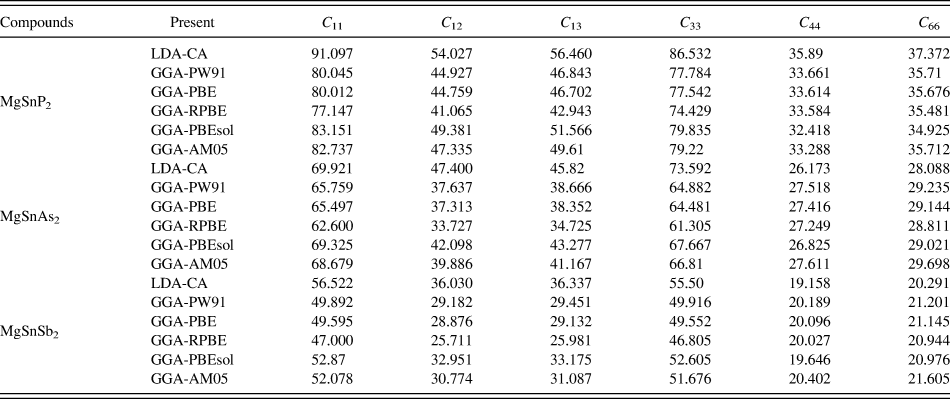
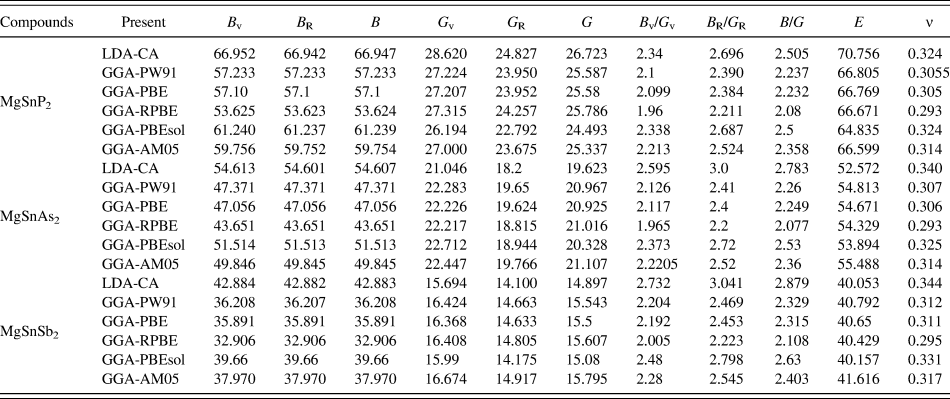
The values of six independent elastic constants for these body centered tetragonal phases (C 11, C 12, C 13, C 33, C 44, and C 66 see Table II) were estimated by calculating the stress tensors on strains applied to equilibrium structure.Reference Page and Saxe30,Reference Mehl, Osburn, Papaconstantopoulos and Klein31 Our obtained elastic constants satisfy all the stability conditions given earlier.Reference Abdellaouia, Ghaffour, Bouslama, Benalia, Ouerdane, Abidri and Monteil32–Reference Mouhat and Coudert35 Clearly, the absent negative values for six independent elastic constants for all selected exchange functionals suggest that all the investigated compounds are mechanically stable in this phase. So far, elastic constants have been neither measured nor calculated in the literature for these compounds. Thus, the present work is the first theoretical prediction for elastic constants. Using the calculated elastic constants, the polycrystalline elastic modulus like bulk modulus (B), shear modulus (G), and Young's modulus (E) and Poisson's ratio (ν) can be calculated using the Voigt-Reuss-Hill approximation.Reference Reuss and Angew36,Reference Hill37 Our calculated data were obtained by the relations given in Refs. Reference Sahin, Ciftci, Colakoglu and Korozlu10, Reference Abdellaouia, Ghaffour, Bouslama, Benalia, Ouerdane, Abidri and Monteil32, and Reference Shein and Ivanovskii38–Reference Peng, Chen and Yang40. The predicted valuable elastic parameters are presented in Tables III and IV allowing us to make the following conclusions:
The calculated elastic constants (C ij in GPa) for MgSnT2 (T = P, As, Sb).
The calculated bulk modulus (B in GPa), shear modulus (G, in GPa), Young's modulus (E, in GPa), B/G ratio and Poisson's ratio (ν) for MgSnT2 (T = P, As, Sb).
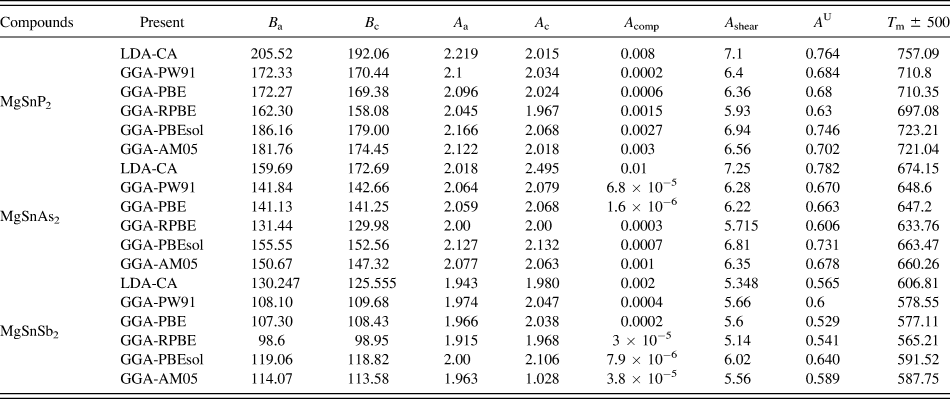
The calculated bulk modulus of B a and B c (in GPa), shear anisotropic factors of A a and A c, the percentage of elastic anisotropy for bulk modulus A comp and shear modulus A shear, universal anisotropy index A U and melting temperature (T m in K) for MgSnT2 (T = P, As, Sb).
(i) It can be seen that our obtained values of the elastic constants for LDA are higher than the all GGA values. It is also expressed that elastic constants are in order of LDA > GGA-PBEsol > GGA-AM05 > GGA-PW91 > GGA-PBE > GGA-RPBE for each compound. Our GGA-PW91 elastic constants are also almost the same that of GGA-PBE as we achieved the close results for lattice constants. It is noticeable that the obtained values of elastic constants decrease with the size of anion atom from P → Sb. For each compound, C 11 has bigger value than C 33 which means that the c-axis is more compressible than the a-axis. It is also pointed out that C 44 is lower than C 66, indicating that the shear along the (001) plane is easier relative to the shear along the (100) plane.
(ii) The bulk modulus measures the resistance of a solid to volume change by applied pressure.Reference Young, Sanloup, Gregoryanz, Scandolo, Hemley and Mao41 The bulk moduli of these compounds increase in the sequence: B(MgSnP2) > B(MgSnAs2) > B(MgSnSb2). The present values of the bulk moduli for several exchange correlation functionals are ordered same with elastic constants. It should be stressed that MgSnSb2 has a higher cell volume than MgSnAs2 and MgSnSb2 which may result in the lower bulk moduli of MgSnSb2.
(iii) The shear modulus is a measurement of resistance to shape change and is more pertinent to hardness.Reference Young, Sanloup, Gregoryanz, Scandolo, Hemley and Mao41 Because of the relationship between the elastic constants and shear modulus, the values of shear modulus are of the same order.
(iv) The Young's modulus E, the ratio between stress and strain is required to provide information about the measure of the stiffness of the solids.Reference Peng, Chen, Fu and Gao42,Reference Peng, Peng, Fu and Yang43 MgSnP2 possesses the largest Young modulus for LDA functional, thus MgSnP2 is the stiffest one. It is also noticed that Young modulus are in order of E(MgSnP2) > E(MgSnAs2) > E(MgSnSb2).
(v) According to criterion,Reference Peng, Chen and Yang45 a material is brittle/ductile if the B/G ratio is less/higher than 1.75. The values of the B/G for these compounds are higher than 1.75; hence, all of them exhibited in a ductile manner.Reference Peng, Peng, Fu and Yang43 Furthermore, the ductile manner is also related to Cauchy pressure. For tetragonal crystals C 13–C 44 > 0, C 12–C 66 > 0 means ductile, while negative Cauchy pressure denotes brittle manner.Reference Pettifor44 In this case, these compounds exhibit positive Cauchy pressure, suggesting ductility.
(vi) Poisson's ratio is the ratio of transverse contraction strain to longitudinal extension strain in the direction of stretching force. Tensile deformation is considered positive and compressive deformation is considered negative. The definition of Poisson's ratio contains a minus sign so that normal materials have a positive ratio.Reference Sokolnikoff46 Poisson's ratio v is an important mechanical property which related to the compressibility. And it is also interpreted to chemical bonding forces than any of the other elastic constants.Reference Peng, Peng, Fu and Yang43,Reference Peng, Chen and Yang45 The lower limit and upper limit of Poisson's ratio ν are given as 0.25 and 0.5 for central forces in ionic solids, respectively.Reference Peng, Chen and Yang45 Calculated ν values for different approximations change between 0.293–0.324, 0.293–0.340, and 0.295–0.344 for MgSnP2, MgSnAs2, and MgSnSb2, respectively. These results demonstrate that interatomic forces are central in nature for all considered compounds. In our case, we found Poisson's ratio the sequence in ν(MgSnP2) < ν(MgSnAs2) < ν(MgSnSb2). On the other hand, Poisson's ratio v > 0.25Reference Aydin and Simsek47 corresponds to the large deformation of volumetric change and high anisotropy. This means that the MgSnT2 compounds exhibit larger deformation to the volume changing and they would have higher anisotropy.
(vii) To gain more information about the mechanical properties, we predicted the bulk modulus and anisotropic factors along the a axis (Ba) and the c axis (Bc)Reference Fu, Li, Peng, Gao and Cheng34,Reference Ravindran, Fast, Korzhavyi and Johansson48 as listed in Table IV. It can be concluded that the bulk moduli along the c-axis are smaller than those along the a-axis for all investigated compounds. Therefore, the c-axis is harder to be compressed compared with the a-axis.
The shear anisotropic factors provide a measure of the degree of anisotropy in the bonding between atoms in different planes. Our calculated results are listed in Table IV. For tetragonal structure, the shear anisotropy factors in the {100} and {001} planes are as follows in equations:Reference Fu, Li, Peng, Gao and Cheng34,Reference Ravindran, Fast, Korzhavyi and Johansson48
 $${{A^{\left\{ {100} \right\}}} = {{4{C_{44}}} \over {{C_{11}} + {C_{33}} - 2{C_{13}}}}}\quad {{A^{\left\{ {001} \right\}}} = {{2{C_{66}}} \over {{C_{11}} - 2{C_{12}}}}}$$
Our obtained values of shear anisotropy factors suggest that these compounds have strong elastic anisotropy of the chalcopyrite phase, both {100} and {001} planes.
(viii) We have also calculated the percentage elastic anisotropy for polycrystalline materials that is defined as A comp = (B V − B R)/(B V + B R) and A shear = (G V − G R)/(G V + G R) in compressibility and shear, respectively.Reference Peng, Peng, Fu and Yang43,Reference Peng, Chen and Yang45 In these expressions, the value of zero corresponds to the elastic isotropy and the value of 100% identifies the largest elastic anisotropy. The calculated results for A B and A G are collected in Table IV. The values of Acomp and Ashear in Table IV indicate that these compounds exhibit large elastic isotropy in compressibility and small elastic anisotropy in shear. Another important elastic anisotropy factor is known as universal anisotropy index A UReference Ranganathan and Ostoja-Starzewski49 which is given by the following relation: A U = [5 (G V/G R) + (B V/B R)] − 6. If A U is equal to zero, elastic isotropy exists. On the other hand, the deviations of A U from zero also show elastic anisotropy. It is noticed that three compounds exhibit elastic anisotropy.
(ix) Finally, our calculated elastic constants can be used to estimate a melting temperature for each of the compounds for various exchange-correlation functionals. For tetragonal structure, the empirical equation of melting temperatureReference Fine, Brown and Marcus50,Reference Alouani, Albers and Methfessel51 is given by (T m/K) = 354 + 4.50[(2C 11 + C 33)/3 GPa] ± 500. Our calculated results indicate that the melting points decrease with the size of anion atom from P → Sb (Table IV).
C. Electronic properties
We now turn our attention to analyze electronic band structure, total and partial density of states (PDOS) as well as an electronic charge density of MgSnT2 (T = P, As, Sb) compounds. Exchange correlation energy functionals play a vital role in the efficiency of DFT calculations, more soundly in the calculation of fundamental electronic energy band gap.
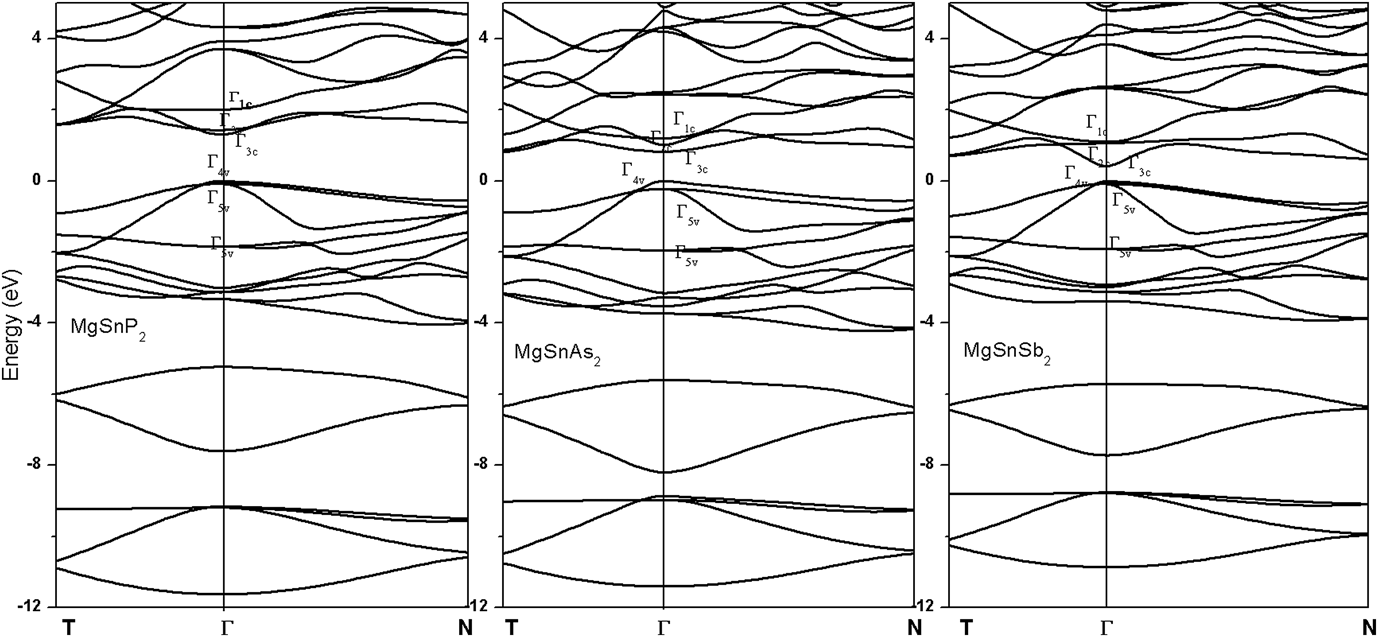
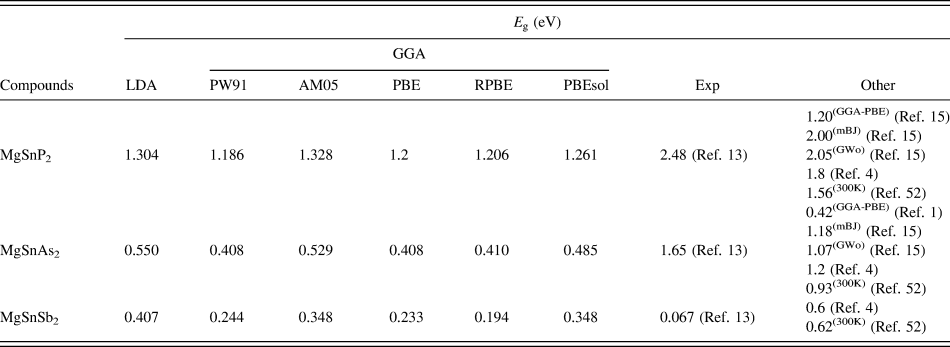
In Fig. 2, we presented the electronic band structure along high-symmetry points in the Brillouin zone of the body centered tetragonal for these compounds under zero pressure and temperature. Since the valance band top and the conduction band bottom are located at Γ-point, these compounds are a direct semiconductor compounds and the obtained value of energy band gap is found to be 1.304, 0.550, and 0.407 eV using LDA scheme of MgSnT2 (T = P, As, Sb) compounds, respectively. The computed band gap values at chosen exchange correlation functionals are presented in Table V with the existing studies. According to Table II, our finding values of LDA scheme are somewhat smaller than experimental valuesReference Suh and Rajan13 (2.48 eV for MgSnP2 and 1.65 eV for MgSnAs2). It is roughly 47 and 66.7 % smaller than experimental studyReference Suh and Rajan13 for MgSnP2 and MgSnAs2, respectively. Our GGA-PBE predictions are consistent with Ref. Reference Shaposhnikov, Krivosheeva and Borisenko15 using the GGA-PBE calculation, while these results show an intermediate error compared to the GW. It is also seen that GW significantly change both LDA and GGA picture of the band gap.Reference Shaposhnikov, Krivosheeva and Borisenko15 The computed values are slightly different from those given in Ref. Reference Jaffe and Zunger4 and Reference Zhaochun, Ruiwu and Nianyi52 and the experiment resultsReference Suh and Rajan13 are very high as compared to our values for all compounds as expected from DFT results. This is most likely related to DFT which cannot be properly described in the band gap values.
LDA band structures of MgSnT2 (T = P, As, Sb) compounds along some high-symmetry directions of the brillouin zone.
The calculated band gap energies of MgSnT2 (T = P, As, Sb) compounds.
Comparing GGA functionals with those obtained by us, GGA-AM05 is bigger than other functionals. It can be seen also from Table V that if we compare the experimental measurements with our results calculated with different exchange-correlation functionals, the best agreement is obtained within the LDA scheme. Thus, from now on we have decided to use the LDA functional for the electronic properties as well as optical and lattice dynamical calculations. The usage of PAW formalism chosen for various exchange correlation potential seems also influenced the results of band gap energy significantly. More specifically, it is observed that the computed value of band gap decreases from MgSnP2 to MgSnSb2. Generally, it should be expressed that the behavior of the electronic band structures is very similar except for the values of their band gaps.
To clarify the contribution of each orbital of these atoms, we computed PDOS of MgSnT2 (T = P, As, Sb) using LDA scheme as given in Figs. 3(a)–(c). The DOS graphs of the semiconducting MgSnT2 (T = P, As, Sb) compounds show the PDOS nearly with same shape. The lowest valence band between about −12.5 eV and −9.5 eV consists mainly of the anion (P, As, and Sb)-s states with a minor contribution coming from the mixture of Sn-s and -p states. The PDOS between about −7.5 and −5 eV is due to mainly the Sn-s states. The electronic structure below the Fermi energy between −4.5 and 0 eV comes from the mixture of Sn-p with the anion (P, As and Sb)-p states. The conduction band is composed of Sn-s and -p states and anion T (P, As and Sb) -p states.
To have an explicit understanding of the interaction among different orbitals of atoms, the charge densities of MgSnT2 (T = P, As, Sb) are calculated. The contour maps of the charge density in (111) plane are given in Fig. 4 using VESTA (Visualization for Electronic and Structural Analysis). It can be noticed from Fig. 4 that the strong covalent bonding occurs between Sn atom and anions (P, As, and Sb) and the weak ionic bonding exists between Mg and anions (P, As and Sb). The main contributions of covalence come from sp hybridization of Sn and anions.
The total and partial electronic DOS for (a) MgSnP2, (b) MgSnAs2, and (c) MgSnSb2 as calculated using the LDA.
Electronic charge density of a) MgSnP2, b) MgSnAs2 and c) MgSnSb2 compounds in the (111) plane within LDA (prepared by VESTAReference Momma and Izumi53).
D. Optical properties
To learn more about the technological importance of these compounds, we focus our attention on optical properties using LDA functional, which gives reasonably satisfactory results for electronic band structure between all the exchange-correlation functional studied here. The calculated real and imaginary parts of the dielectric function ε(ω) as a function of photon energy are illustrated in Figs. 5(a) and (b) for the energy range up to 15 eV. As the crystal structure of MgSnT2 (T = P, As, Sb) compounds is body centered tetragonal, they are characterized by two independent tensor components (perpendicular and parallel to c axis) of the dielectric tensor. The static perpendicular real part of the dielectric function, ε1⊥(0) are found to be 11.357, 13.085, and 16.164 for MgSnT2 (T = P, As, Sb), respectively. And the static parallel real part of dielectric function ε1∥(0) 11.617, 13.654, and 16.996 for MgSnP2, MgSnAs2, and MgSnSb2, respectively. One can notice that from P to Sb, the peaks in the ε1(ω) increase and shift to the low energy region. Using δε = [ε1∥(0) − ε1⊥(0)/εtotal(0)] relation,Reference Reshak, Alahmed and Azam54 we calculated uni-axial anisotropy and they were found to be about 0.011, 0.021, and 0.025 for MgSnP2, MgSnAs2, and MgSnSb2, respectively. It means that the difference between perpendicular and parallel real part of dielectric function suggest the anisotropic behavior of optical property for MgSnT2 (T = P, As, Sb) compounds in chalcopyrite phase. For larger photon energies about 4.83 eV, 4.43 eV, and 3.89 eV the real part becomes negative for MgSnP2, MgSnAs2, and MgSnSb2, respectively. As it can be seen from Fig. 5(b), these compounds have two major groups of the peaks. The first important peak of the imaginary part of the dielectric function ε2⊥(ω) is located at 2.56, 2, 1.63 eV and ε2∥(ω) is also found to be 2.414, 2, and 1.5 eV for MgSnP2, MgSnAs2, and MgSnSb2, respectively, which are related to interband transitions between the valence and conduction bands. These results can be compared favorably with experimental results of band gap energy. Shaposhnikov et al.Reference Shaposhnikov, Krivosheeva and Borisenko15 investigated the optical properties of MgSnP2 and MgSnAs2 compounds. They found that the imaginary part of the dielectric function ε2(ω) are at about 2.0 eV for MgSnP2 and 1.2 eV for MgSnAs2 which agree with our results. With the comparisons of MgSnP2, MgSnAs2, and MgSnSb2, we can see that the peak of MgSnP2 shifts to a higher energy, which is the related to the band-gap energy changed from P to Sb. While the calculated maximum peak values of perpendicular imaginary part of the dielectric function ε2⊥(ω) are 4.26, 3.85, and 3.42 eV for MgSnP2, MgSnAs2, and MgSnSb2, the parallel imaginary parts of dielectric function ε2∥(ω) are located at 3.69, 3.42, and 2.89 eV for MgSnP2, MgSnAs2, and MgSnSb2, respectively.
The computed (a) real and (b) imaginary part of the dielectric function of MgSnT2 (T = P, As, Sb) compounds versus photon energy at 0 GPa and 0 K.
The calculated refractive index n(ω), extinction coefficients k(ω), reflectivity R(ω), and energy loss function L(ω) are estimated by Kramer–Kroning relations.Reference Adachi55,Reference Ravindran, Delin, Johansson, Eriksson and Wills56 Our obtained results are plotted in Figs. 6(a)–(d). The calculated refractive index is displayed in Fig. 6(a) for three compounds. While the predicted values of perpendicular static refractive index n ⊥(0) are 3.37, 3.617, and 4.02, the parallel static refractive index values n ∥(0) are 3.408, 3.695, and 4.123 for MgSnP2, MgSnAs2, and MgSnSb2, respectively. The main peak values of refractive index for MgSnP2, MgSnAs2, and MgSnSb2 are 4.2 at 2.27 eV, 4.25 at 1.713 eV and 4.65 at 1.2 eV, respectively. We note that the refractive index reaches maximal values for the energies near the band gap energy. From Fig. 6(b), we have predicted the extinction coefficients for MgSnP2, MgSnAs2, and MgSnSb2 to be 2.8, 2.64, and 2.80, respectively. As it can be seen from Fig. 6(c), while the static perpendicular reflectivity R ⊥(0) is 0.294, the maximum values of that is about 0.76 at 15.625 eV. While the static parallel reflectivity R ∥(0) is 0.298, the maximum values of that is about 0.618 at 15.34 eV for MgSnP2. For MgSnAs2, the static reflectivity of R ⊥(0) and R ∥(0) are 0.321 and 0.33, but the maximum values of that is about 0.637 at 14.73 eV and 0.65 at 14.49 eV, respectively. While the calculated static reflectivity of R ⊥(0) and R ∥(0) are 0.362 and 0.372, the maximum values of that are about 0.654 at 13.92 eV and 0.67 at 14.35 eV of MgSnSb2. One further point of interest is energy loss functions, which is an important factor describing the energy loss of a fast electron traversing in a material, as shown in Fig. 6(d) for these compounds. The maximum peaks in the energy-loss function indicate that plasmon resonance occurs at around 17.05, 15.625, and 14.56 eV for MgSnP2, MgSnAs2, and MgSnSb2, respectively. It can be pointed out that the plasma frequency of MgSnP2 is the largest one.
The computed (a) refractive index n(ω), (b) extinction coefficient k(ω), (c) reflectivity R(ω), and (d) electron energy loss spectrum L(ω) of MgSnT2 (T = P, As, Sb) compounds versus photon energy at 0 GPa and 0 K.
Figure 7 displays the variation of birefringence Δn (ω) with the photon energy for MgSnT2 (T = P, As, Sb) compounds. It is defined that the difference between the index of refraction for an electric field oriented along the c-axis (n ∥) and the index of refraction for an electric field perpendicular (n ⊥) to the c-axis (Δn = n ∥ − n ⊥). It is also related to fulfill phase-matching condition.Reference Chiker, Kebbab, Miloua and Benramdane12,Reference Reshak and Auluck57 The static values of the birefringence Δn(0) are 0.038, 0.078, and 0.102 eV for MgSnP2, MgSnAs2, and MgSnSb2, respectively. These results indicate that they are a phase matchable. It can be noticed that the general tendency of Δn(ω) for these compounds is similar features, but MgSnSb2 has higher value than others. The positions of the peaks also shift to lower energy regions as we replace the anion element from P to Sb.
The calculated birefringence Δn(ω) versus photon energy of MgSnT2 (T = P, As, Sb) compounds.
E. Vibrational and thermal properties
Knowledge of phonon characteristics is required to describe mechanical, acoustic, dynamic, spectroscopic, and thermodynamic properties of crystals at finite temperature. The easiest and most convenient way to calculate phonons from first-principles is to use existing and well-tested DFT softwares,Reference Kresse and Joubert20,Reference Kresse and Hafner21,Reference Blaha, Schwarz, Madsen, Kvasnicka and Luitz58,Reference Artacho, Gale, García, Junquera, Ordejón, Sánchez-Portal and Soler59 which can calculate crystalline structures, electronic bands, magnetic properties, and so called Hellmann–Feynman forces.
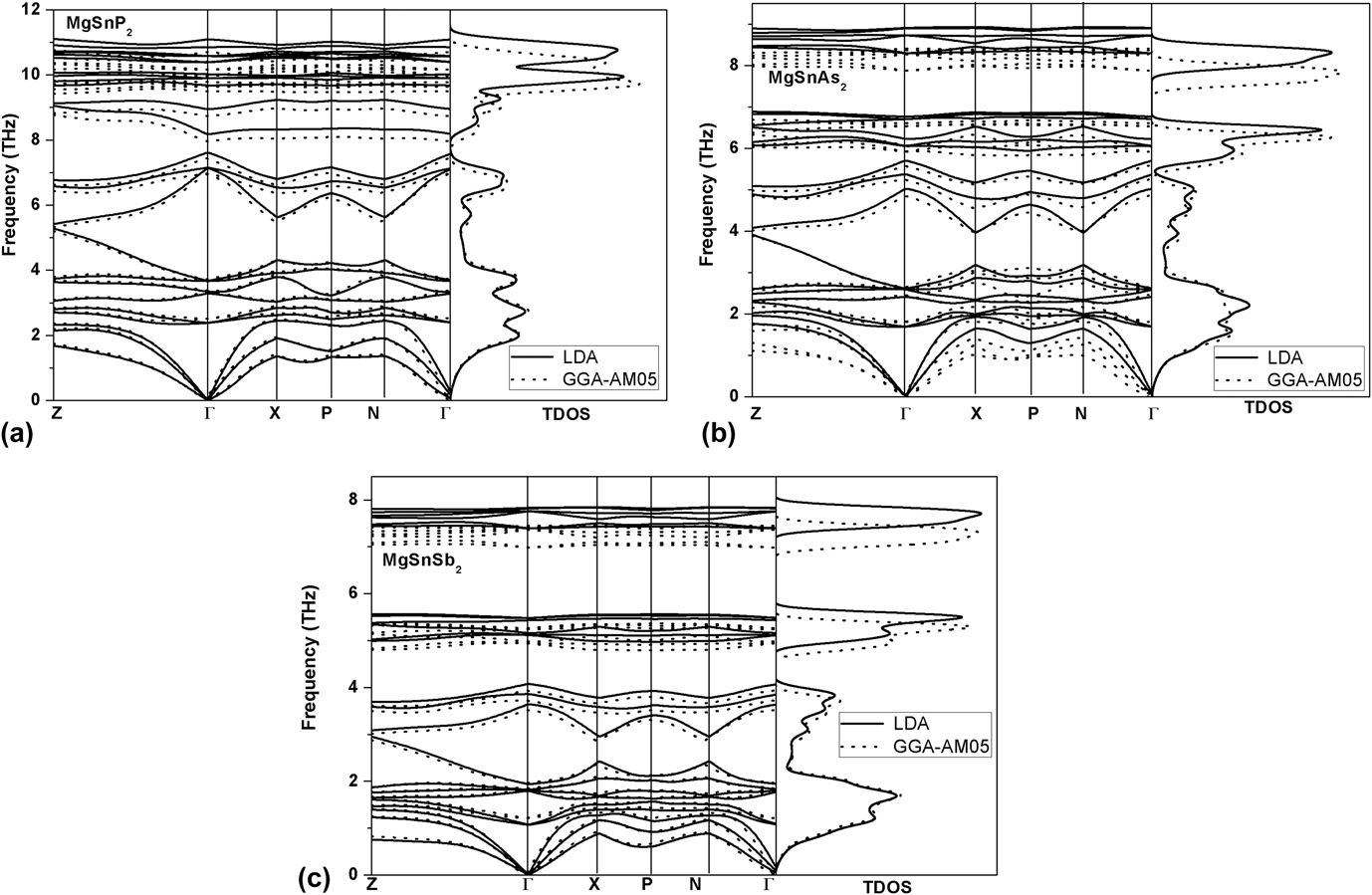
The density-functional perturbation theory employing the force constant method has been used to calculate the phonon dispersion relation and phonon DOS for MgSnT2 (T = P, As, Sb) compounds using both LDA and new functional of GGA-AM05. Throughout this calculation, we used PHONOPY codeReference Togo60 with 2 × 1 × 1 supercell. The phonon dispersion curves along the Z–Γ–X–P–N–Γ high-symmetry directions together with the total phonon density are displayed in Fig. 8 and phonon PDOS are also shown in Fig. 9 for each compound. For the chalcopyrite structure ( $I\bar 42d$) primitive cell, there are eight atoms. Thus, there should be twenty one optical modes and three acoustic modes. Unfortunately, there is no available experimental data for MgSnT2 (T = P, As, Sb) compounds based on phonon dispersion curves. Therefore, we cannot conclude that LDA or GGA exchange-correlation functional gives better results to compare our calculated results of phonon spectrum. On the other hand, our estimated main features of the phonon dispersion and partial phonon DOS can be compared with previous ab-initio calculationsReference Shi, Hu, Qin, Duan, Wu, Yang and Tang17 for BeSiV2 and MgSiV2 (V = P, As, Sb) compounds. Their calculation revealed that the character of vibrational spectra of these crystalline compounds is found to be governed by both chemical bonding strengths and masses of structural units. They noticed that the Si–V bonding is remarkably stronger than the Mg–V bonding in Mg-containing chalcopyrite semiconductors. Their suggestion also consists well with our prediction. Generally, it should be stressed that the calculated phonon spectra and phonon DOS for these chalcopyrites are qualitatively similar to each other. It is also important to notice that all calculated optical and acoustic modes have no soft mode at any wave vectors, suggesting their vibration stability for MgSnT2 (T = P, As, Sb). While the lower acoustic frequencies for LDA and GGA-AM05 functional have almost given similar results, the higher optic frequencies LDA is bigger than that of GGA-AM05 values. When looking at the total DOS in Fig. 8, it looks as if it was simply shifted below when changing the exchange-correlation functionals from LDA to GGA-AM05.
Phonon dispersion curves and total phonon DOS for (a) MgSnP2, (b) MgSnAs2, and (c) MgSnSb2. The solid lines represent the LDA and dashed lines are GGA-AM05.
Phonon PDOS of MgSnT2 (T = P, As, Sb) as calculated using the LDA.
As it can be seen in Fig. 9(a), the phonon PDOS of MgSnP2 consist of two groups of regions: the lower modes with frequencies up to ∼7 THz are mixed states composed of the Mg, Sn, and P atoms and from 8 to 11.5 THz are predominately Mg and P atoms. MgSnAs2 and MgSnSb2 compounds divided into three groups of regions (see Figs. 9(b)–9(c)). The first region with frequencies up to ∼5.7 THz for MgSnAs2 and ∼4.25 THz for MgSnSb2 mixed of Mg, Sn, and anions (As and Sb). The main contribution of the middle region for MgSnAs2 and MgSnSb2 between 5.8–7 THz and 4.6–6 THz comes from Sn and anions (As and Sb). The vibrations of the Mg atom are dominant in the upper range of 8 THz for MgSnAs2 and 7 THz for MgSnSb2.
Phonon dispersion curve plays a key parameter in dynamical behaviors and thermal properties such as constant volume heat capacity (C v), Helmholtz free energy (F), and entropy (S), internal energy (E). As a final remark, the temperature dependence of the C v and S of MgSnT2 (X = P, As, Sb) is estimated using the quasi harmonic approximation as is given following equation.Reference Togo and Tanaka61
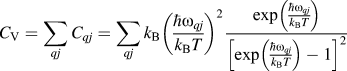 $${C_{\rm{V}}} = \sum\limits_{qj} {{C_{qj}}} = \sum\limits_{qj} {{k_{\rm{B}}}} {\left( {{{\hbar {\omega _{qj}}} \over {{k_{\rm{B}}}T}}} \right)^2}{{{\rm{exp}}\left( {{{\hbar {\omega _{qj}}} \over {{k_{\rm{B}}}T}}} \right)} \over {{{\left[ {{\rm{exp}}\left( {{{\hbar {\omega _{qj}}} \over {{k_{\rm{B}}}T}}} \right) - 1} \right]}^2}}}$$
 $$S = {1 \over {2T}}\sum\limits_{qj} {\hbar {\omega _{qj}}\;{\rm{coth}}\left[ {{{\hbar {\omega _{qj}}} \over {2{k_{\rm{B}}}T}}} \right]} - {k_{\rm{B}}}\sum\limits_{qj} {{\rm{ln}}\left[ {2\;\sinh \left( {{{\hbar {\omega _{qj}}} \over {2{k_{\rm{B}}}T}}} \right)} \right]}$$
In Fig. 10(a), we denote the calculated heat capacity at constant as a function of temperature for these compounds. Clearly, the heat capacity increases linearly with the temperature (∼T < 300 K), but the rate of increase is very moderate especially at high pressures as the heat capacity reaches the classical Dulong Petit limit. The computed values of heat capacity at constant volume at 300 K are 176.29, 185.75, and 189.58 J/mol K for MgSnT2 (T = P, As, Sb), respectively.
Variation of (a) heat capacity at constant volume (C v) and (b) entropy (S) as a function of temperature for MgSnT2 (T = P, As, Sb) compounds within LDA approximation.
The variations of entropy of all considered compounds from 0 K to 1000 K are presented in Fig. 10(b) under zero pressure within LDA functional. This figure revealed that their entropy's are zero at 0 K, when the entropy increases considerably with increasing temperature in low temperature and then the variation of entropy is small above about 300 K. The values of entropy at 300 K are found to be 226.45, 280.39, and 326. 67 J/mol K for MgSnT2 (T = P, As, Sb), respectively. Obviously, it is observed that the entropy increases as we replace anion T from P to Sb. Generally, it is noticeable that the temperature variation of thermo dynamical functions exhibits a similar trend for these compounds.
IV. CONCLUSION
To summarize, we present structural, electronic, optical, elastic, vibration, and thermal properties of the MgSnT2 (T = P, As, Sb) using the first-principles calculation choosing several exchange-correlation functional, namely, LDA, GGA-PW91, GGA-PBE, GGA-PBEsol, GGA-RPBE, and GGA-AM05. The calculated electronic band structures of all the considered compounds here show that LDA approaches give better band gap energy, therefore it is selected for further calculation of electronic, optical, and vibrational properties of these compounds. All the considered compounds are characterized as direct band gap semiconductors and may be a candidate for nonlinear optic and optoelectronic applications. We have also calculated elastic constants C ij, Young's modulus, Shear modulus, and Poisson's ratio in chalcopyrite structure in the first time. Additionally, we have calculated the optical properties such as the real and the imaginary parts of the dielectric function, reflectivity and energy loss function for radiation up to 15 eV for two different polarizations. These optical quantities indicate a considerable anisotropy.