The term medical device, as defined in the Food and Drugs Act, covers a wide range of health products used in the treatment, mitigation, diagnosis or prevention of a disease or abnormal physical condition (Reference Medical1). On occasion, problems with a device may prompt a manufacturer or importer to issue a safety alert (advisory or warning), or recall a health product. Health Canada monitors and reviews the safety of medical devices that are marketed in Canada. Manufacturers and importers of devices are obliged to identify and report problems, and, when appropriate, Health Canada works with the medical device industry to ensure hazardous products are removed from the market (2). In contrast to device manufacturers, healthcare institutions and users of medical devices are not required to report problems to Health Canada. Any person can voluntarily report problems to Health Canada, and Health Canada launched the Canadian Medical Devices Sentinel Network (CMDSNet) program in 2009 to facilitate voluntary reporting from healthcare institutions.
Little is known about the epidemiology of medical devices and the impact of medical device recalls in Canada. While some specific devices, such as cardiac pacemakers and implantable cardioverter-defibrillators (Reference Maisel, Sweeney, Stevenson, Ellison and Epstein3) and automated external defibrillators (Reference Maisel, Moynahan and Zuckerman4), have been subject to frequent safety alerts, few studies have used epidemiologic methods to objectively describe the type and number of recalls for medical devices in general.
When we began this research project, we were interested in understanding several fundamental questions about medical devices in Canada, including the number of devices that are licensed annually, the number of device recalls, and rate at which medical devices are removed from the marketplace. We were ultimately unable to address some of these questions due to lack of certain types of data (most importantly, the number of devices in the marketplace at any point in time). The purpose of this study, therefore, was to identify the number and type of devices that were recalled in Canada over a 10-year period using data collected by Health Canada, which provides insight into the magnitude of the problem of potential harms due to medical devices. This information contributes to the global literature on the safety of medical devices. It is also relevant to policy makers, health system leaders, clinicians, and regulators in Canada and elsewhere, to understand the possible public health risks posed by medical devices, and to explore whether current approaches to postmarket surveillance of medical devices are appropriate.
METHODS
Regulation of Medical Devices in Canada
Health Canada is the federal department responsible for medical device licensing, surveillance, and reporting of advisories and recalls. Medical devices in Canada are categorized into four risk classes, based on their risk and “invasiveness,” from lowest (Class I) to highest (Class IV). Examples of Class I devices are hospital beds, ceiling and patient floor lifts, and crutches. Health Canada does not review and provide individual licenses for Class I products; facilities that manufacture Class I products require establishment licenses; Health Canada periodically inspects these facilities to ensure compliance with the Medical Devices Regulations. Class III and IV devices undergo a premarket license evaluation by Health Canada to evaluate their safety and effectiveness. Manufacturers of Class II devices submit the licensing requirements with an attestation to Safety and Effectiveness data. Manufacturers of Class II, III, and IV devices must also pass a premarket quality management system audit performed by a Health Canada recognized registrar.
Thousands of new medical device license applications are submitted each year to Health Canada; the nature of the supporting documentation required varies according to the class. Examples of Class II devices are endoscopes, surgical gloves, and pregnancy test kits; examples of Class III devices are orthopedic joint implants, glucose monitors, and diagnostic ultrasound systems; and examples of Class IV devices are cardiovascular implants, angioplasty catheters, and HIV test kits. One license can include more than one Device ID (Health Canada assigns a unique Device ID to each product representing a specific Class II–IV device that it licenses for market). Licensed medical devices can be searched through publically accessible databases.
A recall is defined in the Medical Devices Regulations as any action taken by the manufacturer, importer, or distributor of the device that has been sold, to recall or correct the device, or to notify its owners and users of its defectiveness or potential defectiveness, after becoming aware that the device: (i) may be hazardous to health; (ii) may fail to conform to any claim made by the manufacturer or importer relating to its effectiveness, benefits, performance characteristics, or safety; or (iii) may not meet the requirements set in the Act or the Regulations (5). Health Canada can also issue a recall independently. Most recalls in Canada are “Field Safety Notifications” (advisory statements), and do not result in a health product being removed from the market (2).
If a manufacturer or importer is concerned about the safety or performance of a device or seeks to remove it from the market, it must issue a recall and report it to Health Canada. Recalls may also include actions of manufacturers and importers such as issuing labelling changes, or changes to the indications of a device. Health Canada then assesses the cause of the problem, reviews the product disposition, and assigns an appropriate health risk assessment for a recall according to the perceived health risk posed by the product subject to a recall notice (6).
This risk assessment is assigned one of three Hazard Priority classifications, according to the relative degree of health risk posed by the product. Type I (“Serious”) refers to a reasonable probability that the use of, or exposure to, a product will cause serious adverse health consequences or death (example, the separation of pacemaker wires that connect the electronic circuit to the battery component); Type II (“Temporary”) suggests that the use of, or exposure to, a product may cause temporary adverse health consequences or where the probability of serious adverse health consequences is remote (example, needles labeled as sterile, but were not); Type III (“Unlikely”) suggests the use of, or exposure to, a product is not likely to cause any adverse health consequences (example, the mislabeling of an expiration date on laboratory culture media). Hazard Priority classifications are not related to device risk class. Every recall event is assigned a unique Recall Incident ID by Health Canada, and recalls and safety alerts are publically available. Safety alerts comprise several different types of communications from Health Canada, including product recalls, but also other actions such as public advisories, information updates, public communications, notices to hospitals, and health professional communications.
Data Sources
To collect information on licensed medical devices, we used information provided by Health Canada, and the Medical Devices Active License Listing (MDALL), a database of all licensed Class II, III, and IV medical devices. MDALL contains product-specific information on all medical devices that are currently licensed for sale in Canada, or have been licensed in the past (7).
We collected information on medical device recalls for the 10-year period January 1, 2005, to December 31, 2014, using the Recall and Safety Alerts Database (RSAD), which contains information on recalls and safety alerts related to consumer products, vehicles, food, and health products in Canada (8). Because the RSAD is incomplete for medical devices due to the time required to backfill records, we also obtained complete information on all medical device recalls during this time period directly from Health Canada. The RSAD does not automatically include all incidents reported through CMDSNet.
Multiple spreadsheets were provided to us by Health Canada describing events from January 1, 2005, to November 4, 2014. A master file of unique Recall Incident IDs was created. We included data on recall date, Web posting date, device class, hazard classification, device name, manufacturer, original license date (when applicable), and reason for recall. We examined the original files to determine how many unique device IDs were included in each recall, to ensure we had information on each individual medical device subject to a recall. Missing data were looked up manually from MDALL and RSAD. Discrepancies were addressed directly with Health Canada. The data were then updated to December 31, 2014, using RSAD.
Data were further grouped according to specific categories for analysis. We created a list of categories to identify the main purpose of the device. For example, devices used directly on the patient for surgery were classified as surgical instruments, whereas devices used during surgery, but not directly on the patient, were labeled as surgical equipment. Other examples of device categories included diagnostic imaging equipment, laboratory analyzers, hospital beds, ceiling and patient floor lifts, and prosthetic joint implants.
To estimate the entry of new medical devices into the marketplace, we obtained information from Health Canada on the number of new medical device licenses issued for Class II, III, and IV devices in the fiscal years 2005–06 to 2014–15. New licenses represent a fraction of the number of actual devices entering the market; one license is usually associated with more than one device, individual licenses are not required for Class I medical devices, and amendment applications also integrate new products into the market.
Data Analysis
Although we wanted to estimate the rate of recalls and safety alerts among medical devices, there is no way to accurately determine the number of licensed products on the market, due to the lack of individual licenses for Class I devices, and the fact that many health products licensed in the past are no longer in use despite not being subject to a recall or safety alert.
We, therefore, calculated the number of medical device recall events per year according to device class, and graphed the number of recalls by year according to Hazard Priority classification. We also compared the distribution of Hazard Priority classifications according to the Device Class of the recalled device. Finally, we described the most common device categories associated with recalls, according to the Hazard Priority classification. The study protocol was approved by the University Health Network Research Ethics Board UHN REB 14-7708-AE.
RESULTS
New Medical Device Licenses
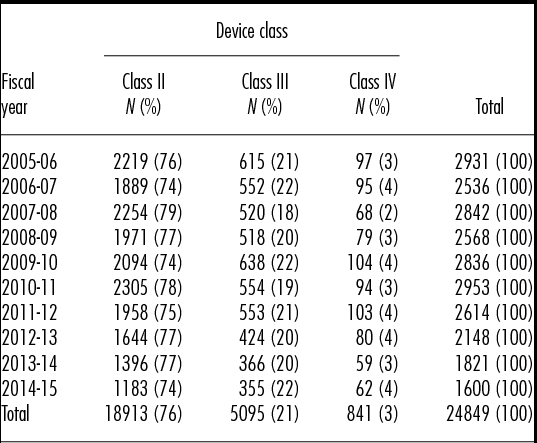
Table 1 shows the number of new medical device licenses between April 1, 2005, and March 31, 2015, by fiscal year and device class for Class II, III, and IV devices (Class I devices are not assigned individual licenses). During this time period, 24,849 new device licenses were issued. Overall, the majority of licensed devices were Class II low risk devices (18,913; 76.1 percent). A total of 5,095 (20.5 percent) were Class III moderate risk devices, and 841 (3.4 percent) were Class IV high risk devices.
Number of New Medical Device Licenses Issued in Canada from Fiscal Years 2005–06 to 2014–15

Note. Data provided by Health Canada. Class I medical devices do not require an individual device license in Canada. The reason for the relative decline in the number of devices in the final year is not clear, it may be due to delays in reporting registration data, or may be due to a real decline in the number of events.
Recalls
During the 10-year period from January 1, 2005, to December 31, 2014, there were 7,382 unique Recall Incident IDs. The number of recall events as identified by Recall Incident IDs is smaller than the number of individual health products included in recalls; a total of 13,192 unique device IDs were affected in the 7,382 recalls issued by Health Canada. Overall, 5,281 of the 7,382 recalls (71.6 percent) were associated with a single Device ID rather than multiple products. The mean number of devices associated with a recall event was 1.8 (standard deviation [SD] 2.6; median 1.0; range 1 to 69). Furthermore, some devices had multiple recalls during the 10-year time period; for example, one automated external defibrillator was subject to twenty-three recalls over the 10-year period, and a linear accelerator, twenty recalls.
We were unable to identify the date of the recall or Device Class for several devices included in recall events. The date was missing for forty-seven recalls, and we were unable to identify the device class in eight cases. Also, 101 recalls were for products that were not associated with a license from Health Canada. Some of these 101 recalls were for products that were marketed but were never licensed for sale in Canada, such as ear candles, toothbrushes, and enema kits. Ultimately, we were able to further analyze 7,226 medical device recalls (Supplementary Table 1). The Device Classes most commonly associated with recalls were Class II (40.1 percent) and Class III (38.7 percent) devices. It is not possible to estimate the rate of recalls over time, because the number of devices on the market at any given time is unknown. However, the absolute number of recalls increased over time, from 479 in 2005 to a high of 941 in 2013.
Recalls by Hazard Priority
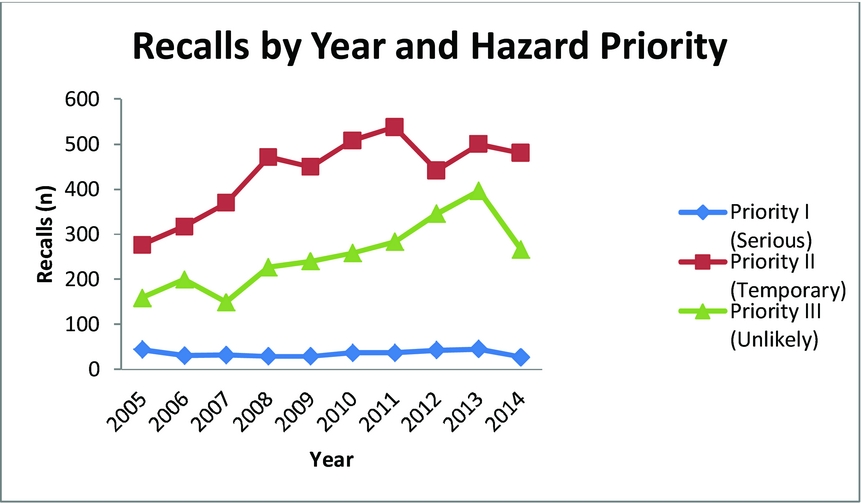
Over the 10-year period, there were 2,524 (34.7 percent) recalls for devices unlikely to cause adverse health consequences (Priority III), 4,348 (60.3 percent) recalls for devices that may cause temporary adverse health consequences but with a remote probability of serious adverse consequences (Priority II), and 354 (5.0 percent) devices with a reasonable probability of serious adverse health consequences or death (Priority I).
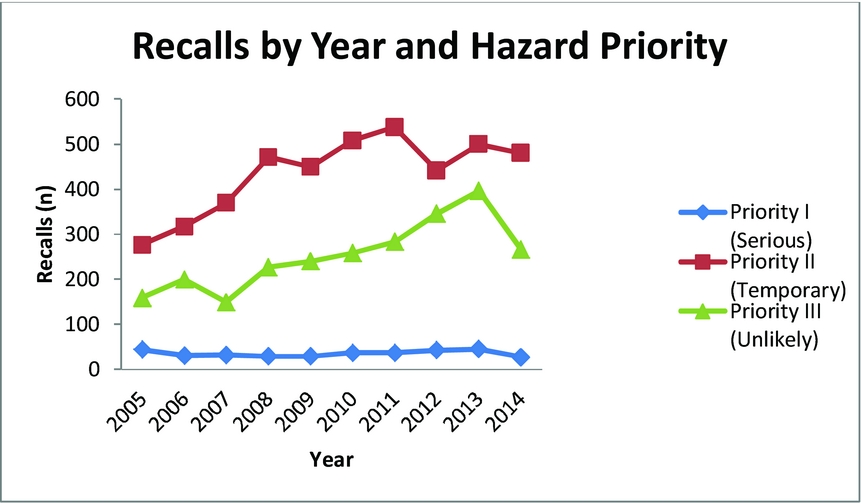
Figure 1 shows the number of recalls by year and device hazard priority level. The number of recalls for devices considered to have remote or unlikely risk of hazard increased from 2005 to 2014, while the number of recalls for devices considered as having a reasonable probability of serious adverse health consequences or death remained relatively consistent.
Number of recalls from 2005 to 2014 by year and Hazard Priority classification.
Recalls by Risk Class and Hazard Priority Level
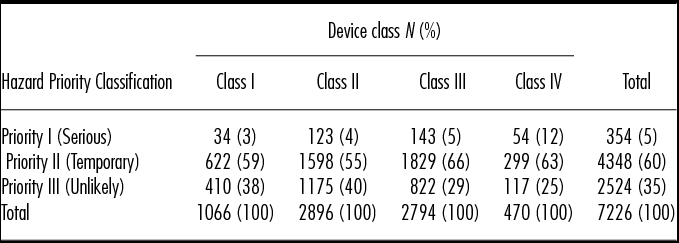
Table 2 shows the association between the risk class and hazard priority level of devices recalled from 2005 to 2015. Among devices that were recalled, Class IV devices were more likely to be associated with the most serious priority level of recall (11.9 percent) than Class III (5.2 percent), Class II (4.3 percent), and Class I (3.2 percent) devices (p < .001).
Medical Device Recalls in Canada by Device Class and Hazard Priority Classification, 2005–2014

Note. Data compiled from information from the Recall and Safety Alerts Database (RSAD) and data provided by Health Canada.
Recalls by Device Category and Hazard Priority Level
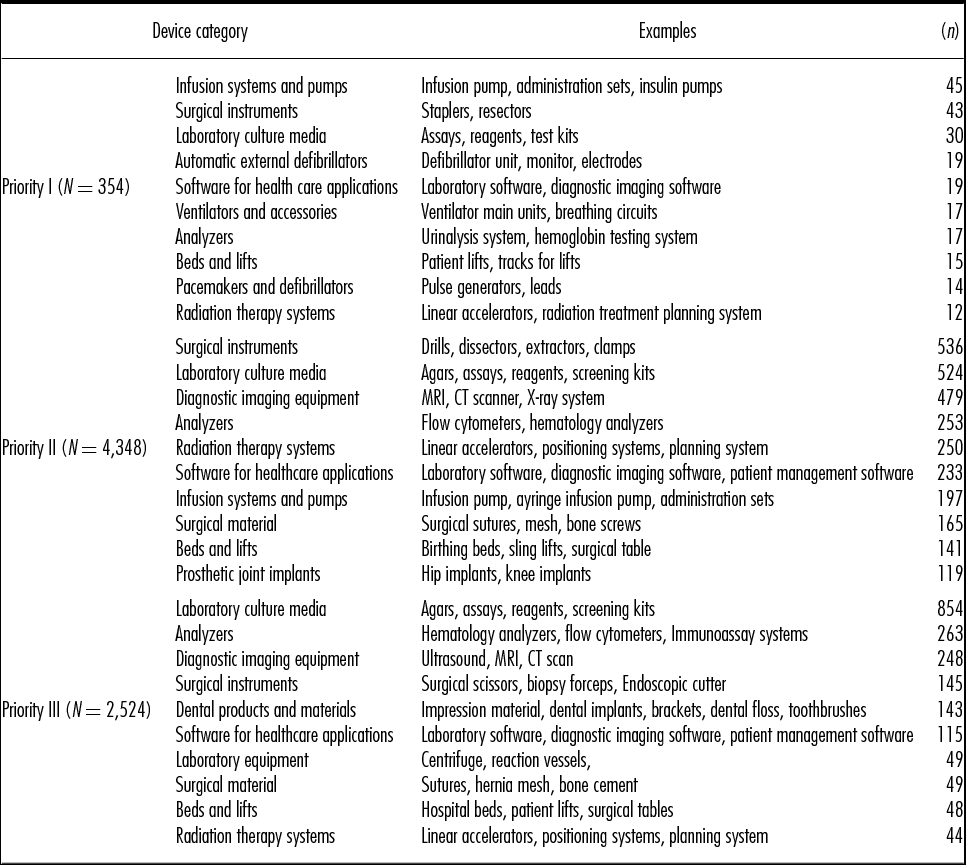
Table 3 presents the ten most frequent device categories subject to a recall, according to the Hazard Priority classification. Surgical instruments, laboratory culture media, analyzers, hospital beds, ceiling lifts, and patient floor lifts were included among the most common categories of devices recalled in all Hazard Priority classes.
Most Common Types of Devices Recalled, According to Hazard Priority Classification

DISCUSSION
Many thousands of medical devices are sold in Canada. Although it is impossible to estimate the number of devices on the market, our analysis of data from Health Canada found nearly 25,000 Class II to IV medical devices were newly licensed over a 10-year period, a number that substantially underestimates the actual number of products brought to market during that period. Over a similar 10-year period, over 7,000 medical device recalls (device Class I–IV) were reported to Health Canada. Five percent of recalls were considered severe enough to be likely to cause serious adverse health consequences or death, and Class IV devices were more likely than other Device Classes to be associated with the highest severity of recall.
Drugs and medical devices are licensed by Health Canada, and both drugs and devices are approved for marketing based on considerations of their safety and effectiveness. New drug applications typically require comprehensive documentation and evidence from large randomized controlled clinical trials, whereas medical device licenses are approved based on clinical evidence according to the risk level of the device. In the United States, devices can be marketed without new clinical data if they are considered substantially similar to an existing device (Reference Maisel9). Although the language used to characterize the safety and effectiveness of medical devices appears similar to that used for licensed drugs, the process and extent of supportive evidence for device approvals is very different.
There are few published literature on the epidemiology of harms associated with medical devices. Most published studies focus on cardiovascular and orthopedic devices. A study of the U.S. Food and Drug Administration (FDA) enforcement reports found that of the 2.25 million pacemakers and 415,780 implantable cardioverter-defibrillators (ICDs) implanted in United States from 1990 to 2002, a total of 17,323 devices (8,834 pacemakers and 8,489 ICDs) were explanted due to a confirmed malfunction. A total of sixty-one deaths (thirty pacemaker, thirty-one ICD) were attributable to device malfunction (Reference Maisel, Moynahan and Zuckerman4). A search of FDA and Healthcare Recall Management websites for recalls of coronary stents between November 2002 and June 2013 found there were seventeen coronary stent recalls involving almost 500,000 individual units implanted in patients. The common reasons for recall were concerns with sterility (29 percent) followed by wrong labeling or packaging (23 percent), and impaired delivery of stent (18 percent) (Reference Kumar, Innasimuthu and Marmur10).
Currently, the onus falls primarily on the medical device industry to issue recalls for devices when problems are identified, although Health Canada is now able to impose a recall independently. Voluntary reporting of device-related incidents by individual health professionals is not common, and voluntary reporting substantially underestimates actual rates (Reference Sievanen11;Reference Hartnell, MacKinnon, Sketris and Fleming12). Widespread concern about device safety has prompted numerous editorials in prominent medical journals advocating enhanced premarket regulation and postmarket surveillance (Reference Resnic and Normand13;Reference Rumsfeld and Peterson14). Due to the nature of device development and marketing, it is unlikely that the licensing criteria and process will change (Reference Vidi, Matheny and Resnic15). Furthermore, stronger premarket regulation will not prevent all device-related incidents because they may not occur or be recognized for several years (Reference Maisel9). Alternatively, postmarket surveillance could prospectively monitor safety and effectiveness for many patients across multiple sites and jurisdictions without impeding access to innovative devices, and more rapidly identify and share information about incidents to avoid further events, particularly for complications that are rare but of a critical nature.
The development of national or international registries, which form the basis of postmarket surveillance, requires considerable investment and coordination. It would be useful to first establish the types of devices that may be prone to adverse outcomes as a means of directing stretched healthcare resources to selectively monitor the devices most likely to be associated with problems. Research to date consists largely of small observational studies, or systematic reviews of such studies. For example, an audit by the United Kingdom's National Patient Safety Agency over seven months found that 1,021 of 12,084 incidents were associated with devices, but reports lacked details about the devices, procedures and outcomes (Reference Thomas and Galvin16). A systematic review of thirty-five independent cohorts in fifty-three articles revealed that the rate of posthospitalization implantable cardioverter-defibrillator-associated incidents ranged from 0.1 percent to 6.4 percent over 2 to 49 months, but the reported quality of evidence was low (Reference Persson, Earley, Garlitski, Balk and Uhlig17).
Our study has limitations. We used data from Health Canada, which in turn relies on manufacturers and importers to report recalls and advisories. In many instances, devices may no longer be marketed even without a recall ever being issued, for example, because a manufacturer has replaced an existing device with a newer or modified device. Many recalls may not reflect problems with device safety, but may relate to changes in product packaging, or additional instructions for use. Many devices subject to a recall continue to be marketed and used, particularly if there is little or no risk to patients.
For several reasons, we were not able to estimate the rate at which devices are recalled. Not every medical device is licensed individually, such as Class I devices, which do not require individual device licenses and may be marketed by manufacturers with a valid establishment license. One recall may affect several unique devices on a single license or a subset of the device ID or certain lots, and some devices may be subject to a recall on more than one occasion. This study did not enumerate the number of actual devices affected by recalls in Canada.
Also, it is impossible to estimate the number of devices currently on the market. Many devices with an active license are no longer marketed for one reason or another, even though a recall has never been issued for the device. Given the impossibility of estimating the “denominator” reflecting the number of active marketed licensed medical devices, we could not estimate the rate at which recall events occur.
It is uncertain to what extent our findings represent a real public health risk. We were unable to estimate the rate at which devices are recalled, and lacked detailed information on whether devices were associated with actual patient harms, and if so, how many persons were affected. However, our results do highlight that medical device recalls are not uncommon, and the safety of medical devices may pose public health risks.
Our study has several implications for policy and research. It will be impossible to study the rate at which devices are withdrawn from the market without better databases that keep current information on all products licensed in a jurisdiction. Recall databases should also contain detailed reasons for the recall, the nature of the recall (advisory/warning versus removal from the market), and detailed information on the health consequences of any problems. Further research could focus in more detail on the reasons for device recalls and their consequences, and a better understanding of the rate at which devices are recalled over time.
In summary, we found that medical device recalls occur frequently in Canada. The extent to which this reflects a substantial public health risk is not clear. Further research is needed to characterize the nature, impact of, and response to medical device recalls, and to explore whether the current approach to postmarket surveillance of medical devices may be improved.
SUPPLEMENTARY MATERIAL
Supplementary Table 1: https://doi.org/10.1017/S0266462317000824
CONFLICTS OF INTEREST
Drs. Gagliardi, Takata, Ducey, Lehoux, Ross, Trbovich, Easty, and Urbach have nothing to disclose. Dr. Bell reports personal fees from Ontario Ministry of Health, outside the submitted work.