For four nights in 1948, a wealthy pig farmer, a gypsy band and an assortment of minor Hungarian nobles waltzed across Tashkent’s musical theatre stage, singing of love, lost treasure, war and hidden identities. The lilting strains of Johann Strauss accompanied the action and, apparently, enthralled Tashkent audiences. During those four nights, the production of Der Zigeunerbaron (Tsyganskii baron, The Gypsy Baron) brought in over 67,000 roubles, nearly 6% of the box office gross that year for operettas in the Uzbek republic. Meanwhile, the production of Azerbaidzhani composer Uzeir Abdul Gusein ogly Gadzhibekov’s Arshin mal alan (The Cloth Peddler) struggled through a run of 125 performances, almost exactly one-third of all operetta performances in Uzbekistan that year. Audiences were apparently unimpressed with the operetta’s pre-revolutionary tale of women’s emancipation and marriage choice, turning up in much smaller numbers so that Arshin mal alan grossed a mere 171,000 roubles, or 15% of the annual gross. Or perhaps they had just tired of Gadzhibekov’s operetta; after all, it had already been performed in Uzbekistan 500 times between 1945 and 1947, and a Stalin-Prize-winning film had been in wide circulation since 1945 as well.Footnote 1
The comparative success and failure of Der Zigeunerbaron and Arshin mal alan in 1948 Tashkent raise questions about the relationship between popular musical theatre programming and general audience taste in the postwar Soviet Union; questions about how music audiences and arts administrators alike responded as the first postwar years gave way to the beginning of the Cold War. Which operettas did Soviet audiences prefer? Which operettas were theatres and arts officials promoting? How did official and popular preferences change after the infamous 1948 Central Committee resolution on Vano Muradeli’s opera, Velikaia druzhba (The Great Friendship), including during a little-known transformation of the funding model for Soviet theatres – and musical theatres – that was enacted in the wake of the resolution? In seeking to answer these questions, I argue that although official programming and audience preferences were rarely in sync, their disjuncture followed a surprising pattern according to which Russian operetta-going audiences proved both more conservative and more patriotic than those responsible for the programming in operetta theatres. Marked differences between this Russian pattern and patterns observable in other republics – Ukraine gets particular attention here – also attest to the diversity of taste and official ambitions for musical theatre programming in the postwar Soviet Union.
This article focuses on operetta performed in the Soviet Union from 1945 to 1948. And my starting definition of operetta within this short period is very straightforward: those works of musical theatre identified as ‘operetta’ by the record keepers of the Soviet Union’s Royalties Administration at the time. Nevertheless, the broader task of defining operetta can be very complicated – a task shirked even by the authors of some of the most encyclopedic works on the subject.Footnote 2 So, what did ‘operetta’ mean to postwar Soviet commentators?
The Soviet professional music journal Sovetskaia muzyka did not publish a single article dedicated to operetta during the period covered here. Compared to the almost monthly examinations of operetta’s more ‘serious’ relative, opera, this paucity of attention to operetta is striking, and all the more so considering the popularity of the genre and the dynamics of operetta programming. Such an absence of discussion also makes a detailed, contemporary definition of operetta somewhat elusive. So I turn to a later but impressively systematic definition published in 1978: the article on operetta in the Muzykal’naia entsiklopediia.Footnote 3 Here, we learn that operetta is:
one type of musical theatre, a staged musical presentation in which vocal and choreographic musical numbers alternate with spoken scenes, and mass-everyday and estrada music (especially couplet songs and dance) form the basis of the musical dramaturgy. In operetta, specific operatic forms – like arias, ensembles, and choruses – are also used, but they are usually simpler and are also maintained in a song and dance character. Vocal and choreographic numbers in operetta serve the development of the action and confirmation of the ideas of the work, and they constitute a dramaturgically interconnected whole. This differentiates operetta from vaudeville, reviews and other varieties of musical comedy and musical drama in which music plays a supporting, diverting or decorative role. Related to opera with spoken dialogues, operetta is differentiated from it by the general accessibility of its music, which is tightly connected to the everyday musical life of its corresponding country and epoch.Footnote 4
Operetta, then, is not merely a small-scale light opera but is something different. As in opera, music in operetta drives the action and helps to communicate the most important ideas. The difference is that operetta music is more accessible to general audiences; it is a more popular form. The notion of ‘popular’ operating here depends on accessibility, but accessibility is defined as having a ‘tight connection’ to ‘everyday’ musical life.
Had this definition been written in the Stalin period, it undoubtedly would have relied on the term narodnost’ and its derivative narodnaia muzyka, which connoted both popularity and a connection to folk or folkish music, with which it has often been conflated. In fact, in a 1938 review of Boris Aleksandrov’s lasting hit operetta, Svad’ba v Malinovke (Wedding in Malinovka, 1937), the composer’s musical language was praised for being ‘simple and approachable’, the simplicity deriving from its ‘tight connection to folk music’.Footnote 5 The formulation is nearly identical to the later encyclopedia definition. The connection to folklore, this time unambiguously defined, was repeated by the well-respected musicologist Ivan Sollertinskii in his devastating critique of the first Soviet monograph devoted to the genre, M.O. Iankovskii’s Operetta. Sollertinskii twice berated Iankovskii for failing to draw essential connections: first, between Offenbach’s early operettas and ‘urban folklore, everyday singing’ and second between operetta and ‘Parisian and Viennese urban folklore’.Footnote 6 The connection between accessibility and everyday or folk music therefore consistently seems to define operetta as a ‘popular’ form from 1938 to 1974.
The importance of popular music, and especially ‘urban folklore’, to the musical language of operetta may have invited conflation with another ‘popular’ and theatrical musical form, from which operetta had evolved in mid-nineteenth-century Paris: vaudeville. Here, the difference lies in the instrumental importance of music and subsequent greater seriousness of the operetta. A defence of the first operetta written by the eventual king of Soviet operetta, Isaak Dunaevskii, again from 1938, is instructive. Dunaevskii’s Zhenikhi (The Bridegrooms, 1939) was praised for making a decisive break from the traditions of the Viennese operetta and defended against ‘some [unnamed] operetta “ideologues”’, who reportedly complained that ‘this is not an operetta, it is vaudeville with music’.Footnote 7 Dismissing an operetta as mere ‘vaudeville’ – and the need to defend the operetta against the charge – underscores the effort, visible again in the 1974 definition, to define operetta as more serious than vaudeville.
Western and domestic operettas on the Soviet stage
So what of these predecessors: Offenbach and Viennese operetta? A brief sketch of this familiar history will help provide context for the Soviet case. Soviet and Western music historians agree that operetta first emerged in mid-nineteenth-century Paris when Jacques Offenbach’s opéras bouffes, starting with Orphée aux Enfers (1858), at his Théâtre des Bouffes-Parisiens filled a gap between the offerings of the Théâtre de l’Opéra-Comique and those of the city’s vaudeville venues.Footnote 8 Offenbach’s remarkable success with Parisian audiences, as well as that of contemporaries such as Hervé (nom de plume of Florimond Ronger), quickly translated to European audiences elsewhere. The two most notable developments occurred in Vienna, where the new form followed logically from the native Singspiele and was eventually developed by Carl Millöcker and most famously by Johann Strauss, and in London, where the librettist-composer team of W.S. Gilbert and Arthur Sullivan adapted the form from native ballad operas with astonishing and lasting success.Footnote 9 From these early periods (1850s–1880s), the most important operettas for the postwar Soviet stage would become Offenbach’s La Belle Hélène (Prekrasnaia Elena, 1864) and La Périchole (Perikola, 1868), Hervé’s Mam’zelle Nitouche (Nitush, 1883) and Strauss’s Der Zigeunerbaron (1885) and, of course, the lasting international hit Die Fledermaus (Letuchaia mysh’, 1874).
By the early twentieth century, operetta was well established as a distinct form of musical theatre particularly prominent in Paris, Berlin, Budapest and Vienna.Footnote 10 The form reached what Western observers consider its heyday in what Soviet music historians classify as the neo-Viennese operetta, primarily of the interwar period but following exemplars from before the First World War. This style was characterised by a new melodramatic impulse that supplemented and at least partially supplanted the dominant comedy and farce of the classic Offenbach and Strauss operettas, as well as by its creators’ attempts at ‘greater gravity and complexity’.Footnote 11 Its paradigmatic work was Franz Lehár’s Die lustige Witwe (Veselaia vdova, The Merry Widow), which premiered in 1905.Footnote 12 For the postwar Soviet stage, Die lustige Witwe was joined in the ranks of the most important by Bohemian-born American composer Rudolf Friml’s Rose Marie (1924) and several operettas penned by the prolific Emmerich Kálmán, especially Die Csárdásfürstin (Sil’va on the Soviet stage, 1915), Gräfin Mariza (Maritsa, 1924) and Die Bajadere (Baiaderka, 1921).
Many of the key characteristics of the Western operettas that featured most prominently on Soviet stages are already present in Offenbach’s two classics from the 1860s. In La Belle Hélène and La Périchole, Offenbach and his librettists direct a sharply satirical gaze at the conservative French establishment, thinly disguised by an exotic setting (ancient Greece or colonial Peru). Special targets of satire include priests (drunken charlatans), politicians (boring, self-aggrandising buffoons) and bourgeois consternation over threats to conventional morality, especially marriage (especially in La Belle Hélène). The action – and much of the comedy – is driven by masking, misidentification and misunderstanding. By the time Hervé’s Mam’zelle Nitouche hit the Parisian stage in 1883, the exotic settings were abandoned (unless a nunnery and an operetta hall are exotic), but the rest remained in place, along with a characteristic tone of raciness. In all these classic Parisian operettas fate conspires to bring a romantic couple together, endanger their relationship through misunderstanding and general silliness, and reunite them in the end. Sometimes the protagonists are in on the masking, sometimes just the audience is. But in every case, the ‘correct’ couples come together in a happy ending.
The classical Viennese operetta of Johann Strauss also typically contains the same elements, and like its Parisian counterparts it puts social standing front and centre. Disguise, misidentification and misunderstanding for comic effect, meanwhile, are such prominent tropes in all these operettas that they should be included as part of the definition of the genre. But the masking and unmasking of classical operetta is not just a comedic device, since it also plays a central role in reproducing the social order, despite the satire. Operetta masking almost always hides not just identity, but also social rank. Offenbach’s Paris of Troy from La Belle Hélène, a prince, is disguised as a shepherd and a priest; in La Périchole, members of Lima’s Viceregal court disguise themselves variously as a humble doctor, a merchant and an Indian. Der Zigeunerbaron’s gypsy waif/Turkish princess Sáffi and, to a slightly lesser extent, Ottakar (son of a governess or the Royal Commissioner?) embody the epitome of social status masking. Each was born a noble but enters the action at the bottom of the depicted society’s hierarchy. But it is the character of the Gypsy Baron himself that highlights the importance of noble identity to the genre and links it to another central theme. When the character Barinkay, the son of a local noble family, returning from exile, is announced as the Gypsy Baron, he uses an exotic element of the local setting – gypsies – to assert his noble status, but it is a claim that can only be justified in the end by military service. Local nobility, endorsed by the gypsy band, combines with service to allow Barinkay to climb to the real, if originally masked, social rank of his true love.Footnote 13 Significantly for the success of the genre on the Soviet stage, nobility is and always remains the ideal social status.
Another trope that is so typical as to be part of the essential definition of operetta is the struggle to align marriage with characters’ romantic proclivities. Though this trope is common to both classical and neo-Viennese operetta, it achieves its most paradigmatic level in the many operettas of Emmerich Kálmán. In nearly all neo-Viennese operettas, there are at least two couples, a primary pair and a secondary pair, struggling with romance. The primary pair’s pursuit of marriage for love is always interrupted by the misunderstanding and high jinks typical of the genre, while the secondary pair’s path is often, though not always, considerably less bumpy. Thus Die Csárdásfürstin’s Sylva and Edwin struggle to make their match while Boni and Stasi hit it off without a hitch; Gräfin Mariza’s title character and Tassilo must overcome disguises and misunderstandings before making their happy match, but Lisa and that other gypsy baron (the Baron Zsupán, Kálmán’s homage to Strauss) find their way quite easily; and in only a bit of a twist, the union of Die Bajadere’s Radjami and Odette is facilitated by the machinations of the secondary love triangle of Napoleon, Marietta and Louis Philippe.
This discussion of libretto tropes should not detract from the fact that operetta is a popular musical genre. And aside from its catchy accessibility, the music in these classical and neo-Viennese operettas plays a significant role in defining and commenting on the action. Whether considered ‘light’ or ‘popular’, operetta’s musical language mixes often very different styles with broad appeal to contemporary audiences. If Johann Strauss’s operettas proved to be a vehicle for his wildly popular waltzes to find their way to the stage, waltzes are nevertheless interspersed with the ‘gypsy’ music of the Austro-Hungarian exotic. In the works of Strauss’s neo-Viennese successors, the juxtaposition of these two modes – the music of the modern dance hall and the presumed-to-be primordial music of the gypsy – essentially unravels misidentifications and misunderstandings in the action, reinforcing what the audience already knows but the characters do not. Gräfin Mariza provides the clearest illustration of this point: Mariza’s original attraction to Tassilo is sparked when she spies him dancing a drunken csardas and singing a gypsy romance. Later, when Mariza’s revellers quit her estate to indulge their taste for modern entertainment at the local dance hall, she remains behind, hoping for another encounter with Tassilo, an encounter couched in gypsy romance. It is the first of two times in which she eschews modern musical entertainment for gypsy music, and both instances prove essential for the development of her romance with Tassilo.
Though Gräfin Mariza is the paradigmatic example of the music of the exotic revealing characters’ true romantic emotions and sincere desires, it is not the only one. The happy ending in La Périchole, too, is furnished by a love song by the Peruvian minstrels, sung so sincerely that it assures them not only of the realisation of their romantic intentions, but also of a sizable fortune as well. The music of the exotic – gypsies and Peruvian minstrels – thus reveals sincere desires and disrupts that which is subsequently cast as artifice, whether social convention and/or rank or the real, modern world, represented by modern popular music, from which the exotic and elemental thus provide listeners with a respite.
Exotic music is not the only element of exoticism typical of classical Viennese, Parisian and neo-Viennese operetta. Another is the setting, the dramaturgical justification for the musical exotic.Footnote 14 Offenbach’s two hits for the Soviet stage both have exotic settings: ancient Greece and colonial Peru. But the peculiar exoticism of Viennese operetta settings requires a bit more attention. The prominence of gypsies and fictitious Balkan borderland settings (i.e. lands only recently controlled by that threshold of the Orient on the southern European frontier, the Ottoman Empire) suggests an intriguing Austro-Hungarian self-orientalisation. A separate investigation could examine the extent to which this self-orientalisation parallels a similar Imperial Russian cultural understanding of itself as simultaneously European and Asian, expressed, for example, in the music of the Mighty Handful, especially Rimsky-Korsakov.Footnote 15 It may also provide a clue to the peculiar prominence of neo-Viennese operetta in postwar Soviet operetta programming decisions discussed below. Recognising – and playing with – the exoticism at home may have appealed to arts administrators and, in some places, audiences in the Soviet Union after the war almost as much as it did to audiences in Vienna and Budapest between the wars. Whatever the explanation, Western operetta occupied a prominent place on postwar Soviet operetta stages, competing extremely well with domestic operetta, to which we now turn.
Though operetta never held the same status as opera in Russian or Soviet culture, composers before and during the first post-revolution decade who wanted to try their hand at tying light musical scores to often satirical librettos did produce a few. Some pre-revolutionary efforts formed important components of distinctly national musical traditions as they came to be defined after the war. Composed in 1913, Gadzhibekov’s Arshin mal alan provides such an example. When Soviet music historians promoted it after the war, they noted the work’s importance for the early formation of Azerbaidzhani musical culture and praised its commitment to what by then were cast as revolutionary values: an attack on conventional morality in the guise of arranged marriages and a justification of marriage for love.Footnote 16 Other similarly foundational operettas (or comic operas) still performed on Soviet stages after the Second World War include Semen Stepanovich Gulak-Artemovskii’s Zaporozhets za Dunaem (Cossack Beyond the Danube, 1863), which premiered in imperial St Petersburg but frequently played on Ukrainian stages later, and Tigran Gevorgovich Chukhadzhian’s Leblebiji Hor-Hor Agha (Hor-Hor The Chickpea Seller, Karine on the Soviet stage, 1875), which premiered in imperial Constantinople but was later credited as an important example of early Armenian musical theatre.Footnote 17 The trend continued immediately after the revolution with such works as Viktor Isidorovich Dolidze’s Keto i Kote (Keto and Kote, 1919, Tbilisi), Aleksei Panteleimonovich Riabov’s Kolombina (Colombina, 1924, Kharkov), and the first post-revolutionary Russian operetta with staying power, Nikolai Mikhailovich Strel’nikov’s Kholopka (The Servant Girl, 1927, Leningrad).
Though these isolated early examples of domestic operetta continued to grace Soviet stages after the war, it was only in the mid-1930s that Soviet operetta really formed into a distinct and prominent genre, led by Isaak Dunaevskii’s Zolotaia dolina (The Golden Valley, 1938), Boris Aleksandrovich Aleksandrov’s Svad’ba v Malinovke (1937), Riabov’s Sorochinskaia iarmarka (Sorochintsy Fair, 1936) and Maiskaia noch’ (May Night, 1937), Matvei Isaakovich Blanter’s Na beregu Amura (On the Banks of the Amur, 1939) and Sigismund Abramovich Kats’s Vzaimnaia liubov’ (Mutual Love, 1940). Svad’ba v Malinovke (with a libretto by L.A. Iukhvid and Russian text by V.Ia. Tipota) provides a good idea of the thematics and musical characteristics of an interwar Soviet operetta. It is set in a Ukrainian village called Malinovka during the civil war. In the course of the operetta, the village repeatedly changes hands between German occupiers, local elites (namely the son of a local ‘kulak’), and finally a detachment of the Red Army. Action centres around the romantic pursuit of the village beauty, Iarinka. Iarinka’s heart belongs to the ‘bedniak’ (‘poor peasant’) shepherd Andreika, and her mother, Sof’ia Mikhailovna, has consented to the match. But the local strongman, Gritsian, wants to marry Iarinka himself, and he sets out to capture her. She escapes to a nearby forest, where she encounters a small Red Army band under the leadership of one Nazar – actually her long-lost father who disappeared in the 1905 peasant uprising and consequently does not recognise his grown daughter. He hatches a plan: she should consent to marry Gritsian, and the Red Army band will fall on the Whites during the wedding feast, rescuing her from the marriage just in time. Through a series of episodes in which the women of the village display Ukrainian folk song and dance, the lone old man not fighting at the front engages in slapstick antics, and the Whites fall into drunken incompetent degeneracy, the plan comes to fruition, the Whites are driven from the village, Nazar and Sof’ia are reunited, and Iarinka can marry Andreika. The ethos of Ukrainian folk music and dance permeates the score, and its overture begins with a reference to a song contemporary audiences would have recognised as the anthem of the First Cavalry army, ‘Oi pri luzhku’.Footnote 18 Such a combination of popular song references and quotations is typical.
After the war, Soviet operetta composers and librettists sought to update operetta themes to address contemporary postwar issues, and a number of new operettas hit the stage. Most successful were works by B.A. Aleksandrov, Moia Giuzel’ (My Giuzel’, 1946), Nikita Vladimirovich Bogoslovskii, 11 neizvestnykh (The Eleven Unknown, 1946) and Kogda poiut solov’i (When the Nightingales Sing, 1948), Ivan Ivanovich Dzerzhinskii, V zimniuiu noch’ (On a Winter’s Night, 1947), Yurii Sergeevich Miliutin, Bespokoinoe schast’e (Restless Happiness, 1947), Oskar Borisovich Fel’tsman, Vozdushnyi zamok (The Aerial Castle, 1948) and, as mentioned above, Dunaevskii, Vol’nyi veter (Free Wind, 1947). In one of the first big postwar hits, Aleksandrov’s Moia Giuzel’, the postwar demobilisation takes centre stage. Set in a village somewhere in Central Asia, the operetta relates the comedic trials and tribulations of Sergeant Donchenko and his beloved Giuzel’. The two met at the front when Giuzel’ travelled there to deliver a tank as a gift to the troops. When they return to her native village to marry, they are faced with the old-fashioned and patriarchal mores of ‘backward’ Central Asia: his relatives must participate in the wedding. Since he does not have any to hand, he invites a group of randomly chosen fellow travellers, thus unintentionally insulting Giuzel’ and her family. The misunderstanding is complicated by the interference of one Kul’kish, who also loves Giuzel’, but all is resolved in the happy ending. The music combines Aleksandrov’s typical popular music idiom grounded in traditional Russian folk songs with an effort to include characteristic Turkmen melodies, but to critically mixed success.Footnote 19
Just one year later, the biggest Soviet operetta premier shifted attention to the Soviet Union’s increasingly tense international situation. Set in a southern European port city, Dunaevskii’s Vol’nyi veter (with a libretto by V. Vinnikov, V. Krakht and V. Tipot) combined a depiction of class struggle in Europe with a score full of musical gestures reminiscent of Western popular music. The operetta’s characters are melodramatically divided into heinous fascists and undercover arms dealers (Mr Chesterfield, George Stan and the local police force) and the heroic dock workers and their lovers (the partisan Ianko, his girlfriend Stella, the dockworker Mickey and his beloved Pepita). The good guys must choose between continued employment and the social good when they are asked to hide an arms shipment in a load of fruit. The main romantic relationship (between Ianko and Stella) also intertwines with this larger social theme of exploitation: Stan, who is also in love with Stella, blackmails her into denying her love for Ianko. Like his Western counterparts before him, Dunaevskii combined a plethora of popular musical styles in his score: waltzes, foxtrots and tangos intermingle with the blues and music meant to be reminiscent of popular Mexican songs and dances. The operetta proved popular from its 1947 premiere onwards, and remained in the operetta repertory at least into the 1970s.Footnote 20 Its foreign setting, diverse musical score and lasting success suggest that postwar Soviet operetta audiences may have been as fascinated by the exoticism of the West as interwar Viennese and Parisian audiences were by the exoticism of the orientalised southern European borderlands. It is to test that suggestion – and to examine the official and popular preferences among postwar operetta on the Soviet stage – that we now turn.
Programming and popularity
The theatre directors and cultural bureaucrats responsible for programming operettas operated in an environment that gave considerable latitude to their own creative interests but was also bounded by the oversight provided by both government and party institutions devoted to managing Soviet artistic life.Footnote 21 In the immediate postwar years, the boundaries of oversight overflowed to outright intervention as the Communist Party sought to instil greater ideological discipline among party members and in the arts and scholarship. This intervention took the form of Central Committee resolutions and public discussions, oversight of which Stalin delegated to Andrei Zhdanov, whose name has since been associated with the campaign: Zhdanovshchina.Footnote 22 For operetta theatres, the most consequential Central Committee resolutions were the 26 August 1946 resolution, ‘About the Repertoire of Dramatic Theatres and Measures to Improve It’, and the 10 February 1948 resolution, ‘On the Opera The Great Friendship [Velikaia druzhba] by V. Muradeli’. The 1946 resolution directly addressed the repertoire of drama theatres, but it was meant to extend to all theatres, including those producing operettas. Through the resolution and subsequent administrative reforms, the Central Committee sought to reorientate theatre programming to create a ‘contemporary Soviet repertoire’ that would focus ‘on the life of Soviet society, on the Soviet person’.Footnote 23 Reliance on plays written by Western playwrights for Western audiences and adapted for Soviet stages was out. The 1948 resolution on music, meanwhile, is perhaps the best known of the individual Central Committee resolutions on the arts because of its infamous attack on all the most prominent Soviet composers, including Dmitrii Shostakovich and Sergei Prokofiev. Like earlier resolutions, the 1948 intervention was intended to make Soviet art more accessible to general audiences, thus fulfilling the edifying purpose that Soviet politicians imagined was the role of the arts in a state socialist society. Footnote 24 Accessibility was a feature at which operetta tended to excel, but that did not put it beyond the boundaries of the decree or its aftermath. Aside from disciplining the Soviet Union’s leading composers, the 1948 resolution reorganised the music profession, the Committee on Artistic Affairs, and the country’s leading opera and ballet theatre (the Bol’shoi). A virtually unknown aspect of this larger reorganisation was a transformation of the funding structures that governed Soviet theatres, something that would have serious ramifications for operetta.
On 4 March 1948, the Council of Ministers decreed that from 15 March – just eleven days later – the vast majority of the Soviet Union’s theatres (646 of 814, including ten of the seventeen most prestigious) would no longer receive direct subsidies from the government. They would henceforth have to be self-sufficient. Over the next days and weeks, theatre directors and bureaucrats in the vast apparatuses of the Committee on Artistic Affairs and its subsidiaries scrambled to develop new financial and repertoire plans for all these theatres. Still reeling from its own reorganisation in January, the Committee on Artistic Affairs issued policy guidance to theatres only on 17 March, after the reform was to have already taken place.Footnote 25 The reform was broadcast in the arts press as a means of ensuring that the repertory offered by Soviet theatres would appeal to audiences.Footnote 26 But it was also a measure intended to strip resources out of a sector of the economy that the preliminary investigations into the Bol’shoi Theatre’s production of Vano Muradeli’s opera Velikaia druzhba had suggested to top policy makers (namely Stalin and his minister of finance) was simply spending those meagre resources too profligately. Like the earlier and more famous resolution of 10 February, the theatre reform was intended to make Soviet art more accessible by appealing to what leading Soviet politicians thought (or hoped) was (or should be) general audience taste. Actual audience preferences rarely if ever constituted a decisive factor in the official promotion of any Soviet art, but that did not stop officials from instituting policies intended to mould those preferences.
When it was applied to operetta and musical comedy theatres, this change in policy had some immediate and dramatic local effects: twelve of the forty-five theatres that existed at the beginning of 1948 were closed in the move to self-sufficiency. This number included all four of the relatively humble theatres run by the Moscow and Leningrad Oblast’-level Artistic Affairs Administrations, two other Russian theatres, one in Karelia, and five of the seven musical comedy theatres in Central Asia.Footnote 27 The new system of thirty-three theatres was divided into three tiers, with nine in the top tier, twenty in the middle and four in the bottom tier. Most (twenty) of these theatres were Russian, but there still remained eleven in the languages of the national republics, and two mixed-language theatres.Footnote 28 These tiers essentially established a hierarchy of prestige within the system, and seven of the nine tier I theatres were Russian-language houses (Voronezh, Irkutsk, Leningrad, Moscow, Rostov na Donu, Sverdlovsk, Khabarovsk), one was the Ukrainian-language Kiev Theatre of Musical Comedy, and one was the Uzbek-language Mukimi Theatre of Musical Drama and Comedy in Tashkent. The operetta and musical comedy theatres in the other republics’ capitals and scattered across Russia and Ukraine were mostly tier II theatres.Footnote 29 The theatre funding reform thus reinforced the pre-existing hierarchies of a centralised and increasingly Russocentric Soviet musical life, drastically cut musical comedy and operetta venues in Central Asia and eliminated less prestigious competitors for the showcase theatres of Moscow and Leningrad.
In response to the requirement to be self-sufficient, all the remaining theatres changed their repertoire plans for the year. These changes, and their interpretation by the bureaucrats of the Committee on Artistic Affairs reveal that directors seem to have violated the spirit of the 1948 intervention while fulfilling the letter of its mandates. In doing so, Russian theatre directors (but not their Ukrainian counterparts) may well have – apparently unknowingly – worsened their already unfortunate financial situations. Because Committee on Artistic Affairs’ bureaucrats proved oblivious to regional variation in audience taste and, in any case, likely did not care what real audiences preferred, they certainly worsened their lamentable political standing.
Analysing two different sources for reception of operetta on Soviet stages demonstrates this point. The first source is a long report summarising the results of an in-depth investigation of operetta and musical comedy theatres penned by bureaucrats in the Committee on Artistic Affairs apparatus at the very end of 1948. This report assessed the response of the Soviet Union’s theatres to the shift to self-sufficiency with a specific eye to corresponding shifts in programming elicited by the reform, and it is most valuable for its assumptions about why theatres did what they did and how audiences ought to react – and sometimes how they did react.Footnote 30
The other source is one that is much less familiar in a Soviet context. Indeed, I think that it is a nearly unique collection of material that allows some assessment of that notoriously difficult, often completely elusive factor in analysing Soviet policies, cultural production, art and anything else produced for general consumption: audience reception. As I found them in the collections of the Russian State Archive of Literature and Art (RGALI) in Moscow, these sources took the form of immense logs: thick books of tables, each of which stretched across pages and pages. The tables were arranged alphabetically by the title of the production on the vertical axis and by administrative division of the Soviet Union on the horizontal. Each cell contained the annual total box office gross for the title in the administrative division. Only the rows (titles) were totalled and only for the entire Soviet Union. In their entirety, the collection included box office grosses for every opera, ballet and operetta performed in the Soviet Union from 1940 to 1948.Footnote 31 Unless otherwise indicated, all statistical information cited in this article is derived from analysis of these archival files, which I refer to as the ‘box office data’.
I analyse this box office data in three categories to determine the relationship between operetta programming and popular audience taste: total box office gross, number of performances and average (mean) box office gross per performance. Total box office gross is the standard measure of popularity in market systems since it is maximised by both coverage and longevity, the latter of which is typically based on positive audience evaluation. In the Soviet system, of course, a true market did not exist and programming was determined at least in part by considerations other than audience taste.Footnote 32 Consequently, I understand total box office gross to be a less reliable indicator of success with a general audience than it would be in the early twenty-first-century West. That is not to say, however, that it is an unreliable indicator of success for the composer. In fact, total box office gross is an extremely good measure of that success, for it was from box office totals that royalties were calculated. For composers and librettists, the most successful production in the Soviet Union – as in the capitalist West – was one that played longest and in the most venues. But in the Soviet Union, audience taste mattered less.
To disaggregate success with a general audience from programming policy, I have relied much more heavily on the other factors. In analysing them, I have made two key assumptions. First, I assume that the number of performances of a given operetta is directly related to the assessment of cultural administrators: the more performances, the more likely that the operetta was being promoted by cultural policy makers, from operetta theatre management and repertory committees to the Committee on Artistic Affairs leadership. Numbers of performances, according to this assumption, provide a relatively reliable indicator of official preferences.
The second assumption, much more difficult to test, is that an operetta’s popularity with general audiences can be determined by its average box office gross per performance. The higher the average box office gross, the fuller the theatres, the more popular the operetta with the local audience. Even though this measure does not take into account local variation in ticket prices, I think it can account for the practice of ‘papering’ the hall with free tickets to trade unions. This measure may overestimate the popularity of productions with very short runs and underestimate the popularity of productions with very long runs, sharpening the actual difference between ‘official’ hits and ‘popular’ ones, but the general picture it provides should still be reliable.
As mentioned previously, the data here cover a relatively short time period, from 1945 to 1948. But this was a period of extremely rapid change in Soviet society: a third of the way into 1945, the Second World War ended triumphantly; by the end of 1948, the relationship with the wartime Western allies had deteriorated into a state of mutual suspicion and open hostility, and the Cold War had begun. This shift in the geopolitical situation of the Soviet Union corresponded to a well-publicised increase in ideological discipline at home: it corresponds almost exactly with the years of the Zhdanovshchina. At the same time, Red Army soldiers were demobilised in massive numbers, and the middle of the period, 1947, saw the end to wartime rationing. The rapid pace of social, cultural and geopolitical change over the course of these years therefore renders it a legitimate period for studying possible shifts in official and popular priorities, measured in terms of programming and audience taste.
Demonstrating how theatres changed their programming after the shift to self-sufficiency and analysing the results of that shift requires an examination of changes in programming and theatre-going audience reception for three categories of operettas: new Soviet operettas; the classic operettas of nineteenth-century Vienna and Paris, especially those written by Jacques Offenbach and Johann Strauss; and the so-called neo-Viennese works typified by Emmerich Kálmán and Franz Lehár.
The order of this list corresponds to the preferences of the Committee on Artistic Affairs. Though the official reception of actual, new Soviet operettas could vary drastically, they constituted the most desirable category of operetta, and theatres that produced them – especially premieres – earned notable praise from Committee bureaucrats.Footnote 33 On the other hand, neo-Viennese operetta was clearly the least officially desirable, and chasing box office returns by resorting to increased programming of neo-Viennese works earned theatres stern words in the Committee on Artistic Affairs report.Footnote 34 A preference for the canonical works of nineteenth-century Western and Central Europe, meanwhile, was justified in the minds of the Committee on Artistic Affairs bureaucrats by the high qualifications that their proper performance demanded; pushing operetta into the lofty terrain of the higher-brow opera apparently meant exposing a general audience to more refined artistic taste, and this was a good thing.Footnote 35
This set of priorities also translated into direct and heavy-handed discouragement of neo-Viennese operettas. Several were simply banned, either in selected translations or altogether, and on 30 July 1948 the Committee on Artistic Affairs established a new Commission for the Reappraisal of Librettos of Operettas by Foreign Authors. In the remainder of the year, it examined 172 works, banning thirty-four for ‘low artistic level’ and for having characteristics of bourgeois ideology. Onerous and obnoxious though this sort of censorship undoubtedly was for theatres, in many cases, the effects were mitigated by a concurrent decision to allow the most popular works, nominally suppressed, to remain in the repertory while new, more suitable translations were found.Footnote 36 Still, one of the main effects of 1948 on operetta theatres took the form of outright intervention into their available repertoire, and Kálmán was a main target, though many of the librettos for his operettas were simply recommended for retranslation.
Unfortunately, from the Committee’s point of view, some theatre directors did not follow these priorities even in the face of the outright suppression of select Western operettas. In some cases, they literally shied away from earlier commitments to perform operettas by Soviet composers and replaced them with neo-Viennese operettas that they apparently assumed would be more popular.Footnote 37 One possible explanation of this reticence appears not to have occurred to the bureaucrats: perhaps theatre directors, already crushed by the loss of state funds, exhibited a certain wariness, afraid that staging new Soviet works might draw the extra attention that had cost the Bol’shoi so dearly in January and February 1948. If so, this reticence is similar to that exhibited by top Soviet composers, who famously shied away from opera as a genre after 1948. And if this explanation is correct, they may have been shooting themselves in the foot.
So, how did theatres react to the removal of state subsidies? Both the Committee on Artistic Affairs’ report and the box office data suggest that they reacted by increasing the number of performances of Western operettas, even while they staged more titles by Soviet composers with short runs, a response that invites consideration of what the box office data reveal about trends over the early postwar years.
These data demonstrate that nearly 42% of all operettas performed in the Soviet Union in the postwar years were written in the West, and Western operettas accounted for almost 50% of all operetta performances. In other words, Western operettas typically had longer runs than their Soviet counterparts. The relative distribution between Western and Soviet operettas changed over the course of the 1940s, with more Soviet operettas hitting the stage. And in 1948, fewer Western titles were performed (about forty works, amounting to 37% of the total) than in earlier years. But those forty or so titles provided 54% of the total number of performances, a larger share than at any time since 1945. The variety of Western operettas offered to Soviet audiences thus constricted, but those Western operettas that were performed had even longer runs. At the same time, more operettas written by Soviet composers made it to the stage, but they did not stay there as long.
Perhaps the most surprising development in 1948 – especially when juxtaposed with the Committee on Artistic Affairs’ report’s hand-wringing regarding the perseverance of the neo-Viennese repertoire – is the dramatic increase in performances of classic operettas. That year the classics suddenly accounted for a full third of all operetta performances in the Soviet Union, up from little more than a tenth the preceding years. This emphasis on classic operetta coincided with a shift towards the classics in other musical spheres following the February 1948 Central Committee resolution. But in operetta, there is a surprising difference: the Central Committee called for increased attention to the Russian classics – Tchaikovsky, the Mighty Five, Glinka – with their students, the oldest generation in the Soviet music profession, thereby seeing their already high status enhanced. In operetta, by contrast, the classics were not Russian, but Parisian and Viennese.
Furthermore, even though over the course of the postwar 1940s new and classic operettas took greater shares of the overall numbers programmed, neither ever matched the share of the repertory taken up by the neo-Viennese. Indeed, neo-Viennese operetta consistently accounted for well more than one-third of the total number of operetta performances in the Soviet Union, and even in 1948 it held a larger share of the repertory than new Soviet operettas and those composed by Offenbach and Strauss combined. This is despite the fact that Offenbach and Strauss saw a remarkable 84% increase in performances, more than doubling their share of the repertory between 1947 and 1948, while new Soviet operettas also increased by more than 50%, especially between 1946 and 1947. These shifts in programming probably related to the Central Committee resolutions of late 1946 and early 1948, yet the incredible resilience of neo-Viennese operetta is quite remarkable. One would be tempted to assume that popularity with general audiences kept neo-Viennese operetta strong in the Soviet repertory – and this appears to have been the assumption of theatre directors forced from March 1948 to look more carefully at their bottom line – despite its apparent lack of fit with the ideological priorities for the arts established during the Zhdanovshchina.
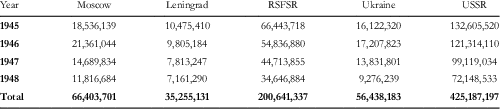
But were these assumptions correct? Analysis of the box office takings from 1945 through 1948 helps relate these programming decisions to what we can surmise about the audience taste for operettas, and the first thing to stress is that operetta was big business in the postwar Soviet Union. From 1945 to 1948, operetta theatres produced nearly 62,000 operetta performances, and their box offices grossed well over 425 million roubles. Operetta was also primarily a Russian phenomenon, with nearly half (almost 201 million roubles) of that total collected by operetta theatres located in the RSFSR but outside Moscow and Leningrad. The two cultural capitals accounted for a bit less than another quarter (almost 102 million roubles, two-thirds of which came from Moscow) while box office grosses in the Soviet Union’s other national republics accounted for only some 29% of the total. Of that remainder, Ukraine’s 54.5 million roubles amounted to just less than half (see Table 1). This overall distribution of box office receipts may suggest that operetta was an insignificant cultural presence in Central Asia and the Caucasus, and indeed it seems to have paled in comparison to its more ‘serious’ counterpart, opera. That said, examining programming and reception trends with an eye towards regional variation helps reveal patterns of cultural flow within the Soviet Union and suggests that while operetta audiences in provincial Russia and Moscow were becoming comparatively more interested in operettas by Soviet composers, Ukrainian audiences rejected them at a truly striking rate.
Operetta box office gross, by year and region (in roubles)

The data also demonstrate that over the course of the postwar 1940s, operetta appears to have been in decline. Table 1 shows that box office gross revenue from operetta dropped by over 60 million roubles from 1945 to 1948, with nearly 45% of that drop occurring between 1947 and 1948 and another 37% occurring between 1946 and 1947. Among the four centres with the largest operetta theatres, there was variation within this pattern. In Moscow and Leningrad, the biggest drop came from 1946 to 1947, after Moscow saw a significant increase in operetta box office gross from 1945 to 1946. From 1947 to 1948, Leningrad stayed close to unchanged while Moscow paralleled the trend of steady but marked decline in the RSFSR from 1945 to 1948 and in Ukraine from 1946 to 1948.
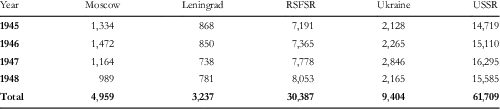
As Table 2 demonstrates, meanwhile, this decline in box office gross cannot be attributed to a decline in the staging of operettas. The number of performances in the Soviet Union actually increased by 10% from 1945 to 1947 before dropping off slightly the next year to a level still significantly above that in 1945. Again, there was variation among the Soviet Union’s main operetta centres: for operetta in Moscow, the postwar 1940s saw a slow, but steady decline after a slight increase from 1945 to 1946. By the end of 1948, there were 26% fewer annual operetta performances than there had been in 1945. Leningrad too saw a decline over the four-year period, but the low point was a 13% drop from 1946 to 1947. The number of performances in Ukraine essentially remained constant, with the only exception a 26% one-time spike from 1946 to 1947. Most remarkable were developments in the RSFSR outside the cultural capitals, which saw steady 2.5 to 5.5% annual increases and an overall growth of 12% over four years. Coupled with declines elsewhere, the RSFSR outside the capitals saw its share of operetta performances increase from 49% to 52% of the Soviet Union’s total. The decline in Russian operetta theatres’ box office receipts was certainly not caused by scaled-back performances.
Operetta performances, by year and region

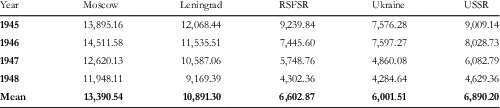
This conclusion is borne out by an examination of the average box office gross per performance over the same period. Table 3 reveals a striking development: in the USSR as a whole and in the RSFSR outside the cultural capitals, receipts dropped by more than half, and in Ukraine, the drop was only a slightly less precipitous 43%. While declines elsewhere were relatively gradual, in Ukraine there was a massive plunge of almost the entire 43% between 1946 and 1947. Moscow (14%) and Leningrad (24%) also saw dramatic drops, though they were not nearly as extreme as those elsewhere. If my assumption about the relationship between popularity with a general audience and box office averages is correct, then the operettas performed on Soviet stages between 1945 and 1948 were becoming significantly less popular.
Average box office gross per operetta performance, by year and region (in roubles)

Note: “Mean” is total box office divided by total performances for the time period, not the average of the yearly averages reported in the table.
An alternative explanation for the decline in box office intake is that ticket prices dropped. If this is the explanation, operetta was not becoming less popular but more accessible. Though I cannot eliminate this possibility with my current sources, it seems to me to be unlikely. If there had been a single decision to lower ticket prices, we would expect an immediate, drastic and consistent drop in box office receipts across the board followed by a plateau rather than the evident pattern of gradual but significant decline. If ticket pricing was left up to local theatres and republican or local branches of the Committee on Artistic Affairs, we would expect the same immediate drop and subsequent plateau in places with ticket price decreases amid a general pattern of continuity elsewhere. The only one of the four major operetta centres that fits this pattern is Ukraine. So it is possible that the decline in box office intake can be explained by a drop in ticket prices, especially in Ukraine, but more likely explanations must be sought elsewhere, in possible changes in programming and the taste for popular entertainment among general audiences.Footnote 38
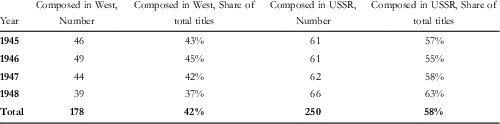
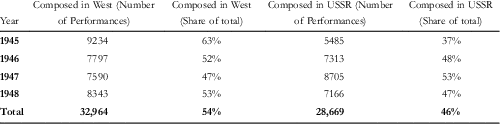
There are two main characteristics according to which operettas might productively be organised in order to chart possible changes in programming: location of composition and date of premiere. A prominent place on the Soviet operetta stage was always reserved for works composed in the West, primarily for the continental European operetta capitals of Paris, Berlin and Vienna. Soviet composers also wrote a significant number of operettas, starting with a few early efforts in the 1920s but really taking off in the mid-1930s with the earliest works by the king of Soviet popular music, Isaak Dunaevskii. By the 1940s, other composers with a gift for crafting popular songs were trying their hand at operetta. Tables 4 and 5 show the relative mix of Western and Soviet operettas performed in the Soviet Union from 1945 to 1948, according to number of titles annually (there were a very large number of duplicates from year to year) and number of performances.
Operettas composed in the West and in the USSR, 1945–8

Performances of Western and Soviet operettas, 1945–8

These tables demonstrate that nearly 42% of all operettas performed in the Soviet Union during these years were written in the West, but those 178 operettas accounted for more than 53% of all operetta performances. In other words, Western operettas typically had longer runs than their Soviet counterparts. The relative distribution between Western and Soviet operettas did change over the course of the 1940s, but not necessarily in predictable ways. In 1945, Western operettas accounted for 43% of all operettas and 63% of all operetta performances. In 1946, an even larger percentage (45%) of operettas had been written in the West, but they accounted for a significantly smaller share (52%) of the total number of performances. The next year, both the number and share of Western operettas declined again, to 42 and 47% respectively. In 1948, even fewer Western operettas were performed (about forty, or 37%), but 1947 turned out to be the only year in which Western operettas accounted for less than half of the total number of operetta performances. In 1948, those forty or so operettas provided 54% of the total number of performances, a larger share than at any time since 1945. The variety of Western operettas offered to Soviet audiences were thus constricted, but those Western operettas that were performed had even longer runs. At the same time, more operettas written by Soviet composers made it to the stage, but they did not stay there as long.
There was considerable regional variation within this general picture. In Moscow, the share of operettas composed in the West declined steadily from a 1945 high of 55% to a 1948 low of 44%, but the total share of performances of Western operettas dropped only to a low of 54% in 1947 from a high of 64% in 1945. In 1948, Western operettas again accounted for nearly 59% of all operetta performances in Moscow. So the programming pattern that pertained for the entire Soviet Union was even more pronounced in Moscow. The trend over the years, however, was different. The number of Western operettas dropped by one-ninth from 1945 to 1946 and by a quarter from 1946 to 1947 before rising by a quarter again in 1948. The number of Soviet operettas dropped by one each year from 1945 to 1947 before increasing nearly 50% from 1947 to 1948. So 1948 saw a significant shift from what was otherwise a consistent trend. The number of performances followed the same trajectory as Moscow’s gross box office receipts: up in 1946, then steadily down thereafter.
In provincial Russia, 1945 and 1946 saw little change in the balance between Western and Soviet operettas, though there was a slight drop in both the number of operettas shown and the number of performances on Russian stages. In both years, Western operettas accounted for 55% of the titles and 60% of the performances. In 1947, there was a relatively dramatic shift towards Soviet operetta, as the share of Western operettas dropped to 47% and performances of Western operettas fell to just 53%. In 1948, the Soviet share of titles continued to increase (to 58%), but the Western share of performances increased again, almost to the level of 1945–6 (59%). So, 1947 marked a turning point for composers of Soviet operettas, who would see more making it to the stage. But 1947 also stands out as an anomalous year for the high share of performances of Soviet operetta.
In terms of programming, Ukraine stands out from the Russian centres and from the aggregate for the Soviet Union as a whole. In fact, whereas Western operettas accounted for a minority of titles but usually a majority of performances in Russia, they never accounted for more than 43% of all performances in Ukraine. While 1945 was the heyday for Western operetta in Russia, in Ukraine, the high point was set in 1948. As in the RSFSR, 1947 proved a watershed. That year, Western operettas accounted for only 24% of all performances, down from a steady 34 to 35% the preceding two years. Soviet operettas consistently comprised the large majority of all titles performed, except in 1945 when they amounted to only 42%. Near parity was reached in 1946 (49% Western, 51% Soviet), before the general plunge in the number of Western operettas in 1947 – to 38%. Although 1948 saw a dramatic increase again (4% Western titles), it was not to 1946 levels.
There is no simple direct correlation between trends in gross box office receipts or averages and programming, but the Ukrainian case suggests the beginning of a possible explanation for the seeming decline in operetta’s popularity on the Soviet stage indicated above. Remember that Ukrainian box office grosses were stable between 1945 and 1946 before plunging dramatically in 1947, not to recover in 1948. Yet 1946 also saw a major shift in programming, away from Western and towards Soviet operettas, exactly as the 1946 theatre repertoire resolution suggested it should. Though that trend partially reversed in 1948, box office receipts did not recover. These data suggest at least the possibility that Ukrainian audiences exhibited a strong preference for Western operetta throughout the period.
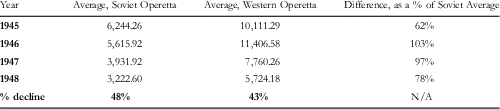
This possibility is borne out – emphatically – through an examination of average box office gross per Western and Soviet title in Ukraine, listed in Table 6.
Ukrainian box office averages, Western and Soviet operettas, 1945–8 (in roubles)

Ukrainian audiences’ preference for Western operetta could scarcely have been stronger, especially in 1946 and 1947, when box office averages for Western operetta performances were roughly double those for performances of Soviet operettas. Though averages for both declined significantly from 1945 to 1948, it appears that the popularity of Soviet operettas was declining even faster (48%) than that of Western ones (43%). However, when the decline is measured either from the respective high points (1945 for Soviet, 1946 for Western) or both from 1946, it appears that in 1947 and 1948, Soviet operetta was closing the gap. Those two measures yield relative declines of 48 and 43% for Soviet against 50% for Western operettas. Western operetta therefore remained much more popular than Soviet operetta and the latter declined in popularity more rapidly over the whole period 1945 to 1948, but not from 1946 on.
Ukrainian audiences exhibited a strong preference for Western operetta, and they appear to have started attending operetta theatres far less in 1947, when theatres programmed many more Soviet operettas and performances than in the preceding years. Though more Western operettas were programmed again in 1948, and though Soviet operetta seems to have been gaining on its Western counterparts, those shifts merely resulted in a plateau at the new, lower level.
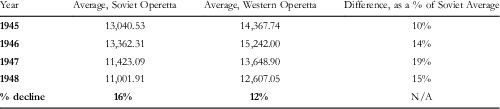
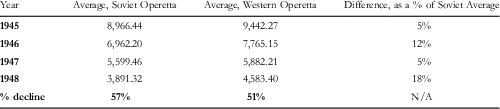
The preference for Western operetta that appears to have been responsible in large part for the decline of operetta in Ukraine did not correlate similarly to declining popularity in Moscow or the rest of the RSFSR. But did Russian audiences also prefer Western operetta? Tables 7 and 8 suggest that they did. Box office averages for Western operettas always exceeded means for Soviet operettas, but not nearly so dramatically as was the case in Ukraine. In the RSFSR outside the capitals, the difference was slightest, between 5% (twice) and 18%, but Moscow numbers were in the same ballpark, from 10 to 19%. Western operetta was also losing popularity more slowly than Soviet operetta, at rates of 12 versus 16% in Moscow and of 51 versus 57% in the RSFSR. Calculated from 1946, the difference in popularity between the two narrowed, but Soviet operetta still declined faster than its Western counterpart. In Moscow, box office averages for Western operettas declined by 17% while averages for Soviet operettas decreased 18%. In the RSFSR, averages for Western operettas declined by 41% while averages for Soviet ones decreased 42%.
Moscow box office averages, Western and Soviet operettas, 1945–8 (in roubles)

RSFSR box office averages, Western and Soviet operettas, 1945–8 (in roubles)

Audiences in all the Soviet Union’s major operetta centres preferred Western operetta to Soviet operetta, though the latter did seem to be rising slightly in the estimation of general audiences. In Ukraine, the combination of this preference and shifts in programming coincided with a dramatic decline in attendance at operetta theatres. In Russia, the preference for Western operetta was far less extreme, but it was still notable. Unlike in Ukraine, however, shifts in programming towards Soviet and away from Western operetta did not correlate so exactly with falling gross or average box office receipts.
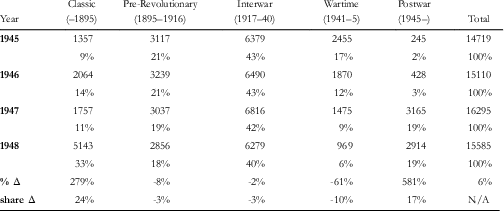
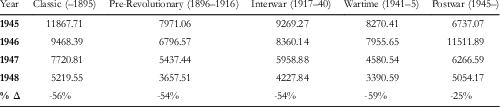
If there was a correlation between programming or possible shifts in general audience taste and the decline of operetta in Russia, we must look to the other variable: date of original premiere. I have divided each year’s titles into several groups defined by time period: classic (to 1895), that is, the heyday of Offenbach, Johann Strauss and their immediate successors; pre-revolutionary (1895–1916); the interwar period (1917–40); the war (1914–45); and the postwar (1945–). A couple of additional categories that combine time and place of premiere are particularly helpful: the neo-Viennese period (Western operettas that premiered between 1905 and 1935) and a period I have dubbed ‘new’ (Soviet operettas that premiered during and after the war). Over the course of the postwar 1940s throughout the Soviet Union, new and classic operettas took greater shares of the overall number of operettas programmed, while the relative balance of wartime and postwar operettas reversed as time went on. Despite significant gains, neither classic nor new operettas ever matched the share of the repertory taken up by interwar operettas or those of the neo-Viennese period that overlaps with it. There was regional variation in programming and popularity alike, but in the USSR as a whole, new operettas and operettas composed by the two paradigmatic classical operetta composers declined in popularity least. By 1948, programming policy was beginning to follow audience preferences, though the unreduced share of neo-Viennese operetta despite its declining popularity contributed to the overall declining popularity of the genre.
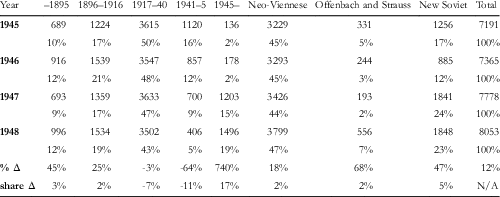
Tables 9 and 10 show the shifts in programming and audience preferences for the entire Soviet Union according to time period. Table 9 demonstrates the obviously unavoidable development that programming of operettas written after the war increased markedly as they were composed. That the relative share of postwar operettas jumped from 2 to 3% in 1945–6 to 19% in 1947–8 can partially be explained by the fact that there were more postwar operettas available in the latter two years; however, the dramatic increase and plateau suggests that a shift in programming policy in 1947 augmented the inevitable change. Operetta programmers did not completely ignore the 1946 Central Committee resolution that called for increasing attention to a contemporary domestic theatre repertory.
USSR operetta programming, by period of premiere (in number and share of total)

Note: Values in each row do not equal the value in the ‘Total’ column because wartime and postwar categories both include all operettas that premiered in 1945. The category ‘% Δ’ is the net change in number of performances per year from 1945 to 1948. The category ‘share Δ’ is the net change in the share of the repertory over the same time period.
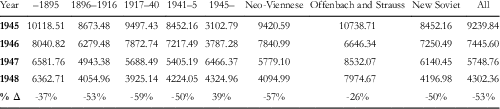
USSR operetta box office averages, by period of premiere (in roubles)

Note: Wartime and postwar categories both include all operettas which premiered in 1945.
However, it also appears that this search for a contemporary operetta repertory came primarily at the expense of the second most contemporary classification, wartime operetta. Operettas written during the war gradually declined from 17% of all performances in 1945 to just 6% in 1948. At the same time, pre-revolutionary and interwar operettas held essentially steady, declining only by about 3% each, and operettas composed between the two world wars still accounted for fully 40% of all performances in 1948.
Perhaps most surprising is the dramatic increase in performances of classic Parisian and Viennese operettas noted above, when they suddenly accounted for a full third of all operetta performances in the Soviet Union, just as the Central Committee called for increased attention to Tchaikovsky, the Mighty Five and Glinka.
Audience preferences, described in Table 10, appear to provide no real justification for the increase in programming of classical operetta. From 1945 to 1948, box office averages for classic operettas declined gradually by a total of 56%, nearly the same as all other categories’ declines. Only postwar operetta departed from this norm, declining only 25% over the whole period, but experiencing a dramatic spike in 1946.
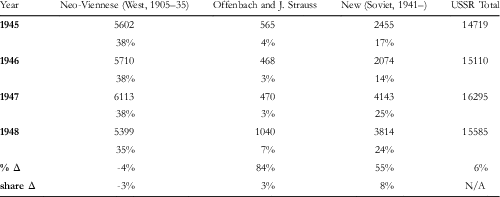
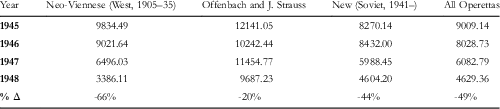
This trend changes a bit when operettas are divided into a few other categories defined by both time and place of original premier: neo-Viennese operetta (Lehár’s Die lustige Witwe (1905) to Paul Abraham’s Dschainah, das Mädchen aus dem Tanzhaus (1935), which I assume to be Tangolita on the Soviet stage); new Soviet operetta (any operetta by a Soviet composer that premiered after 1940); and for comparison purposes, all operettas composed by the two most famous creators of the genre in its classical period, Offenbach and Johann Strauss. Programming data for each of these three categories is summarised in Table 11. Note that neo-Viennese operetta consistently accounted for well more than one-third of the total number of operetta performances in the Soviet Union, and even at the end of the period, it held a larger share of the repertory than new Soviet operettas and those composed by Offenbach and Strauss combined. Still, Offenbach and Strauss saw a remarkable 84% increase in performances and more than doubled their share of the repertory between 1947 and 1948 while new Soviet operettas increased by more than 50%, especially between 1946 and 1947. The shifts in programming probably related to the Central Committee resolutions of late 1946 and early 1948 noted above are thus repeated here. But again, the incredible resilience of neo-Viennese operetta is quite remarkable. One would be tempted to assume that popularity with general audiences kept neo-Viennese operetta strong in the Soviet repertory, despite its apparent lack of fit with the ideological priorities for the arts established during the Zhdanovshchina.
USSR operetta performances, select groups, 1945–8 (in number and share of total)

Note: USSR total represents the total number of performances of all operettas, including those not contained in these three categories.
Examination of box office averages, however, simply does not support that contention. Table 12 displays these averages and demonstrates that the perseverance of neo-Viennese operetta in the repertory cannot be explained by its popularity. Note in particular the dramatic decline in the popularity of neo-Viennese operetta, from a mean box office average of 9,834 roubles in 1945, when it was considerably more popular than the average for all operettas to a measly 3,386 roubles in 1948, when it was considerably less so. The other two categories also declined in popularity over time, but both outperformed the genre as a whole, Offenbach and Strauss markedly so. While the popularity of new operetta surpassed that of neo-Viennese operetta only in 1948, Offenbach and Johann Strauss were consistently the most popular draws throughout the period, often by a wide margin.
USSR operetta box office averages, select groups (in roubles)

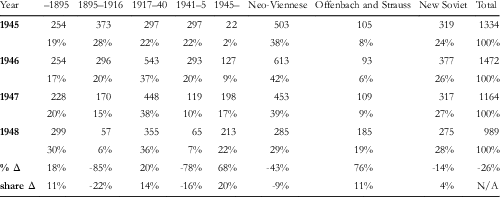
In the RSFSR outside Moscow and Leningrad, most of these all-USSR patterns were repeated, and the staying power of neo-Viennese opera was even exaggerated. Table 13 demonstrates that the USSR-wide shift towards new Soviet operettas in 1947 and the dramatic increase in operettas by Offenbach and Strauss in 1948 were mirrored in provincial Russia. As in the Soviet Union as a whole, the immediate postwar period in the RSFSR saw operettas composed in the postwar replace those composed during the war. But there were also a few differences. The USSR-wide shift towards classical operetta in general, and not just to the two classical masters, was not repeated in Russia, which saw only extremely modest fluctuations in the share of performances allocated to operettas composed before 1895. And the perseverance of neo-Viennese operetta in the entire Soviet Union was actually accentuated in provincial Russia, where the number of performances of neo-Viennese operettas increased 18%, and its share of the repertory also increased very modestly. Since the interwar operetta that overlaps substantially with neo-Viennese operetta declined in programming prominence over the same period, these data suggest that neo-Viennese operetta held a stronger position in postwar Russian operetta theatres than early Soviet efforts. Considering the Central Committee’s efforts to direct theatre programming away from a commitment to Western works, this is a surprising trend. It is especially so when compared to the programming pattern in Moscow.
RSFSR operetta performances, by time period and group (number and share)

Note: “Total” is not a sum of the rows because there is significant overlap between the data reported by time period and group.
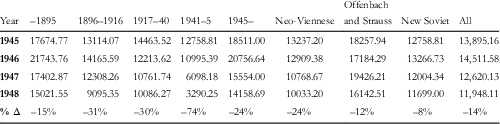
But before we turn to Moscow, a word about the popularity of this programming in provincial Russia is in order. Table 14 demonstrates that operetta composed in virtually every time period declined at similar rates (50 to 59%) – except classical operetta, which retained its popularity much better (a decline of just 37%). Postwar operetta appears to have gained dramatically in popularity, by 39%. However, this apparent gain is merely an artefact of a minuscule data set at the beginning of the period. When wartime and postwar operetta are combined to form the category ‘New Soviet’ operetta, it too declined by 50%, just barely outperforming the genre as a whole. Unlike in programming, the popularity of neo-Viennese operetta in the RSFSR followed the USSR-wide trend, declining more than the genre as a whole, but still outperforming the average every year until 1948. As in the rest of the Soviet Union, Offenbach and Strauss retained their popularity most, dropping only 26% over the entire period and bolstering the success of classical operetta in general. Except in the anomalous 1946, Offenbach and Strauss were the perennial Russian box office winners.
RSFSR operetta box office averages, by time period and group (in roubles)

Moscow departed much more from the USSR-wide developments, especially with regard to the programming of neo-Viennese operetta. Unlike in the USSR as a whole and in provincial Russia, programming of neo-Viennese operetta actually dropped, if only in 1948. The relatively steady roughly one-quarter share of new operetta (as postwar works replaced wartime ones) meant that by 1948, new operettas and neo-Viennese operettas accounted for almost the same number of performances. The significant increase in classical operetta programming in 1948 elevated that category to the top of the Moscow programming charts. The result was a relatively balanced repertory, with each of the three categories accounting for approximately 33% of all Moscow performances. The increase in programming of interwar operetta, coupled with the decline in neo-Viennese, also suggests that early Soviet operetta still saw the Muscovite stage relatively frequently (see Table 15).
Moscow operetta performances, by time period and group (number and share)

Note: “Total” is not a sum of the rows because there is significant overlap between the data reported by time period and group.
A quick perusal of the operettas most performed in Moscow each year reinforces the point. In 1946, the five most programmed Western operettas were four by Kálmán and Millöker’s Der Bettelstudent. In 1948, Kálmán’s Gräfin Mariza still led the way, but it was followed by the two famous Strauss operettas (Fledermaus and Zigeunerbaron), Hervé’s Nitouche and Offenbach’s Périchole. Four of these five (all but Offenbach) were also in the top five of all operettas performed in Moscow. The lone Soviet interloper was Nikolai Mikhailovich Strel’nikov’s 1927 Kholopka. In fact, Kholopka was in the top five Soviet operettas programmed in Moscow every year but 1945. Also appearing four times (not in 1948) in the top five programmed Soviet operettas was Boris Aleksandrovich Aleksandrov’s 1937 hit, Svad’ba v Malinovke. The only Soviet operetta more favoured by programmers was the collectively composed wartime Raskinulos’ more shiroko (Minkh, Vitlin and Kruts, The Sea Spread Wide, 1942), which was the top Soviet operetta and second overall every year except 1948, when it was the second most frequently performed Soviet operetta – and sixth overall. Postwar hits such as Dunaevskii’s Vol’nyi veter (1947), Nikita Vladimirovich Bogoslovskii’s 11 neizvestnykh (1946), and Iurii Sergeevich Miliutin’s Bespokoinoe schast’e (1947) generally only reached the Soviet top five the year after their premiere, and even then they never made it into the overall top five. So Moscow operetta theatre programmers consistently pushed the biggest wartime operetta and two interwar hits at the expense of new Soviet operettas, while shifting Western offerings from the neo-Viennese Kálmán towards Johann Strauss and the French classics.
Muscovite audiences’ taste only partially coincided with these priorities. Like operetta audiences in provincial Russia and in the USSR as a whole, they consistently preferred the classics towards which programmers moved in 1948. As Table 16 makes clear, the classics in general, and Offenbach and Strauss in particular, were always most popular with Muscovite audiences. But postwar operetta never trailed the classics by much and always proved more popular than any other category. In fact, new Soviet operetta retained its popularity better than any other – including Offenbach and Strauss.
Moscow operetta box office averages, by time period and group (in roubles)

The popularity of a few classics and new premieres, and the staying power of new hits, is made even more clear by examining the pinnacle of popularity each year: the top five box office averages among Western and Soviet operettas respectively. A Western classic was the most popular operetta in Moscow every postwar year: Offenbach’s Périchole (twice), Millöcker’s Bettelstudent and Strauss’s Fledermaus all held that honour at least once. But Soviet premieres never trailed by much. Bogoslovskii’s 11 neizvestnykh (1946), Boris Aleksandrov’s Moia Giusel’ (1946), Dunaevskii’s Vol’nyi veter (1947), Oskar Borisovich Fel’tsman’s Vozdushnyi zamok (1948) and Miliutin’s Bespokoinoe schast’e (1948) all opened in the top two Soviet operettas, and only in 1947 did a premiere not occupy the overall number two position, when Vol’nyi veter trailed Périchole and Fledermaus. The only one of these premieres not in the overall top three was Moia Giusel’ in 1946, but it held the number four spot that year and again the next, when it bumped 11 neizvestnykh from its number two spot down to number five. In 1948 two premieres (second and third), 11 neizvestnykh (fourth) and Vol’nyi veter (fifth) occupied four of the top five most popular spots, trailing only Fledermaus and leading even La Périchole, which was sixth overall. The only neo-Viennese operetta to break into the top ten in 1947 or 1948 was Kálmán’s Gräfin Mariza, a consistent number seven overall. Operetta programmers may not have thoroughly heeded Central Committee calls to pay more attention to contemporary Soviet theatre, but Muscovite operetta audiences definitely did.
Conclusion
So what do we learn from this examination of operetta programming and general audience taste in the immediate postwar period? First, operetta was a genre in decline after the war. Despite its growing isolation as the Cold War began, the Soviet Union thus participated in a trend that is observable throughout Europe and North America, where the operetta was virtually replaced by the musical. Still, with the possible exception of the ubiquitous but highly specific perseverance of Gilbert and Sullivan in the Anglophone world, operetta retained its prominence and popularity in the Soviet Union more than it did anywhere else.Footnote 39
A detailed examination of programming and audience taste reveals that there is probably little that operetta theatres could have done to reverse this decline. Though audience taste never determined programming priorities, changes in programming did occasionally align with audience preferences. The dramatic shift towards the classics in general, and Offenbach and Strauss in particular, that took place in provincial Russia and the Soviet Union as a whole in 1948, for example, privileged works that had always been and would continue to be audience favourites.
On the other hand, audiences especially in Moscow seem to have responded less ambiguously to direction from the Central Committee than theatres. The 1946 Central Committee call to pay more attention to contemporary Soviet reality in theatre programming seems to have had a surprisingly minor effect on programming, at least outside of Ukraine. But Moscow audiences at least made new Soviet operettas into huge hits in every postwar year. Programming more Dunaevskii and less Kálmán outside the capital may have drawn more people into operetta theatres. This is certainly what the bureaucrats of the Committee on Artistic Affairs thought.
Or maybe not. Another significant conclusion to be drawn from this examination of programming and audience preferences is that taste differed from place to place. Soviet operetta was not quite so popular in provincial Russia as it was in the capital, and even new Soviet operetta declined in popularity at about the same rate as every other category except the classics. In Ukraine, Soviet operettas were incredibly unpopular, earning minuscule box office averages compared to their Western counterparts, including the neo-Viennese. In fact, neo-Viennese operetta was the most popular category in Ukraine every year but 1948, when it was surpassed only by Offenbach and Strauss (but not the rest of the classics). Perhaps settings just over Ukraine’s western border simply appealed to Ukrainian audiences more than Russian ones. Or else, perhaps operetta provides yet one more example of how difficult central authorities found it to first pacify and then reincorporate Ukraine into a postwar Soviet Union increasingly defined according to Russian preferences and priorities.Footnote 40
This last suggestion illustrates a crucial point. If my assumption about the correlation between box office averages and popularity is correct, this article demonstrates what operettas Muscovite, provincial Russian and Ukrainian audiences preferred. But why they preferred them remains an open question. It appears clear that operetta audiences in all these areas preferred Western operettas to Soviet ones, though to an extremely varied degree. It also seems evident that the most recent operettas written by famous song composers such as Dunaevskii, Boris Aleksandrov, Miliutin and Bogoslovskii were the most popular Soviet operettas, especially in Moscow. These preferences suggest that the general audiences whom I assume – along with Soviet observers – attended operetta performances, exhibited a distinct conservative bent in several ways. The preference for the classics (Offenbach, Strauss, Hervé, Millöcker) suggests a conservative attachment to a long-existing canon. The preference for the newest Soviet operettas, meanwhile, might be explained in one of two not necessarily contradictory ways: first, less as a fascination with the latest artistic trends than a conservative patriotism, and second, a willingness to follow the direction of Central Committee resolutions even more closely than the theatre directors and arts officials responsible for operetta programming. But it may also suggest that it was precisely those Soviet composers known to have a great talent for crafting songs that sparked the popular imagination, who could translate that success on to the music theatrical stage – in operetta.
How did theatres and their oversight bodies respond to this demonstrable taste? It is clear that programming of Western operettas was gradually constricting in the postwar period and shifted from an emphasis on neo-Viennese operetta to an emphasis (in 1948 after the shift to self-sufficiency) on the classics. Considering developments in other musical fields, however, this shift in programming priorities was not nearly as marked as we might have expected. Pauline Fairclough has shown that following the Central Committee’s interventions in 1946 and 1948, concert programming at the Soviet Union’s leading Philharmonias went through the last phases of a marked shift that drastically limited even those Western classics that had been promoted in the 1930s, replacing them with Russian classics.Footnote 41 Fairclough’s finding is consistent with a broader, well-documented Russocentric shift in popular culture and propaganda that became dominant during the years covered by this study.Footnote 42 Furthermore, Marina Frolova-Walker has convincingly demonstrated that the Stalin Prize in music, the prize designed to construct a Soviet musical canon, put music in a ‘national style, often based on folk themes’ at the core of that canon. ‘National’ style always and emphatically included non-Russian works, but after 1948 and consistent with this general trend, music understood to be stylistically Russian could also be promoted on national grounds.Footnote 43
In operetta, though, this pronounced Russocentric shift – visible in so many fields, including other musical ones – appears to have been muted. This difference likely has two main causes. First, there simply were no classic Russian operettas that were remotely comparable in stature to music composed by the canonical Russian composers of opera, symphonic and instrumental music. The increased programming of Strauss and Offenbach was as close as operetta programmers could get, so they kept Western classics in the repertoire. Second, the entire genre of operetta shares characteristics with the sort of music that Communist Party officials and bureaucrats proscribed during the 1948 party intervention. Though neo-Viennese operetta may seem a poor fit with party demands that the arts focus on contemporary Soviet reality – and though it was directly criticised in 1948 – even this most suspect component of the operetta repertoire had an accessible musical style that was consistent with demands of party intervention.
The more pressing problem for operetta theatres appears to have been the less well-known requirement that musical theatres come closer to financing themselves, which only two were able to do by the end of the year.Footnote 44 A possible remedy unlikely to attract party condemnation – programming a more limited range of the classics – resulted in repetition that seems to have made the Western component of the repertory begin to seem stale. At the same time, the new Soviet operettas that the Central Committee implicitly demanded and audiences preferred were not programmed nearly as much as we might have expected, when cautious theatre directors newly forced to consider the box office bottom line replaced new Soviet works with neo-Viennese fare. The result, just as theatres were forced in 1948 to earn their own way, was a whole genre in decline.