



1 Introduction
A question of Ghys asks the following: Is there a pair of the form
 $(M,\, D)$
, where M is a compact Riemann surface of genus at least two, and D is an irreducible holomorphic
 $\text {SL}(2, {\mathbb C})$
-connection on the rank-two trivial holomorphic vector bundle
 ${\mathcal O}^{\oplus 2}_M$
, such that the image of the monodromy homomorphism for D is contained in a cocompact lattice of
 $\text {SL}(2, {\mathbb C})$
. The motivation for this question comes from the study of compact quotients of
 $\text {SL}(2, {\mathbb C})$
by lattices. Such quotients are compact non-Kähler manifolds. While they cannot contain a complex surface [Reference Huckleberry and Margulis19, Theorem 2, p. 239], it is not known whether they can contain compact Riemann surfaces of genus
 $g \,>\,1$
. A positive answer to Ghys’ question would provide a nontrivial holomorphic map from the Riemann surface M to the quotient of
 $\text {SL}(2, {\mathbb C})$
by the cocompact lattice containing the image of the monodromy homomorphism for D. In fact, the two problems are equivalent (see [Reference Calsamiglia, Deroin, Heu and Loray11] for explanations for the origin of Ghys’ question).
Let us also mention that a related question of characterizing rank-two holomorphic vector bundles
 $\mathcal V$
over a compact Riemann surface, such that for some holomorphic connection on
 $\mathcal V$
, the image of the associated monodromy homomorphism is Fuchsian, was raised in [Reference Katz20, p. 556] (there this question is attributed to Bers).
The above, still open questions of Bers and Ghys, and some related questions in [Reference Calsamiglia, Deroin, Heu and Loray11, Reference Katz20], motivated us to investigate the holomorphic connections on a trivial holomorphic vector bundle. Answering a question asked in [Reference Calsamiglia, Deroin, Heu and Loray11], examples of irreducible holomorphic
 $\text {SL}(2, {\mathbb C})$
-connection with real monodromy, on the trivial holomorphic
 $\text {SL}(2, {\mathbb C})$
-bundle over a compact Riemann surface, were constructed in [Reference Biswas, Dumitrescu and Heller5].
Here, we consider integrable holomorphic connections on trivial holomorphic vector bundles over a compact Kähler manifold X. The purpose of the above discussions is to demonstrate the significance of holomorphic connections on the trivial holomorphic vector bundles. While highly motivated by the abovementioned questions of Bers and Ghys, it should be clarified that the present work does not shed particular light on those questions which remain open, but provides a study of the relevant category of integrable holomorphic connections on trivial holomorphic vector bundles.
Once we fix a base point
 $x_0\, \in \, X$
in order to define a fiber functor, using the Tannakian category theory, it is shown that the category of integrable holomorphic connections on trivial holomorphic vector bundles produces a quotient of the pro-algebraic completion
 $\varpi (X,\, x_0)$
of the fundamental group
 $\pi _1(X,\, x_0)$
(the details are in Section 3); this quotient of
 $\varpi (X,\, x_0)$
is denoted by
 ${\Theta }(X,\, x_0)$
. Then, we prove a Torelli-type Theorem with respect to
 ${\Theta }(X,\, x_0)$
, for compact Riemann surfaces and also for compact complex tori.
The main results of Sections 3 and 4 are the following:
-
(1) For compact Kähler manifolds X and Y, the natural homomorphism
is an isomorphism. (See Proposition 3.8.) $$ \begin{align*} \Theta (X,\,x_0)\times\Theta (Y,\,y_0)\,\longrightarrow \,\Theta (X\times Y,\, (x_0,\,y_0)) \end{align*} $$
-
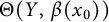
(2) Let
$\beta \, : \, X\, \longrightarrow \, Y$
be an orientation preserving diffeomorphism between compact Riemann surfaces such that the corresponding homomorphism descends to a homomorphism from
$$ \begin{align*} \beta_{\natural}\, :\, \varpi(X,\, x_0)\, \longrightarrow\, \varpi(Y,\, \beta(x_0)) \end{align*} $$
${\Theta }(X,\, x_0)$
to
${\Theta }(Y,\, \beta (x_0))$
. Then, the two Riemann surfaces X and Y are isomorphic. (See Theorem 4.1.)
-
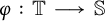
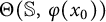
(3) Let
$\varphi \, :\, {\mathbb T}\, \longrightarrow \, {\mathbb S}$
be a diffeomorphism between two compact complex tori such that the corresponding homomorphism descends to a homomorphism from
$$ \begin{align*} \varphi_*\, :\, \varpi({\mathbb T},\, x_0)\, \longrightarrow\, \varpi({\mathbb S},\, \varphi(x_0)) \end{align*} $$
${\Theta }({\mathbb T},\, x_0)$
to
${\Theta }({\mathbb S},\, \varphi (x_0))$
. Then, there is a biholomorphism which is homotopic to the map
$$ \begin{align*} {\mathbb T}\, \longrightarrow\, {\mathbb S}, \end{align*} $$
$\varphi $
. (See Proposition 4.2.)








In Section 5, we consider integrable holomorphic connections on holomorphic vector bundles over X which decompose into a direct sum of holomorphic line bundles. Using the Tannakian category theory in a similar way, we show that this category also produces a quotient
 ${\Delta }(X,\, x_0)$
of the pro-algebraic completion
 $\varpi (X,\, x_0)$
of the fundamental group
 $\pi _1(X,\, x_0)$
. Then, we adapt our methods in Section 4 in order to prove the same Torelli-type theorems for
 ${\Delta }(X,\, x_0)$
.
As is well known, the category of vector bundles easily fails to be abelian, but as observed as far back as [Reference Seshadri27, Proposition 3.1], semistability can be brought in to mend this failure and produce interesting abelian categories of vector bundles. Section 6 connects the group scheme
 $\Theta $
to such an idea by means of the category of pseudostable vector bundles (stemming from Simpsons’ foundational work). We produce group schemes
 $\Sigma (X,\,x_0)$
, accounting for connections on pseudostables, and
 $\pi ^{\mathrm {S}}(X,\,x_0)$
, accounting for pseudostables solely, and then establish a link between these and
 $\Theta $
; see Theorem 6.5.
2 Neutral Tannakian categories for a Kähler manifold
Let X be a compact connected Kähler manifold of complex dimension d. Fix a Kähler form
 $\omega $
on X. The degree of a torsion-free coherent analytic sheaf F on X is defined to be
 $$ \begin{align*}\text{degree}(F)\, :=\, (c_1(\det F)\cup\omega^{d-1})\cap [X]\, \in\, \mathbb R\, . \end{align*} $$
Here and elsewhere, we write
 $c_i$
for the ith Chern class in
 $H^{2i}_{dR}(X,\,\mathbb R)$
and define the holomorphic line bundle
 $\det F$
following [Reference Kobayashi21, Chapter V, Section 6]. The real number
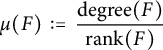 $$ \begin{align*}\mu(F)\,:=\, \frac{\text{degree}(F)}{\text{rank}(F)} \end{align*} $$
is called the slope of F.
Fix a base point
 $x_0\, \in \, X$
. Let
 $$ \begin{align} \phi\, :\, \pi_1(X,\, x_0) \, \longrightarrow\, \varpi(X,\, x_0) \end{align} $$
be the pro-algebraic completion of the fundamental group
 $\pi _1(X,\, x_0)$
. We recall that
 $\varpi (X,\, x_0)$
is a pro-algebraic affine group scheme over
 $\mathbb C$
which is uniquely characterized by the following property: for any homomorphism
 $$ \begin{align*}\gamma\, :\, \pi_1(X,\, x_0)\, \longrightarrow\, G \end{align*} $$
to a complex affine algebraic group G, there is a unique algebraic homomorphism
 $$ \begin{align*} \widehat{\gamma}\, :\, \varpi(X,\, x_0)\, \longrightarrow\, G \end{align*} $$
such that
 $\widehat {\gamma }\circ \phi \,=\, \gamma $
. There are mainly two equivalent constructions of
 $\varpi (X,\,x_0)$
: one by means of the Tannakian category of finite-dimensional representations of
 $\pi _1(X,\,x_0)$
and Tannakian duality [Reference Deligne, Milne, Ogus and Shih13] and the other by Freyd’s adjoint functor theorem applied to the
 $\mathbb C$
-points functor from group schemes to groups [Reference Freyd16, Section 3.J, 84ff].
We shall recall from [Reference Simpson29, p. 70] three neutral Tannakian categories associated to the pointed Kähler manifold
 $(X,\, x_0)$
which, in particular, furnish a Tannakian description of
 $\varpi (X,\, x_0)$
.
Let
 ${\mathcal C}_{dR}(X)$
denote the category whose objects are pairs of the form
 $(E,\, D)$
, where E is a holomorphic vector bundle on X and D is an integrable holomorphic connection on E (see [Reference Atiyah3] for holomorphic connections). Morphisms from
 $(E,\, D)$
to
 $(E',\, D')$
are all holomorphic homomorphisms of vector bundles
 $h\, :\, E\, \longrightarrow \, E'$
that intertwine the connections D and
 $D'$
, meaning
 $D'\circ h\,=\, (h\otimes \mathrm {Id}_{\Omega ^1_X})\circ D$
as differential operators from E to
 $E'\otimes \Omega ^1_X$
with
 $\Omega ^1_X$
being the holomorphic cotangent bundle of X. This category is equipped with the operators of direct sum, tensor product, and dualization. More precisely,
 ${\mathcal C}_{dR}(X)$
is a rigid abelian tensor category (see [Reference Deligne, Milne, Ogus and Shih13, Definition 1.14, p. 118] for rigid abelian tensor categories).
Remark 2.1 It is known that any coherent analytic sheaf on X admitting a holomorphic connection is locally free (see [Reference Borel, Grivel, Kaup, Haefliger, Malgrange and Ehlers9, Proposition 1.7, p. 211]); it should be clarified that although this proposition in [Reference Borel, Grivel, Kaup, Haefliger, Malgrange and Ehlers9] is stated only for
 ${\mathcal O}_X$
-modules with an integrable holomorphic connection (the same as a
 ${\mathcal D}_X$
-module), its proof uses only the Leibniz rule which is valid for holomorphic connections.
It is straightforward to check that the above category
 ${\mathcal C}_{dR}(X)$
, equipped with the faithful fiber functor that sends any object
 $(E,\, D)$
to the fiber
 $E|_{x_0}$
over
 $x_0\, \in \, X$
, defines a neutral Tannakian category (see [Reference Deligne, Milne, Ogus and Shih13, Definition 2.19, p. 138], [Reference Saavedra Rivano25], [Reference Simpson29, p. 67], [Reference Nori23, p. 76] for neutral Tannakian category). Given any neutral Tannakian category, a theorem of Saavedra Rivano associates to it a pro-algebraic affine group scheme over
 $\mathbb C$
[Reference Deligne, Milne, Ogus and Shih13, Theorem 2.11, p. 130] (and the remark following [Reference Deligne, Milne, Ogus and Shih13, Definition 2.19, p. 138]), [Reference Saavedra Rivano25], [Reference Nori23, Theorem 1.1, p. 77], [Reference Simpson29, p. 69]. Therefore, the neutral Tannakian category
 ${\mathcal C}_{dR}(X)$
corresponds to a pro-algebraic affine group scheme over
 $\mathbb C$
.
Let
 ${\mathcal C}_{B}(X)$
denote the category whose objects are all finite-dimensional complex representations of
 $\pi _1(X,\, x_0)$
. Using the tautological fiber functor, it defines a neutral Tannakian category. The pro-algebraic affine group scheme over
 $\mathbb C$
corresponding to
 ${\mathcal C}_{B}(X)$
, by the abovementioned theorem of Saavedra Rivano ([Reference Deligne, Milne, Ogus and Shih13, Theorem 2.11, p. 130], [Reference Saavedra Rivano25]), is the group scheme
 $\varpi (X,\, x_0)$
in (2.1) [Reference Simpson29, Lemma 6.1, p. 69].
A Higgs bundle on X is a pair of the form
 $(E,\, \theta )$
, where E is a holomorphic vector bundle of X and
 $\theta \, \in \, H^0(X,\, \text {End}(E)\otimes \Omega ^1_X)$
with
 $\theta \bigwedge \theta \,=\, 0$
[Reference Simpson28, Reference Simpson29]; the holomorphic section
 $\theta $
is called a Higgs field on E. A Higgs bundle
 $(E,\, \theta )$
is called stable (respectively, semistable) if
 $$ \begin{align*} \mu(F)\, <\, \mu(E) \ \ \text{(respectively, }\,~\mu(F)\, \leq\, \mu(E)\text{)} \end{align*} $$
for every coherent analytic subsheaf
 $F\, \subset \, E$
with
 $0\, <\, \text {rank}(F)\, <\, \text {rank}(E)$
and
 $$ \begin{align*} \theta(F)\, \subset\, F\otimes\Omega^1_X\, . \end{align*} $$
A Higgs bundle
 $(E,\, \theta )$
is called polystable if it is a direct sum of stable Higgs bundles of the same slope.
Let
 ${\mathcal C}_{Dol}(X)$
denote the category whose objects are Higgs bundles
 $(E,\, \theta )$
such that
 $ch_2(E)\cup \omega ^{d-2}\,=\, 0$
and there is a filtration of holomorphic subbundles
 $$ \begin{align*} 0\, =\, E_0\, \subset\, E_1\,\subset\, \cdots \, \subset\, E_i \,\subset\,\cdots\, \subset\, E_{\ell-1} \,\subset\, E_{\ell}\,=\, E, \end{align*} $$
satisfying the following three conditions:
-
(1)
$\theta (E_j)\, \subset \, E_j\otimes \Omega ^1_X$
for all
$1\, \leq \, j\, \leq \, \ell $
, -
(2)
$\text {degree}(E_j/E_{j-1})\,=\, 0$
for all
$1\, \leq \, j\, \leq \, \ell $
, and -
(3) the Higgs bundle
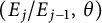
$(E_j/E_{j-1}, \, \theta )$
is stable for all
$1\, \leq \, j\, \leq \, \ell $
(with a mild abuse of notation, the Higgs field on
$E_j/E_{j-1}$
induced by
$\theta $
is also denoted by
$\theta $
).






Notice that the above second condition implies that
 $\text {degree}(E)\,=\,0$
.
In [Reference Biswas and Gómez6], such Higgs bundles are called pseudostable.
A homomorphism from
 $(E,\, \theta )$
to
 $(E',\, \theta ')$
is a holomorphic homomorphism
 $$ \begin{align*} h\, :\, E\, \longrightarrow\, E' \end{align*} $$
such that
 $\theta '\circ h\,=\, (h\otimes \mathrm {Id}_{\Omega ^1_X})\circ \theta $
as homomorphisms from E to
 $E'\otimes \Omega ^1_X$
. It is known that
 ${\mathcal C}_{Dol}(X)$
is a rigid abelian tensor category [Reference Simpson29, p. 70]. This category
 ${\mathcal C}_{Dol}(X)$
admits the faithful fiber functor that sends any object
 $(E,\, \theta )$
to the fiber
 $E|_{x_0}$
. In other words,
 ${\mathcal C}_{Dol}(X)$
is a neutral Tannakian category.
The two categories
 ${\mathcal C}_{dR}(X)$
and
 ${\mathcal C}_{B}(X)$
are equivalent by the Riemann–Hilbert correspondence that assigns to a flat connection the corresponding monodromy representation. Using fundamental theorems of Corlette [Reference Corlette12], and Simpson [Reference Simpson28], in [Reference Simpson29], Simpson proved that the category
 ${\mathcal C}_{Dol}(X)$
is equivalent to
 ${\mathcal C}_{dR}(X)$
(see [Reference Simpson29, Lemma 3.5, p. 36], [Reference Simpson29, p. 70]). Therefore, all these three neutral Tannakian categories, namely
 ${\mathcal C}_{dR}(X)$
,
 ${\mathcal C}_{B}(X)$
, and
 ${\mathcal C}_{Dol}(X)$
, produce the same pro-algebraic affine group scheme over
 $\mathbb C$
using the theorem of Saavedra Rivano mentioned earlier ([Reference Deligne, Milne, Ogus and Shih13, Theorem 2.11, p. 130], [Reference Saavedra Rivano25]). In other words, each of these three neutral Tannakian categories produces the pro-algebraic affine group scheme
 $\varpi (X,\, x_0)$
in (2.1).
It should be mentioned that when X is a smooth complex projective variety, and the cohomology class of the closed form
 $\omega $
is rational, then the category
 ${\mathcal C}_{Dol}(X)$
coincides with the category of semistable Higgs bundles
 $(E,\, \theta )$
on X with
 $$ \begin{align*} ch_2(E)\cup\omega^{d-2}\,=\, 0 \end{align*} $$
and
 $\text {degree}(E)\,=\, 0$
[Reference Simpson29, Theorem 2, p. 39].
3 The Tannakian subcategory
${\mathcal T}_{dR}$
of
${\mathcal C}_{dR}$


3.1 The Tannakian category and the associated group scheme
As before, X is a compact connected Kähler manifold of complex dimension d.
Definition 3.1 Let
 ${\mathcal T}_{dR}(X)$
be the full subcategory of
 ${\mathcal C}_{dR}(X)$
(defined in Section 2) whose objects are all the couples
 $(E,\, D)$
satisfying the condition that the holomorphic vector bundle E is holomorphically trivial.
Clearly,
 ${\mathcal T}_{dR}(X)$
is stable under tensor products and duals. The identity object
 $({\mathcal O}_X,\, \mathrm {d})$
, where
 $\mathrm {d}$
is the de Rham differential, certainly is an object of
 ${\mathcal T}_{dR}(X)$
. In addition,
 ${\mathcal T}_{dR}(X)$
is stable under quotients, as shown by the next proposition.
Proposition 3.1 Let
 $(E,\,D)\,=\, ({\mathcal O}^{\oplus r}_X,\, D)$
be an object of
 ${\mathcal T}_{dR}(X)$
and
 $$ \begin{align*} q\,:\,({\mathcal O}^{\oplus r}_X,\,D)\,\longrightarrow\,(E',\,D') \end{align*} $$
an epimorphism in
 ${\mathcal C}_{dR}(X)$
. Then, the holomorphic vector bundle
 $E'$
is also trivial.
Proof We note that
 $c_1(E')\,=\,0$
, because
 $E'$
carries an integrable connection [Reference Atiyah3, Theorem 4, pp. 192–193], [Reference Griffiths and Harris17, Proposition, p. 141]. Let
 $r'$
be the rank of
 $E'$
, and introduce
 $\mathrm {Gr}(r,r')$
, the Grassmann manifold of
 $r'$
dimensional quotients of
 ${\mathbb C}^r$
. Note that the trivial bundle
 ${\mathcal O}^{\oplus r}_{\mathrm {Gr}(r,r')}$
comes with a tautological quotient of rank
 $r'$
, call it
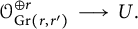 $$ \begin{align*} {\mathcal O}^{\oplus r}_{\mathrm{Gr}(r,r')}\,\longrightarrow\, U. \end{align*} $$
Then, q induces a morphism
 $f\,:\,X\,\longrightarrow \, \mathrm {Gr}(r,r')$
such that
 $E'\,=\,f^*U$
. In particular, we have
 $c_1(f^*(\det U))\,=\, c_1(E')\,=\, 0$
. The fact that
 $\det (U)$
is ample implies that f is a constant map [Reference Griffiths and Harris17, p. 177]. Hence,
 $E'$
is holomorphically trivial.▪
Corollary 3.2 The full subcategory
 ${\mathcal T}_{dR}(X)$
of
 ${\mathcal C}_{dR}(X)$
is an abelian subcategory.
Proof Let
 $\alpha \,:\,(E,\,D)\,\longrightarrow \,(E_1,\,D_1)$
be an arrow in
 ${\mathcal T}_{dR}(X)$
. Now,
 $\mathrm {Image}(\alpha )$
is a subconnection, call it
 $(I,\,D_1)$
, of
 $(E_1,\,D_1)$
, and we have an epimorphism
 $$ \begin{align*}\alpha\,:\,(E,\,D) \,\longrightarrow\,(I,\,D_1)\end{align*} $$
in
 ${\mathcal C}_{dR}(X)$
. We note that I is locally free (see Remark 2.1). We conclude from Proposition 3.1 that
 $(I,\, D_1)$
is an object of
 ${\mathcal T}_{dR}(X)$
. Again from Proposition 3.1, it follows that
 $\mathrm {coker}(\alpha )$
is an object of
 ${\mathcal T}_{dR}(X)$
, because it is a quotient of an object of
 ${\mathcal T}_{dR}(X)$
.
To prove that
 $\mathrm {kernel}(\alpha )$
is in
 ${\mathcal T}_{dR}(X)$
, consider the dual connections
 $(E^*,\,D^*)$
and
 $(E^*_1,\,D^*_1)$
of
 $(E,\,D)$
and
 $(E_1,\,D_1)$
, respectively. Let
 $$ \begin{align*} \alpha^*\,:\,(E^*_1,\,D^*_1)\,\longrightarrow\,(E^*,\,D^*) \end{align*} $$
be the dual of the homomorphism
 $\alpha $
. The above argument gives that
 $$ \begin{align*} \alpha^*(E^*_1)\, \subset\,E^* \end{align*} $$
is a trivial subbundle, and the quotient
 $E^*/\alpha ^*(E^*_1)$
is also a trivial holomorphic vector bundle. Hence,
 $$ \begin{align*} \text{kernel}(\alpha)\,=\, (E^*/\alpha^*(E^*_1))^* \end{align*} $$
is a trivial holomorphic vector bundle. Therefore,
 $\mathrm {kernel}(\alpha )$
, equipped with the integrable holomorphic connection induced by D, is also in
 ${\mathcal T}_{dR}(X)$
.
Hence, the standard criterion for a subcategory to be an abelian subcategory can be applied [Reference Freyd16, Theorem 3.41].▪
Let
 $$ \begin{align} {\Theta}(X,\, x_0) \end{align} $$
be the affine group scheme over
 $\mathbb C$
corresponding to
 ${\mathcal T}_{dR}(X)$
via [Reference Deligne, Milne, Ogus and Shih13, Theorem 2.11, p. 130] by means of the exact functor
 $(E,\,D)\,\longmapsto \, E|_{x_0}$
. From Proposition 3.1 and the standard criterion [Reference Deligne, Milne, Ogus and Shih13, Proposition 2.21, p. 139], we conclude that the natural arrow of group schemes
 $$ \begin{align} \mathbf{q}_X\, :\, \varpi(X,\, x_0)\, \longrightarrow\, {\Theta}(X,\, x_0) \end{align} $$
is a quotient homomorphism, where
 $\varpi (X,\, x_0)$
is the group scheme in (2.1).
Clearly, for any given holomorphic map
 $f:Y\longrightarrow X$
, we obtain tensor functors
 $$ \begin{align*} f^{\#}\,: \, \mathcal C_{dR}(X)\,\longrightarrow\,\mathcal C_{dR}(Y) \end{align*} $$
and
 $$ \begin{align*} f^{\#}\,:\, \mathcal T_{dR}(X)\,\longrightarrow\,\mathcal T_{dR}(Y) \end{align*} $$
defined by
 $(E,\, D)\, \longmapsto \, (f^*E,\, f^*D)$
. If, in addition, we let
 $y_0\in Y$
be a point which is taken to
 $x_0$
, we derive homomorphisms of group schemes
 $$ \begin{align*} f_{\natural}\,:\,\varpi(Y,\,y_0)\,\longrightarrow\,\varpi(X,\,x_0) \end{align*} $$
and
 $$ \begin{align*} f_{\natural}:\Theta(Y,\,y_0)\longrightarrow\Theta(X,\,x_0)\, . \end{align*} $$
Using the equivalence of categories between
 ${\mathcal C}_{Dol}(X)$
and
 ${\mathcal C}_{dR}(X)$
mentioned in Section 2, the above subcategory
 ${\mathcal T}_{dR}(X)$
of
 ${\mathcal C}_{dR}(X)$
gives a Tannakian full subcategory of
 ${\mathcal C}_{Dol}(X)$
. It is natural to ask the following:
Question 3.3 What is a direct description of the Tannakian full subcategory of
 ${\mathcal C}_{Dol}(X)$
corresponding to the subcategory
 ${\mathcal T}_{dR}(X)$
of
 ${\mathcal C}_{dR}(X)$
?
Answering Question 3.3 amounts to classifying all Higgs bundles
 $(E,\, \theta )$
such that the holomorphic vector bundle V underlying the flat connection
 $(V,\, D)$
corresponding to
 $(E,\, \theta )$
is trivial. The problem is that the holomorphic structure of V depends on
 $(E,\, \theta )$
in a rather intricate manner.
3.2 Characters of
$\Theta $
: multiplicative and additive

Let
 ${\mathbb G}_m$
be the multiplicative group of nonzero scalars and
 ${\mathbb G}_a$
the additive group of scalars. Let G be an affine group scheme over
 $\mathbb C$
. Two of the most basic abstract groups associated to it are its group of characters
 $\mathrm {Hom}(G,\,{\mathbb G}_m)$
and its group of additive characters
 $\mathrm {Hom}(G,\,{\mathbb G}_a)$
(notations are those of [Reference Waterhouse31, Section 1.2, p. 5]). These are denoted, respectively, by
 $\mathbb X(G)$
and
 $\mathbb X_a(G)$
in what follows. We note that
 $\mathbb X_a(G)$
comes with the extra structure of a
 $\mathbb C$
-vector space. Clearly,
 $\mathbb X(G)$
is the group of isomorphism classes of rank-one representations of G. In turn, the standard immersion of
 ${\mathbb G}_a$
into
 $\mathrm {GL}(2, {\mathbb C})$
permits us to view
 $\mathbb X_a(G)$
as the vector space
 $$ \begin{align*} \mathrm{Ext}_G({\mathbf 1},\, {\mathbf 1}) \end{align*} $$
parameterizing extensions of the rank-one trivial representation by itself.
We shall record some observations on characters and additive characters of
 $\varpi (X,\,x_0)$
and
 $\Theta (X,\,x_0)$
. In what follows,
 $$ \begin{align*} \mathrm{Pic}^{\tau}(X) \end{align*} $$
is the subgroup of
 $\mathrm {Pic}(X)$
formed by the classes of holomorphic line bundles on X with vanishing first Chern class. Recall that according to our convention, Chern classes are real. The subgroup
 $\mathrm {Pic}^0(X)$
of classes having vanishing integral first Chern class is of finite index in
 $\mathrm {Pic}^{\tau }(X)$
as we learn from the theorem of the base.
Lemma 3.4 The map
 $$ \begin{align*} H^0(X,\,\Omega_X^1)\,\longrightarrow\, {\mathbb X}(\Theta(X,\,x_0)) \end{align*} $$
sending a form
 $\alpha $
to the isomorphism class
 $({\mathcal O_X},\,\mathrm d+\alpha )$
is an isomorphism. The group
 $\mathbb X(\varpi (X,\, x_0))$
sits in a short exact sequence
 $$ \begin{align*} 1\,\longrightarrow\, {\mathbb X}(\Theta(X,\,x_0))\,\longrightarrow\,{\mathbb X}(\varpi(X,\,x_0)) \,\longrightarrow\, \mathrm{Pic}^{\tau}(X)\,\longrightarrow\,1\, . \end{align*} $$
Proof The first claim is very simple and its verification is omitted. Then, if
 $(L,\,\nabla )$
is an integrable connection with L a holomorphic line bundle, the interpretation of
 $c_1(L)$
as curvature form [Reference Griffiths and Harris17, Proposition, p. 141] assures that
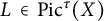 $L\,\in \,\mathrm {Pic}^{\tau }(X)$
, and we obtain the arrow
 $$ \begin{align*}\mathbb X(\varpi(X,\,x_0))\,\longrightarrow\,\mathrm{Pic}^{\tau}(X)\,.\end{align*} $$
The kernel is precisely the group of (isomorphism classes of) objects in
 $\mathcal T_{dR}(X)$
of rank one, which is
 $\mathbb X(\Theta (X,\,x_0))$
. That any class in
 $\mathrm {Pic}^{\tau }(X)$
carries an integrable connection is explained by [Reference Lübke and Teleman22, Corollary 1.3.12, p. 40].▪
We shall now be concerned with the additive characters or, with the vector spaces
 $$ \begin{align*} {\mathbb X}_a(\varpi(X,\,x_0)) \,\simeq\, \mathrm{Ext}_{\mathcal C_{dR}(X)}({\mathbf 1},\,{\mathbf 1}) \end{align*} $$
and
 $$ \begin{align*} {\mathbb X}_a(\Theta(X,\,x_0)) \,\simeq\, \mathrm{Ext}_{\mathcal T_{dR}(X)}({\mathbf 1},\,{\mathbf 1})\, , \end{align*} $$
where
 ${\mathbf 1}$
is the identity object of the pertinent categories.
Let
 $H^1_{dR}(X,\,\mathbb C)$
be
 $\mathbb H^1(X,\, \Omega _X^{\bullet })$
[Reference Griffiths and Harris17, p. 446], which is of course canonically isomorphic to
 $H^1(X,\,\mathbb C)$
[Reference Griffiths and Harris17, p. 448], and let
 $$ \begin{align} \lambda_X\,:\, H^0(X,\,\Omega_X^1)\,\longrightarrow\, H^1_{dR}(X,\,\mathbb C) \end{align} $$
be the natural arrow obtained from the fact that global holomorphic one forms on X are closed. Here, we use that X is Kähler.
Lemma 3.5 There are functorial isomorphisms of vector spaces
 $$ \begin{align*} \mathrm{Ext}_{\mathcal C_{dR}(X)}({\mathbf 1},\,{\mathbf 1})\, \stackrel{\sim}{\longrightarrow}\,H^1_{dR}(X,\, {\mathbb C}) \end{align*} $$
and
 $$ \begin{align*} \mathrm{Ext}_{\mathcal T_{dR}(X)}({\mathbf 1},\,{\mathbf 1})\, \stackrel{\sim}{\longrightarrow}\, H^0(X,\,\Omega_X^1)\, . \end{align*} $$
Under these isomorphisms, the canonic arrow
 $$ \begin{align*} \mathrm{Ext}_{\mathcal T_{dR}(X)}({\mathbf 1},\,{\mathbf 1}) \,\longrightarrow\, \mathrm{Ext}_{\mathcal C_{dR}(X)}({\mathbf 1},\, {\mathbf 1}) \end{align*} $$
corresponds to the homomorphism
 $\lambda _X$
in (3.3).
Proof Let
 $(E,\,\nabla )\,\in \,{\mathcal C}_{dR}(X)$
be an extension of
 $(\mathcal O_X,\,\mathrm d)$
by itself. Let
 ${\mathfrak U}\,=\,\{U_i\}$
be an open covering of X on which we have
 $e_i\,\in \, H^0(U_i,\,E)$
mapping to
 $1\,\in \,\mathcal O_X(U_i)$
. Consider the holomorphic
 $1$
-form
 $\theta _i$
on
 $U_i$
such that
 $\nabla (e_i)\,=\,1\otimes \theta _i$
. Then, on
 $U_i\cap U_j$
, we have
 $e_i\,=\,a_{ij}\cdot 1+e_j$
with
 $a_{ij}$
a holomorphic function. The element
 $$ \begin{align*} (\theta_i,\,a_{ij})\,\in\, C^0(\mathfrak U,\,\Omega_X^1)\oplus C^1(\mathfrak U,\,\mathcal O_X) \end{align*} $$
defines a
 $1$
-cocycle of the total Čech complex associated to the bicomplex
 $$ \begin{align*} (C^p(\mathfrak U,\,\Omega^q_X))_{0\le p,q}: \end{align*} $$
the form
 $\theta _i$
is closed and
 $\mathrm { d}a_{ij}\,=\,\theta _i-\theta _j$
. Hence,
 $\{(\theta _i,\,a_{ij})\}$
gives an element of
 $H^1_{dR}(X,\,\mathbb C)$
, call it
 $[E,\,\nabla ]$
. Note that a 1-cocycle with coefficients in
 $\mathrm {GL}_2$
representing the vector bundle E is given by the matrices
 $\begin {pmatrix}1&-a_{ij}\\0&1\end {pmatrix}$
, so that E is isomorphic to
 ${\mathcal O}_X^2$
if and only if there exists, after eventually passing to a finer covering, a 0-cochain
 $(h_i)$
with
 $$ \begin{align*} h_j-h_i\,=\,-a_{ij}\, . \end{align*} $$
In this case,
 $[E,\,\nabla ]$
belongs to the subspace
 $H^0(X,\,\Omega _X^1)\,\subset \, H^1_{dR}(X,\,\mathbb C)$
.
It is a lengthy but straightforward verification to show that
 $$ \begin{align*} \mathrm{Ext}_{\mathcal C_{dR}(X)}({\mathbf 1},\,{\mathbf 1})\,\longrightarrow\,H_{dR}^1(X,\,\mathbb C)\, ,\ \ (E,\,\nabla)\,\longmapsto\,[E,\,\nabla] \end{align*} $$
is actually bijective.▪
3.3 Properties of the pro-algebraic group scheme
$\Theta $

Lemma 3.6 Let X and Y be compact connected Kähler manifolds and V a holomorphic vector bundle on
 $X\times Y$
of rank r such that
-
• the restriction of V to
$\{x\}\times Y$
is holomorphically isomorphic to
${\mathcal O}^{\oplus r}_Y$
for every
$x\, \in \, X$
, and -
• the restriction of V to
$X\times \{y\}$
is holomorphically isomorphic to
${\mathcal O}^{\oplus r}_X$
for every
$y\, \in \, Y$
.


Then, V is holomorphically isomorphic to
 ${\mathcal O}^{\oplus r}_{X\times Y}$
.
Proof Fix a point
 $y_0\, \in \, Y$
. For any point
 $x\, \in \, X$
, the restriction
 $V_x$
of V to
 $\{x\}\times Y$
trivializable. Hence, the evaluation to
 $y_0$
of sections of
 $V_x$
 $$ \begin{align*} H^0(Y, \, V_x) \, \longrightarrow\, V_{x,y_0}\, ,\ \ \sigma\, \longmapsto\, \sigma(y_0) \end{align*} $$
is an isomorphism. This implies that for the natural projection
 $$ \begin{align*} p^X\, :\, X\times Y\,\longrightarrow\, X\, , \end{align*} $$
the direct image of V to X is
 $$ \begin{align} p^X_* V\,=\, V^{y_0}\, :=\, V\vert_{X\times\{y_0\}}\, . \end{align} $$
The vector bundle
 $V^{y_0}$
is supposed to be holomorphically trivial. Fixing r linearly independent holomorphic sections
 $\{s_1,\, \ldots , \, s_r\}$
of
 $V^{y_0}$
, we get a holomorphic trivialization of
 $V^{y_0}$
. Using the isomorphism in (3.4), each
 $s_i$
produces a section
 $$ \begin{align*} \widetilde{s}_i\, \in\, H^0(X, \, p^X_* V)\,=\, H^0(X\times Y,\, V)\, . \end{align*} $$
Now, these holomorphic sections
 $\{\widetilde {s}_1,\, \ldots , \, \widetilde {s}_r\}$
of V trivialize V holomorphically.▪
Proposition 3.7 The group scheme
 $\Theta (X,\,x_0)$
is the projective limit of connected algebraic groups.
Proof Consider an algebraic quotient
 $\Theta (X,\,x_0)\, \longrightarrow \, \Theta '$
. We need to show that
 $\Theta '$
is connected and this amounts to showing that if
 $\Theta '\, \longrightarrow \, G$
is an algebraic quotient morphism to a finite group G, then G is the trivial group. Now, write R for the left regular representation of G and note that the multiplication operation
 $$ \begin{align*} R\otimes R\, \longrightarrow\,R \end{align*} $$
and the identity
 $\mathbb C\, \longrightarrow \, R$
are G-equivariant.
Because G is a quotient of
 $\Theta (X,\,x_0)$
, any G-module gives a
 $\Theta (X,\,x_0)$
-module. In particular, R gives a
 $\Theta (X,\,x_0)$
-module. Let
 $({\mathcal R},\, \nabla )$
be the object in the category
 ${\mathcal T}_{dR}(X)$
corresponding to this
 $\Theta (X,\,x_0)$
-module R. We note that
 ${\mathcal R}$
is the trivial holomorphic vector
 ${\mathcal O}_X\otimes _{\mathbb C}R$
on X with fiber R. In particular, the rank of
 ${\mathcal R}$
is
 $|G|$
. The above homomorphism
 $\mathbb C\, \longrightarrow \, R$
produces an arrow
 ${\mathcal O}_X \, \longrightarrow \, {\mathcal R}$
. The above mentioned multiplication operation
 $R\otimes R\, \longrightarrow \, R$
produces another arrow
 ${\mathcal R}\otimes {\mathcal R}\, \longrightarrow \, {\mathcal R}$
. Endowed with these,
 $\mathcal R$
becomes a locally free
 ${\mathcal O}_X$
-algebra. Note, in addition, that giving
 ${\mathcal R}\otimes {\mathcal R}$
the tensor product connection, the arrow
 ${\mathcal R}\otimes {\mathcal R} \, \longrightarrow \, {\mathcal R}$
is also horizontal.
Let
 $f\,:\,Y\, \longrightarrow \, X$
be the analytic spectrum of
 $\mathcal R$
(see [26, Exposé 19 and Definition 2] and [Reference Fischer15, Section 1.14] and [Reference Fischer15, Theorem 1.15]); the morphism f is finite and
 $f_*\mathcal O_Y\,=\,\mathcal R$
. In addition, it is not hard to see that f is a local biholomorphism, so that Y is a compact complex manifold; here are the details. Let
 $x\,\in \, X$
be arbitrary. We have a G-equivariant isomorphism of R-algebras
 $$ \begin{align*} R\otimes R\, \longrightarrow\,R^{\oplus|G|}, \end{align*} $$
which allows us to see that the
 ${\mathcal R}_{x}$
-algebra
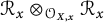 ${\mathcal R}_x\otimes _{\mathcal O_{X,x}}{\mathcal R}_x$
(multiplication on the left) is isomorphic to
 ${\mathcal R}_x^{\oplus |G|}$
. Consequently,
 ${\mathcal O}_{X,x}\, \longrightarrow \, \mathcal R_x$
is an étale morphism by flat descent [Reference Raynaud24, Ch. II, Proposition 4, p. 14]. Let now
 $y\in Y$
be above x. We know that
 $\mathcal O_{Y,y}$
is, as an
 $\mathcal O_{X,x}$
-algebra, the localization of
 $\mathcal R_x$
at some maximal ideal [26, Exposé 19 and Proposition 6]. So, the natural arrow
 $\mathcal O_{X,x}\, \longrightarrow \,\mathcal O_{Y,y}$
is an isomorphism [Reference Raynaud24, Ch. VII, Proposition 3, p. 76].
Finally, Y is connected because any idempotent
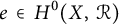 $$ \begin{align*} e\,\in\, H^0(X,\,\mathcal R) \end{align*} $$
is horizontal, so that it produces a horizontal arrow
 ${\mathcal O}_X\, \longrightarrow \, {\mathcal R}$
and then a G-invariant element of R.
Because
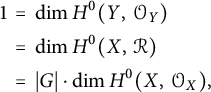 $$ \begin{align*} \begin{split} 1&\,=\,\dim H^0(Y,\,\mathcal O_Y)\\ &\,=\,\dim H^0(X,\,\mathcal R)\\ &\,=\, |G|\cdot\dim H^0(X,\,\mathcal O_X), \end{split} \end{align*} $$
we conclude that
 $|G|\,=\,1$
.▪
Proposition 3.8 Let
 $(X,\,x_0)$
and
 $(Y,\,y_0)$
be pointed compact Kähler manifolds. Set
 $P\,=\,X\times Y$
, and let
 $i\,:\,X\,\longrightarrow \, P$
(respectively,
 $j\,:\,Y \,\longrightarrow \, P$
) stand for the immersion defined by
 $x\, \longmapsto \, (x,\, y_0)$
(respectively,
 $y\, \longmapsto \, (x_0,\, y)$
). Then, the arrow of affine group schemes
 $$ \begin{align*} (i_{\natural},\,j_{\natural})\,:\,\Theta(X,\,x_0)\times\Theta(Y,\,y_0)\,\longrightarrow \,\Theta(P,\, (x_0,\,y_0)) \end{align*} $$
is an isomorphism.
Proof Let p (respectively, q) be the natural projection of P to X (respectively, Y). In what follows, we abandon reference to the base points.
We know that the natural morphism
 $$ \begin{align*} (i_{\natural},\,j_{\natural})\,:\,\varpi(X)\times\varpi(Y)\,\longrightarrow \,\varpi(P) \end{align*} $$
is an isomorphism.
We claim that
 $i_{\natural }\,:\,\Theta (X)\,\longrightarrow \, \Theta (P)$
is a closed and normal immersion.
First, note that
 $i_{\natural }$
is closed, because
 $$ \begin{align*} p_{\natural} \circ i_{\natural}\,:\,\Theta(X)\,\longrightarrow\, \Theta(X) \end{align*} $$
is the identity map. Next,
 $i_{\natural }$
is normal, because
 $i_{\natural }\,:\,\varpi (X)\,\longrightarrow \, \varpi (P)$
is a normal immersion, and we possess the following commutative diagram:
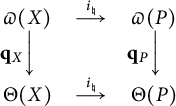 $$ \begin{align*} \begin{matrix} \varpi(X) & \stackrel{i_{\natural}}{\longrightarrow} &\varpi(P)\\ {\mathbf q}_X \Big\downarrow\,\,\,\,\,\,\, && {\mathbf q}_P\Big\downarrow\,\,\,\,\,\,\, \\ \Theta(X)& \stackrel{i_{\natural}}{\longrightarrow} & \Theta(P) \end{matrix} \end{align*} $$
in which the vertical arrows are the quotient morphisms. This proves the claim.
Clearly, the same arguments apply to
 $j_{\natural }\,:\,\Theta (Y)\,\longrightarrow \,\Theta (P)$
.
Let
 $$ \begin{align*} \chi\,:\,\Theta(P)\,\longrightarrow\, Q \end{align*} $$
be the cokernel of
 $i_{\natural }\,:\,\Theta (X)\,\longrightarrow \, \Theta (P)$
[Reference Waterhouse31, Theorem 16.3]. It is easy to see that the kernel of the composition
 $$ \begin{align*} \Theta(Y) \,\stackrel{j_{\natural}}{\longrightarrow}\,\Theta(P)\,\stackrel{\chi}{\longrightarrow}\, Q \end{align*} $$
is trivial; indeed,
 $q_{\natural }\,:\,\Theta (P)\,\longrightarrow \,\Theta (Y)$
factors as
 $$ \begin{align*} \Theta(P)\,\stackrel{\chi}{\longrightarrow}\, Q\,\stackrel{r}{\longrightarrow}\Theta(Y), \end{align*} $$
because
 $q_{\natural }\circ i_{\natural }$
is trivial, and
 $\mathrm {id}_{\Theta (Y)} \,=\,q_{\natural }\circ j_{\natural }$
. We conclude that
 $\mathrm {Im}(i_{\natural })\cap \mathrm {Im}(j_{\natural }) \,=\,\{e\}$
. Now, a well-known lemma from group theory says that
 $$ \begin{align*} (i_{\natural},\,j_{\natural})\,:\,\Theta(X)\times\Theta(Y)\,\longrightarrow\, \Theta(P) \end{align*} $$
is a normal monomorphism of group schemes [Reference Bourbaki10, I.4.9, Proposition 15, p. 48]. As such, it is a closed immersion [Reference Waterhouse31, Theorem 15.3]. Finally, because
 $$ \begin{align*} (i_{\natural},\,j_{\natural})\,:\,\varpi(X)\times\varpi(Y)\,\longrightarrow\, \varpi(P) \end{align*} $$
is a quotient morphism, we conclude that
 $$ \begin{align*} (i_{\natural},\,j_{\natural})\,:\, \Theta(X)\times\Theta(Y)\,\longrightarrow\, \Theta(P) \end{align*} $$
is also one. Hence,
 $\Theta (X)\times \Theta (Y)\,\simeq \, \Theta (P)$
.
Take a pointed compact Kähler manifold
 $(X,\, x_0)$
. Let
 $$ \begin{align} \Gamma\, \subset\, H^0(X,\, \Omega^1_X)^* \end{align} $$
be the image of the homomorphism
 $H_1(X,\, {\mathbb Z})\, \longrightarrow \, H^0(X,\, \Omega ^1_X)^*$
that sends any
 $$ \begin{align*} \gamma\, \in\, H_1(X,\, {\mathbb Z}) \end{align*} $$
to the element of the dual vector space
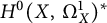 $H^0(X,\, \Omega ^1_X)^*$
defined by the integral
 $$ \begin{align*} \nu\, \longmapsto\, \int_{\gamma} \nu\, , \ \ \nu\, \in\, H^0(X,\, \Omega^1_X)\, . \end{align*} $$
Let
 $\text {A}(X)\,=\, H^0(X,\, \Omega ^1_X)^*/\Gamma $
be the Albanese variety of X. Let
 $$ \begin{align} {\mathcal A}\, :\, X\, \longrightarrow\, \text{A}(X) \end{align} $$
be the Albanese map defined by
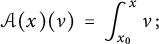 $$ \begin{align*} {\mathcal A}(x)(\nu)\, =\, \int_{x_0}^x \nu\, ; \end{align*} $$
this does not depend on the choice of path from
 $x_0$
to x. We have
 $H^0(X,\, \Omega ^1_X)\,=\, H^0(\text {A}(X),\, \Omega ^1_{\text {A}(X)})$
, and the homomorphism
 $$ \begin{align} \alpha\,: \, H^0(\text{A}(X),\, \Omega^1_{\text{A}(X)})\, \longrightarrow\, H^0(X,\, \Omega^1_X) \end{align} $$
defined by
 $\xi \, \longmapsto \, {\mathcal A}^*\xi $
, for all
 $\xi \, \in \, H^0(\text {A}(X),\, \Omega ^1_{\text {A}(X)}),$
is an isomorphism. Hence, the homomorphism
 $$ \begin{align} \overline{\alpha} : H^1(\text{A}(X), {\mathcal O}_{\text{A}(X)}) = \overline{H^0(\text{A}(X), \Omega^1_{\text{A}(X)})} \longrightarrow \overline{H^0(X,\Omega^1_X)}=H^1(X, {\mathcal O}_X) \end{align} $$
is an isomorphism.▪
In view of the isomorphism
 $\alpha $
in (3.7), we conclude that there is a natural bijection between the holomorphic connections on
 ${\mathcal O}^{\oplus r}_X$
and the holomorphic connections on
 ${\mathcal O}^{\oplus r}_{\text {A}(X)}$
; this isomorphism sends a holomorphic connection D on
 ${\mathcal O}^{\oplus r}_{\text {A}(X)}$
to the holomorphic connection
 ${\mathcal A}^*D$
on
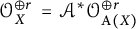 ${\mathcal O}^{\oplus r}_X\,=\, {\mathcal A}^* {\mathcal O}^{\oplus r}_{\text {A}(X)}$
.
If D is integrable, then
 ${\mathcal A}^*D$
is integrable. Notice that the converse need not be true in general. To construct examples of nonintegrable D such that
 ${\mathcal A}^*D$
is integrable, we recall that there are examples of
 $(M,\, \mathbb {D})$
, where M is a compact Riemann surface and
 $\mathbb {D}$
is an irreducible holomorphic connection on
 ${\mathcal O}^{\oplus 2}_M$
[Reference Biswas and Dumitrescu4, Reference Biswas, Dumitrescu and Heller5, Reference Calsamiglia, Deroin, Heu and Loray11] (any holomorphic connection on a Riemann surface is automatically integrable). Because the fundamental group of a compact complex torus
 $\mathbb T$
is abelian, there is no irreducible integrable connection on a rank-two bundle over
 $\mathbb T$
. In addition, the pullback of a reducible connection is reducible. Therefore, for any
 $(M,\, \mathbb {D})$
as above, the corresponding holomorphic connection on the Albanese variety
 $\text {A}(M)$
is not integrable.
Note that
 $\Gamma $
in (3.5) is a quotient of
 $\pi _1(X,\, x_0)$
, because
 $H_1(X,\, {\mathbb Z})$
is a quotient of
 $\pi _1(X,\, x_0)$
, and
 $\Gamma $
is a quotient of
 $H_1(X,\, {\mathbb Z})$
.
Proposition 3.9 Let D be an integrable holomorphic connection on
 ${\mathcal O}^{\oplus r}_X$
. Then, there is an integrable holomorphic connection
 $\widetilde {D}$
on
 ${\mathcal O}^{\oplus r}_{\mathrm {A}(X)}$
such that
 $$ \begin{align*} ({\mathcal O}^{\oplus r}_X,\, D)\,=\, ({\mathcal A}^*{\mathcal O}^{\oplus r}_{\mathrm{A}(X)},\, {\mathcal A}^*\widetilde{D})\, , \end{align*} $$
where
 $\mathcal A$
is the map in (3.6), if and only if the monodromy representation
 $$ \begin{align*} \rho_D\,:\, \pi_1(X,\, x_0)\, \longrightarrow\, \mathrm{GL}(r,{\mathbb C}) \end{align*} $$
for D factors through the quotient group
 $\Gamma $
of
 $\pi _1(X,\, x_0)$
.
Proof We have
 $\pi _1(\mathrm {A}(X))\,=\, \Gamma $
, and the homomorphism
 $$ \begin{align*}{\mathcal A}_*\, :\, \pi_1(X,\, x_0)\, \longrightarrow\, \pi_1(\mathrm{A}(X)) \end{align*} $$
induced by the Albanese map
 $\mathcal A$
in (3.6) actually coincides with the quotient homomorphism
 $\pi _1(X,\, x_0)\, \longrightarrow \, \Gamma $
. Therefore, if
 $$ \begin{align*}({\mathcal O}^{\oplus r}_X,\, D)\,=\, ({\mathcal A}^*{\mathcal O}^{\oplus r}_{\mathrm{A}(X)},\, {\mathcal A}^*\widetilde{D}) \end{align*} $$
for some integrable holomorphic connection
 $\widetilde {D}$
on
 ${\mathcal O}^{\oplus r}_{\mathrm {A}(X)}$
, then the monodromy representation
 $\rho _D\,:\, \pi _1(X,\, x_0)\, \longrightarrow \, \mathrm {GL}(r,{\mathbb C})$
for D factors through the quotient group
 $\Gamma $
of
 $\pi _1(X,\, x_0)$
.
To prove the converse, assume that the monodromy representation
 $$ \begin{align*}\rho_D\,:\, \pi_1(X,\, x_0)\, \longrightarrow\, \mathrm{GL}(r,{\mathbb C})\end{align*} $$
for D does factor through the quotient group
 $\Gamma $
of
 $\pi _1(X,\, x_0)$
. Therefore, the representation
 $$ \begin{align} \rho^{\prime}_D\,:\, \Gamma\,=\, \pi_1(\mathrm{A}(X),\, {\mathcal A}(x_0)) \, \longrightarrow\, \mathrm{GL}(r,{\mathbb C}) \end{align} $$
given by
 $\rho _D$
produces a pair
 $(V,\, \widetilde {D})$
, where
-
•
-
V is a holomorphic vector bundle of rank r on
$\mathrm {A}(X)$
, -
•
$\widetilde D$
is an integrable holomorphic connection on V, and -
•
$({\mathcal A}^*V,\, {\mathcal A}^*\widetilde {D})\,=\, ({\mathcal O}^{\oplus r}_X,\, D)$
.



Consequently, to prove the proposition, it suffices to show that
 $$ \begin{align} V\,\simeq\, {\mathcal O}^{\oplus r}_{\mathrm{A}(X)}\, . \end{align} $$
Consider
 ${\mathbb C}^r$
as a
 $\Gamma $
-module using the homomorphism
 $\rho ^{\prime }_D$
(in (3.9)) together with the standard action of
 $\mathrm {GL}(r,{\mathbb C})$
on
 ${\mathbb C}^r$
. Because
 $\Gamma $
is an abelian group, we contend that the
 $\Gamma $
-module
 ${\mathbb C}^r$
decomposes as
 $$ \begin{align} \mathbb C^r\,=\, \bigoplus_{i=1}^m L_i\otimes U_i\, , \end{align} $$
where
 $L_i$
(respectively,
 $U_i$
) is a one-dimensional (respectively, unipotent) representation of
 $\Gamma $
. Indeed, let S be an indecomposable summand of the
 $\Gamma $
-module
 $\mathbb C^r$
and, for any given
 $\gamma \,\in \, \Gamma $
, consider the decomposition of S into generalized eigenspaces:
 $\bigoplus _iS_i$
. Because every
 $\delta \,\in \,\Gamma $
commutes with
 $\gamma $
, we can say that every
 $S_i$
is invariant under
 $\Gamma $
; it follows that
 $\gamma $
has a single eigenvalue in S (recall that S is indecomposable). Associating to each
 $\gamma $
the previous eigenvalue, we get a homomorphism
 $\Gamma \,\longrightarrow \, \mathbb C^*$
and, hence, a one-dimensional representation L. Now,
 $L^{\vee }\otimes S$
is indecomposable and has only one eigenvalue, namely
 $1$
; here,
 $L^{\vee }$
denotes the dual of L. Simultaneous triangularization—which follows easily from the fact that
 $\Gamma $
is abelian—now shows that
 $L^{\vee }\otimes S$
is unipotent, thus establishing the decomposition in (3.11).
From (3.11), we obtain a decomposition of the connection
 $(V,\,\widetilde D)$
as
 $$ \begin{align} (V,\,\widetilde D)\,=\,\bigoplus_{i=1}^m {\mathcal L}_i\otimes {\mathcal U}_i\, , \end{align} $$
where
 ${\mathcal L}_i$
stands for a rank-one integrable connection and
 ${\mathcal U}_i$
stands for a connection with unipotent monodromy. Note that, because
 ${\mathcal U}_i$
has unipotent monodromy, each
 ${\mathcal L}_i$
is a subconnection of V and, hence,
 ${\mathcal A}^*{\mathcal L}_i$
is a subconnection of
 ${\mathcal A}^*V$
. Using a dualization and Proposition 3.1, we can say that the vector bundle underlying
 ${\mathcal A}^*{\mathcal L}_i$
is trivial. Because the homomorphism
 $$ \begin{align*} \text{Pic}^0(\mathrm{A}(X))\, \longrightarrow\, \text{Pic}^0(X)\, ,\ \ L\,\longmapsto\, {\mathcal A}^*L\, , \end{align*} $$
where
 $\mathcal A$
is the map in (3.6), is an isomorphism, we conclude that
 $$ \begin{align} \text{the underlying holomorphic line bundle of} {\mathcal L}_i \text{ in } (3.12) \text{ is trivial}, \end{align} $$
for all
 $1\, \leq \, i\,\leq \, m$
.
Next, we note that the connection
 ${\mathcal A}^*{\mathcal U}_i$
is a subconnection of
 $$ \begin{align*} {\mathcal A}^*(V)\otimes({\mathcal A}^*{\mathcal L}^{\vee}_i), \end{align*} $$
and hence, applying a dualization and Proposition 3.1, from (3.13), we conclude that
 $$ \begin{align*} {\mathcal A}^*{\mathcal U}_i\,\in\,{\mathcal T}_{dR}(X)\, . \end{align*} $$
The holomorphic vector bundle underlying
 ${\mathcal U}_i$
will be denoted by
 $U_i$
. The integrable holomorphic connection on
 $U_i$
defining
 ${\mathcal U}_i$
will be denoted by
 $D_i$
. Let s be the rank of
 $U_i$
.
Because
 ${\mathcal U}_i$
is an integrable connection with unipotent monodromy, there is a filtration of holomorphic subbundles
 $$ \begin{align} 0\,=\, V_0\, \subset\, V_1\, \subset\, \cdots\, \subset\, V_i\, \subset\, \cdots\, \subset\, V_{r-1}\, \subset\, V_s\, =\, U_i \end{align} $$
such that
-
(1)
$\mathrm {rank}(V_i)\,=\, i$
for all
$1\, \leq \, i\, \leq \, s$
, -
(2) every quotient
$V_i/V_{i-1}$
is
${\mathcal O}_{\mathrm {A}(X)}$
, -
(3) each
$V_i$
is preserved by
$D_i$
, and -
(4) for every
$1\, \leq \, i\, \leq \, s$
, the connection on
$V_i/V_{i-1}$
induced by
$D_i$
is the trivial connection on
${\mathcal O}_{\mathrm {A}(X)}$
given by the de Rham differential.



Let
 $$ \begin{align} 0= {\mathcal A}^* V_0 \subset {\mathcal A}^*V_1 \subset \cdots \subset {\mathcal A}^*V_i \subset \cdots \subset {\mathcal A}^* V_{s-1} \subset {\mathcal A}^*V_s = {\mathcal A}^*U_i = {\mathcal O}^{\oplus s}_X \end{align} $$
be the filtration of
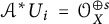 ${\mathcal A}^*U_i\,=\, {\mathcal O}^{\oplus s}_X$
obtained by pulling back the filtration in (3.14) using the map
 ${\mathcal A}$
. We know that
 $$ \begin{align*}({\mathcal A}^*V_i)/({\mathcal A}^*V_{i-1})\,=\, {\mathcal A}^*(V_i/V_{i-1})\,=\, {\mathcal O}_X, \end{align*} $$
for all
 $1\, \leq \, i\, \leq \, s$
.
We will prove that the filtration in (3.15) splits holomorphically.
For any
 $1\, \leq \, j\, \leq \, s$
, let
 ${\mathcal S}_j\,=\, {\mathcal O}_X\, \subset \, {\mathcal O}^{\oplus r}_X$
be the jth factor in the direct sum
 ${\mathcal O}^{\oplus s}_X$
. Let
 $\psi _j$
denote the following composition of homomorphisms:
 $$ \begin{align*} {\mathcal S}_j\,\hookrightarrow\, {\mathcal O}^{\oplus s}_X\,=\, {\mathcal A}^*V_s\, \longrightarrow\, ({\mathcal A}^*V_s)/({\mathcal A}^*V_{s-1})\,=\, {\mathcal A}^*(V_s/V_{s-1})\,=\, {\mathcal O}_X \end{align*} $$
(see (3.15)), where
 ${\mathcal A}^*V_s\, \longrightarrow \, ({\mathcal A}^*V_s)/({\mathcal A}^*V_{s-1})$
is the natural quotient map. For some
 $1\, \leq \, j_0\, \leq \, s$
, the above homomorphism
 $\psi _{j_0}$
is nonzero. This
 $j_0$
is evidently an isomorphism. Hence, we conclude that
 $$ \begin{align} {\mathcal O}^{\oplus s}_X\,=\, {\mathcal S}_{j_0}\oplus \left(\bigoplus_{j=1,j\not=j_0}^s {\mathcal S}_j\right) \,=\, {\mathcal A}^*V_s\,=\, {\mathcal A}^*V_{s-1}\oplus {\mathcal O}_X\, ; \end{align} $$
the above direct summand
 ${\mathcal O}_X\, \subset \, {\mathcal A}^*V_s$
is the image of
 ${\mathcal S}_{j_0}$
by the identification in (3.15) between
 ${\mathcal A}^*V_s$
and
 ${\mathcal O}^{\oplus s}_X$
. Applying [Reference Atiyah2, Theorem 2, p. 315] to the decomposition in (3.16), we conclude that
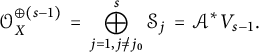 $$ \begin{align*}{\mathcal O}^{\oplus (s-1)}_X\,=\, \bigoplus_{j=1,j\not=j_0}^s {\mathcal S}_j\,=\, {\mathcal A}^*V_{s-1}. \end{align*} $$
Repeating the above argument, after replacing
 ${\mathcal O}^{\oplus s}_X$
(respectively,
 ${\mathcal A}^*V_s$
) by
 ${\mathcal O}^{\oplus (s-1)}_X$
(respectively,
 ${\mathcal A}^*V_{s-1}$
), we conclude that
 $$ \begin{align*}{\mathcal A}^*V_{s-1}\,=\, {\mathcal A}^*V_{s-2}\oplus {\mathcal O}_X\, . \end{align*} $$
Now, proceeding inductively, we conclude that the filtration in (3.15) splits holomorphically.
The homomorphism
 $$ \begin{align*}H^1(\mathrm{A}(X), \, {\mathcal O}_{\mathrm{A}(X)})\, \longrightarrow\, H^1(X,\, {\mathcal O}_X)\, ,\ \ \theta\, \longmapsto\, {\mathcal A}^*\theta \end{align*} $$
is an isomorphism. Because the extensions of
 ${\mathcal O}_{\mathrm {A}(X)}$
by
 ${\mathcal O}_{\mathrm {A}(X)}$
are parameterized by the cohomology
 $H^1(\mathrm {A}(X), \, {\mathcal O}_{\mathrm {A}(X)})$
, from this and the fact that the filtration in (3.15) splits holomorphically, it follows that the filtration in (3.14) splits holomorphically. This proves that
 $U_i\,=\, {\mathcal O}^{\oplus s}_{\mathrm {A}(X)}$
.▪
Let us now study the case of “abelian” Kähler manifolds by first recalling certain fundamental facts from the theory of affine group schemes.
Let U be an algebraic affine and unipotent group scheme over
 $\mathbb C$
[Reference Waterhouse31, Section 8.3]: there is a closed immersion of U into some group of strict upper triangular matrices. Endowing the nilpotent Lie algebra
 $\mathrm {Lie}(U)$
with its Baker–Campbell–Hausdorff multiplication, it is known that
 $$ \begin{align*} \exp\,:\,\mathrm{Lie}(U)\,\longrightarrow \,U\end{align*} $$
is an isomorphism of group schemes [Reference Hochschild18, Theorem XVII.4.2, p. 232]; in particular, if U is, in addition, a commutative group scheme, then
 $U\,\simeq \, {\mathbb G}_a^r$
for some r. Moreover,
 $r\,=\,\dim _{\mathbb C}\mathrm {Hom}(U,\,\mathbb G_a)$
[Reference Waterhouse31, Theorem 8.4]. Said differently,
 $$ \begin{align*} U\,\simeq\, \mathrm{Hom}(U,\,{\mathbb G}_a)\, . \end{align*} $$
Still in the topic of affine group schemes, for any given abstract abelian group
 $\Lambda $
, we shall denote by
 $\mathrm {Diag}(\Lambda )$
the diagonalizable group scheme corresponding to the abstract group
 $\Lambda $
as explained in [Reference Waterhouse31, Section 2.2]; on the level of
 $\mathbb C$
-points,
 $\mathrm {Diag}(\Lambda )$
is just
 $\mathrm {Hom}(\Lambda ,\,{\mathbb C}^{\times })$
.
Proposition 3.10 Suppose that
 $\pi _1(X,\,x_0)$
is abelian. Then,
 $$ \begin{align*} \Theta(X,\,x_0)\,\simeq\, H^0(X,\,\Omega_X^1)\times\mathrm{Diag}(H^0(X,\,\Omega_X^1))\, . \end{align*} $$
Proof Because
 $\pi _1(X,\,x_0)$
is abelian, the group scheme
 $\varpi (X,\,x_0)$
is abelian. This implies that
 $\Theta (X,\,x_0)$
is abelian and, hence, is a product of a unipotent U and a diagonal group scheme
 $\mathbb D$
[Reference Waterhouse31, Theorem 9.5, p. 70]. The arguments made in Lemmas 3.4 and 3.5 jointly with the preliminary material on group schemes recalled above now allow us to explicitly determine U and
 $\mathbb D$
as wanted. Indeed, the group of characters of
 $U\times {\mathbb D}$
(respectively, additive characters) is simply the group of characters of
 $\mathbb D$
(respectively, additive characters of U) as explained in [Reference Waterhouse31, Chapter 8], Corollary in 8.3 and Exercise 6.▪
4 Riemann surfaces and compact complex tori
4.1 Neutral Tannakian category for a Riemann surface
Let X and Y be two compact connected Riemann surfaces of common genus g, with
 $g\, \geq \,1$
. Fix a point
 $x_0\, \in \, X$
. Let
 $$ \begin{align} \beta\, :\, X\, \longrightarrow\, Y \end{align} $$
be a
 $C^{\infty }$
orientation preserving diffeomorphism. Let
 $$ \begin{align*}\widehat{\beta}\, :\, \pi_1(X,\, x_0)\, \longrightarrow\, \pi_1(Y,\, \beta(x_0)) \end{align*} $$
be the homomorphism of fundamental groups induced by
 $\beta $
. It produces a unique algebraic homomorphism
 $$ \begin{align} \beta_{\natural}\, :\, \varpi(X,\, x_0)\, \longrightarrow\, \varpi(Y,\, \beta(x_0)) \end{align} $$
such that
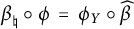 $\beta _{\natural }\circ \phi \,=\,\phi _Y\circ \widehat {\beta }$
, where
 $\phi $
is the homomorphism in (2.1) and
 $$ \begin{align*}\phi_Y\, :\, \pi_1(Y,\, \beta(x_0)) \, \longrightarrow\, \varpi(Y,\, \beta(x_0))\end{align*} $$
is the similar homomorphism for Y.
We will say that the homomorphism
 $\beta _{\natural }$
in (4.2) descends to a homomorphism from
 ${\Theta }(X,\, x_0)$
, constructed in (3.1), to
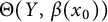 ${\Theta }(Y,\, \beta (x_0))$
if there is a homomorphism
 $$ \begin{align*}\beta^{\prime}_{\natural}\, :\, {\Theta}(X,\, x_0) \, \longrightarrow\, {\Theta}(Y,\,\beta(x_0)) \end{align*} $$
such that
 $$ \begin{align*}\beta^{\prime}_{\natural}\circ\mathbf{q}_X\,=\, \mathbf{q}_Y\circ\beta_{\natural}\, , \end{align*} $$
where
 $\mathbf {q}_X$
is the homomorphism in (3.2) and
 $$ \begin{align*}\mathbf{q}_Y\, :\, \varpi(Y,\, \beta(x_0))\, \longrightarrow\, {\Theta}(Y,\, \beta(x_0))\end{align*} $$
is the similar homomorphism for Y, while
 $\beta _{\natural }$
is constructed in (4.2).
Theorem 4.1 Assume that the homomorphism
 $\beta _{\natural }$
in (4.2) descends to a homomorphism from
 ${\Theta }(X,\, x_0)$
to
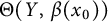 ${\Theta }(Y,\, \beta (x_0))$
. Then, the two Riemann surfaces X and Y are isomorphic.
Proof Let
 $\beta ^{\prime }_{\natural }\, :\, {\Theta }(X,\, x_0) \, \longrightarrow \, {\Theta }(Y,\,\beta (x_0))$
be a homomorphism such that the diagram
 $$ \begin{align} \begin{matrix} \varpi(X,\, x_0)& \stackrel{\beta_{\natural}}{\longrightarrow}& \varpi(Y,\, \beta(x_0))\\ \mathbf{q}_X \Big\downarrow\,\,\,\,\,\,\, && \mathbf{q}_Y\Big\downarrow\,\,\,\,\,\,\, \\ {\Theta}(X,\, x_0)&\stackrel{\beta^{\prime}_{\natural}}{\longrightarrow}& {\Theta}(Y,\,\beta(x_0)) \end{matrix} \end{align} $$
is commutative. Let
 $$ \begin{align} \begin{matrix} \mathbb X_a( \Theta (Y,\, \beta(x_0)) )& {\longrightarrow} & \mathbb X_a( \Theta (X,\, x_0) )\\ \lambda^2\Big\downarrow\,\,\,\, &&\lambda^1 \Big\downarrow\,\,\,\,\\ \mathbb X_a(\varpi(Y,\, \beta(x_0)))& \stackrel{\rho}{\longrightarrow} & \mathbb X_a( \varpi(X,\, x_0) ) \end{matrix} \end{align} $$
be the corresponding commutative diagram of vector spaces (see Section 3.2).
Now, according to Lemma 3.5,
 $$ \begin{align*}\mathbb X_a( \Theta (X,\, x_0) )\,=\, H^0(X,\, \Omega^1_X) \ \ \text{ and }\ \ \mathbb X_a( \varpi(X,\, x_0) )\,=\, H^1_{dR}(X,\, {\mathbb C})\, . \end{align*} $$
Similarly, we have
 $$ \begin{align*}\mathbb X_a( \Theta(Y,\, \beta(x_0)) )\,=\, H^0(Y,\, \Omega^1_Y) \ \ \text{ and }\ \ \mathbb X_a( \varpi(Y,\, \beta(x_0)) )\,=\, H^1_{dR}(Y,\, {\mathbb C})\,. \end{align*} $$
The homomorphism
 $\lambda ^1$
in (4.4) is the natural inclusion of
 $H^0(X,\, \Omega ^1_X)$
in
 $H^1_{dR}(X,\, {\mathbb C})$
given by the fact that any holomorphic
 $1$
-form on X is closed. The homomorphism
 $$ \begin{align} \rho\, :\, H^1_{dR}(Y,\, {\mathbb C})\,=\, \mathbb X_a( \varpi(Y,\, \beta(x_0)) ) \, \longrightarrow\, \mathbb X_a( \varpi(X,\, x_0) )\,=\, H^1_{dR}(X,\, {\mathbb C}) \end{align} $$
in (4.4) coincides with the pullback homomorphism
 $$ \begin{align} \beta^*\, :\, H^1_{dR}(Y,\, {\mathbb C})\, \longrightarrow\,H^1_{dR}(X,\, {\mathbb C})\, ,\ \ c\, \longmapsto\, \beta^*c\, , \end{align} $$
where
 $\beta $
is diffeomorphism in (4.1).
For the isomorphism
 $\beta ^*$
in (4.6), we have
 $$ \begin{align*}\beta^*(H^1(Y,\, {\mathbb Z}))\,=\, H^1(X,\, {\mathbb Z})\, . \end{align*} $$
Furthermore, because the diffeomorphism
 $\beta $
is orientation preserving, it takes the natural symplectic pairing on
 $H^1_{dR}(Y,\, {\mathbb C})$
defined by
 $$ \begin{align} c_1\otimes c_2\, \longmapsto\, \int_Y c_1\wedge c_2\, \in\, {\mathbb C} \end{align} $$
to the corresponding symplectic pairing on
 $H^1_{dR}(X,\, {\mathbb C})$
.
The Jacobian
 $J(Y)$
of Y coincides with the following quotient:
 $$ \begin{align*}(H^1_{dR}(Y,\, {\mathbb C})/H^0(Y,\, \Omega^1_Y))/H^1(Y,\, {\mathbb Z})\, =\, J(Y)\, , \end{align*} $$
and the natural principal polarization on
 $J(Y)$
is constructed using the pairing in (4.7) and the complex structure of
 $H^1_{dR}(Y,\, {\mathbb C})$
. More precisely, the holomorphic tangent bundle
 $TJ(Y)$
of
 $J(Y)$
is the trivial holomorphic vector bundle
 $$ \begin{align*}J(Y)\times \overline{H^0(Y,\, \Omega_Y^1)}\, \longrightarrow\, J(Y)\end{align*} $$
with fiber
 $\overline {H^0(Y,\, \Omega ^1_Y)}\,=\, H^1(Y,\, {\mathcal O}_Y)$
. The Hermitian form on
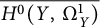 $\overline {H^0(Y,\, \Omega ^1_Y)}$
defined by
 $$ \begin{align*}\overline{c}_1\otimes \overline{c}_2\, \longmapsto\, -\sqrt{-1}\int_Y \overline{c}_1\wedge c_2 \, \in\, {\mathbb C}\, , \ \ c_1,\, c_2\, \in\, H^0(Y,\, \Omega^1_Y) \end{align*} $$
produces the canonical principal polarization on
 $J(Y)$
.
We noted above that the
 $\mathbb C$
-linear isomorphism
 $\beta ^*$
in (4.6) takes
 $H^1(Y,\, {\mathbb Z})$
to isomorphically
 $H^1(X,\, {\mathbb Z})$
and takes the symplectic pairing in (4.7) to the corresponding pairing for X. Because
 $$ \begin{align*}\rho\,=\, \beta^*\, , \end{align*} $$
where
 $\rho $
is the homomorphism in (4.5) (and (4.4)), from the commutativity of the diagram in (4.4), we now conclude that
 $J(Y)$
is isomorphic to the Jacobian
 $J(X)$
of X as a principally polarized abelian variety. Now, from the standard Torelli theorem (see [Reference Arbarello, Cornalba, Griffiths and Harris1, Chapter VI, Section 3, pp. 245–246]), we conclude that X is isomorphic to Y.▪
4.2 Neutral Tannakian category for a compact complex torus
Let
 $\mathbb T$
be a compact complex torus of complex dimension d. The group scheme
 $\varpi ({\mathbb T},\, x_0)$
is abelian, because
 $\pi _1({\mathbb T},\, x_0)$
is so. Hence, the quotient
 ${\Theta }(X,\, x_0)$
of
 $\varpi ({\mathbb T},\, x_0)$
is also abelian. As in the proof of Theorem 4.1, we consider the corresponding additive character spaces
 $\mathbb X_a(\varpi ({\mathbb T},\, x_0))$
and
 $\mathbb X_a(\Theta ({\mathbb T},\, x_0))$
and their Lie algebras. From Lemma 3.5, we have
 $$ \begin{align*}\mathbb X_a( \varpi({\mathbb T},\, x_0) )\,=\, H^1_{dR}({\mathbb T},\, {\mathbb C}) \end{align*} $$
and
 $$ \begin{align*}\mathbb X_a(\Theta ({\mathbb T},\, x_0) )\,=\, H^0({\mathbb T},\, \Omega^1_{\mathbb T})\, , \end{align*} $$
where
 $\Omega ^1_{\mathbb T}$
is the holomorphic cotangent bundle of
 $\mathbb T$
. Consider the linear map
 $$ \begin{align} \Psi\, :\, H^0({\mathbb T},\, \Omega^1_{\mathbb T})\,=\, \mathbb X_a( \Theta({\mathbb T},\, x_0) ) \, \longrightarrow\, \mathbb X_a(\varpi({\mathbb T},\, x_0) )\,=\, H^1_{dR}({\mathbb T},\, {\mathbb C}) \end{align} $$
induced by the homomorphism
 $\mathbf {q}_{\mathbb T}$
in (3.2). We note that
 $\Psi $
coincides with the natural inclusion of
 $H^0({\mathbb T},\, \Omega ^1_{\mathbb T})$
in
 $H^1_{dR}({\mathbb T},\, {\mathbb C})$
given by the fact that any holomorphic
 $1$
-form on
 $\mathbb T$
is actually closed.
Let
 ${\mathbb S}$
be a compact complex torus of complex dimension d, and let
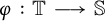 $$ \begin{align*}\varphi\, :\, {\mathbb T}\, \longrightarrow\, {\mathbb S} \end{align*} $$
be a diffeomorphism. Let
 $$ \begin{align} \varphi_{\natural}\, :\, \varpi({\mathbb T},\, x_0)\, \longrightarrow\, \varpi({\mathbb S},\, \varphi(x_0)) \end{align} $$
be the homomorphism corresponding to
 $\varphi $
. We say that
 $\varphi _{\natural }$
descends to a homomorphism from
 ${\Theta }({\mathbb T},\, x_0)$
to
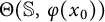 ${\Theta }({\mathbb S},\, \varphi (x_0))$
if there is a homomorphism
 $$ \begin{align*}\varphi^{\prime}_{\natural}\, :\, {\Theta}({\mathbb T},\, x_0) \, \longrightarrow\,{\Theta}({\mathbb S},\, \varphi(x_0)) \end{align*} $$
such that the diagram
 $$ \begin{align} \begin{matrix} \varpi({\mathbb T},\, x_0)& \stackrel{\varphi_{\natural}}{\longrightarrow}& \varpi({\mathbb S},\, \varphi(x_0))\\ \mathbf{q}_{\mathbb T} \Big\downarrow\,\,\,\,\,\,\, && \mathbf{q}_{\mathbb S}\Big\downarrow\,\,\,\,\,\,\, \\ {\Theta}({\mathbb T},\, x_0)&\stackrel{\varphi^{\prime}_{\natural}}{\longrightarrow}& {\Theta}({\mathbb S},\,\varphi(x_0)) \end{matrix} \end{align} $$
is commutative, where
 $\mathbf {q}_{\mathbb T}$
and
 $\mathbf {q}_{\mathbb S}$
are the projections in (3.2).
Proposition 4.2 Let
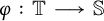 $\varphi \, :\, {\mathbb T}\, \longrightarrow \, {\mathbb S}$
be a diffeomorphism such that the homomorphism
 $\varphi _{\natural }$
in (4.9) descends to a homomorphism from
 ${\Theta }({\mathbb T},\, x_0)$
to
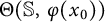 ${\Theta }({\mathbb S},\, \varphi (x_0))$
. Then, there is a biholomorphism
 $$ \begin{align*}\widetilde{\varphi}\, :\, {\mathbb T}\, \longrightarrow\, {\mathbb S}, \end{align*} $$
which is homotopic to the map
 $\varphi $
.
Proof Let
 $\varphi ^{\prime }_{\natural }\, :\, {\Theta }({\mathbb T},\, x_0) \, \longrightarrow \,{\Theta }({\mathbb S},\, \varphi (x_0))$
be the homomorphism such that the diagram in (4.10) is commutative. Let
 $$ \begin{align} \begin{matrix} H^0({\mathbb S}, \Omega^1_{\mathbb S}) &\!\! =\!\! & \mathbb X_a( \Theta({\mathbb S}, \varphi(x_0)) )&\!\!\! {\longrightarrow}\!\!\! & \mathbb X_a( \Theta ({\mathbb T}, x_0)) &\!\!\! =\!\!\! & H^0({\mathbb T}, \Omega^1_{\mathbb T})\\ && \xi^2\Big\downarrow &&\xi^1 \Big\downarrow\\ H^1_{dR}({\mathbb S},{\mathbb C}) &\!\! =\!\! & \mathbb X_a( \varpi({\mathbb S}, \varphi(x_0)) )& \stackrel{\delta}{\longrightarrow} &\mathbb X_a( \varpi({\mathbb T}, x_0) ) &\!\!\! =\!\!\! & H^1_{dR}({\mathbb T},{\mathbb C}) \end{matrix} \end{align} $$
be the commutative diagram of
 $\mathbb C$
-linear maps corresponding to (4.10).
Let
 $$ \begin{align} \varphi^*\, :\, H^1_{dR}({\mathbb S},\, {\mathbb C})\, \longrightarrow\, H^1_{dR}({\mathbb T},\, {\mathbb C}),\, \ \ c\, \longmapsto\, \varphi^*c \end{align} $$
be the pullback map. The homomorphism
 $\delta $
in (4.11) coincides with the homomorphism
 $\varphi ^*$
in (4.12). Therefore, from (4.11), we conclude that
 $$ \begin{align} \varphi^* (H^0({\mathbb S},\, \Omega^1_{\mathbb S}))\,=\, H^0({\mathbb T},\, \Omega^1_{\mathbb T})\, . \end{align} $$
We also have
 $$ \begin{align} \varphi^* (H^1({\mathbb S},\, {\mathbb Z}))\,=\, H^1({\mathbb T},\, {\mathbb Z}), \end{align} $$
because
 $\varphi $
is a diffeomorphism.
We consider
 $\mathbb T$
(respectively,
 $\mathbb S$
) as a complex abelian Lie group by taking
 $x_0$
(respectively,
 $\varphi (x_0)$
) to be the identity element of
 $\mathbb T$
(respectively,
 $\mathbb S$
). From (4.13) and (4.14), it follows immediately that the homomorphism
 $\varphi ^*$
in (4.12) induces a holomorphic isomorphism
 $$ \begin{align*}\widetilde{\varphi}^{\vee}\, :\, {\mathbb S}^{\vee} \, :=\,(H^1_{dR}({\mathbb S},\, {\mathbb C})/H^0({\mathbb S},\, \Omega^1_{\mathbb S}))/H^1({\mathbb S},\, {\mathbb Z}) \end{align*} $$
 $$ \begin{align*}\longrightarrow\, (H^1_{dR}({\mathbb T},\, {\mathbb C})/H^0({\mathbb T},\, \Omega^1_{\mathbb T}))/H^1({\mathbb T},\, {\mathbb Z})\,=\, {\mathbb T}^{\vee}\, ; \end{align*} $$
here,
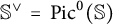 ${\mathbb S}^{\vee }\,=\, \text {Pic}^0({\mathbb S})$
is the dual torus of
 $\mathbb S$
, and
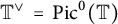 ${\mathbb T}^{\vee }\,=\, \text {Pic}^0({\mathbb T})$
is the dual torus of
 $\mathbb T$
. Let
 $$ \begin{align*}\widetilde{\varphi}\, :\, {\mathbb T}\,=\, ({\mathbb T}^{\vee})^{\vee} \, \longrightarrow\, ({\mathbb S}^{\vee})^{\vee}\,=\,{\mathbb S} \end{align*} $$
be the dual of the above homomorphism
 $\widetilde {\varphi }^{\vee }$
.
From the construction of the above homomorphism
 $\widetilde {\varphi }$
, it is evident that the pullback homomorphism
 $$ \begin{align*}\widetilde{\varphi}^*\, :\, H^1_{dR}({\mathbb S},\, {\mathbb C})\, \longrightarrow\, H^1_{dR}({\mathbb T},\, {\mathbb C}),\, \ \ c\, \longmapsto\, \widetilde{\varphi}^*c, \end{align*} $$
coincides with the homomorphism
 $\varphi ^*$
in (4.12). This implies that the two maps
 $\widetilde {\varphi }$
and
 $\varphi $
are homotopic.▪
5 Completely decomposable vector bundles
As before, X is a compact connected Kähler manifold. We define and study in this section a subcategory of
 ${\mathcal C}_{dR}(X)$
given by the following:
Definition 5.1 Let
 ${\mathcal D}_{dR}(X)$
be the full subcategory of
 ${\mathcal C}_{dR}(X)$
whose objects are pairs
 $(E,\, D)$
satisfying the condition that the holomorphic vector bundle E is a direct sum of holomorphic line bundles.
It is straightforward to check that
 ${\mathcal D}_{dR}(X)$
is stable under tensor products and duals. In order to prove that
 ${\mathcal D}_{dR}(X)$
is abelian, we will need the next two lemmas.
Lemma 5.1 Let L be a holomorphic line bundle on X. Then, L admits a holomorphic connection if and only if
 $c_1(L)\,=\, 0$
. If L admits a holomorphic connection, then any holomorphic connection on L is integrable.
Let
 $L_i$
,
 $1\, \leq \, i\, \leq \, r$
, be holomorphic line bundles on X such that the holomorphic vector bundle
 $\bigoplus _{i=1}^r L_i$
admits a holomorphic connection. Then, each
 $L_i$
admits a holomorphic connection; in other words,
 $c_1(L_i)\,=\, 0$
.
Proof Because X is Kähler, if L admits a holomorphic connection, then
 $c_1(L)\,=\, 0$
[Reference Atiyah3, Theorem 4, pp. 192–193]. If
 $c_1(L)\,=\, 0$
, then L admits an integrable holomorphic connection
 $\nabla ^L$
whose monodromy lies in
 $\mathrm {U}(1)$
(see [Reference Lübke and Teleman22, Corollary 1.3.12, p.40]); note also that any holomorphic line bundle admits a Hermitian–Einstein metric [Reference Uhlenbeck and Yau30], [Reference Lübke and Teleman22, Theorem 3.0.1, p. 61].
If L admits an (integrable) holomorphic connection
 $\nabla ^L$
, then any holomorphic connection on L is of the form
 $\nabla ^L+\beta $
, where
 $\beta \, \in \, H^0(X,\, \Omega ^1_X)$
. The curvature of
 $\nabla ^L+\beta $
is
 $\mathrm {d}\beta $
, because
 $\nabla ^L$
is integrable. Because any holomorphic
 $1$
-form on X is closed, we conclude that
 $\nabla ^L+\beta $
is integrable.
Let
 $p_j\, :\, \bigoplus _{i=1}^r L_i\, \longrightarrow \, L_j$
be the projection to the jth factor. Then, for any holomorphic connection D on
 $\bigoplus _{i=1}^r L_i$
, the composition of homomorphisms
 $$ \begin{align*}L_j\, \hookrightarrow\, \bigoplus_{i=1}^r L_i\, \stackrel{D}{\longrightarrow}\, (\bigoplus_{i=1}^r L_i)\otimes\Omega^1_X\, \stackrel{p_j\otimes\mathrm{Id}_{\Omega^1_X}}{\longrightarrow}\, L_j\otimes\Omega^1_X \end{align*} $$
is a holomorphic connection on
 $L_j$
.▪
Lemma 5.2 Let
 $L_i$
,
 $1\, \leq \, i\, \leq \, r$
, and
 ${\mathcal L}_j$
,
 $1\, \leq \, j\,\leq \, \ell $
, be holomorphic line bundles on X such that
 $c_1(L_i)\,=\, 0\,=\, c_1({\mathcal L}_j)$
for all
 $i,\, j$
. Let
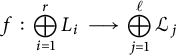 $$ \begin{align*}f\, :\, \bigoplus_{i=1}^r L_i\,\longrightarrow\, \bigoplus_{j=1}^{\ell} {\mathcal L}_j \end{align*} $$
be a holomorphic homomorphism. Then, the following two hold:
-
(1) If
$\mathrm {kernel}(f)\, \not =\, 0$
, then
$\mathrm {kernel}(f)$
is a direct sum of holomorphic line bundles of vanishing first Chern class. -
(2) If
$\mathrm {cokernel}(f)\, \not =\, 0$
, then
$\mathrm {cokernel}(f)$
is a direct sum of holomorphic line bundles of vanishing first Chern class.



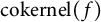
Proof Because X is Kähler, every holomorphic line bundle
 $L'$
on X with
 $c_1(L')\,=\, 0$
admits a flat unitary connection. In fact, there is a unique flat unitary connection on
 $L'$
; the flat Hermitian structure is unique up to a constant scalar multiplication. Equip each
 $L_i$
(respectively,
 ${\mathcal L}_j$
) with an integrable holomorphic connection
 $\nabla ^i$
(respectively,
 $\widetilde {\nabla }^j$
) such that the monodromy lies in
 $\mathrm {U}(1)$
. Therefore,
 $\bigoplus _{i=1}^r \nabla ^i$
is a flat unitary connection on
 $\bigoplus _{i=1}^r L_i$
, and
 $\bigoplus _{j=1}^{\ell } \widetilde {\nabla }^j$
is a flat unitary connection on
 $\bigoplus _{j=1}^{\ell } {\mathcal L}_j$
. Because any flat unitary connection is a Hermitian–Einstein connection with respect to any Kähler metric,
 $\bigoplus _{i=1}^r \nabla ^i$
and
 $\bigoplus _{j=1}^{\ell } \widetilde {\nabla }^j$
are Hermitian–Einstein connections on
 $\bigoplus _{i=1}^r L_i$
and
 $\bigoplus _{j=1}^{\ell } {\mathcal L}_j$
, respectively.
If A and B are holomorphic vector bundles on X with
 $c_1(A)\,=\, 0\, =\, c_1(B)$
, and are equipped with Hermitian–Einstein connections
 $\nabla ^A$
and
 $\nabla ^B$
, respectively, then every holomorphic homomorphism
 $f'\, :\, A\, \longrightarrow \, B$
is flat with respect to the connection on the holomorphic vector bundle
 $\text {Hom}(A,\, B)$
induced by
 $\nabla ^A$
and
 $\nabla ^B$
(see [Reference Lübke and Teleman22, Theorem 2.2.1, p. 50]). Therefore, we conclude that the holomorphic homomorphism f in the lemma intertwines the connections
 $\bigoplus _{i=1}^r\nabla ^i$
on
 $\bigoplus _{i=1}^r L_i$
and
 $\bigoplus _{j=1}^{\ell } \widetilde {\nabla }^j$
on
 $\bigoplus _{j=1}^{\ell } {\mathcal L}_j$
(equivalently, it is flat with respect to the connection on
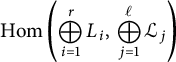 $$ \begin{align*} \text{Hom}\left(\bigoplus_{i=1}^r L_i,\, \bigoplus_{j=1}^{\ell} {\mathcal L}_j\right) \end{align*} $$
induced by
 $\bigoplus _{i=1}^r \nabla ^i$
and
 $\bigoplus _{j=1}^{\ell } \widetilde {\nabla }^j$
). Consequently,
 $\mathrm {kernel}(f)$
is preserved by the connection
 $\bigoplus _{i=1}^r\nabla ^i$
on
 $\bigoplus _{i=1}^r L_i$
, and
 $\mathrm {image}(f)$
is preserved by the connection
 $\bigoplus _{j=1}^{\ell } \widetilde {\nabla }^j$
on
 $\bigoplus _{j=1}^{\ell } {\mathcal L}_j$
. From Remark 2.1, we know that both
 $\mathrm {kernel}(f)$
and
 $\mathrm {image}(f)$
are locally free. Therefore,
 $\mathrm {kernel}(f)$
is a holomorphic subbundle of
 $\bigoplus _{i=1}^r L_i$
, and
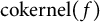 $\mathrm {cokernel}(f)$
is a quotient bundle of
 $\bigoplus _{j=1}^{\ell } {\mathcal L}_j$
. Note that
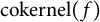 $\mathrm {cokernel}(f)$
has an integrable holomorphic connection induced by
 $\bigoplus _{j=1}^{\ell } \widetilde {\nabla }^j$
, because
 $\mathrm {image}(f)$
is preserved by
 $\bigoplus _{j=1}^{\ell } \widetilde {\nabla }^j$
.
Because
 $\mathrm {kernel}(f)$
and
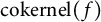 $\mathrm {cokernel}(f)$
both admit integrable holomorphic connections, we have
 $$ \begin{align*}c_1(\mathrm{kernel}(f))\,=\,0\, =\, c_1(\mathrm{cokernel}(f)) \end{align*} $$
(see [Reference Atiyah3, Theorem 4, pp. 192–193]), and hence we conclude that
 $$ \begin{align} \text{degree}(\mathrm{kernel}(f))\,=\,0\, =\, \text{degree}(\mathrm{cokernel}(f)) \end{align} $$
with respect to any Kähler form on X.
Any holomorphic line bundle on X is stable. Because
 $\bigoplus _{i=1}^r L_i$
is a direct sum of stable bundles of slope zero, we conclude that
 $\bigoplus _{i=1}^r L_i$
is a polystable vector bundle. Any subbundle of degree zero of a polystable vector bundle of degree zero is again polystable. Therefore, from (5.1), we conclude that
 $\mathrm {kernel}(f)$
is a polystable vector bundle of degree zero, if
 $\mathrm {kernel}(f)$
is nonzero. Assume that
 $\mathrm {kernel}(f)$
is nonzero, so
 $\mathrm {kernel}(f)$
is a polystable vector bundle of degree zero. Hence,
 $\mathrm {kernel}(f)$
is a direct sum of stable vector bundle of degree zero. If S is a stable subbundle of
 $\mathrm {kernel}(f)$
of degree zero, then S is also a stable subbundle of
 $\bigoplus _{i=1}^r L_i$
of degree zero, because
 $\mathrm {kernel}(f)$
is a subbundle of
 $\bigoplus _{i=1}^r L_i$
. But any stable subbundle of
 $\bigoplus _{i=1}^r L_i$
of degree zero is holomorphically isomorphic to
 $L_i$
for some
 $1\, \leq \, i\, \leq \, r$
. Therefore, we conclude that
 $\mathrm {kernel}(f)$
is a direct sum of holomorphic line bundles of vanishing first Chern class, if
 $\mathrm {kernel}(f)\, \not =\, 0$
.
Next, we note that
 $\bigoplus _{j=1}^{\ell } {\mathcal L}_j$
is a polystable vector bundle of degree zero, and
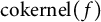 $\mathrm {cokernel}(f)$
is a quotient bundle of
 $\bigoplus _{j=1}^{\ell } {\mathcal L}_j$
of degree zero. Hence,
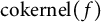 $\mathrm {cokernel}(f)$
is a polystable vector bundle of degree zero, if
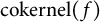 $\mathrm {cokernel}(f)$
is nonzero. Assume that
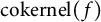 $\mathrm {cokernel}(f)$
is nonzero. So
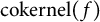 $\mathrm {cokernel}(f)$
is a polystable vector bundle of degree zero. Therefore,
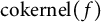 $\mathrm {cokernel}(f)$
is a direct sum of stable vector bundles of degree zero. Any stable quotient of
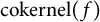 $\mathrm {cokernel}(f)$
of degree zero is also a stable quotient of
 $\bigoplus _{j=1}^{\ell } {\mathcal L}_j$
of degree zero, because
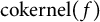 $\mathrm {cokernel}(f)$
is a quotient of
 $\bigoplus _{j=1}^{\ell } {\mathcal L}_j$
. But any stable quotient of
 $\bigoplus _{j=1}^{\ell } {\mathcal L}_j$
of degree zero is holomorphically isomorphic to
 ${\mathcal L}_j$
for some
 $1\, \leq \, j\, \leq \, \ell $
. Therefore, if
 $\mathrm {cokernel}(f)\, \not =\, 0$
, then
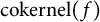 $\mathrm {cokernel}(f)$
is a direct sum of holomorphic line bundles of vanishing first Chern class.▪
Using Lemma 5.2, it can be deduced that the category
 ${\mathcal D}_{dR}(X)$
is abelian.
Fix a point
 $x_0\, \in \, X$
. Equip the category
 ${\mathcal D}_{dR}(X)$
with the exact functor to the category of finite-dimensional complex vector spaces defined by
 $(E,\,D)\,\longmapsto \, E|_{x_0}$
. Let
 $$ \begin{align} {\Delta}(X,\, x_0) \end{align} $$
be the affine group scheme over
 $\mathbb C$
corresponding to
 ${\mathcal D}_{dR}(X)$
[Reference Deligne, Milne, Ogus and Shih13, Theorem 2.11, p. 130]. Note that
 $\Delta (X,\,x_0)$
is the target of a morphism of affine group schemes
 $$ \begin{align} \varpi(X,\, x_0)\, \longrightarrow\, {\Delta}(X,\, x_0)\, , \end{align} $$
where
 $\varpi (X,\, x_0)$
is the group scheme in (2.1). According to the standard criterion [Reference Deligne, Milne, Ogus and Shih13, Proposition 2.21, p. 139], amplified by [Reference Biswas, Hai and dos Santos7, Lemma 2.1], using Lemma 5.2, it follows that the homomorphism in (5.3) is a quotient morphism.
The homomorphism
 $ \mathbf {q}_X$
in (3.2) factors through the quotient
 ${\Delta }(X,\, x_0)$
and gives a quotient homomorphism
 $$ \begin{align} \mathbf{p}_X\, :\, {\Delta}(X,\, x_0)\, \longrightarrow\, {\Theta}(X,\, x_0)\,. \end{align} $$
For a pointed compact Kähler manifold
 $(Y,\,y_0)$
, it can be shown that the natural homomorphism
 $$ \begin{align*}\Delta(X,\,x_0)\times\Delta(Y,y_0)\,\longrightarrow \,\Delta(X\times Y,\, (x_0,\,y_0)) \end{align*} $$
is an isomorphism; its proof is similar to that of Proposition 3.8.
The homomorphism of additive character
 $\mathbb C$
-vector spaces
 $$ \begin{align*}\mathbb X_a({{\Theta}(X,\, x_0)})\, \longrightarrow\, \mathbb X_a({{\Delta}(X,\, x_0)}) \end{align*} $$
induced by
 $\mathbf {p}_X$
in (5.4) is an isomorphism as follows from Lemma 5.2 and the interpretation of these vector spaces as extension groups (see Section 3.2). In view of this, examining the proofs of Theorem 4.1 and Proposition 4.2, we conclude that these two results remain valid if
 ${\Theta }(X,\, x_0)$
is replaced by the group scheme
 ${\Delta }(X,\, x_0)$
in (5.2).
6 Connections on pseudostable vector bundles
We shall now relate the group scheme
 $\Theta (X,\, x_0)$
of Section 3.1 to another group scheme which deals only with a full subcategory of vector bundles.
Definition 6.1 A holomorphic vector bundle E over X is said to be pseudostable (see [Reference Biswas and Gómez6]) if the Higgs vector bundle
 $(E,\,0)$
is an object of the category
 ${\mathcal C}_{Dol}(X)$
introduced in Section 2. In other words, E is pseudostable if and only if
-
•
$\mathrm {degree}(E)\,=\, 0$
, -
•
$ch_2(E)\wedge \omega ^{d-2}\,=\,0$
, and -
• there exists a filtration of E by holomorphic subbundles
in which every
$$ \begin{align*} 0\,=\,E_0\,\subset\, E_1\, \subset\, \cdots \,\subset\, E_{\ell-1}\, \subset\, E_{\ell}\,=\,E \end{align*} $$
$E_j/E_{j-1}$
,
$1\leq \, j\, \leq \, \ell $
, is stable and of degree zero.





(Actually the third condition implies the first condition.) The full subcategory of pseudostable vector bundles on X will be denoted by
 $\mathrm {Vect}^{\mathrm {s}}_0(X)$
.
The following theorem, which is based on the works of Simpson and Corlette, is proved in [Reference Simpson29] (see [Reference Simpson29, Sections 3.4.1–3.4.5, pp. 35–37], [Reference Simpson29, p. 70]).
Theorem 6.1 [Reference Simpson29, 3.4.1–3.4.5]
The following three statements hold.
-
(1) The category
$\mathrm {Vect}^{\mathrm {s}}_0(X)$
is abelian and stable under the tensor product of vector bundles. -
(2) Any
$E\,\in \,\mathrm {Vect}_0^{\mathrm {s}}(X)$
carries a canonical holomorphic integrable connection. -
(3) If X is projective, and the cohomology class of
$\omega $
is rational, then
$\mathrm {Vect}^{\mathrm {s}}_0(X)$
coincides with the category of all semistable vector bundles E such that (see [Reference Simpson 29 , Theorem 2, p. 39] for it).
$$ \begin{align*}ch_1(E)\wedge\omega^{d-1}\,=\,ch_2(E)\wedge\omega^{d-2}\,=\,0 \end{align*} $$




Remark 6.2 As mentioned earlier in Section 2, the category
 ${\mathcal C}_{Dol}(X)$
is equivalent to
 ${\mathcal C}_{dR}(X)$
[Reference Simpson29, Lemma 3.5, p. 36]. Take
 $(E,\,\theta )\, \in \, {\mathcal C}_{Dol}(X)$
, and let
 $(V,\, \nabla )\, \in \, {\mathcal C}_{dR}(X)$
be the object corresponding to
 $(E,\,\theta )$
by the equivalence of categories between
 ${\mathcal C}_{Dol}(X)$
and
 ${\mathcal C}_{dR}(X)$
. Although the
 $C^{\infty }$
vector bundles underlying E and V coincide, their holomorphic structure do not coincide in general. However, if
 $\theta \,=\, 0$
, then the holomorphic structures of E and V coincide. Therefore,
 $\nabla $
is a holomorphic integrable connection on
 $V\,=\, E$
. We note that if E is polystable, then this holomorphic connection
 $\nabla $
on E coincides with the unique holomorphic integrable connection on E whose monodromy is unitary. See [Reference Biswas and Subramanian8, Theorem 3.1, p. 4004] for a generalization of this canonical connection on
 $E\, \in \,\mathrm {Vect}^{\mathrm {s}}_0(X)$
to the principal bundles over X.
Remark 6.3 Take
 $E_1,\, E_2\, \in \, \mathrm {Vect}^{\mathrm {s}}_0(X)$
. The canonical holomorphic integrable connections on
 $E_1$
and
 $E_2$
(see Remark 6.2) will be denoted by
 $\nabla ^1$
and
 $\nabla ^2$
, respectively. Let
 $$ \begin{align*}\Phi\, :\, E_1\, \longrightarrow\, E_2 \end{align*} $$
be a homomorphism of coherent analytic sheaves. Then,
 $\Phi $
is a homomorphism from
 $(E_1,\, 0)\, \in \, {\mathcal C}_{Dol}(X)$
to
 $(E_2,\, 0)\, \in \, {\mathcal C}_{Dol}(X)$
. Therefore, from the equivalence of categories between
 ${\mathcal C}_{Dol}(X)$
and
 ${\mathcal C}_{dR}(X)$
([Reference Simpson29, Lemma 3.5, p. 36]), we conclude that
 $\Phi $
is a homomorphism from
 $(E_1, \, \nabla ^1)\, \in \, {\mathcal C}_{dR}(X)$
to
 $(E_2, \, \nabla ^2)\, \in \, {\mathcal C}_{dR}(X)$
. In particular,
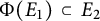 $\Phi (E_1)\, \subset \, E_2$
is preserved by the integrable holomorphic connection
 $\nabla ^2$
on
 $E_2$
. Now, setting
 $E_1$
to be the trivial line bundle
 ${\mathcal O}_X$
, we conclude that every holomorphic section
 $s\, \in \, H^0(X,\, E_2)$
is flat (the same as integrable) with respect to the integrable holomorphic connection
 $\nabla ^2$
on
 $E_2$
. It also follows that the canonical connection on
 $E_1\oplus E_2$
coincides with
 $\nabla ^1\oplus \nabla ^2$
. Moreover, the canonical connection on
 $E_1\otimes E_2$
(respectively,
 $\text {Hom}(E_1, \, E_2)$
) coincides with the connection on
 $E_1\otimes E_2$
(respectively,
 $\text {Hom}(E_1, \, E_2)$
) induced by
 $\nabla ^1$
and
 $\nabla ^2$
. In addition, the canonical connection on the dual vector bundle
 $E^*_1$
coincides with the one induced by the connection
 $\nabla ^1$
on
 $E_1$
. These properties of the canonical connection were crucial in the proofs of [Reference Biswas and Subramanian8, Theorem 3.1, p. 4004] and [Reference Biswas and Gómez6, Theorem 1.1, p. 20].
It then follows that there exists an affine group scheme
 $\pi ^{\mathrm {S}}(X,\,x_0)$
over
 $\mathbb C$
such that the functor
 $$ \begin{align*} \bullet|_{x_0} \,:\, \mathrm{Vect}_0^{\mathrm{s}}(X)\,\longrightarrow\, \mathrm{Vect}_{\mathbb C} \end{align*} $$
induces an equivalence between
 $ \mathrm {Vect}_0^{\mathrm {s}}(X)$
and the category of finite-dimensional algebraic representations of
 $\pi ^{\mathrm {S}}(X,\, x_0)$
.
Following the path taken in the previous sections, we define
 ${\mathcal S}_{dR}(X)$
as the full subcategory of
 ${\mathcal C}_{dR}(X)$
consisting of those
 $(E,\,\nabla )$
such that E belongs to
 $\mathrm {Vect}_0^{\mathrm {s}}(X)$
. This produces another group scheme
 $$ \begin{align} \Sigma(X,\,x_0) \end{align} $$
whose category of representations is, via the functor
 $\bullet |_{x_0}$
, simply
 $\mathcal S_{dR}(X)$
.
Using the forgetful functor
 $$ \begin{align*} U\,:\, \mathcal S_{dR}(X)\, \longrightarrow\, \mathrm{Vect}_0^{\mathrm{s}}(X) \end{align*} $$
and the natural inclusion
 $$ \begin{align*} J\,:\,\mathcal T_{dR}(X)\,\longrightarrow\,{\mathcal S}_{dR}(X), \end{align*} $$
we arrive at morphisms
 $$ \begin{align} \pi^{\mathrm{S}}(X,\,x_0)\,\stackrel{\mathbf u_X}{\longrightarrow}\,\Sigma(X,\,x_0)\, \stackrel{\mathbf j_X}{\longrightarrow}\, \Theta(X,\, x_0)\, . \end{align} $$
Clearly,
 $\mathbf j_X\circ \mathbf u_X$
is the trivial homomorphism.
We shall now explore some properties of
 ${\mathbf u}_X$
. For that, we make a group theoretical interlude. No particular property concerning the ground field
 $\mathbb C$
is required; so, in what follows, an “affine group scheme” should be interpreted as an “affine group scheme over a unspecified field.”
From the existence of limits in the category of affine group schemes, we can make:
Definition 6.2 Let G be an affine group scheme and
 $H\,\subset \, G$
a closed subgroup scheme. The normal closure of H inside G is the intersection of all normal and closed subgroup schemes of G containing H.
Here are two simple features of the normal closure. The reader unfamiliar with the construction of arbitrary quotients in the theory of group schemes should consult Chapters 15 and 16 of [Reference Waterhouse31]. In particular, the verification of the following result is immediate once Section 15.4 and Section 16.3 in [Reference Waterhouse31] are understood.
Lemma 6.4 Let G be an affine group scheme,
 $H\,\subset \, G$
a closed subgroup scheme, and N the normal closure of H in G.
-
(1) For each quotient morphism
$q\,:\,G\,\longrightarrow \, Q$
of group schemes such that
$q|_H$
is the trivial morphism, there exists a factorization -
(2) Let
$D\,\subset \, G$
be a closed and normal subgroup scheme containing H. Suppose that D enjoys the property attributed to N in the previous item. Then,
$D\,=\,N$
.



Theorem 6.5 The following three statements hold.
-
(1) In (6.2), the morphism
$\mathbf {u}_X$
is a closed immersion, and
$\mathbf j_X$
is a quotient map. -
(2) The normal closure of
$\mathrm {Im}(\mathbf {u}_X)$
inside
$\Sigma (X,\,x_0)$
is
$\mathrm {Ker}(\mathbf j_X)$
. -
(3) The morphism
$\mathbf u_X$
possesses a left inverse
$$ \begin{align*} {\mathbf v}_X\,:\,\Sigma(X,\,x_0)\,\longrightarrow\,\pi^{\mathrm{S}}(X,\,x_0)\, . \end{align*} $$


Proof The morphism
 $$ \begin{align*}\mathbf q_X\,:\,\varpi(X,\,x_0)\,\longrightarrow\,\Theta(X,\,x_0) \end{align*} $$
in (3.2) factors through
 $\mathbf j_X$
, so that the fact that
 ${\mathbf q}_X$
is a quotient morphism shows that
 ${\mathbf j}_X$
is likewise. That
 ${\mathbf u}_X$
is a closed immersion follows from the standard criterion [Reference Deligne, Milne, Ogus and Shih13, Proposition 2.21, p. 139] and Theorem 6.1.
To show that
 $\mathrm {Ker}({\mathbf q}_X)$
is the normal closure of
 $\mathrm {Im}({\mathbf u}_X)$
inside
 $\Sigma (X,\,x_0)$
, we verify the condition (2) in Lemma 6.4. Let
 $$ \begin{align*}\rho\,:\,\Sigma(X,\,x_0)\,\longrightarrow\, G\end{align*} $$
be a quotient morphism such that
 $\rho \circ {\textbf { u}}_X$
is trivial. Let
 $$ \begin{align*} \xi\,:\,\mathrm{Rep}_{\mathbb C}(\Sigma(X,\,x_0))\,\longrightarrow\,\mathcal S_{dR}(X) \end{align*} $$
be an inverse to the tensor equivalence
 $\bullet |_{x_0}$
[Reference Saavedra Rivano25, I.4.4] and let
 $\mathrm {Res}_{\rho }$
be the functor restricting representations from of G to
 $\Sigma (X,\,x_0)$
. It follows that, for each
 $V\,\in \, \mathrm {Rep}_{\mathbb C}(G)$
, the vector bundle underlying
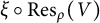 $\xi \circ \mathrm {Res}_{\rho }(V)$
is trivial, which means that
 $\xi \circ \mathrm {Res}_{\rho }$
is in fact a functor to
 $\mathcal T_{dR}(X)$
. Passing to group schemes, we obtain a morphism
 $\Theta (X,\,x_0)\,\longrightarrow \, G$
factoring
 $\rho $
[Reference Saavedra Rivano25, II.3.3.1, 148ff].
Assigning to any pseudostable vector bundle
 $E\, \in \, \mathrm {Vect}_0^{\mathrm {s}}(X)$
the canonical integrable holomorphic connection on E (see Theorem 6.1(2)), a functor is obtained; call it
 $$ \begin{align*}{\mathbb V}\,:\,\mathrm{Vect}_0^{\mathrm{s}}(X)\,\longrightarrow\,\mathcal S_{dR}(X)\, .\end{align*} $$
This
 $\mathbb V$
is a tensor functor (see Remark 6.3). Hence,
 ${\mathbb V}$
produces the section
 $\mathbf v_X$
to
 $\mathbf u_X$
.▪
Proposition 6.6 Suppose that X is a compact Riemann surface of genus at least two. Then,
 $\mathrm {Im}(\mathbf {u}_X)$
is not normal in
 $\Sigma (X,\,x_0)$
.
Proof If
 $\mathrm {Im}(\mathbf {u}_X)$
is normal, then, for each representation
 $$ \begin{align*}\rho:\Sigma(X,\,x_0)\,\longrightarrow\, \mathrm{GL}(V)\, ,\end{align*} $$
the subspace
 $V^{\pi ^S(X,\,x_0)}$
is invariant under
 $\Sigma (X,\,x_0)$
[Reference Esnault, Hai, Sun, Kapranov, Manin, Moree, Kolyada and Potyagailo14, Theorem A.1(iii)]. This translates into the following property on the side of connections. Given
 $(E,\,\nabla )\,\in \, {\mathcal S}_{dR}(X)$
, the largest trivial subbundle of E is preserved by
 $\nabla $
.
Let L be a nontrivial invertible sheaf affording an integrable holomorphic connection
 $$ \begin{align*}D\,:\,L\,\longrightarrow\, L\otimes\Omega_X^1\, . \end{align*} $$
In addition, let us choose L satisfying
 $H^0(X,\, L\otimes \Omega _X^1)\,\not =\,0$
(this is possible given the hypothesis on the genus). Let
 $$ \begin{align*}\varphi\,\in\, H^0(X,\, L\otimes\Omega_X^1)\setminus\{0\} \end{align*} $$
and consider the connection
 $\nabla $
on
 $\mathcal O_X\oplus L$
defined, on an unspecified open subset, by
 $$ \begin{align*} \nabla(a,\,\ell)\,=\,(da,\,a\varphi+D\ell)\, . \end{align*} $$
Then,
 ${\mathcal O}_X\oplus \{0\}\,\subset \,\mathcal O_X\oplus L$
is the largest trivial subbundle, and
 $\nabla (1,\,0)\,=\,(0,\,\varphi )$
, meaning that
 $\mathcal O_X\oplus \{0\}$
is not preserved by
 $\nabla $
.▪
Remark 6.7 Let
 $\widetilde {\mathrm {Vect^{\mathrm {s}}}}_0(X)$
be the full subcategory of
 $\mathrm {Vect}_0^{\mathrm {s}}(X)$
defined by all holomorphic vector bundles in
 $\mathrm {Vect}_0^{\mathrm {s}}(X)$
that are direct sum of holomorphic line bundles. It is a Tannakian subcategory, and defines a quotient group scheme
 $$ \begin{align*}\pi^{\mathrm{S}}(X,\,x_0)\, \longrightarrow\, \widetilde{\pi}^{\mathrm{S}}(X,\, x_0) \end{align*} $$
of
 $\pi ^{\mathrm {S}}(X,\,x_0)$
. A result similar to Theorem 6.5 can be deduced by replacing
 $\Sigma $
with
 $\Delta $
(constructed in (5.2)) and
 $\pi ^S$
with
 $\widetilde {\pi }^{\mathrm {S}}$
.
Acknowledgment
We would like to thank the referees for their helpful comments. We would also like to thank Carlos Simpson for a useful discussion. The first- and third-named authors would like to thank the International Center for Theoretical Sciences, Bengaluru, India, for hospitality.



