


1. Introduction
Innovation-based subgroupings have played an important role in historical linguistics since at least Brugmann Reference Brugmann1884 and have remained the predominant method for language subgrouping ever since. However, in light of some issues surrounding the traditional “family tree” framework, the present approach deviates slightly from the standard process of innovation-based subgrouping. Certain steps in the process, such as the observation of sound changes, the reconstruction of the protolanguage, and the grouping together of languages that have undergone common changes (typically sound changes) are fundamental to the comparative method and are in no way necessarily intertwined with the cladistic (that is, family tree) approach (Kalyan & François 2018). Some other steps in the process are approached here from a different angle. For one, it is now well known that sound changes are not the only types of innovations that are of use for subgrouping (Anttila Reference Anttila1989, Campbell Reference Campbell2004).Footnote 1 Second, the cladistic model is abandoned in place of an alternative quantitative method, historical glottometry, proposed by Kalyan & François (2018). The purpose of this study is to produce a more accurate subgrouping result for the Germanic (sub)family by means of this new method.Footnote 2 The interactions of the early Germanic languages, namely, Old English, Old Frisian, Gothic, Old High German, Old Low Franconian, Old Norse, and Old Saxon are accounted for and attributed to subgroups according to the distribution of shared innovations.Footnote 3
This paper is structured as follows: Section 2 provides a review of the stammbaum model and the wave model and explains Historical Glottometry. Section 3 explains the methodology used in conducting the research reported here. Throughout section 4, each subgroup that is supported by the data is listed and discussed in its own subsection. The section concludes with an overview of all supported subgroups, along with their glottometric values, and a glottometric diagram that depicts the network of subgroup “waves” within Germanic. The subgroups are posited on the basis of evidence from seven early Germanic languages: Old English, Old Frisian, Gothic, Old Low Franconian, Old Norse, Old High German, and Old Saxon. Additionally, innovations exclusive to Old English, Gothic, Old Norse, and Old High German are accounted for at the end of section 4.2. In section 5, the results are discussed. Section 6 is a conclusion.
2. Background
2.1. The Stammbaum
As stated in the previous section, the tree model is not optimal for capturing some types of historical innovations. Since its introduction by August Schleicher (Reference Schleicher1860), the tree model, or Stammbaum, has historically been spoken of almost interchangeably with the comparative method, but the two need not be so inseparably associated (François Reference François, Bowern and Evans2014). Figure 1 represents a model language family that demonstrates some of the issues associated with a tree framework. Suppose there is a language family ABC, defined by the languages A, B, and C, and divided into the subgroups A and BC.
Model language family ABC.

The primary issue with cladistic models is the inability for innovations to crosscut splits within the tree. In terms of the family ABC, this means that positing any AB or AC innovations is incompatible with the inherent limitations of the tree model; only those that reflect ABC, BC, A, B, or C as subgroups are permitted. If a historical linguist has posited branches on a tree on the basis of several shared innovations, but a later discovery of another potentially shared innovation contradicts the posited tree, then the newly discovered innovation is to be dismissed as a coincidental parallel innovation in order to satisfy the constraints of the model. Even complex computational cladistic models function under the expectation of such situations, so that maximum parsimony is sought in order to select the tree with the least homoplasy (that is, conflicting innovations) among several possible trees (see Goldstein Reference Goldstein2020). However, the rigid constraint that a language must be faithful to one node on a tree or the other regarding all of its innovations is not accurate (Gray et al. Reference Gray, David and Greenhill2010) and does not hold for many language families through-out the world (Bossong Reference Bossong, Braunmüller and House2009).Footnote 4
Parallel innovations of course can and do arise in separate subgroups or languages, and identifying them is necessary so that they can be excluded. One way of identifying two innovations as parallel versus reflections of a single shared innovation is of course to consider the naturalness of the change. Some sound changes, for example, might be more common crosslinguistically and therefore more likely to occur independently than others. Additionally, some patterns of syntax or morphology may be prone to similar or identical parallel developments across subgroups, such as certain grammaticalization tendencies (Heine & Kuteva 2002, Soteria Svorou p.c. 2018). It is naturally these types of changes that have a higher probability of reflecting coincidentally parallel developments than a more uncommon change. However, a cladistic treatment would require that they be regarded as parallel, being unequipped to account for shared, postsplit developments. The reasoning for this inclination stems from a bias against language-external diffusion, but even so-called common innovations can be diffused in a crosscutting distribution (Kalyan & François 2018).
With a focus on internal changes in language descent, the Stamm-baum is limited to diversification situations that are less typical (François Reference François, Bowern and Evans2014). Any external parameters such as horizontal transmission or areal diffusion are considered irrelevant and of no value to subgrouping. The cladistic approach is concerned purely with language divergence and does not accommodate language convergence.Footnote 5 Acknowledging this, the Stammbaum’s broad groupings may be considered sufficient, as long as no more than a broad outline is desired and the Stammbaum model is not overextended in its explanatory power (Haspelmath Reference Haspelmath2004). However, this approach only accounts for a portion of language history; a language’s history involves convergence between other subgroups of the family just as well as divergence, so an accurate model for accounting for it ought to be capable of taking both phenomena into account. Additionally, there are likely to be families or subgroups in which language-external diffusion is significant, in which case a broad outline arranged only from internal diffusions may miss a great deal of the overall picture.
As a consequence of being unable to handle language convergence and horizontal transmission, there is a weakness in the tree model regarding its ability to handle internal diffusion as well. Note that figure 1 encompasses not just the descent of separate descendant languages, but also the mutually intelligible dialects of the ancestor language that gave rise to those languages. Even though dialects B and C may have shared an innovation together, it is still possible for an innovation to arise that is shared between A and B and not by C. As these dialects diverge into separate languages, the innovations that were shared between A and B represent a point of crosscutting even within a single language; thus, there is language-internal diffusion that a cladistic model would neces-sarily overlook as a result of its inherent constraints. Initial variation occurs during a period of mutual intelligibility, during which the sharing of innovations is not just entirely possible, but common.
2.2. Ramifications for Germanic Subgrouping
The division of the Germanic (sub)family into subgroups has traditionally been done under a cladistic framework (Schleicher Reference Schleicher1860). The classic tree representation usually takes some form resembling that in figure 2, with varying degrees of detail.
A typical tree of the early Germanic languages.

Germanic is one of the best-studied language families in the world, and it has been evaluated with many different subgrouping approaches, including innovation-based, character-based (see Ringe et al. Reference Ringe, Tandy and Ann2002), distance-based (see Dyen et al. Reference Dyen, Kruskal and Black1992), and other quantitative subgrouping models. However, innovation-based subgrouping methods are often limited by cladistic constraints, and several treatments of the historical development of the family, or of the early daughters, seem to have defaulted to a tree framework (see Rask Reference Rask1818, Schleicher Reference Schleicher1860, Krause Reference Krause1968, Braune & Ebbinghaus Reference Braune and Ebbinghaus1973, Voyles & Barrack Reference Voyles and Barrack2009). For example, as recently as 2009, Voyles & Barrack, in discussing the development of Gothic, address some changes, such as the shift of unstressed -am to -um, as only reflecting exclusive developments, despite evidence that they may be shared with Northwest Germanic. Additionally, cladistic assumptions have even sometimes been the basis for unnecessary dispute between historical linguists over the placement of certain languages such as Gothic within the tree (see, among others, Holtzmann Reference Holtzmann1870, Schwarz Reference Schwarz1951, Rosenfeld Reference Rosenfeld1954, Kuhn Reference Kuhn1955).
The shortcomings of the Stammbaum, however, are actually not a novel topic in Germanic linguistics. Several specialists (Schmidt Reference Schmidt1872, Prokosch Reference Prokosch1939, Nielsen Reference Nielsen1989, Robinson Reference Robinson1992, Stiles Reference Stiles2013, Ringe & Taylor Reference Ringe and Taylor2014) have acknowledged the existence of developments that cut across clades, but the apparent lack of alternative frameworks for interpreting these developments within a noncladistic innovation-based model has seemingly prevented any preferable substitutes to cladistic subgrouping models—like the cladistic model in figure 2—from surfacing. However, in recent years, several new developments in wave-based subgrouping approaches have begun to remedy this situation, one of which—Historical Glottometry—is central to the present study.
2.3. Wave Theory
The predominant alternative to the Stammbaum, the wave theory (or Wellentheorie), is also far from new, having been first proposed by Johannes Schmidt (Reference Schmidt1872) only shortly after Schleicher’s introduction of the Stammbaum model. It is designed in consideration of areal diffusion and allows for more freedom regarding the range through which linguistic innovations may spread. Figure 3 shows an example model originally given by Schrader (Reference Schrader1883:99) for Indo-European, where each numbered wave represents a unique innovation.
Schrader’s depiction of a wave network in Indo-European.

This more accurately depicts the mechanisms of diffusion that are truly at work in the spread of linguistic innovations. Central to the idea is the independence of the waves from one another—the areal distribution of one wave does not restrict the distribution of the next. One wave could cover a relatively small area and another one following it could cover a much larger area that would include the area covered by the previous wave. This concept is fundamentally incompatible with the tree model, where the smaller wave would represent a node of departure in the tree, which would not allow for crosscutting of this split by a later overlapping innovation. It is demonstrated that this model accommodates many developments observable within the history of Germanic. Wave-based approaches, such as Historical Glottometry, are therefore preferable for truly accurate subgrouping.
Consider figure 4, which shows a wave model depiction of the model language family ABC from figure 1.
A wave portrayal of the ABC language family.

The thickness of the lines is proportional to the strength of the subgroup that each pair of languages comprises according to the number of shared innovations. Naturally, the BC subgroup is the strongest, reflecting the structure posited in figure 1. However, there are also shared innovations between A and C, and between A and B. This would not be possible in a pattern of development like that of a Stammbaum, as depicted in figure 1.
2.4. Historical Glottometry
Historical Glottometry, introduced by Kalyan & François (2018), is a quantitative approach for capturing language diversification and for accounting for linguistic subgroups. It captures all of the types of innovation distributions at work in language diversification that are discussed above by accounting for them using a set of special metrics.Footnote 6 Most importantly, it allows for a more accurate and realistic subgrouping by utilizing a wave-based treatment of innovations and by allowing for the possibility of crosscutting innovations, which cladistic treatments simply disregard. The remainder of this section details the application of the method.
For a given subgroup of languages, the number ε of exclusively shared innovations is a measure of how frequently the speakers of its member languages tended to align with each other’s speech (as opposed to speakers who are not members of the speech community defined by the subgroup; François Reference François, Bowern and Evans2014). It is exclusively shared innovations that have defined the branches on a Stammbaum. Indeed, they play a major role in language diversification. They tell one a great deal about the community that spoke the variety. In particular, a subgroup with a lower number of exclusively shared innovations (that is, a lower value for ε), can be assumed to have had weaker social bonds than a subgroup characterized by a higher number of shared innovations (and a higher value for ε).
As mentioned, the development of a language family can be tree-like. At the same time, innovations can resemble others without having been shared, despite a completely contemporaneous diffusion; a more accurate result will be arrived at if innovations are correctly classified as parallel or shared according to the actual historical or geographical evidence. However, if this evidence is lacking, the glottometric approach frees the historical linguist from the need to worry about homoplasy (that is, crosscutting developments), since these types of developments are acceptable in this framework. Fortunately, the Germanic (sub)family is one of the best-studied of all, and the history of the peoples of Germanic Europe is relatively well documented in comparison to some other parts of the world. One can therefore be confident in the validity of the status and distribution of most of the innovations in the database.
The calculation of the cohesiveness measure (k) involves several other measures. For a given subgroup G, the variable p represents supporting innovations: all innovations that include the entire subgroup within their scope, whether exclusive or not (that is, p ≥ ε). The variable q represents crosscutting, or conflicting, innovations: inno-vations that characterize some members of subgroup G, and some that are attested in languages outside of G. The cohesiveness measure is calculated by dividing the number of supporting innovations by the sum of supporting innovations plus conflicting innovations, as shown in 1.
(1)


In 1, k G represents the resulting cohesiveness value for subgroup G. This measure is a determination of how close to a perfect, cohesive subgroup the given cluster is. Cohesiveness in a Stammbaum situation would therefore always be equal to 1 (that is, a 100% tree-like subgroup), because p=ɛ, q=0, and therefore p/p =1. However, this is rarely the case (François Reference François, Bowern and Evans2014).
The cohesiveness value yielded by k G implies that when any of the members of the (potential) subgroup G undergoes an innovation, the isogloss encompasses all members of the subgroup k percent of the time. For the sake of demonstration, consider that one is dealing with a potential subgroup with five all-encompassing innovations and two crosscutting innovations (that is, p=5, q=2). This means that five out of seven times, the innovations that occurred within the proposed subgroup encompass all of the target subgroup (whether exclusively or also including languages outside the subgroup). It is a way of singling out the crosscutting innovations, which a cladistic approach would make the mistake of simply excluding. By acknowledging the existence of such developments, Historical Glottometry can provide a more accurate picture of the realities of subgroup diversification.
The variables ε and k are further utilized to yield an overall score of a given subgroup’s strength. High values for both the measures ε and k signal strong support for the subgroup. The purpose of the subgroupiness measure is to account for both of these scores in a way that produces a final output that represents the overall strength of a subgroup. It is calculated by multiplying the number of exclusively shared innovations by the cohesiveness quotient. The resulting subgroupiness product is represented by the variable ς, and the measure is expressed as in 2.
(2)

In 2, the subgroupiness score (ς) of subgroup G is equal to the product of its exclusively shared innovations (ε) and its cohesiveness quotient (k). Subgroupiness is unique in that it is not the direct result of any tangible quantity of some aspect of the language; it is an arbitrary number whose sole purpose is to create an overall score for the strength of a subgroup, which may then be weighed against other scores as a means of comparing relative strengths of support for a subgroup.
The relative nature of a glottometric signal is important to note. It becomes clear in section 4 that each result is sensitive to the particular assortment of languages that are surveyed for innovations. Each of the metrics function in such a way that the final score for a subgroup can vary depending on how many languages are included in the database. For example, if Old Low Franconian were not included in the present study, the significant overlap between several subgroups that include that language would be overlooked, yielding higher cohesiveness scores (and thus false implications of purity) than arrived at here. Thus, a strong glottometric study is one that encompasses all languages of a family or subgroup.
The two metrics ε and k are independent dimensions of support for a subgroup. For this reason, a subgroup may have many exclusive innovations but still be only weakly cohesive. Conversely, it may be highly cohesive but have few exclusive innovations. More glottometric studies will be necessary in order to better understand what a “high”, “low” or “average” result typically amounts to.
2.5. Application to Germanic
A glottometric account of Germanic diversification would add a valuable new perspective to historical Germanic linguistics. To illustrate the framework, figure 5 shows a hypothetical hybrid model of Northwest Germanic, combining the properties of a tree and wave model (NWGmc=Northwest Germanic; ON=Old Norse; WGmc=West Germanic; OE=Old English; OHG=Old High German).
A hybrid tree/wave model of Northwest Germanic.
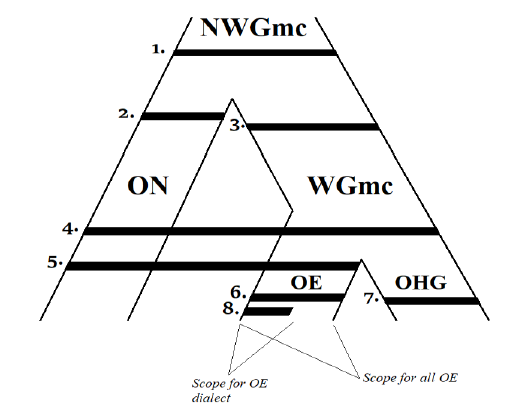
This (greatly oversimplified) model depicts the types of developments considered in Historical Glottometry in the context of Northwest Germanic and its split into Old Norse and West Germanic, and breakup of West Germanic into, for example, Old English and Old High German. Each line represents a wave with a different range. Waves 1 and 4 represent innovations that are shared among all members of Northwest Germanic; whether they occur prior to or after the breakup of the subgroup is irrelevant. Waves 2 and 3 represent innovations that are exclusive to the subsequent subgroups (and waves 2, 6, and 7 are exclusive to the resulting languages). Wave 5 represents an example of an innovation that includes all of one branch (Old Norse) but only part of West Germanic (purely for illustration). The black outlines represent the minimum scope of each subgroup or languages for consideration in the present approach; wave 8 therefore represents merely dialectal, or language-internal innovations, which fall beyond the scope of this study.
As previously mentioned, even though crosscutting diffusions have been acknowledged for over a century, even relatively recent treatments of Germanic development have seemingly fallen prey to the unnecessary assumptions of the tree model, and even scholars who have acknow-ledged the existence of noncladistic developments, both outside and within the field of Germanic linguistics, have apparently been divided on the issue of how to account for them effectively (see Southworth Reference Southworth1964, Anttila Reference Anttila1989, Hock Reference Hock1991).
Throughout the remainder of this paper, the innovations that have contributed to the linguistic history of the early Germanic languages are classified and processed using Historical Glottometry. The reader is encouraged to refer to the appendices in Agee Reference Agee2018 for an exhaustive list of the innovations considered for this study and their discussions.
3. Methodology
3.1. Building a Database
The most important and fundamental step in applying Historical Glottometry (henceforth HG) is the collection and allocation of innovations that are observable within the family or clade.Footnote 7 HG utilizes innovations that have been inferred from a particular reconstruction that has been posited through an application of the comparative method. In classifying innovations in this way, there often arise uncertain cases. On the one hand, there are extremely common sound changes, which could easily reflect parallel developments (such as syncope in unstressed syllables, for example). On the other hand, there are some situations in which there may be several conflicting interpretations (the status of +ē 2; see Krahe & Meid 1969, Voyles & Barrack Reference Voyles and Barrack2009:60). These are not new problems distinctive to HG, but classic problems of historical linguistics that are characteristic of the comparative method and subgrouping in general. The best that can be done is to use one’s own best judgment given what is known about the principles of language change and accommodate any language-external facts that harmonize best with the findings (such as the written historical or archeological record, where applicable). For the present approach, the database of innovations was compiled, with innovations collected from secondary literature on early Germanic development.
The primary challenge in conducting a study of this scale is the identification, collection, and interpretation of a massive amount of data within a framework that is compatible with HG and quantitative innovation-based subgrouping in general. No application of the comparative method was necessary in the construction of the innovation database used here. The comparative method has been applied and reapplied by countless specialists for many years. Indeed, Ringe & Taylor (Reference Ringe and Taylor2014:2) put it as follows:
Comparative Germanic linguistics has been worked over so intensively by so many specialists for so long that getting the facts is seldom a problem, though the wealth of conflicting interpretations has to be sorted (and ruthlessly pruned, since in each case no more than one can be correct).
Most of the data on the prehistoric development of Germanic are drawn from the works of Donald Ringe, who has so far provided the most detailed and up-to-date discussion on the development of the Germanic languages from a contemporary linguistic perspective. His compelling analysis has proven particularly useful for the application of an HG approach to the data. This has in some cases required some reinterpretation of the data to suit the quantitative nature of HG. For the attested languages, several prominent grammars by many influential authors have also been extensively utilized, such as Wright Reference Wright1888, Noreen Reference Noreen1923, Robinson Reference Robinson1992, Braune & Reiffenstein 2004, etc.; the reader is encouraged to refer to the References section for a full bibliography.
An important point that ought to be made about HG (and also about any innovation-based subgrouping approach) is that, since one is constantly learning about new innovations or reinterpreting those that are already known, it is possible that no glottometric subgrouping will be an end-all solution to the matter of subgrouping within a family. The exact result of a glottometric study of any language family will likely be continuously subject to adjustments as our understanding of the family improves.
3.2. Innovations
The most important point to be made about the innovations addressed in this study is that only innovations that are considered to have affected all dialects of each language are incorporated into the present database. Innovations affecting only one or several dialects of a language are not considered. Figure 5 demonstrates the minimum scope that has been predefined as a criterion for the consideration of innovations. Even innovations that cover most varieties of a language, but not all, still only serve to define a smaller, dialectal subgroup that is beyond the scope of the present study. The addition of dialectal diffusion to the equation adds a great deal of complexity to the task, as there is an abundance of variation both within and across the confines of the languages. A future glottometric analysis of this variation will be of particular interest as an answer to some infamous classification issues within the West Germanic clade; in the case of languages such as Old Saxon and Old Low Franconian in particular, there are several complications relating to dialectal variation within these languages that have made classification difficult (see Robinson Reference Robinson1992, Stiles Reference Stiles2013, Highlander Reference Highlander2014). A more exhaustive glottometric analysis that incorporates the interactions of dialects with other dialects, languages, or subgroups will provide a much-needed framework for the interpretation of such issues. For now, a more refined analysis focusing solely on the earliest attested daughter languages shall serve as a sufficient starting point.
Note that innovations in HG are equal in terms of their value for subgrouping. In executing HG, it is tempting to attribute greater weight to an innovation that affects more words of the language than one that is observable in only one word, but the reader is advised to remember that the purpose of subgrouping is to track the quantity of innovations. An innovation, for the purposes of HG, is any change that reflects a social connection between speech communities; its effect on the language can be either large or small in scale, ranging from a regular, all-encompassing phonological chain shift to a single lexically-specific innovation.
Lexical replacements were included in the present approach, but conservatively. There have obviously been numerous changes in the lexicon from the breakup of Proto-Germanic to the development of the individual daughters, but for the purposes of the present study, only the clearest cases of lexical replacement and lexically-specific sound- and morphological changes have been considered. This means that only words that are most clearly limited to a subgroup are considered (for example, the North Germanic replacement of inherited +aldaz ‘old’ with gamall). Purely semantic changes such as levellings of synonym complexes (for example, PGmc +mikilaz ∼ +storaz ∼ +grautaz ‘big’ > OE grēat), or replacements with native words are not considered. The traditional predominance of sound changes, morphological changes, etc. in the comparative method and subgrouping is maintained here.
Following François Reference François, Bowern and Evans2014, innovations that are not regular in scope are considered according to their presence in the core vocabulary. For example, a sound change that has a regular distribution, even if it is rare, is used for subgrouping in this approach, but a lexically specific sound change, lexical replacement, lexically-specific paradigm levelling, etc. are only considered if they affect a word within the core vocabulary, which here refers to the 200-word “Swadesh list” (Swadesh Reference Swadesh1955). What words truly constitute a universal core vocabulary, and the number of words that ought to be considered, are of course subject to debate, and I leave that matter open to scrutiny and adjustment by other scholars. For now, the Swadesh list shall suffice.
I am confident that the present approach at the very least sets a firm foundation for glottometric subgrouping of the Germanic languages, which may be amended, corrected, and further built upon by other scholars in the field as necessary. Every attempt has been made to confirm the exact distribution of all innovations used for this study. In some cases, the literature is not entirely clear on whether an innovation that affects a particular language also affects some other(s) as well. In such cases I have done my best to confirm the distribution of each innovation using the resources available to me.
4. Results
4.1. Database of Shared Innovations
As mentioned above, the languages surveyed for innovations are Old English, Old Frisian, Gothic, Old High German, Old Low Franconian, Old Norse, and Old Saxon. The Appendix lists developments extracted from the full database that are either innovations certainly shared between languages, or identical innovations with any reasonable possibility of having been shared.Footnote 8 The list is comprised of 162 innovations that are observable throughout early Germanic, spanning several centuries of development. Most are clearly shared, while some are more ambiguous.Footnote 9 Innovations that are exclusive to each of the attested languages, which are much more numerous, are not included in the Appendix, but a tally of them is presented in section 4.2. Also, as the innovations listed in the Appendix may not always be obvious from their label, or may require further explanation, the reader is referred to the complete list with details presented and discussed in full throughout the appendices in Agee Reference Agee2018.
As mentioned previously, the outcome of HG may vary depending on each analyst’s perspective on certain developments. It may be gathered from the list in the Appendix that the final subgrouping result inferred from this dataset could differ depending on how any incon-clusive or uncertain innovations are interpreted. Some subgroups could turn out to be quite strong if many similar innovations are generously attributed to them. Others could end up quite weak if many similar innovations are skeptically dismissed as coincidental. For example, Old Norse and Gothic exhibit a number of identical innovations, but they are for the most part all highly natural changes that could easily have been parallel developments. A generous approach would posit a strong Northeast Germanic subgroup on the basis of all of these innovations, while a conservative approach would not even consider any of them. Where a compelling case has been made here on the status of an innovation as a parallel development by prior specialists, the parallel status has generally been accepted. Otherwise, where an identical innovation is not too repeatable (that is, it is not a routine change that commonly affects languages), and there is no compelling reason not to assume a shared development, this approach has generally been taken in the spirit of the glottometric method. In such cases, the reader is encouraged to remember that the given analysis is one out of several possible perspectives on the matter (see Agee Reference Agee2018 for full discussion). Decisions with respect to some uncertain innovations have been made one way or the other depending on where the evidence points, and a few particularly inconclusive innovations have been excluded altogether. At any rate, every effort has been made to accommodate both the realities of language diffusion and the indications of the reconstructed evidence where possible. The following section presents my projections for the subgroups of early Germanic, comprising the most reliable interpre-tations of the data, as suggested by the historical record, linguistic science, or the inclinations of prior specialists, where they are available. For the first subgroup, the full calculation is provided to demonstrate how the glottometric measures are applied.
4.2. Proposed Subgroups
The proposed subgroups of early Germanic are provided in 3.
(3)

It has long been claimed that Proto-Germanic first split into a Northwest Germanic variety and an East Germanic variety (see Kuhn Reference Kuhn1955, Adamus Reference Adamus1962), and the evidence as indicated by the innovation history of early Germanic certainly confirms that Northwest Germanic is the strongest subgroup from the post-Proto-Germanic period. Northwest Germanic is comprised of Old English, Old Frisian, Old High German, Old Low Franconian, Old Saxon, and Old Norse; that is, all early languages except Gothic (that is, East Germanic).
According to the collected data, Northwest Germanic is most likely supported by about 21 exclusively shared innovations (see Ringe & Taylor Reference Ringe and Taylor2014).Footnote 10 In glottometric terms, this state of affairs is represented as follows:
(4)

Of the exclusive innovations, 14 are phonological, 1 is morphological, and 6 are lexical.Footnote 11 It was apparently a very cohesive subgroup, being only potentially crosscut by one “Northeast Germanic” innovation (which is of highly uncertain status):
(5)

The cohesiveness of the Northwest Germanic subgroup and its subgroupiness are represented in 6 and 7, respectively.
(6)

(7)

In all likelihood, Northwest Germanic was a relatively cohesive speech community with a cohesiveness rate of at least around 95.4%. The subgroupiness value of 20.04, which is not a percentage, is the product of a 95.4% cohesiveness quotient and 21 exclusive Northwest Germanic innovations. Recall that subgroupiness is a measure that is determined by both the strength of the cohesiveness rate and the number of exclusively shared innovations. In the case of Northwest Germanic, there is an abundance of exclusive innovations that strengthen its subgroupiness value, and a relatively high cohesiveness percentage of 95.4 does little to dilute the subgroupiness of Northwest Germanic to any significant degree. The lack of crosscutting innovations demonstrates that the split between Northwest Germanic and East Germanic was relatively clean. Depending on the true status of the single Northeast Germanic innovation, it may have even been 100% cohesive. As mentioned in section 3.1, more glottometric studies will be necessary to understand the relative significance of this particular result with respect to subgroups within other language families throughout the world, but what can be said is that this score almost doubles the most “subgroupy” Torres–Banks language subgroup in the database of François (Reference François, Bowern and Evans2014), which comes out to be 12.82 (where ε=14, k=0.92).
The next subgroup is Northeast Germanic, which includes Old Norse and Gothic. For about as long as a split between Northwest Germanic and East Germanic has been proposed as initiating the breakup of Proto-Germanic, other scholars have insisted on a split between two groups consisting of West Germanic on the one hand, and Old Norse plus Gothic (referred to here as Northeast Germanic) on the other. The latter approach maintains closer connections between Old Norse and Gothic than the two have with any other Germanic language (see Holtzmann Reference Holtzmann1870, Rosenfeld Reference Rosenfeld1954). While many of these claims have been shown to be based on shared retentions rather than innovations, there is in fact a handful of identical developments between Old Norse and Gothic. However, they are all highly natural and cross-linguistically common changes that do little to prove a connection between the two languages.
Holtzmann’s Law (or Verschärfung) is the only traditionally supported Northeast Germanic innovation, but even that change is now viewed skeptically by several specialists.Footnote 12 As Ringe (p.c. 2019) pointed out to me, changes of semivowels to obstruents are actually quite common crosslinguistically (for example, Latin consonantal i > [ʤ] in Romance; PIE +w- > Welsh gw-, etc.), making this a cross-linguistically common change and probably of little value for subgrouping. Nonethe-less, as long as this fact is kept in mind, it is still worth calculating the potential cohesiveness and subgroupiness of Northeast Germanic for the sake of testing this hypothetical subgroup. In this case, it consists of a single innovation and is supported only by the same innovation (p=1). It would have been crosscut 30 times, yielding a cohesiveness of 3.2% and a 0.032 subgroupiness. While the existence of a Northeast Germanic group is doubtful, it is worth noting that there is also a slim possibility that these scores may even have been higher, but the few identical developments are simply too natural to be reliable for use in a quantitative subgrouping approach.
A Continental Northwest Germanic subgroup comprising Old Norse, Old Saxon, Old Frisian, Old Low Franconian, and Old High German (but excluding Old English) is supported by one exclusive sound change that raised unstressed +ō to +ū in nonfinal syllables.Footnote 13 The distribution of this innovation (being restricted to the mainland) has been previously acknowledged (see Krause Reference Krause1968, Ringe & Taylor Reference Ringe and Taylor2014). Its distribution fully overlaps with, and is therefore supported by every Northwest Germanic innovation, but it is crosscut extensively (111 times), giving it a 16.5% cohesiveness and an equivalent subgroupiness. Continental Northwest Germanic therefore hardly ranks much higher than Northeast Germanic in terms of both subgroupiness and cohesiveness, but it is reliably supported by at least one relatively solid sound change.
A Northern Northwest Germanic subgroup comprising Old Norse, Old English, Old Frisian, and Old Saxon (but not Old Low Franconian, Old High German, or Gothic) is supported here by 5 exclusively shared morphological innovations, plus 21 encompassing innovations. It is crosscut 95 times, giving it a cohesiveness of 21.5%, and a subgroupi-ness of 1.07. Northern Northwest Germanic is therefore also a relatively weak subgroup, but it is supported by several exclusive innovations, which are reasonably attributable to this subgroup.
West Germanic (comprising Old English, Old Saxon, Old Frisian, Old Low Franconian, and Old High German, but excluding Old Norse and Gothic) is a very strong subgroup, which was identified since at least Schleicher Reference Schleicher1860. It is supported by 66 exclusive innovations and 21 encompassing innovations. Of its exclusive innovations, 24 are phonological, 23 are morphological, and 19 are lexical (see Agee Reference Agee2018). The subgroup is crosscut 9 times in the data, yielding a cohesiveness of 90.6% and a subgroupiness of 59.81.
Not surprisingly, West Germanic is an extremely well-supported subgroup. It has been debated as to whether it was ever spoken as a single language (see Robinson Reference Robinson1992), but the sheer wealth of develop-ments certainly points in favor of the possibility that it was spoken as a unitary Proto-West Germanic language for at least some period of time before beginning to diverge (see Stiles Reference Stiles2013).
A northern West Germanic subgroup (which I refer to here as Ingvaeonic) comprising only Old English, Old Frisian, and Old Saxon has been formally recognized at least since Wrede Reference Wrede1919. Here it is supported by 20 exclusive innovations plus 97 encompassing innovations. Of the exclusive innovations, 10 are phonological, 4 are morphological, and 6 are lexical (see Agee Reference Agee2018). It is crosscut 27 times in the data, giving it a cohesiveness of 81.5% and a subgroupiness of 16.30.
The next subgroup is comprised of Old English, Old Frisian, Old Saxon, and Old Low Franconian. In a few cases, Old Low Franconian has taken part in some developments with northern West Germanic. This Old Low Franconian–Ingvaeonic subgroup is supported by at least 6 exclusive innovations plus 87 encompassing innovations. Of the exclusive innovations, 2 are phonological, 1 is morphological, and 3 are lexical. It is crosscut 43 times in the data, bringing its cohesiveness to 68.4%, and its subgroupiness to 4.10.
Anglo-Frisian is another relatively strong subgroup, supported here by 9 exclusive innovations and 124 encompassing innovations. It has been identified as a subgroup since before Ingvaeonic was established as one: It was apparently not until Wrede Reference Wrede1919 that Old Saxon was also proposed to be one of the “North Sea Germanic” languages. Of its exclusive innovations, 4 are phonological, 4 are morphological, and 3 are lexical (see Agee Reference Agee2018). It is apparently only crosscut 6 times in the data, giving it a 95.5% cohesiveness and a 10.51 subgroupiness.
The next subgroup is formed by Old High German, Old Low Franconian, and Old Saxon. It is well established that Old Saxon and Old Low Franconian represent transitional dialects between southern and northern West Germanic (see Stiles Reference Stiles2013, Highlander Reference Highlander2014). With regards to their relationship with southern West Germanic, there are several innovations that demonstrate a connection between Old High German, Old Low Franconian, and Old Saxon. However, in some cases, limited Old Low Franconian evidence makes it difficult to confirm the subgroup’s participation in some developments, so the subgroup could in fact be stronger than reported here. According to the database, it is comprised of at least 16 exclusive innovations and encompassed by 90 more. Of its exclusive innovations, 5 are phonological, 8 are morpho-logical, and 3 are lexical. The subgroup is apparently interrupted 31 times in the database, yielding a 77.4% cohesiveness and a 12.38 subgroupiness.
The next subgroup is Teuto-Franconian (Old High German–Old Low Franconian). Old Low Franconian, like Old Saxon, is known to have been influenced by Old High German independently, and several innovations appear in the data that are consistent with an exclusive Teuto-Franconian isogloss. I have identified 5 exclusive innovations here (though there are likely more), plus 101 supporting innovations. Of the exclusive innovations, 3 are phonological, 1 is morphological, and 1 is lexical. This subgroup appears to have been crosscut only 11 times in the data, making it 90.6% cohesive, and giving it a subgroupiness of 4.53.
The next subgroup is Teuto-Saxon (Old High German–Old Saxon). Despite their separation by a northern (Ingvaeonic) versus southern West Germanic isogloss, similarities between Old High German and Old Saxon have been acknowledged since at least Wrede Reference Wrede1919. A Teuto-Saxon subgroup is supported by 5 exclusive innovations plus 107 encompassing innovations. Of the exclusive innovations, 3 are phonological, and 2 are morphological (see Agee Reference Agee2018). It appears to be crosscut 36 times in the data, with a 75.5% cohesiveness and a subgroupiness value of 3.77.
A Continental West Germanic subgroup comprising Old Frisian, Old Saxon, Old Low Franconian, and Old High German is supported by a single exclusive innovation and is encompassed by 88 more. The single defining innovation is a lexical development, replacing the masculine 3rd person singular possessive pronoun with the reflexive, probably under the influence of Old High German (Ringe & Taylor Reference Ringe and Taylor2014:165). The subgroup is crosscut 46 times, according to the database, with a 65.9% cohesiveness and an equivalent subgroupiness value (0.659). The single innovation that defines Continental West Germanic is solidly attested, so it is likely that it was indeed a real, though weak, subgroup defined by at least one innovation.
The next subgroup is Anglo-Norse (Old English–Old Norse). Stiles (Reference Stiles2013:31) identifies a syncope of medial +-ai- that is unique to Old Norse and Old English, signaling an Old English–Old Norse isogloss that is supported by an additional 26 encompassing Northwest Germanic and Northern Northwest Germanic innovations. The subgroup is crosscut 108 times, according to the data, giving it a 20% cohesiveness and a 0.20 subgroupiness.
The next subgroup is non-Frisian West Germanic (Old English–Old Saxon–Old Low Franconian–Old High German). One innovation that apparently affected all West Germanic languages except for Old Frisian is the lowering of the vowel in +hir ‘here’ > +hēr (though, like the other West Germanic languages, Old Frisian does exhibit the lengthening; Ringe & Taylor Reference Ringe and Taylor2014:36). As in the case of Northeast Germanic, it is defined only by a single innovation that is not guaranteed to be shared. If one takes this to imply a unique subgroup, then this subgroup would be weakly represented by this sole innovation but encompassed by 87 more. It would be crosscut 45 times and would be 66.2% cohesive, with a subgroupiness of 0.662.
The next subgroup is Frisio–Norse (Old Frisian–Old Norse). A couple of identical innovations between Old Norse and Old Frisian may represent a connection between these languages (see Highlander Reference Highlander2014).Footnote 14 This potential subgroup is crosscut 106 times, according to the data, with a 21.5% cohesiveness and a 0.429 subgroupiness.
Finally, in harmony with the probable pattern of shared develop-ments projected throughout section 4.2, table 1 accounts for the exclusive developments distinguishing four of the individual daughter languages that were identified in this study.
Exclusive Developments of the Daughter Languages.
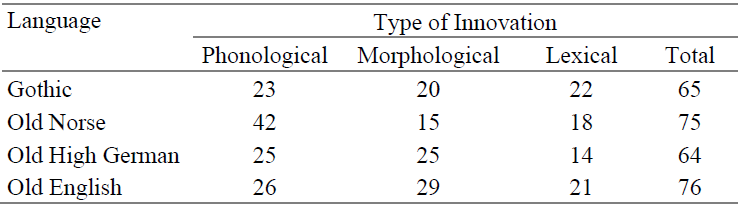
Since variation internal to these languages was beyond the scope of this study, crosscutting developments affecting only one or more dialects of a language have not been deliberately counted; but by examining the separate developmental histories of the daughters, several interesting postsplit developments were identified, contributing to the support for greater subgrouping patterns.Footnote 15 At any rate, the amount of crosscutting between the languages would have only decreased as these speech communities began to become more exclusive and their languages became less intelligible from one another; and the subgroupiness values of each language are probably quite high, perhaps not deviating from their ε values to a significant degree.
5. Discussion of Final Results
Table 2 summarizes the glottometric values for each of the subgroups that have been obtained from the data summarized in section 4.1 (and presented in full in Agee Reference Agee2018) and reviewed throughout section 4.2. Recall from section 2.2 that a cladistic approach to Germanic subgrouping only reveals a small portion of these subgroups. Assuming these results indeed represent the most realistic subgroupings and do reflect the true pattern of isoglosses within Germanic, then several subgroups have been revealed through HG that the cladistic approach overlooks (compare with figure 2).
Glottometric values for supported Germanic subgroups.

It is immediately clear that the primary subgroups tend to be concentrated at the top of the table. This is little surprise, since they are supported by many more innovations and reflect speech networks that were tightly geographically contiguous. The Old High German–Old Low Franconian–Old Saxon subgroup is one example of a subgroup that breaks the mold in that it is supported by many innovations but crosscuts the established division between northern and southern West Germanic. At the same time, Anglo-Norse traverses a major boundary, but receives relatively weak support.
No Germanic subgroup turns out to be 100% tree-like in this study, though the divergence of East Germanic from Northwest Germanic may have been a relatively clean split, depending on the true status of Holtzmann’s Law (though there surely must have been some dialectal exchange in the years immediately following the divergence). The high rate of isogloss overlap is reflected in the assortment of cohesiveness values. The lowest cohesiveness rate is in the potential Northeast Germanic subgroup, at 3.2%. Northwest Germanic and Anglo-Frisian nearly tie for the highest cohesiveness at 95.6% and 95.5%, respectively. West Germanic dominates in terms of subgroupiness: With its sheer volume of attested innovations and high cohesiveness rate, it yields a subgroupiness value of nearly three times the next highest value.
Several subgroups, such as West Germanic and Ingvaeonic, return particularly high scores in comparison to the range of scores reported by François (Reference François, Bowern and Evans2014) and Kalyan & François (2018) in their treatments of the Torres–Banks languages of Vanuatu. In their studies, the 15 highest subgroupiness scores (see table 3 below) range quite evenly from 2.37 to 12.82. The results in table 2 are similar in showing several small subgroups in addition to large ones, but different in that the range of scores is not as gradual, instead jumping several points between most subgroups, for example, from 4.53 (Teuto-Franconian) to 10.51 (Anglo-Frisian). This is likely because many more languages were surveyed in their approach (17 total), which produces a greater variety of possible patterns of isogloss distributions. The results of the present study would probably be comparable to the Torres–Banks situation if dialects of the daughters were also considered. Additionally, François & Kalyan are largely unconcerned with the possibility of parallel innovations, instead (more or less) freely assuming any identical innovations to be shared. This practice is acceptable in dealing with language families with poor written attestation, but the wealth of historical knowledge and expert insight on the development of the Germanic family warrants a more cautious approach in this regard. A more generous approach would change the results considerably.
The 15 strongest Torres–Banks subgroups (Kalyan & François 2018).

The larger subgroups uncovered by the present approach generally align with the historical record of the Germanic tribes during this period.Footnote 16 The same seems to hold for the smaller subgroups as well. Historical geography helps to support or discredit certain hypothetical subgroups. For example, there is no need to test for a potential Anglo–Gothic subgroup since historical records show no evidence of direct contact between Goths and Anglo-Saxons during this period. In the case of subgroups such as Continental West Germanic, there is a distinct possibility that West Germanic was, for some time, a single language. At that time communication between the remaining West Germanic speakers on mainland Europe was still possible. As a result, there could have been at least one shared development after the dissolution of West Germanic had begun. The presence of a Continental Northwest Germanic development similarly suggests the possibility of some degree of mutual intelligibility of the Northwest Germanic dialects after the departure of Old English. The participation of, for example, Old Frisian in both the Continental Northwest Germanic network as well as Anglo-Frisian also begs the question of mutual intelligibility of languages caught between conflicting isoglosses: How mutually intelligible would Old Frisian remain with Old English versus the other continental Northwest Germanic varieties? To what degree should a language such as Old Frisian be associated with Old English versus the Continental Northwest Germanic languages? The higher subgroupiness for Anglo-Frisian certainly seems to suggest that for at least some period of time after the breakup of Anglo-Frisian, Old Frisian would have remained more mutually intelligible with Old English than with Continental Northwest Germanic.
A few points ought to be reiterated about the Old Low Franconian and Old Saxon situation. The position of these languages on the Germanic Stammbaum has been a point of debate for some time. Franconian in general spans a continuum of varieties with varying degrees of participation in Old High German innovations. Old Low Franconian, also known as Old Dutch, represents one of the more independent varieties, with Old Central Franconian and Old East Franconian having been mostly absorbed into Old High German. There were also many dialects of Old Saxon (Stiles Reference Stiles2013:10), and that language has also been influenced by Old High German (and simultaneously by Ingvaeonic). As mentioned, the focus of this paper has been the subgrouping of the full daughter languages, and dialectal variation within and across them has not been accounted for. In addition, the limited Old Low Franconian corpus prevents a comprehensive account of the Franconian clade. A future continuation of the present study that supple-ments the above results with a more detailed account of the dialectal divisions will be essential for unraveling this complicated subgrouping problem, which HG is best suited to solve. In addition, a continued survey of the later “middle” languages (and their dialects) will also be of particular use.
Figure 6 depicts the subgroups listed above in the form of waves, where thicker lines represent higher subgroupiness values. Note the similarity of subgroup waves to the distributions of isoglosses and isogloss bundles in dialectology.
A glottometric diagram of Germanic.

The subgroupiness values of each subgroup that has been discussed henceforth are portrayed in this diagram visually. The strength of Northwest Germanic is the most apparent in the form of the thick, dark line that encompasses those languages. Ingvaeonic, Old High German–Old Low Franconian–Old Saxon and Anglo-Frisian feature moderately thick lines. Finally, the weaker subgroups are portrayed by faint, thin lines. The Northeast Germanic (Gothic–Old Norse) subgroup (which in all likelihood never existed) is the weakest of all.
6. Conclusion
It has been demonstrated in this paper that the development of the Germanic (sub)family is characterized by a significant amount of crosscontamination between subgroups. While it also features no shortage of exclusive innovations, there has been an abundance of crosscutting developments throughout the history of its diversification. In allowing the consideration of such developments, several small subgroups—which are overlooked in the traditional cladistic approach—are identified. In particular, several small subgroups that deviate from the arrangement outlined in the traditional Germanic Stammbaum in figure 2 have been revealed. These include a Continental Northwest Germanic subgroup, a Northern Northwest Germanic subgroup, a Central Germanic subgroup, an Anglo-Norse subgroup, among several others (see table 2).
It has been shown in section 5 that subgroupiness scores can differ considerably between these subgroups. In this paper, the most “subgroupy” of the subgroups detected was by far West Germanic at ς=59.81. The next highest value was shown by Northwest Germanic at ς=20.04, followed by Ingvaeonic at ς=16.30. Next, an Old High German–Old Low Franconian–Old Saxon subgroup and an Anglo-Frisian subgroup were supported with values of ς=12.38 and ς=10.51, respectively. After these, subgroupiness values take a notable dip, with the next highest value belonging to Teuto-Franconian at only ς=4.53. The three highest Germanic subgroupiness values greatly surpass the highest subgroupiness value in Kalyan & François 2018, which is only ς=12.82 for the Volow–Mwotlap subgroup (see table 3). Considering the sheer abundance of research that has been undertaken on the development of the Germanic languages over the course of the last few centuries by countless specialists, in addition to the fact that Germanic languages have a relatively long history of written attestation, it is not surprising that such a high result is returned for West Germanic. In other words, in the case of Germanic, much of the work involved in assembling a database of innovations has already been well underway for many years. Further attention by more specialists on the Torres–Banks languages would surely augment its innovation database considerably. However, there are also fewer languages in the Germanic network than in the Torres–Banks network. On a similar note, if the modern Germanic languages and dialects (or even the dialects of the old languages) were considered, the results would probably be comparable to the Torres–Banks network. In other words, the differences in results between the two families are more likely due to methodological differences (and the total number of languages comprising the family) than to any inherent properties of either language family. It will certainly be interesting to compare these results to those of other language families as more linguistic subgroupings are identified using HG.
The present study has therefore addressed the noncladistic develop-ments of the early Germanic varieties by using HG—the framework that takes into consideration the reality of areal diffusion, which a cladistic approach would disregard. The identification of crosscutting develop-ments by previous scholars of Germanic linguistics has been particularly helpful in achieving this. By accounting for the distribution of every innovation that is observable throughout early Germanic, and by accommodating crosscutting developments, HG has proven to be a powerful method for the subgrouping of the early Germanic languages.
APPENDIX
Database of shared innovations
Gothic=GO, Old Norse=ON, Old English=OE, Old Frisian=OFr, Old Saxon=OS, Old Low Franconian=OLF, Old High German=OHG



