INTRODUCTION
Traditionally, in the UK, cattle have been overwintered in slatted or straw-bedded housing and concrete yards, or outside on grassland or forage crops. However, indoor housing carries a high initial capital cost and, depending on housing system, day-to-day labour requirement; there may also be negative effects on animal health, welfare and productivity (Hickey et al. Reference Hickey, French and Grant2002; French & Hickey Reference French and Hickey2003), while animals over-wintered on pasture or forage crops can cause significant sward and soil structural damage in wet weather conditions. Outdoor woodchip pads can provide a reduced-cost alternative to conventional housing systems, while reducing the risk of soil damage and, possibly, potential for gaseous emissions of ammonia and nitrous oxide (Luo et al. Reference Luo, Ledgard and Lindsey2008).
Previous research has highlighted a significant risk of pollution to groundwater associated with unlined woodchip pads (Edwards et al. Reference Edwards, Campbell and Paterson2003). This and other studies challenged the early assumption that the woodchip matrix acts as a biological treatment system, reducing the pollutant load from dung and urine deposited by the livestock wintered on the pad. More recent research has substantiated this view (French & Hickey Reference French and Hickey2003; Smith et al. Reference Smith, Agostini and Laws2005; Vinten et al. Reference Vinten, Donnelly, Ball, Crawford, Ritchie and Parker2006), concluding that without careful design and management, woodchip pads are likely to give rise to substantial pollution and, if poorly constructed or managed, could pose serious risks of groundwater contamination with nutrients and pathogens. Moreover, catastrophic failure of a pad is likely to result in consequential negative impacts on animal health and welfare and loss of farm income, e.g. significant surface water logging and accumulation of slurry solids can cause foot disorders and increase the risk of slurry contamination which could contravene acceptable standards of cleanliness for animals presented for slaughter.
Research has been undertaken within a LINK funded (industry partnership) research project on three commercial pads and an experimental site in the UK in order to assess the impact of important elements of the design and management of woodchip pads on pad and animal performance and consequential risks of environmental emissions to air and water. The aim of the project was to evaluate the hypothesis that woodchip pads provide a reduced cost over-wintering system for cattle with reduced pollution risk to air and water. In the current paper, results from the detailed monitoring of two commercial farm pads are reported. Further details of the background and rationale for these studies are described in Jackson & Smith (Reference Jackson and Smith2012).
MATERIALS AND METHODS
Sites
Detailed hydrological monitoring, effluent sampling and nutrient balance studies were undertaken at two commercial farm sites with beef cattle wintered on woodchip pads; one near Brecon, Powys, UK (52°0′N, 3°13′W, 130 m asl), and the other at Coalville, Leics, UK (52°44′N, 1°19′W, 201 m asl), over winter 2009/10.
The pad at Brecon, designed for up to 100 cattle and completed in November 2008, was set up on an exposed, south-facing, sloping site, the 35×35 m pad bounded by raised banks at three sides to provide shelter for the animals. On the fourth side, a raised feed race adjacent to concrete yards allowed mechanized feeding of forage during the accommodation period. An impervious, plastic high-density polyethylene (HDPE) barrier was laid over the site, following excavations and grading, and covered with 200–300 mm depth of woodchip. The 7° slope across the base of the pad was considered sufficient to provide gravity flow within the woodchip, to a single slotted pipe, positioned in an arc of c. 10 m radius at the lower corner. This drainage collector pipe was connected to a 1 m diameter access chamber, from which the effluent was channelled to a below ground collection tank, outside of the woodchip pad. Detailed images of the pad construction are included in Jackson & Smith (Reference Jackson and Smith2012).
The Coalville pad, completed in January 2009, was used for out-wintering up to 100 beef cattle. The pad was 38×36 m, divided into three equal, independently drained sections. Four surface drains were installed within each pad section, running longitudinally at 3 m spacing. Each drain consisted of perforated plastic pipe with internal diameter of 100 mm, c. 300 mm deep within a trench, backfilled with gravel. An impervious barrier below the drainage was assumed unnecessary due to the impermeable clay subsoil, and following water infiltration tests carried out across the site. A coarse geo-textile membrane (Terram 500 from Terram, Maldon, UK) was laid above the drainage stone to minimize the ingress of solids and help prevent admixture of soil and woodchip, particularly over the drain lines.
Conifer timber was chipped on site at both farms and the resultant chips, averaging ⩽50 mm in size (except for a small proportion of larger end pieces, >100 mm), were laid to a depth of c. 300 mm.
Effluent flow and sampling
Effluent flow was monitored and flow proportional samples taken using a modified water wheel and tipping bucket device, at Brecon and Coalville, respectively (Jackson & Smith Reference Jackson and Smith2012). At Brecon, the flow monitoring assembly was installed in the lower, northern corner of the pad with a protective fencing surround, while at Coalville, the tipping bucket and sample tank were set into a headland between the pad and effluent lagoon. Sampling frequency was flow proportional, being determined by precipitation and resulting drainage, the main aim being to avoid over-topping of the sample tank as this could result in decanting of the contents and consequential (and unrepresentative) increase in solids content within the sample. Samples were analysed for dry matter (DM), total nitrogen (N), ammonium nitrogen (NH4-N), total phosphorus (P), total potassium (K) and chemical oxygen demand (COD) (MAFF 1986), and the flow-weighted concentrations were used to determine nutrient flux through the pads.
Chemical composition of woodchip
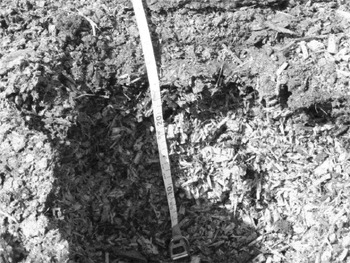
Samples were taken from within the surface layers (0–100 mm, four replicate, excavated samples at Brecon and nine at Coalville) of soiled woodchip (Fig. 1), the ‘spent timber residue’ (STR), after an extended period with animals on the pad. The number of animals and time spent on the pads were recorded throughout the monitoring periods in order to estimate nutrient loadings. The nutrient content of the STR is of importance with regard to land application and it was also anticipated that these results would be needed in order to estimate nutrient retention within the woodchip and, hence, the relative partitioning of N, P and other nutrients between the woodchip matrix and effluent drainage. Samples of the lower layers (100–300 mm) of chips were also taken for analysis at the end of the wintering period.
Excavation in the woodchip at the Coalville site, showing accumulation of excreta in the top 200 mm.

Water balance
Estimates of the overall water balance for both pads are detailed in Jackson & Smith (Reference Jackson and Smith2012). Evaporative loss from the pad area was estimated by detailed analysis of the precipitation and hydrology data, focusing on ‘dry’ periods when flow had ceased. The impervious membrane separating the woodchip from the soil at the Brecon site was assumed to preclude any below-pad drainage, thus channelling all of the effluent by gravity, through the monitoring equipment via the collector drain. At Coalville, however, the woodchip was laid directly above the clay subsoil which, despite low permeability test results across the site, over an extended period could allow some minor drainage of effluent into the subsoil beneath. Absorption of precipitation by the mixture of chip and excreta can be expected to occur and, in a more transient fashion, following periods of surface evaporative moisture loss. Small tank studies, reported in Jackson & Smith (Reference Jackson and Smith2012), were carried out to test the water retention capacity of different grades of woodchip following initial wetting up.
Stocking rates and animal health and welfare
The numbers of animals present on the pads, feeding practices, animal cleanliness and general condition scores were recorded. Animal dirt scores, using a five-point scoring system (1=clean; 5=filthy) as applied within FSA Meat Hygiene Service (Food Standards Agency 2002), were made at each site visit.
Other information
Details of woodchip pad management (including the performance of the pads over defined periods), e.g. dirt scores of woodchip surface and removal of layers of soiled woodchip and replacement with clean chips, were collected during operation of the pads under practical farming conditions.
RESULTS
The Brecon and Coalville pads were monitored from July 2009 to May 2010 and from March 2009 to June 2010, respectively. Critical examination of the hydrological balance in the woodchip pads was necessary to support robust interpretation of nutrient fluxes.
Hydrology
Details of a simple hydrological balance between water volume input (precipitation, dung+urine input from stock) and output (effluent flow, drainage below pad, evaporative loss), established for monitoring restricted to comparable time periods at the two pads, i.e. for a short period in summer 2009 prior to the introduction of stock followed by the winter period (2009/10), have been presented in Jackson & Smith (Reference Jackson and Smith2012). By combining effluent flow data with assumptions for excretal additions by the animals, estimations of drainage and evaporative losses, and potential water absorption and release characteristics of the woodchip, most of the inputs to the pads could be accounted for in the recorded output effluent volumes from the woodchip pads at both of these sites, with total outputs representing between 0·90 and 1·26 of input.
Nutrient balance
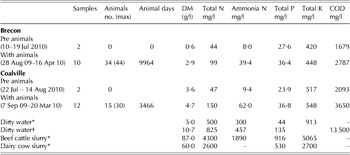
Effluent analyses data, including nutrient content, total solids and COD, adjusted according to overall flow-weighted average nutrient concentrations, are summarized in Table 1. Reference to the typical composition of dirty water and cattle slurries are also included for comparison.
Flow-weighted effluent nutrient concentrations from the two commercial pads, compared with equivalent analysis data for typical dirty water and cattle slurries

COD: Chemical oxygen demand.
* Source data: Chambers & Nicholson Reference Chambers and Nicholson2004.
† Source data: Cumby et al. Reference Cumby, Brewer and Dimmock1999.
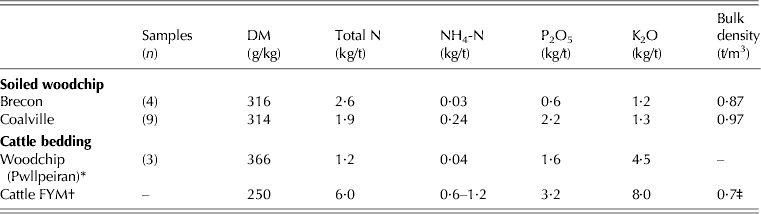
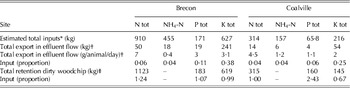
From samples of the STR – replicated measurement of the depth of the layers sampled and corresponding assessments of bulk density (0·87 t/m3 at Brecon and 0·97 t/m3 at Coalville) – it was possible to estimate the nutrient content of the material retained on the pad. Average analyses and nutrient content of the STR as sampled from the two pads are presented in Table 2. An example of the typical surface accumulation of the animal excreta (c. 200 mm) in the woodchip is shown in Fig. 1. The estimated nutrient balances for the two pads are shown in Table 3.
Nutrient content of the soiled woodchip (STR) from the two woodchip pads compared with analysis of soiled woodchip used for animal bedding (ADAS Pwllpeiran) and with typical nutrient content of cattle farmyard manure
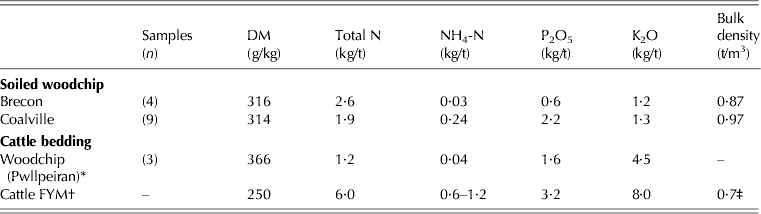
* Source data: Aldwyn Clarke, ADAS, personal communication.
† Source data: Defra 2010.
‡ Source data: Smith Reference Smith2005.
Estimated nutrient balance during 2009/10 monitoring periods at Brecon and Coalville; includes estimates of inputs from the stock, nutrient content of effluent and retention in surface layers of woodchip

* Estimated from daily N and P excretal output standards (Anon 2009).
† Derived from flow data and effluent sample analyses.
‡ Derived from sampling and analysis of dirty woodchip, estimated depth of soiled chip and bulk density.
Excretal input to the pads was estimated on the basis of the current standard values agreed for the Nitrate Vulnerable Zone (NVZ) Action Programme, for large (c. 500 kg liveweight) growers of 26 litres/head/day (Anon 2009). However, digital image recording at the Coalville site showed animals spending only 0·62 of time on the pad during daylight hours, the remainder being spent on the concrete feed race. A very similar partitioning of livestock effluent loading (65:35) was established from collection and measurement of excreta from the feed stance on the experimental pads at Rowden Farm, N Wyke, Devon, also within the LINK research project (Dumont et al. forthcoming). These estimates were very similar to the 0·66 time on the woodchip area prescribed in the Irish guidelines for woodchip pads (Department of Agriculture, Food and the Marine 2007). The c. 0·33 of excretal deposition on the concrete feed race would normally be scraped into separate slurry or solid manure storage, thus not contributing to the hydrological or nutrient loading on the woodchip pad area. For the purpose of arriving at an estimate of a rough effluent volume and nutrient balance for both pads, the overall contribution from input by animal excreta was, therefore, taken as 17·2 litres/animal/day (i.e. 26 litres×0·66).
DISCUSSION
Effluent concentrations of nutrients and COD were similar to, or lower than, levels found in typical dirty water and, consistently, well below those in cattle slurries (Table 1). These results are of significant importance to the management of effluent from woodchip pads. Under NVZ Regulations, dirty water is acknowledged to have low total nitrogen and other nutrient content and can be managed and spread safely onto land, i.e. so that it does not exceed the capacity of the soil for nutrient retention and, hence, pose a risk of surface water pollution. Taking into account the low nutrient content of dirty water, Defra and the Environment Agency have adopted a low risk regulatory position which allows dirty water to be excluded from the need for long-term storage and to be applied to land during the closed periods (Anon 2011). Under the regulations, ‘dirty water’ is lightly contaminated run-off from lightly fouled concrete yards or from dairy/parlour washings that are collected separately from slurry (Anon 2009). Within supplementary guidance, effluent arising from over-wintering pads, e.g. woodchip corrals or stand-off pads is considered as ‘slurry’ (Anon 2011).
Studies on woodchip absorption have shown that small-sized chips (10–20 mm) can absorb nearly three times its dry weight in water (Tegan Darch, University of Reading, personal communication) and wood shavings (30–70 g/kg moisture), nearly four times (Ward et al. Reference Ward, Wohlt, Zajac and Cooper2000). During the initial wetting up of the woodchip following pad construction, substantial water absorption is to be expected. However, the results of the small tank studies also showed up to 0·06–0·16% retention by weight of the wet chips, even in the winter months, following periods of surface evaporative moisture loss and helping to explain the periods of relatively low drainage from the pad.
During the period cattle spend on the woodchip pad, a considerable build-up of dung solids will often occur on the surface; high stocking density, feeding on the pad, extended periods of very dry or cold weather and fine woodchip size all contribute to the rapid accumulation of solids on the surface of the pad. Separate studies within the project have focused on the properties of the STR, the soiled woodchip and best management practices, e.g. it has been shown that composting may not be essential for land application of smaller sized woodchip. Analysis of woodchip STR, although quite variable, is similar to that of farmyard manure (FYM) in terms of the high DM and high proportion of organic N, although relatively low in total N content (Table 2). It is clear that appreciable retention of nutrients occurs within the woodchip matrix (Table 3). Based on the analytical data, land spreading of the STR should follow similar guidelines to FYM, i.e. because of its low mineral N content it should not be subject to the closed period spreading restrictions applied to slurries and other high available N content manures. However, suitability for spreading on grassland must take into consideration the size of the woodchips. Based on the grassland spreading experiments at N Wyke, the finer chips (<10–20 mm) are absorbed rapidly within the sward and surface soil, and composting of such material is not required before application (Dumont et al. forthcoming). Significantly higher N and K content of STR were reported by Augustenborg et al. (Reference Augustenborg, Carton, Schulte and Suffet2008a), probably as a result of higher stocking rates on the woodchip pads. However, grassland spreading trials reported by Augustenborg et al. (Reference Augustenborg, Carton, Schulte and Suffet2008b) again confirmed the speedy incorporation of the woodchip into the sward following application, but a rather poor response to N content, reflecting the high proportion of organic N in the material.
The current results confirm the low nitrogen and phosphate content of the effluent draining from the pads which, based on cumulative balance, was estimated at only 0·055, 0·111 and 0·044 and 0·056 of N and P inputs, respectively, for the Brecon and Coalville pads (Table 3). These findings are consistent with estimates made by other researchers, e.g. 0·10 N and 0·05 P of estimated excretal output (French & Hickey Reference French and Hickey2003). However, these concentrations are such that effluent should not be allowed to enter surface or groundwater. Therefore, even if woodchip pad effluent is treated as dirty water, it still needs to be collected, stored and applied to land in a controlled manner. It is also of note that sampling and analysis of STR indicates a substantial accumulation of N and P in the surface layers of woodchip. As indicated above, and by the findings of other research, analysis of the dirty chip is known to be very variable and, along with estimates of the depth of the surface layer of dirty chip (Fig. 1), significant error in the estimates of N and P content of the surface layer of woodchip is to be expected. Hence, it is not surprising that >1·00 nutrient recoveries were found in both pads, although this is substantial in the case of the P content of the soiled woodchip at the Coalville site (Table 3). The few research data of this type available for woodchip pads, e.g. in column studies in New Zealand, have confirmed similarly low nutrient loadings in effluent drainage and relatively high retention within the woodchip matrix, e.g. 0·04 N in drainage from the pads with sawdust or bark and >0·60 N retained within the sawdust or bark (Luo et al. Reference Luo, Donnison, Ross, Ledgard and Longhurst2006). Similarly, recent studies on geo-textile and gravel pads used for livestock feeding in the USA have confirmed very low nutrient content in runoff and drainage water and high retention of nutrients on the pad surface layers (Singh et al. Reference Singh, Bicudo and Workman2008). These data provide a clear rationale for the low nutrient content of the effluent drainage from woodchip pads and support for the view that the effluent should be considered as ‘dirty water’ rather than slurry.
The results of the ammonia (NH3) emission measurements, not reported in the current paper, show that ammonia also represents an important component of N balance across the woodchip pad; assessments carried out on both the commercial farm pads, as well as on the N Wyke research pads, are reported elsewhere (Dumont et al., forthcoming; R. A. Hill et al., unpublished data).
CONCLUSIONS
Results collected from the detailed monitoring of the two farm pads are presented within the current paper and confirm the low nutrient content of effluent draining from woodchip pads used for wintering beef cattle. The analysis of this out-wintering pad (WOP) effluent was consistently similar to that of dirty water and much lower than of typical cattle slurries. The nutrient balance data from the current study have confirmed the high retention of nutrients in the woodchip (>0·90 of estimated N and P inputs in cattle excreta), as found in other research, with almost all of this in the surface layers of the STR and the OWP effluent containing only 0·05–0·10 of the N and P inputs.
The STR is similar in analysis to FYM, with a high DM content and only a low proportion of mineral N; thus the storage and land application of STR should be managed in a similar way to FYM, except that application to grassland should be avoided where there is a high proportion of coarse woodchip (>20–50 mm) pieces. The effluent quality data and nutrient balance calculations, together, provide strong evidence that woodchip pad effluent should be considered and managed as ‘dirty water’ and not as ‘slurry’, as in the current regulations within NVZs in England and Wales (Anon 2009). Controlled application of OWP effluent during the ‘closed periods’ should not present a significant risk of pollution to ground or surface waters and, therefore, should be permissible; moreover the rules on minimum storage requirements for slurry should not apply to the effluent draining from a well-designed woodchip pad.
The results reported within the current paper, combined with similar data from the replicated experimental pads at Rowden Farm, N Wyke (D. R. Chadwick et al., unpublished data) and including information on animal and woodchip pad performance, have been used to draft new guidelines for farmers on the design, construction and management of woodchip pads within an industry-funded booklet for farmers.
The research was funded under the Department for Environment, Food and Rural Affairs (DEFRA) Sustainable Livestock LINK Programme (Project LK0676), and the support of the following industry sponsors is gratefully acknowledged: DairyCo Ltd, EBLEX Ltd, Hybu Cig Cymru (HCC), SW Forest, British Grassland Society (BGS), Alan Cottle (Woodcott Chips, Barnstaple) and Dave Simmons Contracting (North Tawton); also with Environment Agency (EA) support, Rothamsted Research, North Wyke and Richard Hill, Jacobs. The considerable help and co-operation of the two host farmers at the commercial farm sites is also gratefully acknowledged: Joel Durrell, L Porthamel, Brecon; Andrew Danvers, High Tor, Coalville (and landlords, Leicester and Rutland Wildlife Trust).