Introduction
Citron (C. medica), mandarin (C. reticulata) and pummelo (C. maxima) are considered to be modern cultivated types most similar to the ancestors (Barret and Rhodes, Reference Barret and Rhodes1976; Nicolosi et al., Reference Nicolosi, Deng, Gentile, La Malfa, Continella and Tribulato2000; Luro et al., Reference Luro, Rist and Ollitrault2001). Economically important types (orange, grapefruit, lemon and lime) are believed to have originated from one or more generations of hybridization between these ancestral genera. In terms of composition and commercial assessment of fruit maturity, sweetness and acidity are considered as major components of any citrus (Ting and Attaway, Reference Ting, Attaway and Hulme1971; Tucker, Reference Tucker, Seymour, Taylor and Tucker1993). Organic acids and sugars vary according to species, varieties, and also to environmental conditions (e.g. climate, irrigation, etc.) and fruit maturation (Bain, Reference Bain1958; Sinclair, Reference Sinclair1984; Marsh et al., Reference Marsh, Richardson and Erner2003). In mandarin, sweet orange and their hybrids, acidity decreases during fruit maturation and thus determines the most favourable time of harvest, suitable for commercial fruit quality (Sinclair, Reference Sinclair1984). In terms of genetic evolution, acidity and sweetness had probably played a determinant role in the natural selection and dissemination of these species during their history. Unfortunately, their impact on natural selection is hard to verify and remains only a hypothesis suggested by the extension of pulp acid character on citrus varieties. Nevertheless, some ‘acidless’ varieties exist, due to spontaneous mutations, characterized by a very low acidity and a lack in citric acid (Bogin and Wallace, Reference Bogin and Wallace1966; Canel et al., Reference Canel, Bailey-Serres and Roose1995). More often, they are considered as useful biological models to display the cellular mechanisms and genes expression involved in acidity and sweetness regulation (Albertini et al., Reference Albertini, Carcouet, Pailly, Gambotti, Luro and Berti2006; Cercos et al., Reference Cercos, Soler, Iglesias, Gadea, Forment and Talon2006; Talon and Gmitter, Reference Talon and Gmitter2008). The general behaviours in terms of primary metabolic contents and evolution for different cultivars are largely described in the literature. Nevertheless, these characteristics have never been investigated for a large panel of species representing the Citrus genus simultaneously in a standard time and environmental conditions. The objective of this work was to investigate the variation of pulp sweetness and acidity between and within major species for citrus history (ancestral species) and for citrus industry (cultivars) and then to explore its relationship within Citrus phylogeny. The polymorphism of gene sequences involved in the primary metabolic pathway was explored by single strand conformation polymorphism (SSCP) approach to find genetic markers related to this biochemical diversity.
Materials and methods
Materials
Fruit and leaves were sampled from 87 citrus varieties growing in “Institut National de la Recherche Agronomique-Centre International de Recherche Agronomique et de Developpement” citrus germplasm (San Giuliano, Corsica, France), in the first week of February. Each taxonomic group was represented by several genotypes to evaluate intra and interspecific diversity: 18 for mandarin (Citrus reticulata Blanco), 9 for pummelo (C. maxima (Burm) Merr.), 9 for citron (C. medica L.), 12 for orange (C. sinensis (L.) Osb.), 8 for grapefruit (C. paradisi Macf.), 7 for lemon (C. limon (L.) Burm.), 11 for limes (C. aurantifolia (Christm.) Swing), 9 for sour orange (C. aurantium L.), 1 for combava (C. hystrix D.C.) and 5 for various putative lemon hybrids. Lemon, orange, sour orange, lime and citron acidless mutants have also been included in the sample design.
HPLC analysis
Each fruit juice was diluted tenfold for sugar analysis and twofold for organic acids analysis and centrifuged at 2250 g for 10 min. The supernatant was filtered through 0.45 μm acetate cellulose membrane filter. The separation of organic acids and sugars was achieved by method described in Albertini et al. (Reference Albertini, Carcouet, Pailly, Gambotti, Luro and Berti2006), using an analytical HPLC unit (Series 200; Perkin-Elmer, France).
SSCP analysis
Primers were designed using Primer3 software for nine genes involved in primary metabolic pathway: vacuolar acid invertase (AB074885), mitochondrial malic enzyme (CB417399), aconitase (AF073507), phosphoenolpyruvate carboxylase (EF058158), isocitrate dehydrogenase (AF176669), vacoluar citric acid transporter (EF028327), phosphofructokinase (AF095520), phosphoenolpyruvate carboxykinase (Csi5808) and malate dehydrogenase (DQ901430). DNA extraction from citrus leaves was carried out according to Doyle and Doyle (Reference Doyle and Doyle1987). PCR reactions (mixture and amplification conditions) were performed in a ‘Mastercycler gradient’ thermocycler (Eppendorf) according to Luro et al. (Reference Luro, Costantino, Argout, Froelicher, Terol, Talon, Wincker, Ollitrault and Morillon2008). SSCP analyses of amplified fragments were displayed according to the method of Markoff et al. (Reference Markoff, Savov, Vladimirov, Bogdanova, Kremensky and Ganev1997).
Statistical analysis
DARwin5 v. 4.0 (Perrier et al., Reference Perrier, Flori, Bonnot, Hamon, Seguin, Perrier and Glaszmann2003) was used to examine the molecular genetic diversity. From SSCP data, a dissimilarity matrix was established using Dice's distance (Dice, Reference Dice1945) and a dendrogram was elaborated by Hierarchical and Ascendant classification method. A principal component analysis (PCA) was performed with R software for HPLC data.
Results and discussion
The general organization of Citrus diversity based on the amount of primary metabolic compounds is presented in the PCA (Fig. 1) It is organized around three groups where the main ancestor species are citrons (associating lemons, lemon hybrids, limes and combava), pummelos (associating oranges and grapefruits) and mandarins (without any other species). This representation totally agreed with the Citrus diversity and supposed phylogenic relationships established with molecular markers (Nicolosi et al., Reference Nicolosi, Deng, Gentile, La Malfa, Continella and Tribulato2000; Luro et al.; Reference Luro, Rist and Ollitrault2001; Barkley et al., Reference Barkley, Roose, Krueger and Federici2006). Lemon may have originated from a cross between citron and sour orange, orange from a cross between pummelo and mandarin, and grapefruit from a cross between orange and pummelo. These hypotheses were confirmed with our analysis of sugars and organic acids composition of citrus pulp. Sample 3, representing Clementine, is linked to pummelo group in total accord with its mandarin × orange origin. One major deviation from the putative phylogeny was observed for sour orange origin supposed to be a mandarin × pummelo cross, which is not supported by our analysis since sour orange varieties have an intermediate position between pummelo and citron groups. Mandarin is the most diversified group characterized by a high variation of succinic and citric acid amounts. Moreover, sucrose content is a valuable criterion to distinguish mandarins from all other taxi.
PCA plot of citrus species based on the pulp concentrations of soluble sugars and organic acids and the contribution of each component to the diversity represented on the two first axes of PCA (at right and lower part of the plot); ‘acidless’ mutants have been removed from the citrus samples.

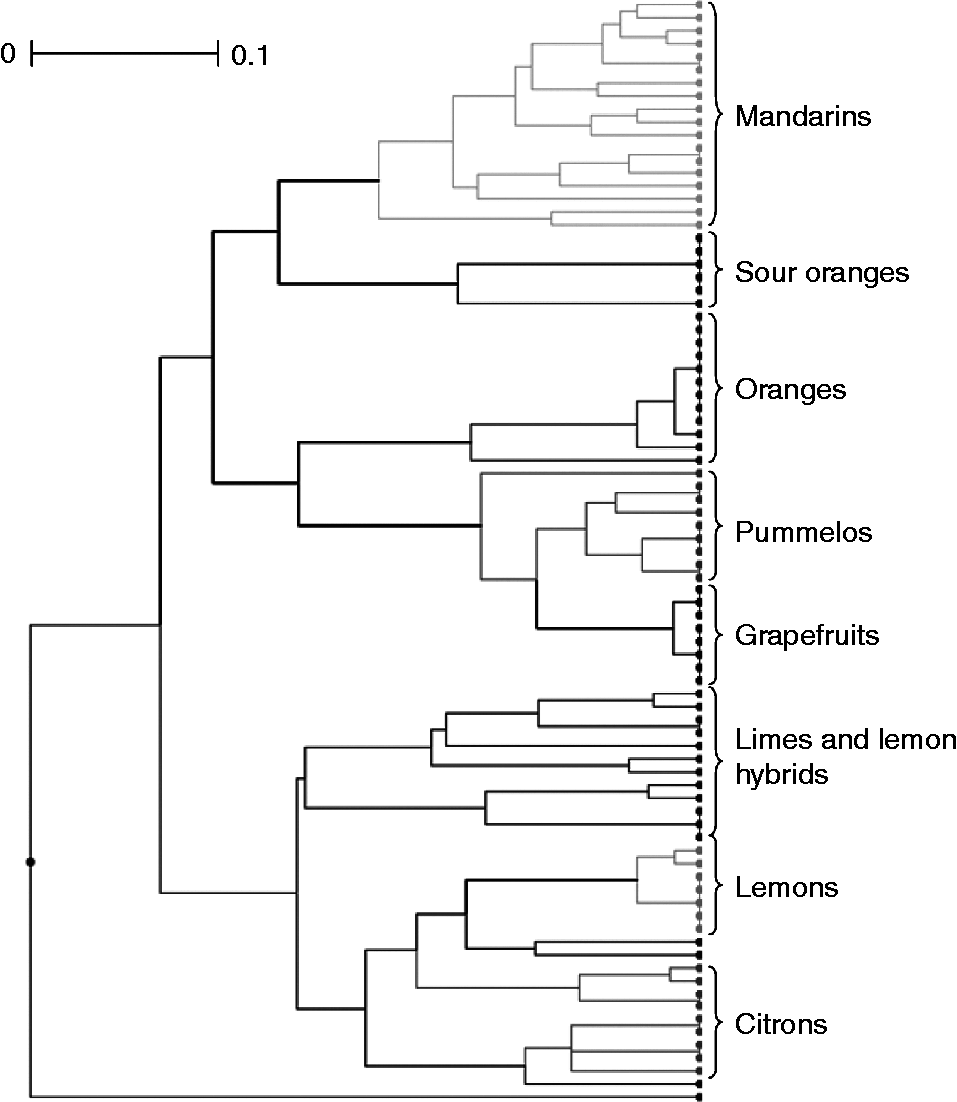
SSCP technique of DNA fragments from genes involved in the metabolic pathway of sugars and organic acids allowed the detection of diversity between varieties undetectable at the amplified fragment-size level. Then, these polymorphisms were supposed to be related to single nucleotide variations and not insertions or deletions. The general organization of Citrus diversity obtained with the SSCP data is quite similar to that observed with biochemical criteria (Fig. 2). The three major groups are maintained. However, some cultivated species such as sour oranges are associated with mandarins, whereas, phylogenetically, they have been suggested to derive from a pummelo and mandarin crossing. This is also the case for sweet oranges, associated with pummelo group while they are supposed to derive from a mandarin backcross following an initial pummelo × mandarin cross. The second major information resulting from this analysis was the high level of diversity between varieties of each species. This is a common situation for ancestral species that have evolved by intersexual crosses. But molecular diversity between varieties resulting from somatic mutations, such as for oranges, lemons or grapefruits, is very rare or not detected previously by neutral markers (Luro et al., Reference Luro, Rist and Ollitrault2001; Barkley et al., Reference Barkley, Roose, Krueger and Federici2006). Four genotypes are detected for oranges and two for both lemons and grapefruits. ‘Acidless’ mutant profiles were not distinguishable from the other, suggesting independency between molecular polymorphism and biochemical variations.
Hierarchical and Ascendant classification tree showing the relationships of Citrus species accession as determined by Darwin using a distance matrix calculated from the proportion of shared alleles scored on SSCP gels.

The overall biochemical diversity of Citrus reinforced the idea that Citrus diversity is distributed among three ancestral species suggesting a speciation of fruit pulp sweetness and acidity prior to secondary species genesis. SSCP approach revealed a polymorphism apparently neutral against acidity and sweetness regulation but suitable for further genetic studies such as quantitative trait loci mapping and gene expression profiling.