Introduction
In European countries, including Norway and England, social policies increasingly emphasise user participation as a goal when designing welfare services (Alm Andreassen, Reference Alm Andreassen2004; Barnes and Cotterell, Reference Barnes, Cotterell, Barnes and Cotterell2012; Askheim et al., Reference Askheim, Christensen, Fluge and Guldvik2017). This goal is part of a wider European welfare change in the citizen/state relationship during recent decades. The idea is to move people's roles away from welfare dependency to becoming active citizens ‘willing to take a full part in the remaking of modern societies’ (Newman and Tonkens, Reference Newman and Tonkens2011: 9). A body of literature gives insight into this, for instance the change in perception from welfare recipients as (passive) ‘pawns’ towards positions like (independent consumer) ‘queens’ on the chess board (Le Grand, Reference Le Grand1997; Reference Le Grand2003), or the inclusion of hybrid arrangements involving public service users in role combinations of consumers, citizens and co-producers of services (Fotaki, Reference Fotaki2011; see also Clarke et al., Reference Clarke, Newman, Smith, Vidler and Westmarland2007; Dent and Pahor, Reference Dent and Pahor2015). The article will engage in this discussion by presenting findings from an analysis of policy documents – carried out only by a few others in the user participation literature (e.g. Greener Reference Greener2009; Greener and Powell, Reference Greener and Powell2009) – laying the ground for social policy changes. We will analyse user participation as presented in national policy documents related to social care services for older people, primarily a selection of White papers from the 1960s until today, using a discourse analytical approach inspired by Bacchi (Reference Bacchi2009).Footnote 1 Although older people represent the main target group of social care services, the user participation literature has almost neglected them (Barnes and Walker, Reference Barnes and Walker1996; with a few exceptions, e.g. Fotaki, Reference Fotaki2011). Social care services for older people represent a key policy issue in Norway's (in 2017) 426 municipalities, and in the 152 English local authorities responsible for funding social services for older people.
While user participation can be studied at different levels (Alm Andreassen, Reference Alm Andreassen2004), the analysis here is limited to a macro level, focusing on changes in the political rhetoric about user participation as this phenomenon appears in national documents. User participation in an everyday life context of social care is not included in our discussion.Footnote 2 In the following, we will present our theoretical/methodological framework and context differences for user participation implementation in Norway and England. Then follows the analysis, and a discussion comparing the specific discourses found.
A discourse analytical framework
The discourse approach stresses the understanding of social phenomena as socially constructed in a specific historical time and context. While varying, discourse analyses are all inspired by Foucault's theories. In Foucault's terms, simply expressed, a discourse is ‘a certain way of talking about and understanding the world (or a part of the world)’ (Jørgensen and Philips, Reference Jørgensen and Phillips2002: 9). Discourse analysis can be applied to different data, but it particularly relates to text and rhetoric as is the case here, where policy rhetoric is the analysis objective. Inspired by Foucault, Bachhi (Reference Bacchi2009) has provided tools for analysing policy documents. Her main idea is to turn away from focusing on what the documents say about specific political problem solving, to focusing on the problem and how this is constructed in a specific way and for specific reasons. Bacchi criticises an evidence-based (positivistic) approach, replacing this with a social construction approach. Methodologically, she suggests this main analytical question: ‘What is the problem represented to be?’.
Inspired by these ideas, we have applied these questions: Which main problem does the document present? And in order to ‘find’ this problem, we have asked: What is presented as the solution to this problem? The solution presented in the document will contribute analytically to pointing out the problem. A final Bacchi-inspired question we have used is: What is left unproblematic in problem discussion? Rather than this being about leaving out some topics, which is always the case, analyses never covering the ‘total’, it is about pointing out those topics that, if included, would have weakened the policy argument. We have then added a question regarding the role older people are given, because insight into this adds to the problem-questioning analysis, being part of the picture. Summarised, our method is a qualitative document analysis, using critical questions to understand the assumptions behind the policy text, then discussing welfare discourses over time.
Perspectives on user participation
Due to the nature of the phenomenon of ‘user participation’ – which includes different ‘degrees’ of participation’ (Arnstein, Reference Arnstein1969) – there is no uniform definition of this term and it can include different expressions like ‘user involvement’ or ‘user influence’. The literature presents different welfare discourses. The oldest – relating to the post-war period – is inspired by Marshall's classical idea about the historical development of civil, political and (relevant here) social welfare rights (Marshall, Reference Marshall1950). Here, user participation means developing a full citizenship through rights, representing a democratic discourse focusing on full membership of society. This discourse points at the state as responsible for its citizens; a political discourse always being based on an idea of the state/individual relationship and its power distribution. The democratic discourse stresses the strongest state responsibility. In a social democratic approach, this implies that services are universal, but typically of fairly basic standard, and that the services are then often determined by ‘experts’ (Le Grand, Reference Le Grand1997: 156), potentially making the users ‘pawns’. However, if the users are actively involved in decision making, the literature relates to Hirschman's (1970) concept of ‘voice’ (e.g. Newman and Tonkens, Reference Newman and Tonkens2011; Dent and Pahor, Reference Dent and Pahor2015), although ‘voice’, in terms of citizen involvement, can develop into different democratic models (Alm Andreassen, Reference Alm Andreassen2018). ‘The ‘pawns’–‘voice’ contrast – representing passive recipients versus individuals with influence – illustrates an important point about the ambiguity of this, and the other discourses.’
A very different discourse is developed later, historically related to the New Public Management (NPM) approach inspired by private sector ideas (Christensen and Pilling, Reference Christensen and Pilling2014). This approach makes the users consumers of welfare services, implying a choice logic (Dent and Pahor, Reference Dent and Pahor2015). However, the literature points at important nuances. For example, analysis of healthcare policy documents starting from 1944 in the UK point out a choice logic in terms of responsiveness – which makes the services increasingly responsive to users’ needs (Greener, Reference Greener2009; Greener and Powell, Reference Greener and Powell2009). This choice logic was first about choosing a long-term association with welfare professionals, then about making easier and faster choices/changes, and later again about choices within a market including competition between providers (Greener, Reference Greener2009: 319), representing a more pure form of consumerism. Although these changes were found within health services, they show important variations in the choice-logics possible for welfare services and are relevant here. Greener (Reference Greener2009) points to a development over time from long-term relationships – stressing Hirschman's ‘voice’ combined with compulsory ‘loyalty’ to public services – moving to relationships with preference for ‘exit’ through individual patient choices. ‘Exit’ is typically linked to individual choices and navigation in a market. The different consumerism strengths are also discussed in the literature through role- and discourse-combinations such as citizen-consumers (Clarke et al., Reference Clarke, Newman, Smith, Vidler and Westmarland2007), or consumer-citizens (Fotaki, Reference Fotaki2011), combining voice and choice/exit, and state and market. Related to the various choice politics, the literature, importantly, also points out that these are often pure rhetoric, avoiding learning from non-successful choice-scheme experiences (Fotaki, Reference Fotaki2007:1071). When the consumer discourse stresses competence and individual decisions in the user role, the state responsibility is weakened.
A third discourse contrasts with the market model. It has no particular focus on users as consumers but neither does it maintain the traditional approach to welfare professionals as experts with users (passively) receiving help (Hunter and Ritchie, Reference Hunter and Ritchie2007). The focus rather is on state/local authorities–user partnership; users are e.g. engaged in the delivery of their services in partnership with professionals (Dent and Pahor, Reference Dent and Pahor2015, Alm Andreassen, Reference Alm Andreassen2018). While associated with power-sharing, this is also about pushing the user to take more responsibility for their own needs, individually, e.g. ‘the expert patient’ (Dent and Pahor, Reference Dent and Pahor2015) or collectively, e.g. ‘self help groups’ (Fotaki, Reference Fotaki2011). However, the state/local authorities are still a strong part of the cooperation. The literature again points to possible overlapping roles dependent on context, with one relevant option being about the citizen as a co-producer, strengthening the citizen's ‘voice’ in a context of collectivism (rather than individualism) (Fotaki, Reference Fotaki2011: 947). Alm Andreassen (Reference Alm Andreassen2018) suggests three democratic/co-production models of citizen involvement: advisory bodies of services users; panels of the general public; service users as (ideally paid) (co-)workers in service delivery. The literature also points to the risk, in a market context, of forced co-production, turning the co-producer into a ‘responsibilised’ (individually dis-empowered) agent, with little choice (Fotaki, Reference Fotaki2011: 947). Again, there are potentials of both empowering and dis-empowering users. In our analytical discussion, we will use these three presented discourses and their nuances.
The Norwegian and English context
Norway is one of the richest and most democratic countries worldwide with no colonialism in its history and a welfare state with a forerunner status. In 2016 total public social expenditure was 25.1% of GDP in Norway and 21.5% in the United Kingdom (UK) (OECD, 2016); with Norway's expenditure increasing since 2009, while UK's has fallen since 2013. In Norway, assessments of whether one can be allocated welfare services are based on needs (not means-testing), making services independent of class, gender, ethnicity and location. Social care services for older people developed in the post-war period, through local municipal governance, the largest extensions taking place in the 1970s. While first dominated by institutional/residential care, priority was later given to home-based care (Borgan, Reference Borgan2012). Although including some periods of right-wing policy-based governments – as is the case currently – the social care policy overall has been dominated by Social Democratic politics. Therefore, the inclusion of for-profit market actors has remained low (Vabø et al., Reference Vabø, Christensen, Jacobsen, Trætteberg, Meagher and Szebehely2013). Important Norwegian cultural values include a strong norm of equality, particularly regarding gender, avoidance of social class differences and a broad support for the welfare state. Within social care for older people, this implies accepting public rather than family care, as this encourages women in maintaining their relation to the labour market rather than doing unpaid care, thereby strengthening the gender equality norm (Christensen and Syltevik, Reference Christensen and Syltevik2013).
The English picture is different. England is the largest country in the UK, with a history of colonialism, although decolonisation followed the Second World War. After the war, the Labour party gained victory and instituted public policies for which it is often claimed that there was ‘a post-war consensus’. These policies introduced the welfare state, including establishing the National Health Service (NHS), free of charge at the point of delivery. Historically social support had been provided by voluntary action and the Poor Law which, in the 19th century, was intended to be very harsh to deter the ‘feckless’. Post-war reforms made local authorities responsible for services (Glasby, Reference Glasby2012); from 1968, local authorities were given general powers to promote older peoples’ welfare, and provision of home help services became mandatory. Cultural values stressed that services are best provided by family or voluntary organisations (Means et al., Reference Means, Morbey and Smith2002), although a post-war commitment to publicly provided services existed. Social service provision by for-profit organisations started in the 1980s, and was encouraged by the Conservative government in the 1990 NHS and Community Care Act. In 2014–15 local authorities’ gross total costs for their own provision of adult social care (excluding capital charges) were only a third of their expenditure on provision by others (NHS Digital, 2015). Unlike the NHS, there have always been mean-tested charges for social services, targeting those most in need.
In summary, Norway and England represent different historical, welfare political and cultural contexts for making user participation a key policy phenomenon over time. The different eldercare contexts can be described by using the ‘total social organisation of labour’ framework (Lyon and Glucksmann, Reference Lyon and Glucksmann2008), exploring the predominance of paid/unpaid and formal/informal care work in different provision types (public sector, market, family/household and voluntary sector). While both countries strengthened their public sector, England developed a stronger informal economy relying more on unpaid care work in family/household and the voluntary sector. The cultural widespread value of equality, including the avoidance of social class differences, contributes to explain Norway's weakly developed involvement of markets, as these are typically maintaining and stimulating class differences. England, in contrast, strongly included what could be called formal, but market based, (in general terms) paid social care work.
Selection of documents for the policy analysis
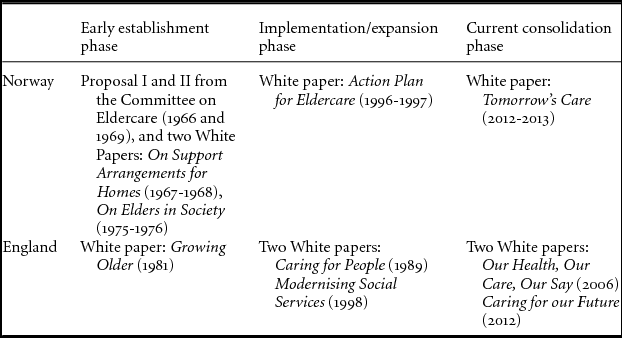
Our selection focuses on White papers, due to their significant impact on changing policies. The first selection criterion was that the document should have a particular focus on older people or include all service user groups, with older people being the largest. The next criterion was – inspired by the important discourse-related issue of historical time and changes (Jørgensen and Philips, Reference Jørgensen and Phillips2002) – to cover different historical times. In a Norwegian White paper, the historical development of social care services is divided into three phases: an establishment phase, an expansion phase and a current consolidation phase (St.Meld.25, 2005–06). For comparability, we used this same classification for the analysis of English papers.
As user participation policies develop gradually, it is important to include early documents. In Norway these consist of two Proposals (Proposal I, 1966; Proposal II, 1969) provided by a committee on eldercare. The importance of these proposals is their follow-up by two White papers: in 1967–68 On Support Arrangements for Homes Footnote 3, about home-based care, and On Elders in Society 1975–76, about older people in society. Together, these documents represent an early action plan for Norwegian eldercare, here the establishment phase. The earliest relevant English White paper discussing social care and support of older people is Growing Older (Secretaries of State for Social Services, Scotland, Wales and Northern Ireland, 1981).
The next important White paper in Norway directed at older people is Action Plan for Eldercare. Safety – respect – quality, (St.Meld.50, 1996–7), outlining the main historical plan for service expansion. As the user participation policy is introduced in the 1990s in Norway (Alm Andreassen, Reference Alm Andreassen2004), this White paper represents the Norwegian implementation, or expansion, phase. Two critical White papers relate to developments of social services in England, both covering all adult user groups. Caring for People (Secretaries of State for Health, Social Security, Wales and Scotland, 1989) deals with overcoming an unintended bias towards residential care, sees encouragement of non-statutory provision as the way to offer more choice, and makes users into consumers given a choice of services. Modernising Social Services (Secretary of State for Health, 1998) goes further in wanting users, including older people, to have greater control over their services.
While the other selected Norwegian papers relate to older people specifically, the last document, Tomorrow's Care (Meld.St.29, 2012–2013), relates to all user groups. This is presented as a paper about future possibilities, including looking at innovative solutions for tomorrow's eldercare involving user participation. It represents the current time phase. Two White papers, Our Health, Our Care, Our Say (Secretary of State for Health, 2006) and Caring for Our Future (Secretary of State for Health, 2012), represent the current consolidation phase for England and, like the Norwegian paper, represent all user groups. Both set out intentions to extend user choice and control over services.
Overview of selected national documents

Due to the importance of the original language (Norwegian/English) for a policy rhetoric analysis, one author has analysed all the selected documents (Christensen, with Fluge co-analysing the Norwegian documents, cf. note 1), while the co-author (Pilling) concentrated on the English documents. This ensures analytical comparative continuity rather than two separated analyses, with the advantage of including expert knowledge about the Norwegian and English social care sectors respectively.
Early establishment phase
The Norwegian problem of dependency and social disintegration
The main problem presented in On Support Arrangements for Homes (St.Meld.nr.59, 1967–68) is built on the early Proposal I. The problem concerns the risk of inactivity:
‘Inactivity or a too passive lifestyle causes serious body changes with impairments of most organs. . . It is a serious consequence of our time's rise to wealth that the population's physical standard is decreasing because people want as much comfort as possible and as little effort as possible. . . Getting older means that this decrease will be stronger. . .’ (p.12)
The seriousness of this inactivity problem must be seen in the light of a society on its way to developing social care for its older population: the more passive people are, the more needs have to be covered by social care. In a background section, Proposal I's committee presents a historical change in older peoples’ social position: from once playing a key role in transferring traditions and experiences to the next generation, towards being seen as dependent people, first on family and kinship, then on society. In this establishment phase, dependency in old age was related to class; it was the poor without family networks who needed social help. Helplessness and dependency, implicitly, were key issues; eldercare took the form of poor relief. In the new welfare society, class would be replaced by needs. Therefore, society should take responsibility for preventing the needs/dependency from being too high. The 1967–68 White paper states that:
The main aim of eldercare is that old people should live in their own homes as long as possible. . . Many older people, however, will need help and support to manage this and therefore home help and other support arrangements . . . play such a major role in eldercare today. (p.13)
A characteristic of this early phase, following the era of poor relief, is that the authorities want to take responsibility for this dependency. They explicitly recognise older people's needs for help and avoid separating older people from society. Therefore, home-based care should be developed: this will give older people the option of staying in the environment they belong to and of participating in local communities. As stated in the 1967–68 White paper ‘the idea about eldercare as a specialised care is too narrow’ (p.17). Old people should receive respect from the public and its care workers. As home-based care had not yet fully developed, the problem of separation from society in institutional care is important. The rhetorical argument about this in the 1975–6 White paper On Elders in Society follows the arguments related to home-based care, and the early Proposal II, in stating that there will be older people too weak to live alone at home, needing institutions (Proposal II, 1969: 10). This White paper also suggests, following the eldercare committee's proposal regarding giving older people influence on daily activities, calling this influence ‘democracy in older people's homes’ (St.Meld.22, 1975–76: 68). Included in this democracy, based on Proposal II, were suggestions such as:
Work councils in elderly institutions aiming at giving the pensioners rights of co-determination and, by that, increase their interest in and influence on carrying out well-being arrangements. (p.10)
Not problematised in these early documents is the fact that older people – in a society increasingly stressing labour market productivity – are no longer integrated in the productive society. However, constructing the problem as an inactivity problem, the solution, rhetorically, lies in treating people as citizens, showing them respect and giving them democratic influence, even at a vulnerable time in their later lives.
The English problem of un-coordinated local community resources
The ‘early’ English phase here is the 1980s. The main problem presented in Growing Older is about the costs of care needs for the increasing number of people living longer. Published in March 1981, with Britain in a recession, high unemployment and inflation (ONS, 2015), the main objective of the Conservative government was to limit public expenditure.
It is estimated that support and services for elderly people now account for more than one-third of total expenditure on the main social programmes of the United Kingdom. . . Public authorities simply will not command the resources to deal with it [adequate support/care]; nor, even if they did, would it be right or possible for official help to meet all individual needs. (pp. 2, 3)
The problem presented is how to make use of all facilities in the local community and resources of family, friends, neighbours, voluntary organisations and older people themselves:
. . . the primary sources of support and care for elderly people are informal and voluntary. These spring from the personal ties of kinship, friendship and neighbourhood. They are irreplaceable (our italics). It is the role of public authorities to sustain . . . but never to displace . . . such support and care. Care in the community must increasingly mean care by the community. (original italics) (p.3)
Older people are presented as having ‘a distinctive and valuable contribution to make to society’ (p.2). It is suggested that the increasing numbers of older people will strengthen their political/social influence and raise their expectations. However, ‘[this] will make it all the more necessary that there should be a wider appreciation of the limits to public provision’ (p.59). The presented solution is a coordination of all available community resources ‘demanding the closest partnership between public and voluntary bodies, families and individuals’ (p. 59).
What is not problematised is the strain on families, though it is mentioned that care and support ‘may often involve considerable personal sacrifice’ (p.37) and that families may need ‘a break from the strain of providing continuous care’ (p.38). Furthermore, the fact that some older people may be reluctant to be dependent on families is not problematised, nor is the dismissal of problems for people with no available family. Additionally, the paper avoids discussing how social services for older people should develop, and the role older people should play as social services recipients.
Implementation or expansion phase
The Norwegian problem of no safety
This next phase represents the Norwegian historical time for making user participation an explicit policy. In this phase's 1996–7 White paper Action Plan for Eldercare one objective is that there is a need for developing ‘bigger space for user participation and personal choice options in daily care’ (St.Meld.50, 1996–97:5). The type of user participation, constructed here, follows on from the earlier period the idea of living-at-home-as-long-as-possible:
The goal of the government's policy is to develop the future care offer so that the individual shall as much as possible have a real possibility to choose living at home or to get adequate housing even with disabilities. (p.25, our italics)
With a policy solution generally about expanding the services related to housing, particularly home-based care, the problem constructed is that older people cannot stay at home if the services are insufficient. The problem is presented as staying at home not being a choice. The paper appears to be about housing issues in old age, relating housing to welfare services. The plan is to make services in people's homes the dominating ones, with 24-hour care in institutions (nursing homes) required only when home-based solutions are exhausted. To reach this goal, the strategy is to replace traditional institutions in Norway (older people's homes) with sheltered housing (implying more services in homes) and, simultaneously, having enough nursing home places to meet institutional needs at end of life. This White paper gives older people the role of needing safety: they need to be safe in terms of being able to choose living at home as long as they want.
In order to give people an option of choice, it is important that the municipalities offer 24-hour home-based care in the user's own home. Nursing-and-care services should be adapted to increasing needs so that the individual user is secured an offer that, as much as possible, is adapted to need. Simultaneously, the users should feel safe about getting an adequate nursing-and-care offer if it is no longer safe to live in their own home. . . (p.25)
It is not problematised that a safe life may not have housing and housing-related-services as the central issue. Also, if the criteria for moving to an institution are made more restrictive, the choice to stay at home can easily transfer to a forced choice, implying loneliness and/or dependency on family members.
The English problem of bias towards residential care, lack of choice, clarity and consistency
Growing Older said nothing about the development of community-based publicly funded social services for older people. The 1989 White paper Caring for People built on a review, commissioned by the Conservative government (the Griffiths report, Reference Griffiths1988), of how to use public funding more effectively to support community care. The problem presented was that:
Progress [of community-based services] has . . . been slower and less even than the Government would like, and the arrangements for public funding have contained a built-in bias towards residential and nursing home care, rather than services for people at home. . . Promoting choice and independence underlies all the Government's proposals. (p.4)
The bias was due to an amendment to social security regulations in the early 1980s resulting in people on low income living in a private or voluntary residential home obtaining a substantially higher benefit than someone living in the community. There was no assessment of the suitability of such care.
Their [these arrangements’] unintended consequence has been that priority has not been given to developing services to enable people to be supported in their own homes, with a consequent restriction on the choice available to individuals . . . (pp.63–4)
The presented solution was for local authorities to assess individuals’ needs, design care packages tailored to meet the individuals’ and carers’ needs, and secure the delivery of all publicly funded services, including quality and cost effectiveness. Funding arrangements would secure the delivery of services. However, local authorities would not act as direct providers but as ‘enabling authorities’, stimulating non-statutory provision particularly in the non-residential sector. This would result in a wider choice of services, meeting individual needs more flexibly, and greater cost-effectiveness through providers’ competition.
Choice, including that for older people, seems to mean having a say in 'how they live their lives and the services they need to help them do so’ (p. 4), ‘taking account of the individual and his or her carer’ in the assessment (p.19) and designing care arrangements ‘in consultation with the client and other care professionals’ (p.21). So choice is limited for those needing services, though greater than previously, mainly through more non-residential providers. It is not problematised whether increased non-statutory provision would increase both choice and quality of care.
Following the Labour party's election in 1997, their 1998 White paper Modernising Social Services stated that social services had a serious lack of clarity, consistency and choice despite the Conservative government's community care reforms:
Decisions about who gets services and who does not are often unclear. . . Decisions about care can. . . concentrate on doing things for people according to what is available, rather than tailoring services to the needs of individuals and encouraging those who are helped to do what they can for themselves. (2.3)
Choice for older people could be limited:
People generally want to live in their own homes if they can, and admission to institutional care. . . can lead to lower self-confidence and a decline in activity. . . yet. . . many authorities are setting a financial ceiling on their domiciliary care packages, particularly in services for older people, which can lead to premature admissions to care homes. . . (2.7)
Since the 1989 White paper there had been a period of economic growth, low inflation and unemployment (ONS, 2015). The 1998 White paper announced extra funding to improve social services. Direct payments were one way of giving people greater control over their lives, giving people money for non-residential care and letting them make their own decisions about care delivery. While legalised in 1996 but limited to people under the age of 65, direct payments were now extended to those aged 65+. The paper does not ‘share’ its predecessor government's ‘devotion to privatisation’ nor supports ‘near-monopoly local authority provision’; Labour's ‘third way moves the focus away from who provides the care, and places it firmly on the quality of services’ (1.7). The paper sets out how to deliver improvements through initiatives such as more emphasis on prevention and rehabilitation, stronger national direction for service standards/priorities, guidance on eligibility and charging, improved staff training, more support for carers, better health-and-social care co-ordination, strengthening user/carer consultation and more effective government monitoring and management.
Summarising, the paper gives older people more influence on their services and is the first White paper mentioning ‘user control’ as opposed to consultation, though only in relation to direct payments. Not problematised is how ‘the third way’ can provide a solution that sits between privatisation and near-local-authority monopoly, and it omits discussing effects of social inequalities on user control and choice.
Current consolidation phase
The Norwegian problem of withdrawal from society
The White paper Tomorrow's Care explicitly presents user participation as a way to gain user control; this is seen as ‘real influence’ (Meld.St.29, 2012–13:53). Simultaneously, by describing younger disabled people as having the ability to carry out user-controlled arrangements, older people are, implicitly, viewed as not having this ability now and only able to achieve it in the future. The younger generation is presented as the forerunner generation showing older people the way of ‘doing’ real user participation. The paper presents the main problem as older people's current withdrawal, but in the future they will be able to do the same as the current younger generation:
. . .it is important to facilitate society so that the new senior population can utilise its resources. Then we will not accept withdrawal, but will start expecting stronger participation in. . . society. . . and not accept that the senior life is lived withdrawn from societal duties and responsibility. (pp.55-56, our italics)
The White paper focuses on the post-war cohort, contributing to developing a modern society, but not sufficiently using their resources to meet their later care needs. The main point is to establish arrangements facilitating co-production of eldercare services. Instead of ‘pensioners’ who have finished their ‘duties and responsibilities’, the new role for older co-producing people is as seniors, living ‘senior lives’ (see quote above). Arrangements facilitating senior lives are about everyday rehabilitation based on individual resources, new assistive technology, and inclusion of available support from family members in their potential roles as co-producers. This way, the problem with ageing-related demand for services is rhetorically constructed as an option for using all available resources, including senior resources, as means for active participation.
What is not problematised is that stressing seniors’ and their network's resources can increase inequality among older people, and that activity/rehabilitation programmes are costly. Such programmes are therefore already reduced in places: for example, in Denmark, where this is a widespread policy. The Danish example shows how easily need for help can be overlooked when the entire focus is on rehabilitation, a non-problematised problem in the document here.
The English problem of inadequate independence, choice and control
The two most recent relevant White papers, Our Health, Our Care, Our Say (2006) and Caring for Our Future (2012), though published at the time of a Labour and a Coalition (Conservative/Liberal Democrat) government respectively, have similar themes. The earlier paper covers both health and social care, stating that many challenges remain, despite a major investment programme since Labour came into office in 1997. Problems are indicated here:
. . . high quality services meeting people's aspirations for independence and greater control over their lives, making services flexible and responsive to individual needs . . . putting people more in control and shifting to a greater emphasis on prevention. (p.5)
Specifically: ‘Services also must respond to the needs of the ageing population, supporting people to continue to live full, healthy and independent lives as they grow older’ (p.25). Health and well-being are to be promoted for older people, by e.g. ‘physical activity’ and ‘social engagement’ (p.30).
The main means for putting people in control of their social care was extension of direct payments, with councils now having the duty to make this a first option for eligible people, and the piloting of individual budgets (amalgamating various funding streams) for older and disabled people, giving more flexibility in choosing services without the responsibilities involved in direct payments.
Caring for Our Future is more emphatic, saying ‘our system of care and support . . . is broken, and in desperate need of reform’ (p.3). Problems included the system often only reacting in a crisis, people not having enough information, access/standards of social care varying across the country. The paper has two core principles: ‘to prevent, postpone and minimise people's need for formal care and support’ and ‘people should be in control of their own care and support’ (p.3). A way of achieving this was for everyone assessed as eligible for support to have a personal budget (similar to an individual budget, but with only social care funding, as the pilots found funding streams difficult to amalgamate). There is more emphasis on the role of volunteers, in conformance with the government's ‘Big Society’ ideas of devolving a significant amount of responsibility for running society to local communities and people. A national minimum eligibility threshold was to be introduced to achieve greater consistency in access to social care across England.
These two White papers do not differentiate between older people and others in aiming at their greater control over services; age discrimination is to be banned. There is much emphasis on informal care, support for carers, encouraging volunteering and keeping formal care to a minimum. However, the right balance between the two is non-problematised. The 2012 paper says that shifting towards prevention/early intervention will help to manage future costs but these are to be discussed separately. Also not problematised is how to achieve the proposed reforms when social care spending has not kept pace with demographic change (Humphries, Reference Humphries2011); nor is the increasing numbers of people not receiving public social care due to restricted eligibility requirements problematised (Age UK, 2012).
Comparative discussion
We will now relate our discourse analytical findings to the literature's discussion of user participation discourses and their variations. Despite a difference in implementation time, we have found a democratic discourse in both countries in the early phase, but with differences between the two. While the Norwegian one appears as a citizen discourse due to democratic ideas about respecting and including people in society through, for example, user-representatives (e.g. ‘work councils’), even if they are living in institutions, the English one points instead at a local community member discourse (including available lay people), making citizens also co-producers of social support and voluntary services. Older people are respected as society members but this respect is used for arguing that they should be co-participants, together with their kinship and networks. In this sense, there is an important difference in the early democratic Norwegian/English discourse. The Norwegian moves in the classic democratic direction of rights and influence – including what Alm Andreassen (Reference Alm Andreassen2018) describes as a democratic involvement through spokespersons – and the English rather in the direction of what is much later in English policy named the ‘Big Society’ (we find historical political roots of the Coalition government's policy idea in 1980s national documents). The English case represents a combination of what Alm Andreassen (Reference Alm Andreassen2018) calls a democratic involvement of ‘generalised publics of lay people’ and a co-production model about older people as co-workers together with their networks (although here unpaid). Our findings show the early ambiguity in both countries, between respecting older people as in need of receiving social care (‘pawns’) and giving older people, in different terms, simultaneously a ‘voice’ (Le Grand, Reference Le Grand1997; Newman and Tonkens, Reference Newman and Tonkens2011; Dent and Pahor, Reference Dent and Pahor2015). This ambiguity is stronger in formal social care in Norway, while in England it is stronger in informal social care.
In the expansion phase, we again find a similarity in discourses, now concentrated in the consumer discourse but, again, there are variations. The Norwegian version of this discourse concerns safe choices in regard to being able to choose to stay at home if this is, as generally anticipated, the wish of older people. This is associated with long-term/loyal relationships to the welfare system, with no provider competition included in this choice logic (Fotaki, Reference Fotaki2011). The English version stresses what we would call a supported choice discourse. While the ‘safe choices’ discourse expresses a social democratic or early choice logic, the ‘supported choice discourse’ rather takes into account the many actors involved. This increasingly includes for-profit actors to avoid local authority monopoly of social care services, a key English policy goal at this time. The related choice logic represents a choice-and-exit variation including provider competition in a market (Greener, Reference Greener2009). However, the co-production discourse is not left out but is, rather, incorporated into the policy of choice, with consumers being encouraged to be co-producers (Fotaki, Reference Fotaki2011). This is near to the co-worker model (Alm Andreassen, Reference Alm Andreassen2018) due to emphasis on more user control of service provision/delivery supported by carers and others, particularly in the later part of this phase.
An important difference between the Norwegian and English consumer discourse is also that the Norwegian one is temporary, replaced by the co-production discourse in the last phase. The Norwegian co-production discourse is a co-responsibility discourse, now nearer the co-worker model described by Alm Andreassen (Reference Alm Andreassen2018). This is particularly due to the increasing stress on using seniors’ resources and the growing idea of rehabilitation as a means of bringing into the services these ‘seniors’ as active and resourceful users (Newman and Tonkens, Reference Newman and Tonkens2011), thereby actually ‘working’ for the state, although unpaid (Lyon and Glucksmann, Reference Lyon and Glucksmann2008). The co-production discourse also remains in the English rhetoric in current times but, unlike the Norwegian version, there is also a strong choice discourse, making older people consumers navigating in a market like ‘queens’ on the chess board (Le Grand, Reference Le Grand2003). While there is a policy stress on co-production in terms of involving the users directly, like co-workers (Alm Andreassen, Reference Alm Andreassen2018), in their services through personalisation policies encouraging direct payments and personal budgets, there is also a strong tendency to bring in more choices through more social care providers, which is also an important aspect of personalisation. The middle phase stress on choices is thus a key issue in the phase following and older people may potentially also sometimes be like consumer-citizens (Fotaki, Reference Fotaki2011), combining individually choice-and-exit-in-a-market with being forced to become responsibilised agents, with limited resources and choices (Fotaki, Reference Fotaki2011; Alm Andreassen, Reference Alm Andreassen2018).
As a rhetoric analysis our findings also included language changes. In the Norwegian documents this is relatively clear, starting with the term ‘pensioners’ (respected for their contribution to society), then changing to ‘individual users’ (underlining an early choice logic) and in current times making them ‘seniors’, expressing the new expectations of older people to be independent and resourceful. The early English document mostly uses the term ‘elderly people’, but the later documents predominantly use ‘people’ and ‘individuals’, referring to all adults user groups, or sometimes ‘older people’ when referring specifically to that group. ‘People’ appears to underline the continuous co-production idea, and ‘individuals’ the choice logic, strongly emphasised from the implementation phase.
Conclusion
Over five decades, Norway and England relate to the same user participation discourses within a Northern European common context. Due to historical, welfare, political and cultural context differences, however, they move differently. Unlike Norway, the English user participation policies, directed at older people as social care users, quickly translates into the choice rhetoric. The consumer discourse clearly, from the middle phase, becomes much stronger and, unlike its temporary and weak character in Norway, becomes a continuing discourse into the current phase, realising, rhetorically, the development from ‘pawns’ to ‘queens’. This is related to the stronger right-wing policy development in England. However, the countries also have different value traditions, and these can explain early differences. While both countries have a point of departure in the democratic discourse, the English version points early on at co-production (in terms of co-working state-individual-partnering) and takes this discourse into later phases. In England this discourse is related to the much stronger orientation to the family as informal unpaid carers and to local communities. Norway early on starts to take account of women's increasing role in the labour market and, therefore, strengthens public care to a much greater extent.
Our most interesting findings are the discovery in England of an early and strong co-production discourse, continuing until current times, and in Norway the discovery of a consumer discourse related to older people (although we found this consumer discourse of weak character). These discoveries particularly point to the importance of future analyses within a European context, as no policy implications can be taken for granted and all therefore need to be analysed critically, including examining all nuances.
Acknowledgements
We would like to thank the two reviewers for their very helpful comments.