Since Moffitt (Reference Moffitt1993) presented her seminal taxonomy of antisocial behavior over two decades ago, there have been significant advances in understanding the heterogeneity in longitudinal patterns of antisocial behavior (for reviews, see Jennings & Reingle, Reference Jennings and Reingle2012; Piquero, Reference Piquero and Liberman2008). Moffitt's initial framework posited three life-course patterns of antisocial behavior: youth who abstain from antisocial behavior (abstainers), youth whose antisocial behavior begins and ends in adolescence (adolescence-limited antisocial individuals), and youth whose antisocial behavior begins in childhood and persists into adulthood (life-course persistent antisocial individuals). Over time, longitudinal investigations not only have provided robust support for elements of Moffitt's taxonomy but also have aided in the refinement of the framework. Specifically, when applied to criminal offending, it has become apparent that Moffitt's original theory was not comprehensive of all the subsequently identified offending trajectories. In particular, Moffitt's initial taxonomy posited a single, rare group of life-course persistent antisocial individuals, but recent longitudinal investigations of serious juvenile offenders reveal both high- and moderate-level persistent offenders (Monahan, Steinberg, Cauffman, & Mulvey, Reference Monahan, Steinberg, Cauffman and Mulvey2009, Reference Monahan, Steinberg, Cauffman and Mulvey2013; Mulvey et al., Reference Mulvey, Steinberg, Piquero, Besana, Fagan and Schubert2010). Although individuals on the life-course persistent pathway constitute a small fraction of the population (e.g., Farrington & West, Reference Farrington and West1993), these individuals are often the most resistant to intervention efforts, and place a burden on society disproportionate to their relatively low presence within the population. It has been estimated that one chronic offender's criminal career can cost society an average of $1.5 million (Cohen, Piquero, & Jennings, Reference Cohen, Piquero and Jennings2010).
Given the societal cost and notoriously difficult to treat nature of persistently antisocial individuals, the field's next logical step is to unpack the subgroups that make up this problematic subpopulation of offenders. While the bulk of research has focused on what differentiates desisting from persisting antisocial individuals, very little is known about the sources of heterogeneity among individuals on the life-course persistent pathway. In order to advance theory and our ability to prevent and reduce serious chronic antisocial behavior, it is of great importance to understand (a) the etiological mechanisms that differentiate individuals on low-rate, desisting, moderate-level persisting and high-level persisting antisocial pathways and (b) what types of criminal activity (i.e., drug, aggressive, and income-generating offenses) constitute these trajectories of criminal offending. These are the goals of the present study. Given the study's interest in serious juvenile offending, and because Moffitt's dual taxonomy of antisocial behavior has been applied extensively to patterns of criminal offending (e.g., Henry, Caspi, Moffitt, & Silva, Reference Henry, Caspi, Moffitt and Silva1996; Piquero, Reference Piquero2001), we use the terms “antisocial behavior,” “offending,” and terminology describing criminal activity synonymously.
Moffitt's (Reference Moffitt1993) developmental taxonomy is the most widely cited theory regarding etiological factors that discriminate patterns of antisocial behavior. Among youth who engage in antisocial behavior (i.e., not abstainers), she originally distinguished between adolescence-limited antisocial individuals whose delinquent behavior starts and stops in adolescence (about 90% of antisocial individuals, depending on the study), and the few life-course persistent offenders whose antisocial behavior begins in childhood and persists into adulthood. Adolescence-limited antisocial behavior is considered developmentally normative, and the temporary increases in delinquent behavior are thought to be the result of peer pressure and youth's desire to establish maturity. In contrast, life-course persistent antisocial behavior is rooted in neurological deficits amplified by chronic contextual adversity. Many studies have tested these hypotheses, and there is compelling evidence that persistently antisocial youth can be differentiated from adolescence-limited deviant youth on measures of intraindividual functioning and contextual adversity in childhood (Aguilar, Sroufe, Egeland, & Carlson, Reference Aguilar, Sroufe, Egeland and Carlson2000; Moffitt & Caspi, Reference Moffitt and Caspi2001; Roisman et al., Reference Roisman, Monahan, Campbell, Steinberg and Cauffman2010).
Trajectory analyses of antisocial behavior have found robust support for Moffitt's developmental taxonomy. Researchers consistently document a small group of chronically antisocial youth marked by early onset of antisocial behavior and subsequent continuity into adulthood, a relatively larger group of youth whose deviant behavior is limited to adolescence, and finally youth who abstain from antisocial behavior (e.g., Higgins, Bush, Marcum, Ricketts, & Kirchner, Reference Higgins, Bush, Marcum, Ricketts and Kirchner2010; Moffitt, Caspi, Harrington, & Milne, Reference Moffitt, Caspi, Harrington and Milne2002). Nevertheless, studies often document more trajectories of offending than Moffitt originally hypothesized. Two recent reviews of criminal trajectory analyses found that studies identified three to five groups on average, with some longitudinal investigations finding up to seven trajectories (Jennings & Reingle, Reference Jennings and Reingle2012; Piquero, Reference Piquero and Liberman2008). In addition to Moffitt's postulated groups of abstainers, adolescence-limited youth, and life-course persisters, statistical analyses across samples tend to identify a group of individuals whose offending begins in middle to late adolescence and continues at a steady rate into adulthood (i.e., late-onset offenders), a group of individuals whose antisocial behavior is limited to childhood (i.e., childhood-limited offenders), and moderate-level persistent offenders whose criminal trajectories are marked by persistent but lower levels of offending relative to high-level life-course persisters. This last group, moderate-level persistent offenders, has received little empirical attention. This group is the focus of the current investigation.
Although multiple studies have documented persistent offender subgroups, limitations of criminal trajectory studies have hindered the field's progress in clarifying subgroups' correlates. It is notable that the over 10 studies that have examined criminal behavior trajectories across adolescence and adulthood have identified more than one group of persistent offenders, providing robust evidence that there are various subgroups within life-course persisters (for a review, see Jennings & Reingle, Reference Jennings and Reingle2012). Failure to identify variations in persistent offending in other studies may be due to characteristics of the study's design (Jennings & Reingle, Reference Jennings and Reingle2012; Piquero, Reference Piquero and Liberman2008). For instance, fewer persistent criminal trajectories are found within population-based samples compared to offender-based samples, due to the low base rates of continuous antisocial behavior within the general population. Moreover, researchers identify fewer offending patterns when using official criminal records than when using self-report assessments of criminal behavior, because official records are only indicative of when the criminal activity was caught. Beyond sample makeup and method of assessment, the length of follow-up can also impact how many life-course persistent trajectories identified. For example, Eggleston, Laub, and Sampson (Reference Eggleston, Laub and Sampson2004) found two persistent criminal trajectories (low-rate and moderate-rate chronic groups) when the maximum age of the sample was 24 years of age, but found three persistent offender trajectories (low-rate, moderate-rate, and high-rate chronic groups) when increasing the follow-up period to 31 years of age. The limitations of longitudinal study design may have buried these moderate-level persistent offenders in previous investigations.
Given the rarity of persistent antisocial behavior within the general population, the reliance on official criminal reports, and the limited follow-up of antisocial youth (Jennings & Reingle, Reference Jennings and Reingle2012; Piquero, Reference Piquero and Liberman2008), to date we have been unable to distinguish etiologically between moderate-level and high-level persistent offenders. The present study uses a sample of serious juvenile offenders that were followed for 7 years from middle adolescence into early adulthood. Utilizing a sample of antisocial individuals ensures an adequate base rate of offenders in persistent offending trajectories and also provides clearer policy implications on chronic offending and its etiologies. Moreover, the current study uses individuals' self-report of criminal activity to provide a more accurate measure of the level of youth's engagement in antisocial behavior. Further, the present sample was followed into early adulthood, which is beyond the typical age of desistance from criminal activity (late adolescence), allowing us to be more confident we are identifying youth who are on the persistent pathway. Previous trajectory analyses have utilized this unique sample and have identified more than one persistent offending group when running models by time using the first 3 years of data (Mulvey et al., Reference Mulvey, Steinberg, Piquero, Besana, Fagan and Schubert2010) and by age using 5 (Monahan et al., Reference Monahan, Steinberg, Cauffman and Mulvey2009) and all 7 years of data (Monahan et al., Reference Monahan, Steinberg, Cauffman and Mulvey2013).
Because no current developmental or criminological theories focus on the etiological mechanisms that may underlie varying levels of persistent delinquency, we refer back to Moffitt's developmental taxonomy and extant literature on desistance from crime and persistent offending. Foremost, remember that Moffitt's premise is that persistent offending is the result of neurological deficits combined with exposure to environmental risk. Among persisters, consistent evidence suggests that they are more likely to have neurological problems than adolescence-limited and nonoffenders (Moffitt et al., Reference Moffitt, Caspi, Harrington and Milne2002; Moffitt, Lynam, & Silva, Reference Moffitt, Lynam and Silva1994; Odgers et al., Reference Odgers, Moffitt, Broadbent, Dickson, Hancox and Harrington2008; Raine et al., Reference Raine, Moffitt, Caspi, Loeber, Stouthamer-Loeber and Lynam2005). Moreover, evidence suggests that the association between risk and promotive factors and offending is linear, such that the greater exposure to environmental risk, the greater likelihood of persisting offending compared to desisting from offending (Sampson & Laub, Reference Sampson and Laub2005; Stouthamer-Loeber, Wei, Loeber, & Masten, Reference Stouthamer-Loeber, Wei, Loeber and Masten2004; Thornberry & Krohn, Reference Thornberry, Krohn and White2001).
Taking these two ideas together, we arrive at four possible explanations of how moderate-level persistent offenders differ from low-rate, desisting, high-level persistent offenders. First, in comparison to low-rate and desisting offenders, it could be that elevated neurological risk without environmental risk explains the continuous rates of offending at moderate levels. Second, it could be the case that exposure to high levels of environmental risk in the absence of neurological deficits leads to moderate-level persistent offending. In other words, moderate-level persistent offenders may only possess one of the two key ingredients (i.e., only neurological or environmental risk) that would graduate them to high-level persistent antisocial behavior. Third, moderate-level persisters may possess elevated levels of neurological and environmental risk relative to low-rate offenders and desisters, but each of these risk factors is still lower than high-level chronic offenders (i.e., only a difference in dosage of each of these factors). Fourth and finally, in a somewhat different approach, high-level persistent offenders are often marked by enduring contextual adversity, and it may be differences in cumulative environmental risk over time that differentiate low-rate, desisting, moderately persistent, highly persistent offenders. Ultimately, comparing individuals who comprise these respective criminal trajectories will inform if similar or unique etiological mechanisms underlie subgroups of persistent offenders.
In addition to differences in etiological mechanisms, it is also possible that moderate-level persisters differ from other criminal trajectories in the types of crimes that they commit over the life course. That is, regardless of whether the etiological mechanisms are similar or different for moderate- and high-level persisters, the types of criminal behaviors that these youth endorse may elucidate the overall level differences in offending. Specifically, high-level persistent offenders' criminal trajectories may be marked by versatility, while moderate-level persisters' relatively lower levels of chronic offending may be indicative of criminal specialization. Theoretical perspectives that inform the versatility versus specialization debate of life-course persisters have been centered on high-level persistent offending. In general, many theorists suggest that high rates of continuous offending often go hand in hand with a versatile criminal repertoire, underscored by lack of self-control (Gottfredson & Hirschi, Reference Gottfredson and Hirschi1990), neurological and environmental risk (Moffitt, Reference Moffitt1993), or high antisocial potential (from poor impulse control, strain, modeling, socialization, and life events; Farrington, Reference Farrington2003). Gottfredson and Hirschi (Reference Gottfredson, Hirschi, Ketterlinus and Lamb1994) refute the notion that life-course persistent offenders can specialize in crime, given their deficits in self-control. Instead, they suggest that an observation of specialization is likely an artifact of circumstance or opportunity, rather than a deliberate choice of the chronic offender.
Although there is a strong argument for versatility among high-rate chronic offenders, many acknowledge that specialization often occurs later in offenders' criminal careers, and it could be the case that moderate-level persisters are simply “early specializers.” On average, evidence suggests that diversification of antisocial behavior increases until 20 years of age, and then from 20 years and onward crimes become progressively utilitarian in their motives (Farrington, Reference Farrington1993; Le Blanc, Reference Le Blanc1996), although individual variability in this progression is not well understood. In other words, for most youth, adolescence is not a time of criminal specialization. For example, some offenders' crimes may become increasingly motivated by income generation or revenge, but less so by excitement or thrill. Given that high rates of criminal engagement are typically linked to increased versatility, it is plausible that this sort of specialization may be specific to a subgroup of persistent offenders with lower levels of criminal activity. Moderate-level persistent offenders may be a unique subgroup of persisters whose criminal catalogue is restrained to certain types of offenses. Prior research suggests that in adulthood, some offenders specialize in violent, drug-related, and property crimes (Baker, Metcalfe, & Jennings, Reference Baker, Metcalfe and Jennings2013; Lo, Kim, & Cheng, Reference Lo, Kim and Cheng2008), but it is unknown if moderate-level persisters specialize in one of these types of crimes, more than one type of these crimes, or none of these crimes. Given our sample was followed until 25 years of age (well into the years when specialization is posited to occur), the current study is poised to clarify if there is heterogeneity in persisting offenders' criminal specialization.
The Present Study
The current analyses aim to provide a better understanding of moderate-level persistent offenders, a less understood subgroup of life-course persistent offenders. Analyses utilize five criminal trajectories that have been identified previously in a sample of serious juvenile offenders: a low-rate group, an early desisting group, a late desisting group, a moderate-level persisting group, and a high-level persisting group (Monahan et al., Reference Monahan, Steinberg, Cauffman and Mulvey2013). The present study examines (a) if neurological and environmental risk interact to predict trajectory membership, (b) if changes in cumulative environmental risk across adolescence and early adulthood differ for these five groups, and (c) if these five groups differ in the types of offenses they commit across adolescence and early adulthood. This investigation builds upon prior research that has leveraged this sample of young offenders in that we consider interactions between risk factors, rather than additive effects (Monahan et al., Reference Monahan, Steinberg, Cauffman and Mulvey2009, Reference Monahan, Steinberg, Cauffman and Mulvey2013; Mulvey et al., Reference Mulvey, Steinberg, Piquero, Besana, Fagan and Schubert2010; Piquero, Monahan, Glasheen, Schubert, & Mulvey, Reference Piquero, Monahan, Glasheen, Schubert and Mulvey2013); we examine how trajectory membership is linked to environmental risk across adolescence and young adulthood, rather than relying on just one assessment of environmental risk (Mulvey et al., Reference Mulvey, Steinberg, Piquero, Besana, Fagan and Schubert2010; Piquero et al., Reference Piquero, Monahan, Glasheen, Schubert and Mulvey2013); and we disaggregate types of criminal offending over time.
Our three research aims are essential in advancing our understanding of the moderate-level persistent offender and will progress the field in multiple ways. First, we take a theoretically integrative approach in identifying the etiological factors and potential criminal specialization of this subgroup, which will serve to update current theoretical perspectives that do not address these moderate-level persisters. Second, elucidating these processes will enlighten targeted intervention efforts aimed at reducing continuous antisocial behavior. Ultimately, the present study is poised to inform the unknown, whether we can parse apart the heterogeneity in persistent offending.
Method
Participants
The present study used a reduced analytic sample of 1,088 male participants who completed 70% of interviews in the Pathways to Desistance study (Mulvey et al., Reference Mulvey, Steinberg, Fagan, Cauffman, Piquero and Chassin2004). In the full sample (N = 1,354, 1,170 males), adolescents between the ages of 14 and 18 were recruited from Philadelphia, Pennsylvania (n = 700), and Phoenix, Arizona (n = 654), if they had committed a felony or similarly serious nonfelony offense (e.g., misdemeanor sexual assault or weapons offense). Potential subjects were contacted if they were adjudicated delinquent or found guilty of an eligible crime, or if they had been arraigned and were being considered for trial in adult court. Males who had been charged with drug offenses were limited to 15% at each site to hinder the influence of the disproportionately high prevalence of drug offenses committed by adolescent males. See Schubert et al. (Reference Schubert, Mulvey, Steinberg, Cauffman, Losoya and Hecker2004) for complete study methodology.
In the present study, our analytic sample focused on 1,088 males (age at baseline, M = 16.02 years, SD = 1.17 years) who comprised the five offending trajectories of interest: low-rate, early desisting, late desisting, moderate-level persisting, and high-level persisting. These classifications were identified in a previous analysis of the Pathways data (Monahan et al., Reference Monahan, Steinberg, Cauffman and Mulvey2013). Full details of this methodology are available in Monahan et al. (Reference Monahan, Steinberg, Cauffman and Mulvey2013), and key aspects of the model decisions are presented briefly in the Results section. Baseline demographic information indicated that participants were primarily of lower socioeconomic status (e.g., 40% of participants' parents had less than a high-school education, and less than 4.5% held a 4-year college degree), and were racially and ethnically diverse (41% Black, 35% Hispanic American, 20% non-Hispanic White, and 4% other). Comparing the analytic sample to the full sample (i.e., also including females, n = 184, and males who completed less than 70% of interviews, n = 82), there were no differences with respect to race/ethnicity χ2 (3) = 6.13, p = .10, or antisocial behavior prior to the baseline interview, t (1, 169) = 0.86, p = .40. Although the age difference is modest (16.01 years vs. 16.53 years), the analytic sample was significantly younger than the full sample t (1, 169) = 3.59, p < .01. Females were not used in the Monahan et al. (Reference Monahan, Steinberg, Cauffman and Mulvey2013) paper because there were not a sufficient number of females to control effectively for gender or to conduct separate analyses.
Procedures
Study interviewers attempted to contact each of the teens from the juvenile court in Philadelphia and Phoenix who was eligible to participate based on age and offense, as provided by each of the respective courts. Interviews were conducted in the home, in a facility if the participant was confined, or in a mutually agreed-upon community location, after juvenile assent and parental or guardian consent were obtained.
Baseline interviews were completed within 75 days of juvenile adjudication hearing, or within 90 days of decertification or waiver hearings if they were prosecuted as an adult in Philadelphia, or adult arraignment in Phoenix (M = 36.9 days, SD = 20.6 days). Interviewers read questions aloud to the participants in order to avoid comprehension or reading difficulties, as they sat side-by-side facing a computer, outside of earshot of other individuals when possible. The baseline interview took place over two, 2-hr sessions over the course of 2 days. Study interviewers informed participants that all information obtained during the study was prohibited from being shared with anyone outside of the project staff, as mandated by a certificate of confidentiality from the federal government. The only exceptions to this confidentiality were (a) if child abuse was suspected, or if the subject (b) expressed plans to hurt him/herself or someone else, (c) had a specific plan to commit a crime in the future, or (d) disclosed that someone was in jail for a crime that he had committed. Each participating university's institutional review board approved all recruitment and study procedures.
After the baseline interview, follow-up interviews took place every 6 months for 3 years, and annually thereafter for 4 years, comprising a 7-year longitudinal study with 11 interviews total. Follow-up interviews were composed of one 2-hr session. Retention of the sample was excellent. In the present analyses, 858 individuals (67.8%) completed all 11 interviews from the baseline interview to the 84-month follow up, 221 individuals (17.5%) completed 10 interviews, 94 individuals (7.4%) completed 9 interviews, 59 individuals (4.7%) completed 8 interviews, and 34 individuals (2.7%) completed 7 interviews. To create uniform time measurements for the purposes of the present analyses (recall that assessments were biannual from 6 to 36 months, and annual from 48 months to 84 months), we combined data from the 6- and 36-month biannual follow-up interviews into yearlong intervals by averaging variables across the 6- and 12-month assessments, 18- and 24-month assessments, and 30- and 36-month assessments, respectively. Because Pathways is an overlapping, accelerated cohort design (youth began the study between the ages of 14 to 18 years), there were varying numbers of participants in the analytic sample at each age group from 14 to 25 years: 14 years, n = 141; 15 years, n = 352; 16 years, n = 673; 17 years, n = 994; 18 years, n = 1,088; 19 years, n = 1,088; 20 years, n = 1,088; 21 years, n = 1,088; 22 years, n = 947; 23 years, n = 736; 24 years, n = 415; and 25 years, n = 94.
Measures
Variables of interest in the current study were self-reported antisocial behavior, type of antisocial behavior, cumulative environmental risk, neurological risk, the age at which youth began the study, and the amount of time a youth spent in a secure setting (versus a community setting) at each time interval. See Table 1 for descriptive information of the sample.
Demographic information for trajectory groups and full analytic sample

Note: Moderate, Moderate-level persister; High, high-level persister.
Antisocial behavior
Antisocial behavior was measured by a revised version of the Self-Report of Offending (Huizinga, Esbensen, & Weihar, Reference Huizinga, Esbensen and Weihar1991). This measure assessed whether the participants had engaged in each of 22 different antisocial acts (e.g., “Been in a fight,” “Bought, received or sold stolen property,” or “Sold marijuana”) since the previous interview. At baseline, the participants were asked whether they engaged in these behaviors in the past 12 months.
Following the baseline interview, annual variety scores (a count of how many acts) were calculated to evaluate how many of the 22 antisocial acts each participant endorsed in a year. Thus, for each act, the participants received either a “0,” if they did not endorse it, or a “1,” if they did. When interviews were 6 months apart (i.e., 6- to 36-month assessments), responses were collapsed such that participants could only endorse a behavior once in a yearlong interval, even if they had engaged in the behavior at both time points (i.e., 6- and 12-month, 18- and 24-month, and 30- and 36-month interviews). Variety scores are a preferred method for measuring rates of antisocial behavior, because they are highly correlated with frequency of offending, but are less prone to error in recalling the frequency of each behavior (Hindelang, Hirschi, & Weis, Reference Hindelang, Hirschi and Weis1981; Thornberry & Krohn, Reference Thornberry and Krohn2000). This is of particular importance in samples that endorse high rates of antisocial behavior (e.g., it is more likely that an adolescent will remember whether he sold illegal drugs in the last 6 months, rather than how many times he sold illegal drugs in the same time span).
Type of antisocial behavior
The Self-Reported Offending Scale (Huizinga et al., Reference Huizinga, Esbensen and Weihar1991) at each time point was used to assess the type of offenses committed by individuals in each offending trajectory across adolescence and adulthood. Twenty of the 22 antisocial behaviors assessed (see above) were divided into three categories: drug offenses (3 items; e.g., “Sold marijuana”), aggressive offenses (11 items; e.g., “Took something by force with a weapon”), and income-generating offenses (6 items; e.g., “Used check or credit card illegally”). Annual proportion scores were derived for each of the three offense categories (i.e., drug, aggressive, income generating), in which participants were given a score of how many behaviors they endorsed out of how many they answered (i.e., not missing data) in that particular category during the past year. For example, if a participant endorsed three income-generating acts out of the 6 answered income-generating offense items, the participant would receive a score of 0.5. Scores ranged from 0 (i.e., committed zero crimes out of the answered items) to 1 (i.e., committed all crimes out of the answered items) at each interview. All drug, aggressive, and income-generating proportion scores across the study were based on offending within the past 12 months, with exception of the baseline proportion scores. This was because the data masked certain items at baseline and only offered calculated proportion scores for the past 6 months (rather than 12 months) of offending. Age at baseline was entered as a covariate in all analyses to account for this difference.
Neurological risk
Neurological risk was assessed at baseline as a variety score of three possible neurological risk factors. Head injury was a dichotomous indicator of whether the youth had ever suffered a head injury that resulted in the loss of consciousness or needed medical attention. Those with a history of head injury were coded as 1 on this risk factor (32.1% of youth endorsed this risk factor). Cognitive dysfunction was measured by underperformance on the Trail-Making Test and the Stroop Color and Word Test. The Trail-Making Test (Reitan, Reference Reitan1979) measures processing speed, ability to order stimuli, and ability to shift cognitively by presenting participants with a set of numbers or numbers and letters, and assessing how long it takes to sequence the set in correct order. Participants were coded as 1 on the Trail-Making Test if they showed completion times long enough to be indicative of moderate or severe impairment (11.6% of youth met this threshold). The Stroop Color and Word Test (Golden, Reference Golden1978) examines participants' cognitive flexibility, impulse control, and cognitive complexity. In this task, individuals are presented with names of colors printed in black ink and names of colors printed in ink that is a different color than the word. Depending on the round, participants are told to name either the word or the ink color. Participants' scores measure how well they are able to stop interference from the competing stimuli, with higher scores indicating better performance and less interference. Participants were coded as 1 on the Stroop if their performance was poor enough to indicate a prefrontal disorder (3.4% of youth met this threshold). Neurological risk was a variety score that summed together all three risk factors, with a possible and observed range of 0–3 at the baseline interview.
Cumulative environmental risk
Given that certain environmental risk factors are more developmentally relevant during adolescence versus early adulthood (i.e., parental hostility, parental monitoring, and academic engagement), cumulative environmental risk was calculated in two ways for the first (predicting trajectory membership from baseline neurological and environmental risk) and second (examining cumulative environmental risk across adolescence and early adulthood) research aims.
The first research aim used individuals' baseline cumulative environmental risk scores, which was a variety score of seven possible risk factors: neighborhood disorder, peer delinquency, exposure to violence (as a witness), exposure to violence (as a victim), parental hostility, parental monitoring, and academic engagement. Binary presence of risk for each factor (1 = yes, 0 = no) was established for those exceeding 1 SD above the mean for each negative factor (e.g., peer delinquency) or 1 SD below the mean for each positively valenced factor (e.g., parental monitoring).
Neighborhood disorder was assessed via the Neighborhood Conditions Measure (Sampson & Raudenbush, Reference Sampson and Raudenbush1999) by evaluating the degree to which individuals experienced physical (e.g., “cigarettes on the streets or in the gutter”) and social (e.g., “adults fighting or arguing loudly”) disorder in their community. Ranging from never to often on a 4-point Likert scale, participants with higher average scores experienced greater neighborhood disorder. This scale had excellent fit for this sample (α = 0.94). Neighborhood disorder was calculated as an average of all 21 items, and youth with a mean score above 2.99 were coded as a 1 for neighborhood disorder.
Peer delinquency was measured via items from the Rochester Youth Study (Thornberry, Lizotte, Krohn, Farnworth, & Jang, Reference Thornberry, Lizotte, Krohn, Farnworth and Jang1994), which inquired about the antisocial behavior of the individual's friends. Participants were asked to state how many of their friends engaged in each of 12 behaviors (e.g., “During the last 6 months, how many of your friends have sold drugs?”), from none of them to all of them, on a 5-point Likert scale. Peer delinquency was calculated as the mean of the prevalence of friends who engaged in the 12 antisocial acts, with higher means indicating a greater proportion of one's friends being perceived as delinquent. This scale demonstrated excellent reliability in this sample (α = 0.92). Participants with peer delinquency scores higher than 2.93 were coded as 1 on the peer delinquency risk factor.
Exposure to violence was captured by the Exposure to Violence Inventory (Selner-Ohagan, Kindlon, Buka, Raudenbush, & Earls, Reference Selner-Ohagan, Kindlon, Buka, Raudenbush and Earls1998). In this inventory, participants indicate whether they had ever experienced certain violent events. Six items asked about exposure to violence as a victim (e.g., “Have you ever been shot at?”), while seven items asked about exposure to violence as a witness (e.g., “Have you ever seen someone else sexually assaulted, molested, or raped?”). Thus, exposure to violence as a victim and exposure to violence as a witness scores were calculated as a count out of six or seven possible violent events, respectively. Participants who had exposure to violence as a victim scores above 2.62 and those who had exposure to violence as a witness score above 5.34 were coded as 1 on these respective risk factors.
Parental hostility was measured via the Quality of Parental Relationships Inventory (Conger, Ge, Elder, Lorenz, & Simons, Reference Conger, Ge, Elder, Lorenz and Simons1994). Composite scores were created as an average of 12 items measuring maternal hostility (e.g., “How often does your mother get angry at you?” and “How often does your mother throw things at you?”). Participants reported on a 4-point Likert scale ranging from never to always, with higher scores indicating greater parental hostility. This scale had adequate reliability (α = 0.85). Individuals with a parental hostility average score above 1.94 were coded as a 1 for this risk factor.
Two positively valenced environmental factors were examined, such that individuals with scores 1 SD below the mean were considered at risk. Parental monitoring was measured via the Parental Monitoring Inventory (Steinberg, Dornbusch, & Darling, Reference Steinberg, Dornbusch and Darling1992). In this questionnaire, participants answer seven questions (e.g., “How often do you have a set time to be home on weekend nights?”) pertaining to how much their parent, or the person primarily responsible for them, monitors their behavior, on a 4-point Likert scale from never to always. Parental monitoring scores were calculated as an average of four items, with higher scores indicating greater parental monitoring. Individuals with average parental monitoring scores below 2.05 were recoded as a 1 on this risk factor.
Academic engagement was assessed via items established by Cernkovich and Giordano (Reference Cernkovich and Giordano1992) that examine relative degree of school orientation (e.g., “Schoolwork is very important to me”). With items answered on a 5-point Likert scale from strongly disagree to strongly agree, academic engagement was calculated as the mean of seven items, with higher averages indicating a greater degree of academic commitment. This scale showed adequate reliability (α = 0.83). Participants with academic engagement scores below 2.98 were considered at risk on this factor and scored a 1.
For the second research aim, we calculated the cumulative environmental risk score based on the four variables that were consistently asked at each time point: neighborhood disadvantage, exposure to violence as a victim, exposure to violence as a witness, and peer delinquency. When assessing exposure to violence as a victim, exposure to violence as a witness, and peer delinquency during follow-up interviews, participants were asked about each construct since the last interview (e.g., “In the last 12 months, have you been shot at?”), whereas neighborhood disorder continued to ask about current neighborhood conditions. When asked about exposure to violence at baseline, we only had information at that time point if they had ever been exposed. Because this would have falsely inflated cumulative environmental risk scores at this time point (lifetime exposure to violence vs. past 12 months), scores derived from baseline data were not used (note that this does not mean that participants were dropped, but rather their one data point from baseline was dropped). This led to all 14-year-old data, which was derived from only baseline data, being dropped from analyses. Thus, cumulative environmental risk scores ranged from 0 to 4 and spanned from 15 to 25 years of age. Annual cumulative environmental risk scores were averaged across assessments when appropriate (i.e., 6- and 12-month, 18- and 24-month, and 30- and 36-month interviews).
Age at baseline
Participants' age at baseline, which was calculated as the baseline interview date minus the participant's date of birth, was used as a covariate for the first and third research aims for two respective reasons. The first research aim uses baseline data to predict trajectory membership, and individuals varied in their age of when they began the study. The third research aim uses baseline offending data, which only asks about aggressive offending during the past 6 months versus the past 12 months in every other time point. To adjust for these differences, age at baseline was entered as a covariate in the models comprising these two research aims.
Time spent in a secure setting
Since incarceration and other similarly confining environments affect how much opportunity a youth has to commit certain antisocial acts (e.g., stealing a car or motorcycle), all models in the third research aim (examining types of offenses across age) controlled for the proportion of time spent in an institutional setting (Piquero et al., Reference Piquero, Blumstein, Brame, Haapanen, Mulvey and Nagin2001) at each age. Participants reported on how many days during the recall period they were in a detox/drug-treatment program, psychiatric hospital, residential treatment program, or secure institution. The proportion of time spent in a secure setting at baseline was set to 0, because exposure time was not available at this initial assessment. Annual exposure time was calculated by averaging proportion of exposure time for each 6-month assessment when appropriate (i.e., 6- and 12-month, 18- and 24-month, and 30- and 36-month interviews).
Plan of analyses
Multiple imputation was used to address missing data in the analytic sample (Schafer & Graham, Reference Schafer and Graham2002) via NORM version 2.03 (Schafer, Reference Schafer1997). The amount of missing data varied by time point, ranging from 0% to 41.90% on any given variable across time. Forty data sets were imputed, and each imputed data set included environmental risk factors and offending variables across all time points, neurological risk factors, demographics (gender, race and ethnicity, socioeconomic status, site), and cited covariates. All variables were imputed at the scale level. Data analyses were conducted across the 40 imputed data sets and subsequently aggregated according to Rubin rules (Rubin, Reference Rubin1987). SPSS version 22 was used to analyze multinomial logistic regressions of baseline cumulative environmental risk and neurological risk, MPlus version 6 was used to analyze growth models of cumulative environmental risk, and SPSS version 22 was used for analyses of covariance of offense types across age.
Analyses were conducted in four steps. Previously identified trajectories of offending were used in the analyses for this study (for full details, see Monahan et al., Reference Monahan, Steinberg, Cauffman and Mulvey2013). Five offending patterns were identified from this previous investigation and were used as either categorical outcomes or predictors in the present analyses: low-rate offending (n = 405), early desistance from offending (n = 340), late desistance from offending (n = 114), moderate-level persistent offending (n = 147), and high-level persistent offending (n = 82).
First, we employed two multinomial logistic regressions to test if neurological risk interacted with baseline environmental risk to predict trajectory membership. All five trajectories were included in the two models. The first multinomial logistic regression model used the moderate-level persistent offenders as the reference group, given the inquiry of this paper. The second multinomial logistic regression model used the high-level persistent offenders as the reference group to enable a more thorough distinction between moderate-level and high-level persistent offenders. To account for the varying ages at baseline, these models controlled for age at baseline interview.
Second, we tested whether growth in cumulative environmental risk across adolescence and early adulthood (i.e., 15 to 25 years) varied for the five trajectories of antisocial behavior. Growth models were conducted by age, with the data centered at age 16. Because the Pathways sample is an overlapping cohort, relatively few youth provide data at age 15; centering the data at age 16 was selected because 16 is near the average of the sample at the baseline. In a series of models, we examined the form and function of the growth in cumulative environmental risk over age, testing for both fixed and random effects on each parameter (i.e., intercept, linear growth, and quadratic growth). Thus, these analyses indicated the extent to which offending trajectory membership was related to the level of cumulative risk experienced at age 16 and the rate of change in cumulative risk across adolescence and early adulthood.
Third, for the final aim, we used a series of analysis of covariance (ANCOVA) tests to examine whether the five groups of offenders varied on the types of offenses committed across adolescence and early adulthood (i.e., 14 to 25 years), after including age at baseline and proportion of time spent in a secure setting as covariates. We conducted these analyses separately for drug, aggressive, and income-generating (nondrug, nonaggressive) offenses at each age.
Results
Trajectories of antisocial behavior
Details on how the trajectories of offending were derived are available in Monahan et al. (Reference Monahan, Steinberg, Cauffman and Mulvey2009, Reference Monahan, Steinberg, Cauffman and Mulvey2013). In brief, this study used group-based trajectory modeling (Nagin, Reference Nagin2005; Nagin & Land, Reference Nagin and Land1993) to identify trajectories of antisocial behavior. The analyses specified a zero-inflated Poisson modeling to account for the distribution of antisocial behavior (i.e., clustering at zero; Lambert, Reference Lambert1992). Proportion of time spent in a secure setting was used as a covariate when deriving trajectories of antisocial behavior. The best trajectory solution was determined by three criteria: the lowest Bayesian information criterion value across models (Jones, Nagin, & Roeder, Reference Jones, Nagin and Roeder2001), a conceptually clear model, and a model in which each group included at least 5% of the sample.
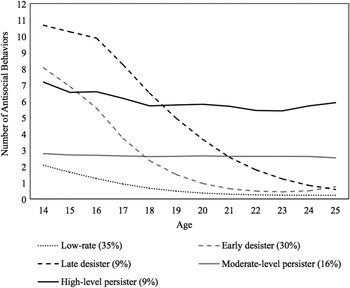
Five trajectory groups were identified in this study, and all five trajectory groups were used in the present analyses: low-rate (n = 405), early desisters (n = 340), late desisters (n = 114), moderate-level persisters (n = 147), and high-level persisters (n = 82).Footnote 1 Figure 1 presents these trajectories. The low-rate group consisted of individuals who reported relatively low levels of offending at every time point. The early desisting group engaged in relatively high levels of antisocial behavior in early adolescence but declined in antisocial behavior steadily and rapidly thereafter. The late desister group engaged in relatively high levels of antisocial behavior through middle adolescence, peaking around age 15, and then declined in antisocial behavior across the transition to adulthood. The moderate-level persister group showed relatively moderate levels of antisocial behavior consistently from ages 14 to 25 (approximately three different types of criminal acts). The high-level persister group reported relatively high levels of antisocial behavior consistently from ages 14 to 25 (ranging from approximately six to seven different criminal acts).
Trajectories of antisocial behavior.

Posterior probabilities reflect the likelihood that an individual would belong to each of the derived groups. Average posterior probabilities indicated that individuals were well matched to the groups to which they were assigned (see Nagin, Reference Nagin2005): low rate = .90, early desister = .85, late desister = .85, moderate-level persister = .81, high-level persister = .85.
Baseline environmental and neurological risk predicting group membership
Table 1 presents descriptive information of baseline demographic, environmental, and neurological risk by trajectory group and the full analytic sample.
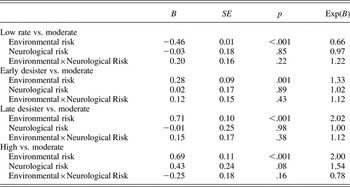
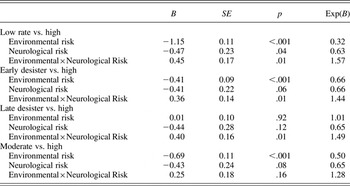
Two multinomial logistic regression models were used to test how baseline neurological risk interacted with baseline environmental risk to predict offending trajectory membership (see Table 2 and Table 3), the first using moderate-level persisters as the reference group and the second using high-level persisters as the reference group. Given the theoretical support for examining how neurological deficits moderate the effect of environmental risk on offending trajectory membership (i.e., Moffitt, Reference Moffitt1993), we present the models including the interaction of neurological and baseline environmental risk. All models controlled for age at baseline.
Multinomial logistic regressions predicting trajectory group membership by neurological risk and baseline cumulative environmental risk (moderate-level persisters as reference group)

Note: Models controlled for age at baseline. Moderate, Moderate-level persister; High, high-level persister.
Multinomial logistic regressions predicting trajectory group membership by neurological risk and baseline cumulative environmental risk (high-level persisters as reference group)

Note: Models controlled for age at baseline. Moderate, Moderate-level persister; High, high-level persister.
The first multinomial logistic regression model used moderate-level persisters as the reference group. Compared to the low-rate group, moderate-level persisters reported significantly greater levels of baseline environmental risk. Low- and moderate-level persistent offenders did not significantly differ with respect to neurological risk, nor did environmental and neurological risk interact to predict offending group membership. Compared to early desisters, late desisters, and high-level persisters, moderate-level persisters reported lower levels of cumulative environmental risk at baseline. Moderate-level persisters did not differ significantly in neurological risk from any of these remaining groups, and neurological and environmental risk did not interact to differentiate group membership.
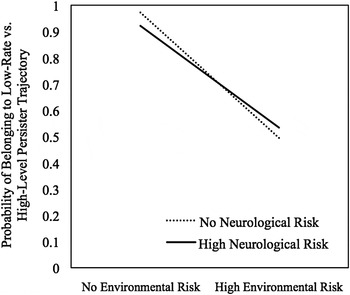
Next, we repeated the same multinomial logistic regression, but used the high-level persisters as the reference group. Recall that we are primarily interested if the moderate-level persister is etiologically distinct from the high-level persister, and thus it is also important to examine how high-level persisters differ from other trajectories. With exception to the moderate-level persistent versus high-level persistent offender comparison, baseline cumulative environmental risk and neurological risk interacted to predict group membership. Figure 2 presents this probed interaction, graphing the probability of belonging to the low-rate group versus the high-level persistent group at no (i.e., at zero) and high levels (i.e., 1 SD above the mean) of environmental and neurological risk. The figure suggests that high neurological risk in the context of no environmental risk decreases the probability of belonging to the low-rate group versus the high-level persistent group, but this pattern reverses in the context of high environmental risk. Similar patterns were found in the comparisons of high-level persistent offenders and other trajectories with varying probabilities. Across all analyses, environmental risk was more robust than neurological risk in differentiating trajectory membership.
Baseline Environmental Risk × Neurological Risk predicting membership in low-rate versus high-level persistent offending trajectory. Figure is graphed at zero and 1 SD above the mean for environmental and neurological risk.

Cumulative environmental risk across age as a function of trajectory group membership
To examine how cumulative environmental changes across adolescence and early adulthood, growth curve models (centered at age 16) were estimated for cumulative environmental risk across age for all youth (the unconditional model), and then were estimated as a function of trajectory group membership (the conditional model). The highest order significant model polynomial was assessed (e.g., linear growth, quadratic growth, etc.), and the models were tested to determine whether there was significant individual variation in the level and rate of change in cumulative environmental risk over age.
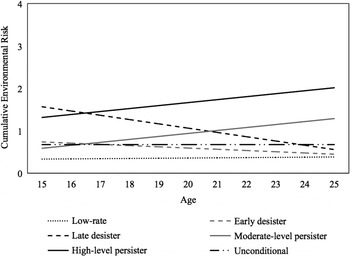
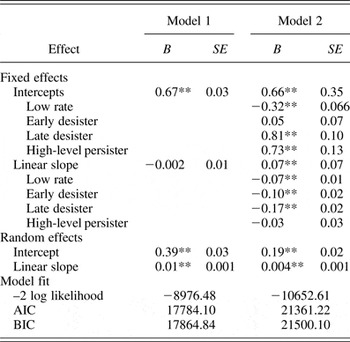
Growth curve models indicated that linear growth of environmental risk over age best represented the data for two key reasons (Table 4, Model 1). First, both the intercept and variance around the intercept in the unconditional model were significantly different than zero. Although the linear slope was not significantly different than zero, there was significant variance around the linear slope. In other words, individuals demonstrated significant variability in the level and rate of change in cumulative environmental risk across age. Second, both the fixed and random effects of a quadratic term were not significantly different than zero. Taken together, a linear growth model was selected. The unconditional growth model indicated that cumulative environmental risk remained relatively low across adolescence and early adulthood (Figure 3, dashed line represents unconditional growth of environmental risk over age).
Growth in cumulative environmental risk across age as a function of trajectory membership.

Unconditional growth (Model 1) and conditional growth (Model 2) models of cumulative environmental risk

Note: The reference group for conditional effects is the moderate-level persister group. AIC, Akaike information criterion; BIC, Bayesian information criterion.
*p < .05. **p < .01.
In the conditional growth model, we tested how offending trajectory membership was related to individual differences in the intercept and linear slope of cumulative environmental risk, using moderate-level persistent offenders as the reference group. Model results are presented in Table 4, Model 2. Results indicated that low-rate offenders' environmental risk remained low across age, while both early and late desisters' cumulative environmental risk declined as youth transitioned from adolescence to early adulthood. In contrast, both moderate- and high-level persisters' cumulative environmental risk showed similar rates of positive, linear growth in cumulative environmental risk across adolescence and early adulthood, albeit with different starting levels of environmental risk. Figure 3 depicts the unconditional trajectory of cumulative environmental risk and cumulative environmental risk trajectories as a function of offending group membership.
Type of offenses across age as a function of trajectory membership
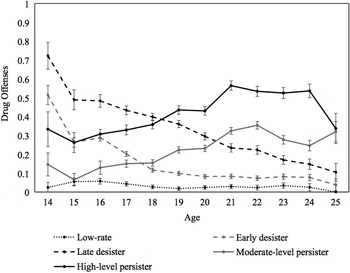
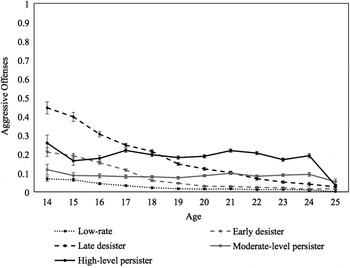
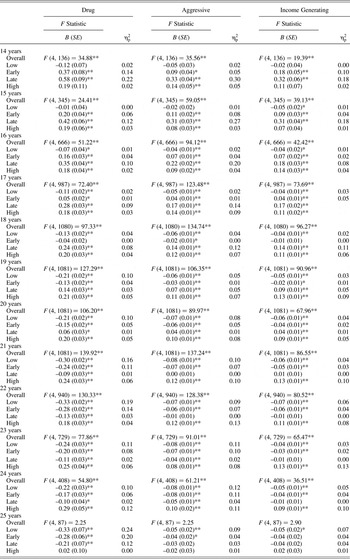
To determine whether offending groups differed by specific types of criminal behavior, we conducted a series of ANCOVA tests, which tested group differences in drug, aggressive, and income-generating offenses at each age. These three sets of ANCOVAs for drug, aggressive, and income-generating offenses were conducted separately at each age from 14 to 25 years, and covaried out age at baseline and time spent in a secure setting during the respective year. Table 5 presents the results of between-subject effects and model fit indices when predicting drug, aggressive, and income-generating offenses, while Figures 4–6 depict the estimated marginal means and their standard errors for each offending trajectory.
Drug offenses across age as a function of trajectory membership.

Aggressive offenses across age as a function of trajectory membership.

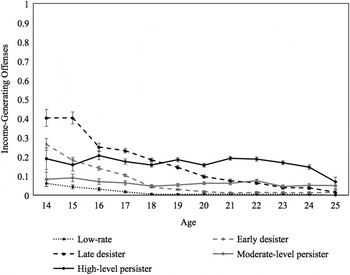
Income-generating offenses across age as a function of trajectory membership.

Analysis of covariance test of differences in drug, aggressive, or income-generating offenses across age as a function of trajectory membership

Note: Models controlled for age at baseline and time spent in a secure setting. The F statistic and partial eta-squared are the effects of “group” in the model. Low, Low rate; Early, early desister; Late, late desister; High, high-level persister. Moderate-level persisters were the reference group for group contrasts, thus parameter estimates for moderate-level persiststers are not provided.
*p < .05. **p < .01.
The results indicated that low-rate offenders reported the lowest proportions of acts at each age. Early and late persisters declined in all types of offending across age at similar rates, albeit with different intercepts. Although the level of offending differed for moderate- and high-level persisters, both showed increases in their drug offenses as they age, and remained relatively stable in their aggressive and income-generating offending. In sum, it appears that both groups of persisters show a similar pattern in the types of offenses they commit across age (i.e., increasing in drug offenses and engaging in similar levels of aggressive and income-generating offenses across age), but can be distinguished by the level of which they are engaging in these types of offenses.
Discussion
Over the last 20 years, much has been learned about heterogeneity in patterns of desistance from or persistence in criminal behavior from adolescence to early adulthood. Significantly less research has focused on understanding heterogeneity among persisting offenders. The present study is one of the first to examine comprehensively heterogeneity among persistent offenders, differentiated by relative level of antisocial behavior from adolescence to early adulthood. We find that moderate-level persisters are more similar to high-level persisters in their etiology and criminal patterning than they are to low-rate and desisting offenders, but we also found important differences between these two groups of persisters. Specifically, both moderate-level and high-level persisters are characterized by increased exposure to environmental risk as they age, but moderate-level persisters experience consistently lower levels of contextual adversity. Similarly, both persisters report increases in drug offenses in early adulthood and relatively stable levels of aggressive and income-generating offenses across age, but moderate-level persisters report lower levels of offending across all categories of criminal behavior.
The previously identified trajectories that were utilized in the present study provide support for Moffitt's (Reference Moffitt1993, Reference Moffitt and Caspi2001) theory, in that a relatively small proportion of youth engaged in high levels of continuous antisocial behavior across the transition to adulthood. However, we do not find evidence that similar etiological mechanisms underlie all persistent offenders. Rather, Moffitt's hypothesized interaction between neurological risk and exposure to adversity is only supported in high-level persisters, not moderate-level ones. Moderate-level offenders do not appear to be particularly at risk for continued problem behavior, given that, at least in adolescence, they do not report significantly higher levels of neurological risk than any other trajectory group. Furthermore, out of the four other trajectories, only low-rate offenders report lower levels of cumulative environmental risk in comparison to moderate-level persisters. However, when examining environmental risk across age, both moderate- and high-level persisters report increasing rates of contextual adversity, although moderate-level offenders show consistently lower levels of environmental risk. This is consistent with work that suggests that more exposure to contextual challenges (e.g., low socioeconomic status or poor parenting) increases risk for conduct problems across adolescence (Roisman et al., Reference Roisman, Monahan, Campbell, Steinberg and Cauffman2010). Although further research is needed to determine the directionality of environmental risk and criminal offending, intervening with both moderate- and high-level persisters' contexts may be a fruitful target for reducing their continuing antisocial behavior. Further, moderate-level offenders' relative lack of neurological deficits in adolescence suggests that they may be amenable to treatment.
Our findings shed light on the versatility versus specialization debate among life-course persistent offenders. In general, we find that both moderate- and high-level persisters engage in a variety of antisocial behavior throughout their criminal careers. Further, we find rank-order stability, such that high-level persisters in comparison to moderate-level persisters consistently engage in higher levels of criminal activity across all types of crimes. In contrast to the versatility argument, however, the level of drug-related offenses committed increases among both high-level and moderate-level persistent offenders. Still, aggressive and income-generating offenses remain relatively stable for both life-course persistent offenders. Notably, the two persisting groups were the only two who had increases in drug offending across adolescence into adulthood.
We propose two nonmutually exclusive interpretations of moderate- and high-level persisters' increase in drug offenses. First, in accordance with the utilitarian hypothesis (i.e., crimes become more purposeful later in the criminal trajectory), these groups may focus on drug dealing as a predominant form of earning a living. Second, it is possible that persistent offenders' drug offending may be underscored by substance use dependency. Although the majority of drug offense items are selling drugs, drug selling and drug using often co-occur (e.g., Kerr, Small, Johnston, Montaner, & Wood, Reference Kerr, Small, Johnston, Li, Montaner and Wood2008; Shook, Vaughn, & Salas-Wright, Reference Shook, Vaughn and Salas-Wright2013). Probing the idea that addiction may be linked to persistent offending, we found that, at the final interview in which substance abuse was assessed, moderate- and high-level persisters report similarly high levels of substance abuse in the past 12 months (mean difference = −0.03, p = .36), while both groups exceed low-rate offenders' low levels of alcohol and drug abuse (moderate-level persisters and low-rate mean difference = 0.11, p < .001; high-level persisters and low-rate mean difference = 0.14, p < .001), as well as early desisters (moderate-level persisters and early desisters mean difference = 0.08, p = .001; high-level persisters and early desisters mean difference = 0.11, p < .001) and late desisters (moderate-level persisters and late desisters mean difference = 0.09, p < .01; high-level persisters and late desisters mean difference = 0.12, p < .001). Thus, etiologically, it could be that substance use dependency combined with maintaining addiction to substances through selling or manufacturing drugs leads to moderate- and high-level offenders perpetuating a life of crime across the transition to adulthood. Future longitudinal studies may wish to examine substance use dependency as a driving force for continuous drug offending, which could shed light on targeted interventions for moderate- and high-level persistent offenders.
We observed unexpected findings in our etiological analyses: the interaction between neurological and environmental risk differentiating low-rate and desisting trajectories from high-level persistent offending deviated from our expectations. In accordance with Moffitt's theory, we expected that higher levels of neurological and environmental risk in concert would exacerbate youth's chances of falling into the high-level persistent versus other trajectory groups. However, high neurological risk only increases youth's odds of belonging to the high-level persister group in the context of relatively lower environmental risk. Although this interaction seems counter to Moffitt's hypothesis, we attribute this finding to the high-risk nature of this population. Youth crime is robustly associated with high contextual risk (e.g., Morenoff, Sampson, & Raudenbush, Reference Morenoff, Sampson and Raudenbush2001), such that a full standard deviation increase in environmental risk in a population of serious juvenile offenders is quite high relative to typically developing youth. As such, there are few other factors (i.e., neurological) that could exacerbate risk for poor outcomes. In sum, we speculate that this surprising pattern of interactions was due to the nature of our sample, and that the expected set of interactions would be found within a population sample.
Although the present study is strengthened by its focus on serious juvenile offenders, longitudinal design spanning adolescence to adulthood, and advanced trajectory analyses, it is limited in several respects. First, the present study relies on self-report measures of environmental risk and antisocial behavior. With respect to environmental risk, individuals' perceptions of their environments are often stronger predictors of adjustment than objective measures of context (e.g., Adler, Epel, Castellazzo, & Ickovics, Reference Adler, Epel, Castellazzo and Ickovics2000). In regard to antisocial behavior, although these assessments are potentially prone to issues of recall, it is likely the case that official records would have strongly underestimated youth crime (i.e., only the crimes for which youth were caught would be available). Still, it is notable that, in the pathways sample, self-report and official arrest records are correlated (Brame, Fagan, Piquero, Schubert, & Steinberg, Reference Brame, Fagan, Piquero, Schubert and Steinberg2004). Further, using self-reported criminal behavior often yields richer criminal trajectories, given that some criminal behavior, especially criminal behavior of seasoned, persistent offenders, is less likely to be documented in official arrest records.
Second, we are also limited by the timing of our assessments. For instance, our measure of neurological problems, which was a nonspecific tally of potential neurological risk factors, was only assessed at one time point and was retrospective. We did not get detailed information regarding the timing of the neurological damage, nor were we able to track neurological development across adolescence. This may explain the general small weight of neurological risk in our etiological analyses. Furthermore, it is possible that neurological risk during adolescence may be, in part, due to environmental risk factors. To examine the extent to which these two variables were related, we examined their bivariate correlation and found a positive, but small association (r = .09, p < .01). Given that the variables share relatively little variance, it is likely that the two are independent constructs, but the timing of our assessments limits our ability to understand how the two impact one another over time.
The current study also lacks more general prospective child information (e.g., cumulative environmental risk prior to adolescence). The etiological mechanisms that explain criminal patterning likely begin earlier than adolescence, and although our study is relatively rare in that it follows serious juvenile felons from middle adolescence through their mid-20s, more research is needed to explore these processes beginning in childhood. Future studies using data from early childhood to predict heterogeneity in offending prospectively would be important for further etiological analyses. Such an analysis would also afford examining potentially reciprocal relations between neurological/personality deficits and environmental risk over time, as suggested by transactional models of development (Sameroff, Reference Sameroff2009). Third, the findings are limited in that there is no normative reference group, and thus we are only able to examine differences among serious offenders. It may be that all adolescent offenders in this sample would show elevated neurological and environmental risk in comparison to a normative population. This is a question that warrants further investigation. Fourth, although we use etiological and criminal specialization frameworks in the current investigation, we acknowledge that other mechanisms likely underlie heterogeneity in offending. For example, other studies have examined individual differences in psychosocial maturation (Monahan et al., Reference Monahan, Steinberg, Cauffman and Mulvey2009, Reference Monahan, Steinberg, Cauffman and Mulvey2013), as well as differential involvement in the juvenile justice system (Mulvey et al., Reference Mulvey, Steinberg, Piquero, Besana, Fagan and Schubert2010) as predictors of persistent offending patterns.
Over the last two decades, Moffitt's (Reference Moffitt1993) dual taxonomy has generated a rich understanding of antisocial behavior. Applying this framework to patterns of criminal offending, we examine an important subgroup of life-course persisters, moderate-level persistent offenders, who we find to be etiologically and criminologically distinct from low-rate, desisting, high-level persistent offenders. In particular, we find that increases in contextual adversity underlie this offending trajectory, although the level of environmental risk never reaches high-level persisters'. It stands to reason that similar etiological differences may also explain heterogeneity among general chronic antisocial behavior. Further, we find that while both moderate- and high-level persisters commit predominantly drug-related criminal acts later in their criminal career, moderate-level persisters do so at lower levels. For both high- and moderate-level persisters, it appears that shifting youth from these persisting trajectories may involve reduction in the level of environmental risk exposure, particularly across the transition to adulthood. Given that these persistent youth's contextual adversity goes from relatively poor to increasingly worse over time compared to lower rate offenders, sustained contextual intervention may be warranted.