



Introduction
The post-mortem treatment of bodies is a critical aspect of human behaviour worldwide. The dead body is an influential entity that can be “appropriated” (Sofaer Reference Sofaer2006: 20) through physical manipulation. The array of documented treatments of the dead is broad, ranging from embalming and excarnation to the reassembly of human remains into composite skeletons and mummies (Aufderheide et al. Reference Aufderheide1999, Reference Aufderheide, Cartmell, Zlonis and Sheldrick2004; Montt et al. Reference Montt, Fiore, Santoro and Arriaza2021). The memories and histories of deceased individuals may have shaped how their bodies and body parts were perceived and altered following death (Tung Reference Tung2014: 438). Such manipulation of human remains was performed to achieve varying goals: making territorial claims, expressing socio-political relationships and, perhaps most fundamentally, transitioning the dead from one status to another (van Gennep Reference van Gennep1960 [1909]; Hertz Reference Hertz1960 [1907]).
The removal and modification of parts of dead human bodies—particularly the head—are well-documented cultural traditions in the Andes, starting in the second millennium BC, if not before, and continuing for millennia. Moche (c. AD 100–800) graves, for example, were re-entered to remove body parts (e.g. hands), which were then deposited elsewhere as offerings (Nelson Reference Nelson1998; Millaire Reference Millaire2004). Of similar date, trophy heads are found in Nasca (c. AD 1–800) and Wari (c. AD 600–1000) contexts (Browne et al. Reference Browne, Silverman and García1993; Tung Reference Tung2008). Finally, drums made using flayed human skins, skulls carved into drinking cups and other trophies made from human remains were reportedly produced in the Late Horizon (or Inca) period (AD 1400–1532) (Guamán Poma de Ayala Reference Guamán Poma de Ayala2009 [1615]: 126, 248–49 & 266).
The present article contributes to the extensive record of Andean mortuary behaviours an example from the Chincha Valley, Peru. Here, we have documented the practice of inserting posts made of reeds through human vertebrae to create what we refer to as ‘vertebrae-on-posts’. Recent archaeological fieldwork in the Chincha Valley has documented the wide distribution of these vertebrae-on-posts, predominantly within large, elaborately built graves, known as chullpas. Both unmodelled and Bayesian modelled radiocarbon dates on samples of these vertebrae-on-posts are consistent with activity during the end of the Late Horizon and the beginning of the Colonial period (AD 1532–1825). Several interpretations, not necessarily mutually exclusive, have been put forward for the practice of inserting reeds through vertebrae (Bongers Reference Bongers2019). The practice may have facilitated the transportation of remains of individuals who had died away from their communities; it is also possible that vertebrae-on-posts were trophies, symbols of status and power, or representations of certain individuals. Further, we cannot rule out that these modified remains were displayed as part of ceremonies. Although we cannot be certain that the treatment of these human remains does not relate to the actions of looters, we suspect that it was local peoples who strung the vertebrae of their kin on reed posts. Here, we suggest that these modified remains constituted a social process involving the placement of human remains in graves, the harvesting of reeds, the revisiting of graves and the insertion of reeds through vertebrae. We argue that this process reconstructed the dead in response to Colonial-period looting. This study offers critical data to broaden theoretical debates on the enduring social lives of body parts and how Indigenous relationships with the dead were materialised through social practice (Sofaer Reference Sofaer2006; Tung Reference Tung, Chacon and Dye2007; Robb Reference Robb, Stutz and Tarlow2013).
The Chincha Valley
The Chincha Valley (Figure 1), located approximately 200km south of Lima, is one of the largest and most agriculturally productive areas along the southern coast of Peru. The Chincha Kingdom was a complex polity that dominated the Chincha Valley in the Late Intermediate Period (LIP; AD 1000–1400), before its incorporation into the Inca Empire during the Late Horizon. Chincha society was organised into a network of inter-dependent communities of specialists, including farmers, fisherfolk and merchants (Crespo Reference Crespo1975; Sandweiss & Reid Reference Sandweiss and Reid2016). Silver, gold and other prestigious items were reportedly acquired by merchants through trade networks that may have spanned Cuzco and the Titicaca Basin (Sandweiss & Reid Reference Sandweiss and Reid2016). In the fifteenth century AD, an alliance between Inca and Chincha was established—one of the few political relationships of its kind documented from this era. Inca consolidation of the Chincha Valley resulted in the administrative reorganisation of the Chincha population, appropriation of agricultural land, expansion of trade networks, intensification of local fishing and installation of a new political system granting power to both Chincha and Inca elites (Cieza de León Reference Cieza de León1959 [1553]; Crespo Reference Crespo1975; Sandweiss Reference Sandweiss1992; Sandweiss & Reid Reference Sandweiss and Reid2016).
The location of the Chincha Valley in southern Peru (map by J.L. Bongers).

The Colonial period was a turbulent time for Chincha peoples. The population declined catastrophically from over 30 000 documented heads of household in 1533, to 979 in 1583 (Menzel & Rowe Reference Menzel and Rowe1966: 69). This was probably due to a combination of events reported in Peru, including epidemics in 1546 and 1558, and famines in 1539 and 1548 (Menzel & Rowe Reference Menzel and Rowe1966: 69). Looting of Indigenous graves was also widespread in Chincha. Pedro Cieza de León (Reference Cieza de León1959 [1553]: 347), a chronicler of Peruvian history, states that “there was an enormous number of graves in this valley in the hills and wastelands. Many of them were opened by the Spaniards, and they removed large sums of gold”. The “hills” probably refer to the foothills that bracket the middle Chincha Valley, where recent research has documented over 500 previously disturbed graves and nearly 200 vertebrae-on-posts (Bongers Reference Bongers2019).
Methods
Survey, sample acquisition and biological analysis
The authors are among a team of international researchers that has carried out fieldwork in the Chincha Valley for several seasons since 2012. In 2013, we conducted a pedestrian survey in a zone of approximately 40km2 in the middle valley (Figure 1). We documented grave architecture and recorded the presence and absence of vertebrae-on-posts for 664 graves, which cluster in 44 mortuary sites. This dataset includes chullpas (n = 554). These are large, elaborately constructed graves that feature openings and multiple individuals.
We collected a sample of 79 vertebrae-on-posts from the middle Chincha Valley. These samples are from 20 mortuary sites, and most (n = 42) were collected from inside chullpas, while others (n = 37) were collected directly outside of these graves. We examined the vertebrae-on-posts carefully and recorded biological data on several attributes, including MNI (minimum number of individuals), age, anatomical order and vertebra-type present (among others) (see the online supplementary material (OSM2)). Each vertebra was evaluated and classified into one age group: either adult (>20 years old) or juvenile (<20 years old). When possible, we estimated age-at-death for adolescents and young adults using vertebral ring epiphyseal union (Albert & Maples Reference Albert and Maples1995) and/or the fusion of sacral vertebrae (Schaefer et al. Reference Schaefer, Scheuer and Black2009).
Nine vertebrae-on-posts from inside eight chullpas in six mortuary sites were selected for dating. Six ‘paired’ samples (i.e. three vertebrae and the three reeds they were placed on) and six additional reeds were selected for AMS radiocarbon dating.
Radiocarbon dating and calibration methods
Twelve AMS radiocarbon dates were obtained from the Keck-CCAMS Facility at the University of California Irvine (UCIAMS) (Table S1, OSM1), four of which were reported previously (Bongers et al. Reference Bongers, O'Shea and Farahani2018). Nine botanical samples from reed posts were processed using the acid-base-acid (ABA) technique, while three dates on human vertebrae were obtained using ultra-filtered collagen. Reed dates were calibrated according to the SHCal20 Southern Hemisphere calibration curve (Hogg et al. Reference Hogg2020) using OxCal v4.4 (Bronk Ramsey Reference Bronk Ramsey2009).
Due to stable nitrogen isotope (δ15N) enrichment connected to aridity and guano exploitation (Poulson et al. Reference Poulson2013; Santana-Sagredo et al. Reference Santana-Sagredo2017), the significance of the δ15N composition of human remains and its relation to marine diet is a perennial point of discussion in the archaeology of the Andes and the Pacific coast of South America. Substantially elevated δ15N values in human remains (≥15.0‰), as we observe for the Late Horizon individuals in the Chincha Valley (see Results, below), are routinely encountered at inland sites in northern Chile and southern Peru (Santana-Sagredo et al. Reference Santana-Sagredo, Lee-Thorp, Schulting and Uribe2019). Poulson et al. (Reference Poulson2013) observed greatly elevated δ15N values (>30‰) in the hyper-arid regions of Arica and the Izapa Valley in Chile. The latter is an extreme case, where δ15N values beyond those observed in other parts of the food web are probably indicative of enrichment due to the extensive use of seabird guano as an agricultural fertiliser.
The difference between the radiocarbon content in marine and terrestrial organisms—known as the marine reservoir effect (MRE)—can influence radiocarbon dating of human remains. Dates on samples derived from people who consumed nitrogen-enriched foods, such as marine organisms, can appear older than they are. Marine reservoir corrections (ΔR), which are often based on reservoir ages of marine shells, can be integrated into radiocarbon calibration to produce more accurate dates. Although available ΔR values for the Pacific coast can vary greatly (Taylor & Berger Reference Taylor and Berger1967; Jones et al. Reference Jones2007) and are undoubtedly affected by diachronic variability due to coastal upwelling (Latorre et al. Reference Latorre, De Pol-Holz, Carter and Santoro2017), Etayo-Cadavid et al. (Reference Etayo-Cadavid, Andrus, Jones and Hodgins2019) have found no statistically significant difference in the reservoir ages of Donax obesulus and Protothaca asperrima shells collected in northern and central Peru. Their ΔR value for the Paracas area (110±49, calculated according to the Marine13 calibration curve) is derived from an average of 30 dates made on two modern (pre-bomb) shells, and provides the most proximate and best available estimate of ΔR for the Chincha Valley.
Under normal circumstances, δ15N values provide a roughly linear scale of the relative importance of marine dietary resources, with ~11.5‰ indicating a wholly terrestrial diet and ~22.0‰ indicating a predominantly (~90 per cent) marine diet (Bongers et al. Reference Bongers2020; Nakatsuka et al. Reference Nakatsuka2020: 8). We, however, follow Santana-Sagredo et al. (Reference Santana-Sagredo2017) and consider the δ15N value of 15.0‰ as a baseline for a marine diet in the Chincha Valley, due to the desert climate and the possible local use of guano fertiliser (Curátola Reference Curátola, Gabai and Espinoza1997). Thus, we have chosen to categorise the Late Horizon individuals as having a 10 per cent, rather than 30–40 per cent (as applied in Bongers et al. Reference Bongers2020), marine-based diet. The dates on vertebrae were calibrated with a mixed curve of 90 per cent SHCal20 and 10 per cent Marine20 (Heaton et al. Reference Heaton2020). The applied local ΔR value was recalculated to −25±46, according to the new Marine20 curve.
Results
Distribution and mortuary contexts
There is a wide distribution of vertebrae-on-posts in the Chincha Valley (Figure 2); so far, we have documented 192 of these remains (Figure 3) in the middle and lower valleys. Most (n = 190) are found either inside or outside of the chullpas that are located in over half of the middle valley mortuary sites (52 per cent, n = 23). Vertebrae-on-posts were sometimes observed in association with disturbed textile bundles (Figure 4). Excavations at Las Huacas (Dalton Reference Dalton2020; Dalton et al. Reference Dalton, O'Shea, Mejía and Pizarro2021) and Jahuay (J. Osborn, pers. comm.)—two sites in the lower valley—have recovered vertebrae-on-posts from mortuary structures containing multiple individuals.
Archaeological sites that have vertebrae-on-posts (map by J.L. Bongers).

Examples of vertebrae-on-posts (scale in cm; photograph by C. O'Shea).

a–b) Vertebrae-on-posts associated with disturbed textile bundles (scales in cm; photographs by J.L. Bongers).

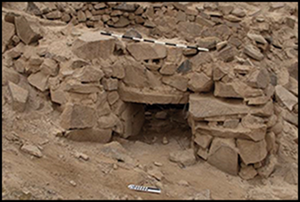
We documented vertebrae-on-posts inside 88 middle valley chullpas. Such graves have varying architectural attributes (Figure 5). They can be above ground or subterranean, built with fieldstone, adobe and tapia (poured mud), and feature openings, evidence of roofing, and interior platforms—possibly for the display of human remains and offerings. Vertebrae-on-posts were also recovered from chullpas containing human remains with soft tissue. Surface collection recovered eight vertebrae-on-posts from UC-008 Tomb 1 (chullpa) and three from a chullpa in the UC-012 cemetery. Bioarchaeological analyses of these subterranean, fieldstone chullpas have revealed naturally mummified remains and many insect pupae (Weinberg et al. Reference Weinberg2016; Bongers Reference Bongers2019). Since insects infest decaying bodies after death, the presence of pupae in the graves suggests that the human remains had been exposed for some time before burial.
a) Chullpa with roof; b) fieldstone chullpa with opening; c) interior platform in a chullpa; d) chullpa with fieldstone and adobe materials (photographs by J.L. Bongers).

Stable isotope analysis
Stable carbon and nitrogen isotope measurements (δ13C and δ15N) were taken from the three paired vertebrae. The δ13C results (−12.9 to −10.9‰) are appropriate for individuals who consumed a substantial quantity of maize—a C4 plant. Values of δ15N are substantially elevated (δ15N = 14.9–15.7‰). This could normally indicate a diet with as much as 30–40 per cent deriving from marine sources. In this case, however, the results are probably skewed by the regional use of guano fertiliser. Our previous work dating these samples (Bongers et al. Reference Bongers2020) presented both terrestrial and marine reservoir-corrected calibrated dates. The latter results, while having 2σ ranges that overlapped with the Late Horizon and Colonial periods, showed evidence of over-correction, with several mean results dating to the seventeenth century AD. This is somewhat inconsistent with the artefact assemblages of the graves, which overwhelmingly support a pre- or immediately post-Colonial attribution. Comparison with dates from the reed posts, which should logically post-date the vertebrae that are strung on them, however, illustrates the need for a more considered approach (see Methods, above).
Chronology
With the exception of UCIAMS-184547—an outlier dated to the mid-fifteenth century AD—all of the vertebrae and posts date to the interval of c. AD 1450–1640 (at 95.4% confidence), with mean calibrations falling in a tight band between AD 1545 and 1560 (Figure 6). Although the dates at which the individuals died and the dates at which the reeds were harvested are essentially indistinguishable, these events were probably not simultaneous, but rather, part of a diachronic social process. We assume this process consisted of the death of the individuals and primary deposition of their remains within the chullpas, followed later by harvesting of the reeds and the stringing of vertebrae on the posts (Figure 7).
Summed radiocarbon probability distributions for AMS-dated vertebrae (reservoir-corrected) and reed samples, plotted in relation to regional cultural periods (Bronk Ramsey Reference Bronk Ramsey2017; Hogg et al. Reference Hogg2020). The displayed results for individual dates include the mean calibration (points) and the 2σ range (lines) (figure by T.K. Harper).

Model of the process that produced vertebrae-on-posts (figure by J.L. Bongers).

By dividing the vertebrae and posts into two distinct phases within a Bayesian sequence in OxCal (Figure 8), we argue for placing the death of the individuals in the range of c. AD 1520–1550 (μ: 1530) and the harvesting of the posts at c. AD 1550–1590 (μ: 1570). The earlier phase is consistent with the early sixteenth-century AD epidemics and famines reported in Peru (Menzel & Rowe Reference Menzel and Rowe1966: 69). We find that our radiocarbon data fit this model well. An agreement index (A or Amodel) and overall agreement index (Aoverall) are calculated to evaluate the agreement between the Bayesian model and the radiocarbon data. If agreement indices are above 60.0, then the model is generally accepted (Bronk Ramsey Reference Bronk Ramsey2009). Indeed, the agreement indices for this Bayesian sequence (Table S2, OSM1) indicate good agreement with its assumptions (Amodel = 107.0; Aoverall = 98.1). We note that the individual values of A are lowest among reeds a and b (A = 93.5 and 83.2, respectively), indicating that the model parameters are forcing these dates to be younger than is optimal, although still well within the bounds of significance.
Bayesian sequence of AMS-dated vertebrae (reservoir-corrected) and reed samples (Bronk Ramsey Reference Bronk Ramsey2009; Hogg et al. Reference Hogg2020). Displayed results include mean calibration (points) and 2σ range (brackets) (figure by T.K. Harper).

Overall, both unmodelled and modelled results support the dating of the vertebrae-on-posts to the end of the Late Horizon and beginning of the Colonial period. The exact duration of the process that produced vertebrae-on-posts is unknown, but it appears, in these cases, to be shorter than the resolution that AMS radiocarbon dating readily permits, and is probably no greater than the ~40 year difference suggested by the modelled vertebrae and reed post dates. Furthermore, the dates support the hypothesis that vertebrae-on-posts were a response to looting during the early Colonial period, when the remains of those recently deposited within chullpas may have been disturbed and subsequently assembled on reed posts.
Composition
We analysed 79 vertebrae-on-posts to learn about their compositions (OSM2; Figure 9). All posts appear to be made from reeds (possibly Phragmites spp.) (A. Farahani, pers. comm.), but the identification of the reeds and their place of origin is challenging. It should be noted that Phragmites spp. derive a small amount of dissolved inorganic carbon (DIC) from the water column, as well as from the sediments in which they root (Marty & Myrbo Reference Marty and Myrbo2014). The total DIC fixed, however, is minimal (<1 per cent) and is unlikely to necessitate either marine or freshwater reservoir correction. The lengths of measured reed samples (n = 74) average 0.32m and range from 0.10–0.505m; the range of counts for vertebrae on all samples is 1–16. Vertebrae from different regions of the spinal column are represented in our entire sample (Figure 9).
Top left) distribution of vertebrae count and reed-post length (cm) (n = 74); top right) counts of reeds inserted through vertebrae from different regions of the spinal column (n = 79); bottom left) counts of reeds inserted through vertebrae of different ages (n = 79); bottom right) counts of reeds inserted through vertebrae arranged in different types of anatomical order (n = 67) (figure by J.L. Bongers).

Data suggest that the threading of posts into vertebrae was not restricted by age (Figure 9). There are 64 reeds (81 per cent) inserted through adult (>20 years old) vertebrae and 14 reeds inserted through juvenile (<20 years old) remains. The MNI on nearly all posts (n = 78) is one. Only one vertebrae-on-post has remains that come from at least one adult and one juvenile (MNI = 2).
In most cases, the reeds appear to have been threaded through vertebrae at an advanced stage of decomposition. We gathered data on anatomical order from vertebrae on 67 posts. Vertebrae-on-posts were considered partially in anatomical order if two or more vertebrae were found to be in order on the post. Six vertebrae-on-posts are in anatomical order, 30 are in partial order and 27 demonstrate no anatomical order (Figure 9). We find relatively high counts of posts threaded through disarticulated vertebrae (n = 76) and through remains that lack soft tissue (n = 75). None of the remains in the sample have cut marks. These general trends are consistent with the hypothesis that selected vertebrae were already disarticulated prior to being strung onto reed posts. For environments comparable to the Chincha Valley, skeletonisation generally takes place between a few weeks to months (Nelson Reference Nelson1998: 204).
To illustrate what these modified remains look like, we concentrate on one vertebrae-on-post example (Figure 10). Sixteen adult cervical, thoracic and lumbar vertebrae were strung on a reed post and then inserted into an adult cranium, through the occipital foramen. There is no evidence of soft tissue or post-mortem treatments (e.g. cuts) on the sun-bleached vertebrae. Since the sequence of vertebrae (Figure 10) does not correspond with the anatomical sequence of the elements on the cephalon-caudal axis of the human spine, this may suggest that the maintenance of order was not important. The consistent patterns in age and taphonomic characteristics and the non-repetition of elements suggest that the vertebrae were collected from a single, relatively recently deceased body. If so, several vertebrae are missing, perhaps due to taphonomic processes, post-mortem removal, or because no effort was made to assemble a complete spine.
a) Vertebrae-on-post inserted into a cranium, as found within a chullpa; b) annotated photograph showing lumbar (L), cervical (C) and thoracic (T) elements on the same vertebrae-on-post without the cranium (scale in cm) (photographs by J.L. Bongers; annotation of (b) by J. Gómez Mejía).

Discussion
In the Chincha Valley, the threading of posts through vertebrae was a mortuary phenomenon of the Late Horizon and Colonial periods. Despite being recovered from predominantly disturbed chullpas in this coastal valley, vertebrae-on-posts were probably not created by modern looters, for the following reasons:
1) the probability that looters took the time to string vertebrae onto at least 192 reed posts, which are distributed throughout this coastal valley, is considered low;
2) given that a few vertebrae-on-posts were found within disturbed textile bundles, it appears that they were incorporated into local mortuary practices; and
3) the 12 dates reported here are consistent with the Late Horizon and Colonial periods, arguing against the idea that the assembly of these remains was a recent phenomenon.
Instead, we argue that the threading of these vertebrae onto posts is an example of ritualised behaviour dating to a period of profound socio-political change. Critically, this practice is also not entirely without precedent, as it resembles an early Chinchorro (10 000–4000 cal BP) procedure observed on the coast of the Atacama Desert: maintaining the rigidity of a mummified individual's trunk by threading a wooden stick into vertebrae via the spinal canal (Aufderheide et al. Reference Aufderheide, Muñoz and Arriaza1993: 191). The authors note that the stick functioned as an anchor for the head, and that the vertebrae were not always in anatomical order, suggesting that external form and appearance were more important than anatomical precision (Aufderheide et al. Reference Aufderheide, Muñoz and Arriaza1993: 191). The parallels between these practices of threading posts through vertebrae—separated by thousands of years and over 1000km—are striking.
Our data presented here best fit a model that considers the mounting of vertebrae on posts as a response to Colonial-period looting of graves in the Chincha Valley and as a social process that reconstructed disaggregated human remains. This argument rests on the notion that Indigenous peoples were concerned with the wholeness of the dead body, which may have represented social order and memory (Buikstra & Nystrom Reference Buikstra, Nystrom, Shimada and Fitzsimmons2015: 255). Indeed, Andean peoples are known to have valued bodily integrity during the Late Horizon and Colonial periods (Buikstra & Nystrom Reference Buikstra, Nystrom, Shimada and Fitzsimmons2015: 254–55). In Inca capacocha ceremonies, for example, young children were sometimes killed through ‘non-bloody’ sacrificial techniques, such as drowning, strangulation, or live burial, allegedly in the belief that nothing ‘incomplete’ should be offered to the sun (de Murúa Reference de Murúa1946 [1590]: 263–64; Classen Reference Classen1993; Ceruti Reference Ceruti2004: 115). The Inca ruler Atahuallpa was said to be deeply concerned with the integrity of his body, reportedly converting to Christianity shortly before his killing in order to avoid death by burning and to ensure that his body remained intact (Hernández et al. Reference Hernández1987).
Given the significance of bodily integrity for Andean peoples, how would they have viewed the disaggregation or destruction of their dead bodies? In the turbulent Colonial period, Europeans destroyed mummified ancestors, prompting local outcries (Lau Reference Lau, Shimada and Fitzsimmons2015: 232). Indigenous peoples salvaged human remains, such as hair and nails, to reconstitute new cult images, which may have functioned as replacements for stolen, captured or destroyed effigies and dead bodies (Doyle Reference Doyle1988: 66). This “resourceful redefinition of the ancestral” (Lau Reference Lau, Shimada and Fitzsimmons2015: 232) suggests that the destruction of bodies during the Colonial period may have corrupted the dead in some way, urging local peoples to carry out post-mortem manipulation. We cannot rule out that looting may have similarly corrupted the dead, eliciting varied local responses. In this vein, we argue that after chullpas were looted—possibly as part of European campaigns to extirpate Indigenous religious practices—local groups re-entered these graves to assemble disaggregated human remains by threading posts through vertebrae. As looting became widespread and epidemics and famine decimated the Chincha population in the sixteenth century AD, it is possible that communities across the Chincha Valley coordinated to string vertebrae on reeds to reconstruct the dead. This social process may have served as a means of restoring the potency of the formerly corrupted dead.
Another question concerns whose vertebrae were strung on these posts. Recent ancient DNA (aDNA) research on remains from UC-008 Tomb 1—a looted and commingled chullpa in the middle Chincha Valley that yielded at least eight vertebrae-on-posts—strongly suggests that these modified remains came from non-local individuals. Genome-wide data were gathered from teeth samples associated with two Late Horizon crania from UC-008 Tomb 1. Since these crania were found disarticulated in the tomb, the relationship between these individuals sampled for genetic analysis and the eight vertebrae-on-posts documented in this grave is unclear. Nevertheless, the sampled individuals are genetically most similar to ancient and modern peoples from the north Peruvian coast (Bongers et al. Reference Bongers2020). The arrival of north-coast peoples in Chincha may have created cosmopolitan communities, resulting in new socio-political relationships between the living and the dead that necessitated a novel form of mortuary practice: the insertion of reed posts through non-local vertebrae. From this perspective, vertebrae-on-posts may have embodied, within the chullpas, social differences between locals and non-locals. Alternatively, non-local peoples could also have brought the vertebrae-on-posts with them to Chincha. Further genetic and stable isotope analyses, however, are needed to understand the origins and identities of individuals selected for this practice.
Notably, maintaining the wholeness of dead bodies was also critical for societies outside of the Andes. Mummies, for example, were deposited in grave chambers featuring openings, located in the Kellis site at Ismant el-Kharab in Egypt's Dakhleh Oasis (Aufderheide et al. Reference Aufderheide1999, Reference Aufderheide, Cartmell, Zlonis and Sheldrick2004). The Kellis site was occupied from the Ptolemaic Period (332–30 BC) until around AD 400 in the Roman Period (Aufderheide et al. Reference Aufderheide, Cartmell, Zlonis and Sheldrick2004: 64). Torn wrappings, disarticulated heads, fragmented bodies and commingled bones attest to extensive looting in antiquity (Aufderheide et al. Reference Aufderheide, Cartmell, Zlonis and Sheldrick2004: 64). The authors document the use of wooden sticks, resin and linen to reconstruct previously disturbed bodies following the looting activity (Aufderheide et al. Reference Aufderheide, Cartmell, Zlonis and Sheldrick2004). Body parts were splinted using palm-leaf ribs, which were also frequently inserted into spinal columns (Aufderheide et al. Reference Aufderheide1999, Reference Aufderheide, Cartmell, Zlonis and Sheldrick2004). While we exercise caution in drawing this cross-cultural comparison, the similarities between these Andean and Egyptian cases are striking, as they reveal that post-mortem body manipulation was among the possible responses to grave looting. Furthermore, these patterns raise questions about the variability of Indigenous responses to grave looting, and suggest that ‘reconstruction’ of looted, disaggregated bodies was not limited or unique to the Andes.
Conclusion
During the Late Horizon and Colonial periods in the Chincha Valley, disarticulated human vertebrae were threaded onto reed posts. We argue that this process reconstructed the dead in the face of looting, during a time of catastrophic upheaval. These post-mortem, tactile interactions with human remains reflect prolonged relationships between the living and the dead. On one hand, vertebrae-on-posts may point to conceptualisations of certain members of the dead as divisible entities, whose component parts—namely the vertebral column—held significant meaning as a critical structure of the body (supporting the head) and were thus in need of reassembly. On the other hand, they raise a broader question: what is the relationship between decomposition, grave disturbance and post-mortem body manipulation? Our research affirms a long-standing notion in mortuary scholarship worldwide: body parts continued to live social lives long beyond biological death.
Acknowledgements
The authors thank the Peruvian Ministry of Culture for granting us permits (206-2013-DGPC-VMPCIC-MC and 107-2016-VMPCIC-MC) to carry out this study. We also thank the Institute of Field Research and the Cotsen Institute of Archaeology for their support. We are grateful to Ioana A. Dumitru, Colleen O'Shea, Abigail J. Moffett and Jo Osborn for providing insightful comments on earlier versions of this article.
Funding statement
Jacob L. Bongers is grateful for support from the National Science Foundation Graduate Research Fellowship Program (grant DGE-1144087), the Ford Foundation Fellowship Program, the National Geographic Young Explorers Grant Program (grant 9347-13) and the Sigma Xi Grants-in-Aid Research Program.
Supplementary material
To view supplementary material for this article, please visit https://doi.org/10.15184/aqy.2021.180



