Introduction
Most of the common metals have a simple crystal structure, body-centered-cubic (bcc), face-centered-cubic (fcc), or hexagonal closed-packed (hcp), though their alloys may include compounds with more complex structures. It is of interest to synthesize novel alloys with different structures that may be expected to give unique and useful properties. One effective method to change structures is by alloying with more metallic elements. This can change the structure from crystalline to glassy even in a cast bulk form.Reference Inoue1–Reference Greer3
The formation of bulk metallic glass (BMG) is associated with alloys in which the selection of components follows three rules, namely: (1) at least three elemental components, (2) significant atomic size mismatches above 12% among the main three elements, and (3) negative heats of mixing among the three elements.Reference Inoue1,Reference Suryanarayana and Inoue4 In addition, such multicomponent alloys have deep eutectic valleys and permit access to a highly supercooled liquid state, resulting in the formation of BMGs, which have an atomic configuration that is disordered at long range and ordered at a medium range of 1.7–2.0 nm.Reference Yang, Liu, Liu, Chen, Dun, Zhao, Man, Chang, Shen, Inoue, Li and Jiang5 These BMGs exhibit unique combinations of properties that cannot be obtained for crystalline alloys (e.g., ultrahigh strength, large elastic strain, high corrosion resistance, high wear resistance, surface smoothness, viscous flowability, net castability, and precise formability).Reference Inoue1,Reference Suryanarayana and Inoue4 In addition, Fe- and Co-based BMGs exhibit good soft magnetic properties with low coercivity, high permeability, and low core loss since their atomic configuration is uniform on the scale of the magnetic domains.Reference Inoue1,Reference Suryanarayana and Inoue4 To exploit these advantages, BMGs have been used in many fields and applications such as structural, soft magnetic, coatings, ornamental, casing, springs, sensors, mirrors, gears, hinges, bolts, and cutlery.Reference Inoue1,Reference Suryanarayana and Inoue4
In general, BMGs have compositions selected to optimize their glass-forming ability ([GFA], which is used to describe the tendency for materials to form glassy phase). An equiatomic multicomponent BMG was synthesized for Ti20Zr20Hf20Ni20Cu20 in 2002.Reference Ma, Wang, Zhang and Inoue6 Two years later, equiatomic multicomponent crystalline alloys with fcc and bcc structures were also formed for Fe20Co20Ni20Cr20Mn20Reference Cantor, Chang, Knight and Vincent7 and AlxFeCoNiCrCu (x = 0–3),Reference Yeh, Chen, Lin, Gan, Chin, Shun, Tsau and Chang8 respectively. The latter was named as a high-entropy (HE) alloy in the paper. Since these syntheses, much attention has also been paid to equiatomic and near-equiatomic multicomponent alloys since these show metastable supersaturated solid-solution phases with bcc and fcc structures in the absence of compounds, or show a glassy structure.Reference Zhang, Zhou, Lin, Chen and Liaw9,Reference Murty, Yeh and Ranganathan10 Subsequently, pseudo-high-entropy (PHE) glassy alloys, where the definition is (1) five elements or more; (2) solvent element of 40–65 at.%; (3) solute elements of 5–15 at.%; and (4) positive heat of mixing and large atomic size mismatching among the solute elements, which is different from HE alloys, have been synthesized.Reference Inoue, Wang, Louzguine-Luzgin, Han, Kong, Shalaan and Al-Marzouki11–Reference Guo, Inoue, Han, Kong, Feng, Zhu and Ikuhara13 The PHE type Zr55–65Al7.5–10(TM1,TM2)27.5–35 (TM1 = Fe, Co, Ni, TM2 = Cu, Ag, Pd, Au) glassy alloys exhibit a novel phase decomposition behavior leading to the formation of a cluster-like glassy structure.
This article reviews the formation, thermal stability, mechanical and chemical properties, and applications of multicomponent Fe- and PHE Zr-based BMGs with high resistance to phase decomposition and investigates the usefulness of these BMGs as heat-resistant materials.
Development of amorphous alloy steels
Alloy steels containing Cr and Mo are well known as low-cost heat-resistant materials. Since the first synthesis of an amorphous alloy (in the Au-Si system) by rapid solidification in 1960,Reference Klement, Willens and Duwez14 amorphous alloys have attracted significant attention as potential novel advanced materials. The metastable nature of amorphous or glassy alloys, however, does not make them obvious candidates as heat-resistant materials.
When considering possible heat-resistant amorphous alloys for structural applications, Fe-based systems with alloy components similar to conventional heat-resistant materials are attractive as precursor materials. In the development of structural Fe-based amorphous alloys, Fe-(Cr,Mo,W)-C ternary and quaternary amorphous alloys were synthesized by rapid solidification in 1978.Reference Inoue, Masumoto, Arakawa and Iwadachi15–Reference Inoue, Arakawa and Masumoto17 Among these, Fe82–x–yCrxMoyC18 alloys had a wide amorphous composition range of 0–50 at.% Cr and 0–26 at.% Mo, and were named amorphous alloy steels. These amorphous steels exhibit a high crystallization temperature (T x) of 765–935 K, good bending plasticity, high tensile fracture strength of 3450–3790 MPa, high Vickers hardness (Hv) of 910–1130, and high corrosion resistance in various solutions. There is a clear tendency for T x and Hv to increase with increasing Cr and Mo contents. In scanning calorimetry, these alloys do not show a glass transition, and have been termed amorphous-type alloys. The absence of a detectable glass transition reflects the instability of the supercooled liquid (SL) state and shows that these systems do not have high GFA.
Much effort was made to develop a highly heat-resistant material by using these amorphous alloy steels as a precursor.Reference Inoue, Arnberg, Oguchi, Backmark, Bäckström and Masumoto18,Reference Inoue, Arnberg, Oguchi, Backmark, Backstrom and Masumoto19 These heat-resistant alloys were produced in two simple stages: (1) production of amorphous alloy powders by high-pressure gas atomization or pulverization of melt-spun amorphous alloy ribbons subjected to annealing-induced embrittlement treatment, followed by (2) uniaxial hot pressing, hot isostatic pressing, or spark plasma sintering of the amorphous powders. The resulting press-sintered bulk materials have high packing densities above 99% and a mixed structure of fine carbides dispersed homogeneously in bcc or tempered martensite matrix phase. The Hv is dependent on the pressing temperature (T p), showing a maximum near the T p of 1273 K and decreasing rapidly with further increase in T p, owing to the grain growth of the constituent phases. Press-sintered bulk alloys of the Fe-Cr-Mo-C and Fe-Cr-Mo-V-C systems were tested as heat-resistant high-speed cutting or bolt materials and were confirmed to exhibit favorable characteristics, such as high hardness even at elevated temperatures.Reference Arnberg, Larsson, Savage, Inoue, Yamaguchi and Kikuchi20 However, no significant applications have been realized so far because of the relatively high cost of these materials.
Fe-based BMGs and their applications
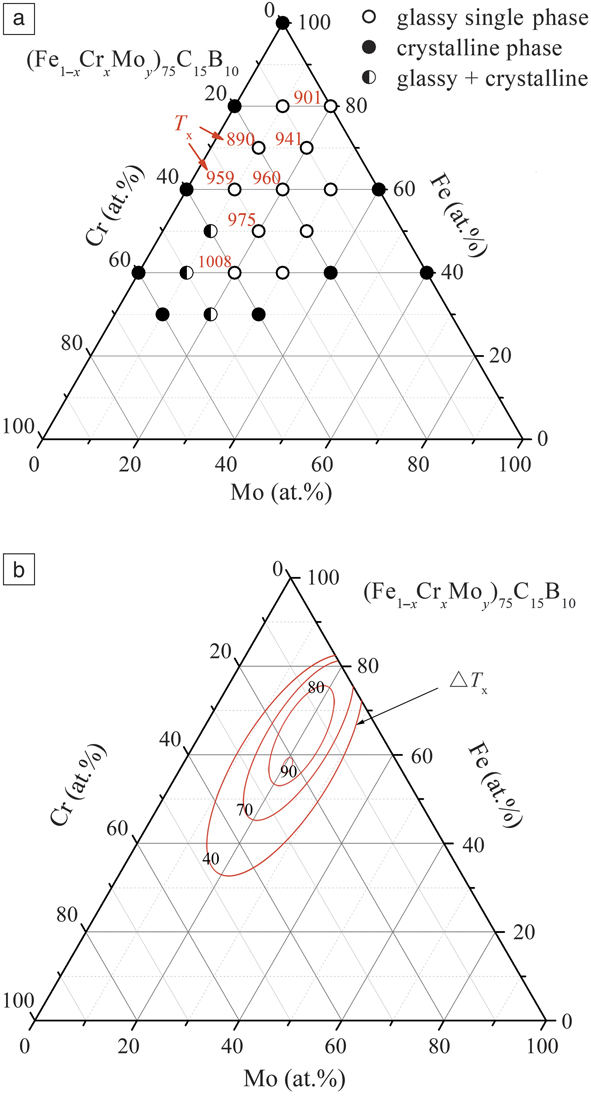
In a 1995 breakthrough, the first Fe-based BMGs were synthesized. Multicomponent Fe-(Al,Ga)-(P,B,Si,C) alloys, with compositions following the three rules previously notedReference Inoue, Shinohara and Gook21 were made by copper mold casting. These pioneering Fe-based BMGs were, however, not usable as structural materials owing to their low corrosion resistance. Much effort has since been devoted to develop a structural Fe-based BMG using previous dataReference Inoue, Masumoto, Arakawa and Iwadachi15–Reference Inoue, Arakawa and Masumoto17 on Fe-(Cr,Mo)-C amorphous alloys. In 2002, new BMGs based on the Fe-Cr-Mo-C-B system were synthesized by copper mold casting into rods with diameters up to 2.7 mm.Reference Pang, Zhang, Asami and Inoue22 The glassy phase was formed over a wide composition range of 0–30 at.% Cr, 7.5–22.5 at.% Mo, and a wide C/B concentration ratio range, as shown in Figure 1. These BMGs exhibit high glass-transition temperature (T g) (860–940 K), wide SL region (40–90 K), high T x (900–1010 K), and high corrosion resistance.Reference Pang, Zhang, Asami and Inoue23 The high corrosion resistance originates from the spontaneous formation of a thin, highly passive Crx(OH)y surface layer.
(a) Glass-formation range and crystallization temperature T x for as-spun Fe-Cr-Mo-C-B alloys, and (b) compositional dependence of the supercooled liquid region, △T x(= T x – T g, where T g is the glass-transition temperature), of these glassy alloys.Reference Pang, Zhang, Asami and Inoue23 The alloys can form a single glassy phase in a wide composition range and exhibit high T x as well as T g.

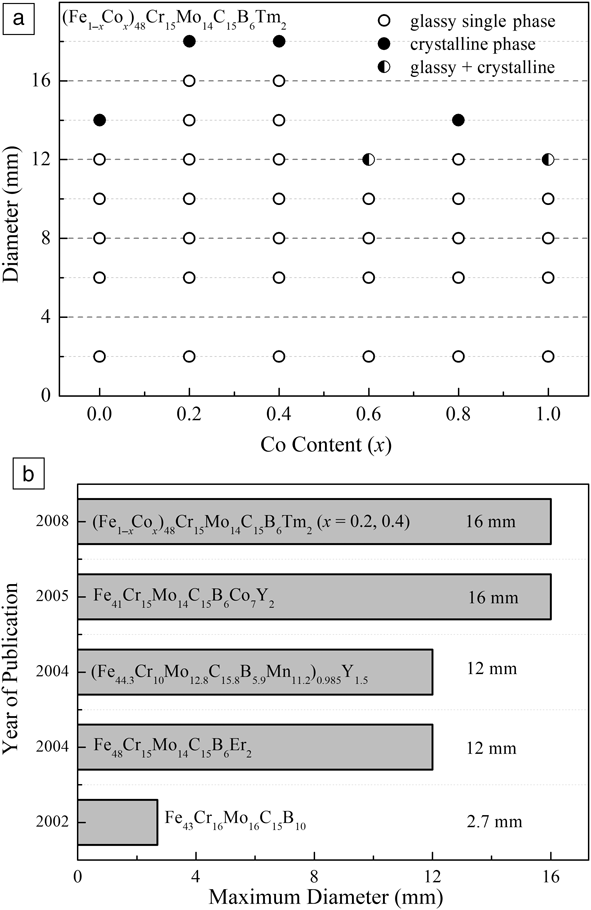
The bulk GFA has been significantly improved by adding small amounts of Y or lanthanide elements (Er and Tm), as exemplified by the maximum rod diameters of Fe-Cr-Mo-C-B-Er,Reference Ponnambalam, Poon and Shiflet24 Fe-Cr-Mo-Mn-C-B-Y,Reference Lu, Liu, Thompson and Porter25 and (Fe-Co)-Cr-Mo-C-B-TmReference Amiya and Inoue26 alloys shown in Figure 2. The maximum rod diameter for glass formation reaches above 10 mm for these alloy systems and 16 mm for the (Fe-Co)-Cr-Mo-C-B-M (M = Tm or Y) system.Reference Amiya and Inoue26,Reference Shen, Chen, Sun, Fan and Wang27 The high GFA for these Fe-based alloys is reportedly related to the development of medium-range-ordered atomic configurations. For example, Fe-Cr-Mo-C-B and Fe-Cr-Mo-C-B-Tm BMGs reflect, respectively, the complex structures of cubic M23(C,B)6 and M6(C,B) (M = Fe, Cr, Mo).Reference Ponnambalam, Poon and Shiflet24,Reference Hirata, Hirotsu, Amiya and Inoue28 These compounds have a large unit cell that includes icosahedral-like local atomic configurations. The addition of Ln has been interpreted to cause the formation of denser atomic configurations through greater adherence to the three component rules for the formation of BMGs and stabilization of the SL.Reference Hirata, Hirotsu, Amiya and Inoue28,Reference Louzguine-Luzgin, Bazlov, Ketov, Greer and Inoue29
(a) Maximum diameters for (Fe,Co)-Cr-Mo-C-B-Tm bulk metallic glass (BMG) rods prepared by copper mold casting. With a 2% addition of Tm element, the maximum rod diameter reaches 16 mm, and (b) maximum diameters of (Fe,Co)-Cr-Mo-C-B(-Ln) BMGs.Reference Ponnambalam, Poon and Shiflet24–Reference Amiya and Inoue26 The glass-forming ability can be significantly improved by adding small amounts of Y, Tm, or Er.

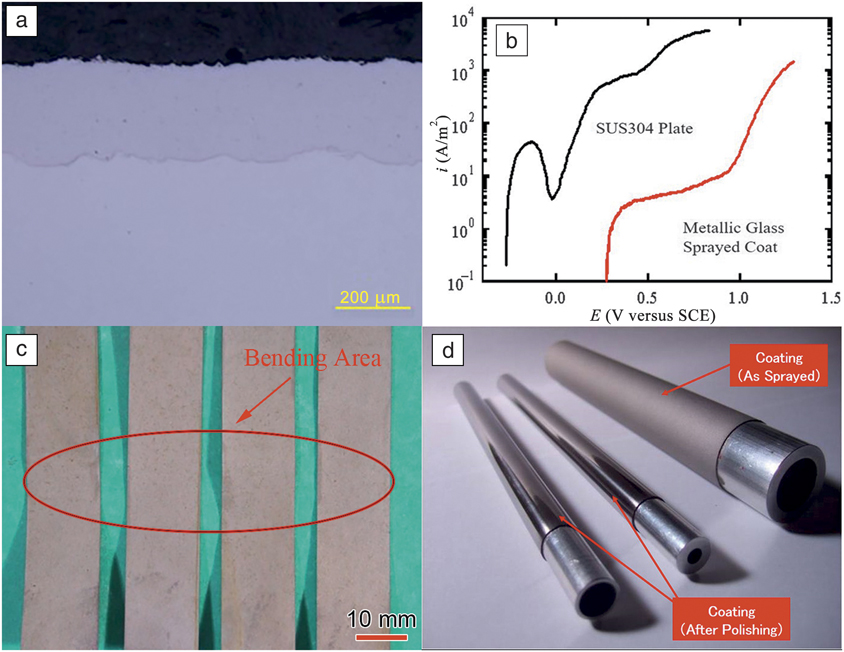
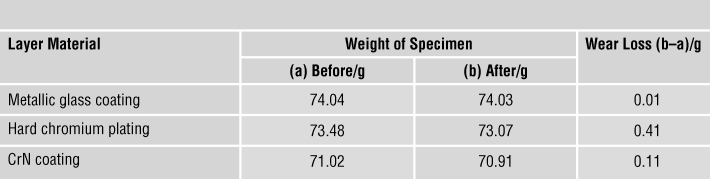
High-velocity oxy-fuel (HVOF) spraying has been widely used for thermal-coating processes. A mixture of fuel and oxygen is ignited to provide heat and high pressure. The coating powder is heated and accelerated in the spray gun and then sprayed at a high velocity onto the surface of the substrate. Exploiting the high GFA that enables the production of BMGs with diameters above several millimeters, glassy deposits with thickness of 0.2–0.5 mm have been applied over the surface by HVOF spraying onto diverse substrates such as stainless steels, plain carbon steels, Al alloys, and Mg alloys.Reference Kim, Nakata, Tsumura, Sugiyama, Igarashi, Fukumoto, Kimura and Inoue30,Reference Sugiyama, Igarashi, Okano, Kimura and Inoue31 Figure 3a shows the cross-sectional structure of a Fe-Cr-Mo-C-B glassy coating that is fully dense and has a high compressive strength.Reference Sugiyama, Igarashi, Okano, Kimura and Inoue31 The coating has good corrosion resistance (Figure 3b). There is no appreciable exfoliation of the coating from the substrate for samples subjected to repeated bending deformation (Japanese Industrial Standards: JIS H 8504:1999, Methods of adhesion test for metallic coatings, Figure 3c). Figure 3d shows coatings applied to pipes.Reference Suryanarayana and Inoue4 The wear resistance test was conducted by the ball-on-disk wear test with a water soluble lubricant for 1 h with a load of 60 kgf. The metallic glass coating shows excellent wear resistance exceeding that of commercial CrN coatings and hard chromium plating (Table I).Reference Igarashi32
(a) Optical micrograph of the cross section of Fe-Cr-Mo-C-B metallic glass (MG) coating. A dense coating with thickness of 200–250 μm was obtained. (b) Corrosive potential (E) and anodic current density (i) curve for stainless-steel SUS304 (with 18 wt% Cr and 8 wt% Ni) plate and Fe-Cr-Mo-C-B MG coating. The MG coating shows a wide stable potential region Note: SCE, saturated calomel electrode. (c) Photograph of an Fe-Cr-Mo-C-B glassy coating prepared by high-velocity oxy-fuel spray coating after repeated bending deformation. Neither abrasion nor swelling can be observed after the bending test. (d) The appearance of MG coatings sprayed onto aluminum pipes.Reference Suryanarayana and Inoue4,Reference Sugiyama, Igarashi, Okano, Kimura and Inoue31

Results of wear tests for metallic glass coating, hard chromium plating, and CrN coating.Reference Igarashi32

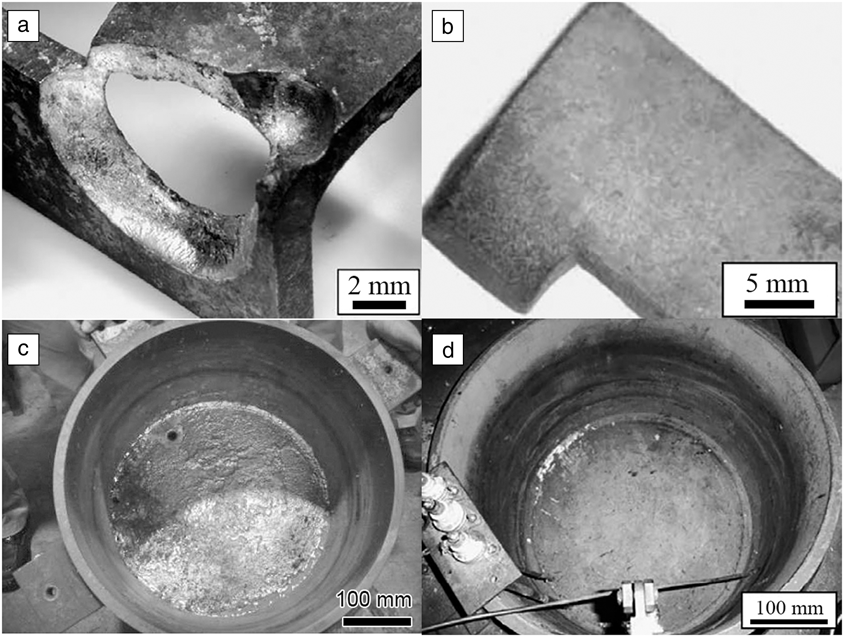
The Fe-Cr-Mo-C-B glassy coating has found use in applications, because its combination of favorable properties cannot be obtained for any crystalline coating. Figure 4 shows the stainless-steel SUS304 test piece with and without a glassy coating after the erosion test and an example of the glassy coating on a vessel used for the melting of lead-free solder.Reference Igarashi, Nakashima, Ishikawa, Sugiyama, Fukumoto, Kimura, Makino and Inoue33 The elimination of lead increases the temperature required for liquid processing and greatly increases the corrosive attack on the steel vessel. The Fe-Cr-Mo-C-B glassy coating demonstrates retention of corrosion and erosion resistances, and of strength, at an elevated temperature.Reference Igarashi, Nakashima, Ishikawa, Sugiyama, Fukumoto, Kimura, Makino and Inoue33 It can be used for at least six months, much longer than the usable life of the best-performing stainless steel.Reference Igarashi, Nakashima, Ishikawa, Sugiyama, Fukumoto, Kimura, Makino and Inoue33 Severe erosion can be observed for the uncoated vessel used for three years, but no sign of erosion can be observed for the coated vessel used for four years under the same condition. The transition to the use of lead-free solder has clear environmental benefits, and the use of the glassy coating facilitates cleaner processing, relevant for sustainability.
Stainless-steel SUS304 test piece subject to an erosion test (a) without Fe-Cr-Mo-C-B metallic glass (MG) coating after 500 h and (b) with MG coating after 2000 h. The photograph of a commercial stainless-steel vessel used for lead-free soldering: (c) three years without MG coating, and (d) four years with MG coating. Severe erosion was observed for the uncoated sample, but no obvious erosion was seen for the coated sample.Reference Suryanarayana and Inoue4,Reference Igarashi32

Zr-based clustered glassy alloys
The primary precipitation phase for Zr65Al7.5Ni10Cu17.5 BMGs changes from a crystalline compound to an icosahedral (I) phase by the partial replacement of Cu with noble metals (NM = Pd, Pt, Ag or Au).Reference Inoue, Zhang, Saida, Matsushita, Chen and Sakurai34 Several studies on I-phase precipitation from the amorphous phase upon annealing have focused on similar Zr-based BMGs with 65–70 at.% Zr and 3–10 at.% NM.Reference Lee, Choi, Kim and Kim35,Reference Jiang, Saksl, Rasmussen, Watanuki, Ishimatsu and Shimomara36 I-phase precipitation has been interpreted to reflect the generation of Ni–NM atomic pairs with positive heats of mixing, leading to the partial destruction of medium-range-ordered atomic configurations. However, there had been no data on the phase decomposition behavior for Zr-rich BMGs containing much larger amounts of NM.
Recently, it was reported that the addition of larger amounts of NMs causes a distinct change in the primary precipitation phase from I-phase to extremely fine cluster-like precipitate; this can be regarded as the formation of a cluster-like glassy phase.Reference Li, Inoue, Han, Kong, Zhu, Shalaan and Al-Marzouki12 The cluster-like glassy alloys have the following compositional features: (1) at least four elements (Zr, Al, TM1, and TM2); (2) large atomic-size mismatches among the main three elements, Zr, Al, and TM; (3) negative heats of mixing among the three elements; (4) large atomic-size mismatches between TM1 and TM2; and (5) positive heats of mixing between TM1 and TM2. Factors (1–3) are the same as those for the formation of ordinary BMGs. The additional (4) and (5) factors seem to be essential for the formation of the cluster-like glassy phase. Multicomponent BMGs with these compositional and structural features are termed as PHE BMGs.Reference Inoue, Kong, Zhu and Al-Marzouki37
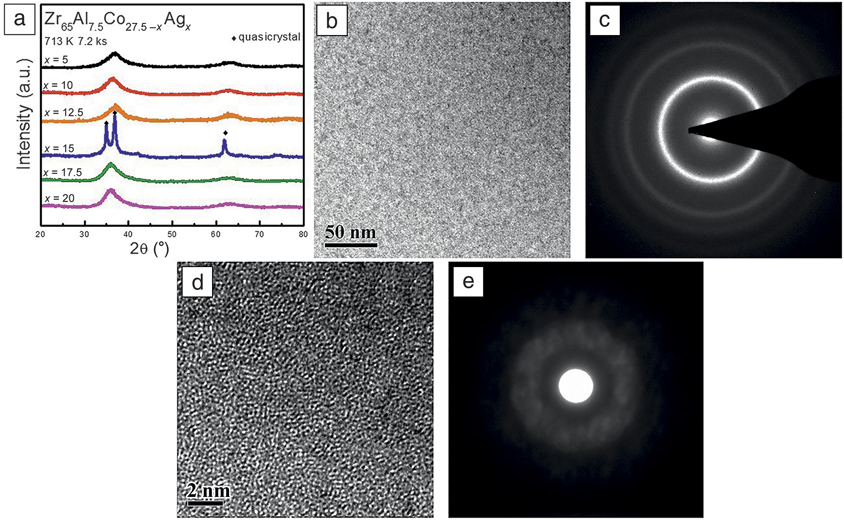
The PHE glassy alloys, Zr65Al7.5Ni10Cu2.5Ag15, Zr65Al7.5Ni15Ag12.5, and Zr65Al7.5Co12.5Ag15,Reference Li, Inoue, Han, Kong, Zhu, Shalaan and Al-Marzouki12,Reference Guo, Inoue, Han, Kong, Feng, Zhu and Ikuhara13 exhibit two exothermic peaks in the differential scanning calorimetry (DSC) curves. Figure 5a shows x-ray diffraction patterns of PHE Zr65Al7.5Co27.5–xAgx glassy alloys annealed for 7.2 ks at 713 K, which is above the onset temperature of the first-stage exotherm peak (T x1). Apart from the x = 15 alloy that shows precipitation of the I-phase, the patterns retain the broad haloes that are typical for a glassy phase, and upon annealing, no distinct change is recognized. In addition, as exemplified for the annealed Zr65Al7.5Co17.5Ag10 alloy in Figure 5b–e,Reference Guo, Inoue, Han, Kong, Feng, Zhu and Ikuhara13 transmission electron microscopy data show the material to be fully amorphous. No appreciable crystalline precipitates were observed even after annealing for a long period of time at temperatures well above T x1, indicating that the PHE amorphous alloys have extremely high stability against phase decomposition. The DSC curves of these annealed cluster-like glassy alloys show only the second exothermic peak.Reference Guo, Inoue, Han, Kong, Feng, Zhu and Ikuhara13 The disappearance of the first exothermic peak indicates that calorimetrically, the effect of annealing is equivalent to completion of the first-stage crystallization reaction. There appear to be no earlier reports of this unusual phenomenon. The change to the cluster-glass phase also increases Hv by approximately 1.5× as compared with as-prepared glassy alloys.
(a) X-ray diffraction patterns of Zr65Al7.5Co27.5–xAgx (x = 5–20 at.%) melt-spun ribbons, where θ is the scattering angle; only the alloy with x = 15 showed an icosahedral phase; (b) transmission electron microscopy (TEM) bright-field image, (c) selected-area electron diffraction pattern, (d) High-resolution TEM image, and (e) nanobeam diffraction pattern of Zr65Al7.5Co17.5Ag10 alloy annealed for 7.2 ks at 713 K, a temperature above the first exothermic peak in differential scanning calorimetry traces.Reference Guo, Inoue, Han, Kong, Feng, Zhu and Ikuhara13

The absence of an appreciable crystalline phase in the cluster-like glassy phase may be due to extremely sluggish crystal grain growth, implying that the PHE alloys also retain bulk GFA, as is evident from the formation of BMG rods with diameters of up to several millimeters.Reference Inoue, Wang, Louzguine-Luzgin, Han, Kong, Shalaan and Al-Marzouki11–Reference Guo, Inoue, Han, Kong, Feng, Zhu and Ikuhara13 These BMGs do not exhibit the first-stage exothermic peak, but no appreciable contrast corresponding to a crystalline phase is observed over the transverse cross section, indicating the formation of Zr-based BMGs with higher resistance to crystallization as compared with ordinary BMGs.Reference Guo, Inoue, Han, Kong, Feng, Zhu and Ikuhara13
Summary
Studies on the potential heat-resistant properties of multicomponent Fe- and Zr-based glassy alloys have been reviewed. Fe-Cr-Mo-C-B glassy alloys have high GFA, which enables the formation of BMG rods with diameters up to 2.7 mm, exhibiting high mechanical strength and good corrosion resistance. The high GFA also enabled glassy coatings with a thickness of at least 0.5 mm to be applied to a diverse range of substrates by a high-velocity spray-coating technique. Such a glassy coating has been applied to vessels that are used for melting of lead-free solder liquid, an application that requires elevated-temperature resistance to corrosion and erosion. Novel cluster-like BMGs with significantly enhanced strength were formed after annealing for long holding times at temperatures well above T x1 for PHE Zr55–65Al7.5–10(TM1,TM2)27.5–35 (TM1 = Fe, Co, Ni, TM2 = Cu, Pd, Ag, Au) alloys. Multicomponent Fe-based and PHE BMGs are promising for future developments of heat-resistant structural materials that retain strength at elevated temperatures.

A. Inoue is a professor at Josai International University, Japan. He received his PhD degree from Tohoku University, Japan, and an honorary doctorate from the Royal Institute of Technology, Sweden, and Shanghai Jiao Tong University, China. He was a professor and president of Tohoku University. He is a member of the Japanese Academy and a foreign member of the US National Academy of Engineering. He also holds special professorships at Tianjin University, China, China University of Mining Technology, King Abdulaziz University, Saudi Arabia, and the National University of Science and Technology, MISiS, Russia. His research focuses on multicomponent bulk glassy, amorphous, and nanocrystalline alloys. Inoue can be reached by email at inoue@jiu.ac.jp.

F.L. Kong is a research associate at the International Institute of Green Materials, Josai International University, Japan. He received his PhD degree in materials science and engineering from Ningbo Institute of Engineering and Technology, Chinese Academy of Sciences, China, in 2012. His research interests include Zr-based bulk metallic glasses and Fe-based soft magnetic amorphous and nanocrystalline alloys. Kong can be reached by email at kong@jiu.ac.jp.

S.L. Zhu is a professor in the School of Materials Science and Engineering at Tianjin University, China. He received his PhD degree in materials science and engineering from Tianjin University. His research interests include Ti-based bulk metallic glasses and nanoporous alloys. Zhu can be reached by email at slzhu@tju.edu.cn.

A. Lindsay Greer is a professor of materials science and head of the School of Physical Sciences at the University of Cambridge, UK. He received his MA and PhD degrees from the University of Cambridge and an honorary doctorate from AGH University of Science and Technology, Poland. He was an assistant professor at Harvard University, has held visiting positions in Grenoble, St. Louis, Vienna, and Turin, and is a foreign principal investigator in the Advanced Institute for Materials Research at Tohoku University, Japan. His research focuses on microstructural kinetics and the glassy state. Greer can be reached by email at alg13@cam.ac.uk.