Introduction
The monotypic genus Saltisedes Kubota, Reference Kubota1944 was established (Kubota Reference Kubota1944) with a single species, Saltisedes brunneus Kubota, Reference Kubota1944, from Takao Mountain, Honshu, Japan, and was placed in the tribe Tyrini. Later, S. brunneus was found to be widespread throughout Japan (Sawada Reference Sawada1966; Hirano Reference Hirano1978; Sugaya et al. Reference Sugaya, Hlaváč and Nomura2003). Recently, Saltisedes was moved from Tyrini to Tmesiphorini (Hlaváč and Chandler Reference Hlaváč and Chandler2005) based on the presence of the unique semicircular setose sulci that partially encircle the antennal insertions that is found in members of the Tmesiphorini.
In this paper, Saltisedes is redefined, the type species redescribed, and three new species are described: S. hainanensis Yin and Nomura, new species (China: Hainan), S. kojimai Nomura and Yin, new species (Japan: Okinawa), and S. yahiroi Nomura and Yin, new species (Malaysia: Perak). Habitus illustrations, diagnoses, and key for the identification of these species are provided.
The synonymy of Saltisedes with Stethotaphrus Newton and Chandler was confirmed using several Stethotaphrus specimens from the Philippines and Australia, which were compared with the above mentioned Saltisedes species. The results showed that species of the two genera are consistent in the foveal pattern and most external characters that define the respective genus. Thus Stethotaphrus is here synonymised with Saltisedes (new synonymy), with the latter being the older name. The five presently recognised species of Stethotaphrus are here moved to Saltisedes with the new combinations in the species list near the end of the paper.
Materials and methods
The terminology follows Chandler (Reference Chandler2001), except for using the term “ventrite” instead of “sternite” when concerning the mesothoracic and metathoracic structures.
A slash (/) is used to separate lines on the same label, and a double slash (//) is used to separate different labels on the same pin.
All measurements are in millimetres. The following acronyms are used in the text:
AL – length of the abdomen; AW – maximum width of the abdomen; BL – length of the body (= HL + PL + EL + AL); EL – length of the elytra along the sutural line; EW – maximum width of the elytra; HL – length of the head from the anterior clypeal margin to the occipital constriction; HW – width of the head across eyes; PL – length of the pronotum along the midline; PW – maximum width of the pronotum.
Material used in the present study is housed in the following institutions:
NSMT – The National Museum of Nature and Science, Tokyo, Japan (Shûhei Nomura).
SNUC – Insect Collection of Shanghai Normal University, Shanghai, China (Zi-Wei Yin).
Saltisedes Kubota
Saltisedes Kubota, Reference Kubota1944: 8. Type species: Saltisedes brunneus Kubota, Reference Kubota1944 (by original monotypy). Type locality: Honshu, Japan.
= Taphrostethus Schaufuss, 1882. (preoccupied by Taphrostethus Fieber, 1844). Type species: Epicaris hamotoides Schaufuss, 1882 (by original monotypy). Type locality: Sarawak, Borneo. New synonymy.
= Stethotaphrus Newton and Chandler, Reference Newton and Chandler1989. (replacement name for Taphrostethus Schaufuss, 1882). New synonymy.
Diagnosis
Head with vertexal and frontal foveae; maxillary palpi with short and triangular palpomeres III, palpomeres IV large and elongate, with apical halves narrowed to acute apices. Pronotum with disc strongly convex; small discal spine usually present in both sexes; median antebasal foveae present; lateral antebasal foveae small. Abdomen with tergite IV largest, deeply impressed across base; discal carinae present.
Redescription
Male. Reddish brown. Length 1.5–2.3 mm. Frontal rostrum short, formed by prominent antennal tubercles separated by shallow median impression; with small and nude vertexal and frontal foveae; with 11 antennomeres, clubs formed by apical 3–4 antennomeres; with shallow postantennal notches at lateral margins, with setose semicircular sulci ventral to antennal insertions; clypeal apex extending posteriorly to form gular-mandibular carinae beneath eyes. Maxillary palpi with four palpomeres; palpomeres I small; II elongate, pedunculate in basal halves, gradually widening to apices; III short and triangular; IV enlarged and elongate, with truncate bases, evenly narrowing from middle to acute apices, with small palpal cone. Postocular margins rounded. Gular moderately swollen, foveae close in shallow transverse pit.
Pronotum with disc strongly convex, usually with well-defined discal spine posterior to middle; median antebasal fovea small and shallow; lateral antebasal foveae very small; lateral procoxal foveae present. Each elytron with two basal foveae; discal striae shallow. Mesoventrite with prepectal foveae; median mesoventral fovea broad, broadly forked internally; lateral mesoventral foveae present; median longitudinal carina present; with small anterolateral mesoventral foveae; with lateral mesocoxal foveae; lateral metaventral foveae absent.
Forelegs with femora modified dorsally at base; first tarsomeres short, with two long spines (also found on meso-pair of tarsi in S. kojimai), third tarsomeres longest, second tarsomeres about half length of third tarsomeres.
Abdomen with dorsal surface strongly convex; tergite IV longest, densely setose and deeply impressed at base; mediobasal foveae combined with smaller basolateral foveae to form composite foveae (see Chandler Reference Chandler2001: 25), discal carinae present, varying in length. Sternite IV with deep basal sulcus, IV, V, and VII with basolateral foveae. Aedeagus with median lobe often slightly asymmetric at apex, with symmetric parameres, endophallus comprised of complicated sclerites.
Female. Similar to male in general; eyes slightly smaller; antennal clubs less stout; profemora simple.
Comparative notes
Saltisedes can be readily separated from all other tmesiphorine genera by the simple maxillary palpi lacking any lateral spines or projections, and the pronotum usually with a distinct discal spine in both sexes.
Discussion
According to Kubota's original description for the genus (Kubota Reference Kubota1944: 9, Fig. 3A), Saltisedes has the maxillary palpomeres IV largely concave on the mesal faces. But both specimens identified as S. brunneus used in this study have the maxillary palpomeres IV normally convex dorsal-laterally and flat mesally, which is contrary to the original description.
Fortunately, Hirano (Reference Hirano1978) provided very useful information of this character based on his examination of the type series and additional material from Kanagawa, Honshu, Japan. Since the paper was published in Japanese, it is roughly translated and introduced here: “The holotype of Saltisedes brunneus has the left maxillary palpus IV not concave, while the right one was broken during the war; the allotype has the left maxillary palpus normally convex, but the right one is concave on mesal face, exactly like the one figured for Saltisedes by Kubota; in the six male and three female specimens from Kanagawa, only one female has the left maxillary palpomere IV impressed. In addition, the single female collected by K. Sawada (Reference Sawada1966) from Mie-ken, Honshu has the fourth maxillary palpi not concave at mesal faces. Based on this observation, I believed that such a concavity may be caused by the change of condition during the drying of specimen.” A similar concavity of maxillary palpi IV was noticed for one of the specimens of a Philippine species by the third author, but it was thought to be a collapse of the surface because the specimen may not have fully hardened yet. The rest of the specimens of this species, another species from Philippines, Saltisedes weiri Chandler from Australia, and the new species described in this paper all have normal maxillary palpi IV. It seems unlikely that such an occasional concavity should be used to define a genus, therefore we exclude it from the generic definition of Saltisedes.
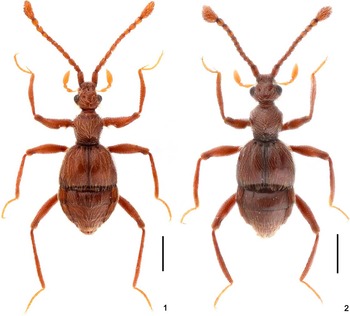
On the other hand, the original figure (Kubota Reference Kubota1944: 9, Fig. 4) indicated that S. brunneus lacks a median antebasal fovea on the pronotum and has discal carinae of the tergite IV extending through entire tergal length. Our examination of S. brunneus reflected that the pronotal median antebasal fovea is present, though not sharply defined, and the discal carinae extend to four-fifths of the tergal length (Fig. 1).
Male habitus of Saltisedes: 1, S. brunneus Kubota; 2, S. hainanensis Yin and Nomura, holotype. Scale = 0.5 mm.

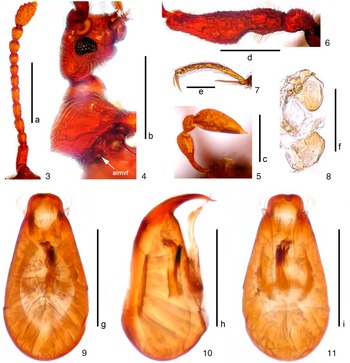
Saltisedes brunneus Kubota: 3, antenna; 4, head and pronotum in lateral view; 5, maxillary palpus; 6, profemur; 7, protarsus; 8, sternite IX; 9, aedeagus in dorsal view; 10, aedeagus in lateral view; 11, aedeagus in ventral view. almvf = anterolateral mesoventral foveae. Scale: a, b = 0.5 mm; c, e, f, g, h, i = 0.2 mm; d = 0.3 mm.

Saltisedes brunneus Kubota
Saltisedes brunneus Kubota, Reference Kubota1944: 9.
Type locality
Takao Mountain, Honshu, Japan
Material examined (two males)
One male, labelled “Mt. Ichifusa / Kumamoto Pref. / Kyushu, Japan // 27.iv.1993 / S. Nomura leg. // FAUNA JAPONICA / Staphylinidae, Pselaphinae / Saltisedes brunneus Kubota / S. Nomura det., 2002;” 1 male, labelled “JAPAN, Hokkaido / Ebetsu, C. HMH / Lasius / Nopporo Forest Park / 7–12.viii.2001 / Shigehisa Hori leg. // HORI-HOKKAIDO Coll. / Staphylinidae, Pselaphinae / Saltisedes brunneus Kubota / S. Nomura det., 2007.”
Diagnosis
No less than 2.0 mm; antennomeres IV–V much longer than wide; tergite IV with discal carinae almost reaching posterior border; aedeagus elongate, with long parameres not split at apices.
Redescription
Male (Fig. 1). Length 2.00–2.14 mm. Head as long as wide, HL 0.40–0.42 mm, HW 0.40–0.42 mm; eyes large, each composed of about 65 facets. Maxillary palpi as in Figure 5. Antennal clubs (Fig. 3) loosely formed by apical three antennomeres; scapes large; antennomeres II slightly elongate, about half length of scapes; III longer than II; IV–V thinner than III, more than twice as long as wide; XI–VIII gradually stouter; XI and X similar, larger than VIII; XI largest, robust, about two-thirds as wide as long.
Pronotum (Figs. 1, 4) about as long as wide, PL 0.40–0.45 mm, PW 0.38–0.45 mm. Elytra wider than long, EL 0.55–0.61 mm, EW 0.82–0.85 mm; discal stria shallow, end at elytral mid-length. Profemora (Fig. 6) obliquely impressed on dorsal face in basal halves, with row of thickened setae at impression; protibiae curved at apical third, thickest at middle; first tarsomeres (Fig. 7) with two long, thin spines reaching past apices of second tarsomeres; meso-pairs and meta-pairs of tarsi simple.
Abdomen wider than long, AL 0.65–0.66 mm, AW 0.83–0.85 mm. Tergite IV slightly longer than V, discal carinae reaching four-fifths tergal length. Sternite IX (Fig. 8) formed by paired membranous sclerites. Aedeagus (Figs. 9–11) length 0.32, well sclerotised; median lobe elongate, apical third strongly curved ventrally, gradually narrowed to pointed apex; endophallus strongly sclerotised, composed of two claw-like sclerites; parameres long, apices not split, each with four long apical setae.
Female. Not examined.
Distribution
Japan: Hokkaido, Honshu, Shikoku, Kyushu.
Saltisedes hainanensis Yin and Nomura, new species
Type locality
Wuzhishan Mountain, Hainan Island, China
Type material (one male, one female)
Holotype, male, CHINA, labelled “China: Hainan Prov. / Wuzhishan Mt. / Guzhandao / 30.xi.2009, 638 m // 18.86657°E / 109.68285°E / M. Y. Ling leg. // [red] Holotype / Saltisedes hainanensis sp. n. / Yin & Nomura / det. 2012, SNUC.” Paratype, one female, CHINA, labelled “China: Hainan Prov. / Baisha County / Yinggeling / Kongkan Reservoir / 24.xi.2009, 525 m // 19.08121°E / 109.49839°E / M. Y. Ling leg. // [yellow] Paratype / Saltisedes hainanensis sp. n. / Yin & Nomura/det. 2012, SNUC.”
Etymology
The species is named after the type locality, Hainan Island.
Diagnosis
No less than 2.0 mm; antennomeres IV–V slightly elongate; tergite IV with discal carinae extending less than half tergal length; aedeagus robust, with short parameres split at apical third.
Description
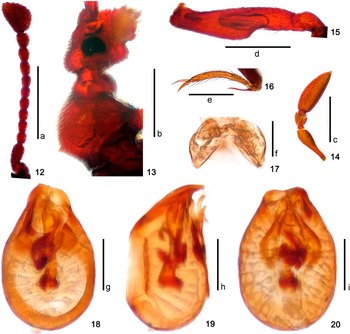
Male (Fig. 2). Length 2.11 mm. Head about as long as wide, HL 0.44 mm, HW 0.42 mm; eyes prominent, each composed of about 60 facets. Maxillary palpi as in Figure 14. Antennal clubs (Fig. 12) formed by apical four antennomeres; scapes large; antennomeres II–VII similar in form, nearly quadrate; VIII–XI enlarged; VIII as large as IX; X slightly wider than IX; XI largest, robust, about three-fourths as wide as long.
Saltisedes hainanensis Yin and Nomura: 12, antenna; 13, head and pronotum in lateral view; 14, maxillary palpus; 15, profemur; 16, protarsus; 17, sternite IX; 18, aedeagus in dorsal view; 19, aedeagus in lateral view; 20, aedeagus in ventral view. Scale: a = 0.5 mm; b, d = 0.3 mm; c, e = 0.2 mm; f, g, h, i = 0.1 mm.

Pronotum (Figs. 2, 13) slightly longer than wide, PL 0.46 mm, PW 0.43 mm. Elytra wider than long, EL 0.52 mm, EW 0.76 mm; discal stria shallow, ending at elytral midpoint. Profemora (Fig. 15) obliquely impressed on dorsal face in basal halves, with several thickened setae at impression; protibiae curved at apical third, thickest at middle; first tarsomeres (Fig. 16) with two long, thin spines reaching apices of second tarsomeres; meso-pairs and meta-pairs of tarsi simple.
Abdomen wider than long, AL 0.69 mm, AW 0.75 mm. Tergite IV much longer than V, discal carinae reaching less than half of tergal length. Sternite IX (Fig. 17) formed by paired membranous sclerites. Aedeagus (Figs. 18–20) length 0.27, well sclerotised; median lobe short, narrowed at apical half, apical fifth curved ventrally; endophallus complicated, strongly sclerotised, composed of three sclerites; parameres short, split at apical third, each with three apical setae.
Female. BL 2.07 mm, HL 0.43 mm, HW 0.42 mm, PL 0.46 mm, PW 0.42 mm, EL 0.52 mm, EW 0.78 mm, AL 0.66 mm, AW 0.76 mm. Eyes each composed of about 60 facets.
Distribution
China: Hainan Island.
Saltisedes kojimai Nomura and Yin, new species
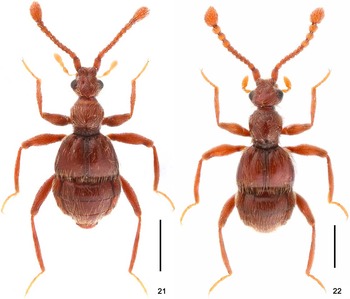
Male habitus of Saltisedes: 21, S. kojimai Nomura and Yin, holotype; 22, S. yahiroi Nomura and Yin, holotype. Scale = 0.5 mm.

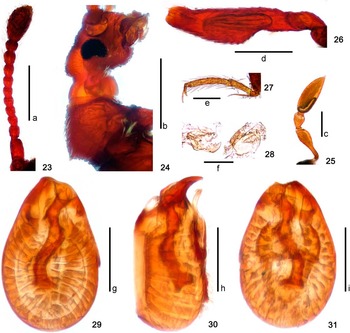
Saltisedes kojimai Nomura and Yin: 23, antenna; 24, head and pronotum in lateral view; 25, maxillary palpus; 26, profemur; 27, protarsus; 28, sternite IX; 29, aedeagus in dorsal view; 30, aedeagus in lateral view; 31, aedeagus in ventral view. Scale: a, b = 0.3 mm; d = 0.2 mm; c, e, f, g, h, i = 0.1 mm.

Type locality
Bannadake Mountain, Okinawa, Japan
Type material (one male, two females)
Holotype, male, JAPAN, labelled “Mt. Bannadake / Ishigakijima Is. / Okinawa Pref. // [Ryuku, JAPAN] / 23.iv.2003 / Hiroaki Kojima leg. // FAUNA JAPONICA / Staphylinidae, Pselaphinae / Saltisedes sp. 1 / S. Nomura det., 2002 // [red] Holotype / Saltisedes kojimai sp. n. / Nomura & Yin / det. 2012, NSMT.” Paratypes, one female, JAPAN, labelled “Airagawa (decayed wood) / Iriommotejima Is., Okinawa / [Ryukyu, Japan] / 19.iii.2004, S. Nomura leg.;” one female, JAPAN, labelled “Mt. Nagodake (decayed/wood), Nago-shi / Okinawajima Is. / [Ryukyu, JAPAN] / 21.iii.2005, S. Nomura leg.” Both paratypes bear the following yellow label: “Paratype / Saltisedes kojimai sp. n. / Nomura & Yin/det. 2012, NSMT.”
Etymology
The species is named after H. Kojima, collector of the holotype.
Diagnosis
Length about 1.6 mm; antennomeres IV–V slightly transverse; tergite IV with discal carinae extending three-fourths tergal length; aedeagus stout, with short parameres not split at apices.
Description
Male (Fig. 21). Length 1.59 mm. Head about as long as wide; HL 0.35 mm, HW 0.32 mm; eyes prominent, each composed of about 60 facets. Maxillary palpi as in Figure 25. Antennal clubs (Fig. 23) loosely formed by apical three antennomeres; scapes large; antennomeres II much shorter; III–VIII each quadrate; IX–X slightly wider than previous antennomeres; X shorter than IX; XI largest, nearly oval, slightly less than twice as long as wide.
Pronotum (Figs. 21, 24) as long as wide, PL 0.33 mm, PW 0.33 mm. Elytra wider than long, EL 0.40 mm, EW 0.64 mm; discal stria shallow, ending before elytral midpoint. Profemora (Fig. 26) obliquely impressed on dorsal face in basal halves, with tuft of thickened setae at impression; protibiae slightly curved at apical third, thickest at middle; first tarsomeres (Fig. 27) with two long, thin spines reaching near apices of second tarsomeres; meso-pair of tarsi with similar spines at same position; meta-pair simple.
Abdomen wider than long, AL 0.51 mm, AW 0.68 mm. Tergite IV much longer than V, discal carinae reaching three-fourths tergal length. Sternite IX (Fig. 28) composed of paired membranous sclerites. Aedeagus (Figs. 29–31) length 0.23, well sclerotised; median lobe short, apical third strongly curved ventrally, gradually narrowed to pointed apex; endophallus composed of strongly sclerotised elongate sclerite; parameres short, not split at apices, each with three to four setae.
Female. BL 1.57–1.68 mm, HL 0.32–0.35 mm, HW 0.32–0.34 mm, PL 0.36–0.37 mm, PW 0.35–0.36 mm, EL 0.40–0.43 mm, EW 0.62–0.66 mm, AL 0.49–0.53 mm, AW 0.66–0.69 mm. Eyes each composed of about 55 facets.
Distribution
Japan: Okinawa.
Saltisedes yahiroi Nomura and Yin, new species
Type locality
Bukit Gantang, Taiping, Malaysia
Type material (one male)
Holotype, male, MALAYSIA, labelled “Taiping / Bukit Gantang / MALAYSIA // 27.xii.1989/K. Yahiro leg. // [red] Holotype / Saltisedes yahiroi sp. n. / Nomura & Yin / det. 2012, NSMT.”
Etymology
The species name is dedicated to K. Yahiro, collector of the holotype.
Diagnosis
Less than 2.0 mm; antennomeres IV–V each transverse; tergite IV with discal carinae extending less than half tergal length; aedeagus stout, with short parameres split at apical third.
Description
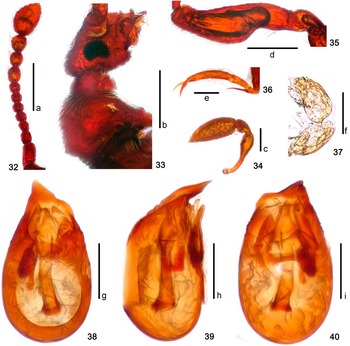
Male (Fig. 22). Length 1.83 mm. Head about as long as wide, HL 0.39 mm, HW 0.41 mm; eyes large, each moderately prominent, composed of about 55 facets. Maxillary palpi as in Figure 34. Antennal clubs (Fig. 32) formed by apical four antennomeres; scapes large; antennomeres II slightly elongate, about half length of scapes; III–VII each transverse; VIII–XI enlarged, similar in form; XI largest, robust, about three-fourths as wide as length.
. Saltisedes yahiroi Nomura and Yin: 32, antenna; 33, head and pronotum in lateral view; 34, maxillary palpus; 35, profemur; 36, protarsus; 37, sternite IX; 38, aedeagus in dorsal view; 39, aedeagus in lateral view; 40, aedeagus in ventral view. Scale: a, b = 0.3 mm; d = 0.2 mm; c, e, f, g, h, i = 0.1 mm.

Pronotum (Figs. 22, 33) nearly as long as wide, PL 0.43 mm, PW 0.41 mm. Elytra wider than long, EL 0.44 mm, EW 0.69 mm, discal stria shallow, end near elytral mid-length. Profemora (Fig. 35) obliquely impressed on dorsal face in basal halves, with several thickened setae at impression; protibiae slightly curved at apical third, thickest at middle; first tarsomeres (Fig. 36) with two long, thin spines reaching apices of second tarsomeres; meso-pairs and meta-pairs simple.
Abdomen wider than long, AL 0.57 mm, AW 0.67 mm. Tergite IV about twice as long as V, discal carinae extending less than half tergal length. Sternite IX (Fig. 37) formed by paired membranous sclerites. Aedeagus (Figs. 38–40) length 0.27, well sclerotised; median lobe short, apex asymmetrical, sharpened and curved ventrally; endophallus strongly sclerotised, composed of two sclerites; parameres short, split at apical third, each with two to three short setae.
Female. Unknown.
Distribution
Malaysia: Perak.
Unidentified female specimen
The single unidentified female specimen is listed here so that it can be located for future study.
Material examined
One female, labelled “Doi-Chang Kian / THAILAND / 18.xi.1989 / K. Yahiro leg.” (NSMT).
Measurements
BL 1.91 mm, HL 0.40 mm, HW 0.40 mm, PL 0.41 mm, PW 0.40 mm, EL 0.51 mm, EW 0.76 mm, AL 0.62 mm, AW 0.79 mm. Each eye composed of about 50 facets.
Comments
The single female looks very similar to S. yahiroi, sharing the small body size and short discal carinae of the tergite IV. However, association with a male will not be certain until a female of S. yahiroi is collected from the type locality, or males from Doi-Chang Kian, Thailand are found.

List of Saltisedes species
1. Saltisedes brunneus Kubota, Reference Kubota1944. Japan: Hokkaido, Honshu, Shikoku, Kyushu.
2. Saltisedes clavatus (Raffray, 1882), new combination, New Guinea.
3. Saltisedes hainanensis Yin and Nomura, new species, China: Hainan.
4. Saltisedes hamotoides (Schaufuss, 1882), new combination, Borneo: Sarawak.
5. Saltisedes javanicus (Raffray, 1882), new combination, Indonesia: Java.
6. Saltisedes kojimai Nomura and Yin, new species, Japan: Okinawa.
7. Saltisedes longispina (Raffray, 1903), new combination, New Guinea: Madang.
8. Saltisedes weiri (Chandler Reference Chandler2001), new combination, Australia: Queensland.
9. Saltisedes yahiroi Nomura and Yin, new species, Malaysia: Perak.
Acknowledgements
The first author thanks Alfred F. Newton Jr. (Chicago, United States of America) for sending Kubota's reprints. We thank Andrew Smith (Ottawa, Canada) for editing the manuscript and the two anonymous reviewers for comments on an earlier draft. This study is supported by the National Natural Science Foundation of China (31172134) and Shanghai Normal University (SK201242).