INTRODUCTION
Guillet's goby, Lebetus guilleti (Le Danois, Reference Le Danois1913), is thought to be Europe's smallest marine fish with the maximum observed standard length of 24 mm (Maitland & Herdson, Reference Maitland, Herdson and Coates2009). It was only recognized as a species in 1971, when it was elevated from sub-species as Lebetus scorpioides guilleti (Le Danois, Reference Le Danois1913) to species level (Miller, Reference Miller1971).
There are few records of this species from the UK. Post-larvae of Guillet's goby have been collected from the English Channel near Plymouth (Demir & Russell, Reference Demir and Russell1971) and from the Isle of Man (Miller, Reference Miller1963, Reference Miller1971). A mature specimen of Guillet's goby was observed in Lyme Bay during benthic surveys in the English Channel in July 2009 (Lin Baldock, personal communication). In Europe, Guillet's goby has been recorded in the Adriatic Sea (Herler & Kovačić, Reference Herler and Kovačić2002) Banyuls (see Zander in Herler & Kovačić), south-west Ireland, the Kattegat, southern Scandinavia (Maitland & Herdson, Reference Maitland, Herdson and Coates2009); and the larval stage from the Iberian Peninsula (Rodriguez et al., Reference Rodriguez, Gonzalez-Nuevo, Gonzalez-Pola and Cabal2009) and Gran Canaria (Moyano & Hernández-León, Reference Moyano and Hernández-León2009). Previously the known range of Guillet's goby extended to 58°N (Kattegat, southern Scandinavia) with no known records in Scotland. Observed specimens in this paper extend the known range of this species.
MATERIALS AND METHODS
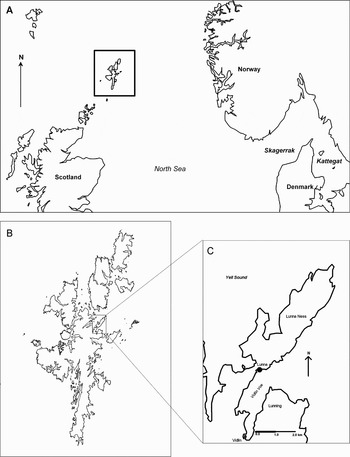
Observations were made using SCUBA during two dives carried out as part of a survey to document marine fauna around the Shetland coast. The Shetland Islands are the United Kingdom's most northerly island group situated on the same latitude as Bergen, Norway (Figure 1A). Two dives took place on the north-east corner of mainland Shetland at Lunna Kirk on the peninsular Lunna Ness (60°24′08.5″N 01°07′07.7″W) (Figure 1B, C) on 20 June and 29 June 2010. Lunna Kirk is a moderately sheltered bay dominated down to 9–11 m by Laminaria hyperborea ((Gunnerus) Foslie, 1884) and Saccharina latissima ((Linnaeus) C.E. Lane, C. Mayes, Druehl & G.W. Saunders, 2006) replaced at greater depths by a shell–gravel substratum which continues to a maximum depth of 50 m. The survey dives involved swimming out over the kelp to a depth of 15 m on the shell–sand substrate and slowly swimming back up the slope to the kelp line looking for marine fauna. Photographs were taken of significant marine fauna using a Nikon D300 and a Nikon D70, Nikkor 60 mm macro lenses with Ikelite housings and Inon Z240 and Z220 flash units. Reference specimens were not collected.
(A) The location of the Shetland Isles in the context of Europe; (B) Shetland Archipelago; (C) Lunna Ness enlarged—black dot indicates the study site.

RESULTS
Guillet's gobies were observed on each dive. On both occasions male and female pairs were found together. Gobies were observed on shell–gravel where the sediment roughness allowed them to sit inconspicuously between pieces of shell. These open patches of sediment were found in gullies within the kelp forest, with one pair located at a depth of 10 m below chart datum and the second pair at 8 m below chart datum. Shetland waters are generally associated with high water clarity and low sediment loading, greatly assisting observations.
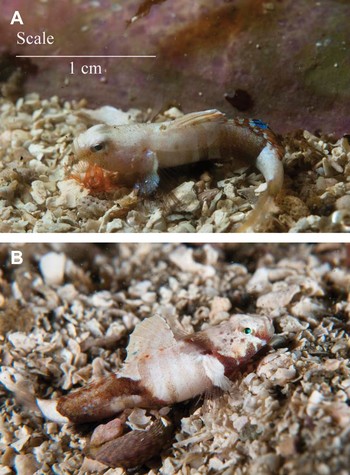
On both occasions the male (Figure 2A) and female (Figure 2B) were found close together, within 15 cm of each other. When the second pair was first approached the male was located in a hole approximately 5 cm from the female. On approach the male moved out of the hole towards the female goby. Additionally the female of this pair appeared to be swollen with eggs (Figure 2B), suggesting the presence of a breeding population. Throughout the observation period the gobies were observed to remain very still to the extent that when a hermit crab walked across one of the pair the goby did not move.
(A) Male Guillet's goby, Shetland; (B) female Guillets's goby, Shetland.

Guillet's goby shows sexual dimorphism that includes both size and colour and in both instances the female, in both pairs, appeared larger than the male.
Coloration
Both the male and female showed a general brown and white coloration (Figure 2A, B). The female appeared to show a generally darker coloration, particularly in the head region (Figure 2B). The male had six orange bands on the second dorsal fin (Figure 2A). The male also had a prominent large blue spot on the anterior upper edge of D2 (Figure 2A) which appears to be absent in the female. D1 is triangular in shape and the female had a small blue-green spot on the first dorsal fin (D1) (Figure 2B).
DISCUSSION
This is the first recorded observation of Guillet's goby in Scotland. This potential breeding site extends the known range of this species approximately 140 miles further north from 58°N (Kattegat, southern Scandinavia) to 60°N (Shetland). Although it is possible this represents a climate linked range expansion, it is probable that small species such as Guillet's goby are under-recorded. This may be due to their small size, cryptic coloration and behaviour. Additionally identification of this species in the field can be difficult as distinguishing markings are hard to discern with the naked eye.
The colour patterns and sexual dimorphism observed in this study are consistent with observations made in the Adriatic (Herler & Kovačić, Reference Herler and Kovačić2002). There are minor differences in colour descriptions given by Herler & Kovačić (Reference Herler and Kovačić2002) and this study, for example, the bands on D2 are described by Herler & Kovačić (Reference Herler and Kovačić2002) as yellow and in our study they appear orange. These differences are unlikely to represent regional differences but may be due to the difference in colour rendition between cameras and perhaps because some of Herler & Kovačić (Reference Herler and Kovačić2002) observations were made using fish which had been anaesthetized, potentially causing colour changes. It should also be noted that images on FishBase (Froese & Pauly, Reference Froese and Pauly2000) show images from the Adriatic with specimens with orange coloured bands on D2.
Adult specimens of Guillet's goby, Lebetus guilleti, can be distinguished in the field from the closely related Diminutive goby, Lebetus scorpioides (Collett, 1874) by a number of key features. In L. scorpioides the male D1 is yellow, large and rounded (Miller, Reference Miller1963, Reference Miller1971) compared to the pale, small and triangular D1 observed in L. guilleti. In L. guilleti there are six bands on D2 in the male, whereas L. scorpioides has four broad bands (Miller, Reference Miller1963, Reference Miller1971).
Guillet's gobies in this study were observed on rough ground consisting of shell–gravel in 8 m and 10 m of water. The association with this type of habitat has been observed in a number of locations. In Lyme Bay Guillet's goby was found on sparse maerl–gravel at a depth of 18 m (Lin Baldock, personal communication), in the Adriatic it was found on biogenic coarsely structured gravel at depths between 6 m and 13 m (Herler & Kovačić, Reference Herler and Kovačić2002). It was caught on rough ground around the Isle of Man in a scallop dredge lined with shrimp netting (Miller, Reference Miller1963). This may indicate that the favoured habitat of adult Guillet's goby is shallow water from 2 to 30 m on a substrate of Lithothamnion alga-encrusted small stones (Maitland & Herdson, Reference Maitland, Herdson and Coates2009) and a mixture of coarse shell–gravel. These structurally varied habitats may allow L. guilleti to sit between shells, stones and algal fragments making it inconspicuous and may act as a predator avoidance strategy.
Records of L. guilleti appear to follow a narrow shallow depth band (2–30 m), contrasting with L. scorpioides, which has been found from 3.5 to 375 m (Miller, Reference Miller1963). It is possible that these species show differing depth profiles, however, it may be difficult to draw firm conclusions without further records for Lebetus guilleti.
ACKNOWLEDGEMENTS
We are indebted to Dr Francis Dipper, Dr Lin Baldock, Paul Kay and Marcelo Kovačić for help in identification of this species. Two anonymous referees provided constructive criticism.