Introduction
Health care disasters are events of sufficient magnitude such that they exceed the capabilities of the resources of the setting and personnel responding.Reference Aluisio, Daniel, Grock, Freedman, Singh, Papanagnou and Arquilla 1 - Reference Tintinalli, Stapczynski, Ma, Cline, Cydulka and Meckler 3 Disasters can be natural geophysical events (eg, earthquakes or floods), human-incurred events (eg, biological exposures or conflict settings), or a combination of both.Reference Noji 4 The morbidity, mortality, and economic impacts of disasters are immense. Between 1994 and 2013, approximately seven thousand natural disasters were recorded affecting more than 200 million people and accounting for greater than one million deaths globally.Reference Leaning and Guha-Sapir 5 , Reference Guha-Sapir and Vos 6 In 2014, there were over 140 million victims of disaster events with an estimated economic cost of US $99 billion. 7 The majority of the public health burdens associated with disasters exist in low- and middle-income countries (LMICs) where resources to respond to disasters often are limited. In 2014, 85% of disaster-related mortalities occurred in LMICs in Asia,Reference Leaning and Guha-Sapir 5 , 8 with India accounting for approximately 18% of all deaths among the top ten most affected nations.Reference Guha-Sapir and Vos 6 , 7
Principles of disaster management focus on maximizing efficacious care for the largest number of affected people. 9 Within this paradigm, effective education pertaining to triage is crucial for efficient resource allocation and in addressing morbidity and mortality associated with disasters.Reference Savoia, Lin and Viswanath 10 - Reference Jenkins, McCarthy and Sauer 12 In many LMIC settings, where disasters occur most frequently, there exists a low per capita proportion of physicians, and as such, non-physicians assume a prominent role in health care venues during disaster events.Reference Hick, Hanfling and Cantrill 13 Additionally, research has highlighted that nurses specifically have significant roles in development of disaster plans, treatment of casualties, and evaluation of response activities, and in India, nurses are identified as key members of disaster response teams. 14 - 17
Although the Sendai Framework for Disaster Risk Reduction calls for training which is easy to conduct, comprehensive, effective, and acceptable, there exists no substantial evidence supporting a specific training methodology as the most effective teaching method.Reference Talati, Bhatia, Kumar, Gupta and Ojha 18 Andragogical adult educational theories assume that learners have an independent sense of self, a reservoir of life experiences they apply, and a problem-centered (rather than content-centered) approach to learning.Reference Carabine 19 The predominant educational methods used for adult learners that satisfy these andragogical assumptions during disaster education include simulation exercises (SEs) and case-based learning (CBL).Reference Kaufman 20 - Reference Kuntz, Frable, Qureshi and Strong 25 Case-based learning employs active participation by learners with cases as a stimulus for small group discussions to facilitate engaged multidirectional educational exchange.Reference Shannon 26 - Reference Holaday and Buckley 28 This form of education can foster collaborative knowledge translation; its weaknesses, however, include insufficient realism and a need for consistent and well-trained facilitators.Reference Schmidt 29 , Reference Albanese and Mitchell 30 Simulation exercises have become a frequently used teaching modality in health care education,Reference Jin and Bridges 31 - Reference Fiedor 35 as simulation facilitates enhanced standardization and realism and encourages active participation in learners.Reference Grenvik and Schaefer 36 - Reference Issenberg, McGaghie, Petrusa, Lee Gordon and Scalese 38 Although both CBL and SEs are dynamic educational methodologies that create learner-to-learner interactions, these modalities differ in that educational instruction predominantly is achieved by oral feedback in CBL versus more tangible manikin- or actor-based feedback in SEs.Reference McCoy, Menchine, Anderson, Kollen, Langdorf and Lotfipour 39
Both CBL and SEs are utilized in teaching adult learners disaster preparedness; however, to date, there is no substantial evidence supporting one as the more efficacious methodology in LMIC settings where the margin of impact with effective instruction is the largest. Given the public health burden associated with disaster events in India, the important role nurses play during disaster response and triage, and the equipoise between CBL and SEs in disaster preparedness education, comparative assessment of these modalities is needed immensely. This randomized controlled trial (RCT) evaluated the effectiveness of CBL versus SEs, in addition to standard didactic instruction, in disaster core content knowledge acquisition among nursing trainees. The focus of the knowledge content for this trial was relevant to the learners: disaster triage processes in India.
Methods
Ethics Statement
The study protocol was approved by the institutional review board of the King George Medical University in Lucknow, India (Reference code: 68 ECM II-A/P5). Written informed consent was obtained from all subjects prior to enrollment.
Study Design, Setting, and Population
This prospective RCT was designed to evaluate the effectiveness of CBL versus SEs, in addition to standard didactic instruction, in disaster triage preparedness knowledge acquisition among nursing students. Study activities were conducted in conjunction with a disaster training workshop hosted in Lucknow, India during October 2014. The training was held as a pre-conference workshop at the 10th INDO-US Emergency Medicine Summit. The INDO-US Summit is an annual emergency medicine development conference organized collaboratively by personnel working in emergency health care from India and the United States.Reference Steadman, Coates and Huang 40 The trial activities occurred at the Era’s Medical College and Hospital in Lucknow, India.
Research participants were recruited from nursing students who voluntarily enrolled in the disaster workshop offered during the INDO-US Emergency Medicine Summit. Nurses were chosen as the study population due to their substantial roles as primary points of contact for emergency triage and treatment of victims from disaster situations. 14 - Reference O’Brien 16 All nursing trainees enrolled in the workshop were eligible for inclusion. Exclusion criteria included: participants less than eighteen years of age; an inability to understand and communicate in either English or Hindi; those planning not to complete the full training schedule; and anyone unwilling or unable to provide informed consent.
Study Protocol
After provision of informed consent, participants were randomized in a 1:1:1 allocation ratio to one of three groups. The randomization sequence was created a priori using the random-number function in STATA version 11.0 (StataCorp; College Station, Texas USA). Allocation assignments were distributed in the sequence in which they were generated to enrolled participants. The randomization arms included the control group, Intervention Group 1 (CBL followed by SE), and Intervention Group 2 (SE followed by CBL). Training and evaluations were carried out in English; however, medical personnel native to India and fluent in both English and Hindi were available for translation and clarification, as required, throughout all activities.
The educational curriculum for the workshop was derived from the American Board of Emergency Medicine (East Lansing, Michigan USA) 2013 Model of the Clinical Practice of Emergency Medicine with the topical focus of triage in disaster situations. 41 Additional content was drawn from the Centers for Disease Control and Prevention (CDC; Atlanta, Georgia USA) guidelines and standard emergency medicine reference texts.Reference Kearns, Cairns and Cairns 2 , 42 , 43 Sub-topics included triage pertaining to general disasters, blasts, chemical, and radiation events. The topic of triage was chosen as it represents an appropriate and useful skillset for the Indian setting, where disaster events from each of the defined sub-topics requiring mass triage have occurred previously. 44 - Reference Sharma 46 All education and evaluation activities were performed by board certified attending physicians or senior resident physicians from accredited US emergency medicine training programs. The research team was comprised of personnel with extensive experience in medical education, simulation, and disaster preparedness training. All trainers utilized scripted educational rubrics with key learning points, which were identical between the didactic, CBL, and SE modalities. Trainers were allocated to either SEs or CBL to maintain consistency in educational delivery across sessions. The didactic topical lecture was provided to all participants as a single group and covered core content for the sub-topics of general disasters, blast, chemical, and radiation events.
Interventions
Two educational interventions were used in this trial: CBL and SE. Three educational cases were used for information delivery during each session. Cases focused on triage during various disaster scenarios, including blast, radiation, or chemical events. Cases were patient-centered and highlighted principles for triage during disaster situations. To enhance uniformity between educational modalities, critical teaching points were standardized across all educational stations, and auditors were present to ensure instructors consistently delivered critical information.
In the CBL sessions, participants worked through the triage evaluation and management of each case as a group; this was facilitated by two workshop instructors. In the SE, six to nine participants worked with a facilitator on a prescribed disaster triage case using a standardized, simulated patient (ie, a live actor) who followed a script and provided information during the encounter. The live actor format was chosen as it represents a feasible and pragmatic methodology for training and evaluation in the Indian study setting.Reference Sharma 47 At the conclusion of each interaction, facilitators debriefed the participants and highlighted the key learning points illustrated in both the CBL and SE sessions. Approximately 20 minutes were used for each case activity, such that all randomized participants had equal educational time with all modalities and topics. Through crossover activities and integration of the control group after the initial knowledge assessment, all randomization groups were exposed equally to all educational components of the trial.
Assessment Tools and Outcome Measures
Data on knowledge acquisition were gathered via a multiple-choice question battery developed by medical educators with extensive disaster preparedness training experience. Two assessment tools were used, each consisting of 20 questions and representing five critical teaching points corresponding to the topics of triage in general disasters, blast, chemical, and radiation events. The primary and secondary evaluation tools assessed the same critical teaching points but utilized different questions to reduce repeat testing bias. Each question contained a single unambiguous correct response, which all were weighted equally. All randomization arms completed the first assessment (the primary outcome), and the two intervention arms completed both the first and second assessments (Figure 1).
Training and Study Throughput. Abbreviation: CBL, case-based learning.

The primary outcome measure was the difference in mean score across participants for CBL versus control and SE versus control based on the outcomes of the first assessment. Additionally, intra-arm comparisons of mean scores were assessed with crossover of educational modalities comparing scores between the first and second assessments. The crossover evaluated for differences in knowledge acquisition based on the sequence of training modalities and controlled for potential intergroup variance. Baseline information was gathered on demographic, educational factors, and prior simulation exposure for all enrolled participants. Accrued data were de-identified and entered into a password-protected database that was accessible only by study personnel.
Study Throughput
The training and trial throughput is outlined in Figure 1. Following orientation, enrollment, and randomization, a simulation conditioning exercise was carried out for all participants. As prior exposure to simulation education was unknown, all participants were immersed in a SE distinct from the disaster curriculum of the RCT. The sensitization SE used a simulated patient and was carried out by the research trainers. The sensitization demonstration was used to illustrate standard simulation educational techniques and debriefing using the validated Debriefing Assessment for Simulation in Healthcare (DASH) methodology.Reference Gillett, Peckler and Sinert 48 The DASH framework was employed consistently in all educational trial exercises. All participants were given a standard didactic lecture, which taught the critical knowledge points pertaining to triage in general disasters, blast, chemical, and radiation events. Following the didactic portion, the control group undertook assessment one. The randomization groups were then exposed to the CBL and SE educational interventions, and subsequently were evaluated using assessment tool one. Intervention arms were then crossed-over to the alternative teaching modality and completed either the CBL or SE sessions. After crossover, participants in the intervention arms completed a knowledge acquisition evaluation using the second assessment tool. Trial activities were completed with a debriefing and feedback session involving all participants.
Data Analysis
The sample size for this study was based on the primary outcome of change in mean knowledge attainment score derived from assessment one comparing the intervention arms to the control. As no prior literature on knowledge assessment in the study population existed, the baseline assumption was set at 50% to facilitate the most conservative sample size estimate. A 20% change from baseline was targeted as an educationally significant impact. Using independent two-sample t-tests with an alpha of 0.05 and a power of 80%, the projected sample size required was 16 patients per arm for a total of 48 participants.Reference Simon, Raemer and Rudolph 49 To account for potential loss-to-follow-up, 60 participants were enrolled in the trial (20 per arm). With the enrolled sample size, the trial had greater than 99% power (alpha of 0.05) to discriminate a 20% mean score change using t-tests for one sample comparison of means for the secondary outcome of assessing differences in knowledge attainment based on the sequence of training with educational crossover. All knowledge attainment data were analyzed using Shapiro-Wilks tests and the distributions satisfied criteria for normality.
Stemming from the potential for variable educational delivery between the CBL and SE sessions due to modality-specific trainers, an analysis by sub-topic to assess for significant differences in knowledge attainment was performed. Mean knowledge attainment scores for the first assessment were stratified by sub-topics (ie, general disasters, blast, chemical, and radiation events) and compared using two-sample t-tests between intervention arms. To account for multiple testing, a Bonferroni correction was utilized and a significance level of P<.0125 was set for stratified analyses.Reference Lachin 50
Demographic and educational data were explored using frequencies with percentages for categorical variables and means with standard deviations for continuous variables. Robustness of randomization was evaluated between groups using independent sample t tests or anova tests for continuous variables and Pearson X 2 or Fishers Exact test for categorical variables. Statistical assessments were performed with STATA version 11.0 (StataCorp; College Station, Texas USA) using intention to treat principles in all analyses.
Results
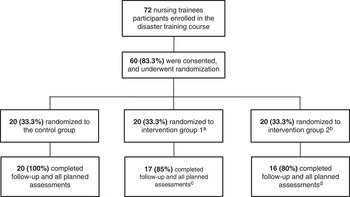
Among 60 participants screened, all consented to participation and were enrolled in the trial. There were 20 participants allocated to each study arm. Among these, 53 (88.3%) participants completed all educational and assessment activities. There was no significant difference in attrition between randomization arms (P=.122). Three participants randomized to Intervention Group 1 failed to complete assessment one, and four participants randomized to Intervention Group 2 failed to complete both assessments one and two (Figure 2).
Study Population, Randomization, and Follow-up. a Intervention Group 1 began with case-based learning and then crossed over to simulation exercises. b Intervention Group 2 began with simulation exercises and then crossed over to case-based learning. c Three participants randomized to Intervention Group 1 failed to complete assessment. d Four participants randomized to Intervention Group 2 failed to complete both assessments 1 and 2.

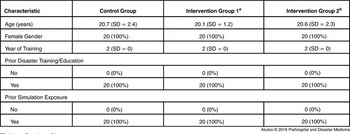
No significant differences were found between randomization arms. The mean age of participants in the control group, Intervention Group 1, and Intervention Group 2 was 20.7, 20.1, and 20.6 years, respectively (P=.647). The overall cohort was comprised completely of females in their second year of training. Among those enrolled, none reported any prior disaster preparedness training or prior exposure to simulation as a methodology for education (Table 1).
Baseline Characteristics

a Intervention Group 1 began with case-based learning and then crossed over to simulation exercises.
b Intervention Group 2 began with simulation exercises and then crossed over to case-based learning.
The baseline knowledge score in the control group was 43.8% (SD=11.0%). For the primary outcome for Intervention Group 1 undergoing CBL initially, a statistically significant 20.8% relative increase in knowledge attainment was observed as compared to controls (P=.003). For Intervention Group 2 beginning with SEs, a non-significant 6.6% relative increase in knowledge attainment versus controls was found (P=.396). For the secondary outcome, crossover to SEs resulted in significantly lower knowledge attainment scores while crossover to CBL significantly improved outcomes on knowledge assessment. With crossover from CBL to SEs, a 26.0% significant decrement in knowledge assessment scores was demonstrated (P<.001). Among participants assessed from Intervention Group 2 in crossover analysis, a 10.3% increase in scores was observed after crossover from SE to CBL activities (P=.033; Table 2).
Knowledge Attainment Outcomes

a Intervention Group 1 began with case-based learning and then crossed over to simulation exercises.
b Intervention Group 2 began with simulation exercises and then crossed over to case-based learning.
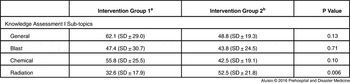
In stratified analysis, no statistical differences in mean knowledge scores were identified between Intervention Groups 1 and 2 in relation to performance on the sub-topics of general disasters, blasts, or chemical events. Sub-topic analysis for scores on radiation events demonstrated significantly better knowledge attainment among participants who underwent SE (Intervention Group 2) as compared to those receiving CBL as their first educational intervention activity (52.5 % versus 32.6%; P=.006; Table 3).
Knowledge Attainment Outcomes by Sub-topic

a Intervention Group 1 began with case-based learning and then crossed over to simulation exercises.
b Intervention Group 2 began with simulation exercises and then crossed over to case-based learning.
Discussion
This RCT demonstrated that CBL was superior to SEs in disaster preparedness educational translation for the topical focus of triage among nursing trainees studied in the Indian setting. The enhanced educational outcome was maintained when randomization arms underwent crossover and was not explained by variations in educational provision and knowledge attainment by sub-topic. These findings suggest that, in populations similar to the one studied in this trial, CBL may be more efficacious than simulation in andragogically oriented disaster preparedness education and training.
The current trial used consistent, structured, education and evaluative methods to assess the utility of CBL and SEs in knowledge translation. In both intervention modalities, organized feedback, which has been shown to improve educational delivery in interactive instructional methods, and specifically in disaster triage education, were used.Reference Gillett, Peckler and Sinert 48 , Reference Streiner 51 Although there was a difference in knowledge acquisition for the sub-topic of radiation events, the discrepancy favored the group randomized to simulation, which would not account for the comparative superiority demonstrated with CBL for the primary outcome. Further, the intention to treat analysis and achievement of the predetermined sample size served to reduce the probability of Type I error in the trial.Reference Cicero, Auerbach, Zigmont, Riera, Ching and Baum 52 These factors support internal validity in the results and findings. The superior educational outcomes demonstrated in this RCT with CBL as compared to SEs are the first from the Indian setting where disaster events account for some of the most substantial burdens globally.Reference Guha-Sapir and Vos 6 , 7 Given these results, in conjunction with educational recommendations from the Sendai Framework and national policies on nursing roles for disaster response in India, CBL may be more appropriate than SEs as an instructional methodology in India and in similar LMIC settings. 14 , Reference Gebbie and Qureshi 15 , 17 , Reference Talati, Bhatia, Kumar, Gupta and Ojha 18
Adult learning theory assumes that learners have an independent sense of self which directs their learning, a reservoir of life experiences they apply, and a problem-centered, rather than content-centered, approach to learning.Reference Carabine 19 Both CBL and simulation satisfy the andragogic assumptions; however, contemporarily simulation has become the more commonly used modality across multiple venues of medical education.Reference Huang, Reynolds and Candler 33 - Reference Fiedor 35 , Reference Fergusson, Aaron, Guyatt and Hebert 53 , Reference McLaughlin, Doezema and Sklar 54 The findings of this RCT do not support this trend for simulation instruction in adult disaster education. A prior RCT also directly comparing CBL to simulation among US medical students found that simulation-based learning was superior for the medical knowledge acquisition.Reference McCoy, Menchine, Anderson, Kollen, Langdorf and Lotfipour 39 These divergent results likely stem from differences in study populations where the current trial population had no prior exposure to simulation education. It is possible that with further sensitization and training that the simulation modality would outperform CBL, as prior literature has concluded.Reference McCoy, Menchine, Anderson, Kollen, Langdorf and Lotfipour 39 However, as has been documented previously in resource-constrained settings, the costs to achieve sufficient levels of simulation exposure for efficacious instruction may outweigh the benefits gained in the larger public health context.Reference Sica, Barron, Blum, Frenna and Raemer 55 - Reference Avila-Guerra 57 Although this study contributes to the knowledgebase pertaining to disaster preparedness education modalities in LMICs, the findings require further evaluation for external validation and assessment of sustained efficacy with more prolonged simulation exposure.
While this trial demonstrated improved knowledge acquisition with CBL in addition to didactic lecture, the baseline knowledge level in the control group was low. Though the post-intervention knowledge level was significantly greater with CBL, it was insufficient to demonstrate adequacy in the knowledge attainment pertaining to disaster triage education. Similar to prior work among nursing trainees showing enhanced education with interactive instruction using clinical cases, this study supports the use of CBL in disaster education.Reference Donner and Bickley 27 It, however, also highlights the need for more substantial research and investment in disaster preparedness education among frontline health care providers in LMICs similar to the one studied here.Reference Albanese and Mitchell 30 Without such investment, it is conceivable that barriers in achieving the goals of the Sendai Framework and improving outcomes in resource-constrained settings where the disaster-related public health burdens are the most substantial will persist.Reference Leaning and Guha-Sapir 5 - 7 , Reference Talati, Bhatia, Kumar, Gupta and Ojha 18
Limitations
This trial must be interpreted in the context of certain limitations. This study was randomized and controlled; however, due to lack of blinding, the potential for bias does exist. Comparison of participant characteristics between arms demonstrated no significant differences and the outcome measures were objective, which should have served to help minimize bias.Reference Limbrick and Dacey 58 The assessment tools were developed by senior personnel in medical disaster preparedness education with extensive experience in India, which likely enhanced content validity. The tools, however, were not piloted in the study population prior to utilization, and, subsequently, their validity in the study setting was not assessed.Reference Hrobjartsson and Boutron 59 , Reference Hambleton and Patsula 60 Additionally, the assessment tools were administered immediately after delivery of educational activities and outcomes for longitudinal knowledge retention and application in actual disaster health care responses cannot be derived from the available data. The study population was immensely homogenous; and although this likely enhanced the internal validity of the findings, the generalizability to other populations is uncertain.
Due to the Indian context, and the topical content focus of triage in disaster events, the trial findings may not be completely applicable to other facets of disaster education. 44 - Reference Sharma 46 , Reference Sullivan 61 Even with this limitation, the results are of substantial importance as triage is one of the most important factors in mitigating poor outcomes in disaster events.Reference Jenkins, McCarthy and Sauer 12 The simulation methods employed standardized patients as opposed to high-fidelity manikins, which are used more routinely in medical education. As discussed, the standardized patient approach is more pragmatic for educational endeavors in LMIC settings where the majority of disaster-related morbidity and mortality occurs;Reference Leaning and Guha-Sapir 5 - 7 furthermore, multiple studies have demonstrated equivalent effectiveness with standardized patients compared to high-fidelity simulation technology in disaster education, thereby making the use of standardized patients appropriate for the setting in which the trial was performed.Reference Sharma 47 , Reference Frykberg 62 , Reference Schulz, Skrzypczak and Raith 63
Conclusions
There is a paucity of literature on disaster preparedness education employing adult learning modalities in LMIC settings where the majority of disaster events take place. In this prospective RCT, didactic lecture complemented by CBL was superior to didactic lecture complemented by simulation in disaster preparedness educational translation pertaining to triage processes among nursing trainees in the Indian setting. These findings suggest that in populations similar to the one studied, CBL should be utilized preferentially over SEs in andragogically oriented disaster preparedness education activities. Additional research in alternative settings is needed to validate these findings and assess longitudinal retention using the comparative educational techniques.
Author Contributions Statement
ARA, PD, AG, JF, AS, DP, and BA conceived and designed the study. ARA, PD, AG, JF, AS, DP, and BA supervised data collection and study activities. ARA, PD, AG, and JF were responsible for statistical analysis and data reporting. ARA, PD, AG, JF, AS, DP, and BA drafted the manuscript and contributed to revisions and final presentation. All authors read and approved the final manuscript.
Acknowledgements
The authors would like to thank all of the study participants and medical staff who aided in study execution. Special thanks to Dr. Max Cooper, Dr. Shruti Chandra, and Dr. Jeffrey Chien from the Department of Emergency Medicine at Thomas Jefferson University (Philadelphia, Pennsylvania USA) who helped facilitate educational activities for the trial. Further, special acknowledgement and appreciation to the INDO-US conference organizers and the administration of the King George Medical University (Lucknow, India) for programmatic and logistical support.