1. Introduction
Lacustrine sediments of the Hajnáčka I maar in the northern part of the Pannonian basin contain skeletal remains affiliated to the Pliocene mammal fauna of the MN 16a subzone (Early Villanyian). Index species are represented by arvicoline rodents Mimomys (Mimomys) hassiacus (= M. hajnackensis; Fejfar & Storch, Reference Fejfar and Storch1990; Fejfar, Reference Fejfar2001) and Mimomys (Cseria) stehlini accompanied by large mammals, such as tapir, rhino, mastodont and hyaena. Normal magnetic polarity of autochthonous volcanic tuff from the maar ring was correlated with the lowermost section (C2An3n) of the Gauss chron (Berggren et al. Reference Berggren, Kent, Aubry and Hardebol1995), thus constraining the maar age to the interval between 3.59 and 3.33 Ma (Vass et al. Reference Vass, Konečný, Túnyi, Dolinský, Balogh, Hudáčková, Kováčová-Slamková and Beláček2000). The stratigraphic extent of the MN 16a subzone was estimated at 2.8–3.3 Ma (Fejfar & Heinrich, Reference Fejfar and Heinrich1987), but the lower boundary is sometimes shifted down to 3.65 Ma owing to the reversed polarity of localities with more archaic types of M. hassiacus (= M. hajnackensis) in Eastern Europe. The upper boundary of the MN 16a subzone was set at ~ 3.1 Ma (Vangengeim et al. Reference Vangengeim, Pevzner and Tesakov2005) at the hypsodonty degree index (HH-index) of 2.55, i.e. the dividing value between M. hassiacus (= M. hajnackensis) of the MN 16a subzone and M. polonicus of the MN 16b subzone.
The exact age of fossiliferous sediments of the Hajnáčka I maar is unknown. This is partly owing to the fact that phreato-magmatic eruptions can be only indirectly dated, using bulk or isochron K–Ar ages of spatially associated lava flows and/or intersecting basalt dykes (e.g. Balogh, Miháliková & Vass, Reference Balogh, Miháliková and Vass1981; Kantor & Wiegerová, Reference Kantor and Wiegerová1981; Pécskay et al. Reference Pécskay, Lexa, Szakacs, Seghedi, Balogh, Konečný, Zelenka, Kovacs, Póka, Fülöp, Márton, Panaiotu and Cvetković2006), and also using the magnetic polarity of the maar-filling sediments or tuff rings (Orlický et al. Reference Orlický, Balogh, Konečný, Lexa, Tunyi and Vass1996; Vass et al. Reference Vass, Konečný, Túnyi, Dolinský, Balogh, Hudáčková, Kováčová-Slamková and Beláček2000; Orlický, Reference Orlický2006). The K–Ar data sometimes yielded scattered results caused by excess argon (Balogh, Vass & Ravasz-Baranyai, Reference Balogh, Vass and Ravasz-Baranyai1994). Moreover, uncertainty of the bulk K–Ar age, normally ranging between ±200 and 400 ka, does not permit precise geochronology of Pleistocene volcanoes.
Recently, the zircon U–Pb isotopic system has become a vital chronometer for studying the history of young igneous rocks. Spatial resolution provided by laser sampling and substantial improvements in the sensitivity of laser ablation inductively coupled plasma mass spectrometry (LA-ICP-MS) analysis allowed precise age determinations of even Holocene zircons (Jackson et al. Reference Jackson, Pearson, Griffin and Belousova2004; Cocherie et al. Reference Cocherie, Fanning, Jezequel and Robert2009; Paquette & Mergoil-Daniel, Reference Paquette and Mergoil-Daniel2009). The high-resolution LA-ICP-MS dating of zircons from syenite xenoliths in basaltic tuffs of the maar near Pinciná village in the northern Pannonian basin revealed short residence times of parental melt in deep-crustal magmatic reservoirs, and severe discordance with available K–Ar ages of spatially associated lava flows (Hurai et al. Reference Hurai, Paquette, Huraiová and Konečný2010). Zircon megacrysts or zircon inclusions in sapphire xenocrysts in other localities of the world yielded U–Pb ages overlapping the K–Ar ages of accompanying basalts (Coenraads, Sutherland & Kinny, Reference Coenraads, Sutherland and Kinny1990; Sutherland & Fanning, Reference Sutherland and Fanning2001; Izokh, Fedoseev & Kutolin, Reference Izokh, Fedoseev, Kutolin, Seltmann, Borisenko and Fedoseev2007; Visonà et al. Reference Visonà, Caironi, Carraro, Dallai, Fioretti and Fanning2007; Yu, Xu & Chen, Reference Yu, Xu and Chen2010). However, potential use of U–Pb geochronology can be hampered by the prolonged residence times of zircon megacrysts in the mantle or magmatic reservoirs prior to entrainment in basalt (Hinton & Upton, Reference Hinton and Upton1991; Siebel et al. Reference Siebel, Schmitt, Danišík, Chen, Meier, Weiss and Eroglu2009). The potential discordance between formation age of the zircon and eruption age of the host basalt can be revealed by zircon fission track dating (e.g. Sutherland & Fanning, Reference Sutherland and Fanning2001).
The Hajnáčka I maar provides an additional opportunity for independent, indirect U–Pb age control, owing to the occurrence of magmatic zircon in fossiliferous sediments (Uher et al. Reference Uher, Sabol, Konečný, Gregáňová, Táborský and Puškelová1999) and known magnetic polarity of the tuff ring (Vass et al. Reference Vass, Konečný, Túnyi, Dolinský, Balogh, Hudáčková, Kováčová-Slamková and Beláček2000). Successful application of high-resolution zircon geochronology at this locality could therefore lead to the refinement of age boundaries based on the magneto- and/or biostratigraphy.
2. Geology
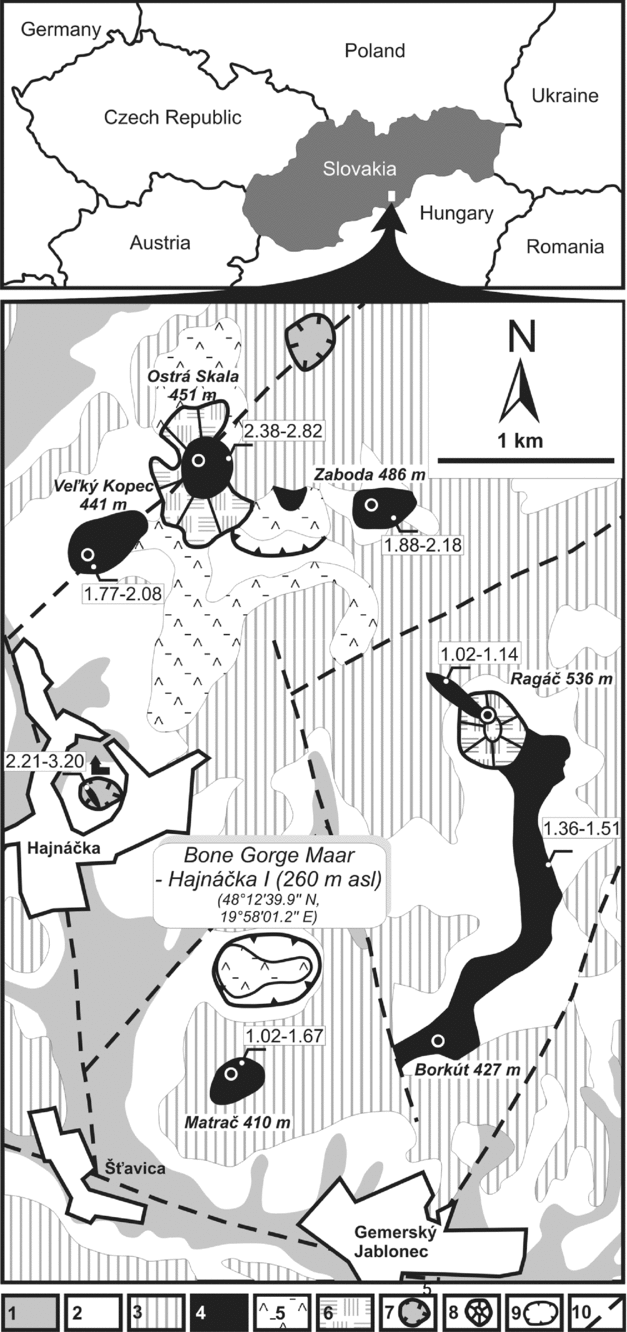
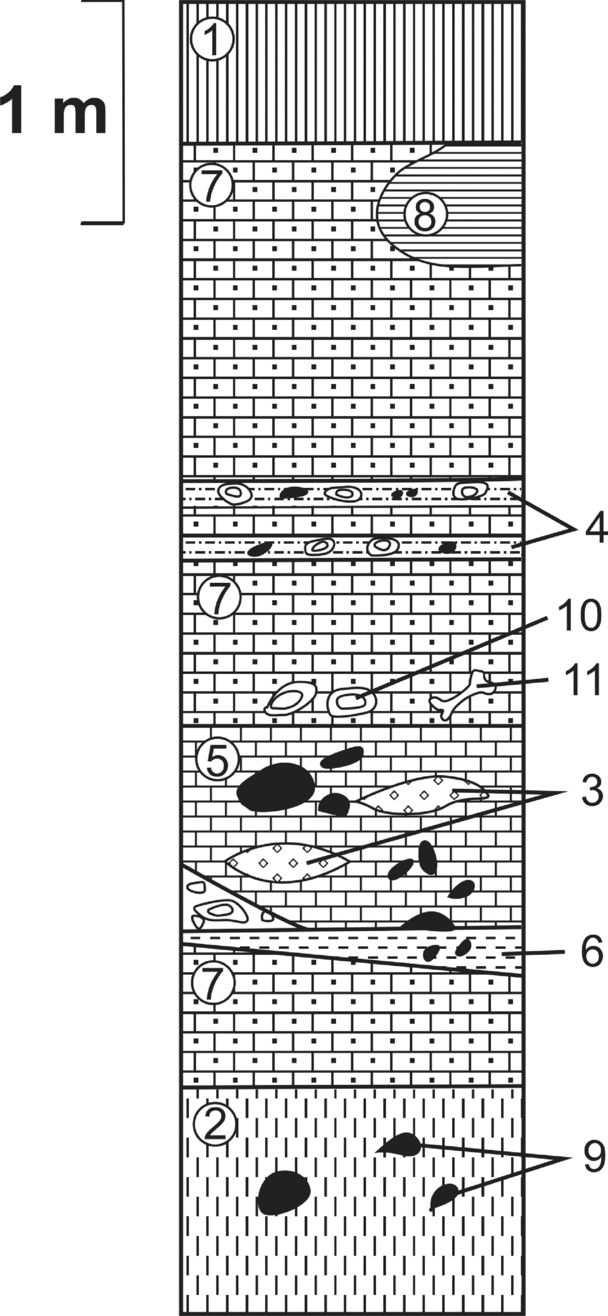
The palaeontological site of Hajnáčka I is situated in a small maar, approximately 580 × 370 m in area (Fig. 1). The maar itself is strongly eroded and partly covered by deluvial-proluvial Upper Pleistocene sediments. Primary maar sedimentary infilling and the tuff ring are discernible only in several places in rain gullies called Bone Gorge (Fig. 2). The pre-volcanic basement is represented by Eggenburgian sandstones of the Fiľakovo Formation. Relics of basaltic lava flows and scoria cones are preserved in the south, east and northeast. The maar structure and the associated volcanic forms are part of the Cerová Formation, the younger of two basalt formations defined by Vass & Kraus (Reference Vass and Kraus1985) based on K–Ar dating. The deepest parts of the sedimentary maar infilling are composed of bedded undisturbed basaltic tuff devoid of fossil remnants. Eggenburgian sandstones enclosed in sandy matrix near the base indicate phreatic explosions and block sliding from the outer maar walls. The increasing amount of tuffite sand and lapilli tuffs towards the top of the sedimentary profile reflects transitions from phreatic to repeated phreato-magmatic eruptions. The uppermost part of the maar sedimentary sequence consists of coarse lapilli tuff and tuffite sand with blocks of fossiliferous sediments, showing textures diagnostic of drained lake sedimentation and redeposition modified by sliding and slumping. Accompanying rare basalt blocks most likely belong to the neighbouring disintegrated basaltic flows (Sabol et al. Reference Sabol, Konečný, Vass, Kováčová, Ďurišová and Túnyi2006; Vass, Elečko & Konečný, Reference Vass, Elečko and Konečný2007). Vertebrate fossil remains occur in gravel lenses and intercalations in rusty-brown tuffaceous sand with limonite concretions and pyroclastic fragments (Fig. 2).
Geological map of the Hajnáčka I maar and the adjacent volcanic structures (modified after Elečko et al. Reference Elečko, Vass, Konečný, Gaálová and Gaál2001). Explanations: 1 – Quaternary fluvial and proluvial sediments (gravel, sand, clay, loam); 2 – Upper Pleistocene-to-Holocene aeolian-deluvial and proluvial sediments (loess, sand, loamy sediments with rock fragments); 3 – Eggenburian sandstones of the Fiľakovo Formation (the Tachty sandstone); 4–9 – Pliocene–Pleistocene basaltic volcanism (Cerová Formation): 4 – lava flow, dyke, neck; 5 – tuff and lapilli tuff; 6 – agglomerate; 7 – diatreme; 8 – scoria cone; 9 – maar; 10 – fault. Numbers in open rectangles correspond to K–Ar ages of basaltic lava flows, dykes and necks (Vass et al. Reference Vass, Konečný, Túnyi, Dolinský, Balogh, Hudáčková, Kováčová-Slamková and Beláček2000; Vass, Elečko & Konečný, Reference Vass, Elečko and Konečný2007).

Schematic profile of pit 5/98: 1 – Holocene dark humus loam; 2 – Quaternary light sandy loam; 3 – rusty-brown tuffaceous sand with limonite concretions; 4 – dark sandy tuffite; 5 – dark lapilli tuff; 6 – light sandy tuffite with intercalation of rusty-brown tuffaceous sand; 7 – tuff with intercalation of rusty-brown tuffaceous sand; 8 – fragment of primary maar filling; 9 – fragments of basaltic rocks; 10 – baked sandstone; 11 – fossil vertebrates (Sabol, Reference Sabol2003).

The Hajnáčka taphocoenosis represents an assemblage of conservative and progressive species consisting of abundant taxa (e.g. Tapirus arvernensis, Stephanorhinus jeanvireti, Mammut borsoni, Anancus arvernensis); frequent taxa (e.g. Mimomys stehlini, Trogontherium minus, Muntiacus sp., Capreolus sp., Castor fiber ssp., Hypolagus petenyi, Prospalax priscus); and rare taxa (e.g. Desmana nehringi, Petenyia hungarica, Beremendia fissidens, Colobinae sp., Mimomys hassiacus, Baranomys loczyi, Apodemus sp., Pliopetaurista pliocaenica, Hyaena perrieri, Parailurus hungaricus, Lutra cf. bravardi, Megantereon sp., Sus minor, Croizetoceros ramosus) (Fejfar, Reference Fejfar1964). Recent excavations (Sabol et al. Reference Sabol, Konečný, Vass, Kováčová, Ďurišová and Túnyi2006) revealed several previously undescribed taxa (e.g. Talpa cf. minor, T. fossilis, Deinsdorfia hibbardi, Sciurus sp., Ungaromys sp., Ursidae gen. et sp. indet.). The faunal assemblage also contains molluscs (Fejfar, Heinrich & Heintz, Reference Fejfar, Heinrich and Heintz1990).
The palaeoenvironment around the Hajnáčka I maar was characterized by bushy humid primeval forest with flowing streams and backwaters, alternating with steppe or open grassy land (Kováč et al. Reference Kováč, Baráth, Fordinál, Grigorovich, Halásová, Hudáčková, Joniak, Sabol, Slamková, Sliva and Vojtko2006). Findings of closed clam shells of Anodonta sp. indicate a rapid sedimentation of hot volcanic ash due to tephra fall, thus pointing to an instantaneous catastrophic eruption. On the other hand, some animals must have been killed by gas emanations on the bank of the maar lake, as indicated by bones gnawed by hyaenas (Fejfar, Reference Fejfar1964).
3. Instrumentation and analytical methods
3.a. Electron microprobe
The chemical composition of zircon, baddeleyite and thorite (online Supplementary Table S1 available at http://www.journals.cambridge.org/geo) was determined using a Cameca SX-100 electron microprobe at the Geological Survey, Bratislava, Slovakia, with an accelerating voltage of 15 keV, a beam current of 40 nA and a beam diameter of 2–5 μm. Calibration was effected using the following natural and pure synthetic compounds: wollastonite for Si (TAP, Kα) and Ca (LPET, Kα), Al2O3 for Al (TAP, Kα), CePO4 for Ce (LLIF, Lα), NdPO4 for Nd (LLIF, Lβ), SmPO4 for Sm (LLIF, Lβ), EuPO4 for Eu (LLIF, Lβ), GdPO4 for Gd (LLIF, Lα), TbPO4 for Tb (LLIF, Lα), DyPO4 for Dy (LLIF, Lβ), HoPO4 for Ho (LLIF, Lβ), ErPO4 for Er (LLIF, Lβ), YbPO4 for Yb (LLIF, Lα), LuPO4 for Lu (LLIF, Lβ), ThO2 for Th (LPET, Mα), UO2 for U (LPET, Mβ), YPO4 for Y (LPET, Lα), apatite for P (LPET, Kα), fayalite for Fe (LPET, Kα), ZrSiO4 for Zr (LPET, Lα), and HfO2 for Hf (LLIF, Lα). Interferences were eliminated using empirical correction coefficients. The following counting times were used: 15 seconds for Si, Ce, Fe, Ca; 20 seconds for Al, Nd, P; 30 seconds for Th; and 25 seconds for the remaining elements. Detection limits were between 0.01 and 0.05 wt%. Uncertainties varied from 1–7% of the measured value for major elements, to 10% for those with low concentrations.
3.b. LA-ICP-MS
U–Pb geochronology of zircon (online Supplementary Table S2) was conducted using LA-ICP-MS at the Laboratoire Magmas et Volcans, Clermont-Ferrand, France. Analytical conditions are described in detail in online Supplementary Table S3. The method used for the zircon isotope dating with LA-ICP-MS is basically similar to that developed for monazite (Tiepolo, Reference Tiepolo2003; Paquette & Tiepolo, Reference Paquette and Tiepolo2007). 230Th disequilibrium corrected according to Schärer (Reference Schärer1984) using a Th/Umagma = 4.5 ± 0.5 (Paquette & Mergoil-Daniel, Reference Paquette and Mergoil-Daniel2009) generally corresponds to an increase of the 206Pb–238U age of about 0.1 Ma. Concordia ages and diagrams were generated using the Isoplot/Ex v. 2.49 software package (Ludwig, Reference Ludwig2001). U, Th and Pb concentrations were calibrated relative to the certified GJ-1 zircon standard (Jackson et al. Reference Jackson, Pearson, Griffin and Belousova2004). The zircon analyses were projected on 207Pb/206Pb versus 238U/206Pb diagrams (Tera & Wasserburg, Reference Tera and Wasserburg1972), where the analytical points plot along a mixing line between the common Pb composition in the upper intercept and the zircon age in the lower intercept. This method is commonly used to date Phanerozoic zircons using in situ techniques (Claoué-Long et al. Reference Claoué-Long, Compston, Roberts, Fanning, Berggren, Kent, Aubry and Hardenbol1995; Jackson et al. Reference Jackson, Pearson, Griffin and Belousova2004).
4. Zircon megacrysts: composition, zoning and inclusions
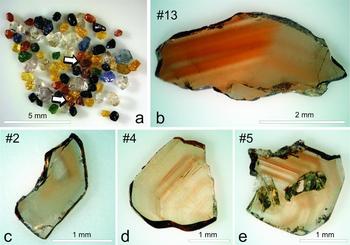
Fragments of zircon megacrysts, up to 5 mm in diameter, were handpicked from washed and sieved fossiliferous maar sediments excavated from the horizontal pit 3/98 and the vertical pit 5/98 (Fig. 2). In the heavy mineral fraction, orange-red zircons (hyacinth) were associated with amphibole, olivine, pyroxene, garnet, apatite, Cr-diopside, spinel, magnetite, corundum (sapphire), titanite and β-quartz (Fig. 3a), together with occasional fragments of basalts and garnet-bearing mica schists. Most minerals, including zircon, exhibited signs of magmatic corrosion. Even the largest zircon grains are in fact fragments of larger crystals, possibly up to several centimetres in diameter, as documented by oscillatory zoning discernible in doubly polished slabs (Fig. 3b–e). Angular breakage planes and sharp edges of broken crystals are diagnostic of either a lack of transport or short-distance transport in an aqueous medium during deposition and redeposition of the maar lake sediments. Rare euhedral zircons, 200–500 μm in size, show a combination of prismatic (100), (110) and pyramidal (101) faces. Lack of magmatic corrosion indicates that the euhedral zircons had been armoured in composite igneous xenoliths later disintegrated during phreato-magmatic explosions. Intergrowths with other minerals were not observed; however, Uher et al. (Reference Uher, Sabol, Konečný, Gregáňová, Táborský and Puškelová1999) mentioned xenomorphic zircon inclusions, up to 200 μm in diameter, in sapphire isolated from the same fossiliferous sediments.
(a) Assemblage of heavy minerals from fossiliferous sediments of the Hajnáčka I maar. Arrows indicate euhedral zircons surrounded by garnet, β-quartz, apatite, sapphire, titanite, Cr-diopside and spinel. (b–d) Fragments of larger zircon megacrysts showing oscillatory zoning and corrosion of crystal faces due to magmatic resorption. (e) Fragment of cavernous zircon megacryst. The cavities are thought to originate during skeletal growth, focused magmatic corrosion, or dissolution of solid inclusions.

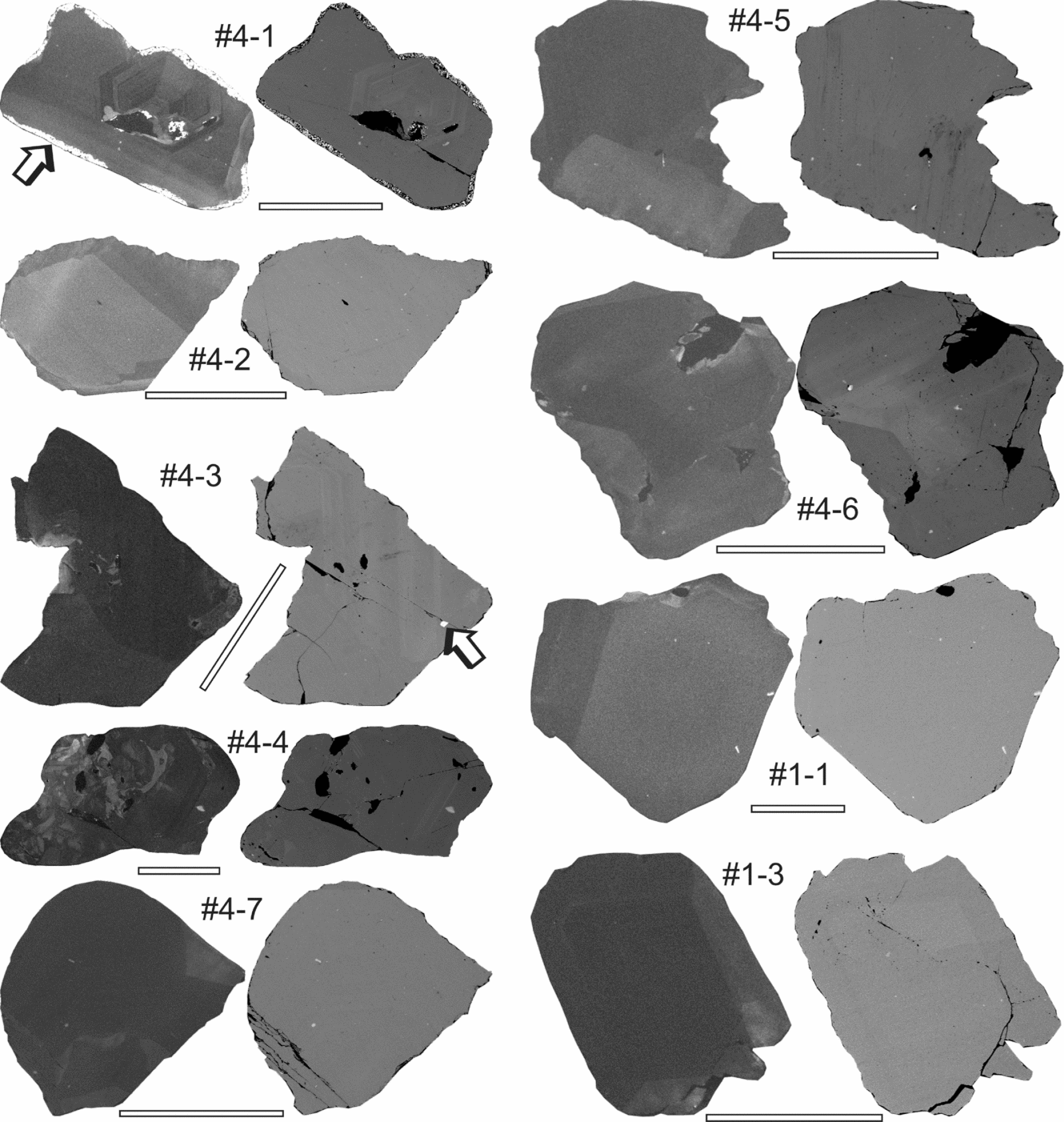
The zircons studied exhibited a weak luminescence and a less pronounced primary magmatic zoning (Fig. 4). Incomplete growth oscillatory zoning patterns, e.g. in grains #1-1 and #4-2, confirmed they are fragments of larger crystals. Domain textures discernible around some cavities and cracks (#4-3, #4-4 and #4-6) as well as indented boundaries cutting across the growth zones indicated a fluid/melt-induced, post-growth metasomatic replacement, though intra-crystal corrosion was not observed. These textures are broadly similar to mantle-derived zircons (Paquette & Mergoil-Daniel, Reference Paquette and Mergoil-Daniel2009).
Cathodoluminescence (left column) and back-scattered images (right column) of zircon megacrysts from the Hajnáčka I maar. Bar scales represent 500 μm. The arrow near grain #4-1 designates a reaction corona with baddeleyite, sanidine and anorthoclase. The arrow at grain #4-3 designates a thorite inclusion.

Zircon grain #4-1 exhibited a complex pattern of an oscillatory zoned euhedral core with hour-glass texture encapsulated in a larger rounded grain with less pronounced magmatic zoning. Several caverns fringed with minute baddeleyite crystals and filled with aluminosilicate glass occurred along the core–rim boundary. Reaction corona composed of fine-grained baddeleyite intergrown with potassium feldspars was also developed along the outer perimeter of the corroded zircon crystal.
The chemical compositions of the zircons studied are typical of low yttrium (0.02–0.66 wt% Y2O3) and hafnium (0.65–0.98 wt% HfO2) concentrations, and the total rare earth element (REE) content is less than 0.01 apfu. The core–rim compositions and ages were homogeneous, except for grain #4-1.
Solid and melt inclusions were observed in three zircon fragments. An isolated thorite inclusion, 20 × 15 μm in diameter, occurred in grain #4-3, while glass inclusions in grain #4-1 contained aegirine-augite and magnetite with titanomagnetite exsolutions. The Fe-Ti oxides contained Al2O3 (0.3–3.1 wt%), MnO (0.7–3.2 wt%) and MgO (0.9–3.5 wt%). The aluminosilicate glass exhibited unusually low alkali (0.2–0.4 wt%) and SiO2 contents (37.7–39.0 wt%), and very high Al2O3 (32.9–33.8 wt%) and P2O5 contents (3.6–4.7 wt%). Low totals of electron microprobe analyses of approximately 80 wt % indicated an increased concentration of volatiles, particularly water. Grain #4-4 contained two primary homogeneous glass inclusions, ~ 20 μm in diameter, with 59.7–61.1 wt% SiO2, 7.5–8 wt% Na2O, 5.5 wt% K2O and 24.8–25.4 wt% Al2O3 (normalized to 100%), corresponding to a strongly peraluminous trachyte-to-phonolite melt.
5. LA-ICP-MS analyses
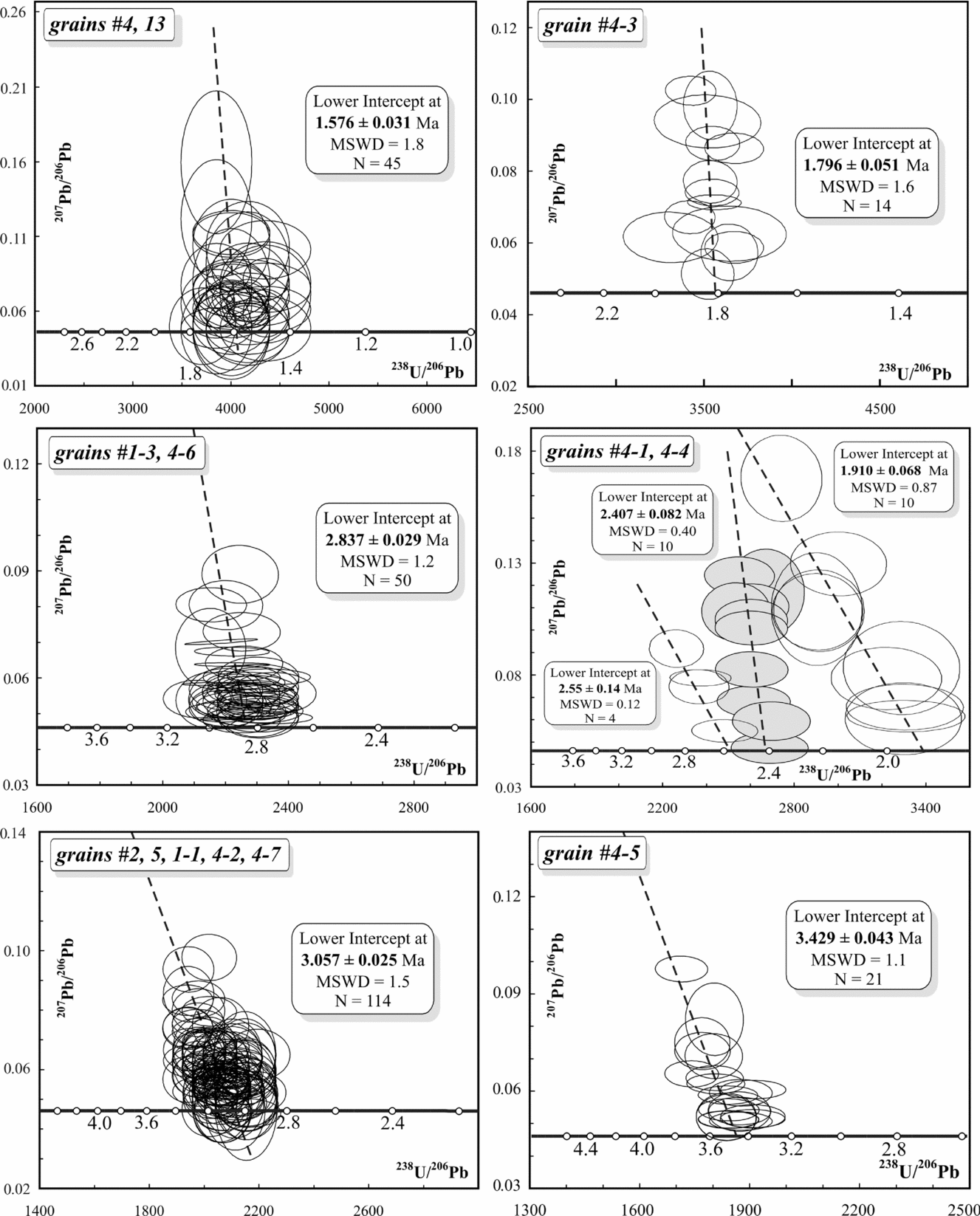
A total of 268 ablation pits were drilled in 13 zircon grains selected for the geochronologic study. Except for grain #4-1, the measured isotopic ratios clustered along discordia lines defining concordant ages within 0.03–0.08 Ma 2σ uncertainty limits and a mean square weighted deviation (MSWD) lower than 1.8. All obtained ages fell within the interval between 1.58 and 3.43 Ma, where a total of six magmatic episodes have been discerned (Fig. 5).
Tera-Wasserburg diagrams for zircon megacrysts from the Hajnáčka I maar. Data point error ellipses correspond to 2σ.

The total Pb, Th and U concentrations were highly variable from grain to grain and sometimes within different zones of single grains. In other grains, however, the Pb, Th, and U contents were almost constant, with total concentrations ranging from 0.06–2.0, 35–9450 and 70–2255 ppm, respectively. These large variations, which reached a factor of 33 for the Th content in a single zircon grain, were attributed to the crystallization of mineral phases strongly enriched in these elements. This was confirmed by thorite inclusions revealed in grain #4-3. The high Th/U ratios, generally ranging from 0.5 to 1.5, are typical for magmatic zircons. Unusually high Th/U ratios from 2 to 4 in zircon crystal #4-6 are also attributed to Th-bearing mineral inclusions, which were not truncated at the polished surface.
6. Discussion
6.a. Origin of zircon megacrysts
Zircon is a common mineral of the group B megacryst suite in alkali basalts, together with corundum, plagioclase, alkalic feldspar and apatite (Irving & Frey, Reference Irving and Frey1984). The assemblage, apparently out of equilibrium with the host basalt, must have crystallized from an evolved salic alkaline parental melt (Aspen, Upton & Dickin, Reference Aspen, Upton and Dickin1990; Guo, Green & O'Reilly, Reference Guo, Green and O'Reilly1992, Upton, Finch & Slaby, Reference Upton, Finch and Slaby2009). A similar origin for the zircon megacrysts from the Hajnáčka I maar is indicated by their typomorphic features (morphology, zonation, composition), chemical composition of mineral and melt inclusions, and intimate relationships (inclusions, overgrowths) with corundum and alkalic feldspars.
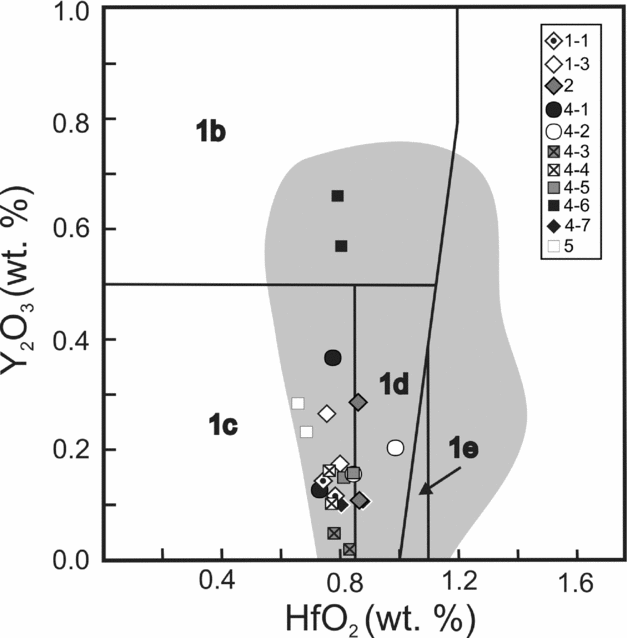
Direct evidence for the parental melt is provided by glass inclusions. The zircon megacryst #4-4 contains phonolite-trachyte aluminosilicate glass, whose strongly peraluminous character (25% Al2O3) is consistent with abundant sapphire, and with zircon inclusions in sapphire megacrysts (Uher et al. Reference Uher, Sabol, Konečný, Gregáňová, Táborský and Puškelová1999). Zr/Hf elemental weight ratios between 51 and 87 in all investigated zircons are diagnostic of a mantle-derived fractionated parental magma unaffected by crustal assimilation (Pupin, Reference Pupin2000). Low Y2O3 (< 0.5 wt%) and HfO2 concentrations (0.6–1 wt%) are typical of zircons crystallized from alkaline/peralkaline syenite/trachyte magma, though a slightly increased Y2O3 concentration in zircon #4-6 could indicate an alkalic rhyolite parental melt (Fig. 6). Thorite with increased UO2 (6.8–7 wt%), Y2O3 (0.7–0.8 wt%) and REE2O3 concentrations (1.9–2.2 wt%) in zircon megacryst #4-3 must have also crystallized from a highly fractionated parental magma.
Discrimination diagram for magmatic zircons (Pupin, Reference Pupin2000), with projection points of the zircon megacrysts from the Hajnáčka I maar. Shaded area encompasses compositions of zircons from syenite xenoliths in a 5.4 Ma old maar near Pinciná village (Hurai et al. Reference Hurai, Paquette, Huraiová and Konečný2010). Explanation for fields: 1b–e – hypersolvus alkalic granite/rhyolite; 1c–e – alkalic/peralkalic syenite/trachyte; 1c – alkalic basalt; 1e – subsolvus alkalic granite/rhyolite.

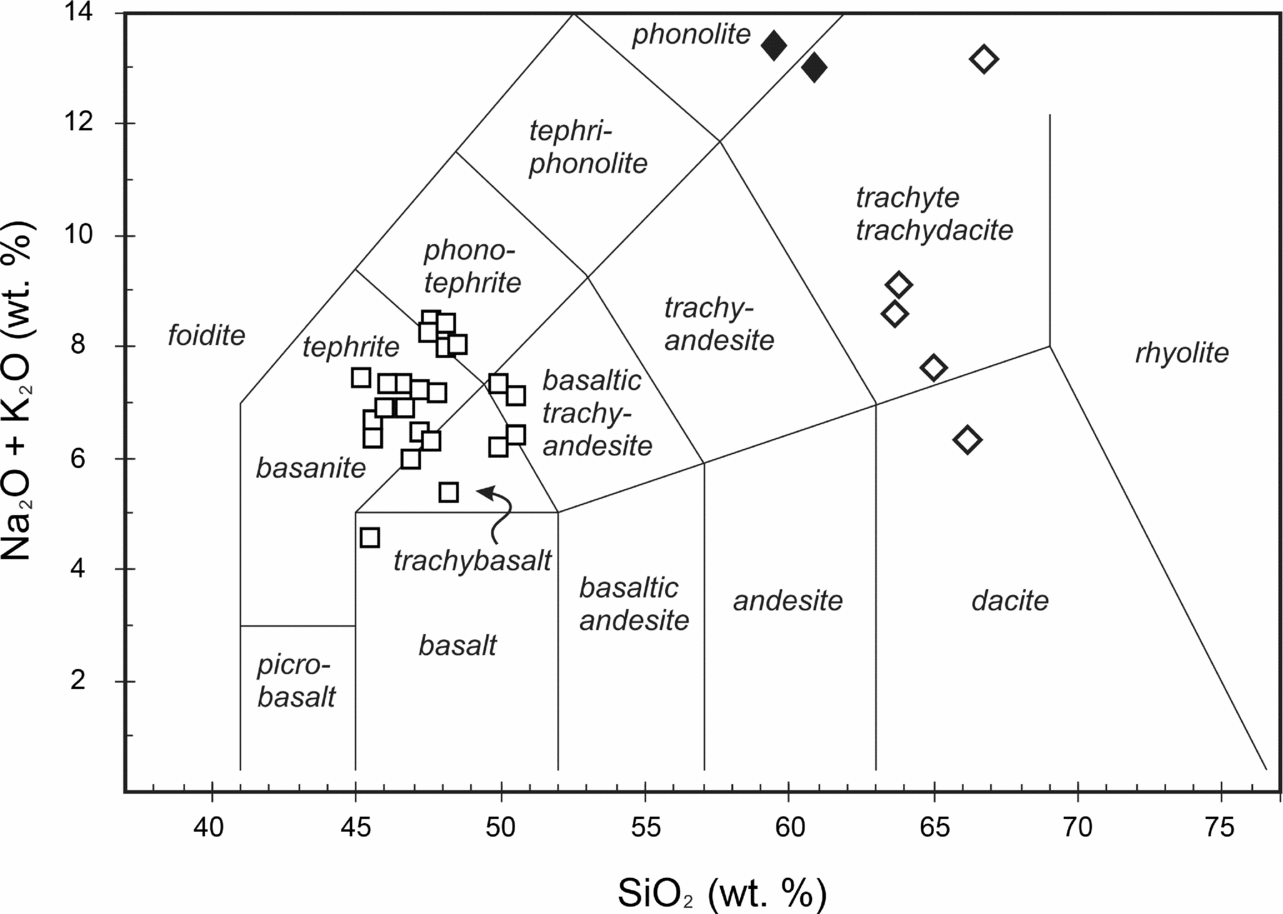
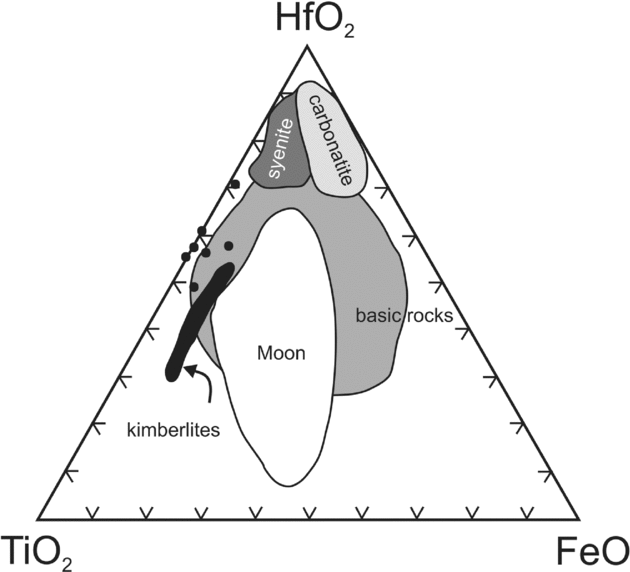
Increased content of alkalis (13.0–13.5 wt% in total) in glass inclusions trapped in zircon #4-4 (Fig. 7) suggests a strongly alkaline mafic magma, which could differentiate to phonolitic melt observed in the inclusions. Indeed, a phonotephrite lava flow occurs at Borkút elevation, 500 m southeast of the maar studied and strongly alkaline basaltic volcanism is indirectly indicated by abundant Ba-rich anorthoclase megacrysts in the exhumed diatreme in Hajnáčka village. On the other hand, alkali-deficient, berlinite-normative compositions of the glass inclusions encapsulated in zircon #4-1 lie beyond anything that could result from an alkali basalt fractionation in spite of a quite ordinary composition of the host zircon projecting into the field of alkalic syenite/trachyte parental magma (Fig. 6). Alkali feldspars in the reaction corona of zircon #4-1 indicate magmatic corrosion in an alkaline syenite/trachyte, rather than in a mafic melt. The composition of the associated baddeleyite projects inconclusively between the fields for syenite and mafic parental magmas in the TiO2–HfO2–FeO discrimination diagram (Fig. 8). The unusual glass inclusion composition in zircon #4-1 may be explained in terms of a late-stage near-solidus fractionation of aegirine-augite and possibly also feldspars. Similar cationic deficiency and crystallization of berlinite from extremely volatile residual melt was observed in pegmatites derived from alkalic granite (Thomas & Webster, Reference Thomas and Webster1999; Thomas, Webster & Rhede, Reference Thomas, Webster and Rhede1999).
Total alkalis versus silica (TAS) diagram with projection points for basalts in the study area (open squares), silicate melt inclusions in zircons from syenite xenoliths of the Pinciná maar (open diamonds) and those in zircon megacryst #4-4 from the Hajnáčka I maar (solid diamonds).

Discrimination diagram for baddeleyite (oxide concentrations in wt%, field contours from Heaman & LeCheminant, Reference Heaman and LeCheminant1993; Bellatreccia et al. Reference Bellatreccia, Ventura, Parodi and Williams1998) with projection points of baddeleyite from the Hajnáčka I maar (solid circles).

6.b. Geochronologic and stratigraphic constraints
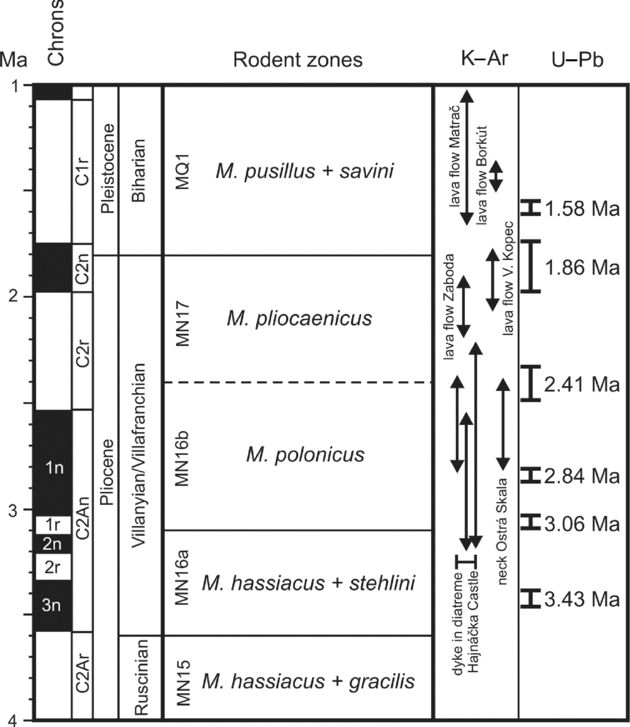
The obtained U–Pb zircon data place important geochronologic constraints on the volcanic events and redeposition of the fossiliferous sediment in the Hajnáčka I maar (Fig. 9). The most recent zircon ages at 1.58 ± 0.03 Ma overlap those of the adjacent Matrač and Borkút basaltic lava flows determined by bulk K–Ar geochronology. Hence, they can be interpreted as near-eruption ages, thus defining also the age limit for the redeposition of the fossiliferous sediments in the drainage lake regime. Two 1.80–1.91 Ma old zircons overlap K–Ar ages of the more distant lava flows near Zaboda and Veľký kopec located 3 km NNE of the Hajnáčka I maar, and therefore they can also be interpreted as eruption ages.
Summary of U–Pb zircon and K–Ar basalt geochronologic data from the Hajnáčka I site compared to magneto-stratigraphic timescale (Berggren et al. Reference Berggren, Kent, Aubry and Hardebol1995) and rodent zones (Fejfar & Heinrich, Reference Fejfar and Heinrich1987; Vangengeim, Pevzner & Tesakov, Reference Vangengeim, Pevzner and Tesakov2005).

Sample #4-1 is the only zircon with a heterogeneous zoning pattern, showing a 2.55 ± 0.14 Ma old core and a 1.91 ± 0.07 Ma younger rim, which reflects a ~ 650 ± 200 ka residence time of the zircon in a magmatic reservoir. This value corresponds to a minimum estimate of the residence time in the magma reservoir before its extraction by the volcanic eruption. In U–Pb geochronology, it is frequently observed that a few zircon crystals deliver slightly older ages than the whole population of a sample. This is generally explained in terms of the possible occurrence of inherited Pb resulting from crustal contamination. However, grain #4-3 possibly demonstrates at a very recent scale that composite ages can sometimes be obtained from a co-genetic population without any crustal contamination process.
One 2.41 ± 0.08 Ma old zircon and another two zircons grouped at 2.84 ± 0.03 Ma overlap the K–Ar age of the basaltic dyke cross-cutting the exhumed diatreme above Hajnáčka village, and also the K–Ar age of the Ostrá Skala lava neck, 3 km north of the maar studied. Consequently, the main group of zircons clustered at 3.06 ± 0.03 Ma can be linked with phreato-magmatic eruptions from the Hajnáčka diatreme and/or from the scoria cone subjacent to the 2.38–2.82 Ma old lava neck at Ostrá Skala. This eruption could not be coeval with the formation of the Hajnáčka I maar, because of the overlapping of the Kaena reversed-polarity subchron at 3.032–3.116 Ma (Gradstein, Ogg & Smith, Reference Gradstein, Ogg and Smith2004). Considering a 39% abundance of zircon grains and 48% of measurements falling into this range, it seems reasonable to assume that the massive 3.06 ± 0.03 Ma eruption was responsible for the extinction of most fauna thriving around and within the Hajnáčka I maar. The maar itself could have formed at 3.43 ± 0.4 Ma, as indicated by the oldest single zircon grain recovered from the redeposited maar sediments. The minimum possible age of the Hajnáčka I maar is defined by the base of the C2An chron at 3.596 Ma (Gradstein, Ogg & Smith, Reference Gradstein, Ogg and Smith2004). Consequently, the possible duration of the index rodent assemblage is bracketed by the two eruptions dated at 3.43 and 3.06 Ma.
The spatial and temporal relationship between deposition of the fossiliferous sedimentary filling and the volcanic activity around the Hajnáčka I maar has been repeatedly discussed. Schafarzik (Reference Schafarzik1899) proposed sedimentation in the maar lake occurred simultaneously with the basalt extrusions and effusions. Fejfar (Reference Fejfar1964) considered a close time relationship between the effusion of lava flows and the sedimentation of fossiliferous deposits in the maar lake. Koch (Reference Koch1904) presumed that explosions producing the lapilli tuff with fossil remains preceded the effusion of lava flows.
Therefore, the exact biostratigraphic age of the Hajnáčka I site has been debatable. Dietrich (Reference Dietrich1953) suggested an Early Pleistocene age, whereas Papp & Thenius (Reference Papp and Thenius1959) proposed the so-called Levantinian (Middle Pliocene) age. Fejfar (Reference Fejfar1964) correlated the Hajnáčka I site with other Villafranchian faunas, particularly on the basis of the rodent record. Subsequently, the progressive species Mimomys (Mimomys) hassiacus (= M. hajnackensis; Fejfar & Storch, Reference Fejfar and Storch1990; Fejfar, Reference Fejfar2001) and M. (Cseria) stehlini were affiliated with the lower part of the Early Villanyian, thus defining the MN 16a subzone (Fejfar & Heinrich, Reference Fejfar and Heinrich1987), distinctly differing from the Late Ruscinian MN 15 assemblages with M. gracilis, Dolomys occitanus or Propliomys hungaricus (Sabol et al. Reference Sabol, Konečný, Vass, Kováčová, Ďurišová and Túnyi2006) and from the late Early Villanyian MN 16b zone with M. polonicus and/or M. pitymyoides (Fejfar, Reference Fejfar2001).
There still exists some controversy related to taxonomy and boundaries of the Mimomys evolutionary lineage (Vangengeim et al. Reference Vangengeim, Pevzner and Tesakov2005; Mayhew et al. Reference Mayhew, Dieleman, Boele, Verhaard and van den Hoek Ostende2008). The name of M. hajnackensis was created by Fejfar (Reference Fejfar1961) for three teeth of the relatively large Mimomys species from Hajnáčka, which was clearly more primitive than M. polonicus Kowalski. The species M. hassiacus was originally described by Heller (Reference Heller1936) from the German site of Gundersheim together with M. pliocaenicus, which constituted the end-member of the evolutionary lineage of the Pliocene Mimomys species. Fejfar & Storch (Reference Fejfar and Storch1990) revealed the extreme similarity between M. hassiacus Heller and M. hajnackensis Fejfar and they suggested re-evaluation of the holotype material previously described from Hajnáčka. The synonymity of both species was later confirmed at the Arondelli–Triversa locality (Fejfar, Reference Fejfar2001). Since then, the taxonomic name of M. hassiacus has been preferred assuming that M. hajnackensis represents its junior synonym (e.g. Fejfar, Heinrich & Lindsay, Reference Fejfar, Heinrich, Lindsay, Kolfschoten and Gibbard1998; Sabol, Reference Sabol and Sabol2004), although some others (e.g. Tesakov, Reference Tesakov2004) consider Heller's type material to be a mixture of various forms, most likely representing a primitive M. polonicus type assemblage. Owing to its unclear nature, however, M. hassiacus has been notably absent in descriptions of Pliocene faunas from Spain and France (Mayhew et al. Reference Mayhew, Dieleman, Boele, Verhaard and van den Hoek Ostende2008) and elsewhere in Europe. M. hajnackensis has been used as a regular name for one of the most archaic large members of the Early Villanyian evolutionary lineage leading to M. polonicus, which was the type species of the MN 16b rodent subzone (Vangengeim, Pevzner & Tesakov, Reference Vangengeim, Pevzner and Tesakov2005). New excavations at Hajnáčka I site corroborated the synonymity proposed by Fejfar, and the coexistence of M. hassiacus with M. (Cseria) stehlini diagnostic of the MN 16a subzone (Sabol et al. Reference Sabol, Konečný, Vass, Kováčová, Ďurišová and Túnyi2006). However, exact hypsometric analysis has not been performed owing to the small number of teeth and/or their fragmentary preservation, although the type specimen shows the relatively low HH-index of 1.1 (Mayhew et al. Reference Mayhew, Dieleman, Boele, Verhaard and van den Hoek Ostende2008), which was also assumed by Tesakov (Reference Tesakov2004).
Large arvicolines of the Hajnáčka I maar are believed to represent one of the most primitive forms of the Mimomys evolutionary lineage, showing a HH-index similar to that from the Korotoyak 2 site in Ukraine (Agadzhanyan, Reference Agadzhanyan2003). However, the assumed extinction at 3.06 Ma is consistent with the ~ 3.1 Ma boundary between the MN 16a and 16b subzones defined by the HH-index of approximately 2.55 (Vangengeim, Pevzner & Tesakov, Reference Vangengeim, Pevzner and Tesakov2005).
7. Summary
(1) Fossiliferous sediments of the Hajnáčka I maar contain zircon megacrysts, whose magmatic origin is indicated by zoning patterns, chemistry and melt inclusions.
(2) U–Pb ages of the zircon xenocrysts reflect a total of six magmatic-volcanic events occurring in the time interval between 1.58 and 3.43 Ma. The age of 1.58 Ma provides the limit for the final redeposition of sediments in the maar drainage lake regime.
(3) The youngest zircon populations grouped at 1.58, 1.80–1.91, 2.41 and 2.84 Ma are consistent with K–Ar ages of spatially associated basaltic lava flows, dykes and necks, thus reflecting several volcanic events in the study area.
(4) One zircon grain exhibited a composite age, with a 2.55 Ma old core and a 1.91 Ma old rim, thus reflecting a ~ 650 ± 200 ka residence time in a deep-seated magmatic reservoir prior to entrainment in the host basalt.
(5) The majority of the zircon grains were tightly clustered at an age of 3.06 ± 0.03 Ma. This age is attributed to that of instantaneous massive eruptions from the neighbouring diatreme and scoria cone that killed the mammal assemblage including the index arvicoline rodents of the MN 16a biostratigraphic zone (Mimomys hassiacus and M. (Cseria) stehlini).
(6) The single 3.43 ± 0.4 Ma old zircon was interpreted as a record of the maar-forming phreato-magmatic eruption. Therefore, the stratigraphic extent of the MN 16a biozone at the Hajnáčka I site covers the interval between 3.06 and 3.43 Ma.
Acknowledgements
We wish to thank Prof. Dirk Frei and an anonymous reviewer for their constructive remarks that helped to improve this contribution. Financial support was provided by the VEGA grants No. 1/0029/10 and 1/0176/10. This is the Laboratory of Excellence – ClerVolc (JLP) contribution No. 4.