INTRODUCTION
Species of the genus Tethya Lamarck, Reference Lamarck1814 have many ecological and physiological peculiarities that make them important subjects of study. Some species such as T. seychellensis (Wright, Reference Wright1881) and T. wilhelma Sarà et al. Reference Sarà, Sarà, Nickel and Brümmer2001 are capable of significant lateral movements along the substrate, a unique trait in the phylum (Fishelson, Reference Fishelson1981; Nickel, Reference Nickel2006). Light transmission was detected in radial bundles of siliceous spicules of Tethya seychellensis, allowing the development of the green algae Ostreobium sp. in the otherwise dark interior of the sponge (Gaino & Sarà, Reference Gaino and Sarà1994). Several species of Tethya produce compounds with pharmacological activities, including haemolytic and larvicidal activity in Tethya sp. from India (Indap & Pathare, Reference Indap and Pathare1998), cytolitic and antitumour activity in a protein extracted from Tethya ingalli Bowerbank, 1858 (O'Keefe, Reference O'Keefe2001), and antiviral properties in crude extracts of Tethya sp. from Brazil (Silva et al., Reference Silva, Kratz, Farias, Henriques, Santos, Leonel, Lerner, Mothes, Barardi and Simões2006).
Tethya is the most diverse genus of the family Tethyidae Gray, Reference Gray1848 (Demospongiae: Hadromerida). Up to 143 species were described around the world, of which 85 are currently considered valid (van Soest et al., Reference van Soest, Boury-Esnault, Hooper, Rützler, de Voogd, Alvarez, Hajdu, Pisera, Vacelet, Manconi, Schönberg, Janussen, Tabachnick and Klautau2010). The genus is cosmopolitan, with species living in shallow and deep waters from polar to tropical regions, including the Atlantic, Indian, Pacific and Arctic Oceans and the Mediteranean Sea (e.g. Burton, Reference Burton1930, Reference Burton1948; Pulitzer-Finali, Reference Pulitzer-Finali1986; Sarà, Reference Sarà, Vacelet and Boury-Esnault1987, Reference Sarà, Hooper and van Soest2002; Corriero et al., Reference Corriero, Balduzzi and Sarà1989; Bergquist & Kelly-Borges, Reference Bergquist and Kelly-Borges1991; Mothes & Bastian, Reference Mothes and Bastian1993; Sarà & Burlando, Reference Sarà, Burlando, van Soest, van Kempen and Braekman1994; Sarà & Corriero, Reference Sarà and Corriero1994; Sarà & Bavestrello, Reference Sarà and Bavestrello1998; Sarà et al., Reference Sarà, Bavestrello and Calcinai2000; Ribeiro & Muricy, Reference Ribeiro and Muricy2004; Sarà & Sarà, Reference Sarà and Sarà2004; Shim & Sim, Reference Shim and Sim2008).
The genus Tethya is characterized by a spherical shape and a cortex distinct from the choanosome, and is thus easily distinguished from other genera of Tethyidae (Sarà, Reference Sarà, Hooper and van Soest2002). Megascleres are strongyloxeas and microscleres are euasters, which are divided in megasters and micrasters. Strongyloxeas form primary spicule bundles, which emerge from the choanosome centre and extend radially to the surface in fan-shaped brushes. Usually, spicules that form bundles are larger and thicker than choanosomal spicules dispersed between bundles, which are named accessory strongyloxeas (Sarà, Reference Sarà, Hooper and van Soest2002). Megasters and micrasters are usually distinguishable on the basis of size alone, but they are also distinct in shape (Sarà, Reference Sarà1994, Reference Sarà, Hooper and van Soest2002). Megasters are classified in spherasters, oxyspherasters and oxyasters when the ratio ray length/centre diameter (R/C) is respectively R/C < 1 (large centre); 1 < R/C < 2 (average centre); and R/C > 2 (small centre). Megasters are especially common in the cortical layer and occur in all species, with low interspecific variation in size and shape. The main micrasters of Tethya are tylasters, strongylasters and oxyasters. These types are named according to ray shape: tylasters have the ray tips expanded, strongylasters have rounded tips, and oxyasters have sharp tips and small centre. These spicules are often spined to various degrees (Boury-Esnault & Rützler, Reference Boury-Esnault and Rützler1997; Sarà, Reference Sarà, Hooper and van Soest2002). Other, less common micrasters include microspherasters, microoxyasters and chiasters. Microspherasters are similar to spherasters, with nucleus diameter equal or larger than ray length and conical, smooth, acerate rays, but comparatively smaller (e.g. Ribeiro & Muricy, Reference Ribeiro and Muricy2004). Microoxyasters have thin, smooth acerate rays and small centre. They are also called ‘smooth oxyasters’ (Sarà & Sarà, Reference Sarà and Sarà2004). Chiaster was used in earlier literature as a general term referring both to strongylasters and tylasters. Boury-Esnault & Rützler (Reference Boury-Esnault and Rützler1997) considered it as a synonym of strongylaster. Sarà (Reference Sarà, Hooper and van Soest2002) defined chiasters as micrasters with truncated ray tips. Finally, Sarà & Sarà (Reference Sarà and Sarà2004) used the term chiaster for all micrasters intermediate between tylasters and oxyasters with pointed ray ends. The term chiaster is confusing and therefore we avoided its use in the present revision. On the other hand, the micrasters of Brazilian Tethya show so many different morphological variations that it was necessary to distinguish new subcategories to prevent misunderstandings (e.g. strongylasters types 1 and 2; tylasters types 1 and 2, etc.). The nomenclature proposed is explained in full detail in the Discussion section.
Despite the great diversity of Tethya around the world, few studies have focused on the taxonomy of the genus on the Brazilian coast. So far, nine species of Tethya have been recorded from Brazil: T. maza Selenka, Reference Selenka1879, T. seychellensis (Wright, Reference Wright1881), T. japonica Sollas, Reference Sollas1888, T. diploderma Schmidt, Reference Schmidt1870, T. aurantium (Pallas, Reference Pallas1766), T. brasiliana Ribeiro & Muricy, Reference Ribeiro and Muricy2004, T. cyanae Ribeiro & Muricy, Reference Ribeiro and Muricy2004, T. rubra Ribeiro & Muricy, Reference Ribeiro and Muricy2004 and T. ignis Ribeiro & Muricy, Reference Ribeiro and Muricy2004 (Selenka, Reference Selenka1879; Carter, Reference Carter1890; Boury-Esnault, Reference Boury-Esnault1973; Hetchel, 1976; Mothes-de-Moraes, Reference Mothes-de-Moraes1980, Reference Mothes-de-Moraes1987; Mothes & Bastian, Reference Mothes and Bastian1993; Ribeiro & Muricy, Reference Ribeiro and Muricy2004). Among these records, only the most recent descriptions (viz., T. brasiliana, T. cyanae, T. rubra and T. ignis) included scanning electron microscopy observations of the shape of micrasters, a very important character for species differentiation (Sarà, Reference Sarà, Hooper and van Soest2002; Ribeiro & Muricy, Reference Ribeiro and Muricy2004; Sarà & Sarà, Reference Sarà and Sarà2004). Tethya aurantium, T. diploderma, T. japonica and T. seychellensis were not originally described from Brazil. The original type locality of T. aurantium is ‘Mare Mediterraneum & Promontorio’; Pallas, Reference Pallas1766: 358), and Sarà (Reference Sarà, Hooper and van Soest2002) designated a neotype for it from Naples, Italy (Mediterranean Sea). Tethya japonica was described from the Philipines (Sollas, Reference Sollas1888) and T. seychellensis is originally from the Seychelles (Wright, Reference Wright1881), both very far from Brazil. It is unlikely that gene flow occurs between disjunct populations from different oceans due to the low dispersion capabilities of sponge larvae (e.g. Klautau et al., Reference Klautau, Russo, Lazoski, Boury-Esnault, Thorpe and Solé-Cava1999). Furthermore, the Brazilian record of T. seychellensis includes no description (Hechtel, Reference Hechtel, Harrison and Cowden1976), Tethya aurantium from Fernando de Noronha was insufficiently described by Carter (Reference Carter1890; as Donatia lyncurium) and its description by Mothes & Bastian (Reference Mothes and Bastian1993) differs from Mediterranean T. aurantium in several characters. Therefore, the Brazilian records of T. japonica, T. seychellensis and T. aurantium were probably misidentified. It is necessary to re-evaluate most of the earlier records of Tethya from Brazil to obtain a better estimate of the biodiversity and rate of endemism of Tethya in the south-western Atlantic.
Recently, extensive collections specifically directed towards species of Tethya revealed an unexpected diversity of the genus in Brazil, including several new species (Ribeiro & Muricy, Reference Ribeiro and Muricy2004). In this study we re-evaluate previous records of Tethya from Brazil, analyse new material, and describe four new species of the genus. A neotype is designated for Tethya maza, in accordance with the recomendations of the International Code of Zoological Nomenclature (ICZN, 1999), and an identification key for all valid species of Tethya from Brazil is provided.
MATERIALS AND METHODS
Collections were made in Paraty (Rio de Janeiro State), São Sebastião (São Paulo State) and Fernando de Noronha (Pernambuco State), through SCUBA or free diving by the authors. Specimens collected were fixed in ethanol 70% and deposited in the Porifera collection of Museu Nacional, Universidade Federal do Rio de Janeiro, Brazil (MNRJ). Other specimens studied were taken on loan from several Porifera collections, listed below. Spicule slides were prepared by dissociation of a small fragment of the sponge in boiling nitric acid (Rützler, Reference Rützler1978). Thick sections of paraffin-embedded specimens were prepared to study skeleton architecture in light microscopy (LM). Microscleres were studied under scanning electron microscopy (SEM) after metallization with gold to observe details of their ornamentation.
Museum acronyms
BMNH, The Natural History Museum, London, United Kingdom; MCN, Museu de Ciências Naturais da Fundação Zoobotânica do Rio Grande do Sul, Porto Alegre, Brazil; MNHN, Muséum National d'Histoire Naturelle, Paris, France; MNRJ, Museu Nacional, Universidade Federal do Rio de Janeiro, Rio de Janeiro, Brazil; MZUSP, Museu de Zoologia da Universidade de São Paulo, São Paulo, Brazil; UFRJPOR, Instituto de Biologia, Universidade Federal do Rio de Janeiro, Rio de Janeiro, Brazil; YPM, Yale Peabody Museum, New Haven, USA; ZMAPOR, Porifera Collection of Zoologisch Museum, Amsterdam, The Netherlands; ZMB, Zoologisches Museum der Humboldt-Universität, Berlin, Germany; ZMUC, Zoological Museum, Copenhagen, Denmark.
SYNONYMS (AFTER SARÀ, 2002)
Tethya Lamarck, Reference Lamarck1814: 71; Selenka, 1880: 472; Lendenfeld, Reference Lendenfeld1888: 48; Sollas, Reference Sollas1888: 427; Thiele, Reference Thiele1898: 11. Donatia Nardo, Reference Nardo1833: 522; Lyncuria Nardo, Reference Nardo1833: 715; Amniscos Gray, Reference Gray1867: 549; Alemo Wright, Reference Wright1881: 16; Tethyorrhaphis Lendenfeld, Reference Lendenfeld1888: 51; Tethycordyla de Laubenfels, Reference de Laubenfels1934: 8; Taboga de Laubenfels, Reference de Laubenfels1936: 452.
DEFINITION
Spherical, sometimes hemispherical body with a well developed cortex, distinct from the choanosome (medulla), more or less dense or lacunar. Main skeleton formed by bundles of strongyloxeas radiating from the centre of the sponge and hispidating the generally flattened, sometimes conulated, tubercles of the surface. The whole choanosome or its periphery may be filled by thinner auxiliary megascleres which also accompany the distal brushes of megascleres in the tubercles. Main megascleres are usually strongyloxeas; interstitial (auxiliary) megascleres are often styles. Megasters and micrasters are variously distributed in the cortex and in the choanosome. Megasters are spherasters or oxyspherasters. Micrasters are tylasters, strongylasters or oxyasters, normally with spined rays. In some species these are accompanied by microrhabds (Sarà Reference Sarà, Hooper and van Soest2002).
TYPE SPECIES
Alcyonium aurantium Pallas, Reference Pallas1766: 357.
DIAGNOSIS
Tethya green or yellow externally and yellowish orange internally. Cortex 750–2000 µm thick. Radial megasclere bundles with terminal fans, 625–1500 µm thick, sometimes branched. Main strongyloxea 448–1475 µm long; accessory strongyloxea 243–809 µm. Spherasters in two size-classes, 13–84 µm and 9–12 µm in diameter. Micrasters are strongylasters type 1 (7–13 µm), and oxyasters type 2 (6–13 µm). Spherasters and strongylasters are densely distributed in the outer choanosome and rare in the centre of the sponge.
DISTRIBUTION
Found in Abrolhos Archipelago, Bahia State, Brazil.
REMARKS
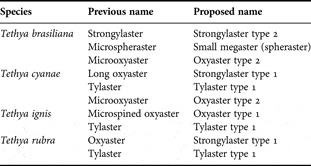
Oxyasters type 2 were called ‘microoxyasters’, the small spherasters (a type of megaster) were called ‘microspherasters’ (a type of micraster) and strongylasters type 1 were called simply ‘strongylasters’ by Ribeiro & Muricy (Reference Ribeiro and Muricy2004), who described this species in greater detail (cf. Discussion; Table 1).
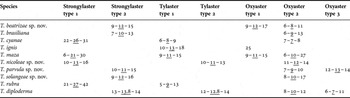
Reinterpretation of the micrasters of Tethya brasiliana, T. cyanae, T. ignis and T. rubra, according to the terminology proposed in the present paper (source: Ribeiro & Muricy, Reference Ribeiro and Muricy2004). See Discussion for definitions of spicule types.

DIAGNOSIS
Tethya dark blue externally and yellow internally. Cortex 900–1500 µm thick, with irregular cavities. A collagenous layer marks the boundary between the cortex and the choanosome. Megasclere bundles with terminal fans, 100–1000 µm in diameter. Main strongyloxeas are 760–1384 µm long; accessory strongyloxeas 380–692 µm. Spherasters 21–42 µm in diameter. Micrasters are tylasters type 1 (6–9 µm), strongylasters type 1 (22–31 µm) and oxyasters type 2 (7–8 µm). Choanosome with exogenous particles and abundant oxyasters, but without large cavities.
DISTRIBUTION
Found in Abrolhos Archipelago, Bahia State, Brazil.
REMARKS
We described this species in greater detail in a previous article (Ribeiro & Muricy, Reference Ribeiro and Muricy2004), in which we called the tylasters type 1 as ‘tylasters’, strongylasters type 1 as ‘oxyasters’ and oxyasters type 2 as ‘microoxyasters’ (cf. Discussion; Table 1).
DIAGNOSIS
Tethya orange externally and yellow internally. Cortex 1000–2000 µm thick, with scattered spherasters and a dermal crust of tylasters. Cortical cavities 300–800 µm in diameter are common between megascleres bundles. Main strongyloxeas 604–1063 µm; accessory strongyloxeas 302–566 µm. Spherasters 29–68 µm. Micrasters are tylasters type 1 (10–18 µm) and oxyasters type 1 (25 µm).
DISTRIBUTION
Found in Abrolhos Archipelago, Bahia State, Brazil.
REMARKS
The strongylasters type 1 were called ‘microspined oxyasters’ and the tylasters type 1 simply as ‘tylasters’ by Ribeiro & Muricy (Reference Ribeiro and Muricy2004), who described this species in greater detail (cf. Discussion; Table 1).
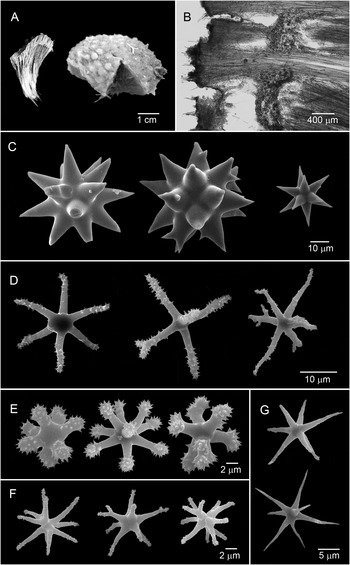
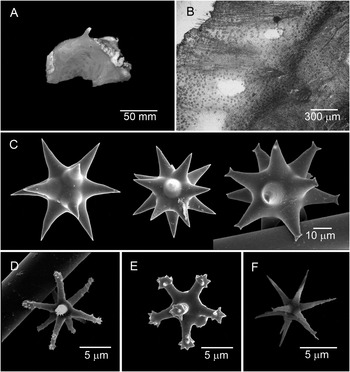
Tethya maza Selenka, Reference Selenka1879. (A) BMNH 1894.11.16.504 (left) and UFRJPOR 100 (right); (B) cortex and choanosome in transverse section; (C) spherasters; (D) strongylasters type 1; (E) tylasters type 1; (F) oxyasters type 1; (G) oxyasters type 2. (B) light microscopy; (C–G) scanning electron microscopy.

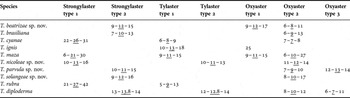
Micrasters of Brazilian species of Tethya. Tethya diploderma from Gulf of Mexico is included for comparison only. All measurements represent diameter minimum–medium–maximum in µm.
SYNONYMS
Tethya maza Selenka, Reference Selenka1879: 472; Wright, Reference Wright1881: 13; Eichenauer, Reference Eichenauer1915: 271; Mothes-de-Moraes, Reference Mothes-de-Moraes1980: 75; Hechtel, Reference Hechtel, Harrison and Cowden1976: 237; Lehnert & van Soest, 1998: 71; Sollas, Reference Sollas1888: 440. Donatia maza sensu Burton, Reference Burton1924: 1040 (non-T. maza sensu Sollas, Reference Sollas1902: 210). Tethya diploderma sensu Mothes-de-Moraes, Reference Mothes-de-Moraes1987: 129 (non-Tethya diploderma sensu Schmidt, Reference Schmidt1870: 52; non-Donatia diploderma sensu Burton, Reference Burton1924: 1039). Tethya seychellensis sensu Hechtel, Reference Hechtel, Harrison and Cowden1976: 242 (non-Tethya seychellensis Wright, Reference Wright1881).
TYPE MATERIAL
Neotype (here designated): Brazil: Riode janeiro State: Rio de Janeiro (type locality): MNRJ 810, Urca Beach, Guanabara Bay, 27 August 1984, coll. Débora Pires.
ADDITIONAL MATERIAL
BMNH 1894.11.16.504, labelled ‘Tethya maza “visit” E.P. Wright from Selenka’, additional information unavailable. Brazil: Pernambuco State: Recife: YPM 8966, Piedade, 1 June 1962, 1 specimen, coll. J. Laborel, depth unknown (Tethya seychellensis sensu Hechtel, Reference Hechtel, Harrison and Cowden1976). Alagoas State: Maceió: MNRJ 4635, Ponta Verde, 3 September 2001, 2 specimens, coll. E. Hajdu. Bahia State: Salvador: MNRJ 12570, Capitania dos Portos, 17 March 2002, 1 m depth, coll. A.V. Madeira; MNRJ 12568, 13 August 1990, 3 specimens, coll. A.V. Madeira; MNRJ 2479, Ponta de Montserrat, 31 July 1999, coll. E. Hajdu; MNRJ 2510, Forte São Marcelo, 1 August 1999, 7 m depth, coll. G. Muricy; all from Todos os Santos Bay. Espírito Santo State: Santa Cruz: UFRJPOR 331, date unknown; UFRJPOR 336-A, 1976, 2 specimens; UFRJPOR 336-B, 1976, 3 specimens; UFRJPOR 338, 1976, 12 specimens; UFRJPOR 351, July 1979; UFRJPOR 359, July 1979; MNRJ 2278, 9 April 1993; all with coll. and depth unknown. Riode Janeiro State: Niterói: UFRJPOR 32, Gragoatá, Guanabara Bay, October 1958, coll. H. Costa. Itacuruçá: MNRJ 53, Praia Grande, Itacuruçá Island, 1 April 1979, coll. D. Pires; UFRJPOR 2364, Calhau Beach, Jaguanum Island, 25 May 1978, coll. and depth unknown; UFRJPOR 2258, Itacuruçá Beach, 25 September 1976, coll. and depth unknown; UFRJPOR 2443, Praia Grande, 1 April 1979, coll. D. Pires, depth unknown. Angra dos Reis: UFRJPOR 1741, 22 April 1987, coll. and depth unknown, 3 specimens; UFRJPOR 1767, 19 October 1980, coll. and depth unknown; UFRJPOR 1806, 17 August 1980, coll. S. Poz; UFRJPOR 1821, 22 April 1987, coll. and depth unknown, 3 specimens; UFRJPOR 1974, 13 June 1980, coll. and depth unknown, UFRJPOR 2086, 14 November 1980, coll. and depth unknown; UFRJPOR 1672, 21 April 1987, UFRJPOR 1709, 19 October 1980, coll. and depth unknown, 2 specimens; UFRJPOR 1111, Cavaco Island, 22 May 1977, coll. and depth unknown. Tarituba (Paraty) (23°02.729′S–44°35.725′W): MNRJ 4555, 15 August 2001, 10 specimens, coll. S. Ribeiro, E. Vilanova & G. Muricy, intertidal zone; MNRJ 3938, 10 February 2001, 5 specimens, coll. E. Hajdu, intertidal zone. São Paulo State: Ubatuba: UFRJPOR 35, October 1958, coll. R. Silva. São Sebastião: UFRJPOR 162, July 1966, Araçá, coll. and depth unknown; UFRJPOR 100, Araçá, July 1961, 3 specimens, coll. Lopes and Pêgo; UFRJPOR 175, Araçá, July 1967, coll. J. Luiz & Neuza, depth unknown.
COMPARATIVE MATERIAL EXAMINED
Tethya maza sensu Mothes-de-Moraes (Reference Mothes-de-Moraes1980): BRAZIL: São Paulo State: São Sebastião: MCN 155, MCN 313 (fragments deposited in MNRJ 1571 and MNRJ 1572, respectively). Tethya diploderma sensu Mothes-de-Moraes (Reference Mothes-de-Moraes1987): BRAZIL: Santa Catarina State: Porto Belo: MCN 555, 558, 1059. Tethya maza sensu Lehnert & van Soest (1998): JAMAICA: Port Royal: ZMAPOR 12747 (Discovery Bay, lagoon, 28/iv/1993, 0.2 m depth).
DIAGNOSIS
Tethya with four types of micrasters: strongylasters type 1, tylasters type 1, oxyasters type 1 and oxyasters type 2.
DESCRIPTION
Body is hemispherical to spherical, 0.6–3.8 cm in diameter by 0.3–2.6 cm high (Figure 1A). External colour in vivo is yellow, white or orange, becoming yellow, beige or pinkish in ethanol. Internal colour is always pale yellow. Surface is covered by buds 0.5–1.0 mm in diameter and stalked by thin peduncles, or tuberculated, with few buds. Flattened tubercles are separated by reticulate areas. Oscules located in the apex or laterally in the sponge body. Oscules 1–3, but most often there is a single apical oscule, 0.5–5.0 mm in diameter, with a slightly elevated rim. Consistency of the cortex is firm; choanosome compressible.
SKELETON
Cortex is 500–2500 µm thick (Figure 1B). Tylasters abundant, forming a dermal crust or irregularly distributed in the cortex. Spherasters may be abundant throughout the cortex or limited to the inner or outer zones. Ovoid or irregular intra-cortical lacunae, 125–1000 µm in largest diameter, are frequent between megasclere tracts. Deposits of collagen form a dense layer in the boundary between cortex and choanosome.
Main bundles of strongyloxeas are 38–650 µm in diameter (Figure 1B). Accessory strongyloxeas dispersed in the choanosome between the bundles of strongyloxeas. Spherasters concentrated in the upper choanosome, commonly smaller than cortical ones. Both tylasters and oxyasters occur in the choanosome, but oxyasters are more abundant. Exogenous particles are present in variable amounts.
SPICULES (TABLE 2; FIGURE 1C–G)
Main strongyloxeas with one extremity rounded and the other acerate, blunt, or mucronate: 540–1196–1868/10–19–32 µm. Accessory strongyloxeas style-like: 224–545–994/2–6–13 µm.
Spherasters with approximately 18–23 smooth, conical and usually straight, acerate rays. Variation in spheraster shape includes rays slightly curved, mammillated, bifurcated, or with a single large lateral spine: 26–51–100 µm in diameter, R/C: 0.3–0.5–1.0 (Figure 1C).
Strongylasters type 1 with small nucleus and 6–9 regular, straight, spined, cylindrical rays with thin rounded tips (Figure 1D). Spines usually occur in the distal 3/4 or 1/2 of the rays, but are concentrated near the tips. Some strongylasters have slightly conical or bifurcated rays and can be confused with oxyasters: 6–21–30 µm in diameter.
Tylasters type 1 with relatively large, rounded nucleus and 6–8 short, cylindrical rays, spined mainly in the distal half and with expanded tips. Spines are thin, directed towards the tip of the ray: 9–11–15 µm in diameter (Figure 1E).
Oxyasters type 1 with large, irregular nucleus and 7–11 irregular, conical rays with thinly blunt or acerate, finely spined tips; in LM they may be confused with strongylasters or tylasters of similar size: 9–11–15 µm (Figure 1F).
Oxyasters type 2 with reduced nucleus and 6–7 thin, smooth, slightly conical rays with acerate or truncate tips: 6–10–27 µm (Figure 1G).
DISTRIBUTION AND ECOLOGY
Brazil: Pernambuco State: Recife (Hechtel, Reference Hechtel, Harrison and Cowden1976, as T. seychellensis). Alagoas State: Maceió (n.r.). Bahia State: Salvador (n.r.). Espírito Santo State: Santa Cruz (n.r.). Riode Janeiro State: Rio de Janeiro (Selenka, Reference Selenka1879; Sollas, Reference Sollas1888), Angra dos Reis, Itacuruçá, Tarituba, Niterói (n.r.). São Paulo State: Ubatuba, São Sebastião (Mothes-de-Moraes, Reference Mothes-de-Moraes1980). Santa Catarina State: Porto Belo (Mothes-de-Moraes, Reference Mothes-de-Moraes1987, as T. diploderma). Jamaica: Port Royal (Hechtel, Reference Hechtel1965; Lehnert & Van Soest, Reference Lehnert and van Soest1998). US Virgin Islands: Saint Thomas (Eichenauer, 1915).
This species occurs from the intertidal zone to 7 m depth, on rocky substrate.
REMARKS
Selenka (Reference Selenka1879) originally described Tethya maza from Rio de Janeiro as having two categories of asters: cortical asters 40 µm in diameter (probably spherasters), and smaller asters, 12–16 µm in diameter (probably tylasters), which occur both in the cortex and in the choanosome. Shortly after, Sollas (Reference Sollas1888) described T. maza with cortical spherasters, somal chiasters, and choanosomal chiasters. Burton (Reference Burton1924) stated that T. maza has tylasters and oxyasters, without decribing their size or location. Hechtel (Reference Hechtel1965) identified Jamaican specimens of Tethya sp. cf. maza as being similar to Tethya maza sensu Selenka (Reference Selenka1879) but not sensu Sollas (Reference Sollas1888). Clearly, the identity of Tethya maza is uncertain, mainly due to the lack of SEM observations of its spicules and to the lack of type material.
The original specimens from Selenka were lost, except for a few slides deposited in the Zoologisches Museum der Humboldt-Universität, Berlin (ZMB) (Stone, Reference Stone1986). Upon request, the curator of the ZMB Porifera collection could not locate these slides (Dr Carsten Lüter, personal communication, 2008). The Porifera collection of the Natural History Museum (London) houses a fragment of T. maza (BMNH 1894.11.16.504) without any information on date, collector or locality, but that is probably part of the original series of Selenka (Reference Selenka1879) according to the only information in its label: ‘Tethya maza “visit” E.P. Wright from Selenka’. It might have been deposited in the Natural History Museum by E.P. Wright, who referred to observations of Tethya maza through material on loan by Selenka (Wright, Reference Wright1881). The curator of the BMNH sponge collection, however, could not confirm this information with certainty (Clare Valentine, personal communication, 2007). The International Code of Zoological Nomenclature recommends the designation of a neotype when the holotype is lost and there are doubts about the identity of the species (ICZN, 1999). Our re-examination of the BMNH specimen confirmed its similarity to other specimens from the same region in south-eastern Brazil. We choose to designate a specimen from Guanabara Bay in Rio de Janeiro as the neotype due to its better conditions compared to the BMNH specimen and to avoid any doubts about the type locality of the species, which remains unchanged. The neotype, as well as the BMNH specimen and all other specimens examined, has the usual megasters (spherasters) and four types of micrasters (strongylasters type 1, tylasters type 1, oxyasters type 1 and oxyasters type 2).
DIAGNOSIS
Tethya red or yellow externally and always yellow internally. Cortex 500–1500 µm thick, with rounded lacunae, abundant spherasters and a dermal crust of tylasters. Megasclere bundles fanning out in the surface, 150–300 µm in diameter in the choanosome and 1000–1750 µm in the cortex. A collagenous layer marks the boundary between cortex and choanosome, which has cavities 100–625 µm in diameter. Main strongyloxeas are 604–1426 µm; accessory strongyloxeas are 291–633 µm. Spherasters with accerated rays, 18–50 µm in diameter. Micrasters are tylasters type 1 5–13 µm and strongylasters type 1 21–42 µm, with branched and twisted rays.
DISTRIBUTION
Found in Abrolhos Archipelago (Bahia State), Recife and Ipojuca (Pernambuco State), Brazil.
REMARKS
Ribeiro & Muricy (Reference Ribeiro and Muricy2004) called the tylasters type 1 simply as ‘tylasters’ and the strongylasters type 1 as ‘oxyasters’ (cf. Discussion; Table 1).
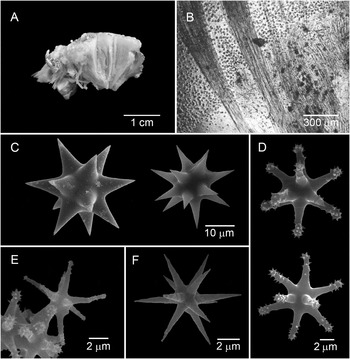
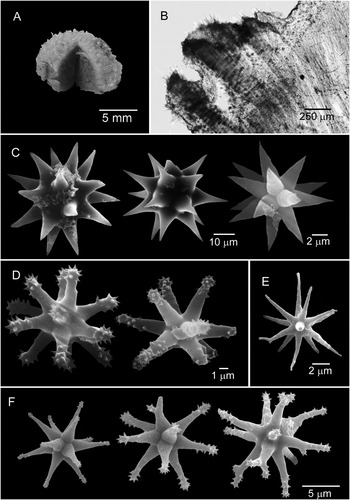
Tethya beatrizae sp. nov. (A) Preserved holotype, sectioned (MNRJ 7802); (B) transition between cortex and choanosome in transverse section; (C) spherasters; (D) strongylasters type 2; (E) oxyaster type 1; (F) oxyaster type 2. (B) Light microscopy; (C–F) scanning electron microscopy.

SYNONYMS
Donatia lyncurium sensu Carter, Reference Carter1890: 256. Tethya aurantium sensu Hechtel, Reference Hechtel, Harrison and Cowden1976: 237; Mothes & Bastian, Reference Mothes and Bastian1993: 19 (non-Alcyonium aurantium sensu Pallas, Reference Pallas1766: 357; non-Tethya aurantium sensu Topsent, Reference Topsent1920: 64, and all other records).
TYPE MATERIAL
Holotype: Brazil: Pernambuco State: Fernando de Noronha Archipelago: MNRJ 7802, Buraco da Raquel, 10 November 2003, coll. E. Hajdu, 1 m depth.
Paratypes: Brazil: Pernambuco State: Fernando de Noronha Archipelago: MCN 1734, Boldró Beach, 8 June 1986, coll. D.O. Pires & C.B. Castro; MCN 1353, Baía do Sueste, 11 June 1986, coll. D.O. Pires & C.B. Castro; MCN 750, 1404, 1413, 1419, Baía do Sueste, 26 December 1978, coll. A.A. Lise (all with depth unknown); UFRJPOR 4802, Rata Island (3°48′39″S–32°23′26″W), 14 February 1998, coll. G. Muricy, 10 m depth.
ADDITIONAL MATERIAL
Brazil: Pernambuco State: Fernando de Noronha Archipelago: MNRJ 7781, 7784, Baía do Sueste, 12 November 2003, coll. G. Muricy; MNRJ 7802, Buraco da Raquel, 10 November 2003, coll. E. Hajdu; MNRJ 7840, Ponta das Caracas, 21 November 2003, coll. F. Moraes; MNRJ 7853, Baía do Sueste, 11 November 2003, coll. G. Muricy & D. Pagnoncelli. Cabo de Santo Agostinho (8°18′12″S–34°56′47″W): MNRJ 800, Xaréu Beach, 20 January 2000, coll. E. Esteves, intertidal zone.
DIAGNOSIS
Tethya with three types of micrasters, homogeneously small (approximately 10–15 µm long): strongylasters type 2, oxyasters type 1, and oxyasters type 2.
DESCRIPTION
Body subspherical, 1.1 cm in diameter by 0.7 cm high (Figure 2A). External colour in life is yellow or whitish green, becoming white externally and brown internally after fixation in alcohol. Surface is smooth, without buds or tubercles. Oscules are not visible. Cortex is firm, choanosome compressible.
SKELETON
Cortex is 1250–2125 µm thick, without lacunae (Figure 2B). Strongylasters and spherasters abundantly dispersed in the cortex. Megascleres project slightly beyond surface. Exogenous particles are often deposited over the surface. Megasclere bundles with terminal fans, 500–875 µm in diameter. The border between cortex and choanosome is not well differentiated.
Choanosome with radial bundles of strongyloxeas, 125–300 µm thick (Figure 2B). Strongylasters abundant and spherasters rare, both irregularly distributed. Exogenous particles are abundant. Choanosomal lacunae are absent.
SPICULES
Main strongyloxeas with rounded, hastate or stepped ends: 595–948–1277/8–15–24 µm. Accessory strongyloxeas style-like with hastate ends: 215–414–679/3–6–8 µm.
Spherasters regular, with approximately 15–20 conical, smooth, acerate, non-bifurcated rays: 17–42–67 µm, R/C: 0.4–0.7–1.0 (Figure 2C).
Strongylasters type 2 with large, irregular nucleus and 10–12 cylindrical rays, with rounded tips and spined only at the distal half; spines short, directed towards the tip of the ray: 9–12–15 µm (Figure 2D).
Oxyasters type 1 with small, irregular nucleus and approximately eight thin, slightly conical, irregularly bent rays with thin, rounded tips; spines small, few, randomly dispersed over the entire length of the ray: 9–12–17 µm (Figure 2E).
Oxyasters type 2 with nucleus small and 10–12 thin, smooth, acerate rays: 6–8–11 µm (Figure 2F).
DISTRIBUTION AND ECOLOGY
Brazil: Pernambuco State: Fernando de Noronha Archipelago (type locality; Mothes & Bastian, Reference Mothes and Bastian1993 as T. aurantium; present study). Cabo de Santo Agostinho (present study). Tethya beatrizae sp. nov. occurs on the undersurfaces of boulders, from the intertidal zone to 10 m depth.
REMARKS
There were two previous records of Tethya from Fernando de Noronha Archipelago: Donatia lyncurium (sensu Carter, Reference Carter1890; synonymized with T. aurantium by Hechtel, Reference Hechtel, Harrison and Cowden1976) and T. aurantium (sensu Mothes & Bastian, Reference Mothes and Bastian1993). Carter (Reference Carter1890) described only the shape and diameter of his specimen and no other features; since the specimen could not be located, this record is clearly unrecognizable. The specimens described by Mothes & Bastian (Reference Mothes and Bastian1993) were re-examined here and are very similar to the new material collected by us. Sarà (Reference Sarà, Hooper and van Soest2002) recently described the neotype of Tethya aurantium from Naples (Italy). The sponges here studied differ from it because in T. aurantium the spicules are larger (strongyloxeas 400–2500 µm long, spherasters 18–105 µm in diameter), microoxyasters are absent, and surface tubercles are present.
Six species of Tethya are similar to T. beatrizae sp. nov., but differ by having four categories of micrasters instead of three: T. wilhelma Sarà et al., Reference Sarà, Sarà, Nickel and Brümmer2001, T. stellodermis Sarà & Sarà, Reference Sarà and Sarà2004, T. coccinea Bergquist & Kelly-Borges, Reference Bergquist and Kelly-Borges1991, T. pellis Bergquist & Kelly-Borges, Reference Bergquist and Kelly-Borges1991, T. bergquistae Hooper & Wiedenmayer, Reference Hooper, Wiedenmayer and Wells1994, and T. amplexa Bergquist & Kelly-Borges, Reference Bergquist and Kelly-Borges1991. The only species with the same micraster categories of T. beatrizae sp. nov. is T. dendyi Sarà & Sarà, Reference Sarà and Sarà2004 from Australia, but it has oxyasters type 1 with little knobbed spined tips and oxyasters type 2 with large nucleus (resembling microspherasters; Sarà & Sarà, Reference Sarà and Sarà2004), thus differing from the new species.
ETYMOLOGY
The name ‘beatrizae’ was given in honour of Dr Beatriz Mothes, who first described this species (Mothes & Bastian, Reference Mothes and Bastian1993, as T. aurantium), and for her great contribution to the taxonomy of Brazilian sponges.
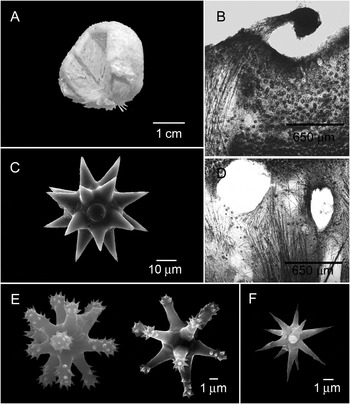
Tethya nicoleae sp. nov. (A) Fragment (UFRJPOR 3374) of the holotype (MNHN.LBIM.D.NBE.1030); (B) cortex and upper choanosome in transverse section; (C) spherasters; (D) strongylaster type 1; (E) tylaster type 2; (F) oxyaster type 2. (B) Light microscopy; (C–F) scanning electron microscopy.

SYNONYMS
Tethya japonica sensu Boury-Esnault, Reference Boury-Esnault1973: 274; Hechtel, Reference Hechtel, Harrison and Cowden1976: 237 (non-Tethya japonica sensu Sollas, Reference Sollas1888; Thomas, Reference Thomas1973; Pulitzer-Finali, Reference Pulitzer-Finali, Morton and Tseng1982; non-Donatia japonica sensu Burton, Reference Burton1924).
TYPE MATERIAL
Holotype: Brazil: Paraíba State: Off Pitimbu—Calypso Expedition, station 1 (7°29′S–34°30′W), 45 m depth: MNHN.LBIM.D.NBE.1030 (fragment deposited in UFRJPOR 3374).
DIAGNOSIS
Tethya with three categories of micrasters: strongylasters type 1, tylasters type 2 and oxyasters type 2.
DESCRIPTION
Shape spherical, 1.5 cm in diameter (Figure 3A). Surface covered by plate-like, flattened tubercles, with irregular shape and variable size (1–3 mm high). Oscules are not visible in the preserved material. Cortex is firm, resistant; choanosome compressible. Colour in alcohol white externally and beige internally.
SKELETON
Cortex is 100–250 µm thick (Figure 3B). Spherasters and oxyasters are abundant and widely distributed. Surface is slightly hispid due to the protruding ends of radial megasclere tracts, which are fan-shaped in the cortex. Ovoid lacunae, 100–750 µm in diameter, are common between megasclere tracts.
In the choanosome megasters, micrasters and accessory megascleres are randomly dispersed between radial bundles of principal megascleres.
SPICULES
Main strongyloxeas with rounded, stepped or hastate ends: 950–1187–1410/14–18–22 µm. Accessory strongyloxeas with hastate ends: 450–713–1110/2–4–7 µm.
Spherasters with large nucleus and 12–20 conical, smooth, straight or slightly curved rays with acerate, sometimes bifurcated tips: 37–48–57 µm in diameter, R/C: 0.5–0.8–0.9 (Figure 3C).
Strongylasters type 1 with small nucleus and approximately 9–11 straight, cylindrical rays, spined only in their distal 1/2 or 1/4 portion with rounded, non-bifurcated ends. Spines are small, perpendicular to the rays: 10–13–16 µm (Figure 3D).
Tylasters type 2 with small nucleus and approximately 6–8 straight, cylindrical rays spined only at the tips, which never bifurcate. Spines robust, directed towards the tip of the rays: 10–11–13 µm (Figure 3E).
Oxyasters type 2 with small nucleus and approximately 10 straight, smooth, thin, slightly conical rays, never bifurcated: 11–12–14 µm in diameter (Figure 3F).
DISTRIBUTION AND ECOLOGY
Brazil: Paraíba State: off Pitimbu (7°29′S–34°30′W; 45 m depth; Boury-Esnault, Reference Boury-Esnault1973).
REMARKS
Boury-Esnault (Reference Boury-Esnault1973) reported Tethya japonica Sollas, Reference Sollas1888 from north-eastern Brazil. However, the type locality of this species (off Manila, Phillipines) is located more than 15,000 km away in a different ocean, and it is currently considered unlikely that gene flow occurs between such disjunct populations due to the short life span of sponge larvae (e.g. Klautau et al., Reference Klautau, Russo, Lazoski, Boury-Esnault, Thorpe and Solé-Cava1999). Re-examination in SEM of the Brazilian specimen described by Boury-Esnault (Reference Boury-Esnault1973) showed that it differs from Tethya japonica sensu Sollas because the latter has a single homogeneous and abundant category of micrasters (‘somal and choanosomal chiasters, similar, actines cylindrical, tylote; 0.118 mm’ (Sollas, Reference Sollas1888), most probably tylasters 11.8 µm in diameter in modern terminology). In contrast, the specimen of the Calypso has three categories of micrasters: strongylasters type 1, tylasters type 2 and oxyasters type 2, all in the same size-range (10–16 µm). Although unlikely, these three categories could be erroneously considered by Sollas as a single one in LM, but according to SEM evidence the Brazilian specimen is not conspecific with Tethya japonica from the Phillipines.
Twelve species of Tethya also have strongylasters, tylasters and oxyasters type 2: T. wilhelma, T. stellodermis, T. coccinea, T. pellis, T. bergquistae, T. maza, T. amplexa, T. hibernica Heim et al., Reference Heim, Nickel, Picton and Brümmer2007, T. gunni Sarà & Sarà, Reference Sarà and Sarà2004, T. mortoni Bergquist & Kelly-Borges, Reference Bergquist and Kelly-Borges1991, T. solasi Bergquist & Kelly-Borges, Reference Bergquist and Kelly-Borges1991 and T. viridis (Baer, Reference Baer1906). However, T. wilhelma, T. maza, T. stellodermis, T. bergquistae, T. amplexa, T. coccinea and T. pellis also have oxyasters type 1, which do not occur in T. nicoleae sp. nov. Tethya gunni differs by having oxyasters and tylasters with large nucleus and thicker rays, and both spherasters and tylasters with mamillate rays. Tethya hibernica has strongylasters with conical rays and tylasters with thicker and shorter rays. Tethya mortoni has megasclere tracts of uniform width. Tethya sollasi differs by an extremely cavernous cortex that is packed with oxyspherasters and oxyasters type 2 with mammilate rays. Tethya nicoleae sp. nov. is characterized among the Brazilian species of the genus by the presence of tylasters type 2, with large spines at the tip of the rays.
ETYMOLOGY
The name ‘nicoleae’ was given in honour of Dr Nicole Boury-Esnault, who first studied this species (Boury-Esnault, Reference Boury-Esnault1973 as T. japonica), and for her great contribution to the taxonomy of Brazilian sponges and the biology of Porifera in general.
Tethya parvula sp. nov. (A) Preserved holotype (MNRJ 96); (B) cortex and choanosome in transverse section; (C) spherasters; (D) strongylasters type 2; (E) oxyaster type 2; (F) oxyaster type 3. (B) Light microscopy; (C–F) scanning electron microscopy.

TYPE MATERIAL
Holotype: Brazil: São Paulo State: São Sebastião: MNRJ 96, Saco da Serraria, Ilhabela (23°49′S–45°14′W), 11 January 1996, coll. E. Hajdu, 3 m depth.
Paratypes: Brazil: São Paulo State: São Sebastião: MNRJ 97, 98, 361, Saco da Serraria, Ilhabela (23°49′S–45°14′W), 11 January 1996, coll. E. Hajdu, 3 m depth; MNRJ 573, Portinho, São Sebastião Channel (23°50′S–45°24′W), 19 June 1997, coll. E. Hajdu, 2 m depth; MNRJ 5128, 5199, Praia do Segredo (23°49′S–45°25′W), 30 November 2001, coll. G. Muricy, intertidal; MNRJ 5122, Cabelo Gordo Beach (23°49′S–45°25′W), 30 November 2001, colls. G. Muricy & S. Ribeiro, intertidal. Paraná State: Pontal do Sul: MNRJ 5961, Galheta Island (25°35′S–48°19′W), 30 May 2002, coll. E. Vilanova, 3 m depth.
DIAGNOSIS
Tethya with small body size (<1 cm), thin cortex, and three categories of micrasters: strongylasters type 2 and oxyasters types 2 and 3.
DESCRIPTION
Body is hemispherical, 0.4–1.1 cm in diameter by 0.2–0.6 cm high (Figure 4A). External colour in vivo is yellow, becoming white or yellowish in ethanol. Surface is hispid due to the protruding extremities of strongyloxeas. Small buds (0.25 mm wide) may be stalked by thin, short peduncles (0.25 mm long) or attached to the surface as tubercles. Surface undulated, with tubercles in the end of radial megasclere tracts (125–500 µm). Oscules could not be seen in the preserved material. Cortex is resistant, choanosome soft.
SKELETON
Cortical layer is 250–1500 µm thick (Figure 4B). Spherasters irregularly distributed. Strongylasters abundant, forming a dermal crust. Cortical lacunae absent.
Choanosome with radial bundles of strongyloxeas, 100–150 µm in diameter (Figure 4B). Spherasters are rare, randomly distributed in the choanosome, slightly smaller than cortical ones. Strongylasters are abundant, distributed in the whole choanosome. Choanosomal lacunae absent.
SPICULES
Main strongyloxeas with rounded or hastate ends: 585–818–1296/8–14–20 µm. Accessory strongyloxeas with hastate ends: 206–400–565/2–6–11 µm.
Spherasters with large size variation, large nucleus and approximately 16–20 smooth, conical, slightly mamillate, sometimes curved or bifurcated rays with acerate ends: 9–37–69 µm in diameter, R/C: 0.4–0.5–1.0 (Figure 4C).
Strongylasters type 2 with nucleus relatively large and 11–18 thick, spined, straight, non-bifurcated, cylindrical or conical rays with rounded ends. Spines occur in the distal 1/2 to 1/4 of the rays, directed towards their tips: 10–11–15 µm in diameter (Figure 4D).
Oxyasters type 2 with 10–12 thin, straight, smooth rays with acerate ends, 7–9–10 µm in diameter (Figure 4E).
Oxyasters type 3 with 10–12 slightly mamillate, conical, irregular, sometimes ramified rays with spined ends, 12–13–14 µm in diameter. Spines small to large, perpendicular to the ray, usually present only at the tips (Figure 4F). Some spicules appear intermediate between oxyasters type 3 and strongylasters type 2 (Figure 4F, right).
DISTRIBUTION AND ECOLOGY
Brazil: São Paulo State: São Sebastião (type locality). Paraná State: Pontal do Sul. Tethya parvula sp. nov. occurs on the underside of boulders and in other sciaphilic environments, from the intertidal zone to 3 m depth.
REMARKS
Tethya brasiliana Ribeiro & Muricy, Reference Ribeiro and Muricy2004 and T. popae Bergquist & Kelly-Borges, Reference Bergquist and Kelly-Borges1991 from New Zealand are similar to T. parvula sp. nov. in the presence of strongylasters type 2 and oxyasters type 2. However, T. brasiliana has a thicker cortex with heavier collagen deposition than the new species. Furthermore, its bundles of strongyloxeas are fan-shaped in the cortex, 625–1500 µm wide, whereas bundles are more cylindrical and only 100–150 µm wide in T. parvula sp. nov. Tethya popae greatly differs from T. parvula sp. nov. by its oxyasters type 2 with deformed rays, megasclere tracts strongly branching, and occurrence of clusters of individuals connected by short basal stolons (Bergquist & Kelly-Borges, Reference Bergquist and Kelly-Borges1991). Type 3 oxyasters are absent in both T. brasiliana and T. popae. Other species such as the Australian T. acuta Sarà & Sarà, Reference Sarà and Sarà2004, T. dendyi Sarà & Sarà, Reference Sarà and Sarà2004, T. stellodermis Sarà & Sarà, Reference Sarà and Sarà2004 and T. tasmaniae Sarà & Sarà, Reference Sarà and Sarà2004 also have micrasters similar to T. parvula sp. nov. Despite the similarity of the mamillated spherasters and of the oxyasters types 2 and 3, T. acuta differs from the new species by the presence of abundant strongylasters. In contrast to T. parvula sp. nov., in T. dendyi spherasters are not mammillated and type 3 oxyasters with bifurcated rays are absent. Both Tethya stellodermis and T. tasmaniae have tylasters, which are absent in the new species.
ETYMOLOGY
The name ‘parvula’ refers to the small body size of this species (from Latin ‘parvulus, -a, -um’ = very small).
Tethya solangeae sp. nov. (A) Preserved holotype (MNRJ 1488); (B) cortex in transverse section, showing a bud; (C) spheraster; (D) choanosome in transverse section; (E) strongylaster type 2; (F) oxyaster type 2. (B–D) Light microscopy; (C, E–F) scanning electron microscopy.

TYPE MATERIAL
Holotype: Brazil: Pernambuco State: Ipojuca: MNRJ 1488, Muro Alto Beach (8°24′S–34°56′W), 19 January 1998, coll. R. Fernandes, 0.2 m depth.
DIAGNOSIS
Tethya with regular choanosomal lacunae and two categories of micrasters: strongylasters type 2 and oxyasters type 2.
DESCRIPTION
Body hemispherical, 2.5 cm wide at the base and 1.5 cm at the top by 3.0 cm high (Figure 5A). External colour in life is yellow, becoming paler after fixation. Surface microhispid, with buds or rounded tubercles 0.5–1.0 mm in diameter. Buds may be stalked or attached directly to the surface. Oscule is single, apical, 3 mm in diameter. Both cortex and choanosome firm, resistant.
SKELETON
Cortex is 825–2125 µm thick (Figure 5B). Tylasters and spherasters are abundant in the whole cortex. Bundles of strongyloxeas almost cylindrical, not fanning out, or slighly expanded near the surface (125–375 µm wide). Some bundles of strongyloxeas surpass the surface to form tubercles or the peduncles of stalked buds, 125–325 µm in diameter (Figure 5B). Circular, oval or cylindrical cavities, 125–600 µm in largest diameter and bordered by abundant tylasters, are present in the cortex.
Choanosome with bundles of strongyloxeas 150–300 µm wide, disposed radially (Figure 5D). Large, regular cavities occur in the choanosome (175–1000 µm in diameter). Accessory strongyloxeas are distributed between the cavities and the bundles of strongyloxeas. Choanosomal spherasters are smaller than cortical ones, irregularly distributed. Tylasters and strongylasters are distributed in the whole choanosome.
SPICULES
Principal strongyloxeas with rounded or hastate ends: 625–1238–1610/5–19–26 µm. Accessory strongyloxeas style-like, with hastate ends: 263–414–660/2–4–7 µm.
Spherasters with large nucleus and approximately 20 straight, conical, smooth rays with acerate, sometimes bifurcated ends: 10–46–84 µm in diameter, R/C: 0.3–0.5–0.9 (Figure 5C).
Strongylasters type 2 with 10–13 straight, slightly conical or cylindrical rays with blunt ends, which are never bifurcated. Spines concentrated in the distal 1/2 to 1/4 of the rays, directed towards their tip: 9–12–16 µm in diameter (Figure 5E).
Oxyasters type 2 with a well marked nucleus and approximately 12 thin, straight, conical, smooth rays with acerate ends, which never bifurcate (Figure 5F): 8–10–17 µm in diameter.
DISTRIBUTION AND ECOLOGY
Brazil: Pernambuco State: Ipojuca. This species was found in the intertidal zone, under boulders in shallow reefs. Polychaetes were found attached to its surface.
REMARKS
Only three other species of Tethya have the same two categories of micrasters of T. solangeae sp. nov., viz., strongylasters type 2 and oxyasters type 2: Tethya brasiliana, T. popae and T. parvula sp. nov. However, the bundles of strongyloxeas in the cortex are fan-shaped, 625–1500 µm wide in T. brasiliana and more cylindrical, 125–375 µm wide in T. solangeae sp. nov. Furthermore, the choanosome of T. brasiliana is solid whereas T. solangeae sp. nov. has characteristic choanosomal lacunae. Tethya popae from New Zealand differs from T. solangeae sp. nov. by its oxyasters type 2 with deformed rays, megasclere tracts strongly branching, and occurrence of clusters of individuals connected by short basal stolons (Bergquist & Kelly-Borges, Reference Bergquist and Kelly-Borges1991). Tethya parvula sp. nov. differs from T. solangeae sp. nov. by its smaller size, thin cortex, absence of lacunae, and the presence of oxyasters type 3.
ETYMOLOGY
The name ‘solangeae’ was given in honour of Dr Solange Peixinho (in memoriam), in recognition of her great contribution to the taxonomy of Brazilian sponges.
DISCUSSION
Taxonomic characters and terminology
Species identification within the genus Tethya is a very hard task due to the great similarity between species and to the high intraspecific variation of several characters. External morphological characters such as colour, surface texture, oscules size, presence of buds or tubercles and consistency may be influenced by environmental (hydrodynamism, sedimentation and light) or physiological conditions (reproductive period, cessation of filtration, etc). They should therefore be used cautiously for the taxonomy of Tethya (Reiswig, Reference Reiswig1971; Sarà, Reference Sarà, Hooper and van Soest2002). In Brazil, only T. solangeae sp. nov. has a distinctively firm consistency, and T. beatrizae sp. nov. has a smooth surface. Some Brazilian species are variable in colour: T. maza (yellow, white or orange), T. beatrizae sp. nov. (yellow or whitish-green), T. brasiliana (yellow or green), and T. rubra (yellow or red; cf. Ribeiro & Muricy, Reference Ribeiro and Muricy2004).
Skeletal arrangement provides some useful taxonomic characters, such as cortex thickness, collagen deposits in the border between cortex and choanosome, arrangement of microscleres and shape of megasclere bundles. Megasters occur in all species of Tethya and are usually homogeneous in shape. Strongyloxeas show variation in the shape of the thinner tip, which can be stepped, mucronate, symmetrical, hastate, or blunt. However, lack of information for many species and high intraspecific variation makes megasclere shape a poor taxonomic character for species of Tethya.
As in previous studies (e.g. Sarà, Reference Sarà, Hooper and van Soest2002; Sarà & Sarà, Reference Sarà and Sarà2004), micrasters are the main diagnostic features for species distinction in Brazilian Tethya. Inaccurate distinction of micraster types is the major cause of many taxonomic problems of the genus, especially in the earlier literature. The reduced size of micrasters and their fine ornamentation makes the identification of Tethya species almost impossible using only LM. However, most studies of Tethya species in Brazil and elsewhere used only LM (e.g. Boury-Esnault, Reference Boury-Esnault1973; Mothes-de-Moraes, Reference Mothes-de-Moraes1980, Reference Mothes-de-Moraes1987), and some did not illustrate the spicules at all (e.g. Carter, Reference Carter1890). In agreement with most modern studies (e.g. Bergquist & Kelly-Borges, Reference Bergquist and Kelly-Borges1991; Sarà & Bavestrello, Reference Sarà and Bavestrello1998; Sarà, Reference Sarà, Hooper and van Soest2002; Ribeiro & Muricy, Reference Ribeiro and Muricy2004), examination in SEM was essential to identify accurately micraster morphology in Brazilian species of Tethya and thus to distinguish between closely related species.
Use of SEM in Brazilian species of Tethya revealed subtle variations in micraster shape (nucleus size; ray shape; size, direction and distribution of spines) that cannot be described by the usual classification in tylasters, strongylasters and oxyasters. We recognized two different types of strongylasters, two of tylasters, and three of oxyasters, as follows:
Strongylaster type 1: nucleus small; rays relatively long, cylindrical, often straight and regular or more rarely irregular or bifurcated. Spines perpendicular and distributed all along the ray, although concentrated at the distal 3/4 of it (T. maza (Figure 1D); T. nicoleae sp. nov. (Figure 3D)).
Strongylaster type 2: nucleus large, irregular; rays cylindrical or slightly conical, relatively short, straight. Spines small, concentrated at the tips (T. beatrizae sp. nov. (Figure 2D); T. parvula sp. nov. (Figure 4D); T. solangeae sp. nov (Figure 5E); T. diploderma (Figure 6E)).
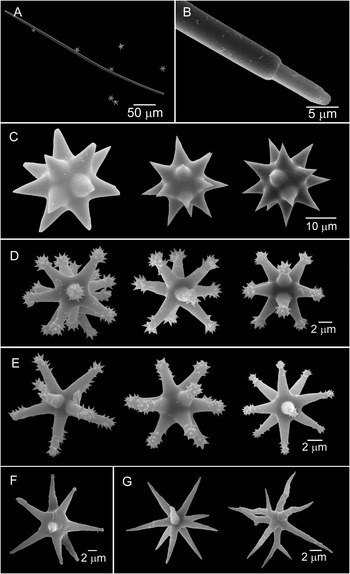
Tethya diploderma (ZMUC unregistered, St Croix). (A) Strongyloxea and micrasters; (B) stepped end of strongyloxea; (C) spherasters; (D) tylasters type 1; (E) strongylasters type 2; (F) oxyaster type 3; (G) oxyasters type 2. (A–G) Scanning electron microscopy.

Tylaster type 1: nucleus rounded; rays short, with tips enlarged; spines large, thin, concentrated at the tips and directed outwards (T. maza (Figure 1E); T. diploderma (Figure 6D)).
Tylaster type 2: nucleus irregular; rays cylindrical, straight; spines few, large, located only at the tips (T. nicoleae sp. nov. (Figure 3E)).
Oxyaster type 1: nucleus large, very irregular, distorted; rays conical, irregular, often bent or bifurcated; tips thin, but rounded; spines very small, usually only at the tip of the rays (T. maza (Figure 1F); T. beatrizae sp. nov. (Figure 2E)).
Oxyaster type 2: nucleus small; rays thin, conical, straight, smooth; tips acerate or thin, blunt; spines absent (T. maza (Figure 1G); T. beatrizae sp. nov. (Figure 2F); Tethya nicoleae sp. nov. (Figure 3F); T. solangeae sp. nov. (Figure 5F); T. diploderma (Figure 6G)).
Oxyaster type 3: nucleus large, rounded or irregular; rays conical, slightly irregular, straight, tips thin, but rounded; spines small, located only at the tip of the rays, which can be slightly mamillated (T. parvula sp. nov. (Figure 4F); T. diploderma (Figure 6F)).
Microspheraster: similar to spheraster, but smaller: nucleus is large, rounded; rays conical, straight, smooth; tips thin, acerate (T. brasiliana (Ribeiro & Muricy, Reference Ribeiro and Muricy2004)). We decided to abandon this term because we found intermediate sizes between spherasters and microspherasters. The microspherasters of T. brasiliana are here reinterpreted as being just small spherasters.
Accurate description of such subtle variations of micraster morphology in SEM may help to distinguish closely related species of Tethya. Due to the high intraspecific and intraspecimen variation in micraster morphology, genetic studies are also required to distinguish between intra- and interspecific variation with more certainty.
Status of previous records of Tethya from Brazil
Records of nine species of Tethya from Brazil were previously considered valid: T. aurantium (by Carter, Reference Carter1890; Mothes & Bastian, Reference Mothes and Bastian1993); T. maza (by Selenka, Reference Selenka1879; Mothes-de-Moraes, Reference Mothes-de-Moraes1980); T. diploderma (by de Laubenfels, Reference de Laubenfels1956; Mothes-de-Moraes, Reference Mothes-de-Moraes1980, Reference Mothes-de-Moraes1987); T. japonica (by Boury-Esnault, Reference Boury-Esnault1973; Hetchel, 1976); T. seychellensis (by Hetchel, 1976); and T. cyanae, T. ignis, T. brasiliana and T. rubra (by Ribeiro & Muricy, Reference Ribeiro and Muricy2004). Below we discuss the validity of each of these records.
Tethya aurantium
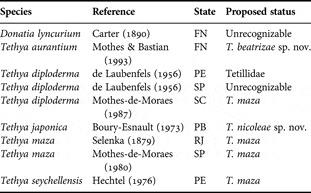
Tethya aurantium was previously reported from Fernando de Noronha Archipelago (Carter, Reference Carter1890 as Donatia lyncurium; Mothes & Bastian, Reference Mothes and Bastian1993). As discussed above (see remarks on Tethya beatrizae sp. nov.), Carter's material is unrecognizable and T. aurantium sensu Mothes & Bastian (Reference Mothes and Bastian1993) differs from the neotype of T. aurantium described by Sarà (Reference Sarà, Hooper and van Soest2002) in the size of strongyloxeas and spherasters, presence of oxyasters type 2, and absence of surface tubercles. We conclude that the previous records of T. aurantium and Donatia lyncurium from Brazil are invalid and that the specimens from Fernando de Noronha belong to a new species, which we named T. beatrizae sp. nov.
Tethya maza
The lack of type specimens and of SEM examination of microscleres is the main reason for the great uncertainty about the identity of Tethya maza. Descriptions of the same specimens using LM by Selenka (Reference Selenka1879), Sollas (Reference Sollas1888) and Burton (Reference Burton1924) are quite different, and in the absence of detailed illustrations it was impossible to objectively recognize this species. The fixation of a neotype and its description in SEM, together with extensive collections of additional specimens, allowed us to determine that T. maza has four types of micrasters: strongylasters type 1, tylasters type 1, oxyasters type 1 and oxyasters type 2. One or more of these types, especially the oxyasters type 2, may be very rare and can only be found after patient search in LM and SEM. It is expected that specimens of T. maza will be identified with more certainty from now on. The specimens described by Mothes-de-Moraes (Reference Mothes-de-Moraes1980) from São Sebastião, São Paulo State, were re-examined here using SEM; they show the same spiculation of the neotype, confirming their identity as Tethya maza.
Tethya diploderma
Mothes-de-Moraes (Reference Mothes-de-Moraes1987), using LM, described and identified as T. diploderma specimens from southern Brazil with two categories of micrasters, viz., oxyasters and tylasters. We re-examined the same specimens in SEM and found strongylasters type 1, tylasters type 1, oxyasters type 1 and oxyasters type 2, just as in T. maza. Mothes-de-Moraes (Reference Mothes-de-Moraes1987) considered T. maza and T. diploderma as synonymous, following Topsent (Reference Topsent1918) and Burton (Reference Burton1924). The original description of Schmidt (Reference Schmidt1870) from the Antilles (St Croix) defined Tethya diploderma with only two kinds of asters: one with short rays around 30 µm (probably spherasters) and another with often bent and swelling rays, 8.5 µm in diameter (probably tylasters). Schmidt did not mention the presence of oxyasters in his description. Nevertheless, other descriptions of T. diploderma (Topsent, Reference Topsent1918; Burton, Reference Burton1924; de Laubenfels, Reference de Laubenfels1953; Mothes-de-Moraes, Reference Mothes-de-Moraes1987) included spherasters, tylasters and oxyasters, bringing confusion to the identity of this species. Some authors even considered it as unrecognisable (Hechtel, Reference Hechtel1965).
We re-examined in SEM an original Schmidt specimen of T. diploderma from the Gulf of Mexico (ZMUC unregistered, fragment deposited at MNRJ 12573). Its micrasters are strongylasters type 2, tylasters type 1, oxyasters type 2, and oxyasters type 3 (Figure 6). The oxyasters type 2 may have irregular, ramified rays (Figure 6G). Although visible only in SEM, these differences in micraster shape appear to be consistent, and therefore justify the separation of T. diploderma and T. maza in two distinct species.
In Brazil, Tethya diploderma was recorded from Pernambuco and São Paulo States (de Laubenfels, Reference de Laubenfels1956), but described only from Santa Catarina State (Mothes-de-Moraes, Reference Mothes-de-Moraes1987). The specimens from Santa Catarina were re-examined here and were considered to belong to T. maza due to the presence of strongylasters type 1, tylasters type 1, oxyasters type 1, and oxyasters type 2 (Table 2). The specimen from Pernambuco State (de Laubenfels, Reference de Laubenfels1956) was also re-examined here. It has triaenes and sigmaspires, and therefore belongs to the family Tetillidae and not to the genus Tethya. The material from São Paulo State (de Laubenfels, Reference de Laubenfels1956) was not located for re-examination but, considering the erroneous identification of the other specimen, it is likely that it also does not belong to T. diploderma sensu Schmidt. As this record cannot be objectively evaluated, we consider the occurrence of T. diploderma in Brazil as not valid (Table 2).
Tethya japonica
Re-examination here, using SEM, of the specimen identified as Tethya japonica by Boury-Esnault (Reference Boury-Esnault1973) showed that it differs from Tethya japonica sensu Sollas (Reference Sollas1888) by having three types of micrasters (strongylasters type 1, oxyasters type 2 and tylasters type 2) versus a single type (tylasters) in Sollas (Reference Sollas1888) specimens, and by the abundant choanosomal spherasters. The Brazilian specimen is thus clearly not conspecific with Tethya japonica sensu Sollas. Comparison with the literature showed that it differs from all previously described species, and we proposed here a new name for it, T. nicoleae sp. nov. The Brazilian record of T. japonica is therefore not valid (Table 2).
Tethya seychellensis
Tethya seychellensis was recorded without description from Pernambuco State (Hechtel, Reference Hechtel, Harrison and Cowden1976). The specimen studied by Hechtel (YPM 8966) was re-examined here under LM and SEM and showed the presence of strongylasters type 1, tylasters type 1, and oxyasters types 1 and 2, as in T. maza. In contrast, T. seychellensis sensu stricto has only two types of micrasters: tylasters (Sollas's ‘somal chiasters’) and oxyasters (Sollas's ‘choanosomal asters’) (Sollas, Reference Sollas1888; van Soest & Beglinger, Reference van Soest and Beglinger2008). Furthermore, Tethya seychellensis is probably a complex of species, which is currently considered unrecognizable by some authors due to lack of type specimens (Sarà & Sarà, Reference Sarà and Sarà2004). A neotype should be designated for T. seychellensis to establish a clear definition of this species, but this is out of the scope of the present contribution. We thus consider the record of Tethya seychellensis from Brazil as not valid, belonging instead to T. maza (Table 2).
Tethya brasiliensis, T. cyanae, T. ignis and T. rubra
Four endemic species of Tethya were recently described from Abrolhos Archipelago, Bahia State (Ribeiro & Muricy, Reference Ribeiro and Muricy2004): T. brasiliensis, T. cyanae, T. ignis and T. rubra. These descriptions are detailed and included in situ colour photographs of living specimens and SEM of microscleres, thus allowing comparison to other species. So far, there are no reasons to question the validity of these records. The name rubra has been used for another species of Tethya, T. rubra Samaai & Gibbons, Reference Samaai and Gibbons2005 from South Africa. This species should receive a new name, since T. rubra Ribeiro & Muricy, Reference Ribeiro and Muricy2004 has precedence (ICZN, 1999, article 23). We propose for it the new replacement name T. samaaii nom. nov.
In view of the new micraster terminology proposed here, it was necessary to re-interpret the micrasters of these four species. This exercise has changed considerably their nominal spiculation (Table 1), although no new spicules were found. This example shows the importance of satisfactory and stable spicule terminology for the systematics of Tethya and of sponges in general.
In conclusion, Tethya maza, T. brasiliensis, T. cyanae, T. ignis and T. rubra are the only previous records of Tethya from Brazil that are considered as valid after this revision; there are no convincing evidences that Tethya aurantium, T. diploderma, T. japonica and T. seychellensis really occur in Brazil.
Biodiversity and endemism of Brazilian Tethya
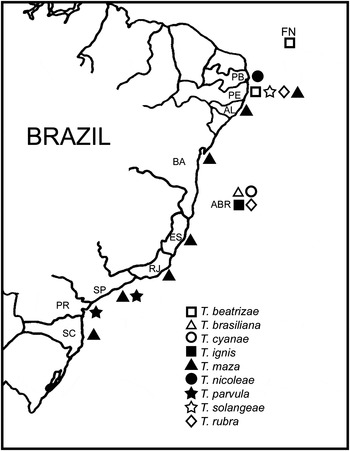
In this study, four earlier records were considered invalid and four new species were added to the five valid previous Brazilian records of Tethya; therefore, there are still nine species of this genus recognized in Brazil: T. beatrizae sp. nov., T. brasiliana, T. cyanae, T. ignis, T. maza, T. nicoleae sp. nov., T. parvula sp. nov., T. rubra, and T. solangeae sp. nov (Table 3; Figure 7). Species of Tethya require a careful field examination for their collection due to their small size and usually cryptic habitats such as the undersides of boulders or they are partially covered by sediments, which make them difficult to see in the field. More studies targeted specifically at species of Tethya will probably show that the biodiversity of Tethya in Brazil and elsewhere is still underestimated.
Present distribution of Tethya in Brazil. Data from: T. beatrizae sp. nov., Mothes & Bastian, Reference Mothes and Bastian1993 and present paper; T. brasiliana, T. ignis, T. cyanae, and T. rubra, Ribeiro & Muricy, Reference Ribeiro and Muricy2004; T. maza, Selenka (Reference Selenka1879) and present paper; T. nicolae sp. nov., Boury-Esnault (Reference Boury-Esnault1973) and present paper; T. parvula sp. nov. and T. solangeae sp. nov., present paper. FN, Fernando de Noronha Archipelago; PB, Paraíba State; PE, Pernambuco State; AL, Alagoas State; BA, Bahia State; ABR, Abrolhos Archipelago (in Bahia State), Bahia State; ES, Espírito Santo State; RJ, Rio de Janeiro State; SP, São Paulo State; PR, Paraná State; SC, Santa Catarina State.

Status of previous records of Tethya from Brazil. FN, Fernando de Noronha Archipelago (oceanic island, which actually belongs to Pernambuco State); PE, Pernambuco State (continental portion); PB, Paraíba State; RJ, Rio de Janeiro State; SP, São Paulo State; SC, Santa Catarina State.

Prior to this study, the list of Brazilian species of Tethya included one allegedly cosmopolitan species (T. aurantium), two species with disjunct distribution (T. japonica and T. seychellensis), two species distributed in the Tropical Western Atlantic (T. maza and T. diploderma) and four Brazilian endemics (T. rubra, T. cyanae, T. brasiliana, and T. ignis). There were thus four endemics out of nine species, or 44% of endemism. With the invalidation of the records of Tethya aurantium, T. diploderma, T. japonica and T. seychellensis, all of which occur in other regions, and the description of four new species, all endemic from Brazil, the rate of endemism doubled to 89%. This high increase in the percentage of endemics is an example of how detailed taxonomic studies are important for the estimation of biodiversity and endemism rates of sponge faunas. Unfortunately, there are no similarly detailed studies focused on Tethya in neighbouring biogeographical regions (Uruguay and Argentina to the south and the Caribbean to the north). Such studies may either show that the rate of endemism in Brazil is actually lower than estimated here (if the provisionally Brazilian endemic species are found elsewhere) or that the endemism of these neighbouring regions is higher than currently accepted (if new, endemic species are found there). It is clear that these studies are greatly needed for a better understanding of the diversity, evolution and biogeography of the genus Tethya.
KEY TO THE BRAZILIAN SPECIES OF TETHYA
1. Tylasters present… … … … … … … … … … … … … …2
– Tylasters absent… … … … … … … … … . . . . … … … . .6
2. Tylasters type 1… … … … … … … … … … … … … … .3
– Tylasters type 2; other micrasters are strongylasters type 2 and oxyasters type 2 … … … … … … T. nicoleae sp. nov.
3. Strongylasters absent; oxyasters type 1 large (25 µm), microspined… … … … … … … … … … … … … T. ignis
– Strongylasters present (type 1); oxyasters present or absent… … … … … … … … … … … … … … . … … . . . . 4
4. Oxyasters absent… … … … … … … … … … … … …T. rubra
– Oxyasters present… … … … … … … … … . … … … . . . 5
5. Oxyasters types 1 and 2 present, type 2 large (6–27 µm); tylasters large (9–15 µm)… … … … … … … … .T. maza
– Oxyasters type 1 absent, type 2 present but small (7–8 µm); tylasters small (6–9 µm) … … … … … …T. cyanae
6. Only one category of oxyasters present (type 2) … … …7
– Two categories of oxyasters… … … . … … … … … … . . 8
7. Radial megasclere bundles fan-shaped; choanosome compact, without lacunae… … … … … … . . .T. brasiliana
– Radial megasclere bundles cylindrical, not fanning out; lacunae are present in both choanosome and cortex… … … … … … … . … … … .T. solangeae sp. nov.
8. Oxyasters types 1 and 2… … … … … T. beatrizae sp. nov.
– Oxyasters types 2 and 3… … … … … . T. parvula sp. nov.
ACKNOWLEDGEMENTS
We thank Beatriz Mothes, Michele Klautau and Eduardo Hajdu for their critical review of the MSc of Suzi Ribeiro that resulted in this paper. The comments of an anonymous referee greatly improved the manuscript. Eduardo Esteves, Eduardo Hajdu, Eduardo Vilanova and Ulisses Pinheiro helped in collections. Rodrigo Rodrigues helped in spicule measurements. We are grateful to Dr Marcia Attias, Noêmia Rodrigues (Laboratório de Ultraestrutura Celular Herta Meyer, UFRJ; using Jeol, JSM 5310), Dr Marlene Benchimol, William Lopes (Laboratório de Biologia Celular, Universidade Santa Úrsula; using Jeol, JSM-5800), Elivaldo de Lima for help with scanning electron microscopy (Museu Nacional/UFRJ—Rede Temática Monitoramento Ambiental Marinho, SAPE 460022548-3; using Jeol, JSM-6390), and Renata Silvano for making spicules preparations. The following curators are greatly acknowledged for their help with specimen loans or information: Beatriz Mothes (Museu de Ciências Naturais da Fundação Zoobotânica do Rio Grande do Sul), Carsten Lüter (Zoologisches Museum der Humboldt-Universität), Claire Valentine (The Natural History Museum, London), Claude Lévi (Muséum National d'Histoire Naturelle, Paris), Eric Lazo-Wasem (Yale Peabody Museum), Ole S. Tendal (Zoological Museum of Copenhagen) and Rob van Soest (Zoological Museum of Amsterdam). This work was supported by Fundação Carlos Chagas Filho de Amparo à Pesquisa do Estado do Rio de Janeiro (FAPERJ), Fundação Universitária José Bonifácio (FUJB), Conselho Nacional de Desenvolvimento Científico e Tecnológico (CNPq), Coordenação de Aperfeiçoamento de Pessoal de Nível Superior (CAPES), and Petrobras (Grant 4600.249798, Programa Rede Temática de Monitoramento Ambiental Marinho, Projeto ‘Desenvolvimento da taxonomia de esponjas marinhas (Porifera) no Brasil’).