INTRODUCTION
The marine coastal region referred to as the Amazon Barrier, which includes French Guiana, presents an approximately 2900 km long obstacle to the interchange of marine organisms between the Caribbean and South America (Briggs, Reference Briggs1974, Reference Briggs1995). Directly and indirectly, outflow from the great rivers of north-eastern South America, including the Amazon, generate a colossal obstacle to biotic dispersal and survival. Alone, the Amazon at its mouth annually disgorges 20% of global freshwater (6300 km3) and the world's second largest riverine sediment discharge (1.2 × 10⁹ tons). The deluge of brackish water and silt that it emits is conveyed by coastal currents toward the Guianese coast where it deposits ‘the longest mud coastline in the world’ (Allison et al., Reference Allison, Lee, Ogston and Aller2000: 242).
Environmental conditions of the Amazon Barrier can exclude animals that require oceanic salinity, clear water, stable substrate, or reef habitat. In fact, salutary marine habitat is largely absent from the Guianese continental shelf, where the Amazon plume creates a 10 m deep surface layer of turbid low-salinity water (Artigas et al., Reference Artigas, Vendeville, Leopold, Guiral and Ternon2003) and deposits 5 m thick mud-banks that extend offshore to the 20 m isobath (Allison et al., Reference Allison, Lee, Ogston and Aller2000). The harsh milieu characterizing the region could account for French Guiana's low diversity of ophiuroids, which on the whole are intolerant of low salinity and heavy siltation. Notably, only four species of ophiuroids had previously been reported from the country, and all of them only occurred at depths >35 m where relatively high salinity prevails and there is relatively firm sediment containing sand or shell hash in addition to silt (Durand, Reference Durand1959; Le Loeuff & von Cosel, Reference Le Loeuff and von Cosel2000). The reported absence of Guianese echinoderms at depths less than 15 m, even near rocky habitat, has been attributed to the influence of soft, almost liquid mud enveloping the shallow sublittoral zone (Durand, Reference Durand1959).
In this paper, we record unexpected new distributional records for Ophiothela mirabilis Verrill, Reference Verrill1867, and Ophiactis savignyi (Müller & Troschel, Reference Müller and Troschel1842), two species of ophiuroids that were found at shallow depths during a recent marine survey in French Guiana. Considering the inhospitable conditions there, we ask how Ophiothela mirabilis and Ophiactis savignyi survived and how they breached a biogeographical barrier that ‘is virtually devoid of coral reefs’ and that restricts the dispersal and connectivity of numerous fish and invertebrate species (Briggs, Reference Briggs1974: 68, Reference Briggs1995; Lessios et al., Reference Lessios, Kane and Robertson2003; Rocha, Reference Rocha2003).
The questions are particularly intriguing as regards Ophiothela mirabilis, an alien species from the eastern Pacific, which recently entered Atlantic waters (Hendler et al., Reference Hendler, Migotto, Ventura and Wilk2012). In that regard, it is notable that Ophiothela mirabilis and Ophiactis savignyi are morphologically and behaviourally well-endowed for dispersal and colonization. The former species has hooked arm spines that attach it to the surface of 20 or more different host species in the Atlantic (Hendler et al., Reference Hendler, Migotto, Ventura and Wilk2012; unpublished observations). The hosts, often found in strong surge and currents, include gorgonians, sponges, Hydrozoa, Bryozoa, Zoantharia, and algae. Individuals of O. savignyi nestle among varied attached animals and plants, to which they cling using minutely toothed arm spines (Hendler et al., Reference Hendler, Miller, Pawson and Kier1995). The small size of both species (disc diameter <5 mm), their resistance to dislodgement, and their association with diverse sessile organisms, could facilitate transport on ships’ hulls and by rafting. Their planktonic larvae could spread in ocean currents and ships’ ballast tanks. Moreover, they belong to a guild of six-armed ophiuroids that reproduce through fissiparity. This permits a single one of these prolific animals to found a population by dividing across the disc, regenerating, and repeatedly reiterating the cloning process. Although the sexual reproduction of Ophiothela mirabilis has not been investigated, it may have a planktonic larval stage as do Ophiactis savignyi and some other asexually reproducing ophiuroids (Hendler, Reference Hendler, Giese, Pearse and Pearse1991). Herein, we consider the means of transport they may have exploited, the route they likely followed to reach French Guiana, and prospects for the long-term dispersal of Ophiothela mirabilis in the Atlantic.
MATERIALS AND METHODS
Ophiuroids discussed in the present paper were collected during an ecological study of hard bottom sites on the Guianese shelf, which was conducted by the Agence des aires marines protégées (French Agency of Marine Protected Areas) (Foulquié, Reference Foulquié2012). Opportunities to make observations and collections were limited owing to strong currents and low visibility. However, SCUBA divers observed, photographed, and collected organisms and substrate by hand. Supplemental samples of substrate were obtained using a triangular rock dredge. In addition, specimens were photographed prior to preservation, and although samples of ophiuroids were lost before they could be studied by the authors, the species were identified based on features seen in the photographs.
Study sites
The localities investigated were several groups of small islands including the îlets de Rémire (le Malingre, le Père, la Mère, and les Mamelles) that are within 4–6 km of the coast at Cayenne, French Guiana. Additional localities were surveyed to the east, including the îles du Connétable (le Grand Connétable and le Petit Connétable) approximately 12 km offshore, and Les Battures du Connétable approximately 20 km offshore.
The benthic community at Rémire Island was the shallowest and most depauperate. It was composed of thickets of hydroids associated with mud-covered balanomorph barnacles growing on rock slope ≤6 m in depth. At the îles du Connétable, blocks of rock as deep as 8 m were colonized by scattered clumps of ascidians, sessile barnacles, solitary corals, and the gorgonian, Leptogorgia punicea (Milne Edwards & Haime, Reference Milne Edwards and Haime1857). The most abundant and diverse benthic hard-bottom fauna occurred at Les Battures du Connétable, and it was the only locality where ophiuroids were found.
Les Battures is a rocky reef located at 4.926°N 51.9586°W, which constitutes a platform roughly several hundred m2 in extent. When it was investigated, on 26 September 2011, the reef emerged from mud bottom at 19 m depth and its submerged summit reached 6 m depth. The surrounding water was extremely turbid, reducing underwater visibility to 1 m at the top of the shoal and to 30 cm near its base. Currents were very strong as is typical for the locality. Even during calm weather powerful eddies sweep Les Battures, and swells break on it in heavy seas (National Geospatial-Intelligence Agency, 2012).
Under these challenging conditions, SCUBA divers conducted three dives near the top of the platform, at 6 m depth, and two dives near the base of the reef. At shallow depths, the reef was covered by massive biogenic concretions of sessile organisms, quite unlike the attenuated cover found at the shallow, inshore localities. Primary space holders were balanomorph barnacles, demosponges, colonial ascidians, plumose hydroids, and filamentous algae; one species each of actiniid sea anemone and ahermatypic coral were noted, as well as several species of gastropods and decapod crustaceans. The base of the reef, near 19 m depth, was colonized by sparsely distributed demosponges, colonial ascidians, and by two species of gorgonians: Leptogorgia miniata (Milne Edwards & Haime, Reference Milne Edwards and Haime1857) and Pacifigorgia elegans (Milne Edwards & Haime, Reference Milne Edwards and Haime1857).
RESULTS
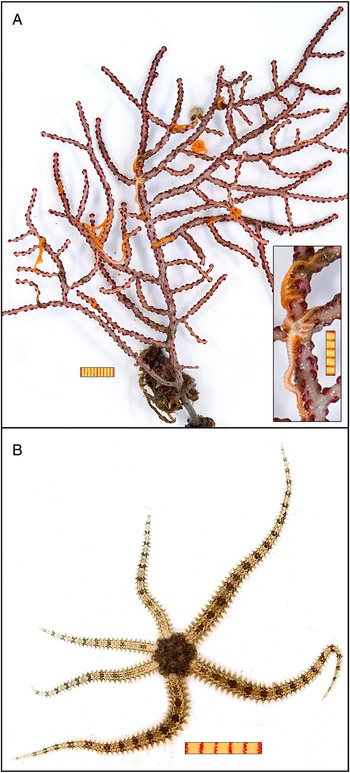
Guianese ophiuroids identified as Ophiothela mirabilis appear to be identical in morphology, colour, and size (disc diameters of ~2 mm) to the yellow-orange individuals from the Atlantic described by Hendler et al. (Reference Hendler, Migotto, Ventura and Wilk2012). However, specific identification of the Atlantic animals is provisional because 2 mm specimens of 6-armed nominal species of Ophiothela are morphologically similar (G. Hendler, personal observation), and because the taxonomy of 6-armed Ophiothela species remains unresolved (A.M. Clark, Reference Clark1976). The only individuals of O. mirabilis and of Leptogorgia miniata that were observed by divers during the entire survey were at Les Battures. The ophiothelas were associated with two colonies of L. miniata that were living at 17 m depth, both of which were collected. Sixteen ophiuroids were photographed on a 13 cm tall gorgonian colony, and nine ophiuroids on a 10 cm colony (Figure 1A). The animals generally had series of three longer and three shorter arms, which indicates that they had undergone fission and were regenerating body structures.
Living individuals of Ophiothela mirabilis and Ophiactis savignyi from French Guiana: (A) sixteen Ophiothela mirabilis on the host, Leptogorgia miniata. Inset detail of two ophiuroids on the gorgonian colony shows the pigmented dorsal surface of the upper animal and the pale ventral surface and central mouth of the lower animal. As a consequence of asexual reproduction, both ophiuroids have two longer arms and four smaller, regenerating arms; (B) Ophiactis savignyi in dorsal view, with three longer arms and three shorter, regenerating arms resulting from asexual reproduction. Scale bars: A, 10 mm (left), 5 mm (right); B, 5 mm.

Only one individual of Ophiactis savignyi was found during the survey. It occurred at Les Battures, and it was removed from biogenic concretion that was dredged from 11 m depth. The specimen, photographed prior to preservation, had morphological features and a colour pattern that is characteristic of the species, and it was of moderate size with a disc diameter of ~3 mm (Figure 1B). It had undergone fission and was in the process of regenerating.
DISCUSSION
The new range extensions of Ophiothela mirabilis and Ophiactis savignyi suggest that the seeming absence of echinoderms in shallow-water off French Guiana, and the extremely low diversity of ophiuroids found on the continental shelf in earlier surveys using shrimp-trawls (Cherbonnier, Reference Cherbonnier1959; Durand, Reference Durand1959; Le Loeuff & von Cosel, Reference Le Loeuff and von Cosel2000), should be ascribed to the type of sampling gear that was employed and the limited number of sites and types of habitats that previously were surveyed. Discovery of the species at Les Battures du Connétable shows that ophiuroids can indeed colonize hard substrate on the Guinean continental shelf, notwithstanding the risks of their exposure to osmotic stress from low-salinity water and to abrasion, anoxia, or smothering in benthic mud.
Despite its widespread distribution, the occurrence of O. savignyi was unexpected in the harsh environment prevailing at Les Battures. The presence of Ophiothela mirabilis there seems extraordinary, given its present rarity in the Atlantic and its usual occurrence in clear, high-salinity water. Evidently, the depth at which O. mirabilis occurred was sufficiently below the layer of low-density, brackish water and sufficiently above the mud bottom to permit its survival. The presence of slow-growing gorgonians with which it was associated indicates that conditions at that depth can remain equable for extended periods. If that hypothesis is correct, ophiuroids aside from Ophiactis savignyi and Ophiothela mirabilis could have colonized nearby localities with relatively clear saline water. Yet to be detected, the additional species may occupy the outcrops of hard bottom that occur at depths of 50 to 100 m on the continental shelf off French Guiana (see Agence des aires marines protégées, 2009: figure 24).
H.L. Clark ventured that Ophiactis savignyi ‘is the most common brittlestar in the world’, as it had been found in tropical seas around the globe (H.L. Clark, Reference Clark1946: 210). Nevertheless, prior to the present study it had never been reported from the Guianas. Clark surmised that its distribution is probably ‘artificial’, because individuals can be rafted or carried on ships’ hulls (H.L. Clark, Reference Clark1919; Hendler et al., Reference Hendler, Baldwin, Smith and Thacker1999). His speculation regarding its mode of dispersal is corroborated by records of O. savignyi in the fouling community on a floating dock that was towed from Hawaii to Guam, and on the hulls of Hawaiian inter-island barges and tug boats (DeFelice, Reference DeFelice1999; Paulay et al., Reference Paulay, Kirkendale, Lambert and Meyer2002; Godwin et al., Reference Godwin, Eldredge and Gaut2004; Paulay & Slapcinsky, personal communication). Based on analysis of a portion of its COI gene (Roy & Sponer, Reference Roy and Sponer2002), the species (sensu lato) appears to comprise two lineages and it has moved between the Atlantic and the Pacific Oceans in the distant past. However, the timing, direction, and frequency of the colonization events cannot be precisely determined based on available data. Nor is it possible to establish the vector or route by which O. savignyi reached Les Battures du Connétable.
Until recently, ophiuroids in the genus Ophiothela were confined to the Pacific Ocean (A.M. Clark, Reference Clark1976; Hendler et al., Reference Hendler, Migotto, Ventura and Wilk2012). However, alien individuals that are provisionally identified as Ophiothela mirabilis, an eastern Pacific taxon, initially were collected from Atlantic waters in 2000, at Ilha do Pai, Rio de Janeiro (Hendler et al., Reference Hendler, Migotto, Ventura and Wilk2012). The species’ Brazilian range now encompasses ~1800 km between Ilha do Mel, Parana and Farol da Barra, Bahia; populations have persisted for a decade at several frequently examined Brazilian sites (Hendler et al., Reference Hendler, Migotto, Ventura and Wilk2012). Late in 2011, a disjunct alien population was discovered at St Vincent in the Lesser Antilles, ~4500 km from the nearest Brazilian occurrence (Hendler et al., Reference Hendler, Migotto, Ventura and Wilk2012). Notably, virtually all O. mirabilis from Brazil and St Vincent are a distinctive yellow-orange colour, whereas Pacific populations of Ophiothela species are variously coloured. The consistent appearance of O. mirabilis from Brazil and St Vincent suggested that they constitute one lineage that proliferated from a single introduction to the Atlantic (Hendler et al., Reference Hendler, Migotto, Ventura and Wilk2012). The very similar individuals in the Guianese population appear to represent the same lineage.
The widely separated populations of O. mirabilis near major ports in Brazil and at St Vincent suggest that the animals have been distributed to new localities by shipping (Hendler et al., Reference Hendler, Migotto, Ventura and Wilk2012), and shipping may account for the presence of O. mirabilis at Les Battures du Connétable. Waters around the reef are used by recreational and commercial fisheries, and the reef is near French Guiana's largest port at Dégrad des Cannes, and also near the country's major hub of marine commerce, fisheries, and tourism at Cayenne (Agence des aires marines protégées, 2009). In addition, freighter traffic connects French Guiana with Brazil and the Antilles, and it could have spread the species, in ballast water or in the fouling communities on marine vessels, among ports in Brazil, St Vincent and French Guiana.
Alternatively, planktonic larvae or rafting adults of O. mirabilis could have been carried by oceanic currents and spread from Brazil, where the species initially was discovered in the Atlantic, onward to French Guiana and St Vincent. The circulation pattern of coastal currents in the Tropical West Atlantic might account for its present distribution. Propagules originating from the population at Bahia, Brazil, which was discovered in 2004 (Hendler et al., Reference Hendler, Migotto, Ventura and Wilk2012), would be carried around the eastern hump of Brazil in the northward flowing bifurcation of the South Equatorial Current that feeds the North Brazil Current (Lumpkin & Garzoli, Reference Lumpkin and Garzoli2005; R. Lumpkin, personal communication). The transit time of planktonic larvae drifting from the Fernando de Noronha Archipelago off north-eastern Brazil, to French Guiana, was estimated to be one year (Rudorff et al., Reference Rudorff, Lorenzzetti, Gherardi and Lins-Oliveira2009), which is considerably longer than the larval period of ophiuroids (Hendler, Reference Hendler, Giese, Pearse and Pearse1991). Thus, westward-flowing North Brazil and Guyana Currents would have had to transport adults and/or larvae of O. mirabilis toward French Guiana in several successive waves, and from there onward to St Vincent, the northern limit of the species’ present range. En route they may have populated hard-bottom sponge communities off the Guianas and Brazil, where reef-dwelling fish already have been found at depths beneath the stratum of Amazon Plume water (e.g. Collette & Rützler, Reference Collette, Rützler and Taylor1977; Rocha et al., Reference Rocha, Rosa and Feitoza2000). The presence or absence of Ophiactis savignyi, Ophiothela mirabilis, and other ophiuroids on the outer continental shelf should be investigated, to find if they have used deep-water communities as ‘stepping stones’ to traverse the Amazon Barrier.
Additional information on the expanding range of O. mirabilis in Atlantic waters could shed light on the vectors that are responsible for its dispersal. If O. mirabilis were disseminated from French Guiana by the Guinea Current, it would be expected to occur between Grenada and St Lucia, since the current enters the Caribbean Sea primarily through the Grenada and St Vincent passages (Johns et al., Reference Johns, Townsend, Fratantoni and Wilson2002; Richardson, Reference Richardson2005; Chérubin & Richardson, Reference Chérubin and Richardson2007). Since O. mirabilis already occurs at St Vincent, its presence at other Windward Islands is likely. Were it next to spread from the Windward Islands in the Caribbean Current, it would probably colonize southerly Caribbean localities because surface flow entering the Caribbean through the windward passages runs southward of 14°N before reaching Central America (Andrade et al., Reference Andrade, Barton and Mooers2003; Richardson, Reference Richardson2005; Chérubin & Richardson, Reference Chérubin and Richardson2007). Alternatively, were O. mirabilis next to spread directly from the Windward Islands into the northerly Greater Antilles and Leeward Islands, it would suggest that shipping was its likely vector for dispersal.
Recently Ophiothela mirabilis has also been discovered off Tobago. On 6–13 July 2013, Keri Wilk observed abundant individuals living on gorgonians at depths of 12–18 m, near SCUBA diving sites at Store Bay, Goat Island and Little Tobago. The ophiuroids are indistinguishable from O. Mirabilis found in French Guiana, St Vincent and Brazil, based on Wilk's excellent underwater macrophotographs. They may have been introduced to Tobago via coastal currents, or by marine vessels, as O. mirabilis occurred within 15–30 km of the port of Scarborough. The latest distributional records underscore that O. mirabilis now is widespread in Atlantic waters. Moreover, the Tobagan and Vincentian populations seem well positioned to disseminate westward via the Caribbean Cunnent and/or human mediated transport. We express our appreciation to Keri and Les Wilk for sharing information and photographs.
ACKNOWLEDGEMENTS
We express our gratitude to Agence des aires marines protégées for providing documentation and its permission to reproduce photographs used in this publication, and we thank the photographer Mathieu Foulquié. We are also grateful to Manfred Grasshoff (Senckenberg Research Institute) for identifying gorgonians, to Rick Lumpkin (National Oceanographic and Atmospheric Administration) for information on Atlantic near-surface currents, to Harilaos Lessios (Smithsonian Tropical Research Institute) for his comments regarding phylogeography, and to Gustav Paulay, John Slapcinsky (Florida Museum of Natural History), Scott Godwin (NOAA), and Steven Coles (Bernice P. Bishop Museum) for information on the dispersal of Ophiactis. Our research received no specific grant from any funding agency, commercial or not-for-profit sectors.