Introduction
Terahertz (THz) radiation generation has aroused much interest for its potential applications in many interdisciplinary fields of research due to its non-ionizing character and penetrating power. THz radiation falls between the infrared and microwave regions (1011 and 1013 Hz) of the electromagnetic spectrum. The diverge applications of THz radiation are found in the field of medical imaging, communication, material characterization, and security screening (Ferguson and Zhang, Reference Ferguson and Zhang2002; Shen et al., Reference Shen, Lo, Taday, Cole, Tribe and Kemp2005; Pickwell and Wallace, Reference Pickwell and Wallace2006; Federici and Moeller, Reference Federici and Moeller2010). During the last decades, ultra-intense (>1018 W/cm2) short duration (femtosecond) laser pulses are used to generate strong THz radiation in plasmas (Hamster et al., Reference Hamster, Sullivan, Gordon and Falcone1994; Antonsen et al., Reference Antonsen, Palastro and Milchberg2007; Yu Tong et al., Reference Yu Tong, Wei-Min, Chun and Zheng-Ming2012; Kumar et al., Reference Kumar, Singh and Sharma2016; Miao et al., Reference Miao, Palastro and Antonsen2016; Liao et al., Reference Liao, Li, Li, Liu, Zhang, Jiang, Yuan, Nilsen, Ozaki, Wang, Sheng, Neely, McKenna and Zhang2017). In comparison to semiconductors and electro-optic crystals, plasma is a suitable medium for the generation of THz radiation since it is free of optical damages (Sheng et al., Reference Sheng, Mima, Zhang and Sanuki2005). Strong THz radiation (with energies up to mJ) can be achieved using such ultra-intense lasers in plasmas (Tooth et al., Reference Tooth, van Tilborg, Geddes, Fubiani, Schroeder, Esarey, Faure, Dugan and Leemans2004; Li et al., Reference Li, Li, Zhou, Wang, Du, Ding, Lin, Liu, Sheng, Peng, Chen, Ma, Lu, Wang, Wei and Zhang2012; Hafez et al., Reference Hafez, Chai, Ibrahim, Mondal, Férachou, Ropagnol and Ozaki2016; Mori et al., Reference Mori, Hashida, Nagashima, Li, Teramoto, Nakamiya, Inoue and Sakabe2019). Therefore, laser–plasma interactions provide a new opportunity to enhance the strength of THz radiation.
The generation of THz radiation has been extensively studied in laser–plasma interaction (Yoshii et al., Reference Yoshii, Lai, Katsouleas, Joshi and Mori1997; Abo-Bakr et al., Reference Abo-Bakr, Feikes, Holldack, Kuske, Peatman, Schade, Wustefeld and Hubers2003; Schroder et al., Reference Schroder, Esarey, Van Tilbong and Leemans2004; Dong et al., Reference Dong, Sheng, Wu, Wang and Zhang2009; Li et al., Reference Li, Zhou, Ding, Du, Liu, Li, Wang, Sheng, Ma, Chen, Lu, Dong, Wang, Lou, Shi, Wei and Zhang2011; Gopal et al., Reference Gopal, May, Herzer, Reinhard, Minardi, Schubert, Dillner, Pradarutti, Polz, Gaumnitz, Kaluza, Jäckel, Riehemann, Ziegler, Gemuend, Meyer and Paulus2012; Jahangiri et al., Reference Jahangiri, Hashida, Tokita, Nagashima, Hangyo and Sakabe2013). Various schemes have been proposed to generate THz radiation in laser-irradiated plasma (Hamster et al., Reference Hamster, Sullivan, Gordon, White and Falcone1993, Reference Hamster, Sullivan, Gordon and Falcone1994; Gildenburg and Vedenskii, Reference Gildenburg and Vedenskii2007; Chen, Reference Chen2013; Peñano et al., Reference Peñano, Sprangle, Hafizi, Gordon and Serafim2010; Jha and Verma, Reference Jha and Verma2014; Liao et al., Reference Liao, Li, Li, Su, Zheng, Liu, Wang, Hu, Yan, Dunn, Nilsen, Hunter, Liu, Wang, Chen, Ma, Lu, Jin, Kodama, Sheng and Zhang2015). The key challenge is to enhance the conversion efficiency of the generated THz radiation. Very high-intensity filamented laser beams have been used to enhance the conversion efficiency of the THz radiation. An experimental and theoretical research work has been carried out to study the generation of THz radiation through the filamentation process in laser–plasma interaction (Tzortzakis et al., Reference Tzortzakis, Mechhain, Patalano, Andre, Prade, Franco, Mysyrowicz, Munier, Gheudin, Beaudin and Encrenaz2002; Sprangle et al., Reference Sprangle, Penano, Hafizi and Kapetanakos2004; Amico et al., Reference Amico, Houard, Akturk, Liu, Le Bloas, Franco, Prade, Couairon, Tikhonchuk and Mysyrowicz2008; Houard et al., Reference Houard, Liu, Prade, Tikhonchuk and Mysyrowicz2008; Singh et al., Reference Singh, Mahmoud and Sharma2012; Rawat et al., Reference Rawat, Rawat, Gaur and Purohit2017). These studies show that filamented laser beams enhance the amplitude of THz radiation. THz radiation can be generated in plasmas by using single or beating of two intense laser beams. Survey of literature reveals that THz radiation sources based on beating of the two laser beams can be scaled to high conversion efficiency. For example, Malik et al. (Reference Malik, Malik and Nishida2011) have studied THz radiation generation by beating of two spatial-Gaussian laser beams in a periodic density plasma. They found that the amplitude and efficiency of emitted THz radiation enhance with an increase in the density ripple amplitude and maximum at resonance condition. They have also investigated resonant excitation of THz radiation by beating of two spatial-Gaussian lasers in a spatially periodic density plasma in the presence of a static magnetic field (Malik et al., Reference Malik, Malik and Stroth2012). Their results show that the frequency and power of the emitted THz radiation can be tuned by optimizing the magnetic field, amplitude, and the periodicity of the density ripples. Singh and Sharma (Reference Singh and Sharma2014) have presented a theoretical model to produce THz radiation generation by the beating of two high powers cross-focused laser beams in magnetized ripple density plasma and shown that the generated THz amplitude and power spectrum strongly depend on the amplitude of the density ripple, cross-focusing of the laser beams, and applied external magnetic field. THz radiation generation by beating of two intense co-axial Gaussian laser beams in rippled density plasma has been studied in the presence of relativistic and ponderomotive nonlinearities (Kumar et al., Reference Kumar, Singh and Sharma2015). In this study, the conversion efficiency of THz radiation of the order of 10−3 have been achieved. Bakhtiari et al. (Reference Bakhtiari, Golmohammady, Yousefi, Kashani and Ghafary2015a) have proposed a model to produce THz radiation by beating of two dark-hollow laser beams in the collisional plasma with a rippled modulated density. They found that the intensity and efficiency of the emitted radiation are highly sensitive to the beam order. Niknam et al. (Reference Niknam, Banjafar, Jahangiri, Barzegar and Massudi2016) have analytically studied THz radiation generation by the interaction of two co-propagating high-intensity laser beams with an inhomogeneous plasma in the presence of thermal, collisional, and ponderomotive effects. Their results showed that the power and efficiency of THz radiation decrease by increasing the collision frequency. Bakhtiari et al. (Reference Bakhtiari, Esmaeilzadeh and Ghafary2017) have investigated the generation of THz radiation with high power and efficiency by using two flat-topped laser beams in magnetized plasma and found that the power and efficiency of THz radiation can enhance drastically in the magnetized plasma relative to the non-magnetized one. Mann et al. (Reference Mann, Sajal, Varshney and Sharma2017) have studied the combined effects of pulse slippage and the transverse magnetic field on THz radiation excitation by nonlinear beating of two cosh-Gaussian laser beams (CGLBs) propagating in a corrugated plasma. This scheme produces the efficiency of THz radiation of the order of 10−4. Recently, the THz radiation generated by mixing two CGLBs in collisional magnetized plasma in the presence of a helical magnetostatic wiggler has been studied (Varaki and Jafari, Reference Varaki and Jafari2018). The results show that the amplitude and efficiency of THz radiation increase with increasing the values of the wiggler frequencies and decentered parameter. Varshney et al. (Reference Varshney, Upadhayay, Madhubabu, Sajal and Chakera2018) have proposed a model for the generation of THz radiation with high THz amplitude and high efficiency by using two CGLBs in axially magnetized rippled plasma. They compared the results with hollow-Gaussian and Gaussian laser beams and found that the THz radiation generated by hollow-Gaussian beams have three orders of higher amplitude as compared with that generated by Gaussian laser beams, the efficiency of THz generated is five times higher in the case of hollow-Gaussian beams.
Different profiles of laser beams, such as Gaussian (Singh and Sharma, Reference Singh and Sharma2014; Niknam et al., Reference Niknam, Banjafar, Jahangiri, Barzegar and Massudi2016), super-Gaussian (Malik et al., Reference Malik, Malik and Nishida2011, Reference Malik, Malik and Stroth2012; Hussain et al., Reference Hussain, Singh and Sharma2016), hollow (Bakhtiari et al., Reference Bakhtiari, Golmohammady, Yousefi, Kashani and Ghafary2015a; Rawat et al., Reference Rawat, Rawat, Gaur and Purohit2017), cosh-Gaussian (Mann et al., Reference Mann, Sajal, Varshney and Sharma2017; Varaki and Jafari, Reference Varaki and Jafari2018; Varshney et al., Reference Varshney, Upadhayay, Madhubabu, Sajal and Chakera2018), and flat-topped (Bakhtiari et al., Reference Bakhtiari, Yousefi, Golmohammady, Jazayeri and Ghafary2015b), have been used to generate strong and tunable THz radiation generation in laser–plasma interaction. The CGLBs (decentred Gaussian beams) have raised considerable interest due to its peerless propagation properties and attractive applications (Lu and Luo, Reference Lu and Luo2000; Gill et al., Reference Gill, Mahajan and Kaur2011; Zhou, Reference Zhou2011; Singh et al., Reference Singh, Singh and Sharma2013; Purohit et al., Reference Purohit, Gaur and Rawat2016). These beams having higher efficient power in comparison to the Gaussian laser beam (Konar et al., Reference Konar, Mishra and Jana2007). One of the important characteristics of CGLBs is that they may be focused at the desired position by choosing a suitable decentred parameter. Therefore, the amplitude and efficiency of THz radiation generated by CGLBs become higher than Gaussian laser beams. In addition, in comparison to only relativistic/ponderomotive nonlinearity, the combined effect of relativistic and ponderomotive nonlinearities with static magnetic field also enhance the amplitude and efficiency of emitted THz radiation.
In most of the earlier works on THz radiation generation by beating of two laser beams in plasma, authors have used paraxial-ray theory in the presence of either ponderomotive or relativistic nonlinearity. In the present study, the generation of THz radiation by beating/cross-focusing of two intense CGLBs propagating in rippled density magnetized plasma have been studied in the presence of a static magnetic field. This study has been carried out in the presence of relativistic and ponderomotive nonlinearities. Higher-order paraxial-ray theory (Sharma and Chauhan, Reference Sharma and Chauhan2008; Rawat et al., Reference Rawat, Singh, Sharma and Purohit2014) have been used in this study, which is based on the expansion of the eikonal and nonlinear dielectric constant up to the fourth power of r, where r is the distance from the axis of beam. Due to coupling between density ripples present in the plasma and density perturbation, nonlinear current is generated, which produce THz radiation at beating frequency. The effect of decentred parameter on the cross-focusing of CGLBs in magnetized plasma, and further its effect on the amplitude and efficiency of emitted THz radiation have been explored for different values of magnetic field and density ripple. The nonlinear effective dielectric constant of the plasma in the presence of relativistic and ponderomotive nonlinearities and brief description of the cross-focusing of two CGLBs in magnetized plasma under non-paraxial approximation have been given in the next section. The equations for the emitted THz field amplitude and efficiency have been derived in the “Formalism of generation of THz radiation” section. In the “Numerical result and discussion” section, the results of the numerical study have been presented and discussed. The conclusions of the present study are given in the last section.
Analytical formulation
Consider two right circularly polarized CGBs with different frequencies (ωj+, j = 1, 2) and wave vectors (k j+) propagating in the collisionless magnetoplasma. We consider that the external applied static magnetic field (B 0) is along to the propagation direction of the beams, i.e., in the z-direction. The complex amplitude of the laser beams is given by the following equation:
 $$(A_{\,j^{+}} )_{z = 0} = \displaystyle{{E_{0j^{+}}} \over 2}\exp \left( {\displaystyle{{b^2} \over 4}} \right)\left[ {\exp \left\{ {-{\left( {\displaystyle{r \over {r_{\,j^{+}}}} + \displaystyle{b \over 2}} \right)}^2} \right\} + \exp \left\{ {-{\left( {\displaystyle{r \over {r_{\,j^{+}}}} -\displaystyle{b \over 2}} \right)}^2} \right\}} \right]$$
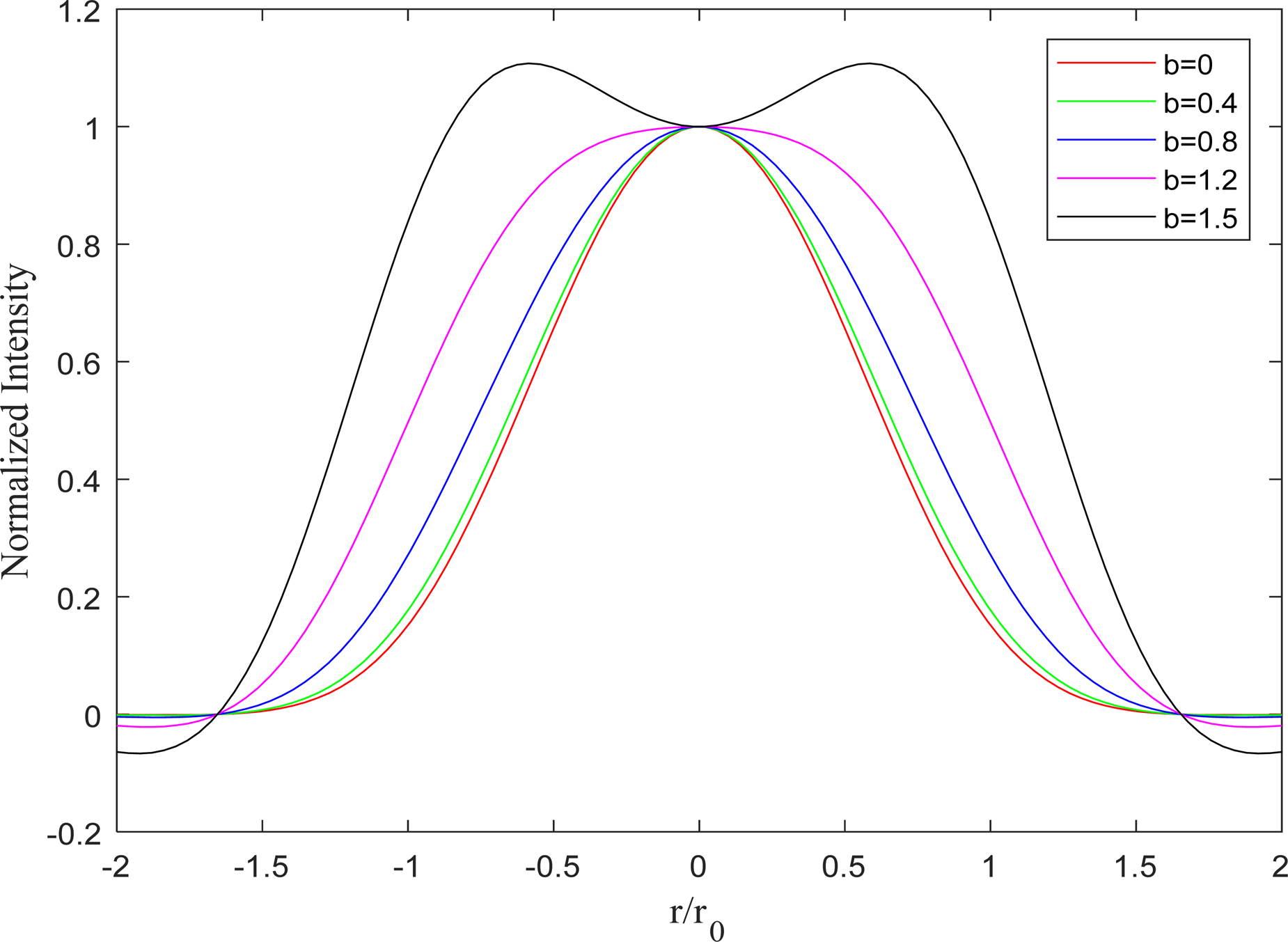
where “+” sign denotes the right circular mode of propagation, E 0j+ is the initial amplitude of the CGBs, r is the radial coordinate of the cylindrical system, r j+ is the initial width of the laser beams, and b is the decentred parameter. The intensity profile of a CGLB is shown in Figure 1. Such profile of laser beam having specific features, namely steep gradient in the distribution of laser intensity and a wider cross-section relative to the other laser beam profiles, which leads to stronger pondermotive force and higher power THz radiation.
Intensity profile of a CGLB with normalized transverse distance (r/r 0) for different values of b. Here, b = 0 corresponds to the Gaussian laser beam.

Effective dielectric constant of the plasma
The dielectric constant  $({{\rm \varepsilon} _{0j+}})$ of plasma is given by the following equation:
 $${\rm \varepsilon} _{0j+} = \left[ {1-\displaystyle{{{\rm \omega} _{\,p0}^2} \over {{\rm \omega} _{\,j+}^2 (1-\Omega _{\,j+} )}}} \right]\comma \;\;\; \Omega _{\,j+} = \displaystyle{{{\rm \omega} _{ce}} \over {{\rm \omega} _{\,j+}}} $$
where ωp0 = (4πn 0e 2/m 0)1/2 and ωce = (eB 0/m 0c) are the plasma frequency and cyclotron frequency, respectively, e is the electronic charge, m 0 is the rest mass of the electron, and n 0 is the electron density of the plasma in the absence of laser beam. The laser fields impart oscillatory velocity  $(\vec{\rm \upsilon} _{j +} )$ to plasma electrons at the beat frequency (ω1 − ω2) and wave number (k 1 − k 2) given by the following expression:
 $$\vec{\rm \upsilon} _{\,j+} = \vec{\rm \upsilon} _{\,jx} + i\vec{\rm \upsilon} _{\,jy} = \displaystyle{{ie} \over {m_0{\rm \omega} _{\,j+} {\rm \gamma} (1-\Omega _{\,j+} /{\rm \gamma} )}}\vec{E}_{\,j+} $$
The laser beams exert ponderomotive force on the electrons in the presence of relativistic nonlinearity. The relativistic–ponderomotive force by laser beams in magnetized plasma is given by the following equation (Sharma and Tripathi, Reference Sharma and Tripathi2012):
 $$\eqalign{{\vec{F}}_{\rm RP} &= -\displaystyle{{m_0} \over 2}\lpar {(\vec{\rm \upsilon}_{\,j+}^{^{\vskip -1.5pt \ast}} \cdot \nabla ){\rm \gamma} {\vec{\rm \upsilon}}_{\,j+}} \rpar -\displaystyle{e \over 2}(\vec{\rm \upsilon} _{\,j+} ^{^{\vskip -1.5pt \ast}} \times {\vec{B}}_{\,j+} ) \cr &= -\hat{r}\displaystyle{{e^2} \over {4m_0{\rm \omega} _{\,j +} ({\rm \gamma \omega} _{\,j+} -{\rm \omega} _{ce})}}\left[{\displaystyle{{2-(\Omega_{\,j+} /{\rm \gamma} )} \over {\lpar {1-(\Omega_{\,j+} /{\rm \gamma} )} \rpar }}} \displaystyle{{\partial (A_{\,j+} A_{\,j+} ^{^\ast} )} \over {\partial r}} \right.\cr &\quad -\left. {\displaystyle{{{\rm \omega} _{ce}A_{\,j+} A_{\,j+}^{^\ast}} \over {{\rm \omega} _{\,j+}^2 {\rm \gamma}^2{\lpar {1-(\Omega_{\,j+} /{\rm \gamma} )} \rpar }^2}}\displaystyle{{\partial {\rm \gamma}} \over {\partial r}}} \right]} $$
where  $\vec{B}_{j +} = \lpar {ic(\nabla \times {\vec{E}}_{j+} )/\omega_{j+}} \rpar$ is the magnetic field of respective laser beams, and γ is the relativistic factor given by the following equation:
 $${\rm \gamma} = \left( {1 + \sum\limits_j {\displaystyle{{a_{0j}A_{\,j+}^{} A_{\,j+}^{^\ast}} \over {{\lpar {1-(\Omega_{\,j+} /{\rm \gamma} )} \rpar }^2}}}} \right)^{1/2}$$
where 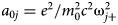 $a_{0j} = e^2/m_0^2 c^2{\rm \omega} _{j+} ^2$. The expression for γ can be written as the fourth order differential equation in γ. Using Eq. (5) in Eq. (4), we get the following equation:
 $$\eqalign{\vec{F}_{\rm RP} &= -\hat{r}\displaystyle{{m_0c^2} \over {4{\rm \gamma} {\lpar {1-(\Omega_{\,j+} /{\rm \gamma} )} \rpar }^2}}\left[ {2-\displaystyle{{{\rm \omega}_{ce}} \over {{\rm \gamma \omega}_{\,j+}}} -\displaystyle{1 \over 2}\displaystyle{{{\rm \omega} _{ce}} \over {{\rm \omega} _{\,j+}}} \displaystyle{{({\rm \gamma}^2-1)} \over {({\rm \gamma}^3-\Omega_{\,j+} )}}} \right] \cr &\quad\times\displaystyle{\partial \over {\partial r}}a_{\,j+} a_{\,j+} ^{^\ast}} $$
where a j+ = eA j+/m 0cωj+. The modified electron density of the plasma due to this relativistic–ponderomotive force can be written as follows:
 $$\displaystyle{n \over {n_0}} = 1-\sum\limits_j {\displaystyle{{\nabla \cdot {\vec{F}}_{\rm RP}} \over {4{\rm \pi}n_0e^2}}} $$
The effective dielectric constant  $({\rm \varepsilon} _{j+})$ of the plasma for the right circularly polarized beams is given by the following equation:
 $${\rm \varepsilon} _{\,j+} = {\rm \varepsilon} _{xxj}-i{\rm \varepsilon} _{xyj} = 1-\displaystyle{{{\rm \omega} _{\,p0}^2} \over {{\rm \omega} _{\,j+} ^2 {\rm \gamma} \lpar {1-(\Omega_{\,j+} /{\rm \gamma} )} \rpar }}\displaystyle{n \over {n_0}}$$
where
 $${\rm \varepsilon} _{xxj} = {\rm \varepsilon} _{yyj} = 1-\displaystyle{{{\rm \omega} _{\,p0}^2} \over {{\rm \omega} _{\,j+} ^2 {\rm \gamma} \lpar {1-(\Omega_{\,j+}^2 /{\rm \gamma}^2)} \rpar }}\displaystyle{n \over {n_0}}$$
 $${\rm \varepsilon} _{xyj} = {\rm \varepsilon} _{yxj} = \displaystyle{{-i\lpar {{\rm \omega} _{\,p0}^2 /{\rm \gamma \omega} _{\,j+}^2} \rpar \lpar {\Omega_{\,j+} /{\rm \gamma}} \rpar } \over {\lpar {1-(\Omega_{\,j+}^2 /{\rm \gamma}^2)} \rpar }}\displaystyle{n \over {n_0}}$$
and
 $${\rm \varepsilon} _{zzj} = 1-\displaystyle{{{\rm \omega} _{\,p0}^2} \over {{\rm \omega} _{\,j+} ^2}} \displaystyle{n \over {n_0{\rm \gamma}}}$$
In order to explicitly write  ${\rm \varepsilon} _{j+}$ in the non-paraxial region, γ can be expended as follows:
 $${\rm \gamma} = {\rm \gamma} _0 + r^2{\rm \gamma} _2 + r^4{\rm \gamma} _4$$
One can obtain from Eq. (11):
 $${\rm \gamma} _0 = 1 + \sum\limits_j {{\rm \gamma} _{0j}} + \sum\limits_{\,j \ne k} {{\rm \gamma} _{0jk}} = \sum\limits_j {\left( {\displaystyle{{a_{0j}^2} \over {2f_{\,j+}^2}} X_j-\displaystyle{{a_{0j}^4} \over {8f_{\,j+}^4}} Y_j-\displaystyle{1 \over 8}\sum\limits_k {\displaystyle{{a_{0j}^2} \over {\,f_{\,j+}^2}} \displaystyle{{a_{0k}^2} \over {2f_{k+}^2}}} Z_{\,jk}} \right)} $$
 $$\eqalign{{\rm \gamma} _2 &= \sum\limits_j {{\rm \gamma} _{2j}} + \sum\limits_{\,j \ne k} {{\rm \gamma} _{2jk}} = \sum\limits_j \left\{ \displaystyle{{a_{0j}^2} \over {2r_{\,j+}^2 f_{\,j+}^2}} (b_j^2 -{\rm \alpha} _{2j}-2)X_j \right.\cr &\quad +\left.-\displaystyle{{a_{0j}^4} \over {8r_{\,j+}^2 f_{\,j +}^6}} (b_j^2 -{\rm \alpha}_{2j}-2)Y_j \right. \cr &\quad -\displaystyle{1 \over 8}\sum\limits_k {\displaystyle{{a_{0j}^2} \over {\,f_{\,j+} ^2}} \displaystyle{{a_{0k}^2} \over {\,f_{k+} ^2}}} \left. {\left[ {\displaystyle{{(b_j^2 -{\rm \alpha}_{2j}-2)} \over {r_{\,j+}^2 f_{\,j+}^2}} + \displaystyle{{(b_k^2 -{\rm \alpha} _{2k}-2)} \over {r_k^2 f_{k+}^2}}} \right]Z_{\,jk}} \right\}} $$
and
 $$\eqalign{{\rm \gamma} _4 &= \sum\limits_j {{\rm \gamma} _{4j}} + \sum\limits_{\,j\ne k} {{\rm \gamma} _{4jk}} = \sum\limits_j \left\{ \displaystyle{{a_{0j}^2} \over {2r_{\,j+}^4 f_{\,j+}^2}} A_{1j}X_j \right.\cr &\quad -\displaystyle{{a_{0j}^4} \over {8r_{\,j+}^4 f_{\,j+}^6}} A_{2j}Y_j -\sum\limits_k {\displaystyle{{a_{0j}^2} \over {\,f_{\,j+} ^2}} \displaystyle{{a_{0k}^2} \over {\,f_{k+} ^2}}} \cr &\quad \times \left. {\left[ {\displaystyle{{{(b_j^2 -{\rm \alpha} _{2j}-2)}^2} \over {r_{\,j+}^4 f_{\,j+}^4}} + \displaystyle{{(b_j^2 -{\rm \alpha} _{2j}-2)} \over {r_{\,j +}^2 f_{\,j+}^2}} \displaystyle{{(b_k^2 -{\rm \alpha} _{2k}-2)} \over {r_k^2 f_{k+}^2}}} \right]Z_{\,jk}} \right\}} $$
where
 $$X_j = 1 + 2\displaystyle{{{\rm \omega} _{ce}} \over {{\rm \omega} _{\,j+}}} + 3\displaystyle{{{\rm \omega} _{ce}^2} \over {{\rm \omega} _{\,j+} ^2}}$$
 $$Y_j = 1 + 8\displaystyle{{{\rm \omega} _{ce}} \over {{\rm \omega} _{\,j+}}} + 22\displaystyle{{{\rm \omega} _{ce}^2} \over {{\rm \omega} _{\,j+} ^2}} + 9\displaystyle{{{\rm \omega} _{ce}^3} \over {{\rm \omega} _{\,j+} ^3}} + 9\displaystyle{{{\rm \omega} _{ce}^4} \over {{\rm \omega} _{\,j+} ^4}}$$
 $$Z_{\,jk} = 1 + 4\left( {\displaystyle{{{\rm \omega} _{ce}} \over {{\rm \omega} _{\,j+}}} + \displaystyle{{{\rm \omega} _{ce}} \over {{\rm \omega} _{k+}}}} \right) + \left( {9\displaystyle{{{\rm \omega} _{ce}^2} \over {{\rm \omega} _{\,j+}^2}} + 9\displaystyle{{{\rm \omega} _{ce}^2} \over {{\rm \omega} _{k+}^2}} + \displaystyle{{{\rm \omega} _{ce}^2} \over {{\rm \omega} _{\,j+} {\rm \omega} _{k+}}}} \right) + 6\displaystyle{{{\rm \omega} _{ce}^3} \over {{\rm \omega} _{\,j+} {\rm \omega} _{k+}}} \left( {\displaystyle{1 \over {{\rm \omega} _{\,j+}}} + \displaystyle{1 \over {{\rm \omega} _{k+}}}} \right) + 9\displaystyle{{{\rm \omega} _{ce}^4} \over {{\rm \omega} _{\,j+} ^2 {\rm \omega} _{k+} ^2}}$$
 $$A_{1j} = \displaystyle{{b_j^4} \over 3}-b_j^2 + b_j^2 {\rm \alpha} _{2j}-2{\rm \alpha} _{2j} + {\rm \alpha} _{4j} + 2$$
 $$A_{2j} = \displaystyle{{5b_j^4} \over 3}-8b_j^2 + 2b_j^2 {\rm \alpha} _{2j} + 2b_j {\rm \alpha} _{2j} + {\rm \alpha} _{2j}^2 -8{\rm \alpha} _{2j} + 2{\rm \alpha} _{4j} + 8$$
Substituting  $\vec{F}_{\rm RP}$ from Eq. (6) in Eq. (7) and using Eq. (9), we get the normalized electron density as follows:
 $$\displaystyle{n \over {n_0}} = 1-\left( {{\rm \delta}n_{0j} + \displaystyle{{r^2} \over {r_{\,j+}^2}} {\rm \delta}n_{2j} + \displaystyle{{r^4} \over {r_{\,j+}^4}} {\rm \delta}n_{4j}} \right)$$
where
 $${\rm \delta}n_{0j} = \displaystyle{{-c^2a_{0j}^2} \over {2{\rm \omega} _p^2 r_{\,j+} ^2 f_{\,j+} ^4}} \times \displaystyle{{(b_j^2 + {\rm \alpha} _{2j}-2)} \over {{({\rm \gamma} _0-\Omega _{\,j+} )}^2({\rm \gamma} _0^3 -\Omega _{\,j+} )}} [{B_{1j}}]$$
 $$\eqalign{{\rm \delta}n_{2j} &= \displaystyle{{-c^2a_{0j}^2} \over {{\rm \omega} _p^2 r_{\,j+} ^2 f_{\,j+} ^6 {({\rm \gamma} _0-\Omega _{\,j+} )}^4{({\rm \gamma} _0^3 -\Omega _{\,j+} )}^3}} \cr &\quad\times\left\{ {8B_{1j}A_{1j}{({\rm \gamma} _0-\Omega_{\,j+} )}^2{({\rm \gamma} _0^3 -\Omega_{\,j+} )}^2 + \displaystyle{{a_{0j}^2} \over {\,f_{\,j+}^2}} {\rm \gamma}_0^2 A_{3j}} \right. \cr &\quad\times \left.\vphantom{\displaystyle{{a_{0j}^2} \over {\,f_{\,j+}^2}}} {\left[ {B_{2j}({\rm \gamma} _0-\Omega_{\,j+} )\displaystyle{{{\rm \omega} _{ce}} \over {{\rm \omega} _{\,j+}}} -B_{1j}({\rm \gamma} _0 + \Omega_{\,j+} )({\rm \gamma} _0^3 -\Omega_{\,j+} )} \right]} \right\}}$$
and
 $$\eqalign{{\rm \delta}n_{4j} &= \displaystyle{{-c^2a_{0j}^2} \over {2{\rm \omega} _p^2 r_{\,j+} ^2 f_{\,j+} ^8 {({\rm \gamma} _0-\Omega _{\,j+} )}^4{({\rm \gamma} _0^3 -\Omega _{\,j+} )}^3}}\cr &\quad\times\left\{ { 9{\rm \gamma}_0A_{4j}B_{1j}{({\rm \gamma} _0-\Omega_{\,j+} )}^2{({\rm \gamma} _0^3 -\Omega_{\,j+} )}^2 + 2\displaystyle{{a_{0j}^2} \over {\,f_{\,j+}^2}} {\rm \gamma} _0^2 A_{5j}} \right. \cr &\quad\times \left.\vphantom{\displaystyle{{a_{0j}^2} \over {\,f_{\,j+}^2}}} {\left[ {B_{2j}({\rm \gamma} _0-\Omega_{\,j+} )\displaystyle{{{\rm \omega} _{ce}} \over {{\rm \omega} _{\,j+}}} -B_{1j}({\rm \gamma} _0 + \Omega_{\,j+} )({\rm \gamma} _0^3 -\Omega_{\,j+} )} \right]} \right\}}$$
with
 $$B_{1j} = 4{\rm \gamma} _0^4 -3{\rm \gamma} _0\Omega _{\,j+} -3{\rm \gamma} _0^3 \Omega _{\,j+} + 2\Omega _{\,j+} ^2$$
 $$B_{2j} = 3{\rm \gamma} _0^6 -3{\rm \gamma} _0^4 -2{\rm \gamma} _0^3 \Omega _{\,j+} + 2\Omega _{\,j+} ^2$$
 $$A_{3j} = b_j^4 -4b_j^2 + 2b_j^2 {\rm \alpha} _{2j}-4{\rm \alpha} _{2j} + {\rm \alpha} _{2j}^2 + 4$$
 $$A_{4j} = b_j^6 /24 - 2{\rm \alpha} _{2j}b_j^2 + {\rm \alpha} _4b_j^2 + (a_{2j}b_j^4 - 2b_j^4 )/3 + 2{\rm \alpha} _{2j} - 2{\rm \alpha} _{4j} + 2b_j^2 - 1$$
 $$A_{5j} = -2{\rm \alpha} _{2j}^2 + {\rm \alpha} _{2j}{\rm \alpha} _{4j} + 6b_j^2 + 6{\rm \alpha} _{2j}-4 + (4{\rm \alpha} _{2j}b_j^4 -8b_j^4 + b_j^6 )/3-6{\rm \alpha} _{2j}b_j^2 -2{\rm \alpha} _{4j} + {\rm \alpha} _{4j}b_j^2 + {\rm \alpha} _{2j}^2 b^2 + b_j^2$$
The effective dielectric constant of the plasma can be expressed as follows:
 $${\rm \varepsilon} _{\,j+} (r,z) = {\rm \varepsilon} _{0j+} (z)-\displaystyle{{r^2} \over {r_{\,j+} ^2}} {\rm \varepsilon} _{2j+} (z)-\displaystyle{{r^4} \over {r_{\,j+} ^4}} {\rm \varepsilon} _{4j+} (z)$$
where  ${\rm \varepsilon}_{0j+} (z), \, {\rm \varepsilon} _{2j+} (z), \, {\rm {and}} \, {\rm \varepsilon} _{4j+} (z)$ are the coefficients associated with r 0, r 2, and r 4, respectively, in the expansion of
 ${\rm \varepsilon} _+ (r,z)$ given by the following equation:
 $${\rm \varepsilon} _{0j+} (z) = 1-\displaystyle{{{\rm \omega} _p^2} \over {{\rm \omega} _{\,j +} ^2}} \displaystyle{{(1-{\rm \delta} n_{0j})} \over {({\rm \gamma} _0-\Omega _{\,j +} )}}$$
 $${\rm \varepsilon} _{2j+} (z) = \displaystyle{{{\rm \omega} _p^2} \over {{\rm \omega} _{\,j+} ^2}} \left\{ {\displaystyle{{({\rm \gamma} _2(1-{\rm \delta}n_{0j}) + f_{\,j+}^2 ({\rm \gamma} _0-\Omega_{\,j+} ){\rm \delta}n_{2j})} \over {r_{\,j+}^2 f_{\,j+}^2 {({\rm \gamma} _0-\Omega_{\,j+} )}^2}}} \right\}$$
and
 $${\rm \varepsilon} _{4j+} (z) = {\kern 1pt} {\kern 1pt} {\kern 1pt} {\kern 1pt}2\displaystyle{{{\rm \omega} _p^2} \over {{\rm \omega} _{\,j+} ^2}} \left\{ {\displaystyle{\matrix{(1-{\rm \delta}n_{0j}) [ {{\rm \gamma}_4({\rm \gamma} _0-\Omega_{\,j+} )-{\rm \gamma} _2^2} ]\cr + f_{\,j+}^2 ({\rm \gamma} _0-\Omega_{\,j+} ) [ {\,f_{\,j+}^2 ({\rm \gamma} _0-\Omega_{\,j+} ){\rm \delta}n_{4j}-{\rm \gamma}_2{\rm \delta}n_{2j}} ] {\kern 1pt} {\kern 1pt} {\kern 1pt}} \over {r_{\,j+}^4 f_{\,j+}^4 {({\rm \gamma}_0-\Omega_{\,j+} )}^3}}} \right\}$$
Propagation of CGLBs in magnetized plasma
The wave equation for the beams propagating through in collisionless magnetized plasma can be written as follows:
 $$\nabla ^2\vec{E}_{\,j+} -\nabla \cdot (\nabla \cdot \vec{E}_{\,j+} ) + {\rm \varepsilon} _{\,j+} (r,z)\displaystyle{{{\rm \omega} _{\,j+} ^2} \over {c^2}}\vec{E}_{\,j+} = 0$$
The electric fields of the laser beams are given by the following equation:
 $$\vec{E}_{\,j+} (r,z) = \hat{r}\,A_{\,j+} (r,z)\exp [i({\rm \omega} _{\,j+} t-k_{\,j+} z)]$$
where  $\hat{r} = (\hat{x} + i\,\hat{y})$ and
 $k_{j+} = \lpar {{\rm \omega} _{j+} /c} \rpar \sqrt {{\rm \varepsilon} _{0j+} (z)}$. The maximum amplitude of the laser beams is defined as follows:
 $$A_{\,j+} = A_{0j+} (r,z)\exp \{ -ik_{\,j+} S_{\,j+} (r,z)\} $$
where A 0j+ is a complex function of space, and S j+(r, z) is the eikonal associated with the CGLBs. Substituting Eq. (17) into Eq. (15) and separating real and imaginary parts of the resulting equation, the following set of equations is obtained:
 $$\eqalign{ & 2\left( {\displaystyle{{\partial S_{\,j+}} \over {\partial z}}} \right) + \displaystyle{1 \over 2}\left( {1 + \displaystyle{{{\rm \varepsilon} _{0j+}} \over {{\rm \varepsilon} _{0zzj}}}} \right)\left( {\displaystyle{{\partial S_{\,j+}} \over {\partial r}}} \right)^2 \cr &\quad = \displaystyle{1 \over {2k_{\,j+} ^2 A_{0j+}}} \left( {1 + \displaystyle{{{\rm \varepsilon} _{0j+}} \over {{\rm \varepsilon} _{0zzj}}}} \right)\left( {\displaystyle{{\partial^2A_{0j+}} \over {\partial r^2}} + \displaystyle{1 \over r}\displaystyle{{\partial A_{0j+}} \over {\partial r}}} \right) \cr &\qquad-\displaystyle{{r^2} \over {r_{\,j+} ^2}} \displaystyle{{{\rm \varepsilon} _{2j+} (z)} \over {{\rm \varepsilon} _{0j+} (z)}}-\displaystyle{{r^4} \over {r_{\,j+} ^4}} \displaystyle{{{\rm \varepsilon} _{4j}(z)} \over {{\rm \varepsilon} _{0j+} (z)}}} $$
and
 $$\displaystyle{{\partial A_{0j+} ^2} \over {\partial z}} + \displaystyle{1 \over 2}\left( {1 + \displaystyle{{{\rm \varepsilon} _{0j+} (z)} \over {{\rm \varepsilon} _{0zzj}}}} \right)\left\{ {A_{0j+}^2 \left( {\displaystyle{{\partial^2S_{\,j+}} \over {\partial r^2}} + \displaystyle{1 \over r}\displaystyle{{\partial S_{\,j+}} \over {\partial r}}} \right) + \displaystyle{{\partial A_{0j+}^2} \over {\partial r}}\displaystyle{{\partial S_{\,j+}} \over {\partial r}}} \right\} = 0$$
The solution of Eqs (18) and (19) can be written as follows (Liu and Tripathi, Reference Liu and Tripathi2001; Sodha and Faisal, Reference Sodha and Faisal2008):
 $$\eqalign{A_{0j+} ^2 (r,z) &= \displaystyle{{E_{\,j+} ^2} \over {4f_{\,j+} ^2}} \exp \left( {\displaystyle{{b^2} \over 2}} \right) \times \left( {1 + \displaystyle{{r^2} \over {r_{\,j+}^2 f_{\,j+}^2 (z)}}{\rm \alpha} _{2j}(z) + \displaystyle{{r^4} \over {r_{\,j+}^4 f_{\,j+}^4 (z)}}{\rm \alpha} _{4j}(z)} \right) \cr &\quad\times \left( {\exp \left[ {-{\left( {\displaystyle{r \over {r_{\,j+} f_{\,j+} (z)}} + \displaystyle{b \over 2}} \right)}^2} \right] + \exp \left[ {-{\left( {\displaystyle{r \over {r_{\,j+} f_{\,j+} (z)}}-\displaystyle{b \over 2}} \right)}^2} \right]} \right)^2} $$
The eikonal S j+(r, z) of the pump beams is given as follows:
 $$S_{\,j+} (r,z) = S_{0j+} (z) + \displaystyle{{r^2} \over {r_{\,j+} ^2}} S_{2j+} (z) + \displaystyle{{r^4} \over {r_{\,j+} ^4}} S_{4j+} (z)$$
where f j+ is the dimensionless beam width parameters for beam 1 and 2, respectively, S 0j(z) is the axial phase shift,
 $$S_{2j}(z) = \displaystyle{{r_j^2} \over {2f_{\,j+}}} \displaystyle{{df_{\,j+}} \over {dz}}\displaystyle{1 \over {(1 + {\rm \varepsilon} _{0j+} /{\rm \varepsilon} _{0zzj})}}$$
where S 2j(z) is indicative of the spherical curvature of the wavefront, and S 4j(z) corresponding to its departure from the spherical nature.
Substituting  $A_{0j +} ^2$ and S j+ from Eqs (20) and (21) into Eqs (18) and (19) and equating the coefficients of r 0, r 2, and r 4 in the resulting equation on both sides of the resulting equation, following equations are obtained for f j+,
 ${S}^{\prime}_{4j+}$, α2j, and α4j:
 $$\displaystyle{{d^2f_{\,j+}} \over {d{\rm \xi} _j^2}} = \left( {1 + \displaystyle{{{\rm \varepsilon}_{0j +}} \over {{\rm \varepsilon}_{0zzj}}}} \right)^2\displaystyle{{{\rm \chi} _{2j}} \over {{\rm \varepsilon} _{0j+} f_{\,j+} ^3}} -\left( {1 + \displaystyle{{{\rm \varepsilon} _{0j+}} \over {{\rm \varepsilon} _{0zzj}}}} \right)\displaystyle{{2{\rm \varepsilon} _{2j+} f_{\,j+}} \over {{\rm \varepsilon} _{0j+}}} {\rm \rho} _j^2 $$
 $$\displaystyle{{d{{S}^{\prime}}_{4j+}} \over {d{\rm \xi}}} = \displaystyle{1 \over 4}\left( {1 + \displaystyle{{{\rm \varepsilon} _{0j+}} \over {{\rm \varepsilon} _{0zzj}}}} \right)\displaystyle{{{\rm \chi} _{4j}} \over {{\rm \varepsilon} _{0j+} f_{\,j+} ^6}} -\displaystyle{{{\rm \varepsilon} _{4j+} {\rm \rho} _j^2} \over {2{\rm \varepsilon} _{0j+}}} -\displaystyle{{2{{S}^{\prime}}_{4j+}} \over {\,f_{\,j+}}} \displaystyle{{df_{0+}} \over {d{\rm \xi} _j}}$$
 $$\displaystyle{{\partial {\rm \alpha} _{2j}} \over {\partial {\rm \xi} _j}} = -8\left( {1 + \displaystyle{{{\rm \varepsilon} _{0j+}} \over {{\rm \varepsilon} _{0zzj}}}} \right){S}^{\prime}_{4j +} f_{\,j+} ^2$$
 $$\displaystyle{{\partial {\rm \alpha} _{4j}} \over {\partial {\rm \xi} _j}} = -4\left( {1 + \displaystyle{{{\rm \varepsilon} _{0j+}} \over {{\rm \varepsilon} _{0zzj}}}} \right){S}^{\prime}_{4j+} f_{\,j+} ^2 (b_j^2 + 3{\rm \alpha} _{2j}-2)$$
where
 $${S}^{\prime}_{4j+} = S_{4j+} \displaystyle{{{\rm \omega} _{\,j+}} \over c}$$
Eliminating  ${S}^{\,\prime}_{4j +}$ from Eqs (24) and (25) and integrating the resulting equation with the initial conditions α4j = 0 and α2j = 0 at ξj = 0, we obtain the following equation:
 $${\rm \alpha} _{4j} = \displaystyle{{(3{\rm \alpha} _{2j}^2 -4{\rm \alpha} _{2j})} \over 4}$$
where
 $${\rm \chi} _{2j} = -\displaystyle{{b_j^4} \over 3}-4b_j^2 + 2{\rm \alpha} _2b_j^2 -3{\rm \alpha} _{2j}^2 -4{\rm \alpha} _{2j} + 8{\rm \alpha} _{4j} + 4$$
 $${\rm \chi} _{4j} = {\rm \alpha} _{2j}^3 + 4{\rm \alpha} _{2j}^2 + 2(2b_j^4 -{\rm \alpha} _{2j}b_j^4 )/3-5b_j^6 /12 + 4{\rm \alpha} _{4j}b_j^2 -8{\rm \alpha} _{4j} + 7/2{\rm \alpha} _{2j}{\rm \alpha} _{4j}-2a_{2j}^2 b_j^2 -4$$
Here, 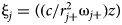 ${\rm \xi} _j = \lpar {(c/r_{j +}^2 {\rm \omega}_{j+} )z} \rpar$ and ρj = (r j+ωj+/c) describe the dimensionless distance of propagation and the dimensionless initial width of the beam, respectively. Equation (22) describes the laser beams propagation in magnetized plasma.
Formalism of generation of THz radiation
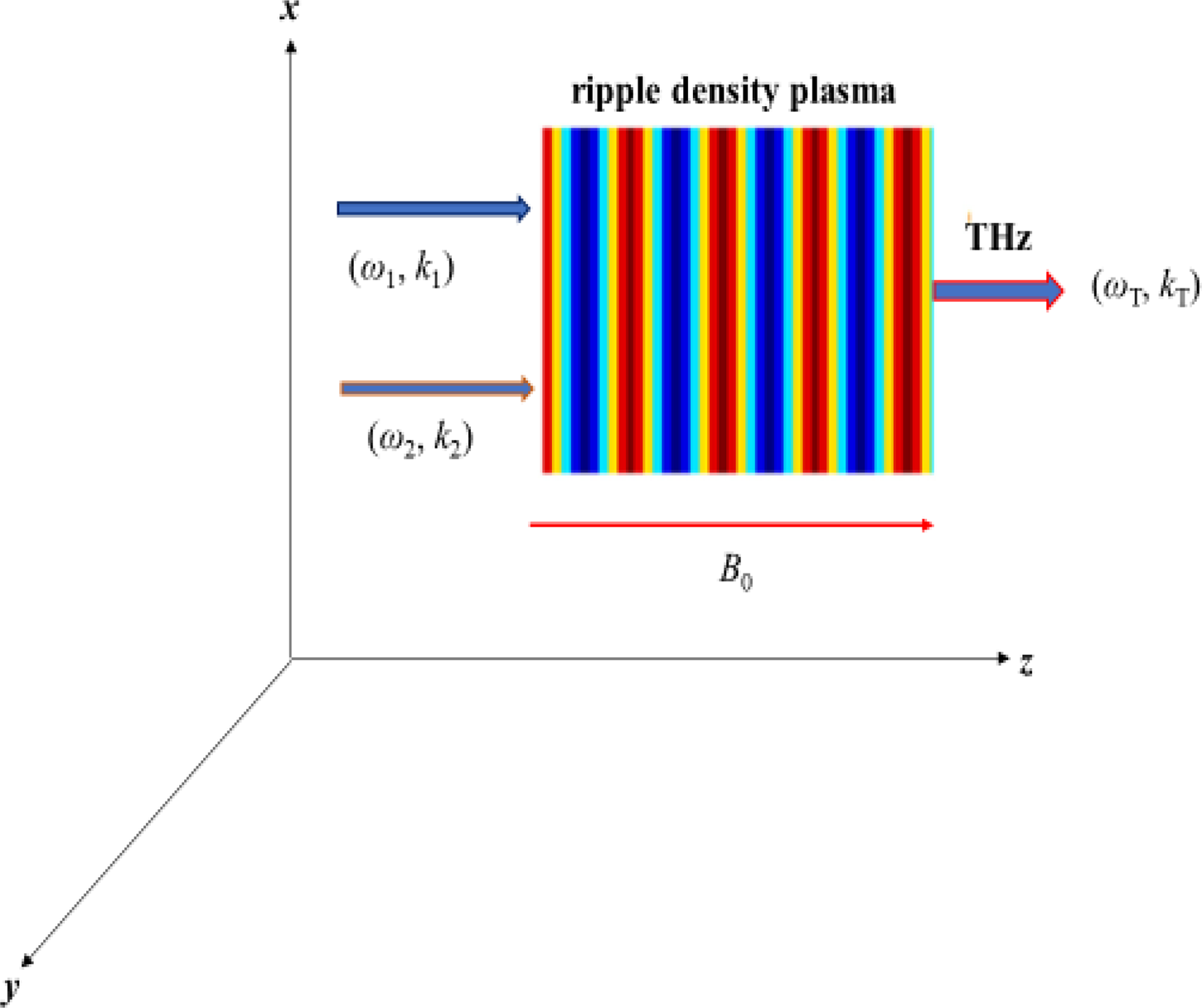
In order to generate THz radiation by beating/cross-focusing of two intense cosh-Gaussian laser beams, we have taken rippled density plasmas as n = n 0 + n q, where n q[ = n q0 exp (iqz)], here, n 0 is the electron plasma density without a ripple, n q0 is the amplitude of the density ripple, q (= 2π/λ) is the ripple wave vector, and λ is the wavelength of the ripple. The rippled plasma density provides phase matching condition for the generation of THz radiation. Such ripple density plasmas can be produced by various schemes (Pai et al., Reference Pai, Huang, Kuo and Lin2005; Kuo et al., Reference Kuo, Pai, Lin, Lee, Lin, Wang and Chen2007; Layer et al., Reference Layer, York, Antonson, Varma, Chen, Lengand and Milchberg2007), namely a machining beam, a patterned mask, and transmission ring grating. The coupling between density ripples with the density perturbations provided by pondermotive force give rise to nonlinear current, which is responsible for THz generation. Figure 2 represents schematic representation for the generation of THz radiation in the presence of an external applied static magnetic field in the ripple density plasma.
Schematic representation for THz radiation generation by beating of two laser beams in the presence of external static magnetic field and ripple density plasma.

The laser beams impart a nonlinear ponderomotive force to the plasma electrons at the beat frequency ωT+ = ω1 − ω2 and wave number k T+ = k 1 − k 2. The range of THz radiation occurs in the beat frequency or frequency difference of two laser beams. The ponderomotive force exerted by laser beams at a beat frequency can be written as follows:
 $$\scale90%{\eqalign {&\vec {{F}_{\,p+} ^{{\rm \omega} _{T+}}} = -\displaystyle{{m_0} \over 2}(\vec{\rm \upsilon} _1^{^\ast} \cdot \nabla ){\rm \gamma} {\vec{\rm \upsilon}} _2-\displaystyle{e \over 2}(\vec{\rm \upsilon} _1^{^\ast} \times {\vec{B}}_2)-\displaystyle{{m_0} \over 2}(\vec{\rm \upsilon} _2^{^\ast} \cdot \nabla ){\rm \gamma}{\vec{\rm \upsilon}} _1- \displaystyle{e \over 2}(\vec{\rm \upsilon} _2^{^\ast} \times {\vec{B}}_1) \cr &= \displaystyle{{-\hat{r}e^2} \over {4{\rm \gamma}m_0}}\displaystyle{{E_{01}E_{02}} \over {{\rm \omega} _1{\rm \omega} _2f_1f_2\lpar {1-({\rm \omega}_{ce}/{\rm \gamma \omega} _1)} \rpar \lpar {1-({\rm \omega}_{ce}/{\rm \gamma \omega}_2)} \rpar }} \left[ 4-\displaystyle{{{\rm \omega}_{ce}} \over {{\rm \gamma \omega}_1}} -\displaystyle{{{\rm \omega}_{ce}} \over {{\rm \gamma \omega}_2}} \right.\cr &\quad \left.-\displaystyle{1 \over 2} \displaystyle{{\lpar {({\rm \omega}_{ce}/{\rm \omega}_1) + ({\rm \omega}_{ce}/{\rm \omega}_2)-2({\rm \omega}_{ce}^2 /{\rm \omega}_1{\rm \omega}_2)} \rpar \lpar {{\rm \gamma}^2-1} \rpar } \over {[ {\lpar {1-({\rm \omega}_{ce}/{\rm \gamma \omega}_1)} \rpar \lpar {{\rm \gamma}^3-({\rm \omega}_{ce}/{\rm \gamma \omega}_2)} \rpar + \lpar {1-({\rm \omega}_{ce}/{\rm \gamma \omega}_2)} \rpar \lpar {{\rm \gamma}^3-({\rm \omega}_{ce}/{\rm \gamma \omega} _1)} \rpar } ] }} \right] \cr &\quad\times \left\{ \cosh \left( {\displaystyle{{rb_1} \over {r_1f_1}}} \right)\cosh \left( {\displaystyle{{rb_2} \over {r_2f_2}}} \right)\left( {\displaystyle{r \over {r_1^2 f_1^2}} + \displaystyle{r \over {r_2^2 f_2^2}}} \right) \right.\cr &\quad \left.+ \left[ \cosh \left( {\displaystyle{{rb_1} \over {r_1f_1}}} \right)\sinh \left( {\displaystyle{{rb_2} \over {r_2f_2}}} \right)\left( {\displaystyle{{b_2} \over {r_2f_2}}} \right) \right.\right.\cr &\quad \left.\left.+ \sinh \left( {\displaystyle{{rb_1} \over {r_1f_1}}} \right)\cosh \left( {\displaystyle{{rb_2} \over {r_2f_2}}} \right) \left( {\displaystyle{{b_1} \over {r_1f_1}}} \right) \right] \right\} \cr &\quad\times \exp \left[ {-\displaystyle{1 \over 2}\left( {\displaystyle{{r^2} \over {r_1^2 f_1^2}} + \displaystyle{{r^2} \over {r_2^2 f_2^2}}} \right)-i({\rm \omega}_{T +} t-k_{T +} z)} \right]}} $$
This nonlinear ponderomotive force causes perturbations in the density of the plasma and imparts nonlinear oscillatory velocity to the electrons. The nonlinear oscillatory velocity of electrons at beat wave frequency can be obtained from the equation of motion, i.e.,
 $$\displaystyle{\partial \over {\partial t}}\lpar {m_0{\rm \gamma} \vec {{\rm \upsilon}_ +^{\rm NL}}} \rpar = \mathop {\vec {F_{\,p+} ^{\omega _{T+}}} -\displaystyle{e \over c}} \,(\vec {{\rm \upsilon} _ + ^{\rm NL}} \times \vec{B}_0)$$
Fourier transform of Eq. (28) can be written as follows:
 $$ \vec {{\rm \upsilon} _ + ^{\rm NL}} = \displaystyle{1 \over {-im_0{\rm \gamma \omega} _{T+} \lpar {1 + ({\rm \omega} _{ce}/{\rm \gamma \omega} _{T+} )} \rpar }} \vec {F_{\,p+} ^{{\rm \omega} _{T+}}} $$
This nonlinear velocity couples with the density ripple and gives rise to the nonlinear current density. The nonlinear current density is given as follows:
 $$ \vec {J_ + ^{\rm NL}} = -\displaystyle{1 \over 2}en_{q0}e^{iqz} \vec {{\rm \upsilon} _ + ^{\rm NL}} $$
This current is responsible for the generation of THz radiation at the beat frequency ωT+ = ω1 − ω2 and wave number k T+ = k 1 − k 2 + q.
The wave equation for the propagation of the THz wave in magnetized plasma can be written as follows:
 $$-\nabla ^2\vec{E}_{T+} + \nabla \, (\nabla \cdot \vec{E}_{T+} ) = -\displaystyle{{4{\rm \pi}i{\rm \omega} _{T+}} \over {c^2}} \vec {J_ + ^{\rm NL}} + \displaystyle{{{\rm \omega} _{T+} ^2} \over {c^2}}{\rm \varepsilon} _ + \vec{E} _{T +} $$
where  $\vec{E}_{T+} [ { = \hat{r}E_{T0 +} (r,z)\exp [ {-i({\rm \omega}_{T +} t-k_{T+} z)} ] } ]$ is the electric field associated with the THz radiation, and
 $${\rm \varepsilon} _ + = {\rm \varepsilon} _{xx}-i{\rm \varepsilon} _{xy} = 1-\displaystyle{{{\rm \omega} _p^2} \over {{\rm \omega} _{T+} ^2 {\rm \gamma} \lpar {1-{\rm \omega}_{ce}/{\rm \gamma \omega}_{T+}} \rpar }}\displaystyle{n \over {n_0}}$$
where  ${\rm \varepsilon} _+$ is the dielectric constant of the plasma at the THz frequency (ωT+).
Substituting the values of  $ \vec {J_ + ^{\rm NL}}$ and
 ${\rm \varepsilon} _+$ into Eq. (31), we get THz electric field as follows:
 $$\eqalign{\left\vert \displaystyle{E_{T0 +} \over E_{10}} \right\vert &= \left\vert \displaystyle{z \over 16} \left(\displaystyle{{\rm \omega}_p^2 \over k_{T+}} \right) \left(\displaystyle{n_{q0} \over n_0} \right) \left(-\displaystyle{ieE_{20} \over c^2m_0} \right) \right.\cr &\quad \left.\times\displaystyle{1 \over {\rm \gamma} _0 (1 + ({\rm \omega}_c/{\rm \gamma}_0{\rm \omega}_T))} [X] [Y] \exp \left[-\left(\displaystyle{r^2 \over r_1^2 f_1} + \displaystyle{r^2 \over r_2^2 f_2} \right) \right] \right \Bigg \vert} $$
where
 $$\eqalign{&[ X ] = \displaystyle{1 \over {\lpar {{\rm \gamma}_0 {\rm \omega}_1-{\rm \omega}_{ce}} \rpar \lpar {{\rm \gamma}_0 {\rm \omega}_2-{\rm \omega}_{ce}} \rpar }} \left[ 4-\displaystyle{{{\rm \omega}_{ce}} \over {{\rm \gamma}_0 {\rm \omega}_1}}-\displaystyle{{{\rm \omega}_{ce}} \over {{\rm \gamma}_0 {\rm \omega}_2}} \right.\cr &\quad \left.-\displaystyle{1 \over 2}\displaystyle{{\lpar {({\rm \omega}_{ce}/{\rm \omega}_1) + ({\rm \omega}_{ce}/{\rm \omega}_2)-2({\rm \omega}_{ce}^2 /{\rm \omega}_1{\rm \omega}_2)} \rpar \lpar {{\rm \gamma} _0^2 -1} \rpar } \over {[ \matrix{\lpar {1-({\rm \omega}_{ce}/{\rm \gamma}_0 {\rm \omega}_1)} \rpar \lpar {{\rm \gamma}_0^3 -({\rm \omega}_{ce}/{\rm \gamma}_0 {\rm \omega}_2)} \rpar\cr + \lpar {1-({\rm \omega} _{ce}/{\rm \gamma} _0 {\rm \omega} _2)} \rpar \lpar {{\rm \gamma}_0^3 -({\rm \omega}_{ce}/{\rm \gamma} _0 {\rm \omega}_1)} \rpar } ] }} \right]}$$
and
 $$\eqalign{[Y] &= \left\{\cosh \, \left(\displaystyle{rb_1 \over r_1f_1} \right) \cosh \, \left(\displaystyle{rb_2 \over r_2f_2} \right)\left(\displaystyle{r \over r_1^2 f_1^2} + \displaystyle{r \over r_2^2 f_2^2} \right) \right.\cr &\quad \left.+ \left[\cosh \, \left(\displaystyle{rb_1 \over r_1f_1} \right) \sinh \, \left(\displaystyle{rb_2 \over r_2f_2} \right)\left(\displaystyle{b_2 \over r_2f_2} \right) \right. \right. \cr &\quad \left. \left. + \sinh \, \left(\displaystyle{rb_1 \over r_1f_1} \right) \cosh \, \left(\displaystyle{rb_2 \over r_2f_2} \right) \left(\displaystyle{b_1 \over r_1f_1} \right) \right] \right\}}$$
The efficiency of the emitted THz radiation is given by the ratio of the THz radiation energy to the energy of incident laser beams. The energy per unit area of the incident lasers is given in the following equation (Singh et al., Reference Singh, Singh and Sharma2013):
 $$W_{\rm pump} = \displaystyle{{{\rm \varepsilon} _0r_1{\vert {E_{10}} \vert } ^2} \over 4}\sqrt {\displaystyle{{\rm \pi} \over 2}} \left\{ {1 + \exp \left( {\displaystyle{{b^2} \over 2}} \right)} \right\}$$
and the energy per unit area of the THz radiation is given as follows:
 $$\eqalign{W_{\rm THz} &= \displaystyle{{{\rm \varepsilon} _0r_1^3 {\vert {E_{10}} \vert } ^2} \over 4}\sqrt {\rm \pi} \left \vert \displaystyle{z \over {16}}\left( {\displaystyle{{{\rm \omega}_p^2} \over {k_{T+}}}} \right)\left( {\displaystyle{{n_{q0}} \over {n_0}}} \right) \right.\cr &\quad \left.\times\left( {-\displaystyle{{ieE_{20}} \over {c^2m_0}}} \right)\displaystyle{1 \over {{\rm \gamma}_0 \lpar {1 + ({\rm \omega}_c/{\rm \gamma}_0{\rm \omega}_T)} \rpar }}[ X ] \right \vert ^2 \cr &\quad \times \left[ {1 + \exp \left( {\displaystyle{{b^2} \over 4}} \right)} \right] \left[ {3-2b^2 + \exp \left( {\displaystyle{{b^2} \over 4}} \right) + \exp \left( {\displaystyle{{3b^2} \over 4}} \right)} \right]} $$
The normalized efficiency of THz radiation generation is given by the following equation:
 $$\eqalign{{\rm \eta} &= \displaystyle{{W_{\rm THz}} \over {W_{\rm laser}}} = \sqrt 2 r_1^2 \left \vert \displaystyle{z \over {16}}\left( {\displaystyle{{{\rm \omega}_p^2} \over {k_{T+}}}} \right)\left( {\displaystyle{{n_{q0}} \over {n_0}}} \right)\left( {-\displaystyle{{ieE_{20}} \over {c^2m_0}}} \right) \right.\cr &\quad \left.\times\displaystyle{1 \over {{\rm \gamma}_0 \lpar {1 + ({\rm \omega}_{ce}/{\rm \gamma}_0{\rm \omega}_T)} \rpar }}[ X ] \right \vert ^2 \displaystyle{1 \over {[ {1 + \exp \lpar {b^2/2} \rpar }] }} \cr &\quad \times \left[ {1 + \exp \left( {\displaystyle{{b^2} \over 4}} \right)} \right] \left[ {3-2b^2 + \exp \left( {\displaystyle{{b^2} \over 4}} \right) + \exp \left( {\displaystyle{{3b^2} \over 4}} \right)} \right]} $$
Numerical result and discussion
This section presents a numerical study for THz radiation by two intense cross-focused CGLBs in the rippled density magnetized plasma under the relativistic–ponderomotive regime. The following set of laser and plasma parameters has been used in numerical calculations: ω1 = 1.776 × 10¹⁵ rad/s, ω2 = 1.706 × 10¹⁵ rad/s, intensity of laser beams a 1 = 1.21 × 10¹⁸ W/cm2, a 2 = 4.84 × 10¹⁸ W/cm2, initial beam waist width of laser beams r j (r 1 = r 2) = 20 µm, ωp0 = 0.02ω1, n 0 = 1.56 × 10¹⁷/cm3, n q0 = 0.1n 0, ωce = 0, 0.2ωp0, 0.4ωp0, and 0.6ωp0, b = 0, 0.4, 0.8, and 1. We have used the initial conditions: fj = 1; dfj/dz = 0; and E T = 0 at z = 0.
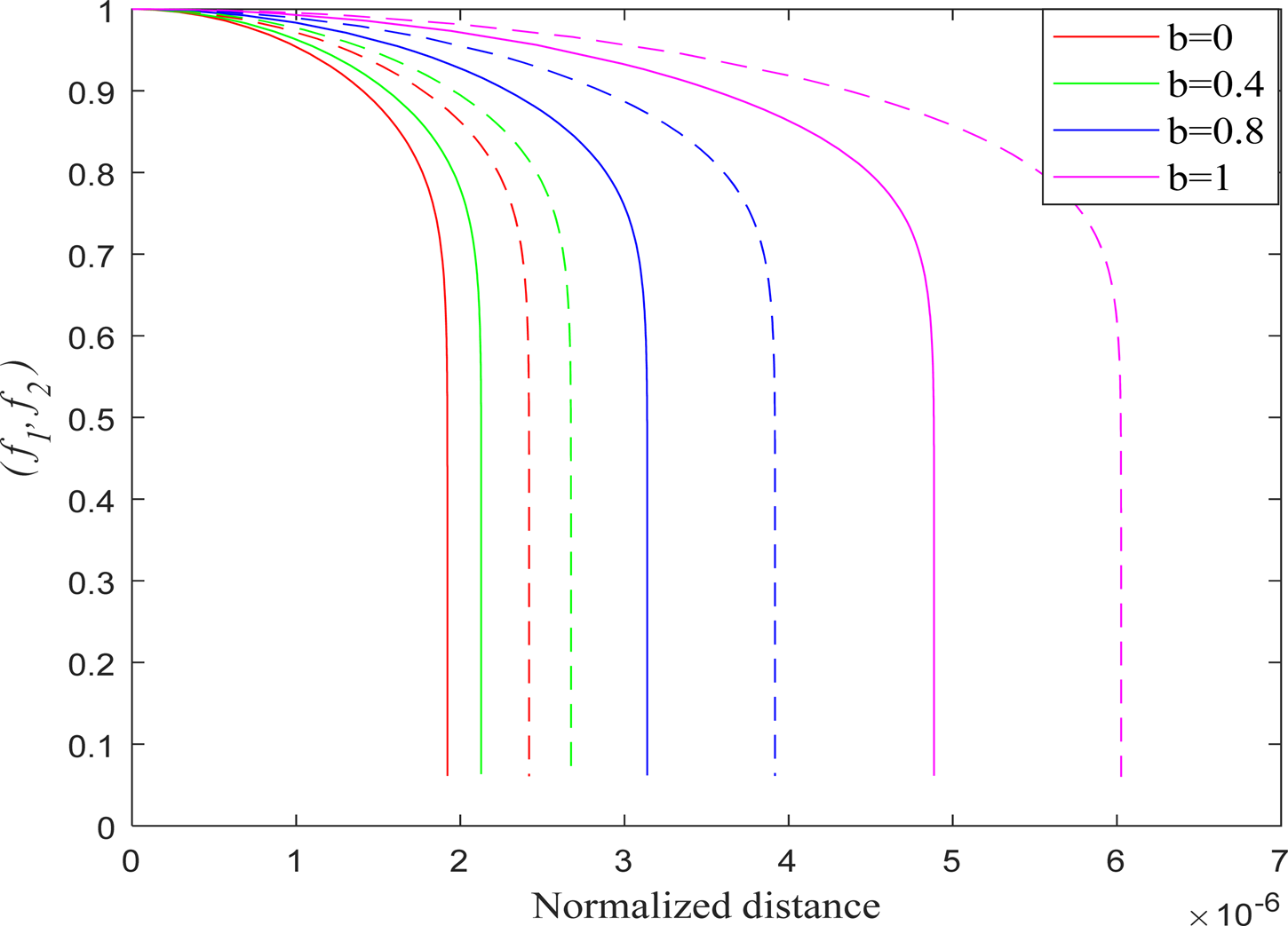
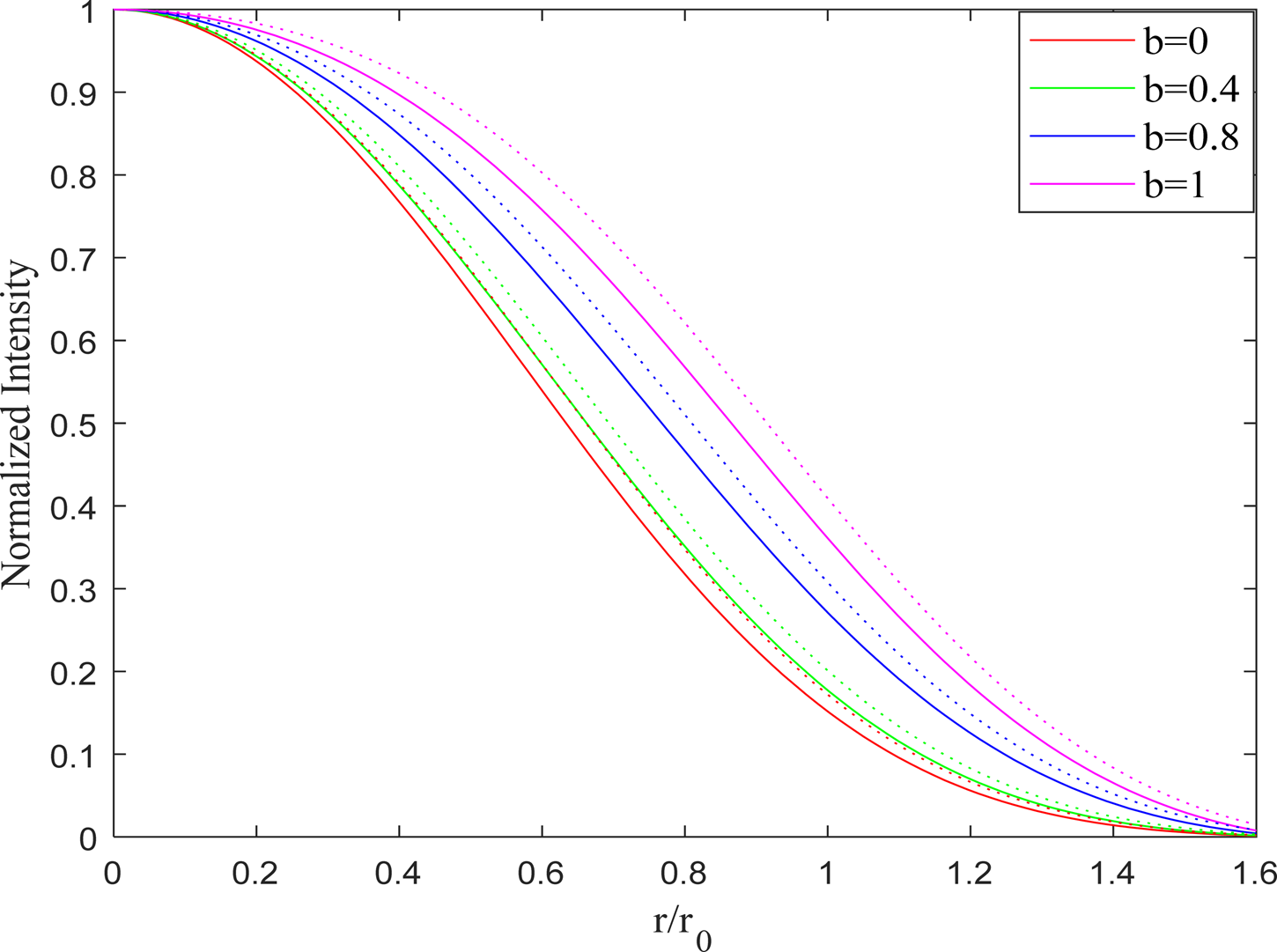
At first, we investigated the effects of relativistic and ponderomotive nonlinearities on the cross-focusing of CGLBs in magnetized plasma. Due to mutual interaction of two laser beams, focusing of one laser beam is affected by the presence of second laser beam, and hence, cross-focusing of laser beams takes place in the plasma. When two intense laser beams propagate through the magnetized plasma, the charge carriers are redistributed due to ponderomotive and relativistic nonlinearities. The dielectric constant of the plasma becomes modified due to redistribution of charge carriers. Equation (20) describes the intensity profile of laser beams in magnetized plasma along with the radial direction. Equation (22) determines the converging/diverging behavior of the laser beams in the magnetized plasma, where the first and second term on the right-hand side show divergence (diffraction) and the convergence (nonlinear coupling term) of the beams in propagation direction, respectively. It is obvious from Eq. (20) that the intensity profile of both laser beams depends on the dimensionless beam width parameter f j and the coefficients (α2j and α4j) of r 2 and r 4 in the non-paraxial region. Equations (22) and (20) have been solved with the help of Eqs (23)–(26) for cross-focused CGLBs in magnetized plasma, and the numerical results are presented in Figures 3 and 4.
Variation of beam width parameters (f 1,2) with normalized distance (ξ) in the direction of propagation of CGLBs for different values of decentered parameter b. The dashed and solid lines are for the first and second laser beams, respectively.

Variation of intensities of CGLBs with normalized transverse distance (r/r 0) in the direction of propagation for different values of decentered parameter b. The dashed and solid lines are for the first and second laser beams, respectively.

Figures 3 and 4 reveal the variation of dimensionless beam width parameters f 1 and f 2 and normalized intensity profiles of CGLBs with the normalized distance of propagation (ξ) for different values of the decentred parameter (b), when relativistic and ponderomotive nonlinearities are simultaneously operative. Focusing of both laser beams depends upon the initial powers of laser beams, initial beam radii r j+ of the laser beams, and plasma density (ωp0/ωj+). In this study, we have fixed the initial powers, beam radii of the laser beams, and cyclotron frequency (ωce) and considered the variation in decentred parameter (b). It is obvious from Figure 3 that with the increase in the value of b, the beam width parameter of both beams decreases. In general, the self-focusing ability of laser beams enhances the higher values of b (Gill et al., Reference Gill, Mahajan and Kaur2011; Purohit et al., Reference Purohit, Gaur and Rawat2016). In our case, focusing on both laser beams decreases with increase in the values of b. This may be due to the contribution of the coefficients α2j and α4j of r 2 and r 4 in the non-paraxial-ray approximation. It is interesting to note that the amplitude and efficiency of THz radiation increase for higher values of b. The normalized intensity profile of the cosh-Gaussian beams for different values of b is plotted in Figure 4. The intensity of both laser beams in magnetized plasma is increasing with the increases of b at the focused position. It is also clear from Figure 4 that the cosh-Gaussian beam is much squarer than fundamental Gaussian beam (b = 0).
When CGLBs propagate in rippled density magnetized plasma, the motion of electrons responds at the beat pumps wave frequency. The rippled density couples with the density perturbations induced by relativistic–pondermotive force of the laser beams and give rise to nonlinear current, which leads to generating THz radiation. It is important to mention here that ripples in plasma density play a very important role to enhance the amplitude of THz radiation because huge numbers of electrons participate for the generation of nonlinear current and the amplitude of THz field increases. For the resonant excitation of the THz radiation, the phase-matching condition (k T+ = k 1 − k 2 + q) should be appropriately satisfied. The ripple parameters (n q0 and q) are the decisive parameter for the exact phase matching. Due to the exact phase matching, energy transfer from the pump laser to the generated THz waves will be maximum, which leads to a considerable enhancement in the efficiency of THz radiation. In addition, the rippled density of plasma increases with the increasing the strength of the magnetic field; therefore, a static magnetic field can be used to enhance the THz radiation.
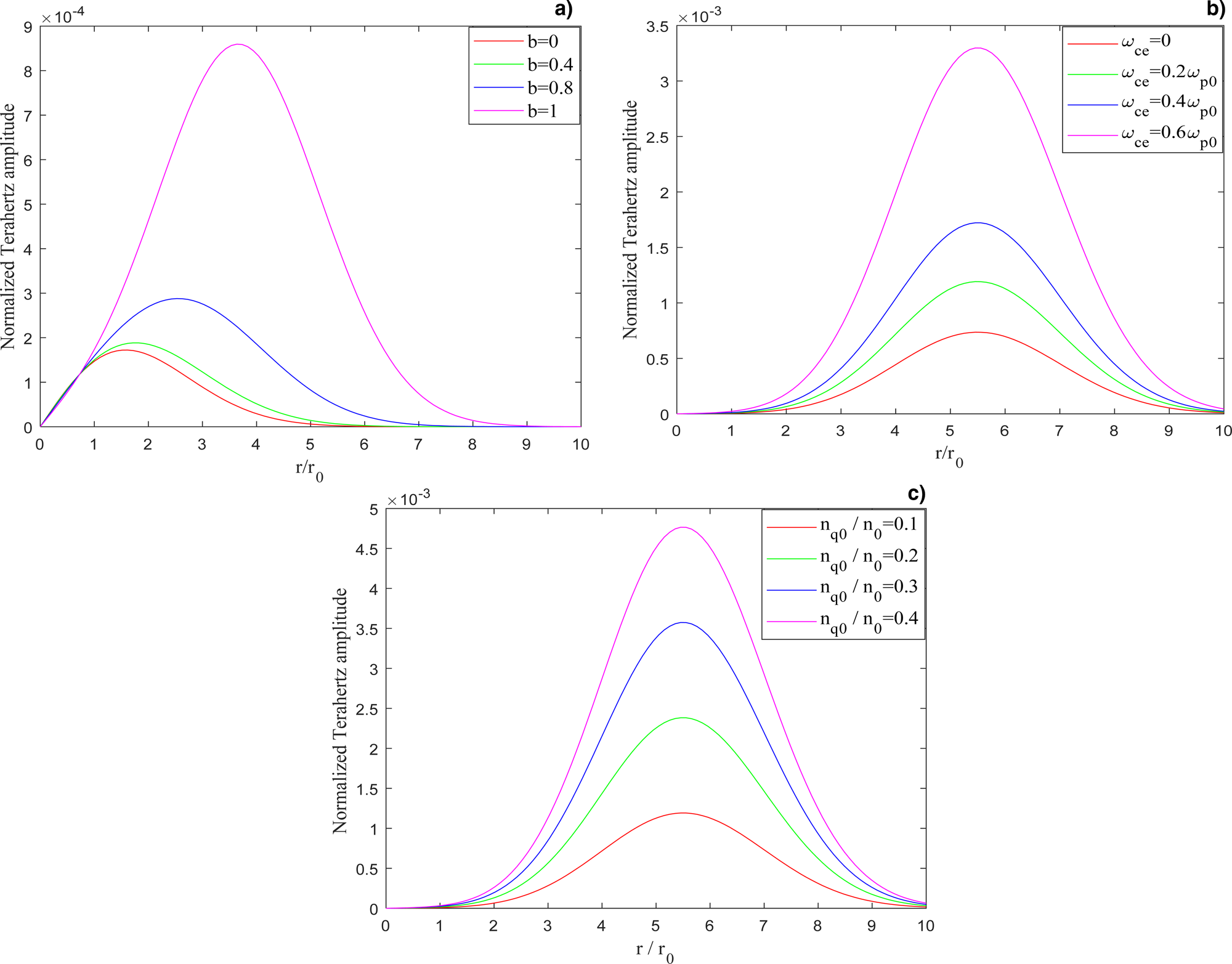
In order to investigate the resonant THz radiation from rippled density magnetized plasma irradiated by two cross-focused CGLBs, Eq. (32) has been solved numerically and the numerical results are presented in Figures 5a–5c. The maximum value of THz amplitude found at a resonance condition [i.e.,  ${\rm \omega} _T\approx ({\rm \omega} _{ce}^2 + {\rm \omega} _{p0}^2 )^{1/2}$] irrespective of the laser profile. Figure 5a shows the variation of the normalized amplitude of THz radiation with the normalized transverse distance (r/r 0) at different values of decentred parameter b. It is seen that, with the increasing value of the decentred parameter, the amplitude of generated THz radiation increases significantly, and its distribution takes place in a wider area in comparison to the Gaussian laser beam (b = 0). The normalized amplitude of THz radiation increases with increasing b because the THz amplitude is directly proportional to the gradient in the intensity of the pump laser beams. Figure 5b presents the normalized amplitude of the THz radiation field as a function of transverse distance (r/r 0) for different values of magnetic field ωce (cyclotron frequency). It is observed that the normalized amplitude of the THz radiation field increases with the increasing strength of the magnetic field (ωce). It is also seen that, in magnetized plasma, the magnitude of emitted THz radiation field increases significantly in comparison to non-magnetized plasma. The change in magnitude is of two to three orders from non-magnetized plasma. Therefore, THz wave radiation enhances to a great extent in magnetized plasma. Figure 5c illustrates the effect of density ripple (n q0) on the amplitude of THz radiation. The amplitude of the emitted THz radiation increases with the increase in the value of n q0 because the number of electrons involved in the generation of oscillatory nonlinear current increases on increasing ripple amplitude. The magnitude of the generated THz field strongly depends on the decentred parameter, cross-focusing of the laser beams, relativistic–ponderomotive force, amplitude of the density ripple, and applied external magnetic field.
(a) Variation of normalized emitted THz amplitude with normalized transverse distance (r/r 0) for different values of decentered parameter b. (b) Normalized THz amplitude variation with normalized transverse distance (r/r 0) for different values of ωce. (c) Normalized THz amplitude variation with normalized transverse distance (r/r 0) for different values of the amplitude of density ripples.

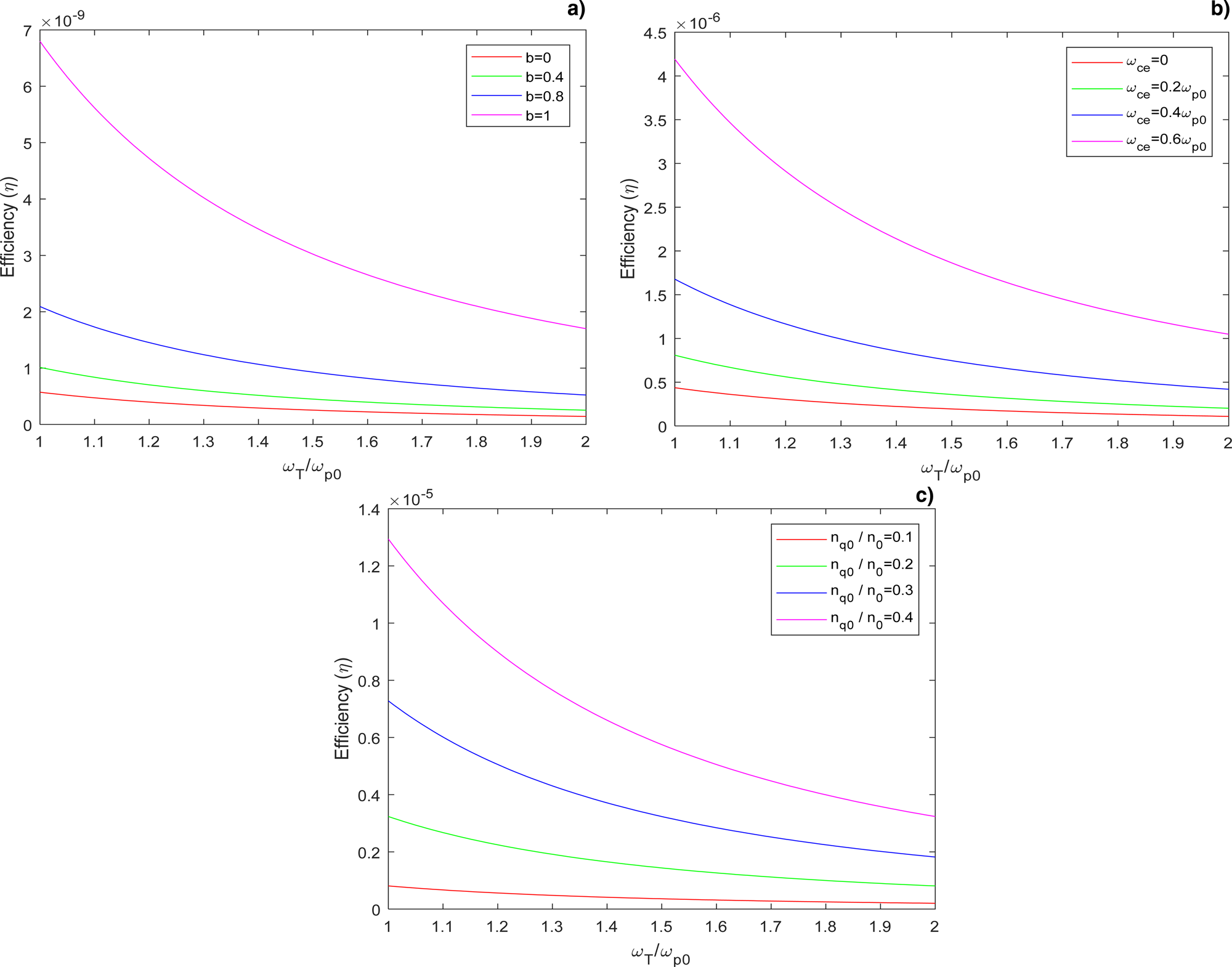
The effect of the decentred parameter (b), cyclotron frequency (ωce/ωp0), and density ripple (n q0) on the efficiency of emitted THz radiation is shown in Figures 6a–6c, respectively. The efficiency of THz radiation depends on the quality of the laser beams, which is directly proportional to the product of the beam divergence and beam waist size of the laser beams, and the amplitude of the generated THz field. Figure 6a shows the efficiency of THz radiation (ɳ) versus the normalized beating frequency (ωT/ωp0) for different values of decentred parameter b. There is an enhancement in the efficiency of THz radiation by increasing the value of b. The effect of cyclotron frequency (ωce/ωp0) in the efficiency of THz radiation generation is depicted in Figure 6b. It is evident that the efficiency of THz radiation increases with increasing cyclotron frequency. Moreover, the efficiency in the non-magnetized plasma (i.e., ωce/ωp0 = 0) is very small as compared to magnetized plasma, i.e., the efficiency of THz radiation increases several orders of magnitude in the presence of the magnetic field. Figure 6c depicts the efficiency of THz radiation generation with normalized beating frequency for different values of normalized ripple amplitudes. It is shown that by increasing value of n q0 from 0.1 to 0.4, the efficiency of THz radiation increases significantly.
(a) Variation of efficiency of THz radiation generation with normalized beating frequency (ωT/ωp0) for different values of decentered parameter b. Here, ωp0 = 0.02ω1, ωce = 0.4ωp0, and n q0 = 0.1n 0. (b) Efficiency of the THz radiation generation with normalized beating frequency (ωT/ωp0) for different values of ωce. Here, b = 0.4, ωp0 = 0.02ω1, and n q0 = 0.1n 0. (c) Efficiency of the THz radiation generation with normalized beating frequency (ωT/ωp0) for different values of the amplitude of density ripples. Here, b = 0.4, ωce = 0.4ωp0, and ωp0 = 0.02ω1.

The THz radiation efficiency of the present scheme is of the orders of ~7 × 10⁻⁹, 4.2 × 10⁻⁶, and 1.3 × 10⁻⁵ for optimized values of b, ωce, and n q0, respectively, comparable to that of several other types of schemes. For example, Singh et al. (Reference Singh, Singh and Sharma2013) have reported the conversion efficiency of THz radiation is ~4.5 × 10⁻⁶ by beating of CGLBs in spatially periodic density plasma in the presence of nonlinear ponderomotive force. Mann et al. (Reference Mann, Sajal, Varshney and Sharma2017) observed that the THz radiation efficiency reaches about 10−4 (for ~1015 W/cm2 laser intensity) by the nonlinear beating of two cosh-Gaussian laser pulses propagating in a corrugated plasma. Varshney et al. (Reference Varshney, Upadhayay, Madhubabu, Sajal and Chakera2018) obtained the efficiency of THz generation up to 15% by CGLBs in axially magnetized collisional plasma under the non-relativistic–ponderomotive regime. THz radiation efficiency up to 8.3% have been obtained by beating of two flat-topped laser beams in a magnetized plasma (Bakhtiari et al., Reference Bakhtiari, Esmaeilzadeh and Ghafary2017). The conversion efficiency of THz radiation of the order of 10−3 has been achieved by the beating of two focused Gaussian laser beams in rippled density plasma when both ponderomotive and relativistic nonlinearities are operative (Kumar et al., Reference Kumar, Singh and Sharma2015). Thus, the proposed scheme is quite effective along with the use of two CGLBs, and the THz radiation efficiency from the present scheme is significantly enhanced relative to the efficiency obtained in the previously studied schemes.
Conclusions
An analytical model has been developed for the generation of THz radiation with high THz amplitude and efficiency by beating of two intense CGLBs in the rippled density magnetized plasma under the relativistic–ponderomotive regime. The effects of the decentered parameter (b), and the strength of the externally applied magnetic field (cyclotron frequency, ωce) on the focusing of laser beams, the amplitude and efficiency of THz radiation have been examined. The focusing of both laser beams strongly depends on the decentred parameter, the strength of the externally applied magnetic field, as well as the intensity of both the laser beams. Due to the employment of ripple density and proper phase matching of the ripple wave number with the beat wave number, the maximum energy becomes transferred from the laser beams to the THz wave under the resonance condition. The amplitude and efficiency of the emitted THz radiation increase with the increase in the value of density ripple. It has been found that the amplitude and efficiency of THz radiation increase drastically in the magnetized plasma relative to the non-magnetized plasma. It is also seen that the amplitude and efficiency of the generated THz radiation increased significantly at higher values of b as compared to Gaussian laser beams.
Acknowledgments
The authors are thankful to the Science and Engineering Research Board (SERB), Department of Science and Technology, Government of India, for providing financial assistance for carrying out this research work vide project file No. EMR/2016/000112.