1. BACKGROUND
In the years immediately prior to his appointment to command the Endeavour on her epic voyage to observe the Transit of Venus, James Cook was engaged in charting the coasts of Newfoundland and the adjacent islands of St. Pierre and Miquelon. For this purpose, the Navy purchased in 1763 a 69-ton schooner the Sally, built in Massachusetts in 1754, and renamed her Grenville, in honour of George Grenville, First Lord of the Admiralty, who became Prime Minister in April 1763.
Because of winter ice conditions around Newfoundland's coasts, the charting season was limited to about six months: May-October. A few years earlier, as master of the Northumberland (70 guns) Cook had spent almost three years (October 1759 to August 1762) in Halifax, Nova Scotia. It might therefore have been expected that the Grenville would winter either in Halifax or St. John's, Newfoundland. By 1763, however, Cook had married, and in October of that year a son was born in Shadwell, east London. The Navy also had its reasons for wanting Cook to winter in London. Beaglehole quoted the Governor of Newfoundland, Thomas Graves, writing to the Admiralty in October 1763:
‘As M rCook whose Pains and attention are beyond my description, can go no farther in surveying this year I send him home in the Tweed … that he may have the more time to finish the diff tsurveys already taken of it to be layn before their Lordships – and to copy the different sketches of y eCoasts and Harbours, taken by y eships on the several stations by which their Lordships will perceive how extremely erroneous y epresent draughts are, & how dangerous to ships that sail by them – and how generally beneficial to Navigation the work now in hand will be when finished…’(Beaglehole Reference Beaglehole1974a).
In London the following spring, Hugh Palliser, about to succeed Graves as Newfoundland's governor, suggested to the Admiralty, no doubt with Cook's knowledge and probably also his encouragement, that it would be more efficient if the Grenville could be refitted and supplied for each season in Britain than in Halifax or St. John's (Beaglehole Reference Beaglehole1974b).
This became the regular pattern. Cook returned to Newfoundland on the Lark in May 1764, but thereafter brought the Grenville back to the Thames each November, spent the winter converting his surveys into publishable charts, and sailed again for Newfoundland in May. Despite the enormous literature on Cook, these voyages have attracted little attention. But they seem of considerable importance, the westbound voyages especially, both in their own right and because of their possible significance in the selection of Cook for the Endeavour (Cook Reference Cook1764–7).
2. THE WESTBOUND VOYAGES: LATITUDE SAILING
Each of Cook's westbound Atlantic crossings in the Grenville followed the same pattern. From the western end of the English Channel, he steered westwards and southwards to reach latitude 48° with little delay and then remained between 46° and 48° until he reached Cape Race (46° 40′N 53° 04′W). In 1765 he reached 48°N within 6 days of passing the Scillies; by taking a more southerly track this was reduced to 4 days in 1766, and in 1767 to 2 days.
At first sight, such latitude sailing appears unremarkable and perhaps even to be expected. In the mid 18th century latitude determinations by a Hadley quadrant were straightforward and reliable, but there was no practicable method available to navigators to estimate longitude other than by dead reckoning, for which Cook would note compass course and stream the log astern every hour, to determine speed. Sailing on or close to the latitude of one's destination was therefore a simple and (until approaching landfall) safe way to avoid the longitude problem. The navigator would then know where his landfall would be, but not when he would arrive there. By the last year of these Atlantic voyages, in 1767, the new Nautical Almanac appeared, making it practicable for mariners to determine longitude by lunar distance; a technique Cook was to learn in 1768, aboard Endeavour.
From a modern standpoint however, westbound transatlantic sailing in latitudes 46–48°N is not in principle the most practical route. In the 1973 edition of Ocean Passages for the World (Hydrographer 1973), which was the last to contain advice for sailing vessels, three routes from the English Channel to Canada and the United States were identified: Southern, Northern and Direct.
‘The Southern route is the best route to be followed during the whole of the year except autumn, on account of the better weather to be experienced, the certainty of the wind, and the avoidance of fog and ice off the Newfoundland banks, during the spring and early part of the summer’. This route involves reaching the North-east Trade Winds in latitudes 30–32°N, then, for Canadian ports, sailing west to 48°W, and thence northwest.
‘The Northern route was considered feasible in autumn when ice danger is at a minimum; it involves reaching 55°N at 30°W. and then steering for St. John's, Newfoundland or for the Strait of Belle Isle and the St. Lawrence.’
‘The Direct route across the Atlantic, from the English Channel … can seldom be taken on account of the prevailing W'ly winds and of the North Atlantic Current and Gulf Stream combined, running contrary to the desired track. It is, however, recommended by some navigators, making as directly as possible from the Channel, to cross 50°W. at 45°N and thence to the desired port.’
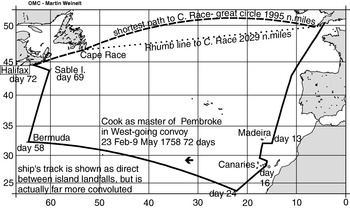
The Southern Route was familiar to Cook, since it was the way he had made his first westbound crossing as master of the Pembroke (64 guns) from Plymouth to Halifax in the spring of 1758 (Figure 1). However, Figures 2 and 3 show that Cook's latitude sailing, in both directions, was closest to the Direct Route.
Three westward routes. Modern advice to westgoing sailing vessels is to seek a fair trade wind by going far to the south, similar to the path taken by the large naval convoy in 1758, prior to the siege of Louisbourg.

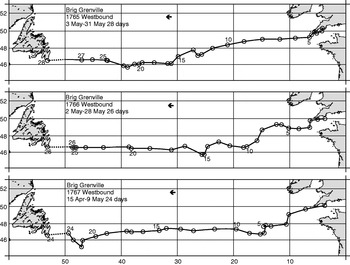
Grenville's westbound tracks from the longitude of Plymouth to landfall near Cape Race, 1765–1767. Note that the 1767 crossing was more than two weeks earlier than in the previous years. The dotted lines indicates the difference between the actual landfall and Cook's estimate of his position by dead reckoning.

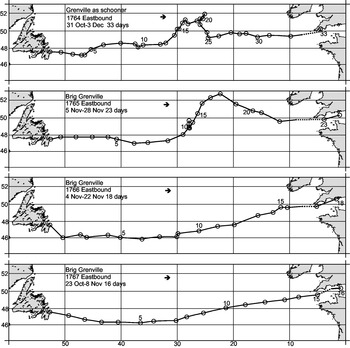
Grenville's eastbound crossings from St. John's, Newfoundland to the English Channel, 1764–1767. The dotted sections again show how far behind was the dead reckoning when landfall was made.

What is quite outstanding in Cook's westbound logs from 1765 to 1767 is that his latitude sailing in Grenville was both swift and consistent, whatever modern advice suggests. Figure 2 shows Cook's westbound Atlantic progress in each of the three years. For consistency, the origin of each of the numbered days is the longitude of Plymouth, 4°10′W. The contrast between the Grenville's direct courses and Pembroke's southern route is not however a fair comparison, because the Pembroke, travelling as part of a large convoy, was necessarily limited to the speed of the slowest ship. Also noteworthy, however, is the fact that the Grenville had been converted from a schooner to a brig during the winter of 1764–65. A square-rigged vessel was better suited to the slow and careful survey work along Newfoundland's coast (Beaglehole, Reference Beaglehole1974c), but schooner-rig would have been better able to adapt to adverse winds on the Atlantic crossings.
As can be seen, there was wide variation in Cook's estimates of daily westward mileage, from 160 nautical miles on 21 May 1766 to a mere 8 miles on 28 May 1765. It is, however, surprising that on only one day of the three voyages (21 April 1767) did Cook fail to make any westward progress. More typical was 28 May 1765: during a ‘strong’ northwesterly gale he was compelled to steer NNE, but as the wind lessened to a ‘moderate’ and then a ‘fresh’ gale he quickly reverted to a westerly course and ended the nautical day with a small westward gain.
Although, in mid-ocean, Cook was free to depart from his intended course to make the best of the wind, it is noteworthy that he was precisely back on track when approaching his landfall. However, a rather surprising feature of each of the westbound crossings is that, towards the end of the voyage, the Grenville was much closer to the coast of Newfoundland than Cook's dead reckoning had estimated her to be, as shown by the dotted part of the track lines of Figure 2. This indicates the discrepancy between the position at landfall and the calculated dead-reckoning up to that moment, and each year, Grenville was consistently ‘ahead of her reckoning’. It was normal in that period to try, by adjustment of the knots on the physical log cast astern of a vessel, to ensure the opposite, so that the navigator did not approach landfall without adequate warning, especially at night. In the appendix to his British Mariner's Guide of 1763, Nevil Maskelyne noted that Richard Norwood had calculated, a century earlier, that:
‘the length of the knots of a log-line for a half-minute glass should be 51 feet, which is the same part of a geographical mile, or 6120 feet, as half a minute is of an hour, namely 1/120th. But he [Norwood] adds, because it is safer to have the reckoning before the ship, than after it, therefore 50 feet may be taken as the proper length of each knot …’(Maskelyne, 1763).
In the eastern approaches to Newfoundland, however, the Grand Banks provide an alternative early warning system that extends far out into the Atlantic. The Banks are 560 km north-south and 675 km east-west, and extend as far south as 42°N. The average water depth is only 55 m, or about 30 fathoms (World Atlas 2001). In 1765, Cook began sounding as early as the afternoon of 25 May (civil day) although it was not until the morning of 28 May that he reached the sea bed in 130 fathoms, ‘fine Grey sand with black specks.’ It was only on the early afternoon of 31 May that he made landfall.
‘Very strong [NW] gales and hard squalls saw the Land from WNW to NNW; at 2 Cape Race, and Cape Bollard in one bearing NEbE … at 4 Cape Race EbS 3 leags Cape Pine WbN½N. at 6 Cape Pine E ¼ of a Mile, unstowed the anchors and bent the cables …’
On his 1767 crossing, earlier than the others, Cook recorded that he passed icebergs on three occasions on 8 May (nautical day), including one at 3 a.m. Each year, by the time he reached the southern coast of Newfoundland, winter sea-ice was gone.
3. THE EASTBOUND CROSSINGS
Like the outward crossings, the four homeward voyages of the Grenville required less time year by year (Figure 3). In 1764, when still schooner-rigged, Cook sailed from St. John's on 1 November, and made landfall on the British mainland on 3 December (33 days). Square-rigged, as on the later crossings, he might have had a theoretical advantage, but the prolonged storm conditions that Grenville encountered in 1764 were probably more important. Additionally, much of Grenville's gear on this passage was in such a state as to be condemned on survey after arrival, (Beaglehole Reference Beaglehole1974d) which would have reduced her ability to withstand heavy weather.
The log for 1767 illustrates how the subsequent faster crossings were achieved. The Grenville sailed from St John's on 23 October, and at noon on the 24th, had already made 3°22′ of longitude eastwards. From then until 4 November, there was only one day when Grenville sailed less than 110 nautical miles and, aided by consistently strong and favourable winds, on two days achieved 165 miles, or an average speed of nearly 7 knots. By 4 November, Cook reckoned the longitude made as 38° 20′ (eastward from St John's). This would put Grenville within eight degrees of longitude, or little more than two days sailing, from the Scillies, so occasional sounding commenced.
The lead had not yet found bottom when a good noon observation, on 5 November (13 days out), put Grenville at a latitude of N 49°01′. This was crucial. Cook then knew that his eastward track would take him safely mid-channel, between Scilly and Ushant. Knowing that track, soundings would pinpoint his position much better than would any estimated dead reckoning over the previous 2000 miles. Four hours later, the first sounding of 73 fathoms provided a fairly good fix of position. He then passed well to the south of the Scillies and Lizard without seeing them, sounding regularly while continuing eastward. Log readings, taken each hour, allow us to reconstruct what the dead reckoning positions would be, although these were no longer of much importance to Cook.
The next noon observation, on 7 November, confirmed Grenville's safe mid-channel latitude at N 49° 36′. Then, after an encounter with an English ship at midnight, under full moon, which confirmed her position as 24 miles south of Portland, no further log readings were made. The first sighting of land was the Isle of Wight, next morning, 16 days out from St John's. This was a ‘textbook’ approach up-Channel, aided by fair winds and a clear sky, when it mattered, at noon. Nothing special about it, but expeditiously done.
The dotted section of her 1767 track, in Figure 3, shows that on this passage, as on all the others, eastbound and westbound, Grenville was ‘ahead of her reckoning’, in this case by about 100 miles. Commonly, that would be explained by an ocean current aiding the progress of a vessel, which could be the result of the westgoing North Atlantic Current, especially in the eastern half of the passage. However, in Grenville's case, the similar effect, eastbound and westbound, implies that the net impact of any ocean current must have been small.
4. EVALUATION
Given our knowledge of Cook's outstanding ability as a navigator, it would be easy to see his choice of westbound route as an example of his skill, but this is unlikely to be the case. Certainly his crossings in 1765, 1766 and 1767 indicate a remarkable ability to move the Grenville westwards under almost any conditions of wind and current, but the choice of the ‘direct’ route itself was probably also made by an unexpectedly large number of vessels. The 1770s were a period when the number of European fishing ships, mainly British or French, making annual voyages to the Grand Banks reached a peak. Up to 300 French vessels and twice that number from Britain made that journey (Harris Reference Harris1987), and it is unlikely that they used any navigation method other than that of ‘latitude sailing’ to reach the Banks. We are not aware of any surviving logs from this fleet to confirm this assumption, valuable though these would be. As Daines Barrington complained at the time, in the context of arctic whaling, ‘if the ship's journal is not wanted by the owners in a year or two (which seldom happens) it is afterwards considered as waste paper’ (Barrington, Reference Barrington1775). It seems more probable that Cook's logs will be found useful by historians of the Grand Banks fishery.
With modern navigational aids and weather information, five main routes are available for a westbound Atlantic crossing under sail. In order of increasing average length they are: Great Circle, Rhumb Line, Northern, Azores, and Trade Wind. Cook's choice of a near-Rhumb Line route was virtually inevitable, especially in view of the relatively short distance between Land's End and Cape Race. Even on the much longer crossings to Boston, Newport or New York, the many single-handed yacht races since 1960 have normally been won by taking a route between the Great Circle and the Rhumb Line. James Cook's experience, like that of Francis Chichester and others, calls into question the advice that ‘The Direct Route … can seldom be taken.’
The apparent practicality in the 1760s of the direct route, contrary to that modern advice, together with the suggestion of minimal drift from the North Atlantic Current, raises the question of whether wind and current patterns have altered significantly over the intervening years: a question we will not pursue.
In the mid-eighteenth century, it was the most practical route, and it is not the choice of route but the speed and efficiency of Cook's westbound crossings that seem impressive nowadays. The Admiralty may also have been impressed at the time, and these voyages may therefore have been an important, but until now largely unrecognized, factor in Cook's selection to command the Endeavour. For Cook himself, and for the fishing fleets heading each spring to the Grand Banks, they appear however to have been a routine and unremarkable ‘journey to work.’
ACKNOWLEDGEMENTS
This article owes its origin to the 2009 special exhibition on ‘Cook and Canada: A Reputation in the Making’ at the Captain Cook Memorial Museum in Whitby, organised by Dr Sophie Forgan.
We are also deeply grateful to John Robson, University of Waikato, New Zealand for providing us with data on the Grenville crossings that supplement the extensive material on ‘Captain James Cook in Newfoundland, 1762–1767’ that he has put online at http://pages.quicksilver.net.nz/jcr/newf. His book, “Captain Cook's War and Peace”, Seaforth, 2009 provides useful information about Cook's surveying of Newfoundland, the purpose of these voyages.
Maps in this paper were produced using open-source Generic Mapping Tools (GMT), interfaced via Martin Weinelt's Online Map Creation- http://www.aquarius.ifm-geomar.de/.