Supplementary material is provided online at http://dx.doi.org/10.15184/aqy.2014.45
Introduction
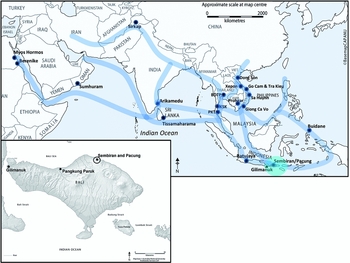
Centrally located along the major maritime route of the Sunda Island Chain, between eastern and western Indonesia, the harbour and burial sites of Sembiran and Pacung on the northern coast of Bali have produced critical evidence for reassessing the timing and impact of Island Southeast Asia's early exchange contacts with India and Mainland Southeast Asia during the late prehistoric period (200 BC–AD 500) (Figure 1). The growth of these networks was a revolutionary process involving different types of cultural interactions that led, by the late first millennium AD, to the formation of Indic-based states in Southeast Asia, whose centres were strategically located along early exchange routes.
Map of sites mentioned in the text and proposed late prehistoric exchange routes; inset: map of Bali. Modified from templates courtesy of CartoGIS, ANU. BDTP: Ban Don Ta Phet; KSK: Khao Sam Kaeo; PKT: Phu Khao Thong.

The current discourse on late prehistoric trans-Asiatic networks, however, is mostly based on archaeological evidence from Mainland Southeast Asia, with the Thai Peninsula representing an important component of the discourse, yet Indonesia and Island Southeast Asia as a whole are still vastly under-represented within existing comparative compositional studies of cultural materials and in terms of chronological data. This constitutes a fundamental gap in the understanding of the Island Southeast Asian component on the map of early trans-Asiatic networks.
New archaeological research at Sembiran and Pacung in 2012 aimed to partly fill this gap by producing new, high-resolution evidence for long-distance contacts with Bali through comparative analytical studies of excavated glass, bronze, gold and carnelian artefacts, and through the revision of the timing of Indian contact to the first century BC, or the late second century BC. This revision was based on the presence of Indian Rouletted Ware in a dated context at Pacung, matching the other dated evidence of Rouletted Ware in Island Southeast Asia, at Batujaya in north-western Java (Manguin & Indradjaya Reference Manguin, Indradjaya, Manguin, Mani and Wade2011). The 2012 excavation season was the first in a three-year collaborative project between the Australian National University and the Indonesian National Centre for Archaeological Research.
Since the first excavations conducted by Ardika from 1987–1989, and several subsequent seasons at Sembiran and Pacung (1990–2008), large quantities of Indian pottery and evidence of local bronze-casting have suggested the presence of a first century AD harbour site with simultaneous links to India and bronze-casting centres in Mainland Southeast Asia (Tim Jurusan Arkeologi 1990–2006; Ardika Reference Ardika1991, Reference Ardika2008; Ardika & Bellwood Reference Ardika and Bellwood1991; Ardika et al. Reference Ardika, Bellwood, Eggleton and Ellis1993, Reference Ardika, Bellwood, Sutaba and Yuliati1997). The first century AD dating for Indian contact proposed by Ardika and Bellwood (Reference Ardika and Bellwood1991), however, was assessed based on the chronology of the Indian pottery and not on radiocarbon dates. A date of 993–429 cal BC (CAMS-723) from rice husk temper in a sherd from Sembiran trench VII (1989) was considered too early to represent Indian contact, although X-ray diffraction and Neutron Activation Analysis of similar sherds could not rule out an early Indian origin (Ardika & Bellwood Reference Ardika and Bellwood1991). Pacung trench III (2000) produced an AMS date of 201 cal BC–AD 21 (Beta-161920) from a human tooth, whose possible Indian origin was suggested and debated based on stable carbon isotope and DNA results (Lansing et al. Reference Lansing, Redd, Karafet, Watkins, Ardika, Surata, Schoenfelder, Campbell, Merriwether and Hammer2004, Reference Lansing, Redd, Karafet, Watkins, Ardika, Surata, Schoenfelder, Campbell, Merriwether and Hammer2006; McLauchlan & Thomas Reference McLauchlan and Thomas2006). Two AMS dates were later obtained from a Pacung burial (VI) in trench IV (2004), and these give a calibrated range of 109 cal BC–AD 78 (KIA-25125–25126; see online supplementary Table S1; Swastika Reference Swastika2008). However, this date was not associated with Indian contact at the time.
Landscape and chronology
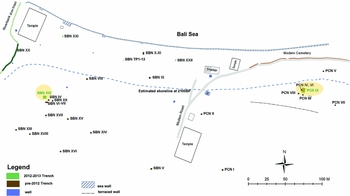
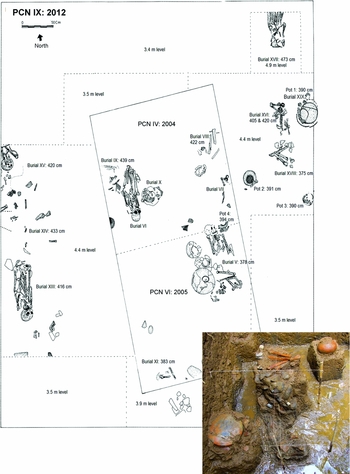
Sembiran and Pacung are adjacent sites that extend 250m inland along a 700m stretch of the coastal plain of the Batur volcano (Figure 2). Since the sites were first occupied some 2200 years ago, alluvial deposition has caused 50–70m of seaward aggradation of the coastline, burying the prehistoric layers beneath 2.7m of sediment at Sembiran and 3.2m at Pacung. In 2012, we opened a 4 × 4m trench at Sembiran (SBN XIX), located 1.5m north of Ardika's 1989 trench (SBN VII), which had produced high concentrations of Indian pottery and evidence of local bronze-casting. At Pacung, we opened a 5 × 6m trench (PCN IX; Figure 3) to incorporate and extend two 2 × 2m trenches dug in 2004 and 2005 (PCN IV and PCN VI), which had produced eight burials (Burials V–XII). PCN IX revealed seven more burials (XIII–XIX), totalling nineteen individuals from Pacung.
Map of Sembiran and Pacung. The yellow shading shows the 2012 trenches SBN XIX and PCN IX.

Plan of Pacung trench IX:2012 around trench IV:2005 and VI:2005 (by I Ketut Puja, BALAR). Inset: north–south view of Burials XVI, XVIII and XIX (jar burial).

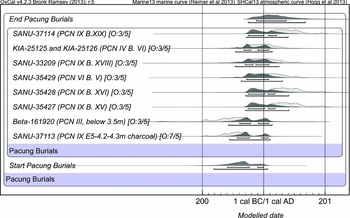
The stratigraphic sequences of SBN XIX and PCN IX are linked by a fine soil layer containing 10 per cent volcanic ash present at a depth of 2.0–2.1m in both sites, although the Pacung layers are sealed beneath deeper alluvium, causing a greater depth for the Pacung burials (3.8–4.8m) than for those at Sembiran (3.2–3.8m). The highest concentrations of cultural materials in SBN XIX came from layer 8 (2.7–3.2m depth), directly above a sparsely occupied burial ground facing a river estuary. An AMS date from charcoal at 2.9–3.0m depth in SBN XIX is 142 cal BC–AD 25 (S-ANU 37107). Pacung trench IX, on the other hand, revealed a dense beach cemetery, with more elaborate burial practices, including the use of jar burials and richer burial goods. The sites have produced a cultural sequence starting from the late second century BC for the burials, to the twelfth century AD, a date represented at 2.2m depth at Sembiran, just below the ‘ash’ layer (see online supplementary Table S1). At 95.4% probability, the Bayesian model of eight direct AMS dates from the bones of seven Pacung individuals, and one from charcoal closely associated with burial XIII, indicates that the burials started between 163 cal BC and AD 13 and ended between 51 cal BC and AD 137 (Figure 4).
Bayesian model for the Pacung burials (see online supplementary material for details). All AMS dates in this article were calibrated using OxCal v.4.2 (Bronk Ramsey 2009) and the SHCal and MarineCal calibration curves (Hogg et al. Reference Hogg, Hua, Blackwell, Niu, Buck, Guilderson, Heaton, Palmer, Reimer, Reimer, Turney and Zimmerman2013; Reimer et al. Reference Reimer, Bard, Bayliss, Beck, Blackwell, Bronk Ramsey, Grootes, Guilderson, Haflidason, Hajdas, Hatté, Heaton, Hoffmann, Hogg, Hughen, Kaiser, Kromer, Manning, Niu, Reimer, Richards, Scott, Southon, Staff, Turney and van der Plicht2013).

Multiple early contacts with India and Mainland Southeast Asia
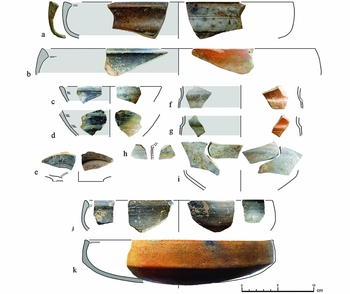
The earlier timing for Indian contact is based on the concentrations of fine grey-fabric Indian pottery in dated contexts at 3.8–4.3m depth in the PCN IX burial layers and at 2.9–3.2m depth in SBN XIX (Figure 5a–i). These include Rouletted Ware dish sherds with beaked rims of Wheeler Type 1, and sherds of non-rouletted vessels of Types 10, 18 and 141, in association with what appear to be, based on microscopy, coarse-fabric south Indian imitations of Rouletted Ware (Figure 5j), identified as Type 3 in the pioneering study of Indian ware found at the port site of Arikamedu on India's south-eastern coast (Wheeler et al. Reference Wheeler, Ghosh and Deva1946), and Balinese imitations of Indian dishes (Figure 5k).
PCN IX burial layers and SBN XIX layer 8. Selection of Indian fine grey pottery: a & b) Rouletted Ware Wheeler Type 1; c & d) Type 10; e) Type 141; f–i) Type 18; j) suggested Rouletted Ware imitation: South Indian; k) suggested Rouletted Ware imitation: Balinese (jar burial lid).

In South Asia, coarse dishes in the shape of Rouletted Ware were not found in northern India, but were widely found in Sri Lanka and southern India, together with Rouletted Ware. The second century BC south Indian and Sri Lankan production of coarse-fabric dishes imitating the shape of Rouletted Ware, which instead was imported from the Ganges Valley of northern India, has been argued for based on the pottery sequence at Tissamaharama in Sri Lanka (Schenk Reference Schenk, Weisshaar, Roth and Wijeyapala2001, Reference Schenk2006; Pavan & Schenk Reference Pavan and Schenk2012). A single geological origin for fine grey-fabric Indian ware, including Rouletted Ware and Northern Black Polished Ware, is indicated by geochemical data (Ardika et al. Reference Ardika, Bellwood, Eggleton and Ellis1993; Gogte Reference Gogte2001; Ford et al. Reference Ford, Pollard, Coningham and Stern2005; Magee Reference Magee2010).
We suggest here that Pacung and Sembiran have also produced these south Indian coarse dishes, as well as local Indian-style dishes. In Southeast Asia, Indian-style coarse dishes are also known, together with Rouletted Ware, from Khao Sam Kaeo and Phu Khao Thong in peninsular Thailand (Bellina & Silapanth Reference Bellina and Silapanth2008), and Batujaya in north-western Java (Manguin & Indradjaya Reference Manguin, Indradjaya, Manguin, Mani and Wade2011). Rouletted Ware is also known from Go Cam and Tra Kieu in central Vietnam (Nguyen et al. Reference Nguyen, Glover and Yamagata2006) and, within the Roman world, from the port sites of Berenike and Myos Hormos on the northern Red Sea in Egypt (Tomber Reference Tomber2000: 630, Reference Tomber2002: 27, Reference Tomber2008). Coarse dishes with beaked rims are also known from Sumhuram in Oman (Pavan & Schenk Reference Pavan and Schenk2012).
To date, the total count of fine Indian sherds from Sembiran and Pacung can be conservatively estimated at over 600, with a similar quantity of coarse-fabric sherds of possible Indian manufacture. This underlines the significance of the sites for Indian traders, possibly involved in the early commerce of Moluccan spices, and reaching Bali mainly from the south Indian subcontinent since the late first millennium BC from sites such as Arikamedu, which produced pre-Roman Rouletted Ware and also Julio-Claudian Arretine ware and coins (Begley Reference Begley1996). Roman glass has been newly identified in SBN XIX through chemical data, indicating indirect contact with the Roman world via India, and new compositional data from gold and carnelian artefacts suggest a route from the north Indian subcontinent to Indonesia, via Mainland Southeast Asia. Macrobotanical investigation has identified the presence of an Indian mung bean (Vigna sp. radiata) at a depth of 3.7m in PCN IX, directly above the burials, thus broadly matching in date the earliest directly dated mung bean in Southeast Asia from Phu Khao Thong (172–2 cal BC; OxA-26628) (Castillo Reference Castillo2013).
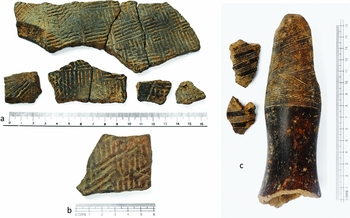
Regarding Mainland Southeast Asia, new analytical data from glass and bronze burial goods at Pacung point, for the most part, to links broader afield with the region of present-day Vietnam. This link with Vietnam, which by the late second to first century BC had begun to show Western Han Chinese influence, is also supported by new evidence of Han-style paddle-impressed pottery at Sembiran, similar to low-fired Han-style pottery known from northern and southern Vietnam (Figure 6a & b; Sophie Peronnet pers. comm.). The SBN XIX Han-style pottery was found at a depth of 3.1–3.2m, in association with other wares of possible Mainland Southeast Asian origin, the highest concentration of fine Indian ware and with incised flask sherds with specific eastern Indonesian parallels at Leang Buidane in the Talaud Islands (Bellwood Reference Bellwood1980), a larger example of which came from 3.7m in PCN IX (Figure 6c). Geochronological and geochemical analyses to provenance the Sembiran and Pacung pottery assemblages are currently underway.
a & b) SBN XIX Han-style pottery; c) PCN IX eastern Indonesian flask neck.

The Pacung jar burials
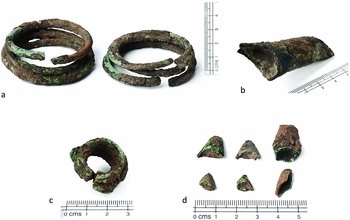
A lidded jar burial was found in PCN IX at a depth of 3.9m (Figure 3, pot 1). It contained the skeleton of an infant (burial XIX) buried with turtle and fish bones, 19 bronze fragments and 5 stone flakes. A direct AMS date from the bone in burial XIX is 52 cal BC–AD 197 (S-ANU-37114). The container was a locally produced round pot with a net-pattern impression, of a morphology widely found in late prehistoric sites in Bali, such as Gilimanuk on the north-western coast (Soegondho Reference Soegondho1985), and dated from the first century BC (Soejono Reference Soejono1977: 280–81; Bronson & Glover Reference Bronson and Glover1984; Anggraeni 1999: 23–25). Its upper section had been removed to allow for the body to be inserted, and an inverted coarse-fabric dish with a beaked rim served as the lid (Figure 5k). The jar was placed right next to the flexed burial of a five–six-year-old child (burial XVI), who wore six circular cross-sectioned bronze anklets (Figure 7a). The skull of burial XVI had been removed and replaced by a 0.5m-high pile of basalt stones, showing evidence of burning. Adult human leg bones (burial XVIII) were placed crossed over the stones, and covered with a round white stone. A direct AMS date from bone from burial XVIII is 131 cal BC–AD 115 (S-ANU-33209), and another from burial XVI is 54 cal BC–AD 200 (S-ANU-35428).
Bronze artefacts analysed: a) Pacung leaded bronze anklets; b) Pacung socketed axe; c) Sembiran unleaded bronze ring; d) Sembiran leaded bronze socketed points (one from PCN IX).

An identical jar burial was found at the same level in 2004 (PCN IV), 2.5m to the south-west of the jar found in 2012, and it contained an adult skull (burial X) (Tim Jurusan Arkeologi 2004; Drawatik Reference Drawatik2008). A supine adult female burial with bent knees and elbows (burial VI) was lying directly next to it, with three pairs of associated circular cross-sectioned bronze bracelets and four gold beads. Two direct AMS dates from bone from burial VI give one calibrated date of 109 cal BC–AD 78 (KIA -25125–25126; Swastika Reference Swastika2008).
The Pacung dishes used as lids for jar burials, and several sherds of this type across the assemblages, correspond in shape to Indian dishes. However, their porous fabric is macroscopically similar to a variety of local wares, including a complete PCN IX round pot associated with burials XVIII–XIX (Figure 3, pot 2). Ardika pointed out the morphological similarity with Rouletted Ware, yet Neutron Activation Analysis results suggested a possible local origin (Ardika Reference Ardika1991: 83, 124: sample 25; Ardika et al. Reference Ardika, Bellwood, Eggleton and Ellis1993). Local production of Indian-style dishes in Southeast Asia has also been suggested by Bouvet (Reference Bouvet2011) for the site of Khao Sam Kaeo.
Mainland Southeast Asian, Indian and Roman glass
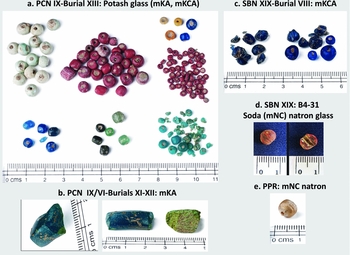
New chemical composition data for glass beads and bracelet fragments excavated in 2012 from a burial context and directly above it at Sembiran and Pacung indicate strong links to Vietnam and, to a lesser extent, elsewhere in Mainland Southeast Asia, India and the Roman world. Some 119 out of a total of 759 samples from SBN XIX, and 33 out of a total of 361 from PCN IX, plus comparative samples from broadly contemporaneous sites in northern Bali, have been analysed using Laser Ablation-Inductively Coupled Plasma-Mass Spectrometry in the Institut des Recherches sur les Archéomatériaux of the Centre National de la Recherche Scientifique (CNRS), Orléans, France (Figure 8). The results have been interpreted against a growing database of more than 3000 samples from across Asia (Figure 9).
Selection of analysed glass samples.

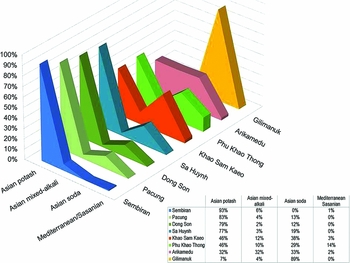
Glass chemical data showing the high percentage of the Sembiran and Pacung potash glass in relation to samples from Dong Son and Sa Huynh related sites in Vietnam.

The earliest glass in Mainland Southeast Asia has been found at Khao Sam Kaeo and Ban Don Ta Phet in peninsular and central Thailand (Glover & Bellina Reference Glover and Bellina2011), at Dong Son-related sites in northern Vietnam, and at Sa Huynh and Dong Nai sites in central and southern Vietnam (Lankton & Dussubieux Reference Lankton and Dussubieux2012). Potash (potassium oxide) silica glass of at least three types was most common in Mainland Southeast Asia from the fourth to the second century BC, although with an occurrence of north Indian high-alumina, high-uranium soda glass at Khao Sam Kaeo (Lankton et al. Reference Lankton, Dussubieux and Gratuze2008) and Ban Don Ta Phet. Towards the end of the first millennium BC, this north Indian raw glass disappeared from Mainland Southeast Asia, to be replaced, after a gap of perhaps 100 years, by large numbers of small, monochrome ‘Indo-Pacific’ drawn beads, made from high-alumina but low-uranium soda glass from new production sites in south India. Both Sembiran and Pacung, particularly in their burial phases, may fall into this chronological gap, since, in spite of the large amount of both north and south Indian pottery, there is very little glass that can be securely identified as having come from India.
Eighty per cent or more of the analysed samples from both Sembiran and Pacung were potash glass, compositionally similar to the low-lime potash glass (mKA) most strongly associated with Dong Son sites (30 per cent in Sembiran burial VIII and layer 8 above; 60 per cent in the Pacung burials), and the moderate-lime, moderate-alumina potash glass (mKCA) associated with Sa Huynh and Dong Nai sites (60 per cent Sembiran; 20 per cent Pacung) (Figure 9). Pacung burial XIII had only one green bead made with moderate-uranium soda glass (mNCA), which may be of Arikamedu production, and Sembiran had another. On the other hand, most of the 54 beads analysed as comparative samples from Gilimanuk were soda glass (mNA1, mNCA), which is associated with Indian sites.
Layer 8 in SBN XIX also produced a red bead with grey striation (Figure 8d), made with Roman soda natron glass (mNC natron; Nenna & Gratuze Reference Nenna and Gratuze2009). Moreover, two drawn beads with gold-foil (Figure 8e), analysed as comparative samples from a cluster of 40 found in a stone sarcophagus at the site of Pangkung Paruk (Gede Reference Gede2009), to the west of Sembiran, were also made of soda natron glass. These finds constitute the first evidence of Roman materials in a prehistoric context in Island Southeast Asia.
Transmission of bronze objects and technology
A selection of bronze burial goods from PCN IX and IV, and bronze artefacts from SBN XIX layer 8, have been incorporated within the Southeast Asian Lead Isotope Project (Pryce et al. Reference Pryce, Baron, Bellina, Bellwood, Chang, Chattopadhyay, Dezon, Glover, Hamilton, Higham, Kyaw, Vin, Natapintu, Nguyen, Pautreau, Pernicka, Pigott, Pollard, Pottier, Reinecke, Sayavongkhamdy, Souksavatdy and White2014) regional database of cupreous samples, adding a critical component from Island Southeast Asia to the Southeast Asian Lead Isotope Project production and exchange programme. Major and trace elemental composition by X-ray fluorescence (XRF) and lead isotope ratios by Multi Collector-ICP-MS were performed at the Curt-Hengelhorn Centre for Archaeometry, Mannheim, Germany. The ten analysed samples include: one of six PCN IX anklets from burial XVI; a PCN IX socketed axe from burial XIII (Figure 7b); one of nineteen PCN IX flat fragments from burial XIX inside the lidded jar; a PCN IX bracelet found 1m to the south of burials XVI and XVIII; a SBN XIX ring with knobs from layer 8 (Figure 7c); two SBN XIX socketed points (Figure 7d); and three PCN IV bracelets from burial VI.
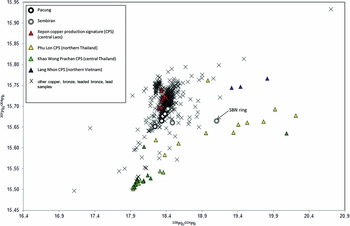
All of the Pacung samples, and one of the Sembiran socketed points, are made from leaded bronze, and it is thus impossible to identify the source of their copper using lead isotope analysis. What can be said is that their relatively tightly clustered lead isotope signatures (Figure 10) are consistent with the bulk of the broadly contemporaneous (500 BC–AD 200) leaded bronze Southeast Asian Lead Isotope Project database for Cambodia, Thailand and Vietnam, perhaps suggesting the addition of lead produced from minerals of a comparable geological age, most probably from the Annam Cordillera, which runs between Vietnam and Laos (Pryce et al. Reference Pryce, Baron, Bellina, Bellwood, Chang, Chattopadhyay, Dezon, Glover, Hamilton, Higham, Kyaw, Vin, Natapintu, Nguyen, Pautreau, Pernicka, Pigott, Pollard, Pottier, Reinecke, Sayavongkhamdy, Souksavatdy and White2014). One of the two analysed socketed points from Sembiran plots away from the Bali leaded bronzes but is still within the general cloud of Mainland Southeast Asia copper-bronze signatures. The two points are among six found in 2012 (Figure 7d), of a typology classified by Soejono as his type Vb (Soejono Reference Soejono1972) (Figure 11), and only known from late prehistoric sites in Bali such as Gilimanuk, a site that has previously produced chemical data from bronze artefacts, contributing to the comparative dataset (Soejono Reference Soejono1977: 23; Aziz & Sudarti Reference Aziz and Sudarti1996; Anggraeni 1999: 23–29). The lead isotope signatures of the points suggest the melting of imported bronze in Bali for local re-casting.
Current Southeast Asian lead isotope dataset plot (206Pb/204Pb: 207Pb/204Pb). Source data: Hirao & Ro Reference Hirao and Ro.2013; Pryce et al. Reference Pryce, Baron, Bellina, Bellwood, Chang, Chattopadhyay, Dezon, Glover, Hamilton, Higham, Kyaw, Vin, Natapintu, Nguyen, Pautreau, Pernicka, Pigott, Pollard, Pottier, Reinecke, Sayavongkhamdy, Souksavatdy and White2014.

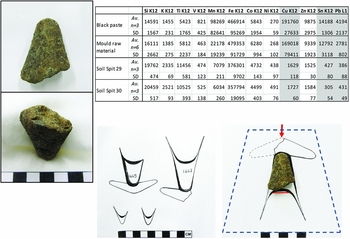
Bronze casting stone core. Table of pXRF net values (uncalibrated) of soils and artefact. Below: proposed use in the lost-wax casting of a Soejono type Vb socketed axe (redrawn from Soejono Reference Soejono1972: pl. 17).

The non-leaded bronze ring with knobs from Sembiran (Figure 7c) is inconsistent with any known Southeast Asian production or consumption signature. Significantly, given that all currently known prehistoric production signatures are from Mainland Southeast Asia, this may point to production in Island Southeast Asia. The testing of this hypothesis depends on the expansion of the Island Southeast Asia copper-bronze-lead consumption database, particularly by incorporating lead isotope signatures from the major porphyry copper deposits that exist across Indonesia and the Philippines.
Evidence for local bronze-casting
To date, local bronze-casting at Sembiran is documented by two volcanic tuff moulds, one for a Pejeng drum found in 1989, and one for a socketed axe found in 2012. Both were found in the same layer. The first stone mould was carved with geometric motifs typical of the decoration on Pejeng-type bronze drums. It was excavated in 1989 in trench SBN VII, in association with Indian Rouletted Ware (Ardika & Bellwood Reference Ardika and Bellwood1991). This Sembiran mould fragment appears to have been used to impress decoration onto a wax model during lost-wax casting (McConnell & Glover Reference McConnell and Glover1990). This specimen provided the first evidence in an archaeological context for the local casting of Pejeng-type bronze drums, a tradition that arose as a result of the import of Dong Son bronze drums to Indonesia (Calo Reference Calo2014: 127–39).
A second stone mould (Figure 11) was excavated in SBN XIX layer 8, which corresponds to the layer where Ardika found the first mould in SBN VII. The conical mould was analysed using portable XRF, and its surface gave significant readings for copper, tin and lead, exceeding those detected in the associated soil. This mould is also made of volcanic tuff, and its conical shape suggests that it would have been used in the lost-wax casting of a socketed bronze axe of Soejono's type Vb, a larger version of the socketed points mentioned above, with a blade. It is suggested here that the lost-wax method would have facilitated the production of its long, thin ends and flat blade (Nick Stranks pers. comm.).
Routes for imported gold
Gold is not found in Southeast Asia before the late prehistoric period, and the earliest evidence coincides with that for new trans-Asiatic contacts, particularly with the Indian subcontinent (Bennett Reference Bennett2009). Sembiran and Pacung have produced a total of 13 miniature gold beads and ornaments from the layer directly above the burials at SBN and in the upper burial layer at Pacung. These include miniature pentagonal (1), hexagonal (5), biconical (2), granulated (1) and spiral wire (1) beads, a hook, a comma-shaped unit and a gold-foil fragment. Stylistically, none of these objects is directly paralleled in a prehistoric context in Southeast Asia. Ten have been analysed for composition using Laser Ablation-Inductively Coupled Plasma-Mass Spectrometry in the Curt-Hengelhorn Centre for Archaeometry laboratory in Mannheim, as part of the first comparative study of prehistoric Southeast Asian gold (Schlosser et al. Reference Schlosser, Reinecke, Schwab, Pernicka, Seng and Vin2012; Figure 12). These samples from Bali are the first from Island Southeast Asia to have entered the Mannheim study, and have been compared with 124 gold artefacts from Prohear (Reinecke et al. Reference Reinecke, Vin and Seng2009) and other sites in Cambodia, and with Sa Huynh sites in central Vietnam.
Gold artefacts analysed. Photograph: Andreas Reinecke.

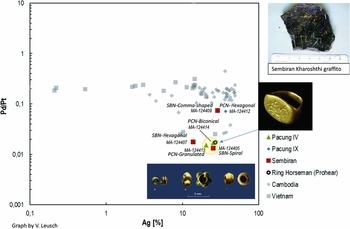
Most of the Bali gold samples are made of electrum, a naturally occurring gold-silver alloy (with 20 per cent or greater silver content) panned from alluvial deposits. Based on palladium/platinum (Pd/Pt) ratios in relation to silver (Figure 13), the Bali samples show no correlation with the samples from the Cambodian and Vietnamese sites. However, three out of the ten plot close to a Prohear gold ring inscribed with a horseman motif, which stands out from the Prohear assemblage stylistically and has been confirmed to be non-Southeast-Asian, based on its composition (Reinecke et al. Reference Reinecke, Vin and Seng2009: 85, fig. 68, no. 9; Schlosser et al. Reference Schlosser, Reinecke, Schwab, Pernicka, Seng and Vin2012). These include a SBN XIX spiral wire bead, a PCN IV granulated bead and a PCN IV biconical bead (Figure 12g–i). The latter two were found in association with the dated burial VI.
Pd/Pt ratios versus Ag scatter plot of the Bali gold samples in relation to samples from Cambodia and Vietnam. Inset mid right: Prohear ring with horsemen motif (Reinecke et al. Reference Reinecke, Vin and Seng2009: 85). Top right: SBN VII sherd with Kharoshthi graffito (photograph: Peter Bellwood).

Stylistically, the Prohear ring resembles inscribed gold, copper and bronze rings typical of Saka-Parthian (first century AD) levels at the site of Sirkap, in the Taxila region of Pakistan (Marshall Reference Marshall1975: vol. II, 642–49; vol. III, pls. 197 & 198). A Sembiran potsherd inscribed with characters in Kharoshthi script (Ardika Reference Ardika1991: 55, fig. 4.4; Ardika & Bellwood Reference Ardika and Bellwood1991), found in SBN VII in 1989, also implies links with the north Indian subcontinent, particularly the Taxila region. The Kharoshthi script was of Aramaic origin in the Achaemenid Empire of Persia (sixth to fifth century BC), and was typically inscribed on gold and copper rings from Saka-Parthian levels at Sirkap (Marshall Reference Marshall1975: vol. III: pls. 197 & 198).
The central Asian region that includes modern Afghanistan and northern Pakistan was under Achaemenid and then Greek rule into the early first millennium AD, and was critical in the early long-distance movement of gold towards Southeast Asia. Perhaps significantly, SBN XIX produced a unique, comma-shaped gold object (Figure 12a), which resembles typical central Asian gold units soldered together to form ornaments. Other gold objects found in Southeast Asia, which bear stylistic parallels with Sirkap gold and copper ornaments include: a) inscribed gold rings from Pyu sites in Burma; b) the above-mentioned inscribed gold ring with horseman motif from Prohear in Cambodia; c) s-shaped gold units from Khao Sam Kaeo in Thailand (Marshall Reference Marshall1975: vol. III. pl. 196: 140–43; Pryce et al. Reference Pryce, Bellina-Pryce and Bennett2008); and d) a gold bracelet with flat band and coiled-wire knots from a Buni-phase burial at Batujaya in Java, of a type unknown elsewhere in Island Southeast Asia, but which resembles copper bracelets from Sirkap (Marshall Reference Marshall1975: vol. III. pls. 171: e-6 & 195: 105–15; Manguin & Indradjaya Reference Manguin, Indradjaya, Manguin, Mani and Wade2011: 122–23, fig. 5.9).
At present, the distribution of gold artefacts that carry Western affinities in Southeast Asia highlights a route from north India across the Bay of Bengal to Burma, Thailand, the Thai-Malay Peninsula and Indonesia. The same route would also have been used for carnelian and agate, both as raw material and finished beads, which were mined and worked in north-west India, and have also been shown to have been worked at Khao Sam Kaeo, adopting Indian technology (Bellina Reference Bellina2007). Laser Ablation-Inductively Coupled Plasma-Mass Spectrometry analysis of the two carnelian beads found directly above the burials in SBN XIX (red biconical) and PCN IX (white round), was conducted in the Elemental Analysis Facility of the Field Museum, Chicago, USA. Preliminary results have not yet identified a geological source, but the perforations suggest the use of a diamond-tipped drill, typical of Indian manufacture (Carter Reference Carter2013).
Conclusions
The evidence from Sembiran and Pacung indicates multiple, broadly simultaneous contacts with different regions of the Indian subcontinent and Mainland Southeast Asia starting from the late first millennium BC. The Pacung burials, dated from the late second century BC, revise the timing of Indian contact to at least the first century BC, based on the fine Indian pottery in the burial layers, and also provide the earliest securely dated evidence for bronze and glass in Island Southeast Asia. The new glass chemical data suggest stronger links with Vietnam than hitherto suspected, and this in turn strengthens the evidence for the transmission of bronze objects and casting technology to Indonesia from bronze-producing centres in north-eastern Mainland Southeast Asia. Preliminary lead isotope data also point to this region, with the exception of the Sembiran unleaded ring, and indicate the melting of at least some imported bronzes for local re-casting in Bali. A newly excavated volcanic tuff core, used to cast a bronze axe of an indigenous form, adds to the previous evidence for a local workshop at Sembiran. Although the analyses of the Sembiran and Pacung gold and carnelian beads need larger sample sets from Island Southeast Asia, the preliminary data suggest links to the northern Indian subcontinent via western Mainland Southeast Asia. Overall, the new analytical data from Bali, added to comparative databases that previously focused on Mainland Southeast Asia, are beginning to fill a major gap in the understanding of Island Southeast Asia's role in late prehistoric trans-Asiatic networks.
Acknowledgements
The Archaeology of the North Coast of Bali project is supported by the Australian Research Council (ARC) through the Australian National University, as Ambra Calo's Discovery Early Career Researcher Award (DECRA-2012–2015). Research is conducted in collaboration with the Indonesian National Institute for Archaeological Research, the Institute of Archaeology Denpasar (BALAR) and Udayana University. We are also grateful to I Wayan Ardika, Marc Oxenham, Philip Piper, Mike Carson, Sophie Peronnet, Bérénice Bellina, Phaedra Bouvet, David Bulbeck, Richard Armstrong, Ulrike Proske, Nick Stranks and Jochen Brocks.