INTRODUCTION
Today, “face-to-face interactions are taking place on a global scale because of unprecedented geographic mobility” (Chambers 2002:117). This has created a world in which there is vast language and dialect contact. Such situations present exceptional opportunities for study, both from the sociocultural perspective and with regard to the underlying mechanisms and biological organization of language. In this article, we focus on one small part of this burgeoning global laboratory of language at its interface with society: the nature of second dialect acquisition, defined as the process by which people transplanted from one region to another acquire a second dialect of the same language (Chambers 1992:674). Indeed, assimilation to the local speech community is perhaps one of the most important factors in an individual's linguistic development. The obvious place to tap into this phenomenon is the linguistic behavior of young children, because they are “well known to be much more rapid and complete accommodators than adults” (Trudgill 1986:31). People who move into a new community where the same language but a different dialect is spoken must adapt a new set of linguistic rules in order to sound like their peers. However, children appear to be the only sector of the population capable of doing this successfully. How do children do it?
Here we address this question by conducting a large-scale quantitative analysis of three transplanted children over a period of six years. In the second section, we review previous research on children, child language acquisition, child language variation, and second dialect acquisition in order to situate our study. In the third section, we describe our corpus and why it provides an important new perspective on second dialect studies. In the fourth section, we detail our methodology, describing our choice of feature for investigation, coding practice, and details of our approach. In the fifth section, we present our findings, focusing on change in real time, variability, and sociolinguistic influences. Finally, we offer our interpretation of the results and discuss their implications.
PREVIOUS RESEARCH
The vast majority of research on child language acquisition has focused on the regular progression of language development (e.g., Brown 1973, Gleason 1985, Bates et al. 1994) and on the structural properties of language that can be inferred from this process (e.g., Wexler & Culicover 1980, Pinker 1984, Yang 2003). The study of second dialect acquisition and child language variation is a slightly different endeavor. Indeed, the available related studies present a mix of those that focus on learning dialect rules, those that focus on the inherent variability of the language acquisition process, including its social and linguistic correlates (e.g., Labov 1989; Wolfram 1989; Roberts 1997a, 1997b), and recently, those that employ variationist methods to tap structured heterogeneity in first language acquisition (e.g., Kerswill 1996, Foulkes et al. 1999, Smith et al. 2007). In what follows, we review a number of these studies in order to position our own research, which offers yet another perspective – a study of variation in the acquisition of a second dialect.
Second dialect acquisition
There are relatively few studies in the literature that focus specifically on second dialect acquisition. These target situations of contrasting ancestry among speakers in a single speech community – those who have long roots in the locale, those who are recent arrivals, and those who have just appeared on the scene. How do the newcomers adapt to the local norms already in place?
Payne 1976, 1980
Perhaps the earliest research comes from Payne 1976, 1980, who studied the children of 12 transported families living in Philadelphia, United States. All the families had moved to Philadelphia from elsewhere; however, some of the 34 children were born in Philadelphia (N = 7), and the others ranged in age from 2 to 13 at the time of their arrival. The data analyzed in Payne's study were collected when the children were between 8 and 20 (Payne 1976:110, 112, Fig. 3.2).
The study focused on a number of phonological variables characteristic of the Philadelphia dialect that distinguish it from other dialects of American English (AmE). All of the children showed success in acquiring the Philadelphian pronunciations of glides, which involve the fronting of /uw/ and /ow/ and raising of /oy/. The age of arrival was the strongest predictor of use. The youngest group (0–4) had the highest proportion of Philadelphia glides, followed by those who arrived between 4 and 9 years of age. However, it is important to note that fronting and raising are straightforward categorical phonetic adjustments.
Payne also included a complex phonological rule, identified as “short-a.” The children's behavior on this variable was dramatically different. In this “notorious instance of complexity” (Chambers 1992:684), the children had to learn to tense and raise

, but not in all contexts. The constraints on using the tense, raised variants are highly complex and involve a convoluted set of conditioning factors.
1The best description of this complex phonological rule can be found in Chambers (1992:684): “It never occurs in ‘weak’ words such as am, and, or can, or before voiced obstruents except for the three words mad, bad, and glad; but it occurs invariably before final anterior voiceless fricatives, as in laugh, path, and class, though never in, say, smash; and also invariably before final anterior nasals as in ham and man, though never in, say, hang. Elsewhere it occurs variably, before liquids, as in pal, and before non-final anterior voiceless fricatives and nasals, as in traffic and hammer.”
Payne (1980:175) argues that the “incomplete acquisition indicates that children do not freely restructure and/or reorganize their grammars up to the age of 14 but that they do have the ability to add lower level rules.” This study exposed the tremendous challenge transported children face in acquiring a second dialect. It also clearly demonstrated the contrast between simple versus complex rules in the process of second dialect acquisition. Indeed, the majority of 10–14-year-olds in Payne's study did not even acquire the simple rules (Payne 1980:155, Table 7.3). Moreover, of those who had moved at a very early age (0–4), only two-thirds acquired the full simple rule system (Payne 1980:156, Table 7.4). This result is critical because it shows that the children's systems in second dialect contact are essentially variable. It also suggests that even the individuals themselves must have gone through a phase of variability in the acquisition process. As we shall see, this variability through the transition zone of second dialect acquisition will become an important focus of our own analysis.
Trudgill 1986
Trudgill's (1986:28–31) groundbreaking work on dialect contact includes two studies particularly relevant to second dialect acquisition. The first is a study of 7-year-old twins, Debbie and Richard, who move from Reading, England to Australia. The twins' acquisition of Australian English (AuE) was documented in monthly audiotaped sessions over a period of six months. The study focuses on 15 phonological features that differentiate British English (BrE) and AuE. Each one involves pronunciations of vowels including /ai/, high, /ou/, low, /ei/, face, /i:/, see, etc., with the exception of /t/ in two different contexts – word-medial (e.g., better) and word-final /t/ (e.g., hit) (see Trudgill 1986:29, Table 1.3). Interestingly, the twins differed with respect to rate and pattern of acquisition, particularly with respect to /t/. Beginning from the first recording at one month after arrival, Richard had acquired the word-medial AuE variant, the flap. However, the word-final context remained BrE

until the fifth month, when he switched to AuE [t]. In contrast, the other child, Debbie, with the exception of a few stray tokens, did not acquire the AuE form of either word-medial or word-final /t/.
This study provides another example of second dialect acquisition in action. However, despite the fact that the twins eventually “sound, at least to a non-Australian, very Australian” (Trudgill 1986:28), we note that (i) an underlying constraint appears to be influencing the acquisition of /t/, namely the contrast between word medial and word final environment, and (ii) this simple phonological rule is not fully acquired at six months post-arrival (Trudgill 1986:29, Table 1.4). This result is consistent with Payne's (1980) study in showing that, despite some successes, there are limits on the second dialect acquisition process even among young children (Trudgill 1986:32). Moreover, like those in Payne's study, these children appear to have a variable system in the transition from one dialect to another.
The second study Trudgill discusses is based in Norwich, a community in southeastern England. Trudgill 1974 contrasted the linguistic performance of 20 speakers aged 30–40, of whom 10 had parents who were born and raised in Norwich and 10 parents who were born elsewhere. Focusing on distinct vowels of the Norwich variety inherited from Middle English, he asked all the speakers to read the target sentence, Norwich city scored an own goal, “in a proper Norwich accent” (Trudgill 1974:36). There was a categorical contrast between the two groups. Those with parents born in Norwich produced the correct local pronunciation,

; the others did not. This result provides a remarkable parallel to the Philadelphia situation (Payne 1976, 1980) and speaks strongly to the importance of community-based influences, particularly parental status, in the acquisition of local vernacular norms. Indeed, Trudgill's (1986:vii) view is that features of an alien linguistic variety become a permanent part of a speaker's accent or dialect as the result of “long-term accommodation.”
Starks & Bayard 2002
A more recent perspective on second dialect acquisition comes from Starks & Bayard 2002, who studied four children born in New Zealand to transplanted North American parents. The children had been exposed to New Zealand English (NZE), via daycare, at different ages. Two children, a brother and sister named Nikkie and Avin, had entered daycare at six weeks of age. Jazmine began daycare at 11 months old. Finally, Ian started daycare much later, at 2 years, 1 month old. The question the researchers addressed was whether this difference would be reflected in the children's acquisition of NZE. Moreover, they discuss sibling order in the contrast between Avin, the elder brother by three years, and Nikkie, his younger sister.
The target variable was post-vocalic /r/, as in car, a feature that categorically differentiates North American English (NAmE), which is rhotic,

and NZE, which is non-rhotic,

. Before entering daycare, the children's only language exposure was to the rhotic NAmE variety spoken by their parents. The analysis of post-vocalic /r/ is based on the children's linguistic performance at the ages of 3;6 (Nikkie), 3;9 (Jazmine), 6;1 (Avin), and of one child, Ian, at ages 8, 12, 16 and 20. The results show conclusively that the earlier the children were enrolled in daycare, the more successful they were at acquiring NZE.
2Nikki and Avin, who were enrolled in daycare at six weeks of age, used North American English post-vocalic /r/ at 0% and 3% respectively. Jazmine, who was enrolled at 11 months, used post-vocalic /r/ 24% of the time. Finally, Ian, enrolled at 25 months, ranges in his use of post-vocalic /r/ from 66% to 85%.
This study was based on a very small number of tokens: Avin, N = 97, Nikkie, N = 39 tokens, Jazmine N = 91 tokens, Ian N = 253 tokens with NAmE parents and 358 with NZE peers. There was no pre-daycare data collection.
Though only a small case study, this work highlights the importance of children's early exposure to the local speech community in their ability to successfully master a second dialect and harkens back to Trudgill's study. Once again, it is clear that there is variability throughout this process. Indeed, by the age of 20, Ian is still robustly variable, with 68.3% rhoticity (N = 82), even after living in New Zealand since birth (Starks & Bayard 2002:190, Table 3). Such a result shows that phonological features may not attain categorical status in the emerging second dialect, even when they are categorical in that dialect. Indeed, results such as these suggest that some individuals may always be variable.
Child language variation
Another related research area that has implications for second dialect acquisition is the study of child language variation more generally. A recent trend in the study of children's language focuses on inherent variability (Weinreich et al. 1968) and employs variationist methods (Labov 1970, 1972) to study trends and patterns in the data. While many studies of child language focus on the acquisition of categorical language rules, studies of variation have consistently demonstrated that children are also acquiring variable rules at the same time (Labov 1989; Wolfram 1989; Roberts & Labov 1995:10; Foulkes et al. 1999). In the former process, children learn to function in their native language (grammatical competence); in the latter, children learn to function as fully participating members of their speech community (sociolinguistic competence) (Chambers 2003:174; Roberts 2005:154). Critical for our study is the consistent finding that “the rule-governed variation which has been found time and time again to be a part of the language of adult speakers is also a part of the overall linguistic competence which a child must acquire in order to be a speaker of her language” (Roberts 1997a:354).
Labov 1989
Labov 1989 set the scene for the investigation of variable constraints in child language acquisition in a small case study focused on a single family (two parents and their 7-year-old child) in Philadelphia. The study provides important insights into how children acquire variable rules, not simply in frequency of variant forms but, importantly, with respect to the constraints operating on their use. Focusing on the well-studied linguistic variables (t,d) and (ing) (e.g., Fasold 1971, 1972; Guy 1980; Wolfram & Hatfield 1984), Labov demonstrated how the patterns of variation compare across parents and child. For both variables, the child (David C.) parallels his parents for internal linguistic constraints, including the hierarchical phonological constraints on (t,d), (obstruent>liquid/glide>vowel>pause) (Labov 1989:91, Figure 2), the major divide in the grammatical constraint (i.e., monomorpheme > regular past tense –ed) (Labov 1989:91, Fig. 3), as well as the overarching grammatical contrast between verbal and nominal forms for (ing) (Labov 1989:93, Fig. 5). Indeed, a comparison of other linguistic features (such as consonant clusters generally, morphological and grammatical features) reveals that “the acquisition of variable rules actually precedes the acquisition of many other features of the grammar” (Labov 1989:94)!
Although these findings came from a relatively limited sample, they were groundbreaking in their demonstration that, at a very early age, children “reproduce the historically preserved variable patterns” of their speech community.
Wolfram 1989
Wolfram 1989 reports on a study of 12 African American children with strikingly similar results. He focused on a well-known African American feature in which word-final vowel and nasal consonants can occur phonetically as a nasalized vowel, e.g., run →

. Interestingly, from the earliest age, 18 months, the children showed evidence of acquiring not only this unique adult African American Vernacular English community feature but also the complexities of its conditioning. Chambers (2003:174) notes that as soon as the children “master the phonological features relevant to the phonology, they also master the processes that apply to them” (Labov 1989:96). Once again, this highlights the presence of both variation and constraints in the acquisition process.
Roberts 1994, 1997a
Roberts 1994 conducted a large-scale quantitative study of young children. Her data come from 146 hours of tape-recorded conversations with 16 preschoolers between ages 3;2 and 4;11. She considers the same features as Labov 1989 and focuses on the constraints operating on variable (t,d) and (ing). For both variables, the children exhibit successful acquisition of the internal linguistic constraints of the adult population in ways consistent with Labov's earlier study. They had acquired (i) the ranking of following segment for (t,d), (ii) the contrast between monomorphemes and past tense verbs for (t,d) (Roberts 1997a:353, 359), and (iii) the noun vs. verb difference for (ing) (Roberts 1994). Interestingly, however, the children were not as successful at acquiring the social constraints on these variables. While they had acquired some of the stylistic constraints for (ing) in that they used more of the

variant with other children than with adults, they had not mastered the same distinction for (t,d). Moreover, the (t,d) data revealed that the girls had higher rates of deletion than the boys, which contrasts with previous findings for the adult population (where women tend to favor retention of clusters) (e.g., Wolfram 1969, Neu 1980). Roberts (1994:369) suggests that the 3- and 4-year-old girls have not yet internalized the societal conditions: “The girls have not yet learned their role as guardians of the conservative linguistic norm.”
In sum, Labov's, Wolfram's and Roberts's research provides a window on early acquisition and an important step toward furthering understanding of the role of grammatical and social constraints. Apparently, variable constraints of the grammar are acquired at the same time as language acquisition is happening. On the other hand, external, social constraints appear to evolve slowly, generated in situ only as children become fully participating members of their community. Moreover, yet another nuance has appeared on the research scene – the hint that not all constraints are acquired equally, and, further, that not all linguistic variables will be acquired in the same way at the same time (see also Smith et al. 2007). It seems that core contrasts are acquired first, while nuances in the constraint ranking of factors – such as semi-weak verbs for (t,d) and following pause for (t,d) – may be qualitatively different for one reason or another (e.g., Horvath & Horvath 2003) or learned at a different stage (e.g., Labov 1989).
Chambers 1992
It now remains to bring all these issues to bear on the second dialect acquisition process in particular. To our knowledge, the most lucid consideration of this phenomenon is Chambers 1992. In this article, Chambers lays out eight generalizations (principles) relevant to the second dialect acquisition process, each one meant to provide an empirically testable hypothesis about the determinants of dialect acquisition (Chambers 1992:677).
Chambers's study (1992) was based on six Canadian children in two families who moved from North America (Canada) to southern England in 1983 and 1984. The data come from interviews with these children, in which the author and individual child “discussed the social circumstances of their old and new neighbourhoods, evaluated taped accents” and “identified various objects on picture cards, and read word lists” (Chambers 1992:675). Using these materials to study the transition from an original dialect, Canadian English (CndE), to a second dialect, British English (BrE), Chambers examines a range of different linguistic phenomena, including a series of key lexical replacements and phonological rules such as T-voicing, rhoticity, intrusive /r/, vowel backing, and low vowel merger (see Chambers 1992:696, Table 6). The principles of second dialect acquisition arise not only from the behavior of individual variables, but crucially on pointed comparison across them. In what follows we review, in brief, the principles.
Principle One is a straightforward observation that lexical replacements (e.g., truck vs. lorry) are acquired faster than pronunciation or phonological rules (Chambers 1992:677). At the beginning of second dialect acquisition, such lexical replacements occur quickly, then trail off (Principle Two) (Chambers 1992:680). Phonological rules are distinguished by type in acquisition. Simple rules (e.g., T-voicing, as in butter

) are acquired earlier and faster than complex rules (e.g., r-lessness, car

) (Principle Three) (Chambers 1992:682). Further, acquisition of complex rules and new phonemes is also distinguished by the age of arrival of individuals into the new community. For example, a complex rule like low vowel merger, e.g., cot/caught, is acquired only by younger children (Principle Four) (Chambers 1992:687). An overarching observation is that in the earliest stages of second dialect acquisition there is variation in all rules and in all acquirers (Principle Five) (Chambers 1992:691). This inherent variability has its own structure. Chambers suggests that new variants occur sporadically at first and only gradually become rule-governed or systematic (Principle Six) (Chambers 1992:693). Principle Seven suggests that it is easier to eliminate the rules of the old dialect (e.g., T-voicing, vowel merger), than it is to acquire rules of the new dialect (intrusive /r/) (Chambers 1992:695). Principle Eight observes that new rules that are reinforced by orthography (e.g., pudding vs. putting) will be acquired before those that are not (e.g., r-lessness). In the former case, eliminating T-voicing in words like putting results in pronouncing the /t/ as [t], just as it is spelled. In the latter case, words are spelled with /r/ but pronounced without it (Chambers 1992:697). Finally, Chambers notes that the principles will have different strengths as well as overlap, suggesting that in practice the setting of second dialect acquisition will involve an intricate array of multidimensional considerations.
Chambers concludes by stating that the principles “are intended to be testable, and since the social situations in which they arise are so commonplace, there should be no lack of opportunities to test them” (1992:703). This is our departure point. The goal of this article is to offer an in-depth quantitative examination of a second dialect acquisition scenario that is very similar to the one Chambers studied. We were fortunate in being privy to a situation that allowed Chambers's principles to be put to the test. It was the perfect opportunity to follow up on Chambers's (1992:703) appeal for broadening the “empirical depth” of his original study.
DATA
Data collection
In 1995, the first author moved from Ottawa, Canada to York in northeastern England along with her three children, who were all under age five.4
For informational purposes, the children's birthdates are as follows: Tara, February 16, 1991; Shaman, December 19, 1992; and Freya, June 10, 1994.
The sessions were recorded using a high-quality tie-clip microphone (SONY ECM 150), which was affectionately referred to as “Mr. Mikey.” The children each took turns wearing Mr. Mikey. Although the children were aware that they were being recorded, after the first few minutes of each tape, they quickly become engrossed in the task at hand. The result is that these language data are uncommonly candid, ideal for tapping the most natural type of speech children engage in. Furthermore, the method of data collection that was developed obviates the innumerable challenges posed by data collection among young children (Roberts 2002:336–37). Perhaps the foremost problem is that children produce far less linguistic material in a given stretch of time than adults do. This requires exponentially more data from the child population. Indeed, Roberts (2002:336) reports that 8–14 hours of interview time with children were required in order to match token counts of (t,d) deletion obtained in 1–2 hours from adult interviews (Roberts 1997a:357). In this study, our data pool represents 82 hours of dense interactive discourse. Another problem in research involving small children is the type of data obtained. Most other studies rely on observations and retrospective notes and often involve only one child (Roberts 2002:336). In this study, the sample pool is still small (N = 3); however, we have access to dozens of hours of taped material, and further, there is an enormous amount of data (typically one to two hours) per day. Finally, and perhaps most thorny, is the “difficulty of distinguishing between variation that is socially motivated and that which is developmental in nature” (Roberts 2002:336). As we shall see, the age span of the children in this study makes this problem particularly compelling; however, the contrast also provides an opportunity to both understand and explain the variability.
This is not to say that our data collection methods were infallible. Owing to the nature of the context, there is considerable noise on the audio record, including extensive overlapping of conversations, yelling, loud noises, unexpected interruptions, volume changes, and so on. Further, the amount of data collected is disproportionate across the children. This is due to their age at collection. For example, Freya was only 19 months old at the earliest stage. At the opposite end of the spectrum was Tara, who at age seven became highly self-conscious in the presence of Mr. Mikey and resolutely avoided participating in the ongoing discourse.5
Indeed, it was necessary to scour family video footage in order to boost Tara's tokens in one of the later time periods (1998). By the time the children were five, six, and nine in February 1999, regular data collection waned and eventually stopped altogether. Tara, in particular, had become overly conscious of the purpose of the research project and started engaging in performance-like behavior.
The day before the family returned to Canada in 2001, three British research assistants conducted one-on-one interviews with each of the children. These data provide the end point of the project, when these children were all considered fluent in the local vernacular.
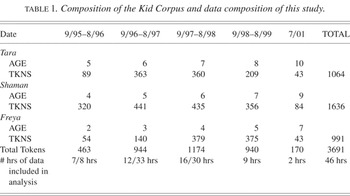
Table 1 summarizes the contents of what we will refer to as “the Kid Corpus.” The present study is based on a subsample of the total corpus, comprising 46 hours of data recorded between January 1996 and June 2001. The sheer amount of data in this corpus enables us to focus on the underlying mechanisms and social influences guiding the change from one system to another, allowing us to track second dialect acquisition as it is happening.
Composition of the Kid Corpus and data composition of this study.

METHOD
Choice of variable
One of the features in Chambers's (1992) study of different lexical and phonological features was the loss of T-voicing (Chambers 1992:682), a rule that is characteristic of NAmE. In this process “a medial /t/ is voiced to

when it follows a vowel or /r/ and precedes an unstressed syllable,” as in (1).
6It makes homophones of pairs of words such as putting/pudding, petal/pedal and hearty/hardy (Chambers 1992:682).

Codes enclosed in parentheses refer to the child who provided the datum, the audiotape number, the side of the tape, and the counter number. After each word containing the target segment, we provide the phonological realization as it was uttered.
In the transition from CndE to BrE, Canadians must “change these voiced stops to voiceless stops” (Trudgill 1986:22).
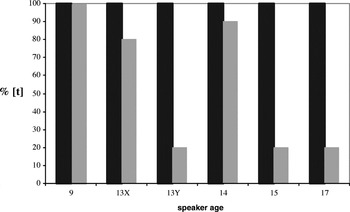
Chambers 1992 demonstrated this process as shown in Figure 1. Each of the six children in Chambers's study is represented across the X axis. The dark columns – where there is categorical [t] – are six control subjects, speakers of BrE matched for age and sex. The lighter columns are the Canadian children. The important observation is how the children are differentiated. The 9-year-old uses 100% British [t]. However, both his older brother (13X) and the 14-year-old still have a few instances of CndE

. The other three children score much lower – they use only 20% [t].

T-voicing in British and Canadian English speaking children (Chambers 1992:682, Figure 5).
This result was only a small part of Chambers's (1992) study; however, it provided several important pieces of the second dialect acquisition puzzle:
- First, the simplicity of this rule makes it easy to acquire.
- Second, the younger speakers were more successful at eliminating the rule than the older speakers.
- Finally, because elimination of T-voicing leads to a pronunciation consistent with orthography, this may contribute to how easy the rule is to acquire.
However, in BrE, at least in York circa 1995–2001, there were actually two variants. In addition to [t], there was also glottal stop, as in (2).

As Trudgill 1986 notes, these variants have important sociolinguistic meaning: The [t] variant is considered “careful, formal, posh, upper class.” In contrast, the glottal stop variant is “careless, informal, rough, lower class.”8
Chambers reports that in the exurban community in southwestern England in 1992, when his original study was conducted, there was no variation between [t] and

(p.c., 3 August 2005).
Moreover, the variants are linguistically constrained: Word-medial contexts, as in (3), contrast with those that occur in word-final position, as in (4). According to Trudgill 1986 and replicated in many subsequent analyses, the glottal variant is much more frequent in word-final position.

In summary, T-voicing is a “simple rule” (Chambers 1992: 682) that is predicted to be acquired easily in second dialect acquisition and also occurs frequently in natural speech data. However, it also involves robust linguistic conditioning and carries sociolinguistic meaning. Thus, it may not be as simple as one might expect. This makes it the ideal choice for the first large-scale analysis on the Kid Corpus.
Circumscribing the variable context
The nature of the T-voicing rule presents a relatively straightforward case for circumscribing the variable context. All instances of word-medial, inter-sonorant /t/ and word-final /t/ before an initial vowel in the following word were extracted for analysis. In addition to these contexts, we also found that medial /t/ is sometimes voiced to

when it follows voiceless stops (e.g., /p/, /k/) and fricatives (e.g., /s/, /f/) in words like helicopter, tractor, and sister, after, respectively.
9For further discussion of the T-voicing rule and detailed formulation see Kahn 1976.
In the process of extracting these contexts from the data, we discovered a number of instances of overgeneralization, as in (5).

Although these tokens are extremely rare (N = 12),10
Of the twelve tokens, ten are from Freya, one from Shaman, one from Tara. Freya's tokens all occur between October 1998 and January 1999 and only on two lexical items: spider (N = 4) and playdough (N = 6).
The nature of these data presents a number of difficulties for data extraction. While it is ideal for studying spontaneous, unmonitored speech, there were many tokens that had to be excluded because of inaudibility of the segment. If the target segment could not be unambiguously identified, it was not included. In addition, a number of exceptional contexts were not considered, including singing, recitation, and reading, as in (6).

Leaving aside tokens of overgeneralization and the other exceptional contexts aside, we amassed 3691 tokens of contexts for T-voicing.
Coding
Each context was then coded for a set of internal and external factors. Extrapolating from other studies and from our own observations and experience with the data, we tested hypotheses that could be expected to play a role in the process of second dialect acquisition.11
The full study actually included numerous other factors, including part of speech, syllable structure, lexical item, frequent collocations, repetition, priming, and so on. We will explore these effects in ongoing research.
Linguistic context
Perhaps the foremost linguistic constraint on the realization of /t/ in BrE is the position in the word in which it occurs (e.g., Reid 1978, Trudgill 1986, Stuart-Smith 1999, Hirayama 2003). Our coding schema enables us to split the data into two categories: word-medial as in (7), and word-final as in (8).

Time
A critical component of our analysis is the contribution of real time to the acquisition process. Each individual audiotaped session was coded separately. This enabled us to examine the trajectory of acquisition by day, by month, by series of months, or by year. Exhaustive testing of all these different possibilities led us to use an optimal categorization schema of school year (September through August) as best suited to the analysis, although, as we shall see, finer distinctions provide informative alternative views of this process.
RESULTS
Change in real time
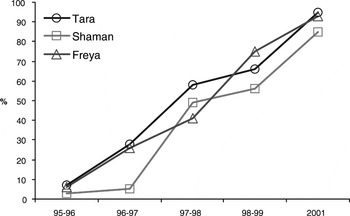
First, we present an overall perspective on the proportion of use of BrE variants in real time, as in Figure 2. Real time is represented on the x-axis and categorized into four school years plus the last interview in 2001.

Real time acquisition of British English by school year.
Figure 2 presents a dramatic trajectory, as all three children move incrementally from CndE to BrE forms. Recall too that all these data were collected in the presence of, and in interaction with, the first author. Chambers (1992:676) points out that British features during interaction with a CndE speaker are evidence that the British features “are those that they could no longer control or suppress.” Thus, the children's steady acquisition of BrE features, in contrast to the first author's own unwavering CndE,12
Sali Tagliamonte did not produce a single instance of BrE [t] or

in the data.
Variability
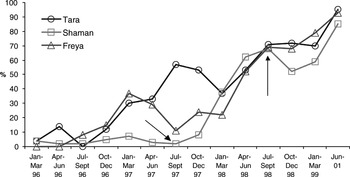
Chambers's (1992:691) Principle Five states that “in the earliest stages of acquisition, both categorical and variable rules of the new dialect result in variability in the acquirers.” Therefore, from the outset, we expect to find variability. While Figure 2 shows that this variability is present from start to finish, we may arrive at an even more nuanced picture by separating real time into three-month intervals, as in Figure 3.

Distribution of British English in three month intervals.
At virtually every point in time, variation exists. However, this more detailed perspective reveals that change is not immediate, but evolves in fits and starts across the six-year period. Chambers's (1992:687) Principle Three states that a simple rule like T-voicing should show “sustained, if erratic, progress.” The results in Figure 3 provide a graphic documentation of this development that is consistent for each child. However, inter-speaker differences now become apparent. Of course, individual routes in the process of second dialect acquisition in the same family are not unprecedented. Indeed, Trudgill's (1986:28–31) research showed striking contrasts in the use of numerous variables in twins. He suggests that this might be due to the male/female contrast as well as to differences in their individual friends and activities. Starks & Bayard 2002 showed a contrast between siblings what they attributed to birth order. We will return to these suggestions below.
Orthography
Another observation made by Chambers (1992:698) is that orthographically distinct rules such as T-voicing will be reinforced by spelling and reading (Principle Eight). This implicates education and literacy in the acquisition process.
Since all three children began school in England, we can test for this effect.13
Both Shaman and Freya attended a community play group from the time of arrival in England. This involved unstructured play accompanied by a parent for two hours on occasional weekday mornings.
First, follow Tara's trajectory of change along the line marked with circles. It begins when she is nearly five years old and ends when she is ten. Tara's entry into the British school system pre-dates the beginning of the recording sessions. She has already been exposed to BrE for four months by the start point of Figure 3 at “Jan-Mar 96.” Thus, it is surprising that her rate of BrE forms is actually so low. However, from that point on her acquisition, though somewhat erratic, shows a regular pathway over the six-year period.
Next, follow Shaman's trajectory of change along the lines marked with squares. It begins when he has just turned four and ends when he is nine. Shaman started school in September 1997 – marked by the first arrow. Notice the remarkable correlation between this event and his burst of acquisition of the new dialect.
Finally, follow Freya's trajectory of change along the line marked with triangles. It begins when she is 19 months old and ends when she is seven. Freya turns two in June 1996. Notice that from the very moment of this important milestone for first language acquisition, her use of British features accelerates rapidly and in tandem with her older sister. But she returns to Canadian norms between July 1997 and March 1998. Thereafter she shows an increase in BrE forms, following along with both of her older siblings from that point on. Note too that her acquisition is characteristically bumpy (as Chambers predicted). And – as with Shaman – after she starts school in September 1998, marked with the second arrow, there is a point of acceleration.
Entering the school system, with its concomitant opportunities for face-to-face interaction, is an unmistakably strong factor in these children's second dialect acquisition and is undoubtedly compounded by the children's developing literacy. The combined effects of these factors are likely what Chambers (1992:702) had in mind when he referred to the overlapping qualities of the principles and the need to understand their relative strengths.
Sibling differences
It remains to explain the dip in Freya's second dialect acquisition that is visible in Figure 3. Why would such a retrenchment occur? While we do not have a conclusive explanation, we suggest the following. The original surge toward BrE up to “Jan-Mar 97” may simply be the product of first language acquisition – Freya acquires the local dialect perhaps through modeling her older sister. Then, as she becomes more proficient at language generally, and perhaps more aware of her personal circumstances, she gravitates toward the CdnE model still present in the home context. This model comes from her older sibling, Shaman, who still shows Canadian usage at the time (see Figure 3), as well as her two CdnE-speaking parents. It is only when both her older siblings are attending school (from September 1997 on) and both are accelerating toward BrE that she starts to pick up the pace toward BrE once again, apparently following their lead. If such an interpretation can be sustained, it lends support to Starks & Bayard's (2002:193) suggestion that younger siblings may be preferentially positioned to acquire a second dialect. Indeed, these results suggest that older siblings are a very important contributing factor to the process of second dialect acquisition. However, the effect cannot be unconditional. Note that Shaman's position as a younger sibling does not appear to have helped his acquisition of BrE forms. Other influences must be involved.
Sociolinguistic influences
The dialect spoken in the city of York presented these children with a considerably more complex situation than simply devoicing an alveolar stop. Indeed, by the 1990s when these children moved to York, intervocalic /t/ varied robustly with glottaled alternates (Hirayama 2003), as schematized in Table 2.
Alternative realizations of intervocalic /t/ in word internal and word final contexts.

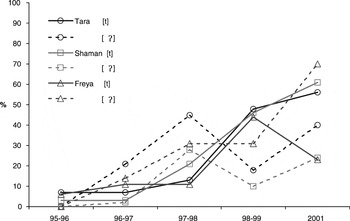
In addition to eliminating the T-voicing rule from their grammar in order to produce [t], the children also had to learn a whole new variant – the glottal stop – as well as when and how to use it. Figure 4 divides the data according to these two British variants.
14Note that all figures present the proportion of [t] and/or

out of the total number of all

, [t], and

.

, variants are the broken lines. This detail reveals that the two variants are acquired at different times and in different ways. From this point on, we return to dividing the data by school year.

Distribution of [t] and by school year.
Glottal stops are acquired first and rise quickly in frequency over the first two years. In contrast, the [t] variant rises slowly. Then in 1997–1998 it catches up and supersedes the glottal variant. Crucially, both these trends are shared by all three children. Finally, in 2001, a complex picture emerges. The glottal and [t] variants are spread out, and Freya has distinguished herself from her two siblings. Why is there a difference between the two variants? Why does Freya pattern similarly at first and then diverge?
Constraints on variation
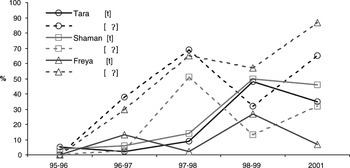
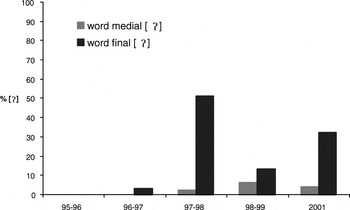
Recall that the two BrE variants are highly constrained by the grammatical contexts in which they occur. In order to see this effect, however, we must disentangle the [t] variants from the glottal variants in word-medial and word-final contexts separately. Word-final contexts are shown in Figure 5. The [t] variants are the solid lines. The

variants are the broken lines.

Distribution of [t] and for word final contexts by school year.
The glottal variant in word-final contexts accelerates fast and early for all the children. Acquisition of the standard variant [t] lags well behind the glottaled variants until 1998–1999, when all the children show an increase in use. Their systems from that point on are variable between the two forms.
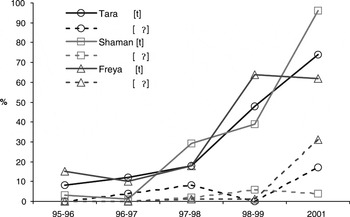
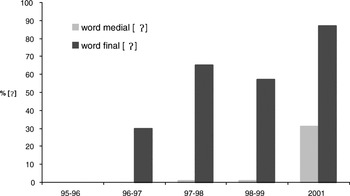
Word-medial contexts are shown in Figure 6. The [t] variants are the solid lines. The

variants are the broken lines. Figure 6 reveals a completely different pattern of acquisition. Overall, the children are slow to acquire BrE variants in this context. The standard variant [t] is of low frequency at first, and only in 1997–1998 does it begin to accelerate. The glottal variant in this context is marginal all the way through. However, note that the two girls exhibit a substantial increase in frequency in the very last period. In contrast, Shaman appears to have stabilized.

Distribution of [t] and for word medial contexts by school year.
To explain the children's use of these variants, we must turn to a consideration of both linguistic and social patterns. Indeed, as we shall see, it is critical to understand the variation in the local speech community, in particular how the variants are constrained linguistically and evaluated socially.
Sociolinguistic patterns
In word-medial contexts, the standard and most common form in BrE is [t]. Following this model, the children gradually learn [t] according to a standard trajectory of linguistic change, moving from their own original [D] variant to [t]. This is precisely what we observed in Figure 6. In word-final contexts, as in Figure 5, however, the local speech community in York provides a different variant – glottal stop. This variant is the more common, nonstandard (but socially unremarkable) variant. In this case, the children acquire glottal stop and only later learn the subtleties of sociolinguistic variation between glottal stop and the alternate [t] in this position.
Linguistic change
There is one final nuance. The second dialect, BrE, is also undergoing a process of rapid change involving increasing use of glottal stop in word-medial contexts (Trudgill 1988, Milroy, Milroy & Hartley 1994a, Milroy, Milroy, Hartley & Walshaw 1994b, Stuart-Smith 1999, Fabricius 2002, Hirayama 2003). Although Trudgill characterized the glottal stop in this position as “informal, rough and lower class” in 1986, by the 1990s there had been a reversal of its traditional low evaluation (Milroy, Milroy, Hartley & Walshaw 1994b:351). Indeed, Milroy and colleagues (1994b:350) associate glottal stops with young middle-class women.
Recall that these children, even in 2001, were only ten years old and younger. They were still too young to be fully participating in this highly circumscribed, socially embedded innovation. Even so, Figure 5 shows the beginning of a gender effect by 2001. This reflects patterns in the local speech community.15
Hirayama (2003, Fig. 16) found that among speakers in their twenties, females tend to have more glottaled variants than males, at 63% vs. 52%.
In sum, the children are acquiring the inherent variability in the local speech community. They start out by getting the majority forms in each context and only later acquire the sociolinguistic patterns.
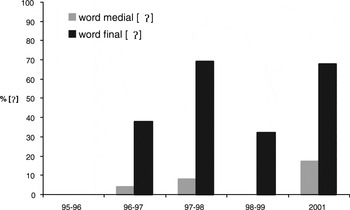
Support for this hypothesis comes from a comparison of the children's acquisition patterns with patterns of use in indigenous York speech. Hirayama 2003 showed that the word- medial/word-final difference was the most significant constraint on variation between [t] and glottal variants in York English. Figures 7a, 7b, and 7c compare when and how this constraint is acquired by the children.

Tara's distribution of by school year.

Shaman's distribution of by school year.

Freya's distribution of by school year.
Figure 7a shows that by the time Tara is using glottal stops in 1996–1997, she has already acquired this constraint. The same is true of Shaman (Figure 7b), even though his acquisition is comparatively delayed. Freya, in Figure 7c, rarely uses glottal stops in the word-medial position until the very last time period.
These figures reveal that the children acquire the contrast between word-medial and word-final contexts from the very beginning. Importantly, this patterning is an inherent part of the variable grammar of the York speech community.
This result corroborates an accumulating body of research that shows that very young children can acquire variable grammatical constraints (Labov 1989; Wolfram 1989; Roberts & Labov 1995; Roberts 1997a, 1997b; Foulkes et al. 1999; Smith et al. to appear). We can now add that children can do it, even in second dialect acquisition.
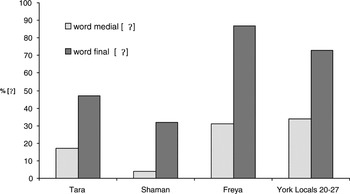
We can push this point one step further by making a direct comparison with local York speakers, as in Figure 8. In this figure we have plotted the distribution of glottal stops from the end point of the children's second dialect acquisition in 2001 compared with data from York from the closest available age group, 20–27-year-olds. Notice that all the children have acquired this constraint. They all mirror the local vernacular in terms of constraint ranking – more glottal variants in word-final contexts than in word-medial contexts. But only Freya – the youngest sibling, the one who had at least some of her first language acquisition in England – reaches the levels of frequency typical of the speech community.

Distribution of comparing Tara, Shaman and Freya in 2001 with York locals.
DISCUSSION
The age of a child's arrival in a new community is said to be one of the most important predictors of success in acquiring a (second) dialect. Early acquirers – typically described as those under age eight – should be able to achieve near native-like, if not perfect, command of the new dialect (Payne 1976, 1980; Trudgill 1986; Chambers 1992, 2003). Yet the children in this study were all under five at the time of their transportation to England and were still not 100% local six years later.
It is unmistakable that the children sounded British. Indeed, this is a common observation in second dialect acquisition studies. The twins in Trudgill's (1986:28) study sounded Australian, and Ian in Bayard's (1995:16) study sounded like a native New Zealander. However, scrutiny of the linguistic detail in these studies reveals that in each of them even the simplest phonological rules of the second dialect are not fully acquired; that is, they do not reach categoricity. Yet our study plainly documents a consistent increase in frequency of use of BrE variants over time. Indeed, second dialect acquisition is essentially a trajectory of monumental change in progress.
Over the six-year period in England, the children gradually acquired the local vernacular to the point where they can be considered local, or just about. In other words, they were well on their way to attaining proficiency in the second dialect. However, it is important to underscore that second dialect acquisition is much more than simply learning categorical rules. Instead, much of the process, perhaps most of it, involves learning the variable rules of the local speech community. In such circumstances, the child's task is even more complex. In the case investigated here – ostensibly, loss of T-voicing – the rule was not simple at all. Indeed, we tapped into a vibrant ongoing linguistic revolution in the pronunciation of /t/ in BrE.
Thus, the most fascinating result is how successfully the children maneuvered through both acquisition of the standard variant, [t], as well as the incoming variant

. Indeed, they acquired native-like patterns for use of these competing variants well before the frequency of these forms had neared local levels. We found that internal linguistic constraints were acquired virtually from the beginning – in this case, the difference between word-medial and word-final contexts. This result highlights the early mirroring of internal linguistic factors of which children of this age are capable. In contrast, the sociolinguistic factors (including stylistic nuances of use and gender effects) were acquired over a much longer time period. In other words, the processes by which the children modeled the second dialect were systematic and orderly, consistent with much of the existing literature on child language variation. But we have discovered how internally complex it is in practice, dependent on the nature of rules in question, the detail of internal mechanism(s), and the status of sociolinguistic norms of the speech community with respect to stability and/or change. For example, in earlier research, Roberts (1994:369) suggested that 3- and 4-year-old girls have not yet internalized the societal conditions appropriate to their cultural standing. Our analyses corroborate this observation and graphically capture the unmistakable influences on this process. The acceleration of second dialect variants occurs at well-defined, culturally embedded milestones (Figure 3). Going to school and interacting with one's own siblings appears to be crucial. Indeed, these findings provide strong support for the idea that successful second dialect acquisition, particularly use of variants at the same level of frequency as indigenous peers, is a direct consequence of sustained access to and integration with the local speech community.
It remains to compare and contrast other variables in the Kid Corpus in order to understand more fully the complexity of the linguistic mechanisms that underlie second dialect acquisition, as well as to explore Chambers's principles more deeply.
16Our focus on a single, simple phonological rule such as T-voicing precludes consideration of the full set of eight principles for second dialect acquisition outlined by Chambers 1992.

contains a context for both T-voicing and r-lessness). It is hoped that ongoing studies of this type will contribute increasingly useful evidence for mapping strategies for successful second dialect acquisition.
We would like to add that the second dialect, once in place, leaves an indelible imprint on the transported individual. Indeed, these children's return to Canada and to CndE – which is another story – is not complete to this day. They all use BrE features some of the time, including [t] and

. Freya, in particular, is still called “England girl” by her peers, and for Shaman the past tense of climb may always be clum. Thus, even at the furthest reaches of second dialect success, these children, like most transplanted individuals, will always retain “flavors” of their mixed repertoires (see also Trudgill 1986:32). These shibboleths of their individual personal histories may always mark them as distinct from the groups they even now identify with, if only in the fine details of frequency and patterns of use of local variants (see also Chambers 2003:106–7).