Introduction
Suicide is the second leading cause of death among young adults in the USA and most often occurs within the context of mood disorders (Nock et al., Reference Nock, Hwang, Sampson and Kessler2010). However, existing predictive models have had only modest success in estimating suicide risk (Franklin et al., Reference Franklin, Ribeiro, Fox, Bentley, Kleiman, Huang, Musacchio, Jaroszewski, Chang and Nock2017; Chang et al., Reference Chang, Franklin, Ribeiro, Fox, Bentley, Kleiman and Nock2016; May and Klonsky, Reference May and Klonsky2016; Rudd, Reference Rudd and Ellis2006; Panagioti et al., Reference Panagioti, Gooding and Tarrier2009). One of the strongest risk factors for suicide is having a previous suicide attempt (Valtonen et al., Reference Valtonen, Suominen, Mantere, Leppamaki, Arvilommi and Isometsa2006; Lewinsohn et al., Reference Lewinsohn, Rohde and Seeley1994; Brown et al., Reference Brown, Beck, Steer and Grisham2000). There is an urgent need for a more precise understanding of risk factors, including those based in neurobiology, to develop better predictive models and targeted treatments to reduce the collective burden of suicide.
Empirical research over the past few decades has identified numerous psychological factors associated with suicide risk (Hawton et al., Reference Hawton, Sutton, Haw, Sinclair and Harriss2005, Reference Hawton, i Comabella, Haw and Saunders2013). These have included cognitive risk factors such as negative cognitive styles, ruminative brooding, self-criticism, impulsivity, and hopelessness (Stange et al., Reference Stange, Sylvia, da Silva Magalhães, Miklowitz, Otto, Frank, Berk, Hansen, Dougherty, Nierenberg and Deckersbach2014, Reference Stange, Hamilton, Burke, Kleiman, O'Garro-Moore, Seligman, Abramson and Alloy2015; Kleiman et al., Reference Kleiman, Riskind, Stange, Hamilton and Alloy2014; Miranda et al., Reference Miranda, Valderrama, Tsypes, Gadol and Gallagher2013; Klonsky and May, Reference Klonsky and May2010; Oquendo et al., Reference Oquendo, Galfalvy, Russo, Ellis, Grunebaum, Burke and Mann2004), neuropsychological impairments within cognitive control, cognitive inflexibility and problem-solving (Miranda et al., Reference Miranda, Gallagher, Bauchner, Vaysman and Marroquín2012; Keilp et al., Reference Keilp, Sackeim, Brodsky, Oquendo, Malone and Mann2001, Reference Keilp, Gorlyn, Oquendo, Burke and Mann2008, 2013, 2014a,b; Malhi et al., Reference Malhi, Bargh, Kuiper, Coulston and Das2013; van Heeringen et al., Reference van Heeringen, Godfrin, Bijttebier, O'Connor, Platt and Gordon2011), interpersonal factors such as thwarted belongingness and perceived burdensomeness (Van Orden et al., Reference Van Orden, Witte, Cukrowicz, Braithwaite, Selby and Joiner2010), and difficulties with emotion regulation (Anestis and Joiner, Reference Anestis and Joiner2011; Pisani et al., Reference Pisani, Wyman, Petrova, Schmeelk-Cone, Goldston, Xia and Gould2013; Bekh Bradley et al., Reference Bekh Bradley, DeFife, Guarnaccia, Phifer, Fani, Ressler and Westen2011). Researchers have also pursued neurobiological factors that might improve these predictive models via brain-based correlates of suicide risk using fMRI (Chang et al., Reference Chang, Franklin, Ribeiro, Fox, Bentley, Kleiman and Nock2016; Drysdale et al., Reference Drysdale, Grosenick, Downar, Dunlop, Mansouri, Meng, Fetcho, Zebley, Oathes, Etkin, Schatzberg, Sudheimer, Keller, Mayberg, Gunning, Alexopoulos, Fox, Pascual-Leone, Voss, Casey, Dubin and Listen2017; van Heeringen et al., Reference van Heeringen, Bijttebier, Desmyter, Vervaet and Baeken2014; Serafini et al., Reference Serafini, Pardini, Pompili, Girardi and Amore2016; Lippard et al., Reference Lippard, Johnston and Blumberg2014).
The emergence of fMRI to probe neural networks has led to the development of tools that might be used to better understand the heterogeneity within mood disorders, by identifying intermediate phenotypes (Drysdale et al., Reference Drysdale, Grosenick, Downar, Dunlop, Mansouri, Meng, Fetcho, Zebley, Oathes, Etkin, Schatzberg, Sudheimer, Keller, Mayberg, Gunning, Alexopoulos, Fox, Pascual-Leone, Voss, Casey, Dubin and Listen2017; Hasler and Northoff, Reference Hasler and Northoff2011; Insel et al., Reference Insel, Cuthbert, Garvey, Heinssen, Pine, Quinn, Sanislow and Wang2010; Insel and Cuthbert, Reference Insel and Cuthbert2015), including biomarkers representing suicide risk via past suicide attempt (van Heeringen et al., Reference van Heeringen, Bijttebier, Desmyter, Vervaet and Baeken2014; Serafini et al., Reference Serafini, Pardini, Pompili, Girardi and Amore2016). One fMRI tool that holds promise for identifying mood disorder subtypes is resting-state functional connectivity (rs-fMRI) (e.g. Drysdale et al., Reference Drysdale, Grosenick, Downar, Dunlop, Mansouri, Meng, Fetcho, Zebley, Oathes, Etkin, Schatzberg, Sudheimer, Keller, Mayberg, Gunning, Alexopoulos, Fox, Pascual-Leone, Voss, Casey, Dubin and Listen2017). Three major intrinsic connectivity networks have been identified (Menon, Reference Menon2011; Seeley et al., Reference Seeley, Menon, Schatzberg, Keller, Glover, Kenna, Reiss and Greicius2007) that may be particularly relevant for understanding regions associated with individual differences in suicide risk. These include the cognitive control network (CCN), a system involving fronto-parietal and dorsal attention networks that is critical for problem-solving and executive functioning; the salience and emotional network (SEN), which is active in response to stimuli relevant to current goals, including emotional stimuli, and involves limbic and ventral attention networks; and the default mode network (DMN), which is active during self-focused thought and when not engaged with external stimuli (Buckner et al., Reference Buckner, Andrews-Hanna and Schacter2008). Recently, researchers have called for rs-fMRI studies to identify features in these intrinsic connectivity networks among individuals at risk for suicide, as few such studies currently exist (Serafini et al., Reference Serafini, Pardini, Pompili, Girardi and Amore2016).
A few recent studies of rs-fMRI have provided evidence that these intrinsic networks may help to differentiate individuals with suicide risk. Individuals with a suicide attempt history had less connectivity within CCN (Cao et al., Reference Cao, Chen, Kuang, Ai, Fang, Gan, Wang, Chen, Xu, Wang and Lv2015) and DMN regions (Zhang et al., Reference Zhang, Chen, Kuang, Cao, Zhang, Ai, Wang, Zhang, Wang, Liu and Fang2016), and elevated connectivity within the SEN (Kang et al., Reference Kang, Na, Choi, Kim, Son and Lee2017; Kim et al., Reference Kim, Kim, Myung, Han, Fava, Mischoulon, Papakostas, Seo, Cho, Seong and Jeon2017). Suicidal ideation (SI) also has been associated with attenuated connectivity within the left CCN (Ordaz et al., Reference Ordaz, Goyer, Ho, Singh and Gotlib2018), elevated connectivity within the SEN (Kang et al., Reference Kang, Na, Choi, Kim, Son and Lee2017; Kim et al., Reference Kim, Kim, Myung, Han, Fava, Mischoulon, Papakostas, Seo, Cho, Seong and Jeon2017; Du et al., Reference Du, Zeng, Liu, Tang, Meng, Li and Fu2017), and decreased connectivity between SEN and DMN regions (Du et al., Reference Du, Zeng, Liu, Tang, Meng, Li and Fu2017; Chase et al., Reference Chase, Segreti, Keller, Cherkassky, Just, Pan and Brent2017). Other studies that did not specifically report on suicide outcomes have linked differences in intrinsic connectivity networks to behavioral characteristics associated with suicidal behavior in depression, including rumination in association with the DMN and CCN (Rogers and Joiner, Reference Rogers and Joiner2017; Kaiser et al., Reference Kaiser, Andrews-Hanna, Wager and Pizzagalli2015; Hamilton et al., Reference Hamilton, Furman, Chang, Thomason, Dennis and Gotlib2011; Jacobs et al., Reference Jacobs, Jenkins, Gabriel, Barba, Ryan, Weisenbach, Verges, Baker, Peters, Crane and Gotlib2014, Reference Jacobs, Barba, Gowins, Klumpp, Jenkins, Mickey, Ajilore, Peciña, Sikora, Ryan and Hsu2016; Stange et al., Reference Stange, Bessette, Jenkins, Peters, Feldhaus, Crane, Ajilore, Jacobs, Watkins and Langenecker2017; Marchetti et al., Reference Marchetti, Koster, Sonuga-Barke and De Raedt2012), self-focused thought and the DMN (Hamilton et al., Reference Hamilton, Furman, Chang, Thomason, Dennis and Gotlib2011; Marchetti et al., Reference Marchetti, Koster, Sonuga-Barke and De Raedt2012), poor inhibitory control and attenuated connectivity within the CCN (Stange et al., Reference Stange, Bessette, Jenkins, Peters, Feldhaus, Crane, Ajilore, Jacobs, Watkins and Langenecker2017), abnormal association of the self with negative emotions (SEN and DMN; Hamilton et al., Reference Hamilton, Furman, Chang, Thomason, Dennis and Gotlib2011; Jacobs et al., Reference Jacobs, Barba, Gowins, Klumpp, Jenkins, Mickey, Ajilore, Peciña, Sikora, Ryan and Hsu2016), and emotion dysregulation (SEN and CCN; Serafini et al., Reference Serafini, Pardini, Pompili, Girardi and Amore2016; Jacobs et al., Reference Jacobs, Jenkins, Gabriel, Barba, Ryan, Weisenbach, Verges, Baker, Peters, Crane and Gotlib2014).
Convergent evidence from task-based fMRI has suggested that these intrinsic networks are relevant to cognitive and affective processes involved in suicide risk (van Heeringen et al., Reference van Heeringen, Bijttebier, Desmyter, Vervaet and Baeken2014; Lippard et al., Reference Lippard, Johnston and Blumberg2014). These studies have indicated reduced activation in the dorsolateral prefrontal cortex (dlPFC) and orbitofrontal cortex in individuals with a history of SB during decision-making tasks (Jollant et al., Reference Jollant, Lawrence, Olié, Guillaume and Courtet2011; Zhang et al., Reference Zhang, Chen, Jia and Gong2014). A recent meta-analysis of six studies found two regions in the right dorsal and rostral ACC in which individuals with a history of SB showed greater activation than matched psychiatric controls while viewing/making decisions about angry faces and during response inhibition in a go/no-go task; and a right posterior cingulate cortex (PCC) cluster in which SB history showed greater activation than psychiatric controls while viewing happy faces (Jollant et al., Reference Jollant, Lawrence, Olié, Guillaume and Courtet2011). The authors concluded that these findings support the putative role of disturbed emotion processing in suicide risk, as the rostral ACC is involved in managing emotional states and emotional interference during such tasks. Although these results provide promising insights into emotional dyscontrol in individuals having experienced or at risk for SB, task-based fMRI is inherently limited by the specific nature of the task demands during fMRI acquisition (Serafini et al., Reference Serafini, Pardini, Pompili, Girardi and Amore2016). In contrast, examining intrinsic networks during rest may have multiple complementary benefits. For example, it provides a measure of the overall integrity of the network with some degree of generalizability to a variety of contexts (Menon, Reference Menon2011; Smith et al., Reference Smith, Fox, Miller, Glahn, Fox, Mackay, Filippini, Watkins, Toro, Laird and Beckmann2009; although see Spreng, Reference Spreng2012). Resting-state scans also are more easily administered and analyzed than task-based designs and thus may be more readily translated to clinical practice for detection and possible intervention (Fischer et al., Reference Fischer, Keller and Etkin2016). Furthermore, few studies have taken an explicitly network-based approach with rs-fMRI in individuals with a history of SB, which holds promise for identifying markers of suicide risk as well as network targets for treatment (Drysdale et al., Reference Drysdale, Grosenick, Downar, Dunlop, Mansouri, Meng, Fetcho, Zebley, Oathes, Etkin, Schatzberg, Sudheimer, Keller, Mayberg, Gunning, Alexopoulos, Fox, Pascual-Leone, Voss, Casey, Dubin and Listen2017; Ge et al., Reference Ge, Blumberger, Downar, Daskalakis, Dipinto, Tham, Lam and Vila-Rodriguez2017).
We examined rs-fMRI within three intrinsic connectivity networks (CCN, SEN, and DMN) among individuals with mood disorders who either had a history of SB, a history of SI but not SB, or no history of SB or SI (MD), as well as healthy comparison participants (HC). All SB, SI, and MD participants were in remission, to reduce the influence of current symptom profile on subtype delineation. Given the lack of rs-fMRI studies among individuals with SBs, our hypotheses were based on behavioral studies of SBs as well as prior findings comparing individuals with mood disorders to HCs. Prior work has indicated that individuals with a history of SB exhibit greater behavioral deficits in cognitive control than depressed individuals without a history of SB and HCs (Miranda et al., Reference Miranda, Gallagher, Bauchner, Vaysman and Marroquín2012; Keilp et al., Reference Keilp, Sackeim, Brodsky, Oquendo, Malone and Mann2001, Reference Keilp, Gorlyn, Oquendo, Burke and Mann2008, Reference Keilp, Gorlyn, Russell, Oquendo, Burke, Harkavy-Friedman and Mann2013, Reference Keilp, Beers, Burke, Melhem, Oquendo, Brent and Mann2014a,Reference Keilp, Wyatt, Gorlyn, Oquendo, Burke and Mannb; Malhi et al., Reference Malhi, Bargh, Kuiper, Coulston and Das2013; van Heeringen et al., Reference van Heeringen, Godfrin, Bijttebier, O'Connor, Platt and Gordon2011). Furthermore, hypoconnectivity within the CCN has been documented in active and remitted depression and in association with poorer course of depression (Kaiser et al., Reference Kaiser, Andrews-Hanna, Wager and Pizzagalli2015; Stange et al., Reference Stange, Bessette, Jenkins, Peters, Feldhaus, Crane, Ajilore, Jacobs, Watkins and Langenecker2017; Sacchet et al., Reference Sacchet, Ho, Connolly, Tymofiyeva, Lewinn, Han, Blom, Tapert, Max, Frank and Paulus2016). Thus, we anticipated that individuals with SB would exhibit attenuated connectivity within the CCN relative to SI, MD, and HC groups. Given the dearth of previous literature on rs-fMRI in other intrinsic connectivity networks in relation to SB, analyses involving connectivity within the SEN and DMN were exploratory.
Method
Participants and procedures
Participants were recruited using flyers and internet postings from the University of Michigan (UM) and the University of Illinois at Chicago (UIC). The research was approved by the IRB at each site, and all participants provided written informed consent. Participants were recruited based on having either no prior history of psychopathology, or having a mood disorder in the remitted state. The SB group comprised 18 individuals (three UM, 15 UIC) with a history of suicide-related behavior (SB), determined with the Diagnostic Interview for Genetics Studies (DIGS; Nurnberger et al., Reference Nurnberger, Blehar, Kaufmann, York-Cooler, Simpson, Harkavy-Friedman, Severe, Malaspina and Reich1994) or the SCID (Shankman et al., Reference Shankman, Funkhouser, Klein, Davila, Lerner and Hee2018); all individuals in the SB group also had a mood disorder (all n = 17 remitted MDD; n = 1 bipolar II). Individuals were considered in the SB group if they endorsed a question on the diagnostic interview indicating that they had ever tried to kill themselves (see Table 1). The SI group comprised 60 individuals (10 UM, 50 UIC) with a history of SI but no SB, and who had a history of major depressive disorder (n = 56) or bipolar disorder (n = 3 bipolar I; n = 1 bipolar II). SI was determined by individuals endorsing thoughts about death, wishing one were dead, or thinking about taking one's own life, during a lifetime depressive episode on the DIGS. The MD group comprised 52 individuals (6 UM, 46 UIC) with a history of major depressive disorder (n = 50) or bipolar disorder (n = 1 bipolar I; n = 1 bipolar II). All individuals with a mood disorder (SB, SI, and MD groups) were in full remission at the time of the study, as defined by DSM-IV-TR criteria. The HC group comprised 82 individuals (19 UM, 63 UIC) who did not meet current or past criteria for any Axis I psychiatric disorder (see Table 2). Participants were recruited from within two studies of remitted mood disorders. Participants were between 18 and 29 years of age (67% Female), so as to minimize cumulative effects of illness and effects of age. Nine participants were taking psychotropic medications at the time of scanning (n = 7 MD; n = 2 SBFootnote 1). All participants completed a battery of cognitive and diagnostic measures, followed by an MRI scan.
Descriptive information about intent and lethality of most serious suicide attempt (n = 18) from the Diagnostic Interview for Genetic Studies (Nurnberger et al., Reference Nurnberger, Blehar, Kaufmann, York-Cooler, Simpson, Harkavy-Friedman, Severe, Malaspina and Reich1994)

Quantitative information is unavailable for one individual whose suicide attempt was evaluated using the SCID (Shankman et al., Reference Shankman, Funkhouser, Klein, Davila, Lerner and Hee2018), which uses a different rating system.
Demographic comparisons between groups

HC, Healthy comparison participants; MD, mood disorder with no suicide-related behavior; SI, history of suicidal ideation; SB, history of suicide-related behavior.
*p < 0.05 (SB > HC; SI > HC; MD > HC; SB = SI = MD).
Symptom measures
The 17-item Hamilton Depression Rating Scale (HAM-D; Hamilton, Reference Hamilton1960) and 14-item Hamilton Anxiety Rating Scale (HAM-A; Hamilton, Reference Hamilton1959), are widely-used interview-based measures of depression and anxiety symptom severity, respectively, and were administered by trained evaluators to assess symptoms.
fMRI acquisition and functional connectivity MRI preprocessing
Eyes-open, resting scans were collected over eight minutes on a 3.0 T GE scanners (Signa scanner at UM, and Discovery scanner at UIC). Both sites used TRs of 2000 ms and a total of 240 TRs for the resting scans. Several steps were taken to reduce the potential impact of sources of noise and artifact. Slice timing was completed with SPM8 (http://www.fil.ion.ucl.ac.uk/spm/doc/) and motion correction algorithms were applied using FSL (http://fsl.fmrib.ox.ac.uk/fsl/fslwiki/). Coregistration of structural images to functional images was followed with spatial normalization of the coregistered T1-spgr to the Montreal Neurological Institute (MNI) 152 brain template. The resulting normalization matrix then was applied to the slice-time-corrected time-series data. These normalized T2* time-series data were spatially smoothed with a 5 mm Gaussian kernel resulting in T2* images with isotropic voxels, 2 mm on each side. Time-series data were de-trended and mean-centered. Motion parameters were regressed out (Jo et al., Reference Jo, Gotts, Reynolds, Bandettini, Martin, Cox and Saad2013). The movement also was addressed in connectivity analyses by regressing out the top 5 PCA components of the masked white matter and CSF signals, as recommended in the recent literature (Jo et al., Reference Jo, Gotts, Reynolds, Bandettini, Martin, Cox and Saad2013; Power et al., Reference Power, Barnes, Snyder, Schlaggar and Petersen2012, Reference Power, Mitra, Laumann, Snyder, Schlaggar and Petersen2014, Reference Power, Plitt, Laumann and Martin2017; Behzadi et al., Reference Behzadi, Restom, Liau and Liu2007). Finally, time-series were band-pass filtered over 0.01–0.10 Hz. Correlation coefficients were calculated between mean time course for seed regions and all other voxels of the brain, resulting in a three-dimensional correlation coefficient image (r image). These r images were transformed to z scores using a Fisher transformation.
See online Supplementary Method for additional details on the acquisition and preprocessing of fMRI data.
Defining the CCN, SEN, and DMN
In line with the triple-network model of Menon (Reference Menon2011), to test hypotheses related to the CCN, SEN, and DMN, masks were created of these three networks based on Yeo et al. (Reference Yeo, Krienen, Sepulcre, Sabuncu, Lashkari, Hollinshead and Roffman2011). The CCN was created by combining the dorsal attention and fronto-parietal network masks. The SEN was created by combining ventral attention and limbic networks, along with bilateral amygdala, ventral striatum, and subgenual anterior cingulate (which were added to the network masks using the WFU pickatlas), as subcortical areas were not included in Yeo et al.'s (2011) analysis. The DMN was the same mask as from Yeo et al. (Reference Yeo, Krienen, Sepulcre, Sabuncu, Lashkari, Hollinshead and Roffman2011), with the addition of bilateral anterior hippocampus (HPF). The triple-network model is presented here for simplicity; our definition of networks was consistent with prior work (Menon, Reference Menon2011; Seeley et al., Reference Seeley, Menon, Schatzberg, Keller, Glover, Kenna, Reiss and Greicius2007).
In addition to the three network masks, a separate second-level model was created from seeds within each of the three networks (Menon, Reference Menon2011; Yeo et al., Reference Yeo, Krienen, Sepulcre, Sabuncu, Lashkari, Hollinshead and Roffman2011) to identify regions of suprathreshold connectivity. Each of these three models contained two bilateral seedsFootnote 2 within a given network. Based on Yeo et al. (Reference Yeo, Krienen, Sepulcre, Sabuncu, Lashkari, Hollinshead and Roffman2011), the CCN model contained dlPFC and inferior parietal lobule (IPL) seeds; the SEN model contained amygdala and inferior ventral striatum seeds; and the DMN model contained PCC and HPF seeds. Each of the three network masks was used with each of the three network seed models to examine within- and between-network connectivity [e.g. for the CCN seed model, we examined the averaged connectivity between the four seeds (bilateral dlPFC and IPL) and each of the three network masks (CCN, SEN, and DMN)]. For any regions identified as differing between groups within a given network seed model (e.g. the CCN seed model), we then examined how groups differed in connectivity between the region and each of the other two sets of network seeds (e.g. with the SEN and DMN seed models). Covariates in each SPM model included site, sex, and head movement.
Statistical analyses
The three network models described above were evaluated in SPM8. The threshold of significance reported for the fMRI analyses was p < 0.005 and k = 57 (3dClustsim with the whole brain corrected p value of 0.01 per analysis). Analyses used the relevant network mask for interpreting regions of activation. The main effect (ANCOVA F test) of group contrasts were used to examine regions of connectivity in which groups differed from one another within each of the three network models, which were, in turn, masked by each of the three network masks and a gray matter mask. Using MarsBaR (Brett et al., Reference Brett, Anton, Valabregue and Poline2002), average beta weights were extracted from each of these regions of group difference, to examine connectivity between these regions and each of the three network seed models. Extracted data then were compared between the three groups using ANOVAs; significant ANOVAs were followed up with Tukey's corrected t tests for pairwise comparisons. Exploratory post-hoc nonparametric correlations examined how data extracted from clusters above were associated with illness characteristics (age of onset, number of prior depressive episodes, and current symptoms of depression and anxiety; see online Supplementary Material). A subset of participants (n = 38 HC; n = 20 MD; n = 25 SI; n = 11 SB) also completed a second resting-state fMRI scan one to four months later, allowing us to examine the stability of group differences in connectivity identified at the first scan. Data were extracted from regions that differed between groups at the first scan, and were extracted from the same regions at the second scan, and were compared using pairwise t tests.
For descriptive purposes, we conducted a post-hoc classification analysis to examine the accuracy, sensitivity, and specificity of using data extracted from clusters identified by the models to classify individuals according to group membership. We considered an approach to the construction of classifiers from imbalanced group datasets, in which the minority class (SB, with the smallest sample size) is over-sampled by creating ‘synthetic’ examples (SMOTE; Chawla et al., Reference Chawla, Bowyer, Hall and Kegelmeyer2002). We generated synthetic examples by varying the percentages of samples added to the data set and applied a 10-fold cross-validated Logistic classifier. The classification algorithms were run for five comparisons (SB v. SI; SB v. MD; SB v. HC; SB v. SI + MD; and SB v. SI + MD + HC), using data extracted from clusters identified at the Time 1 scan and from these same regions at Time 2.
Results
The SB, SI, and MD groups had higher levels of residual symptoms of depression and anxiety than the HC group, but groups did not differ in any other illness characteristics or demographics (Table 2).
Cognitive control network seeds model
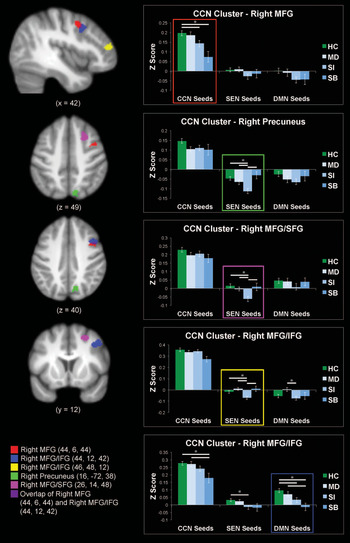
In the CCN seeds model, the main effect of group contrast yielded one cluster within the CCN mask that differed by group, and no clusters within either the SEN or DMN masks (Table 3; Fig. 1). This region was in the right middle frontal gyrus (MFG). Individuals with a history of SB had significantly less connectivity between this right MFG region and the CCN seeds than did either the MD group (p < 0.01) or the HC group (p = 0.001); the SB group had descriptively, but not significantly, less connectivity than the SI group (d = 0.56, p = 0.17; online Supplementary Table S1). The main effect of group contrast did not identify any regions within either the SEN or DMN masks in which groups differed in degree of connectivity to the CCN seeds.
Spatial maps of significant main effect contrasts, and extracted values within each contrast cluster plotted by group and by network seed model (error bars represent standard errors from the mean of each group within each contrast; colored boxes represent the model that was used to identify the cluster).

Regions of significant connectivity within three network models from main effect of group contrast comparing individuals with history of suicide-related behavior (SB), individuals with history of suicidal ideation only (SI), individuals with a mood disorder with no history of SI or SB (MD), and healthy comparison participants (HC), and masks for each of three networks

BA, Brodmann area. x, y, z = MNI (Montreal Neurological Institute) coordinates of significant peak effects.
We then evaluated cross-network connectivity by examining how groups differed in connectivity between these above two CCN clusters and each of the other two networks. Connectivity with the right MFG cluster did not differ between groups for the SEN seeds [F (3, 208) = 1.91, p = 0.13] or the DMN seeds [F (3, 208) = 1.99, p = 0.12].
Salience and emotional network seeds model
In the SEN seeds model, the main effect of group contrast identified three clusters in the CCN mask, and no clusters within either the SEN or the DMN masks (Table 3). The first region was in the right precuneus; individuals with SI had significantly less connectivity between this region and the SEN seeds than did the SB (p < 0.01), MD (p = 0.04), or HC (p < 0.001) groups; no other pairwise comparisons were significant (ps > 0.51). The second region was in the right middle/superior frontal gyrus (MFG/SFG); similarly, individuals with SI had significantly less connectivity between this region and the SEN seeds than did the SB (p = 0.04), MD (p = 0.01), or HC (p < 0.001) groups; no other pairwise comparisons were significant (ps > 0.69). The third region was in the right middle/inferior frontal gyrus (MFG/IFG); again, individuals with SI had significantly less connectivity between this region and the SEN seeds than did the SB (p = 0.03), MD (p = 0.001), or HC (p = 0.02) groups; no other pairwise comparisons were significant (ps > 0.49).
We then examined how groups differed in connectivity between these three regions and each of the other two networks. Connectivity with the CCN seeds did not differ between groups for the right precuneus cluster [F (2, 209) = 2.56, p = 0.06] or the right MFG/IFG cluster [F (2, 209) = 1.27, p = 0.29]. The right MFG/IFG cluster differed by group at a trend level [F (2, 209) = 2.21, p = 0.09], with the SB group demonstrating descriptively, but not significantly, less connectivity than each of the other groups from the right MFG/IFG to the CCN, consistent with a medium-to-large effect size (ds = 0.59–0.68; ps = 0.06–0.27). Connectivity with the DMN seeds differed for the right MFG/IFG cluster [F (2, 209) = 3.27, p = 0.02], such that individuals with a history of SI had significantly less connectivity with the DMN seeds than did the MD group (p = 0.02); no other pairwise comparisons were significant (ps > 0.08). Connectivity with the DMN seeds did not differ between groups for the right precuneus cluster [F (2, 209) = 1.36, p = 0.26] or the right MFG/SFG cluster [F (2, 209) = 0.89, p = 0.45].
Default mode network seeds model
In the DMN seeds model, the main effect of group contrast yielded one cluster within the CCN mask (right MFG/IFG) that differed by group (Table 3; Fig. 1), and no clusters within either the SEN or the DMN masks (Table 3). Individuals with SB had less connectivity between this right MFG/IFG region and the DMN seeds than did the MD group (p = 0.04) and HCs (p < 0.005), and had descriptively, but not significantly, less connectivity than the SI group consistent with a medium effect size (d = 0.43, p = 0.43). The SI group also had less connectivity than did the HC group (p = 0.01). Other pairwise comparisons were not significant (ps > 0.32).
We then examined how groups differed in connectivity between the right MFG/IFG region and each of the other two sets of network seeds. Connectivity between the right MFG/IFG and the CCN seed model differed significantly between groups [F (2, 209) = 3.41, p = 0.02]; individuals with SB exhibited significantly less connectivity than did the MD group (p = 0.04) and HCs (p = 0.02), and also had descriptively, but not significantly, less connectivity than the SI group consistent with a medium effect size (d = 0.45, p = 0.27).
Connectivity between this right MFG/IFG region and the SEN seed model did not differ significantly between groups [F (2, 209) = 1.91, p = 0.13].
Stability of group differences
Extracted data from the four regions in connectivity with the three network masks at Time 1 (12 variables) did not differ significantly at the second scan (ts < 1.64, ps > 0.10), providing evidence that network connectivity with these regions relevant to SB are stable over time (see online Supplementary Fig. S1). In addition, effect sizes of group differences (particularly those between SB relative to the other two groups) were similar at Time 2 relative to Time 1 (see online Supplementary Table S1).
Sensitivity and specificity of classification, and supplemental analyses
At a post-hoc level, prediction of group membership (using the seed-node connectivity values that differed between groups) was achieved with good accuracy (79–86%), sensitivity (80–87%), and sensitivity (78–88%) (Table 4). Prospective data were available for a subset of participants in the subsequent year (n = 7 SB, n = 97 MD; see online Supplementary Material); a greater proportion of individuals in the SB group (43%) had engaged in future SB or required a higher level of care than outpatient treatment (e.g. inpatient care), relative to individuals in the MD Group (5%). Additional analyses of site effects (which did not affect the predictive model) are included in online Supplementary Material.
Accuracy, sensitivity, and specificity of classification of group membership based on extracted data from main effect contrasts of regions of significant connectivity within the three network models at Time 1, and from these same regions at Time 2

SB, history of suicidal behavior; SI, history of suicidal ideation; MD, no suicidal behavior with mood disorder; HC, healthy comparison.
As prior studies have suggested that most individuals with mood disorders experience SI during depressive episodes (Nock et al., Reference Nock, Hwang, Sampson and Kessler2010), a set of alternate models collapsed the MD and SI groups into one group, and thus compared SB, MD (with or without SI), and HC groups (see online Supplementary Results).
Discussion
The aim of the present study was to use rs-fMRI to identify possible neural mechanisms underlying suicide risk in mood disorders, as defined by past SB (Valtonen et al., Reference Valtonen, Suominen, Mantere, Leppamaki, Arvilommi and Isometsa2006; Lewinsohn et al., Reference Lewinsohn, Rohde and Seeley1994; Brown et al., Reference Brown, Beck, Steer and Grisham2000). We identified intrinsic network connectivity with several right-lateralized brain regions that distinguished amongst individuals with past SB, individuals with a mood disorder with no past SB (some of whom had experienced SI), and healthy individuals. Intrinsic network connectivity effects were stable over time and identified group membership with good accuracy, sensitivity, and specificity. In addition, group differences in connectivity demonstrated some specificity to SB rather than to SI in general with moderate effect sizes, although larger sample sizes are needed in future studies to evaluate their significance. These results suggest that individuals with a mood disorder who have a history of an SB may have distinct, trait-like patterns of connectivity within and between intrinsic networks that facilitate cognitive control and self-focused thought. They also suggest that rs-fMRI might be a promising tool for identifying neural underpinnings of suicide risk in the context of a mood disorder.
We hypothesized that individuals with SB would show attenuated connectivity within the CCN relative to MD and HC groups. Consistent with this hypothesis, individuals with SB demonstrated less connectivity between the CCN seeds and the right MFG, a key region of the CCN, relative to individuals with a history of SI (a medium effect size), and relative to MD and HC groups (consistent with large effect sizes). This finding complements prior work showing attenuated connectivity within the CCN among individuals with active and remitted MDD (Kaiser et al., Reference Kaiser, Andrews-Hanna, Wager and Pizzagalli2015; Stange et al., Reference Stange, Bessette, Jenkins, Peters, Feldhaus, Crane, Ajilore, Jacobs, Watkins and Langenecker2017), in individuals at risk for depression (Clasen et al., Reference Clasen, Beevers, Mumford and Schnyer2014), and among those with SI (Ordaz et al., Reference Ordaz, Goyer, Ho, Singh and Gotlib2018), and extends these results to individuals with past SB. These results also are consistent with one previous analysis of individuals with SB outside of the context of a mood disorder, which found attenuated regional homogeneity in bilateral MFG relative to individuals without a history of SB (Cao et al., Reference Cao, Chen, Kuang, Ai, Fang, Gan, Wang, Chen, Xu, Wang and Lv2015). Attenuated connectivity between the CCN and the right MFG at rest may be indicative of disruptions in the neural circuitry supporting adaptive cognitive control (Stange et al., Reference Stange, Bessette, Jenkins, Peters, Feldhaus, Crane, Ajilore, Jacobs, Watkins and Langenecker2017). These impairments might interfere with the ability to divert attentional resources and prevent oneself from acting on impulsive or suicidal thoughts, hence conferring vulnerability to SBs.
Within the DMN seed model, a second CCN region within the right MFG was identified as differing between groups. In this analysis, individuals with an SB history showed less connectivity between this key cognitive control region and the DMN seeds, relative to the other groups (with effect sizes ranging from medium to large). Although speculative, one plausible explanation is that individuals with less MFG-to-DMN connectivity might be less able to engage CCN resources to flexibly disengage from negative self-focused thought. Given that the DMN is active during rest and during self-reflection such as rumination, and that the CCN facilitates cognitive control functions, individuals who have difficulty stopping themselves from ruminating while at rest might show less functional synchronization of these networks. As rumination is associated with risk for SI and suicide behavior (Rogers and Joiner, Reference Rogers and Joiner2017; Surrence et al., Reference Surrence, Miranda, Marroquín and Chan2009; Burke et al., Reference Burke, Connolly, Hamilton, Stange, Abramson and Alloy2016; Stange et al., Reference Stange, Hamilton, Burke, Kleiman, O'Garro-Moore, Seligman, Abramson and Alloy2015), future work might investigate whether disruptions in connectivity between these regions might lead to future suicidal behavior, with rumination as one candidate behavioral mechanism (Hamilton et al., Reference Hamilton, Furman, Chang, Thomason, Dennis and Gotlib2011). Indeed, in our data, individuals with SI and SB both demonstrated attenuated right MFG to DMN connectivity relative to HCs, although only SB differed from MD, suggesting that less connectivity between these regions is associated with greater likelihood of suicidal behavior (see Fig. 1).
In contrast, three CCN regions (right precuneus, MFG/IFG, and MFG/SFG) were identified in which individuals with a history of SI exhibited more negative connectivity with the SEN seeds, relative to each of the other three groups. It is not entirely clear why these differences would characterize individuals with SI, but not those with SB or those with a mood disorder without SI. It may be that individuals who only present with SI, but who do not progress to SB, have a different phenotype of mood disorder. The dorsal right IFG plays a prominent role in facilitating inhibitory control and ventral IFG is critical for reorienting attention to salient stimuli (Levy and Wagner, Reference Levy and Wagner2011; Sebastian et al., Reference Sebastian, Jung, Neuhoff, Wibral, Fox, Lieb, Fries, Eickhoff, Tüscher and Mobascher2016), and both subregions are involved with the successful regulation of distracting emotions (Dolcos et al., Reference Dolcos, Kragel, Wang and McCarthy2006). Prior work also has linked attenuated resting-state connectivity between the IFG and sgACC with higher levels of rumination in MDD (Connolly et al., Reference Connolly, Wu, Ho, Hoeft, Wolkowitz, Eisendrath, Frank, Hendren, Max, Paulus, Tapert, Banerjee, Simmons and Yang2013). Thus, a lack of connectivity between the clusters in the right IFG and SFG and the SEN might represent a tendency to be distracted by salient emotional stimuli in the internal or external environment, perhaps resulting in difficulty with flexibly adapting attentional control toward meeting long-term goals. For individuals with a mood disorder, deficits in the neural circuitry of inhibition and regulation such as these might also lead to thoughts about ways to escape distress, which could manifest as SI (Serafini et al., Reference Serafini, Pardini, Pompili, Girardi and Amore2016; Malhi et al., Reference Malhi, Bargh, Kuiper, Coulston and Das2013). Longitudinal studies are needed to examine these hypotheses. An alternative is that some individuals in the sample who have attempted suicide in the past might have developed protective or compensatory strategies that make them less likely to engage with thoughts of suicide, which potentially could lead to more normalized patterns of connectivity between these network regions. It is worth noting, however, that group differences between these CCN regions and the SEN seeds were attenuated at the second scan, as the SB group looked more similar to the SI group (online Supplementary Fig. S1, online Supplementary Table S1). Thus, this speculative interpretation of these group differences requires replication before further comment can be made.
It is promising that these analyses identified three clusters in which the SB group differed from the other two groups in connectivity within and across networks. However, these results highlight that more work needs to be done in identifying suicide risk above and beyond depression history and previous attempts. This is particularly true given that the sensitivity of the clusters identified for distinguishing between SB and SI groups was somewhat attenuated when participants were re-scanned at Time 2. This future work could include further refining our understanding of the neurobiology of suicide, but also should include examining interactions between biological factors and environmental contexts that may precipitate SI and suicide attempt (Kleiman and Nock, Reference Kleiman and Nock2018; Stange et al. Reference Stange, Kleiman, Mermelstein and Trull2019). In addition to examining the interactive influence with the environment, future studies could examine and replicate these specific connectivity patterns a priori, to validate the role of these regions in suicide risk.
Although there were numerous strengths of this study, such as the use of a remitted sample with individuals early in the course of illness, and being one of few studies to examine rs-fMRI among individuals with a history of SB, several limitations must be noted. First, the size of the SB group was small given that this was a secondary analysis of a study sample collected for other purposes (intended to assess individuals with remitted mood disorders), and not all individuals had full intent to die when they engaged in SBs; nevertheless, results appeared consistent in the subset of SB participants with intent to die (see online Supplementary Fig. S2). Future studies in this area may benefit from a more focused investigation on specific regions identified by studies such as the present one, which might reduce the likelihood of experiment-wise type I error. Independent replication and meta-analysis remain the most formidable tools to reduce type I errors, yet type II errors remain a concern. Moreover, future studies could specifically recruit SI–/SB–, SI+/SB–, and SI+/SB+ samples of equal size to better delineate neural features associated with prior report of SI v. SB. It is possible that some instances of lifetime SI were missed within the MD group, if individuals only experienced SI outside of the context of a depressive episode (as measured with the DIGS depression module). We only were able to prospectively evaluate future SI or SBs in a subset of those who were initially studied, and SB could have led to a greater degree of dropout. Future work should examine these specific patterns of network connectivity as possible vulnerability factors for SI and suicide behavior prospectively, in larger samples. Prospective studies of individuals who may be at risk but who do not have past SB are also called for, to better distinguish between ‘risk’ and ‘scarring’ effects of past attempts (Just et al., Reference Just, Abramson and Alloy2001).
Furthermore, we compared individuals during the remitted state of illness to evaluate potentially trait-like risk markers; although this represents a strength in that it minimizes the potentially confounding influence of current mood state, it is possible that different brain regions would distinguish between the groups when individuals are in an acute depressive episode (e.g. Brady et al., Reference Brady, Tandon, Masters, Margolis, Cohen, Keshavan and Öngür2017; Rey et al., Reference Rey, Piguet, Benders, Favre, Eickhoff, Aubry and Vuilleumier2016). Studying individuals who are in remission may have decreased the overall sensitivity of these analyses, as individuals with remitted mood disorders have relatively low profiles of current symptoms and suicidal thinking. Our aim was to study individuals early in the course of illness of mood disorders to reduce the effects of cumulative mood episodes, increasing age, and additional suicidal behavior (e.g. medical complications); however, the focus on adults under age 30 may limit the generalizability to older adult populations who potentially could show different patterns of connectivity. Although data from the network regions classified the SB group with good accuracy, sensitivity, and specificity, it is important to note that we did not use an independent sample to validate these regions and to account for possible biases in predictor selection. Thus, these results are viewed in the context of clarifying the degree and effect of predictors while accounting for potential shared variance, but should not be viewed as independent or corroborative (Bzdok and Yeo, Reference Bzdok and Yeo2017; Kriegeskorte et al., Reference Kriegeskorte, Simmons, Bellgowan and Baker2009). Finally, recent data have demonstrated that the use of 12-min resting-state scans can ascertain more reliable connectivity values (Birn et al., Reference Birn, Molloy, Patriat, Parker, Meier, Kirk, Nair, Meyerand and Prabhakaran2013).
The present study represents an initial step toward using rs-fMRI to identify neurobiologically-derived subgroups of individuals with mood disorders who may be at risk for suicide. By improving predictive models of suicide risk, this work – in combination with improved clinical assessment – may help us to better understand the mechanisms underlying suicide risk (Desmyter et al., Reference Desmyter, Bijttebier and van Heeringen2013; Fischer et al., Reference Fischer, Keller and Etkin2016), and to better identify those at highest risk.
Supplementary material
The supplementary material for this article can be found at https://doi.org/10.1017/S0033291719002356
Financial support
This work was supported by NIMH grant MH 091811 and MH 101487 (SAL), and UIC Clinical and Translational Science Awards Program NCATS UL1TR000050 and 1S10RR028898. Jonathan P. Stange was supported by grants 1K23MH112769-01A1 and 5T32MH067631-12 from NIMH.
Conflict of interest
None.