Introduction
Dementia challenges healthcare systems worldwide (Hurd et al., Reference Hurd, Martorell, Delavande, Mullen and Langa2013). Although dementia is primarily defined by cognitive disturbances, the so-called neuropsychiatric symptoms, such as wandering, night–day shift, disinhibition, aggression, and agitation, are among the most distressing symptoms for caregivers of patients with dementia. The frequency and severity of neuropsychiatric symptoms are major determinants for the transition of patients from home care to institutionalized care, and have been found associated with caregiver's well-being and morbidity (Sansoni et al., Reference Sansoni, Anderson, Varona and Varela2013), resource utilization and cost of care (Gustavsson et al., Reference Gustavsson, Cattelin and Jonsson2011; Lacey et al., Reference Lacey, Niecko, Leibman, Liu, Grundman and Group2013), and use of psychotropic medication (Rosenberg et al., Reference Rosenberg2012). The neuropsychiatric inventory (NPI; Cummings, Reference Cummings1997) is among the best established instruments for the quantification of severity and frequency of neuropsychiatric symptoms. The NPI has served as primary or secondary endpoint in clinical trials and has been employed across a large range of dementia severities and nosological diagnoses.
The majority of evaluations have been conducted in institutionalized care (Lai et al., Reference Lai, Yeung, Mok and Chi2009), specialized memory clinics (Gustavsson et al., Reference Gustavsson2010), or clinical trials (Zwijsen et al., Reference Zwijsen2014). Studies on the frequency and severity of neuropsychiatric symptoms as determined with the NPI in community dwelling people from primary care obtained during a home visit are still rare (Tatsch et al., Reference Tatsch2006).
Complementing previous evidence from institutionalized care, we aimed to determine the frequency and severity of neuropsychiatric symptoms in people screened positive for dementia living at home. We expected that in a primary care setting, increase in NPI score would be lower than in patients from specialized care as reported in the literature but similar to those obtained in community dwelling elderly patients through specialized outpatient units. As a secondary goal, we investigated potential risk factors and consequences of neuropsychiatric disturbances for both caregivers and individuals with suspected dementia in a sample from a primary care population. Data are still scarce on the prevalence, risk factors, and consequences of behavioral impairments in a primary care sample. Such data, however, will become relevant for the planning of future interventions into a healthcare system.
Participants and methods
Study design
The present analysis was conducted as part of the study “Life- and person-centered help in Mecklenburg-Western Pomerania, Germany” (DelpHi-MV), a general physician (GP)-based epidemiological cohort of people above the age of 70 years who live at home (Thyrian et al., Reference Thyrian2012). These people were screened for eligibility to participate in a trial of dementia care management. The DelpHi trial is a cluster-randomized, controlled intervention trial with two arms (intervention and control) designed to test the efficacy and efficiency of implementing a subsidiary support system for persons with dementia who live at home.
General physician practices participating in the DelpHi Study screen patients aged 70 years and older in their routine care using the DemTect (Kalbe et al., Reference Kalbe2004). In cases with DemTect < 9, indicating presence of cognitive impairment that would be indicative for dementia, the persons are eligible for the DelpHi Trial and are informed in detail about the trial and invited to participate in it. The trial has been discussed in detail and has been approved by the Ethical Committee of the Chamber of Physicians of Mecklenburg-Western Pomerania (registry number BB 20/11).
There is a systematic, computer-assisted, comprehensive assessment at the participants’ homes, with the individual screened positive for dementia and the caregiver being interviewed face-to-face by a trained nurse. Due to cognitive limitations and the amount of information assessed, the interviewers split the assessment into at least three home visits.
Participants
Enrolment into the study started on 1st January 2012 and is still ongoing. By 1st January 2014, 316 participants fulfilling the inclusion criteria for the study and providing written informed consent were included. Seventy persons dropped out before the data about the inclusion criteria for the NPI were obtained (of those participants, 30 withdraw their consent, in 10 cases the holders of the durable power of attorney of the patient withdraw the consent, 23 patients had died, 3 patients had moved, 4 patients had not further specified reasons) and 63 participants were not eligible for this analysis, since they could not provide a caregiver. In the sample fulfilling the eligibility criteria for conducting the NPI, in seven patients the NPI could not be conducted for various reasons (no time, psychological burden too high on the caregiver, etc.). This yielded a final sample of 176 dyads of patients screened positive for dementia and family caregivers.
Assessments
The DelpHi standard assessment comprises a variety of data about socio-demographics, health status, cognitive status, activities of daily living (ADL), pharmacotherapy, utilization of services, quality of life (QoL), and caregiver burden and distress (Thyrian et al., Reference Thyrian2012) using computerized data storage on a portable data management system (Eichler et al., Reference Eichler2014a).
From these assessments we selected the NPI (Cummings, Reference Cummings1997) as our primary endpoint. The NPI represents an interview by proxy on 12 dimensions of neuropsychiatric behaviors, i.e. delusions, hallucinations, agitation, dysphoria, anxiety, apathy, irritability, euphoria, disinhibition, aberrant motor behavior, nighttime behavior disturbances, and appetite and eating abnormalities. The severity and frequency of each neuropsychiatric symptom are rated on the basis of scripted questions administered to the patient's caregiver. A total NPI score is calculated as the product sum of the frequency by severity scores within each domain. The NPI also assesses the amount of caregiver distress engendered by each of the neuropsychiatric disorders, but the caregiver distress scores were not used in our analysis.
As independent variables, we selected the Mini-Mental State Examination (MMSE) as a measure of global cognitive performance (Folstein et al., Reference Folstein, Folstein and McHugh1975), presence of a formal diagnosis of dementia by GP (Eichler et al., Reference Eichler2014b), medication use as part of a comprehensive medication review (Fiss et al., Reference Fiss2013), and QoL as assessed with the QoL-AD score (Logsdon et al., Reference Logsdon, Gibbons, McCurry and Teri2002). The QoL-AD score was averaged across all 13 domains of physical health, energy, mood, living situation, memory, family, marriage, friends, self as a whole, ability to do chores around the house, and ability to do things for fun, money, and life as a whole. In addition, we used a sub-item of resource utilization in the dementia questionnaire scale (resource utilization in dementia or RUD; Wimo et al., Reference Wimo, Wetterholm, Mastey, Winblad, Wimo, Jonsson, Karlsson and Winblad1998). Within the DelpHi trial we only used the sub-items of the RUD focusing on the utilization of caregiver resources by patients. Therefore, only the items on supervising the patient and assisting in instrumental activities of daily living (IADL) and ADL were assessed in the study. In the present analysis, we only used the information on assisting patients in ADL and IADL (number of days within the last 30 days and hours per day) because time of supervision could not always be assessed reliably, with some caregivers reporting more than 24 hours per day supervision. These were excluded from further analyses, leaving 150 patients with valid RUD IADL and ADL assistance items.
The caregiver distress was assessed using the short version of the brief symptom inventory (BSI-18) that assesses three dimensions, i.e. depression, anxiety, and somatization, on six items each (Derogatis and Savitz, Reference Derogatis, Savitz and Maruish2000). We used the Global Severity Index (GSI) derived from the BSI-18 by averaging scores across items and dimensions.
Statistics
The NPI scores were binarized according to clinical relevance. NPL score ≤ 3 was considered clinically non-relevant, and NPL score ≥ 4 was considered clinically relevant (indicating a frequency of symptoms at least once a week and of moderate severity), analogous to previous studies (Lyketsos et al., Reference Lyketsos, Lopez, Jones, Fitzpatrick, Breitner and DeKosky2002; Aalten et al., Reference Aalten2007).
Analyses were conducted in the following three steps:
-
1. We determined potential predictors of higher NPI scores, including age, gender, and MMSE score as measures of global cognitive decline. We used a generalized mixed effects model with a logistic link function and a binomial distribution corresponding to a logistic regression using binarized NPI score as dependent variable, and GP as random effect cluster variable, where subject level observations were blocked within GPs (so that averaged NPI scores were allowed to vary between GPs). We compared the fit of this model with an extended model that included MMSE score as additional participants’ level random effects covariate (so that the effect of MMSE scores on NPI scores was allowed to vary between GPs). To test for overall level of significance, we used the total NPI score as binary dependent variable. If effects were significant for the binarized total NPI score, we determined follow-up models with each of the NPI subscores as dependent variables to determine the NPI subdomain that was associated with a significant overall effect. This procedure was based on the assumption that the high colinearity of NPI dimensions would render the Bonferroni correction for multiple comparisons too conservative. Age, gender, and MMSE score were forced into the model. Analyses were calculated using the procedure-generalized linear mixed models (proc glimmix) in SAS version 9.3.
-
2. We determined the effect of NPI score increase on patient- or caregiver-related outcomes, including RUD, QoL-AD, and total BSI scores, after controlling for MMSE score, age, and gender. These models used RUD, QoL-AD, and total BSI score respectively as continuous dependent variables, and GP as a random effect cluster variable, where subject level observations were blocked within GPs. The fit of these models was compared with the fit of extended models with additional participants’ level random effect covariates, as described for model (1) above. Analyses were calculated using the procedure mixed (proc mixed) in SAS version 9.3.
-
3. Associations between medication use and binarized NPI scores were determined using a random effects logistic regression, with medication use as independent predictor variable and the binarized total NPI score as dependent variable. Observations were blocked within GPs, which were treated as random effects variable. Analyses were calculated using proc glimmix in SAS version 9.3. For assessment of interaction with use of medication, we had a priori assumptions on expected associations of antipsychotics use with delusions and hallucinations, and antidepressants use with depression, sleep, and anxiety that were tested using multiple comparison correction with the Bonferroni–Holmes method if effects survived the uncorrected threshold of p < 0.05. In addition, we tested for a priori unexpected associations between antipsychotics use and the non-psychotic dimensions of the NPI score. These associations were tested at an uncorrected level of significance of p < 0.05 to control the type II error to erroneously reject an a priori unexpected effect.
Results
Participants’ characteristics
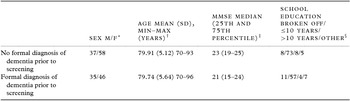
From 316 participants included into the DelpHi trial between 1st January 2012 and 1st January 2014, NPI scores were obtained for 176 patients – 104 women and 72 men. Cognitive impairment was present in all patients according to DemTect screening (a score below 9). Only 81 of the 176 patients had received a formal diagnosis of dementia from their GP. The patients receiving a formal diagnosis of dementia had no higher total NPI scores than the patients not receiving such a diagnosis after controlling for MMSE scores, age, and gender, and even if the effect of diagnosis on NPI scores was allowed to vary across GP offices (F 1 20 = 2.12, p = 0.16). Table 1 summarizes participants’ characteristics stratified to the presence or absence of a formal diagnosis of dementia prior to screening.
Participants’ characteristics

Notes: *Not different between groups, χ 2 = 0.33, 1df, p = 0.57.
†Not different between groups, t = 0.20, 174 df, p = 0.840.
‡Significantly different between groups, Mann–Whitney U test, p = 0.008.
§Not different between groups, χ 2 = 2.8, 3df, p = 0.42; data missing from three cases.
M/F: Male/female.
Frequency of high NPI scores
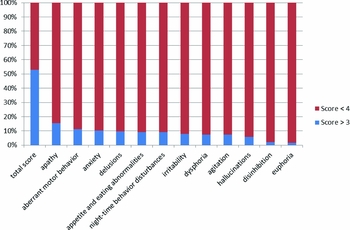
About 43.8% of the patients exhibited behavioral symptoms in at least one of the 12 NPI dimensions with a frequency of at least once a week and at least of moderate severity (NPI score ≥ 4). About 49% of these patients exhibited relevant behavioral symptoms in more than one dimension. Most frequently involved dimensions were apathy in 27 patients, aberrant motor behavior in 20 patients, anxiety in 18 patients, and delusions in 17 patients. About 52.8% of the participants had a total NPI score (12 items) ≥ 4 (Figure 1).
Frequency and severity of NPI total and subdomain scores. Percentage of patients with clinically relevant increases in NPI total and subdomain scores (blue), sorted according to decreasing prevalence. NPI scores were binarized where scores more than 3 were considered clinically significant; 100% corresponds to n = 176 patients.

Association with participant's characteristics
In the random effects logistic regression model, age and gender showed no significant effect on the binarized total NPI score, whereas the MMSE score showed a significant effect with an odds ratio of 0.91, F 1 114 = 9.8, p < 0.003, when averaged total NPI scores were allowed to vary across GPs as random effect covariate. Follow-up tests revealed that MMSE scores were associated with delusions, hallucinations, disinhibition, aberrant motor behavior, and appetite and eating abnormalities (p < 0.05 for all comparisons).
Association of NPI scores with patient- or caregiver-related outcomes
Table 2 shows the effects of total NPI scores on patient- or caregiver-related outcomes. The total NPI score showed a significant association with caregiver resource utilization (combined IADL and ADL subscales of the RUD questionnaire) when averaged RUD scores were allowed to vary across GPs as random effect covariates. When we included NPI scores as a random effect covariate blocked within GPs, the fit of the model was not altered. MMSE score showed an independent contribution on caregiver resource utilization subscores of the RUD questionnaire.
Total NPI score as predictor of patient- or caregiver-related outcomes

Notes: Statistical significance was tested using a mixed effect general linear model, with observations blocked within GP offices and total NPI score as second-level random effect covariate (see statistics section for more details), controlling for MMSE score, age, and gender.
RUD: Resource utilization in dementia IADL and ADL assistance items.
BSI-18: Brief symptom inventory.
NS: Not significant.
We found a significant association of the total NPI score with caregiver distress as assessed with the BSI-18. Adding a random effects term for the total NPI score did not improve the fit of the model, suggesting that the effect of NPI scores on BSI-18 did no significantly vary across GPs. Follow-up tests revealed that the overall effect was driven by the dimensions of agitation, apathy, irritability, aberrant motor behavior, anxiety, and appetite and eating changes (p < 0.05 for all comparisons).
There was no association of the total NPI score with QoL as assessed with the averaged QoL-AD questionnaire score (across all dimensions), after controlling for age, gender, and the MMSE score, neither in the random effects intercept nor the extended model with NPI score subjects’ level random effects covariate.
Medication use
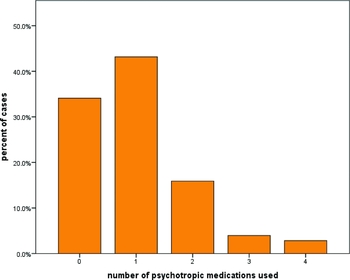
Almost 66% of the patients used at least one psychotropic medication (Figure 2). Twenty-four of the 176 patients used at least one antipsychotic drug, with 20 patients using atypical and eight patients using typical antipsychotics. Twenty-seven patients used at least one antidepressant drug, with 14 of those using a tricyclic antidepressant. Eleven patients used at least one sedative drug, with five of those using benzodiazepines. Twenty-four patients used at least one antiepileptic. Seventy-four patients used at least one antidementive drug, from these 36 patients used a choline-esterase inhibitor.
Frequency distribution of use of any psychotropic medication. Percentage of cases using none, one, two, three, or four psychotropic medications respectively; 100% corresponds to n = 176 patients.

Association between medication use and NPI scores
Overall, antipsychotics use was significantly associated with higher total NPI scores (F 1 121 = 5.74, p = 0.018). Contrary to expectations, use of antipsychotics was associated with anxiety (F 1 120 = 4.76, p = 0.03), apathy (F 1 121 = 6.79, p = 0.01), disinhibition (F 1 121 = 5.44, p = 0.02), and aberrant motor behavior (F 1 120 = 13.26, p = 0.0004). In contrast, overall antipsychotics use was not significantly associated with a clinically higher NPI scores in the dimensions of hallucinations or delusions even at a not-corrected level of significance.
Use of any antidepressant, sedative, antiepileptic, or antidementive drug or use of choline-esterase inhibitors was not associated with higher total NPI scores, even at an uncorrected level of significance of p < 0.05.
Discussion
As primary endpoint of our study, we investigated the frequency and severity of neuropsychiatric symptoms using the NPI in a sample of patients screened positive for dementia in primary care during home visits. The number of patients for whom an NPI score could not be obtained during a home visit due to formal reasons, such as absence of a family caregiver, and had been excluded was relatively low (seven out of 183 eligible patients). Our data suggest that assessment of NPI scores by a trained nurse during a home visit is a feasible approach to determine severity and frequency of neuropsychiatric symptoms in an elderly primary care cohort. NPI assessments during home visits have rarely been used before. A previous population-based study in Brazil had performed assessments during home visits but only used one question from the NPI (depression), and neither reported the exact qualification of the raters (“trained mental health professionals”) nor the number of eligible patients that could not be assessed (da Silva et al., Reference da Silva, Scazufca and Menezes2013).
We found the highest prevalence of higher NPI scores in the domains of apathy, delusions, anxiety, and aberrant motor behavior. These domains represent three of the four components of the factor structure that has been identified to underlie the 12 items of the NPI score (Hollingworth et al., Reference Hollingworth2006), i.e. behavioral dyscontrol (including aberrant motor behavior), psychosis (including delusions), and mood (including anxiety and apathy); in contrast the component of agitation (including irritability/emotional lability and agitation/aggression) has less frequently been reported in our sample. It needs to be studied in the longitudinal course of the DelpHi trial whether a higher expression of symptoms of agitation is associated with a higher likelihood to leave the community (for example, due to institutionalization) compared with the other three domains of behavior so that our community dwelling patients would represent a negative selection in respect of symptoms of agitation.
Overall, the frequency of neuropsychiatric symptoms was considerably lower than the frequency of these impairments previously reported in nursing home cohorts (for instance, Wetzels et al., Reference Wetzels, Zuidema, de Jonghe, Verhey and Koopmans2010). This agrees with a previous longitudinal study reporting a lower prevalence of neuropsychiatric symptoms at baseline in study participants that remained living at home compared with participants that had been institutionalized during one-year follow-up (Benoit et al., Reference Benoit2005). This is further consistent with the observation that more pronounced neuropsychiatric symptoms increase the likelihood of a person to enter into institutionalized care (Sansoni et al., Reference Sansoni, Anderson, Varona and Varela2013).
The prevalence of higher NPI scores was lower than in previous population-based studies (Lyketsos et al., Reference Lyketsos, Lopez, Jones, Fitzpatrick, Breitner and DeKosky2002; Tatsch et al., Reference Tatsch2006), with 53% in our study and 62 to 78% in the previous studies (Lyketsos et al., Reference Lyketsos, Lopez, Jones, Fitzpatrick, Breitner and DeKosky2002; Tatsch et al., Reference Tatsch2006). Several factors may account for this effect. First, one of the previous studies included patients living in nursing homes (Lyketsos et al., Reference Lyketsos, Lopez, Jones, Fitzpatrick, Breitner and DeKosky2002). Second, due to the design of our primary care intervention study, we could not establish a formal diagnosis of dementia in our patients. Instead, patients were included in the DemTect based on a score of 8 or lower. There were 17 patients with an MMSE score of 28 or higher during baseline assessment in our sample, rendering the likelihood for dementia as low in these patients. Although the absence of manifest dementia does not exclude the presence of neuropsychiatric symptoms, their frequency and severity in patients without dementia, including patients with mild cognitive impairment, is lower than in patients with dementia (Lyketsos et al., Reference Lyketsos, Lopez, Jones, Fitzpatrick, Breitner and DeKosky2002). In addition, one previous study counted the presence of any behavioral symptom to estimate the prevalence of behavioral impairments (Tatsch et al., Reference Tatsch2006), thus increasing the prevalence of NPI positive participants. This contrasts with this and previous studies (Lyketsos et al., Reference Lyketsos, Lopez, Jones, Fitzpatrick, Breitner and DeKosky2002; Aalten et al., Reference Aalten2007) that applied a cut-off before counting a reported symptom as clinically relevant.
We had access to formal diagnoses of dementia from the primary care physicians. However, previous evidence suggests that primary care physicians reach a sensitivity of below 50% to reach a diagnosis of dementia (Boustani et al., Reference Boustani2005). Consistent with these previous data, only 46% of patients screening positive for dementia in our study carried a formal diagnosis of dementia by their GP. The frequency of clinically relevant neuropsychiatric symptoms as assessed by the total NPI score was not significantly associated with a formal diagnosis of dementia by their GP in our study, suggesting that the presence of relevant neuropsychiatric symptoms may not be a relevant driver to reach a diagnosis of dementia in primary care.
As a secondary endpoint, we assessed association between higher NPI scores and patient- and caregiver-related variables. Generally, lower MMSE scores were associated with higher NPI scores. This agrees with the observation from previous studies that neuropsychiatric symptoms increase with the severity of dementia (Zuidema et al., Reference Zuidema, de Jonghe, Verhey and Koopmans2009). Against our expectation, NPI scores were not associated with the QoL of patients as assessed by the patients and their caregivers. Associations between QoL and NPI scores have been found in late-stage dementia in a small sample of patients (n = 31) with an atypically high prevalence of men (94%) (Benhabib et al., Reference Benhabib, Lanctot, Eryavec, Li and Herrmann2013). In mild to moderate Alzheimer's disease dementia, the NPI score was associated with proxy-reported and not with self-reported ratings of QoL (Karttunen et al., Reference Karttunen2011). This agrees with a previous study that showed an association of NPI scores at baseline with proxy-rated QoL over time, and not with self-rated change in QoL estimates (Tatsumi et al., Reference Tatsumi2009). Indeed, self- and proxy-rated estimates of QoL are only modestly associated in people with dementia (Buckley et al., Reference Buckley2012). Caregiver-related variables, such as caregiver depression and burden, can strongly influence their estimates of patient's QoL (Conde-Sala et al., Reference Conde-Sala2013), and may mediate the effect of neuropsychiatric symptoms on estimates of QoL. In addition, given the relatively low prevalence of neuropsychiatric symptoms in our sample, the absence of an effect does not preclude that with higher frequency and severity these symptoms become more relevant for the estimated QoL of patients with dementia.
We analyzed associations between NPI scores and resource utilization and distress of the caregiver. Both NPI score and degree of cognitive impairment were independently associated with resource utilization, in agreement with the proposed important role of neuropsychiatric symptoms for cost of care in dementia (Gustavsson et al., Reference Gustavsson, Cattelin and Jonsson2011). There was a significant overall effect of the total NPI score on distress of caregivers that was driven also by less prevalent neuropsychiatric domains such as irritability and agitation. Detailed analyses of specific associations of neuropsychiatric behaviors with caregiver's psychological symptoms are still rare so that our findings require independent replication.
Finally, we assessed association between medication use and NPI scores. Among all psychotropic medications, only antipsychotic use was associated with higher NPI scores. Against primary expectation that antipsychotic use would predominantly be associated with psychotic symptoms such as delusions and hallucinations, the effect was driven by aberrant motor behavior, disinhibition, apathy, and anxiety. National and international guidelines for the management of dementia as well as meta-analyses (Seitz et al., Reference Seitz2013) justify the use of antipsychotics only in the presence of severe psychotic symptoms and agitation. We had decided not to use the Bonferroni correction for testing associations between antipsychotics use and NPI domains that do not confirm with the guidelines. Thus, we reduced the type II error to erroneously reject the assumption that an antipsychotic use occurred against guidelines. Indeed, our findings agree with observational studies in institutionalized care that demonstrate antipsychotic medication use not only for psychotic symptoms but also for the treatment of aberrant motor behavior, disinhibition, anxiety, nighttime behavior, and irritability (Nobili et al., Reference Nobili2009).
There are limitations associated with our study. First, due to the design of our study we could not analyze patients with a clinical diagnosis of dementia but analyzed those that were screened positive for dementia. This sets an upper limit to the number of observable symptoms, i.e. it suggests that the frequency of neuropsychiatric symptoms in a primary care cohort of patients with dementia will be at least as high as in our cohort. Second, we had decided to binarize the presence of neuropsychiatric symptoms according to a certain threshold of severity and frequency at a score ≥4, similar to previous studies (Lyketsos et al., Reference Lyketsos, Lopez, Jones, Fitzpatrick, Breitner and DeKosky2002). Counting every symptom as relevant even if it occurs infrequently and with mild severity appears inadequate to clinical reality where only a minimum degree of symptomatology will trigger interventions in clinical care. If we would have chosen a more conservative threshold of 5 or higher, indicating a frequency of symptoms of at least once a week and high severity, or a frequency of symptoms of at least several times a week and at least moderate severity, then the prevalence of relevant symptoms would have been even smaller but the association with other variables would have prevailed. Third, we had used items of the RUD questionnaire to assess utilization of caregiver resources by patients, focusing on IADL and ADL assistance and supervision of patients. In 26 of the 176 patients, the caregivers reported more than 24 hours per day for supervising their patient, even after further inquiry by the interviewer. This is implausible in physical time but may reflect the felt burden of caregiver. We decided to exclude entirely such cases from the analysis of RUD scores. Our data question the validity of the supervision item of the original RUD questionnaire for application in primary care samples. Indeed, a recent update of the RUD questionnaire supports the need to “set an individual cap on the maximum number of hours per day and night that a caregiver should provide informal care” (Wimo et al., Reference Wimo, Gustavsson, Jonsson, Winblad, Hsu and Gannon2013). Fourth, each single of the 12 NPI items could have been assessed in more depth using domain-specific scales such as the Hamilton or Beck's Depression Scale for depression or the Cohan–Mansfield Agitation Inventory for agitation. However, in the context of a community dwelling setting with assessments being administered at individual's home by a trained nurse, the NPI has proven to be a feasible and reliable tool to comprehensively assess behavioral impairments within a reasonable timeframe.
We used a generalized mixed effect model to take clustering of observations within recruiting GP practices into account. This model allowed us to flexibly integrate the effect of both GP practice on mean levels of the dependent variable and variation in the effect of patients’ level predictors on the outcome variable across GP practices, assuming that the GP practices of our study represented a random selection of all GP practices. One has to note that the likelihood of a given GP practice to participate in the study may have been influenced by systematic factors that would render our sample of GP practices not a truly randomly drawn selection from the entire population of GP practices.
In summary, our data indicate that clinically relevant neuropsychiatric symptoms occur in 53% of the people screened positive for dementia in primary care. The prevalence of these symptoms was below that reported from nursing home samples, consistent with the notion that neuropsychiatric symptoms are a major determinant for the transition of patients from home to institutionalized care. Neuropsychiatric symptoms were associated with the severity of cognitive impairment, distress of caregivers, and utilization of caregiver resources by patients. In addition, consistent with observational clinical data, but in contrast to guideline recommendations, use of antipsychotics was predominantly associated with non-psychotic neuropsychiatric symptoms. From a clinical point of view these findings suggest that neuropsychiatric symptoms should actively be assessed in elderly patients suspected to suffer from cognitive decline. Our data indicate that this can also be reliably done in a primary care setting. Caregiver-centered interventions, such as caregiver education and support, may be the most promising approach with least side effects to treat such symptoms, given the strong association of higher NPI scores with caregiver distress and resource utilization and the discrepancy between guideline recommendations and observed medication use. The DelpHi trial is currently ongoing with a planned longitudinal follow-up over several years (Thyrian et al., Reference Thyrian2012). Here we plan in future to determine the impact of neuropsychiatric symptoms on costs of care and clinical outcome in people screened positive for dementia as well as the impact of caregiver-based intervention on clinical outcomes of patients and caregiver distress in primary care.
Conflict of interest
On behalf of all authors, the corresponding author states that there is no conflict of interest.
Description of authors’ roles
Stefan Teipel formulated the research questions, analyzed the data, and wrote the paper. Jochen René Thyrian designed and carried out the study, and was involved in drafting the paper and analyzing the data. Johannes Hertel was involved in drafting the paper and analyzing the data. Tilly Eichler and Ingo Kilimann were involved in designing and carrying out the study and drafting the paper. Diana Wucherer and Bernhard Michalowsky were involved in designing and carrying out the study. Wolfgang Hoffmann designed and carried out the study and supervised data collection.