




No CrossRef data available.
THE HIATUS AT TIKAL, GUATEMALA
Published online by Cambridge University Press: 11 July 2003
Abstract
Research on the Lowland Maya Hiatus that focuses solely on the inscriptions on monuments is too limited to provide information about its causes, nature, and consequences. I consider the hiatus at Tikal using additional evidence from architecture, settlement patterns, caches and burials, domestic artifacts, and inscriptions on portable objects. A preliminary conclusion is that Tikal's long hiatus can be regarded as part of a sequence of internal political development rather than due to conquest from outside. The displacement and destruction of inscribed and plain stone monuments was an ongoing phenomenon at Tikal. It was present from Terminal Preclassic times and occurred with increasing frequency until the beginning of the late Late Classic period. Monument destruction may have come to a halt then under a series of powerful rulers. The setting of inscribed stone monuments and wooden lintels continued for another two centuries until the disappearance of dynastic rule itself.
Information
- Type
- Research Article
- Information
- Copyright
- © 2003 Cambridge University Press
At several Southern Maya Lowland sites, a hiatus can be observed in the sequence of dates inscribed on monuments, including stationary or semi-portable stone stelae and altars, rock carvings, and lintels of stone and wood. The lowland Hiatus is usually placed in the last decades of the Early Classic period, between approximately 9.5.0.0.0 and 9.7.10.0.0 (ca. a.d. 534–583) in the Maya Long Count (Mathews 1985:25; Willey 1974).
Yet some lowland sites have gaps of different duration, which occur at other times; some sites do not have any important gaps in their records; and other sites may have more than one gap, depending on what is considered to be significant (Willey 1985:176). Therefore, “the Hiatus,” implying a uniform and universal event, is an outmoded term, although several important cities show hiatuses in their sequences of inscribed monuments.
Research into these hiatus periods tends to focus on inscriptions, and a gap in dates at one site is often interpreted according to the historical content recorded in contemporaneous texts found at other sites, especially records of interpolity warfare. For example, Naranjo's hiatus has been attributed to defeats by Caracol in a.d. 631 and a.d. 636 (Culbert 1991:136), Uaxactun's hiatus to subjugation by Tikal in a.d. 378 (Culbert 1991:137), and Tikal's hiatus to its defeat by Caracol in a.d. 562 (Chase and Chase 1987:33, 60–61, 93; Haviland 1992; Jones 1991:117). Hiatuses have also been linked to the disappearance of the Teotihuacan Horizon style toward the end of the Early Classic period (Willey 1974, although modified in Willey 1985:176).
However, the archaeological evidence indicates that some of the gaps could be fortuitous and dependent on the state of preservation of inscribed monuments and the extent of investigation at particular sites. At Tikal, for example, nearly all of the inscribed Early Classic stone monuments were deliberately damaged and displaced, in contrast to those of the Late Classic period (Jones 1991:117). Excavations in the city's epicenter recovered scattered pieces of known inscribed stone monuments, as well as dozens of carved fragments pertaining to unknown monuments. New carved stones are still coming to light, such as the surprising discovery in 1996 of an incomplete, late Early Classic monument, Stela 40, in what is considered to be the well-investigated core of the city, Group 5D-2, the North Acropolis-Great Plaza area (Valdés and Fahsen 1998:71).
Nearly all of the current hypotheses about the causes and nature of site hiatuses derive from the contents of the inscriptions. The excitement of finally being able to decipher some of the texts inclines us to accept them as true reports of historical events, rather than encouraging a synthesis of epigraphic and archaeological data. A better understanding of site hiatuses requires a consideration of other material evidence, such as monumental construction, burials and caches, and portable material culture, not just elite status markers but also everyday pottery and artifacts.
In this paper I present a brief review of the archaeological evidence bearing on Tikal's hiatus, which suggests that it was due more to internal developments than to external causes. T. Patrick Culbert's (1993) ceramic studies provide an essential contribution to the available data and to site chronology. His sequence of ceramic complexes enables a diachronic ordering of material evidence where dates from the Maya and other sources are absent.
DEFINING TIKAL'S HIATUS
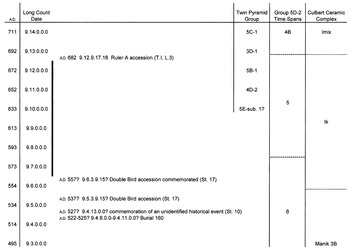
The hiatus at Tikal refers to a gap of 125 years in the dates inscribed on currently known monuments. It extends from 9.6.3.9.15 (a.d. 557), the latest date inscribed on Stela 17, to 9.12.9.17.16 (a.d. 682), the earliest date on Lintel 3 of Structure 5D-1, Great Temple I (Haviland 1992; Jones and Satterthwaite 1982) (Figure 1). Stela 17 records the accession of the ruler nicknamed Double Bird, and Lintel 3 records the accession of the ruler variously referred to as Ruler A, Ah Cacau, and Hasaw Chan K'awil (Haviland 1992).

Chronology of Tikal's hiatus period.
The date ending the hiatus was found in situ and has historical meaning. This inscription simultaneously begins a sequence of dates recorded on monuments that extends throughout the late Late Classic period. In contrast, the date beginning the hiatus appears fortuitous. Its source, Stela 17, was broken and removed from its original location, and its discovery was accidental.
Only two of the 30 inscribed Early Classic stelae now known, Stelae 9 and 10, were thought to be in their original positions when they were discovered (Jones and Satterthwaite 1982:23, 25, Table 3). However, nine of the ten known inscribed Late Classic stelae were regarded as still being in situ, although some of them have also suffered damage.
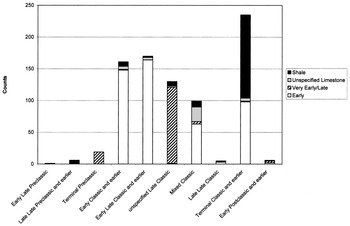
Tikal's inscribed monuments of stone and wood define its hiatus, but additional information comes from a large collection of inscribed and plain stone stela and altar fragments, which were designated Miscellaneous Stones. Miscellaneous Stones were identified by various criteria, such as the kind of stone used, the presence of carvings and glyphs, and general morphology. Four kinds of stone are present among our sample: soft, bedded limestone used for both Preclassic and Late Classic monuments; hard, somewhat porous limestone used during the Early Classic period; shale used sporadically from Preclassic into Late Classic times; and unspecified limestone (Figure 2). Christopher Jones and Linton Satterthwaite (1982:96–96, Figures 63–68) published 166 numbered Miscellaneous Stones (not all of which pertain to monuments), some of which subsume several fragments. In addition to the numbered series, many small inscribed and plain fragments were recovered from the excavations, bringing the total to approximately 871 pieces.

Distribution of Miscellaneous Stones by material and date, excluding 39 undated examples.
The trends indicated by the spatial and temporal distributions of Miscellaneous Stones must be regarded as approximate, because we can present them only in terms of raw counts rather than in standard units such as weight, excavated volume, or area. Nevertheless, their distributions are of interest. Nearly 80% of the Miscellaneous Stones came from Tikal's epicenter, mostly from Group 5D-2. The recovery contexts of nearly all of the Miscellaneous Stones could be dated by the associated ceramics (Figure 2). These dates, in fact, suggest a long sequence of monument displacement and destruction. The earliest episode was during the Terminal Preclassic period, indicated by the recovery from good stratigraphic contexts of a few fragments of Very Early/Late limestone and shale carved in Preclassic style (Jones and Satterthwaite 1982:Figures 64t, z-ff, 65i, q). Destruction of monuments primarily of Early limestone occurred with increasing frequency throughout the Early Classic period (Jones and Satterthwaite 1982:117) and into the following early Late Classic, the time of Tikal's hiatus. Smaller quantities of Late limestone pieces occur during the early Late to late Late Classic transition period. Only five monument fragments, three of Early limestone and two of shale, were recovered from post-hiatus, late Late Classic contexts.
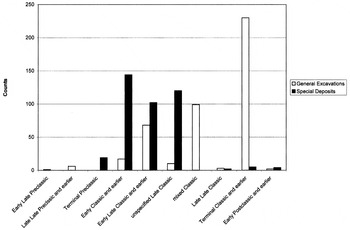
From the Terminal Preclassic through the early Late Classic periods, about two-thirds of the Miscellaneous Stones (n = 387) came from special deposits, most from structure and monument caches (Figure 3). However, nearly 27% of the entire sample (n = 235) dates to the Terminal Classic period. In contrast to Classic times, these fragments come almost exclusively from general excavations that included Terminal Classic ceramics mixed with earlier Classic material, while only five came from special deposits of problematical function. Virtually all of the Terminal Classic sample was of shale and Early stone. Only one fragment was identified as of Late limestone, which is consistent with the larger proportion of surviving Late stone monuments. William R. Coe (1990:872) links this final burst of monument destruction to the widespread looting of caches and burials during the Terminal Classic period.

Recovery contexts of Miscellaneous Stones by date, excluding 39 undated examples.
While the sequence of dates on individual inscribed stelae and lintels shows a gap of more than a century during the late Early Classic and early Late Classic periods, many stone monument fragments indicate that monument displacement and destruction was a persistent phenomenon from Terminal Preclassic to late Late Classic times, with a final and largest episode during the Terminal Classic period.
TIKAL BEFORE, DURING, AND AFTER ITS HIATUS
Several kinds of information suggest that Tikal's hiatus encompasses two phases. The boundary between these phases is admittedly fuzzy because of a problem in reconciling the estimated dates of approximately a.d. 550 for the transition from the Early Classic Manik ceramic complex to the Early Late Classic Ik ceramic complex (Culbert 1993:Table 1) (Figure 1) with the latest date of a.d. 557 inscribed on Stela 17, which was carved of the hard limestone used for Early Classic-period monuments. The first phase, which lasted from approximately a.d. 557 to 593, occurred during the latter part of Time Span 6 of Group 5D-2 (Coe 1990:838–840, Chart 1). The second phase lasted from approximately a.d. 593 to 682, Time Span 5 of Group 5D-2, Coe's Intermediate Classic period, which is equivalent to the early Late Classic period.
The first phase is marked by an absence of royal chamber burials and a lull in building in the monumental civic and ceremonial heart of the city, Group 5D-2 (Coe 1990:839). The only major project was the construction of the final version of the temple, Structure 5D-22-1, around the time of Double Bird's accession (Coe 1990:Chart 1). Tikal's population maximum may have been reached during the early part of the hiatus (William Haviland, personal communication, 1999).
An important burial in the Central area of Tikal, 1.4 km southeast of Group 5D-2, suggests important political changes shortly before the hiatus. The pottery in vogue during much of Time Span 6 of Group 5D-2 consists of the Late Facet of Culbert's Manik Ceramic Complex (Culbert 1993:Table 1), often referred to as Manik 3B (Coggins 1975; Puleston 1979:Figure 5.1), which postdates the Teotihuacan Horizon styles characteristic of Manik 3A. Manik 3B pottery, defined from mortuary assemblages (T. Patrick Culbert, personal communication, 2002), was in use between approximately 9.1.10.0.0 and 9.6.0.0.0 (ca. a.d. 485–554). The only chamber burial, or “tomb,” known from Tikal that includes Manik 3B ceramics is Burial 160. Although the large grave and rich offerings of Burial 160 would not be out of place in Group 5D-2, this chamber burial was actually found in an elite residential-structure group, Group 7F-1 (Haviland 1981:105–107). When considered together with evidence from ceramics, cached offerings, and architectural stratigraphy, an incomplete and ambiguous hieroglyphic date painted on the wall of the chamber suggests that Burial 160 was made between 9.4.8.0.0 and 9.4.11.0.0 (a.d. 522 and a.d. 525) (William Haviland, personal communication, 2000). Group 7F-1 also possessed an incomplete, carved monument, Stela 23, which has a dedicatory date of 9.4.3.0.0.0? (ca. a.d. 517?) (Jones and Satterthwaite 1982:50–51). Stratigraphic associations, however, indicate that the stela was reset during the late Late Classic period and that its offering was redeposited (Coe and Broman 1958:27, 44–45), so we cannot be absolutely certain that Stela 23 was originally erected in Group 7F-1. If the subject of Burial 160 was indeed a ruler, then the location of his tomb at such a distance from Group 5D-2 would be indicative of important pre-hiatus political developments.
In contrast to the earlier hiatus phase, the later one, which lasted almost 90 years, was a time of extensive construction in Group 5D-2, as well as a period of innovation in many aspects of Tikal's material culture. Over the course of the next century of the early Late Classic period, several temples in Group 5D-2 were newly built or enlarged and four richly furnished chamber burials, Burials 200, 195, 24, and 23, in chronological order (Coe 1990:Chart 1), were installed.
Two important architectural innovations that carried through to the end of the Classic period may date to this time. One is the Great Temple form for which Tikal is famous. The earliest of this group now appears to be Structure 5D-5, Great Temple V. Excavations by the Proyecto Nacional de Tikal suggest that this massive building was constructed in one stage approximately a.d. 600 ± 50 (Gómez 1999:193). In the heart of its substructure was an offering of pottery censers belonging to the Early Tulix Complex, which is contemporary with Culbert's early Late Classic Ik Ceramic Complex (Ferree 1972:99).
The other architectural innovation of this time may be the Twin Pyramid Group, depending on the dating of the remnants of such a group found under the ballcourt in Group 5D-3 (Haviland 1992). Twin Pyramid Groups are integrated assemblages of architecture and stone monuments comprising a southern range structure, a northern stela enclosure, twin eastern and western stepped pyramids, and several pairs of stone stelae and altars. One stela–altar pair is set in the northern enclosure, and a variable number of pairs, always plain, are aligned in front of the eastern pyramid (Jones 1969). Among the nine groups defined, five of the six northern stelae in the late Late Classic groups have inscribed dates indicating that Twin Pyramid Groups were erected to celebrate the endings of katuns, a period of 20 Maya years.
Two, probably three, Twin Pyramid Groups were built during the hiatus period and commemorate the katun endings of 9.11.0.0.0 (a.d. 652) and 9.12.0.0.0 (a.d. 672), and perhaps 9.10.0.0.0 (a.d. 633) (Jones 1969). All of the surviving stone monuments are plain. All of these early Late Classic assemblages were later dismantled, and only the late Late Classic complexes built after 9.13.0.0.0 are still relatively intact. No stone monuments of any kind are now associated with the earliest group. A northern stela with a cached offering and a stela from the eastern row remain from the 9.11.0.0.0 group. In the 9.12.0.0.0 group, three stelae and two altars survive in the eastern row, in addition to the northern stela, which was paired with an altar. Three cached offerings were found in this group, one with the northern stela and two with the eastern ones. These early Twin Pyramid Groups are significant because they demonstrate that the long-established tradition of erecting plain stone monuments with associated caches was carried over into a time from which no inscribed monuments have been identified.
Considerable emphasis continued to be placed on the caches placed with temples, and they contain larger quantities of more diverse durable offerings than caches placed with stelae. There was a generous use of imported stone for chert and obsidian eccentrics, some of which are the largest and finest examples known from Tikal. Fine-quality, imported chert usually reserved for bifacial knives and projectile points was now frequently used for eccentrics. Incised obsidians, a Tikal innovation, appeared at this time. What is noteworthy is that these lithics of strictly ceremonial function were made on pieces of imported stone large enough to have been used for utilitarian artifacts. This contrasts with Early Classic eccentrics, which were made of locally available chert or fashioned from exhausted obsidian prismatic blade cores. There was a notable increase in unworked materials of marine origin, including shells and other invertebrates, such as corals and sponges, and spiky elements, such as stingray and porcupine fish spines, generally assumed to have been used as bloodletters (Maxwell 1996:201–289).
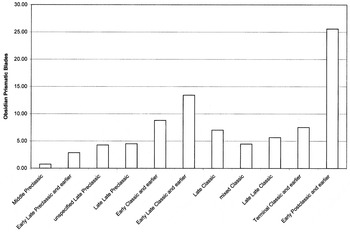
Flourishing regional and long-distance exchange is attested not only by materials in caches and burial offerings, but also by domestic artifacts used by everyone. It is hard to quantify the general level of prosperity, because excavations were not conducted randomly throughout the site; nor was material culture consistently recorded in standard units. However, a comparison of the occurrence over time of two domestic lithic artifact types, expediently made scrapers of local chert and specialist-produced prismatic blades of exotic obsidian, is suggestive (Figure 4). Craft specialists' access to imported material and commoners' access to artifacts made by specialists indicates that the level of prosperity of the population in the Epicentral and Central areas of the city peaked during the latter part of the hiatus. The apparent rise in the ratio of obsidian blades to chert scrapers after the end of the Late Classic period may be due to a considerably smaller sample from fewer recovery contexts.

Ratios of obsidian prismatic blades (n = 8,019) to chert scrapers (n = 1,135) by date.
The Ik ceramic complex (Culbert 1993) was in vogue during the second part of the hiatus period. The display pottery is characterized by simple forms decorated with beautifully painted and incised decorative motifs, including the longest hieroglyphic inscriptions on pottery known from either earlier or later periods. Some vessels are decorated with nothing but functional and pseudo glyphs (Culbert 1993:Figures 39–41, 45–47, 49a2). The occurrence of long inscriptions on pottery vessels at this time hardly seems coincidental. Of special interest are two pottery plates found in Burial 195, the grave of the Tikal ruler, Animal Skull (Haviland 1992), and the second chamber burial to be constructed in Group 5D-2 during Tikal's hiatus. The glyphs painted on these two vessels give the kind of dynastic information that occurs on carved stone monuments (Culbert 1993:Figures 50e, 51). Perhaps in this way Animal Skull hoped to insure its survival.
The accession in a.d. 682 of Ruler A ended Tikal's hiatus and began the late Late Classic period. After that, for almost two centuries until the end of the Classic period, inscribed monuments were erected at frequent intervals with gaps no longer than 20 years (Jones and Satterthwaite 1982:Table 5). This Late series of carved monuments was not subjected to the extensive dislocation and destruction inflicted on earlier ones (Jones 1991:117), not even during the great, final episode of the Terminal Classic period.
Strong, even autocratic, rule is indicated by other developments, as well. The late Late Classic period was a time of large-scale public building projects of various kinds, splendid chamber burials, and numerous in situ carved monuments and lintels. The six post-hiatus Twin Pyramid Groups mark the katun endings 9.13.0.0.0 (a.d. 692) through 9.18.0.0.0 (a.d. 780). In all but the group commemorating 9.15.0.0.0 (a.d. 731), the northernmost stela bears a portrait of the ruler of the time as well as the date of the katun, suggesting a shift of emphasis onto the person of the ruler. Less emphasis is placed on monument and structure caches during the course of the late Late Classic. However, the two latest, undisturbed chamber burials from Group 5D-2, Burial 116 and Burial 196, are the richest known, filled with many kinds of beautiful and labor-intensive durable goods (Coe 1990:604–609, 641–646).
The late Late Classic is the time of the Imix ceramic complex. A common motif on Imix figure-painted display vessels is the unsubtle image of an enthroned ruler receiving homage and gifts from subordinates (Culbert 1993:Figures 68–70, 72, 84). Although the quality of craftsmanship remains high, there is little of the innovation in domestic and ritual artifacts that characterized the later hiatus period.
Among domestic goods, the ratio of obsidian prismatic blades to chert scrapers decreases, suggesting a dip in general prosperity. The overall population of the city may have declined somewhat, as well.
SUMMARY AND CONCLUSIONS
Rather than attributing them to particular victories and defeats, obsolescence, or simply poor preservation, hiatuses in the southern Maya Lowlands could be regarded as indicators of political disorganization and subsequent reactions to it (Haviland 1992; Jones 1991). Carved Maya monuments display the portraits, genealogies, life crisis events, and heroic deeds of specific individuals. They were regarded as symbolic substitutes for the persons and offices they depicted, a tradition as old as state society itself and still flourishing in our own day. This symbolic connection is so strong that when rulers are overthrown, their monuments usually have the same fate. I cannot exclude the suggestions that some monument destruction was due to respectful termination or to raids in the course of interpolity warfare. However, a consideration of both the archaeological and epigraphic evidence from Tikal suggests that intense factionalism within the city's ruling class may well have been a more important cause. The spatial and chronological distributions of Miscellaneous Stones suggest that the destruction and dislocation of monuments began as early as the Terminal Preclassic period and increased in intensity through the Early Classic, culminating during the hiatus of approximately a.d. 557–682. The Early Classic period seems to have ended in disorder under a series of weak rulers, none of whom was able to hold power for long.
The political situation appears to have been partly stabilized around a.d. 600. Elite ceremonial activities resumed the importance they had held during the Early Classic period, although the absence of inscribed stone monuments and plentiful fragments in the excavations indicate that internal strife was still constant and vigorous. Chamber burials were once again made in Group 5D-2, and public construction was resumed there. The portable material culture of the hiatus period, particularly cached offerings, demonstrates that the elite continued to have access to exotic materials and artifacts used for ritual and display.
The city's population as a whole may have attained its highest level of prosperity. The changes in archaeologically observable elite behavior and commoner prosperity during the early Late Classic period conform well to the presence of factionalism among the elite, which often eases the demands made on commoners (Brumfiel 1994:8). The long inscriptions on pottery vessels show that rulers were also recording information about their genealogies and exploits on media less vulnerable than stone monuments. Monument destruction may have come to a halt during the late Late Classic period, whose autocratic rulers were profusely glorified on monuments of stone and wood, but it resumed on a greater scale than ever during the Terminal Classic.
The coexistence of a high degree of material prosperity with a hiatus in dates inscribed on monuments at one important Lowland Maya city, Tikal, provides interesting perspectives on a number of subjects, such as the nature of ruler succession, factionalism, the political and economic interrelationship between the ruler and his subjects, the actual consequences of Maya warfare, the veracity of Maya historical inscriptions, and the ways in which epigraphic and archaeological information can enhance each other. It would now be of considerable interest to see what was going on at other Lowland Maya sites during their hiatus periods.
El estudio del hiato o interrupción en las tierras bajas mayas utilizando solamente inscripciones sobre monumentos es demasiado limitado para proveer información sobre su origen, naturaleza, y consecuencias. En este trabajo he investigado el hiato de Tikal utilizando como evidencias los datos de la arquitectura, ofrendas y entierros, artefactos cotidianos e inscripciones sobre objetos portátiles.
Concluyo que el hiato de Tikal puede ser una parte de un desarrollo político a largo plazo, en lugar de una conquista desde afuera. El desarreglo y destrucción de monumentos inscritos y lisos era un fenómeno continuo desde fines del período preclásico hasta los principios del clásico tardío terminal. La destrucción de monumentos cesó durante los reinados de gobernantes podorosos del clásico tardío terminal. La elevación de monumentos inscritos de piedra y madera continuó hasta la desaparición de los reyes de Tikal mismos.
ACKNOWLEDGMENTS
I thank Liz Brumfiel, William A. Haviland, Christopher Jones, and especially Arlen F. Chase for their valuable comments on earlier versions of this paper, and K. Anne Pyburn for the invitation to participate in the Culbert Festival of 1999. Elizabeth and Dante Sobrevilla generously provided essential help with the Spanish summary.
References
REFERENCES
Brumfiel, Elizabeth M.
1994
Factional Competition and Political Development in the New World:
An Introduction. In
Factional Competition and Political Development in the New World,
edited by
Elizabeth M. Brumfiel and
John W. Fox, pp.
3–13.
Cambridge University Press,
Cambridge.
Chase, Arlen F., and
Diane Z. Chase
1987
Investigations at the Classic Maya City of Caracol, Belize:
1985–1987.
Monograph 3.
Pre-Columbian Art Research Institute,
San Francisco.
Coe, William R.
1990
Excavations in the Great Plaza, North Terrace and North Acropolis
of Tikal.
Tikal Report 14.
University Museum, University of Pennsylvania,
Philadelphia.
Coe, William R., and
Vivian L. Broman
1958
Excavations in the Stela 23 Group.
Tikal Report 3.
University Museum, University of Pennsylvania,
Philadelphia.
Coggins, Clemency C.
1975
Painting and Drawing Styles at Tikal: An Historical and
Iconographic Reconstruction.
Ph.D. dissertation,
Department of Fine Arts, Harvard University,
Cambridge, MA.
Culbert, T. Patrick
1991
Polities in the Northeast Petén, Guatemala. In
Classic Maya Political History: Hieroglyphic and Archaeological
Evidence, edited by
T. Patrick Culbert, pp.
128–146.
Cambridge University Press,
Cambridge.
Culbert, T. Patrick
1993
The Ceramics of Tikal: Vessels from the Burials, Caches, and
Problematical Deposits.
Tikal Report 25, Part A.
University Museum, University of Pennsylvania,
Philadelphia.
Ferree, Lisa
1972
The Pottery Censers of Tikal, Guatemala.
Ph.D. dissertation, Department of Anthropology, Southern Illinois University, Carbondale.
University Microfilms International,
Ann Arbor, MI.
Gómez, Oswaldo
1999
Excavaciones en el interior del Templo V, Tikal. In
XII Simposio de Investigaciones Arqueológicas en Guatemala
1998, edited by
Juan Pedro Laporte,
Héctor L. Escobedo, and
Ana Claudia Monzón de
Suasnávar, pp.
187–194.
Ministerio de Cultura y Deportes, Instituto de Antropología e
Historia, Asociación Tikal,
Guatemala.
Haviland, William A.
1981
Dower Houses and Minor Centers at Tikal, Guatemala: An
Investigation into the Identification of Valid Units in Settlement
Hierarchies. In
Lowland Maya Settlement Patterns, edited by
Wendy Ashmore, pp.
89–117.
University of New Mexico Press,
Albuquerque.
Haviland, William A.
1992
From Double Bird to Ah Cacao: Dynastic Troubles and the Cycle of
Katuns at Tikal, Guatemala. In
New Theories on the Ancient Maya, edited by
Elin C. Danien and
Robert J. Sharer, pp.
71–80.
University Museum, University of Pennsylvania,
Philadelphia.
Jones, Christopher
1969
The Twin-Pyramid Group Pattern: A Classic Maya Architectural
Assemblage at Tikal, Guatemala.
Ph.D. dissertation, Department of Anthropology, University of Pennsylvania.
University Microfilms International,
Ann Arbor, MI.
Jones, Christopher
1991
Cycles of Growth at Tikal. In
Classic Maya Political History: Hieroglyphic and Archaeological
Evidence, edited by
T. Patrick Culbert, pp.
102–127.
Cambridge University Press,
Cambridge.
Jones, Christopher, and
Linton Satterthwaite
1982
The Monuments and Inscriptions of Tikal: The Carved Monuments. Tikal Report 33, Part A.
University Museum, University of Pennsylvania,
Philadelphia.
Mathews, Peter
1985
Maya Early Classic Monuments and Inscriptions. In
A Consideration of the Early Classic Period in the Maya Lowlands,
edited by
Gordon R. Willey and
Peter Mathews, pp.
5–54.
Institute for Mesoamerican Studies, Publication No. 10.
State University of New York,
Albany.
Maxwell, David Bruce Saxon
1996
An Analysis of Caches from Four Sites in the Maya Lowlands.
Ph.D. dissertation, Department of Anthropology, University of Arizona,
Tucson.
University Microfilms International,
Ann Arbor, MI.
Puleston, Dennis E.
1979
An Epistemological Pathology and the Collapse, or Why the Maya
Kept the Short Count. In
Maya Archaeology and Ethnohistory, edited by
Norman Hammond and
Gordon R. Willey, pp.
63–71.
University of Texas Press,
Austin.
Valdés, Juan Antonio, and
Federico Fahsen
1998
Interpretación de la Estela 40 de Tikal. In
XI Simposio de Investigaciones Arqueológicas en Guatemala
1997, edited by
Juan Pedro Laporte and
Héctor L. Escobedo, pp.
71–86.
Ministerio de Cultura y Deportes, Instituto de Antropología e
Historia, Asociación Tikal,
Guatemala.
Willey, Gordon R.
1974
The Classic Maya Hiatus: A “Rehearsal” for the
Collapse? In
Mesoamerican Archaeology: New Approaches, edited by
Norman Hammond, pp.
417–430.
University of Texas Press,
Austin.
Willey, Gordon R.
1985
The Early Classic Period in the Maya Lowlands: An Overview. In
A Consideration of the Early Classic Period in the Maya Lowlands,
edited by
Gordon R. Willey and
Peter Mathews, pp.
175–184.
Institute for Mesoamerican Studies, Publication No. 10.
State University of New York,
Albany.
Chronology of Tikal's hiatus period.
Distribution of Miscellaneous Stones by material and date, excluding 39 undated examples.
Recovery contexts of Miscellaneous Stones by date, excluding 39 undated examples.
Ratios of obsidian prismatic blades (n = 8,019) to chert scrapers (n = 1,135) by date.
 You have
Access
- 12
- Cited by