Introduction
Swimmer's itch (SI), also named cercarial dermatitis, is an allergic skin response which usually develops as a consequence of repeated infection by the larvae (cercariae) of bird schistosomes of the trematode family Schistosomatidae, which are able to localize and penetrate the skin of birds and mammals. Morphologically, the larval stages are characterized as ocellate furcocercariae (cercariae with pigmented eye spots and a long tail stem with furca) which develop in various species of water snails. Depending on the species of parasite, the adult worms locate either in the visceral organs or in the nasal area of their final hosts. In humans, maculopapular eruptions form within a few hours on the parts of the body that had been exposed to cercarial-infected water. Usually, the skin eruptions persist for 1 or 2 weeks and are accompanied by intense itching, but occasionally also by fever and enlarged lymph nodes. Mammals, including humans, are not permissive final hosts for bird schistosomes, so the parasites die at various intervals post-infection, although there is growing concern that pathology may occur from migrating larvae (Horák et al., Reference Horák, Kolářová and Adema2002; Kouřilová et al., Reference Kouřilová, Syrucek and Kolářová2004). In the past two decades a few research laboratories have begun to focus on bird schistosomes and cercarial dermatitis, and since then a number of research papers and reviews have been published (e.g. Horák et al., Reference Horák, Kolářová and Adema2002; Horák & Kolářová, 2005; for a review see Kolářová, Reference Kolářová2007).
Bird schistosomes and cases of SI occur worldwide. Local epidemics are regularly reported and it has been suggested that SI be designated an emerging disease (de Gentile et al., Reference de Gentile, Picot, Bourdeau, Bardet, Kerjan, Piriou, Le Guennic, Bayssade-Dufour, Chabasse and Mott1996). In Iceland, SI was first confirmed in 1997 when hundreds of children were affected after wading in a shallow, artificial pond in Reykjavík, the capital. Some years later, thousands of bathers developed SI after bathing in the geothermally heated, natural bathing site Landmannalaugar in the interior of Iceland. However, the earliest report on SI in the country dates back to 1925 when children who had been playing in a shallow pond with geothermally heated water presented with typical signs of SI. The paucity of knowledge on SI in Iceland encouraged the authors to investigate the disease and the occurrence of cercariae in freshwater snails, and adult schistosomes in water birds (Kolářová et al., Reference Kolářová, Skírnisson and Horák1999, Reference Kolářová, Rudolfová, Hampl and Skírnisson2006; Skírnisson et al., Reference Skírnisson, Magnússon, Kristjánsdóttir and Kolářová1999; Skírnisson & Kolářová, Reference Skírnisson and Kolářová2002, Reference Skírnisson and Kolářová2005, Reference Skírnisson and Kolářová2008; Aldhoun et al., Reference Aldhoun, Kolářová, Skírnisson and Horak2009). The aim of this article was to review current knowledge of bird schistosomes and the risks they pose to humans in Iceland.
Swimmer's itch sites
Early report from Sýkið
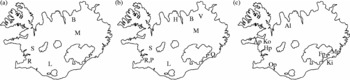
The earliest descriptions of human skin allergic responses in Iceland, retrospectively believed to have been caused by cercariae of bird schistosomes, date back to the summer of 1925, when maculopapular eruptions developed on the legs of children who had been wading in Sýkið, a shallow pond with geothermally heated water, located in the vicinity of Deildartunguhver, Iceland's largest thermal spring (fig. 1a). The pond never freezes and thus attracts water birds in all seasons, and R. peregra snails occur permanently at high densities. For almost a century the local landowners have been aware of the risks and have warned people (especially children) against exposing themselves to the water, knowing the risks of maculopapular eruption at certain water sources.
Ponds or lakes in Iceland (letters) where cercarial dermatitis has been reported (a), sites where Radix peregra snails have been found to shed ocellate furcocercariae (b) and locations where ocellate furcocercariae were not detected in 2001 and 2002 (c). The letters refer to abbrevations of the sites listed in table 2.

Family Park, Reykjavík
SI was confirmed in Iceland for the first time in 1997, when hundreds of children in the Family Park of Reykjavík (fig. 1a) were affected (Kolářová et al., Reference Kolářová, Skírnisson and Horák1999; Skírnisson et al., Reference Skírnisson, Magnússon, Kristjánsdóttir and Kolářová1999). Four years earlier (1993), a leisure park had been established in Reykjavík with a large, 2700 m2 pond that was up to 50 cm deep, to one side of which a wading beach for children was constructed. On warm summer days dozens and even hundreds of children are attracted to the area.
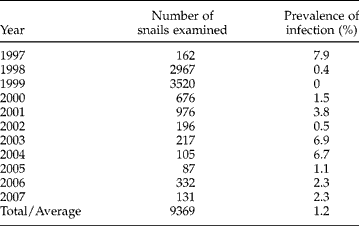
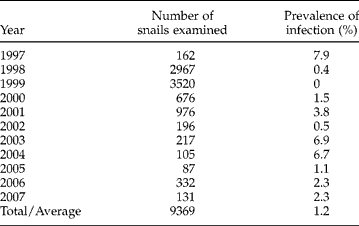
In August 1995, worried parents informed the staff of the park about allergic skin eruptions on the legs of children who had been wading in the pond. This recurred in 1996 but the cause of the allergic responses remained unknown. In late August 1997, when parasitological investigations at the site began, ocellate furcocercariae were found in a high prevalence in R. peregra (table 1) (Skírnisson et al., Reference Skírnisson, Magnússon, Kristjánsdóttir and Kolářová1999). Morphological studies of the cercariae revealed a close resemblance to the genus Trichobilharzia (Kolářová et al., Reference Kolářová, Skírnisson and Horák1999), although they were significantly larger than cercariae of known Trichobilharzia species, the average length being 1.361 μm. As no suitable material is available from these cercariae for sequencing of rDNA internal transcribed spacers (ITS), it has not yet been possible to clarify their systematic position with any certainty.
Prevalence of infection (%) with ocellate furcocercariae in Radix peregra in late summer and autumn, 1997–2007, in the Family Park of Reykjavík (R).
Landmannalaugar
Landmannalaugar is a famous, geothermally heated, natural bathing site in the interior of Iceland (fig. 1a) that attracts approximately 150,000 tourists every year. Many of the visitors bathe in a slowly running brook with a water temperature usually varying between 25 and 35°C. In the late summers of 2003 and 2004, extreme cases of SI affected thousands of bathers in the area (Skírnisson & Kolářová, Reference Skírnisson and Kolářová2005). In both years, schistosome cercariae were detected in R. peregra snails (table 2) and eggs and adult worms in mallards (Anas platyrhynchos) collected on the bathing site (tables 3 and 4).
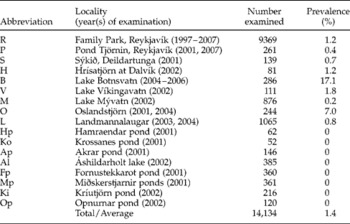
Collection sites of Radix peregra in Iceland with information on their infection prevalence with ocellate furcocercariae. The geographical location of the sampling sites, using the abbreviations below, is shown in fig. 1.

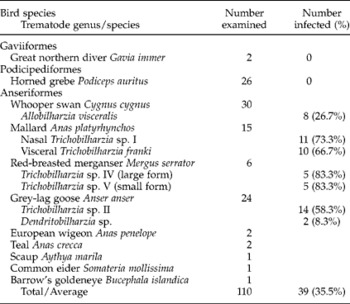
List and number of waterbirds examined for eggs and adults of schistosomes in Iceland.

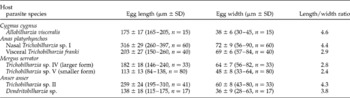
Average dimensions of eggs of seven distinct bird schistosomes found in Iceland.

In both years, a rapid increase in the concentration of cercariae in the water was noted by the middle of August. Subsequent studies showed that a breeding mallard female and its ducklings, which were raised on the brook above the bathing site during summer, were probably responsible. All the ducklings had concurrent infection with visceral and nasal Trichobilharzia schistosomes (table 4), and the infections were acquired very soon after the hatching of ducklings in late June or early July. Development of adult parasites would have taken about 3 weeks, such that egg-laying and the emergence of miracidia to infect the abundant R. peregra would then lead to intense release of cercariae by the middle of August. For the 3 years since 2006, the rapid increase of cercarial density in the water during late summer has been avoided by preventing mallards from rearing chicks above the bathing site. Retrospective enquiries indicate that the situation has now returned to the previous state when only occasional mild cases of SI occurred.
Interestingly, SI has been acquired at the bathing site in Landmannalaugar in all seasons, likely a result of the stable environmental conditions provided by the geothermally heated water that allow the snails to remain active in all seasons (Skírnisson & Kolářová, Reference Skírnisson and Kolářová2005).
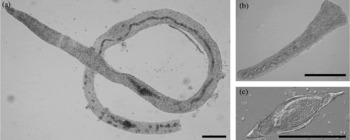
The visceral species detected in the mallards was Trichobilharzia franki, but the nasal parasite (fig. 2) remains an undescribed species of Trichobilharzia. The rDNA ITS region sequence of the latter has been obtained, leading to the designation as Trichobilharzia sp. 3 by Aldhoun et al. (Reference Aldhoun, Kolářová, Skírnisson and Horak2009) and Trichobilharzia sp. I by Skírnisson & Kolářová (Reference Skírnisson and Kolářová2008).
Adult Trichobilharzia female (a), a spatulate posterior end (b) and egg with living miracidium (c) from the nasal cavity of Anas platyrhynchos (Apl 62) from Landmannalaugar, Iceland. Scale bar = 200 μm in each case.

Lake Botnsvatn
Lake Botnsvatn is an approximately 1 km2 oligotrophic lake in the northern part of Iceland (fig. 1a) that frequently attracts people during periods of sunshine in summer. In late July and August of 2004 and 2005, respectively, dozens of people, mainly children, acquired SI after wading in the lake, and almost everyone exposed to the water was affected. Retrospective enquiries revealed that SI had also been noted in the summers 2001 and 2003.
So far, sequencing data have confirmed that cercariae of two different Trichobilharzia species are shed by R. peregra in the lake. One matched with T. franki; the other type is referred to with the designation Trichobilharzia sp. 2 (Aldhoun et al., Reference Aldhoun, Kolářová, Skírnisson and Horak2009). Eggs of this species are probably either those of Trichobilharzia IV or V (table 4) found in the large intestine of Mergus serrator juveniles from the lake (Skírnisson & Kolářová, Reference Skírnisson and Kolářová2008).
Lake Mývatn, Lake Hestvatn
In recent years SI symptoms have been reported at two further locations in Iceland. In hot summer days in 2000 and 2002, bathers in a waterway close to Lake Mývatn (fig. 1a) exhibited typical signs of cercarial dermatitis some hours after exposure. Identical symptoms were also observed on the legs of children that waded in Lake Hestvatn in southern Iceland in the summer of 2003. Trichobilharzia franki cercariae have already been confirmed in R. peregra in Lake Mývatn (table 2) (Aldhoun et al., Reference Aldhoun, Kolářová, Skírnisson and Horak2009) but snails from the latter site have not yet been examined.
Examination of freshwater snails
Radix peregra
The taxonomy of snails in Europe belonging to the genus Radix (Montfort, 1810) has been controversial for decades (Bargues et al., Reference Bargues, Vigo, Horák, Dvořák, Patzner, Pointier, Jackiewicz, Meier-Brook and Mas-Coma2001; Glöer, Reference Glöer2002; Anderson, Reference Anderson2005; Glöer & Zettler, Reference Glöer and Zettler2005; Pfenninger et al., Reference Pfenninger, Cordellier and Streit2006). It seems, however, that only one representative of the genus occurs in Iceland, identified here as Radix peregra.
In August and September of 2001–2007, a total of 4765 R. peregra snails were collected by hand at 16 locations in different parts of the country (fig. 1b and c) and screened for shedding of ocellate furcocercariae over subsequent days (table 2). In addition, during 1997–2007 a total of 9369 snails were collected in the pond of the Family Park in Reykjavík and examined (table 1). Schistosome cercariae were detected in 196 (1.4%) of the snails at 9 of the 17 sampling sites (53%).
The highest prevalence of the schistosome cercariae noted in Iceland was 24.5% – 13 out of 53 snails examined from Lake Botnsvatn were positive on 7 September 2006. In earlier years, 9.6% out of 104 and 19.5% out of 133 snails examined on 8 September 2004 and 16 August 2005, respectively, were positive. These values stress the unusually high infection prevalence in Lake Botnsvatn during three consecutive years.
Secondmost in severity was Oslandstjörn with 9.7% out of 144 R. peregra shedding two types of ocellate furcocercariae on 16 September 2001. One of them was T. franki, and the other was of a type considered to belong to a new, as yet undescribed, genus of bird schistosomes (Aldhoun et al., Reference Aldhoun, Kolářová, Skírnisson and Horak2009). Since the final host remains unknown, and no eggs have been observed, this species has not yet been notified by Skírnisson & Kolářová (Reference Skírnisson and Kolářová2008).
The prevalence rate in snails from the Family Park during 1997 to 2007 showed marked annual differences (table 1) that suggest variations in annual infection pressure in the pond. Despite considerable sampling efforts, no infection could be detected in 1999, and the highest prevalence (7.9%) was observed in 1997. The average infection prevalence during the past 11 years (1.2%) was quite similar to the average value (1.4%) obtained at the other collection sites (table 2).
Dozens, or even hundreds, of cercariae were sampled from 32 of the infected snails that originated from seven locations in Iceland. The larvae were fixed in ethanol for molecular studies and the ITS region of their rDNA was successfully sequenced. Subsequent phylogenetic analysis suggested the presence of at least five different species in this material (Aldhoun et al., Reference Aldhoun, Kolářová, Skírnisson and Horak2009).
The size of the snails shedding ocellate furcocercariae in Iceland appeared to be related to the nature of the habitat. Thus, infected snails in geothermally heated water (Landmannalaugar and Sýkið) were significantly smaller (average length 7.3 mm, SD ± 3.0, n = 9) compared to snails from ponds and lakes that are not affected by thermal water (12.6 mm, SD ± 2.8, n = 36; t-test, P = 0.001). The reason for this is unknown, but might be connected to the accelerated life cycle and shorter lifespan of snails in thermal waters, which mature and produce eggs earlier than in unwarmed ponds or lakes. Furthermore, ducks that feed on snails are attracted to the smaller thermal areas and might selectively remove the larger snails.
Gyraulus sp. and Physa acuta snails
Examinations of 5631 Gyraulus sp., collected at almost all known sites (n = 6) of the snail on the island, and 737 Physa acuta (Draparnaud, 1805) from two locations (fig. 1, ponds P and Op) did not reveal any infections with ocellate furcocercariae.
Examinations of water birds
Egg morphology
A search for bird schistosome worms, eggs and miracidia in the visceral organs and in the nasal cavity of 110 water birds of the orders Gaviiformes (one species), Podicipediformes (one species) and Anseriformes (nine species) revealed 39 (35.5%) infected hosts (table 3), and only anseriform birds were found to be infected (Skírnisson & Kolářová, Reference Skírnisson and Kolářová2008). Based on morphological features and measurements of eggs, seven distinct bird schistosome species were detected in four bird species (table 4). Allobilharzia visceralis was found in 26.7% of the whooper swans (Cygnus cygnus) (Kolářová et al., Reference Kolářová, Rudolfová, Hampl and Skírnisson2006). In mallards (A. platyrhynchos) the nasal Trichobilharzia sp. I (prevalence 73.3%) and the visceral T. franki (66.7%) were detected. In 83.3% of the red-breasted mergansers (M. serrator) examined, two distinct egg types were found: Trichobilharzia sp. IV and Trichobilharzia sp. V. In grey-lag goose (Anser anser), two different egg types were found: a large egg, referred to as Trichobilharzia sp. II (prevalence 54.2%), and a smaller egg of a Dendritobilharzia sp. (8.3%) (Skírnisson & Kolářová, Reference Skírnisson and Kolářová2008).
DNA sequencing of adult worms, eggs and miracidia
The ITS region sequence of the adult schistosome found in the nasal cavity of A. platyrhynchos in Landmannalaugar (fig. 2) indicated that the parasites group with isolates of eggs from the intestinal wall of Anas penelope in Poland (Aldhoun et al., Reference Aldhoun, Kolářová, Skírnisson and Horak2009). This nasal schistosome is referred to by the name Trichobilharzia sp. 3 in Aldhoun et al. (Reference Aldhoun, Kolářová, Skírnisson and Horak2009) but Trichobilharzia sp. I in Skírnisson & Kolářová (Reference Skírnisson and Kolářová2008).
The life cycle of this nasal Trichobilharzia was maintained in the bathing site in Landmannalaugar as an identical sequence was found in cercariae that had been shed by R. peregra in the area the two-month-old mallard juveniles had inhabited until their examination.
Three distinct samples of adult bird schistosomes sequenced from M. serrator matched with cercariae isolated from five distinct R. peregra individuals in Lake Botnsvatn, referred to by the name Trichobilharzia sp. 2 in Aldhoun et al. (Reference Aldhoun, Kolářová, Skírnisson and Horak2009). As previously noted, the eggs of this species are probably either those of Trichobilharzia IV or V, as presented in Skírnisson & Kolářová (Reference Skírnisson and Kolářová2008).
A new species and a new genus in the whooper swan (Cygnus cygnus)
Examinations of 7 out of 27 (26%) adult Icelandic whooper swans revealed their visceral infection by a new bird schistosome, Allobilharzia visceralis. The parasite shows certain similarities to members of the genus Trichobilharzia but possesses morphological features that clearly discriminate it from that genus: the point of caecal reunion in males takes place posterior to the gynecophoral canal, and the genital pore is behind the acetabulum and anterior to caecal reunion. Phylogenetic analysis based on molecular methods and comparison to related species with sequences deposited in GenBank confirmed that the previously undescribed species should be placed in a new genus (Kolářová et al., Reference Kolářová, Rudolfová, Hampl and Skírnisson2006).
It is unlikely that the complete life cycle of A. visceralis is maintained in Icelandic ecosystems, for the following reasons. First, no rDNA ITS sequences identical to A. visceralis were detected among the 32 samples of cercariae already analysed from R. peregra in Iceland (Aldhoun et al., Reference Aldhoun, Kolářová, Skírnisson and Horak2009). Second, the most heavily infected individuals examined were adult swans that had recently returned to Iceland from their wintering grounds, so the parasites were probably acquired elsewhere. Third, juvenile swans that died and could be examined without having left Iceland were uninfected. Therefore, we assume that A. visceralis is a long-lived species and that its intermediate host is a snail that is probably absent from Iceland. Thus, infections are likely acquired at wintering grounds, which are mainly located on the British Isles, and, to a lesser extent, also in Western Norway (Petersen, Reference Petersen1998). The geographical distribution, however, seems not to be confined to the Palaearctic because the parasite has also recently been detected in North America (Brant, Reference Brant2007). With respect to the possible intermediate host in the life cycle, it should also be mentioned that examinations of more than 15,000 snails originating either from brackish water (mainly Hydrobia ventrosa) or from the littoral zone in Iceland (Littorina spp., among others) have not revealed any infections with ocellate furcocercariae (Galaktionov & Skírnisson, Reference Galaktionov and Skírnisson2000; Skírnisson & Galaktionov, Reference Skírnisson and Galaktionov2002; Skírnisson et al., Reference Skírnisson, Galaktionov and Kozminsky2004).
Grey-lag goose (Anser anser) schistosomes
Two distinct egg types have been detected in the large intestine of grey-lag geese (Skírnisson & Kolářová, Reference Skírnisson and Kolářová2008). Our colleagues D. Jouet and H. Ferté, based in Reims, France have successfully sequenced the ITS region from these species; one belongs to the genus Trichobilharzia but the other, with the smaller egg, belongs to the genus Dendritobilharzia.
Conclusions
The great species diversity of bird schistosomes in Iceland seems to be supported by a single intermediate host, R. peregra, which is usually very common in lakes and ponds in the country, and a few anseriform bird species, especially C. cygnus, A. anser, A. platyrhynchos and M. serrator. Many of these birds overwinter in Iceland (the mallards and the red-breasted mergansers usually live in coastal areas during winter, all geese that have been found to be infected belonged to a non-migrating population of approximately 600 birds in the Reykjavík area) but most of the swans leave Iceland during winter. However, the possibility that non-anseriform bird species might be involved in the life cycles of the schistosomes found cannot be excluded. For example, the final host of a cercaria that was found in Oslandstjörn, with an ITS sequence indicating that a new genus might be involved in this case, is still unknown (Aldhoun et al., Reference Aldhoun, Kolářová, Skírnisson and Horak2009). Several candidates, such as larids (terns, small and even large gulls), are all very abundant in the area (Petersen, Reference Petersen1998), and any of these may be the mystery final hosts.
Complete life cycles of both nasal and visceral bird schistosomes are clearly maintained successfully in the wild in the country. In Landmannalaugar, thousands of bathers were exposed to the nasal species that seemed to be the dominant species in the area. However, approximately 40% of the bathers did not develop any signs of SI, indicating that their immune systems were apparently not sensitive to cercarial attack. Several studies have shown (reviewed in Kouřilová et al., Reference Kouřilová, Syrucek and Kolářová2004) that only severe and heavy infections of mammals by bird schistosomes lead to the development of an intensive skin reaction which manifests by maculopapular eruption. During primary and low-level infections by cercariae, the parasites may escape from the skin and, depending on the species involved, the schistosomula may migrate further to the lungs or the CNS of the host. The consequences of these infections in humans, if any, remain unknown but there is clearly cause for concern (Skírnisson & Kolářová, Reference Skírnisson and Kolářová2005).
So far, representatives of three known genera (Allobilharzia, Trichobilharzia and Dendritobilharzia) have been confirmed in Iceland and the presence of a fourth genus has been suggested (Kolářová et al., Reference Kolářová, Rudolfová, Hampl and Skírnisson2006; Aldhoun et al., Reference Aldhoun, Kolářová, Skírnisson and Horak2009; Jouet et al., Reference Jouet, Ferté, Hologne and Depaquit2009). So, the number of bird schistosome species confirmed in Iceland now totals eight. It is, therefore, evident that natural conditions for bird schistosomes are highly favourable in the country and it seems likely that further investigation will reveal more species.
Retrospective enquiries indicate that SI has affected humans in Iceland for almost a century, at least. The first reports originated from sites with geothermally heated water (Sýkið, Landmannalaugar), locations that are perennially warm enough to attract humans for leiasure activities. If Icelandic lakes are not influenced by geothermal water, they are usually so cold, even in summer, that they do not attract swimmers for more than few minutes each time. This fact alone minimizes the risk of acquiring SI. The combined effects of climate warming and the high density of aquatic (anseriform) birds in Iceland may mean that the number of natural freshwater bodies used for leisure activities might rise in the future, with a consequent increase in the risk of SI.
For the moment, the increasing incidence of SI in Iceland, whether through increased outdoor activities or enhanced awareness of the condition by medical practitioners and the general population, stimulated by the massive outbreaks in 1997, 2004 and 2005, clearly argue that cercarial dermatitis should be considered an emerging disease in Iceland.
Acknowledgements
We thank Þorkell Lindberg Þórarinsson for the collection of snails and birds from Lake Botnsvatn; Andrés Jónsson for descriptions of human skin allergic responses from Sýkið in 1925, Elsa Ingjaldsdóttir and Ólafur Karl Nielsen for submitting the information on SI in Lake Hestvatn and Lake Mývatn, respectively; Hubert Ferté and Damien Jouet for fruitful discussions on the material examined from Anser anser; and Malcolm Kennedy for reviewing the English of this article. The project was supported by the Research Fund of the University of Iceland, the Grant Agency of the Czech Republic (Grant nos. 206/06/0777 and 206/07/P092) and by the Ministry of Education, Youth and Sports of the Czech Republic (Grant nos. MSM 0021620828 and MSM LC06009).