The topic of donor fragmentation has occupied academic and policy debates.Footnote 1 Recent research shows that fragmentation has negative consequences for aid efficiencyFootnote 2 and helps to destabilize recipient country institutions.Footnote 3 Thus, as a prescription to reduce aid fragmentation, practitioners and academics alike have called for better coordination between donors.Footnote 4 Yet empirical evidence shows that donors largely fail to heed these calls.Footnote 5 Surprisingly, despite the importance of the issue, scholars know little about donor coordination. I therefore study donor coordination behavior, distinguishing between private and public goods properties of aid, in the hope that this will help to put the donor fragmentation debate on a sound theoretical footing.
As a background to the study, consider the following two examples. After the end of the civil war in 1992, the international donor community turned its attention to Mozambique. Disbursements of official developmental aid (ODA) surpassed $1 billion a year, for an average of $64.5 in aid per capita. At the same time, the proliferation of donors lead to a strong fragmentation of aid delivery. Despite the negative association between fragmentation and aid effectiveness,Footnote 6 Mozambique ended up an economic success story. Its gross domestic product (GDP) per capita more than doubled from a paltry $371 in 1992 to $759 in 2009. At the same time though, corruption in the public sector spread and elections became increasingly plagued by irregularities.
The neighboring country across the Mozambique channel, Madagascar, also saw a move toward greater democracy in 1992. In this year, a new constitution instituted multiparty democracy, ending the eighteen-year rule of Vice Admiral Didier Ratsiraka. The international donor community's reaction to the changes in Madagascar differed considerably from their response to Mozambique. France had been the biggest supporter of Madagascar since the country's independence in 1960, and France stayed in the top donor seat throughout the 1990s and 2000s. Aid levels remained far below those to Mozambique with an average of $25.6 per capita. Madagascar was spared donor fragmentation, though France's share of total aid steadily declined from an average of 53 percent in the 1990s to 43 percent in the 2000s. Still, the economy stagnated during this period, with a decline in GDP per capita from $843 in 1992 to $753 in 2009. The democratic process faltered in a coup d'état in 2009 and has yet to be restarted.
What accounts for the different donor reactions to the political changes in Mozambique and Madagascar in the early 1990s? In Madagascar the former colonial power continued to play an important role, in contrast to Mozambique. But French influence by itself cannot explain why other donors did not throw in their lot with the new democratic government. Why did no other donor step up to end French lead donorship? The key to this puzzle is the role of donor coordination. We can think of the lack of international aid support for Madagascar as a form of coordinated behavior, whereas the rush to help Mozambique shows uncoordinated behavior.Footnote 7
At the core of my theory of donor coordination is the central distinction between the private good and public good properties of aid. Private good characteristics arise when donors obtain a benefit from providing aid that is not shared with other donors. For example, tying aid to contract work from the donor country generates economic benefit for the donor country and presumably a political benefit for its government.Footnote 8 Public goods characteristics of aid arise when donors use aid to promote goals that are shared and can be enjoyed by other donors, such as improved public health and general economic development.Footnote 9
Donor coordination means different things for private and public good aid. To be sure, aid is a blunt policy instrument and both characteristics are usually present. However, the relative mixture can vary widely. Importantly, coordination in the provision of aid with public goods properties helps to reduce free-riding and increases aid levels, with ultimately positive results for development. This form of coordination actually increases donor fragmentation. The implication is that greater fragmentation might not be all bad if it arises as the flip side of a more developmentally oriented aid practice. On the other hand, if donors mainly provide private goods aid, coordination amounts to a delineation of spheres of influence. Donor fragmentation decreases, lead donorship arises, but overall aid amounts fall. The welfare effects of this are not straightforward, but more concentrated donor power means shifting rents from the recipient to the donor government.
Then there is the largely overlooked empirical puzzle of lead donorship. We understand lead donorship as a long-time stable exclusive relationship between one donor country and a recipient country, in which the donor continuously acts as biggest provider of foreign aid. Over the past forty years lead donorship decreased as donor fragmentation increased, but lead donorship is still a pervasive feature of the international aid system. In the 2000s, around 20 percent of recipient countries still have a lead donor. Despite this prevalence, lead donorship is a remarkably understudied phenomenon.Footnote 10 I provide the first systematic theoretical and empirical account of this important aid practice.Footnote 11
The exclusive relationship between a lead donor and a recipient country sometimes lasts for decades. Its relevance for overall aid policy is reflected in the fact that the international aid community often expects lead donors to shoulder a larger burden than others when dealing with problems in affected states. Examples of this include the US's role in Haiti and British lead donorship in Zimbabwe before official independence. But there are also surprising episodes, for example, Japanese support for small Caribbean island nations such as Antigua and Barbuda.
Lead donorship differs from other forms of aid provision on two dimensions. First, lead donors have long-standing ties with recipient countries. The personalistic networks between French officials and their counterparts in francophone AfricaFootnote 12 are a well-known example of such dynamics though the French political engagement in these instances clearly goes beyond merely providing foreign aid. Second, the lead donor-recipient relationship is exclusive, that is, no or few other donors vie for the role as top aid contributor. For example, despite the francophone roots of Haiti, in the late 1980s and 1990s France steered clear of greater involvement in the country's crisis because of long-standing American engagement.Footnote 13
Exclusive spheres of donor influence established by lead donorship come at a cost. Long-lasting relationships lead to personalistic ties that are detrimental to efficient aid practices.Footnote 14 I do not claim that lead donorship is a panacea to the ills of donor fragmentation. In contrast, donor coordination will lead to more fragmentation if donors mainly care about development outcomes, with benefits potentially outweighing costs. I therefore believe that only an understanding of the possible modes of donor coordination allows for an informed debate about the relative costs of donor fragmentation. My work aims to put this debate on a more sound theoretical footing.
Theoretical Considerations
The study of donor fragmentation has received attention over the last years. Recent studies have focused on the effects of donor fragmentation on economic development and government institutions. They find a number of negative effects. Growth performance suffers as a result of duplication of aid programs and the concomitant increased administrative burden.Footnote 15 Increased demands on recipient administration capacities are associated with poor institutional performanceFootnote 16 and increased corruption.Footnote 17 This negative track record of proliferating aid programs highlights the need for an effective policy response. Since the Paris Declaration of 2005, the international donor community has recognized donor coordination and increased specialization as tools to combat fragmentation.Footnote 18 These prescriptions have been wholeheartedly embraced by the policy community.Footnote 19 Specialization can either target specific aid sectors or countries. However, Nunnenkamp, Ohler, and Thiele show that donors have made little progress toward avoiding overlap of aid allocations.Footnote 20
Lead donorship constitutes a frequent but overlooked instance of successful donor coordination. I seek to identify the theoretical underpinnings of lead donorship, and by implication shed light on donor herding behavior and the conditions that lead to fragmentation and lead donorship. The phenomenon of lead donorship has received scant academic attention. An extensive search produced only one piece that explicitly deals with the topic. Lebovic argues that donors benefit from being the largest aid contributor beyond the payoff associated with a given level of aid.Footnote 21 In other words, lead donors receive a bonus for being in the top position.
This raises several important questions. If it is lucrative to be the top donor, why do other donors not compete for this position? And, if competition exists, how can we explain the rise and persistence of long-lasting lead donorship? Also, is donor fragmentation a result of competition?
To answer these questions, we need to move beyond the notion that the largest aid provider is automatically a lead donor. Lead donorship can be characterized by two properties. First, it is in essence a longitudinal phenomenon. It is precisely the ongoing and exclusive commitments that some donors have toward select recipient countries that make them worth studying. Germany, for example, has served as largest- or second-largest aid contributor to Iran for the entire time I analyze in this study, from 1970 to 2010 (only in 1986 did German aid come in ranked third). During this time, Iran underwent the Islamic Revolution, fought a costly war with Iraq, and was subject to the destabilizing regional effects of two American-Iraqi wars. In the face of this variety of circumstances, we want to explain the steadfastness of Germany's aid commitments.
A second aspect of lead donorship is the exclusivity of the relationship between a donor and a recipient country. Going back to the previous example, the German commitment to Iran was not only characterized by its longevity, but also by a lack of competition from other donors for Germany's top spot. This forms an important part of the lead donorship puzzle. If donors use aid to secure private benefits they should face pressures to compete with each other. To the extent that this is true for Germany's engagement in Iran, we need to explain why such competition did not materialize. If, on the other hand, Germany's engagement in Iran mainly produced benefits with public goods characteristics, we need to explain why Germany remained a top donor and did not succumb to incentives to free-ride on the efforts of other donors. My theory of lead donorship provides plausible explanations for both scenarios.
On the other side of the spectrum that defines exclusive donor-recipient country ties lie those countries that attract much support from the international donor community. Frequently, humanitarian needs or political crises lead a great number of donors to engage. Although this cause of donor fragmentation is laudable, evidence indicates that donors also imitate each other's actions in the absence of crises.Footnote 22 This type of “herding” behavior is not need-driven. It results from competitive behavior and the need to flag specific projects for a donor country for either fundraising purposes or to garner influence.Footnote 23 Herding results in fragmentation. For example, South Africa received widespread support after the fall of apartheid, resulting in relatively fragmented aid delivery. After 1992, the Herfindahl-Hirschman index (HHI) of bilateral donor concentration surpassed 0.2 in only 2008, and went as low as 0.0934, compared with a sample average of 0.319.Footnote 24
To systematically study the conditions under which donors coordinate and when lead donorship arises, we need to develop a theory that explains both lead donorship and donor fragmentation. The goal is to distinguish coordinated from uncoordinated behavior and to develop observable implications of both.
Studying donor coordination is complicated by the fact that there are two principal scenarios for providing aid, each of which has a different logic of cooperation and generates different empirical predictions. First, if donors have aligned incentives, for example, if they care about development outcomes, aid should exhibit classic public good properties.Footnote 25 In the second scenario, donors use aid to further their goals, the fruits of which cannot be enjoyed by others. Thus aid takes on private goods characteristics. Since in reality aid policies always represent a mixture of both private and public goods motives, we need to gain some empirical leverage over the relative public versus private goods content of aid. This relative mixture should vary across aid delivery channels.Footnote 26 I test my theory against newly available Organisation for Economic Cooperation and Development (OECD) data on aid delivery channels but first, it will be useful to develop the ideal-typical characteristics of cooperation and lead donorship in the two pure scenarios.
I start with the public goods character of aid. It is necessary to emphasize that the public goods I refer to in this study are not simply publicly provided infrastructure such as better roads, schools, and the like (though aid supporting such infrastructure may help produce public goods). The public goods properties of aid I am interested in arise from the donors' perspective.
Usually, donors announce policy goals that promise to ameliorate some of the ills associated with poverty. To name just a few typical examples, the United States President's Emergency Plan for AIDS relief (PEPFAR) promises to “help save the lives of those suffering from HIV/AIDS around the world”; the mission statement of the British Department for International Development (DFID) includes a call for “unlocking the potential of girls and women”; and the French Development Agency (Agence Française de Développement, AFD) states that its programs “enhance more sustainable and shared economic growth.”Footnote 27
Assuming that these pronouncements reflect donor preferences (as opposed to purely providing political cover for other purposes), donors who successfully meet some of these developmental goals cannot exclude other donors from benefitting from this success, even if those other donors did not contribute to it. If, for example, two donor governments both value a reduction in child mortality rates in a given country, but only one of them supports an active child nutrition and vaccination program, any success from this program will also benefit the inactive donor. At the same time, the achievement for the active donor is not reduced because the inactive one enjoys its benefits as well. Together, these two properties (nonexcludability and nonrivalry in consumption) are the classic criteria for a public good.
The insight that international aid given for development purposes forms a public good was first formulated by Olson and Zeckhauser and was recently revived by scholars of the modern aid system.Footnote 28 Olson and Zeckhauser show that if contributors have differences in marginal returns on contributions to a public good, the contributor with the largest marginal returns carries the largest burden. For aid with public goods properties this means that the donor with the greatest marginal returns will consistently provide the largest share, and thus will become a lead donor.
Differences in marginal returns result from either variation in the costs of providing aid, or in tastes for development. In practice, this distinction is quite inconsequential. What matters is that donors have different valuations for what they seek to achieve in specific recipient countries. There are several mechanisms through which differences in marginal returns on aid can arise. For example, in both France and Britain, there are domestic interest groups that support ongoing engagement with former colonies, driven in part by family ties but also investment interests. These domestic inputs increase the political rewards for the government to provide aid, both of the public and the private goods kind. At the same time, lobby groups can also provide recipient country expertise, thus lowering the costs of implementing aid programs. Ethnic minority groups living in former colonies seem to exert a similar effect, as can be seen from Germany's engagement in Namibia since the country's independence in 1990. These examples are by no means exhaustive because issue salience and political costs of providing aid are affected by many factors.
I have already shown that in the absence of donor coordination, lead donorship in the public goods scenario arises from asymmetries in returns to aid. The donor with the largest returns should be able to get others to shoulder more of the burden of contributing to the public good. Thus, coordination in a public goods scenario decreases free-riding and will lead to more symmetry in aid contributions, attenuating or entirely erasing lead donorship.
My analysis of aid with public goods properties has interesting implications for the link between donor coordination and fragmentation. Since coordination allows for more even aid contributions, it should also be associated with greater donor fragmentation. For public goods aid, fragmentation results from coordination, not a lack of coordination. This contrasts sharply with standard accounts that attribute fragmentation to a lack of coordination. I do not argue that the practitioners have it wrong. Rather, I point out that donor fragmentation that arises from a lack of coordination is logically not consistent with public goods characteristics of aid.
In the empirical analysis I directly recover how donors condition their own aid contributions on the actions of other donors. In other words, I examine whether aid from one donor produces “spill-ins” for the aid decisions of other donors. I therefore need to establish the observable implications of coordination on the nature of spill-ins. As Olson and Zeckhauser show, when aid has public goods properties, donors have incentives to free-ride on the aid contributions of others. Because developmental benefits from aid are nonexcludable, if donor X receives declining marginal utility from development in recipient A and Y spends more on development in A, the marginal benefit to X from providing aid itself declines. Accordingly it will reduce its aid contributions so that marginal benefits and costs match again. Since all donors face the same strategic logic, in equilibrium each donor will provide less aid than it would have in the absence of other donors. In this uncoordinated equilibrium scenario we should observe negative spill-ins—greater contributions from other donors are an incentive to give less. Therefore, when donors give public goods aid in an uncoordinated fashion, we expect to observe negative spill-ins, or substitution behavior.
In contrast, coordination allows donors to overcome free-riding incentives. Standard results from the theory of repeated interactions show that with a sufficiently long time horizon cooperation becomes possible. Simple strategies such as the threat of retaliation for free-riding (a “grim trigger” strategy) or a “tit-for-tat” approach overcome free-riding incentives.Footnote 29 Coordination therefore should strongly reduce or eliminate negative spill-ins.
Can positive spill-ins arise from coordination in the public good scenario? Positive spill-ins can arise only if a donor's marginal utility of aid provision increases when other donors provide more aid. It is possible to think of mechanisms that can bring this about. For example, donor conferences are designed to increase the public visibility of aid policies. This arguably leads to a “shaming” effect, with donors pledging more than they otherwise would. It is important to point out though that any increase occurs because donors have selective incentives to avoid public shaming. Shaming might lead to an increase in the marginal utility of providing aid as others pledge more, but this increase is due to the private benefit of avoiding public embarrassment. It is not driven by the developmental goals that characterize public goods aid. Hence, private and public benefits are mixed, making aid an impure public good. Although in reality most aid is impure, my goal is to identify the ideal-typical logic of aid with public goods properties. Under coordination, pure public goods aid should not exhibit positive spill-ins.
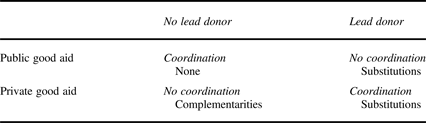
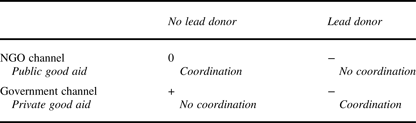
Table 1 summarizes the observable implications of coordination for aid with public good properties in the first row. Lead donorship arises as a result of uncoordinated donor actions and free-riding. In the presence of a lead donor, we thus expect substitution effects in the provision of aid. Coordination reduces free-riding incentives and hence asymmetries in aid provisions. Thus, when we do not observe lead donorship, there should be no complementarities or substitution effects in the provision of aid.
Donor coordination and predicted observable behavior

Next, we consider the situation in which donors use aid to secure private benefits. The notion that donors give aid to secure individual advantages is as old as the practice of giving foreign aid. Scholars have identified a long list of goals that donors pursue with their aid policies. These include export promotion,Footnote 30 diplomatic influence,Footnote 31 and secure access to raw materials.Footnote 32 The literature on donor herding has identified as additional goals the need for visibility at home to garner domestic support.
Although concerns about fragmentation and herding have led to a focus on the incentives driving donor engagement, the competitive nature of aid for private purposes has largely gone unnoticed. The exception are Knack and Rahman,Footnote 33 who argue that donors compete to attract qualified local staff to facilitate program implementation. Scholars of political economy have long recognized that competing interest groups can use money to influence policy outcomes, with a key insight that competing interests tend to cancel each other out.Footnote 34 The obvious parallel in the aid realm has been ignored so far.
If donors vie for influence, they are in competition with each other: aid provisions are used to counteract the influence gained by other donors. Although the politically sensitive nature implies that these contests do not occur in the open, anecdotes abound and the range of competitive issues is wide. For example, in the early 2000s French officials saw the new American engagement in Northern and Western Africa increasingly in terms of competition for oil in the region.Footnote 35 As another example, in the late 2000s Germany stopped supporting alternative energy development in Namibia because the Namibian government preferred the grant-based aid approach of the United States to the German offer of concessional credits. In yet another example, a German aid official complained about the “diluted influence” of his country on developmental policies in Bangladesh more generally, attributing this lack of power to the relatively low seventh place of German aid in this country.Footnote 36
Competition between donors implies that there is no coordination. Lead donorship will be hard to achieve, since for any single donor it is difficult to remain the top contributor for extended time periods. Private good characteristics of aid coupled with competition therefore ensure that aid contributions are more even. As a result, aid delivery will be more fragmented.
Looking at donor competition through the prism of the private goods characteristics of aid allows us to present a theoretically coherent role of coordination in reducing fragmentation. Since donors compete on aid provision, they would be collectively better off if they were able to reduce competition between themselves. Coordination achieves this aim. Through silent or explicit agreements to delineate spheres of influence or specialize in particular aid sectors, donors can attain a form of coordination that is the equivalent of collusion in oligopoly theory. The result of collusion is lead donorship. Individual donors get to dominate the aid regime in individual recipient countries while other donors stand by. This in turn reduces donor fragmentation.
When it comes to collusion and spill-ins in the provision of private good aid, we expect that lead donorship is associated with substitution behavior. As the lead donor gives more aid, other countries reduce their own contributions to uphold the collusive agreement. In the absence of lead donorship, donors fail to coordinate and remain locked into competition. They therefore provide aid in complementary fashion. The second row of Table 1 summarizes these predictions.
Comparing private goods aid and public goods aid in Table 1, we see that in the presence of a lead donor, both predict substitution behavior. To gain empirical leverage, we therefore need to develop strategies that allow us to distinguish between private and public goods aid.
As a first strategy, I break down aid allocations by delivery channel. The idea is that the relative mixture of private and public goods content of aid varies by channel. Aid going toward recipient government channels has a stronger private goods component, while aid channeled through nongovernmental organizations (NGOs) is more public goods oriented. From a theoretical perspective, aid to the government affords the donor more direct influence on political decision makers, which will be instrumental to secure private benefits.
In contrast, aid to NGOs isolates the donor from direct contact with public officials, stymieing the ability to extract rents and gain political influence. This means that the share of aid flowing through the NGO channel that actually is used for developmental programming will be relatively higher. The policy outputs thus created are more likely to have public goods characteristics from the donor perspective. For example, no donor can be prevented from enjoying reduced child mortality and improved water supplies and these public benefits do not decrease as more donors enjoy them.
To verify this assumption, we look at the tying rates of aid by delivery channel. The practice of tying aid to be spent on goods and services from the donor country generates benefits for domestic constituencies at home. Therefore the tying rate provides a measure of the private goods content of aid.Footnote 37 In the data, aid provided through NGO channels has an average tying rate of 10.8 percent, compared with a 24.8 percent tying rate for government channels. This supports the notion that government aid has a relatively higher private goods content than NGO aid.
Other authors have found a similar relationship, though since the OECD's Development Assistance Committee started collecting data on delivery channels in only 2004, research on the makeup of aid flows by channel is still sparse. For example, Dietrich shows that donors who care more intensely about developmental results and who distrust the government prefer to provide aid through NGO channels.Footnote 38 Similarly, Swedish ODA provided through government channels is more responsive to Swedish political and economic interests than aid provided to NGOs.Footnote 39
I use the difference in relative private and public good content to compare estimated spill-ins in each delivery channel with the spill-ins for total aid. If the recovered effect is stronger for a specific delivery channel, we have evidence that the dominant aid type in this channel is responsible for the observed data patterns. Consider an example where we have a lead donor, and we observe substitution effects in the provision of total aid. Relative to this baseline, government aid exhibits larger substitution effects and NGO aid has lower substitution effects. This suggests that the strategic dynamics in the overall data are primarily driven by the aid's private goods content. We would count this pattern as evidence of coordinated provision of private goods aid.
As a second strategy, I vary how I estimate spill-ins using different connectivity weights. The important aspect of this approach is that I fit several different models to the data. In one model, donors are assumed to condition their behavior mainly on the lead donor. Other specifications assume that the actions of all donors matter in equal measure or that donors that are geographically closer to the recipient matter more. I then use a model discrimination method to determine which model better fits the data. If the lead donor-specification fits better, I count this as evidence for coordination.
Measuring Lead Donorship
The standard measure of donor concentration is the HHI of donor concentration. The HHI picks up on outsized aid contributions of individual donors by taking the square of aid shares, and summing up across donors. This is a good start, but for our purposes not enough to identify lead donorship. Most importantly, the HHI does not allow us to track the identity of the top aid contributor over time. A scenario in which important donor countries alternate in giving the largest aid share each year will produce high and unchanging HHI values, but does not represent lead donorship. In addition, the HHI does not uniquely map from donor configurations into the zero to one interval. It is possible for a small number of donors that provide the same amount of aid to generate the same HHI value as a lead donor with a larger number of small donors.Footnote 40
I therefore develop a measure of lead donorship that integrates the conceptual key features of lead donorship with the conventional HHI approach to measuring donor concentration. I have argued that a lead donor enjoys exclusive and long-lasting ties with a recipient country. To capture the exclusive nature of this relationship, I use three criteria. First, a lead donor will operate in a donor environment in which aid delivery is concentrated, and therefore donor fragmentation as measured by the HHI is relatively low. Second, the lead donor is not only the top contributor. Its aid payments should be significantly larger than those of any other donor. Two ways to think about this are (1) in terms of the difference in aid between the top donor and the second-largest donor, and (2) accounting for absolute size of the top donor's aid share. To some extent all three of these concepts overlap. Instead of adjudicating their relative merits, I identify countries as having an exclusive recipient-donor relationship if they score high on all three measures. To this end, I choose the sample medians of the variables as cutoffs, and require lead donor countries to lie above this cutoff for all three measures. As robustness check, I reproduce the results of the statistical analysis relying only on the HHI to capture exclusivity of donor relations. The results hold up even for moderately concentrated donor systems.Footnote 41
To capture the longitudinal aspect of lead donorship, I am looking for long spells in which one donor country continuously acts as top donor. In doing so, I need to balance the need to capture the “long duration” of lead donorship with costs that come from pooling data over a multitude of years, including decreased power of the statistical tests and a reduced ability to pinpoint when lead donorship episodes begin and end.
To illustrate these trade-offs, consider one extreme approach. I could simply pool all the data, and ask whether an individual donor acted as top donor to a particular country in at least half of all the years in the analysis. This would allow me to look at top donorship in the long run (the data cover forty-one years from 1970 to 2010). But obviously, this would unnecessarily eliminate all intertemporal variation from the analysis. Also, lead donorship can be rock solid for a number of years and then change because of political developments inside and outside the recipient country. An example of this is Chad, which has been part of the French sphere of influence in Northern Africa for all years in the analysis beginning in 1970. However, French lead donorship unexpectedly ended in 2005, when the United States took over the role as lead donor. Driving forces behind this change were the discovery of oil reserves in Chad, which are developed by American companies, and a newly found American interest in containing the influence of the regime in neighboring Sudan. A measure of lead donorship that does not pick up on such intertemporal changes would be of little use.
At the other extreme, simply labeling whoever provides most aid in a given year as lead donor misses the point of the argument. For a meaningful long-term relationship to exist, a donor should show commitment to remaining in the top position across at least two aid program periods. A one-time up-tick in aid to a specific recipient country can easily arise from short-lived domestic or international political constellations. However, renewing a program that provides aid at exceptionally high levels will require more political capital and justification. Typical aid programs run between four and five years. I therefore require that a lead donor provides the largest aid share during the majority of at least two program periods, or five out of nine consecutive years. The results of this analysis are not sensitive to the choice of this particular time window.Footnote 42
To be better able to capture changes in lead donorship status over time, I also require that a donor never drops its role as top donor for more than two consecutive years within the nine-year period. This way, I can more precisely determine when a lead donorship spell has ended or is about to begin. To return to our example, France was top aid contributor to Chad until 2004. Without the extra requirement, I would code France incorrectly as lead donor until 2009. With the two-year gap rule I assign lead donor status only until 2006.
A check for face validity shows that the coding scheme accurately classifies a number of important cases of lead donorship, such as French involvement in French-speaking Africa, and US aid engagement in Central America. More difficult to evaluate is the loss or change of lead donorship. A number of prominent examples pass the face validity test. For example, the measure shows that former colonial power Belgium acted as lead donor to Rwanda from 1970 until 1993, just the year before the genocide, as we would have expected. The years after the genocide were marked by almost all important western donors engaging in Rwanda, and my measure correctly shows that there is no lead donor.
Patterns of Lead Donorship
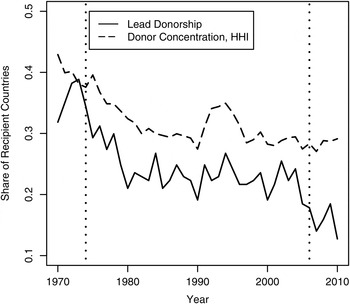
I next explore the patterns of lead donorship in the data. There are 1,555 instances of countries with lead donor, or 24.16 percent, in the years 1970 to 2010. At face value, this establishes lead donorship as an important empirical phenomenon. However, the presence of lead donors varies strongly over time. Figure 1 plots the share of lead donorship in all recipient countries in a given year. The vertical dotted lines indicate the range for which our measure of lead donorship incorporates all lagging and leading years (up to four). Before 1973 and after 2006, we pick up on some instances of lead donorship, but are bound to underreport total numbers because of the lags involved in determining lead donorship.
Lead donorship over time

The emerging pattern shows that instances of lead donorship (solid line) have been steadily declining since the 1970s, with steeper drops during the 1970s and the 2000s, and a more shallow descent in the decades leading up to and following the end of the cold war. The data for 2006 show a historic low, with only 17.8 percent of all recipient countries having a lead donor. This compares with a high point of 38.9 percent in 1973.Footnote 43 Looking at donor concentration (HHI, dotted line), we see that concentration follows a similar decline to lead donorship. This confirms that fragmentation has become an increasingly important problem in aid delivery. The simultaneous decline in lead donorship suggests that at least part of this development is attributable to decreased donor coordination in the provision of aid with private goods characteristics.
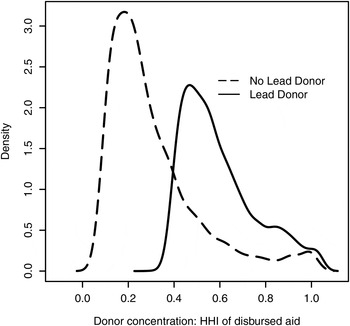
The closely related trends in donor concentration and lead donorship do not come as a surprise since I base part of my definition of lead donorship on high donor concentration. However, the two are not identical concepts. An Engle-Granger test provides no evidence that the two time trends are co-integrating (p = 0.26). In addition, lead donorship is not the only way to overcome donor fragmentation. Cases with highly concentrated aid delivery do not necessarily have a lead donor. Figure 2 shows the densities for lead donorship (solid line) and no lead donorship (dashed line) over the range of the HHI variable. The distribution of cases without lead donor has a long right tail, and even a small second mode at HHI = 1, for countries with only a single source of aid.
Distribution of lead donorship over donor concentration

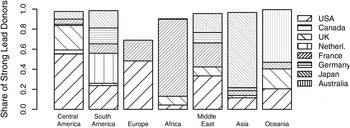
Next, I consider the regional distribution of lead donorship by donor. Figure 3 shows the share of total lead donorship for important donor countries, broken down by region. A clear pattern of geographic proximity emerges. The United States is a lead donor in more than half of the cases in Central America, and is the most prevalent lead donor in South America. With 75 percent, Japan has an even larger share of lead donorship in Asia. Australia is the preeminent lead donor in Oceania (52 percent of the times). Other patterns point to persistent colonial ties, with France contributing fully 76 percent of lead donorship in Africa, and the UK maintaining lead donorship 24 percent of the time in Central America.
Lead donorship by region

There are also a number of surprises. Germany is a lead donor in South America in 15 percent of all instances and has a sizable share in the Middle East (10 percent). The Netherlands are engaged as lead donor in Suriname, which is a former colony (thirty-eight continuous years, for 29.9 percent of instances of lead donorship in South America). However, there is little engagement in other former colonies. Scandinavian countries are generally thought to have a more developmentally oriented aid policy. In line with this, we find that they rarely act as lead donor (Norway never, Sweden for a number of years in Cuba and Vietnam), though it is possible that this is mainly because of relative resource constraints. The bar plots omit Italian lead donorship in Malta and Albania. Italy also sporadically acted as lead donor in Libya (during the 1970s) and Somalia (during the 1980s).
Coordination Versus Competition
I now investigate the different forms of spill-ins accompanying aid allocation decisions. The aim is to garner evidence for coordination or lack of coordination, according to the predictions spelled out in Table 1. To achieve this, I fit a series of spatial autoregressive (SAR) models of aid provision.Footnote 44 The SAR setup allows me to model spill-ins from aid provision as endogenous right-hand-side component, and estimate the strength of these spill-ins.Footnote 45 For each recipient country r and donor i, the SAR models take the form:
 $$y_{r\comma\, i} = \rho \sum\limits_{\,j \ne i} b_{r\comma\, i\comma\,j} y_{r\comma\, j} + x \beta + \varepsilon _{r\comma\, i}\comma \;$$
where y r,i is aid provided by donor i to country r, ρ is a connectivity parameter that captures complementarities (positive values) or substitutions (negative values) in aid provision, and b r,i,j are connectivity weights that capture how much donors j influence i's aid decision when giving aid to r.Footnote 46
To avoid having to deal with temporal dynamics, which can be quite complicated in the presence of spatial autocorrelation, I collapse the data across a number of years and estimate separate models for each time period. A set of standard covariates and coefficients xβ, and an iid normal disturbance ε finish off the model.
A key challenge in the specification of SAR models is the choice of connectivity weights b i,j .Footnote 47 My approach is driven by theoretical considerations. I divide the sample into cases of lead donorship and no lead donorship. For each of the two samples, I choose connectivity weights that reflect the theorized lead donor relationship. In the presence of a lead donor, we'd expect that other donors heavily condition their allocation decisions on this donor's actions. Accordingly, I give this donor a greater connectivity weight than other donors. If country k is identified as lead donor, I set country i's connectivity weight with k to b i,k = .5. All other countries receive a lower weight, b i,¬k = .5 = (n − 2). The n − 2 scaling reflects that all weights add up to 1 and i is not connected to itself (b i,i = 0).
Although these connectivity weights reflect the theory's predictions, dividing the sample into cases of lead donorship and no lead donorship leads to a risk of biased inference about strategic interactions. In the lead donor case, by design our connectivity weights establish a potentially strong relationship between the donor who provides most aid (the lead donor) with all other donors who give less. That is, the weights are endogenously determined by donor behavior. This is no accident, because the theory predicts that donors coordinate and therefore endogenously determine who will act as lead donor. Endogeneity of best responses is of course the central hallmark of Nash equilibrium play. To address this potential problem, I chose a two-pronged strategy. First, I follow the advice of Zhukov and Stewart and specify a number of other plausible connectivity relationships.Footnote 48 I then estimate several SAR models with different weight matrices, and use model discrimination methods to determine which model best fits the data-generating process.Footnote 49 Second, I use a fixed-effects design that accounts for unmodeled heterogeneity of lead donor aid allocations.
I first introduce two additional plausible connectivity structures. Structure number one captures the idea that no strategic relationship exists that puts special emphasis on any single donor country. Weights are perfectly even and assign each donor in the sample identical importance, b i,j = 1/(n − 1). We can think of these weights as reflecting a lack of information on part of the analyst. As a second set of weights, I follow a widespread convention in applied spatial analysis and use actual geographic distance as connectivity criterion. Distance is exogenous to aid allocation decisions, so these weights are not subject to endogeneity problems.Footnote 50 The weights compare the distances between donor countries and the recipient, and give more importance to donors that are closer to the recipient.Footnote 51
For cases without a lead donor, the theory does not predict a special strategic role for any individual donor. Accordingly, I perform the analysis with even connectivity weights as well as geographic weights.
I test which connectivity weight specification better summarizes the data using a modified Clarke test for nonnested models.Footnote 52 The Clarke test compares models on the basis of likelihood values (more specifically, the Kullback-Leibler information criterion). Using a nonparametric strategy, the test compares individual likelihoods for each observation in the sample. For models that have a similar fit, the observations of Model 1 should have a larger likelihood than those of Model 2 around half of the time. If Model 1 outperforms Model 2, this ratio should increase in favor of Model 1. The binomial test statistic has H 0 : p = .5 for equally well-performing models.Footnote 53
I apply this framework to the SAR models. However, I cannot obtain individual likelihoods for each recipient-donor dyad because dyadic aid allocations are codetermined by other dyads through the connectivity structure embedded in the b i,j weights and the connectivity parameter ρ. Instead, the estimation procedure generates exactly one joint likelihood for each recipient country and its n donors. Accordingly, I perform the Clarke test on the more aggregated recipient country level. That is, I compare the likelihoods of both models for each recipient country in the data, counting the times that a recipient country has a larger likelihood under Model 1 than Model 2.
As second guard against problems with endogeneity, I introduce lead donor fixed effects. From an econometric perspective, endogenous weights are not a problem as long as my model corresponds to the data-generating process and correctly specifies all strategic and nonstrategic factors that influence aid allocations. However, if the model omits nonstrategic variables x that determine the amount of extra aid provided by the lead donor, we will inaccurately attribute this nonstrategic effect to the strategic relationship between lead donor and nonlead donors. In other words, ρ will be subject to omitted variable bias.Footnote 54 To address this risk, we include a dummy variable for lead donor countries into the analysis. This separate intercept absorbs unmodeled nonstrategic lead donor effects. Our results do not change substantively with the intercept, but including it decreases absolute estimated values of ρ, and likelihood ratio tests show that model fit improves.
The dependent variable is disbursed bilateral aid in constant 2010 US dollars, per donor and recipient country. In a first cut, I do not standardize aid or take transformations such as natural logs, considering that complementarities and substitutions arise because donors compare aid contributions on a dollar-by-dollar basis, not in terms of recipient needs or their own fiscal capacity. Similarly, there is no theoretical basis to expect that donors condition each other's contributions on arbitrary transformations such as logged aid. However, unmodeled heterogeneity of aid contribution levels could lead to biased inferences about strategic interactions.Footnote 55 Normalizing aid by population size reduces heterogeneity. I therefore rerun the analysis with this dependent variable. My findings do not change substantively, but the size of estimated strategic effects decreases when normalizing per capita. Since this is the more conservative set of estimates, I rely on aid per capita when I report results.Footnote 56
I include a list of independent variables that are relevant determinants of aid allocation, including recipient country characteristics, regional effects, donor-recipient pair-specific variables, and donor system variables. Since budget constraints limit the amount of aid that a particular donor can provide across recipient countries, I include the total sum of aid each donor gives per year.
I begin the analysis with different aid delivery channels. Specifically, I distinguish between aid provided through NGOs and through official government channels. I also look at aggregate aid flows. The OECD's Creditor Reporting System has only recently begun recording delivery channel data. I therefore limit this first step of the analysis for the years 2004 to 2010. To test my differing predictions about complementarities and substitution behavior, I subdivide the sample into cases with no lead donor and lead donor. The quantity of interest is the connectivity parameter ρ that captures the strength of strategic interactions between donors. Table 2 provides an overview of how my theoretical predictions generate expectations about the sign of ρ (this is a modified version of Table 1). Looking at the left column first, we see that for the sample without lead donors, we expect a positive sign of ρ for government aid and no spatial effect for the NGO channel. A positive sign of ρ shows there are complementarities in aid provision, that is, donors will increase their own allocations in reaction to increases by others. My theory predicts that complementarities matter only when aid has private goods properties and there is competition between donors. Since I argue that government aid has greater private goods content than NGO aid, I expect a positive sign of ρ only for government aid and have no expectation for NGO aid. If I find complementarities, this will count as evidence for competition in the provision of aid with private goods properties and a lack of coordination.
Expected sign of connectivity parameter ρ
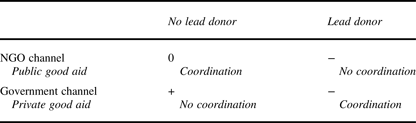
Looking at the right column of Table 2, which makes predictions for the sample with lead donors, we expect that ρ takes on a negative sign. Substantively, this means that donors reduce their own aid as other donors increase allocations. These substitution effects have different substantive implications depending on aid delivery channel—NGO aid has stronger public goods content. Substitution behavior therefore is evidence of free-riding and a lack of coordination. For government aid, which has more private good characteristics, substitution behavior provides evidence of collusive coordination practices among donors.
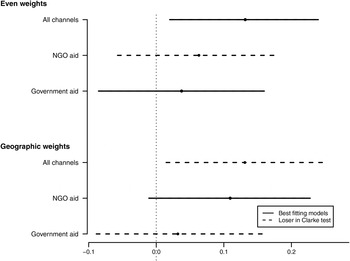
Turning to the results, for recipient countries without lead donor, Figure 4 shows point estimates for the connectivity parameter ρ and 95 percent confidence intervals. For each delivery channel I used the Clarke test to check which connectivity weight specification best fits the data. The winner of these pairwise Clarke tests is shown with solid lines, the underperforming models with dashed lines.
No lead donor, connectivity parameter ρ, 2004–2010

I find positive values for ρ across all delivery channels and connectivity weight specifications. Looking at aggregate aid provisions first (all channels), the parameter is statistically significant. Thus, donors provide more aid in reaction to aid increases by others. In line with the predictions from our theory (column 1 in Table 2), we therefore have evidence of donor competition. Aggregate aid allocations appear to be made in a competitive manner. This suggests that aggregate aid has private goods properties and that donors fail to coordinate.
However, my more fine-grained predictions about differences between delivery channels fail. Government aid does not appear to be more prone to competition. I argued that NGO aid has public goods properties. Donors therefore would coordinate to reduce free-riding (negative spill-ins) and drive down asymmetries in aid provision, and I predicted no spill-ins. Instead, with geographic connectivity weights, I have some weak evidence for spill-ins, but they are actually positive (p = 0.073). This casts some doubt on my assumption that NGO aid is more public goods oriented than government aid at all times. Without wanting to make too much of a statistically weak finding, from the perspective of the theory, this counts as evidence that donors compete with each other when they provide aid through NGO channels.
The clear evidence of positive spill-ins shows that in the absence of a lead donor, there is competition in the provision of aid. Since donor fragmentation is relatively high in the subsample, competition seems to contribute to fragmentation and coordination could help to reduce fragmentation. This is in line with arguments from the policy debate. I add to this the insight that the private benefits that donors derive from providing aid are the driving force behind fragmentation, and that coordination needs to address the resulting competitive relationship.
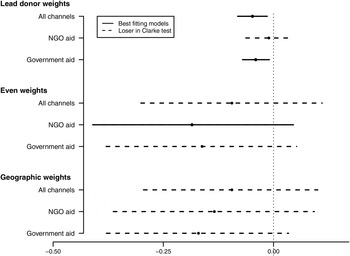
The next part of the analysis strongly suggests that lead donorship can reduce competition between donors. Figure 5 shows results for the subsample of cases with a lead donor. As before, solid lines indicate that a set of connectivity weights produces a better fit with the data than competing specifications. We find negative values of ρ in all model specifications. Thus, donors provide less aid in reaction to positive aid allocation decisions of other donors. These spill-ins are statistically significant only when I use theoretically motivated lead donor connectivity weights. For even and geographic connectivity weights, point estimates of spill-ins are substantively larger, but estimated with much more uncertainty. The connectivity weights specifications that best summarize the data also produce the statistically significant results. For government aid and aggregate aid, theoretical lead donor weights beat out even weights and geographic weights. For NGO aid, even weights perform best, followed by lead donor weights and geographic weights. The superior model performance of the lead donor weight specification and the fact that I recover smaller spill-ins with more precision increases the confidence in my findings.
With lead donor, connectivity parameter ρ, 2004–2010

I expected that lead donorship is associated with negative spill-ins (right column of Table 2), and I have strong evidence for this. Turning to the more fine-grained analysis of aid delivery channels, negative substitution effects are congruent with either collusion in a private goods scenario or free-riding in the absence of donor coordination with public goods aid. Two pieces of evidence support the collusion hypothesis. First, for aid in the NGO delivery channel, I do not find a statistically significant substitution effect. Under the assumption that NGO aid has a higher public goods content, uncoordinated donor actions driving substitution behavior should most clearly show up in this channel.
The second piece of evidence for collusion comes from the comparison of different connectivity weights. Although the theoretically driven lead donor weights fit best for government aid, for NGO aid even connectivity weights outperform all other specifications. This means that the strategic connectivity structure associated with lead donorship does not fit the data-generating process for this aid channel. I therefore can isolate the strategic interactions that give rise to lead donorship as occurring mainly in the government aid channel.
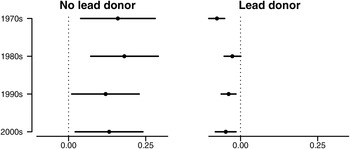
I now broaden our analysis to all years in the sample. I rerun the analysis for all aid channels, starting in 1970. I break up the data into subsamples, covering the 1970s, 1980s, and 1990s. Again, I average the dependent and all independent variables over the years in each subsample.
Figure 6 summarizes results. We see that both direction and size of spill-ins are stable over time. The magnitude of complementarities in aid provision for countries without a lead donor is somewhat larger during the cold war in the 1970s and 1980s, but the differences are not substantively significant. For lead donorship, substitution behavior varies even less, with the lowest observed value of ρ occurring in the 1970s. Taken together, the great continuity of spill-in patterns over time increases the confidence in my findings. The strategic interactions between donors are not dependent on a specific sample from a limited time period.
Connectivity parameter ρ, over time

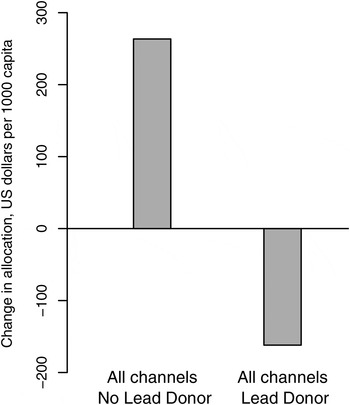
I next look at the substantive importance of complementarities and substitution effects. The bar plot in Figure 7 shows how much predicted aid allocations differ with and without spill-ins.Footnote 57
Substantive effect of spill-ins

The results are based on the time period 2004 to 2010, and I look at all delivery channels. Without a lead donor, competition increases aid allocations on average by $263 per $1,000 capita for each donor. In the presence of a lead donor, substitution behavior leads to a decrease of around $162 per $1,000 capita for each donor. All effect sizes are substantively meaningful. For comparison, in this time period, average aid allocations per donor are $3,660 per $1,000 capita. Thus, competition increases average aid allocations by about 7.7 percent, and collusion reduces average aid by about 4.24 percent.
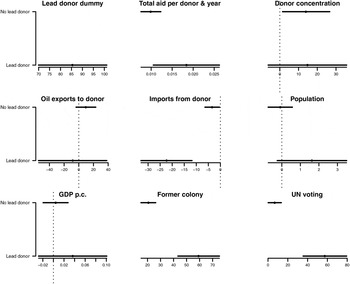
Now we turn to the other variables in the analysis. Figure 8 shows point estimates for all aid channels and the two subsamples. The reported values are based on the time period, 2004 to 2010. In the SAR model, parameter estimates are not equal to marginal effects, but they do represent marginal changes of the dependent variable for each observation, net of any complementarities or substitution effects.
Other variables, all aid delivery channels

The first three variables cover systemic characteristics of foreign aid provision. The lead donor dummy captures extra aid that cannot be attributed to strategic interactions. On average, each lead donor provides $85,400 per $1,000 capita in extra aid compared with other donors. The role of the lead donor as top aid contributor therefore is substantively very clear. Total yearly aid is an aggregate measure of all aid per individual donor across all recipient countries (measured in $100 millions). If a donor provides more aid overall, it also is more likely to give more to any specific country. The variable behaves in line with this expectation, with only minor differences with and without a lead donor.
Donor concentration (HHI of aid disbursements) is the same measure I used to measure lead donorship. According to my theory, lead donor fragmentation is either associated with competition (private goods aid) or coordination (public goods aid). In either case, more fragmentation should lead to higher aid allocations. In the subsample without a lead donor I find the opposite. Aid allocations are higher as donor concentration increases. The source of this counterintuitive result is unclear. It is not sensitive to my specific SAR setup and holds up in a simple ordinary least squares (OLS) analysis. In the lead donor subsample, the HHI variable is not statistically significant.
A number of control variables tap into the economic relationship between a donor and a recipient country. There is anecdotal evidence that western donors have supported oil-producing states to secure access to crude oil. Japan in particular has been identified with this practice.Footnote 58 However, I do not find that oil exporters are able to attract significantly more aid from recipient countries, both with and without a lead donor.Footnote 59
The next variable is designed to measure donor trading interests. It measures total trade from the donor to the recipient.Footnote 60 I include the trade variable because some evidence exists that donors provide aid to foster sales of goods and products.Footnote 61
In contrast, I find that total trade is associated with a decrease in aid allocations, and this decrease is stronger in countries with a lead donor. This is not a function of the strategic interactions built into the SAR setup because OLS generates substantively similar estimates. However, the results are highly sensitive to scaling. If I divide total trade by population, similar to the dependent variable, I obtain a strong positive and significant relationship. The recovered positive effect is stronger for the lead donor subsample. This is in line with my expectations that donors are better able to generate private benefits from aid when they collude in lead donorship countries. Without a lead donor, each dollar per capita in imports on average is associated with 0.26 cents of aid per capita. In countries with a lead donor, this number is 0.52 cents per capita in aid, or double the effect.
The next set of variables measures recipient needs. My theory generates no direct predictions for the effect of recipient needs. From a public goods perspective, aid should be sensitive to economic deprivation. In contrast, from a private goods perspective, opportunities for economic and political gains from aid should be greater in better-off countries.Footnote 62 I include GDP per capita and population size, but neither of the two tendencies plays itself out. There are no strongly significant effects, though population size is weakly positively associated (p = 0.085) with aid allocations in the lead donor sample.
The last set of control variables covers strategic relationships between donor and recipient countries. Similar to the economic variables, I expect that collusion allows lead donors to secure greater strategic advantages than would be possible in a more competitive aid environment. I find that former colonies receive more aid, and that this effect is significantly larger in lead donor countries. Though lead donorship is an understudied concept, aid practitioners have long accepted that former colonial powers continue to play a dominant role in their former colonies. My data confirm this insight. Importantly though, my analysis produces evidence for the strategic underpinnings of lead donorship even when I take into account these historic ties.
Joint vote shares in the UN General Assembly are indicative of aligned preferences,Footnote 63 but also capture influence due to structural power.Footnote 64 I expect that there should be a stronger association between aid and voting in lead donorship cases than with competition between donors. The analysis bears this out. With a lead donor, a one percentage point increase in joint voting is associated with a 57 cent increase in aid per $1,000 capita. Without a lead donor, the effect is much smaller, with a 6.8 cent increase.
Conclusion
In this article I addressed the lack of theoretical and empirical underpinnings of the contemporary debate on donor coordination and fragmentation. Distinguishing between the private and public goods content of aid is an important starting point for tracing out the different sets of incentives and strategic logics that underpin the possibility of coordination. Treating foreign aid as a black box undermines our ability to come to precise predictions and policy prescriptions. As such, my approach provides a theoretical basis for the growing literature that disaggregates aid by sector and delivery channel. Scholars of foreign aid should more explicitly address the dichotomy in the private versus public goods characteristics of aid.
My empirical analysis revealed a picture of donor coordination that is more differentiated than the blanket calls for more coordination in the fragmentation debate suggest. There is clearly a lack of coordination in a big subgroup of cases—those without lead donors. Often these cases are quite prominent and attract a lot of media attention and aid. But the patterns of aid provision show that this aid has primarily private goods characteristics, perhaps as donors compete for local bureaucratic resources or seek to increase the visibility of their aid programs. Donors compete in providing this type of aid. In this situation, donor coordination serves as an important step toward reducing fragmentation.
However, motivations for giving aid and delivery channels vary, and there are clear instances in which donors primarily care for developmental outcomes. The debate about donor fragmentation does not adequately address these cases of aid with public goods properties. One-size-fits-all solutions to problems of donor fragmentation might have unintended consequences for aid volumes if fragmentation results from implicit coordination that helps to overcome free-riding problems. More research into the characteristics of aid for different sectors and delivery channels is needed to shed light on this question.
Finally, I find convincing evidence that the presence of a lead donor helps to coordinate the behavior of other donors and is associated with reduced donor fragmentation. Coordination of aid under lead donorship is driven by a private goods logic. It appears as a viable solution to reduce competition and fragmentation. From a historic perspective, I found that lead donorship is in long-term decline, whereas uncoordinated competitive behavior is on the rise. On the basis of this analysis, the loss of well-defined spheres of influence among donors accounts for some of the increases in donor fragmentation over the past decades.
The practice of lead donorship during the Cold War conjures up notions of patronage that give rise to the question of whether fragmentation might not be the smaller of two evils. I do not take a position in this debate. At a minimum, it seems important to recognize that lead donorship presents a form of donor coordination that is capable of reducing fragmentation. Lasting donor-recipient ties might generate costs because of institutional capture and increased rent-extraction opportunities. These costs need to be weighed against the negative effects of donor fragmentation. As one source of these costs, both fragmentation and institutional capture decrease policy performance of governmental institutions. Future research could fruitfully compare these costs.
Another fascinating aspect of donor coordination is the entry of economically rising powers such as China into the aid arena. China is usually thought of as undermining the Western regime of aid conditionality. It uses aid to develop infrastructure and natural resources, with few political strings attached.Footnote 65 Its stated goal is to secure access to natural resources to fuel its economic ascent. From the perspective of coordination, China therefore might be unwilling to submit to old implicit agreements, especially with regard to spheres of influence. Thus the Chinese entry into the aid arena might help to further disturb existing agreements between western donor nations, and further accelerate the fragmentation of the aid arena. Like everything related to Chinese aid practice, a dearth of reliable data on Chinese aid makes studying these questions impractical for now.
Finally, I believe that my theoretical and empirical results have laid much-needed ground work for the future systematic study of the determinants of donor coordination. My typology of lead donor regimes raises important questions about why donor governments are able to preserve spheres of influence in some cases, while they end up competing in other instances. I suspect that recipient country characteristics in conjunction with historic processes account for much of the observed variation, but this awaits future research. Answers to these questions will play an important role in a more nuanced policy debate about donor fragmentation and coordination.
Supplementary Material
Replication data and an online appendix are available at http://dx.doi.org/10.1017/S0020818314000381.