Introduction
Head and neck cancers are defined as malignant mucosal tumours that occur in the pharynx and larynx. They can also arise in the nasal or oral cavities, paranasal sinuses, and salivary glands. It is estimated that there are approximately 550 000 new cases around the world annually.Reference Jemal, Bray, Center, Ferlay, Ward and Forman1 Although head and neck cancers vary in terms of anatomical sites and morphologies, more than 90 per cent of them are squamous cell carcinomas (SCCs) in terms of histology, and carcinogens such as tobacco and alcohol are the most critical risk factors for these tumours.Reference Argiris and Eng2 Recent studies have also identified the role of human papillomavirus (HPV) in the aetiology of some subtypes of head and neck SCCs.Reference Chaturvedi, Engels, Pfeiffer, Hernandez, Xiao and Kim3 Management of head and neck cancers is often multimodal, involving a combination of surgery, radiotherapy and chemotherapy.
In order to study the history, evolution and progression of head and neck cancer research and treatment, a bibliometric citation analysis can be performed. Bibliometric analysis is the study of the citational history of individual manuscripts on a subject of interest. It is one of the methods used to determine the most influential papers within a topic, mainly based on the number of citations and journal impact factor.
Bibliometric analyses have been used to identify the most influential scientific papers in different medical fields, including otolaryngology.Reference Fenton, Roy, Hughes and Jones4,Reference Saunders, Rymer and McNamara5 To the best of our knowledge, there has been no citation analysis in the area of head and neck cancer research and treatment that includes all types of studies. Therefore, the aim of this study was to conduct a bibliometric analysis to identify the top 100 most cited articles on head and neck cancer, in order to provide a perspective on the thematic foci of research in this field, and how they have changed over time.
Materials and methods
Thomson Reuters Web of Science citation indexing database and research platform was used to identify the top 100 articles in head and neck cancer by including the terms ‘head and neck cancer’, ‘head and neck neoplasms’, ‘head and neck malignancy’ or ‘neck cancer’. The results were first filtered to include only English language and full manuscripts and were then sorted by the number of citations. This method was developed by Paladugu et al.Reference Paladugu, Schein, Gardezi and Wise6 and was used in several other studies.Reference Ellul, Bullock, Abdelrahman, Powell, Witherspoon and Lewis7–Reference Chan, Mak, Chu, Hui and Kwan9 The 100 most cited manuscripts were identified from a large number of manuscripts returned. Before further evaluation, these manuscripts were then reviewed to exclude papers that were unrelated to or did not have a primary focus on head and neck cancer. Information including title, first author and senior author, institution of the first author, topic, year of publication, and the country of origin were reviewed and analysed. The individual and five-year impact factors in 2017 of each journal publishing the manuscripts were also recorded.
Results
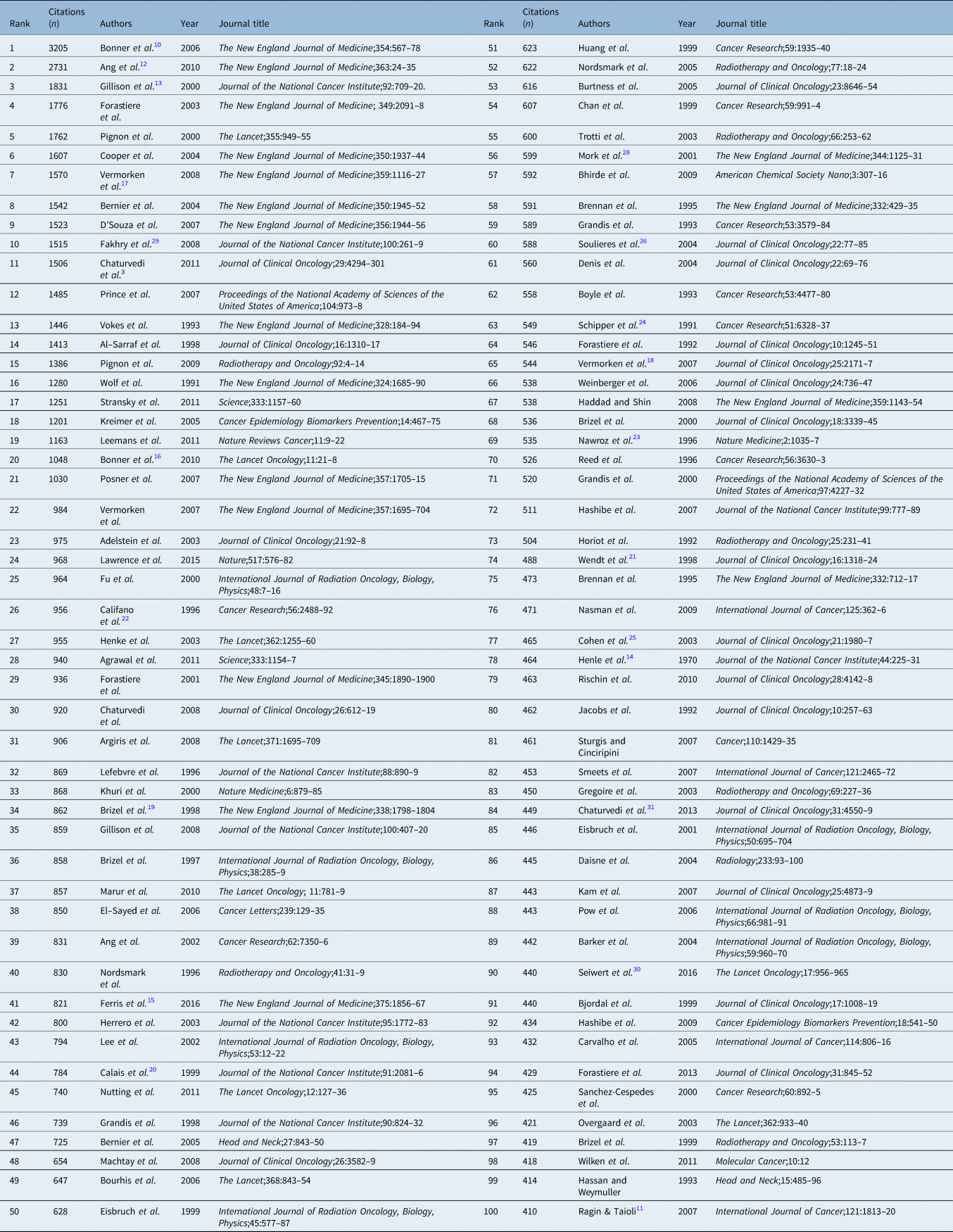
The Web of Science search returned 63 538 papers which fulfilled the criterion described above. Table 1 lists the top 100 papers with the highest number of citations. The mean and median citation number from the list are 828 and 626, respectively. The number of citations ranged from 3205 (Radiotherapy plus cetuximab for SCC of the head and neckReference Bonner, Harari, Giralt, Azarnia, Shin and Cohen10) to 410 (Survival of SCC of the head and neck in relation to HPV infection: review and meta-analysisReference Ragin and Taioli11).
The top 100 most cited articles in head and neck cancer

The most cited article was published by Bonner et al.Reference Bonner, Harari, Giralt, Azarnia, Shin and Cohen10 and was cited 3205 times. It compared the use of radiotherapy alone and radiotherapy plus cetuximab, an epidermal growth factor receptor antibody for treating locoregionally advanced SCCs of the head and neck. Following this are the papers by Ang et al.Reference Ang, Harris, Wheeler, Weber, Rosenthal and Nguyen-Tan12 (2731 citations) and Gillison et al.Reference Gillison, Koch, Capone, Spafford, Westra and Wu13 (1831 citations).
The oldest article on the list, which discussed antibodies to Epstein-Barr virus in head and neck cancer, was published in 1970.Reference Henle, Henle, Ho, Burtin, Cachin and Clifford14 The latest article on the list, ‘Nivolumab for recurrent squamous-cell carcinoma of the head and neck’, was published in 2016.Reference Ferris, Blumenschein, Fayette, Guigay, Colevas and Licitra15 The year with the greatest number of the publications was 2007, with a total number of 10 papers. Overall, there were 32 randomised trials and 19 basic science studies. The majority of the studies focused on the treatment of head and neck cancer and the relationship between HPV and head and neck cancer, with 45 and 16 papers focusing on these areas, respectively.
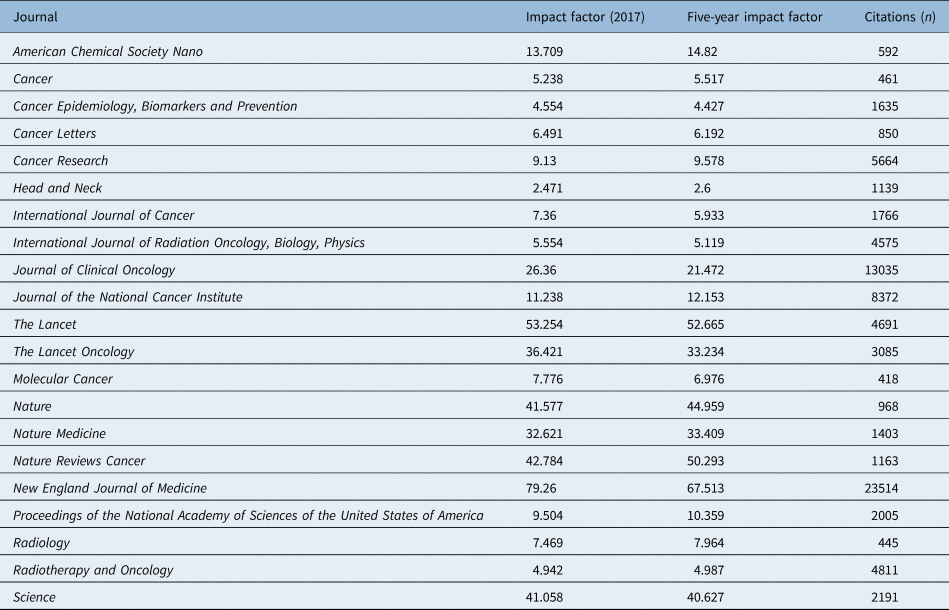
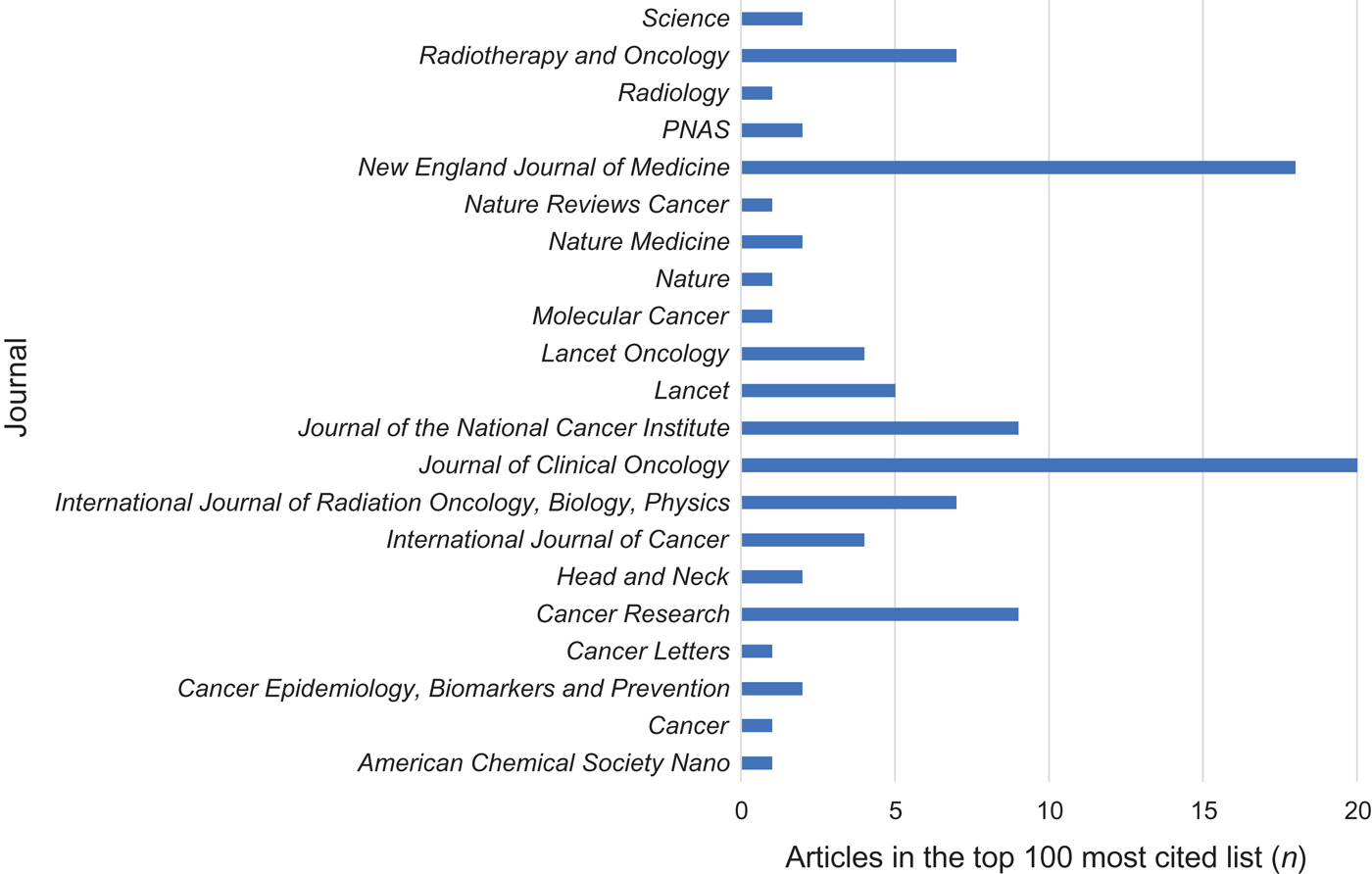
The top 100 papers were published across 21 journals (Table 2). The Journal of Clinical Oncology published the highest number of papers (20) on the list. This was followed by The New England Journal of Medicine, which published 18 papers. The New England Journal of Medicine also had the highest impact factor among the list of journals (79.26). Figure 1 shows the number of papers on the top 100 list by journal.
Journals with the top 100 cited manuscripts in head and neck cancer

Number of articles on the top 100 list by journal. PNAS = Proceedings of the National Academy of Sciences of the United States of America

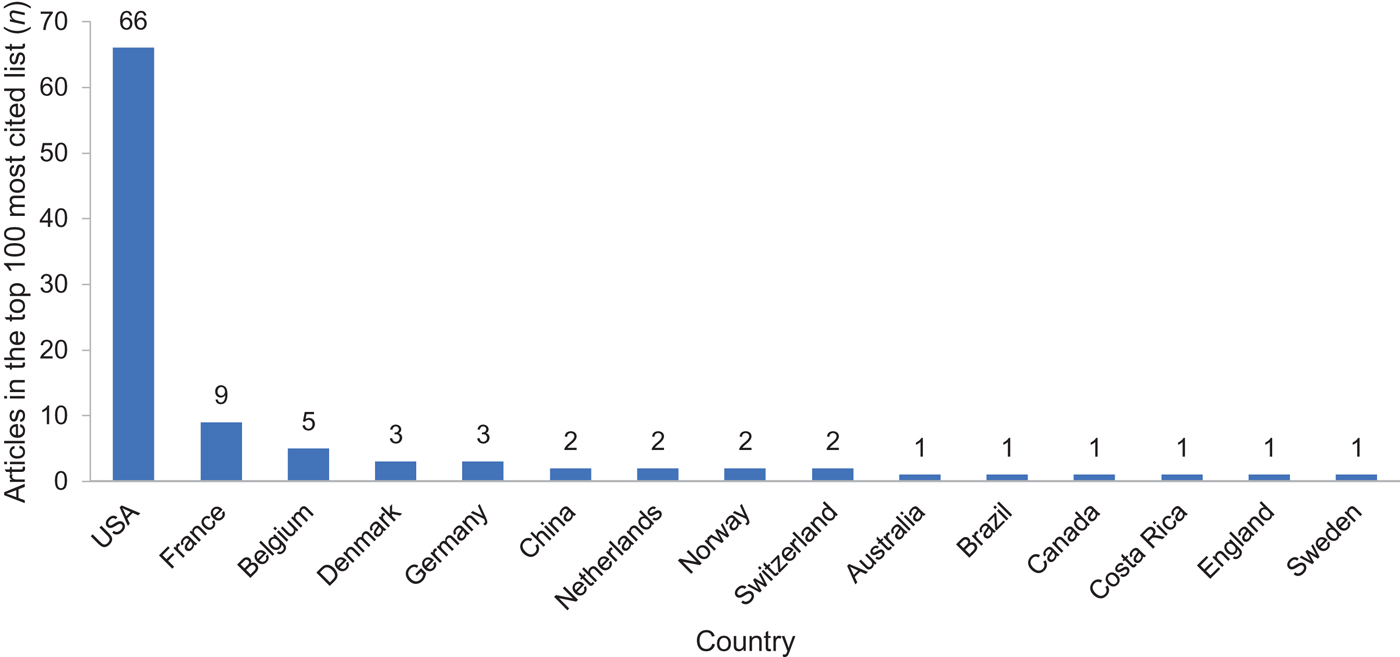
As shown in Figure 2, the USA published the greatest number of articles on the list (66), followed by France (9). There were 11 authors with more than two papers on the list. Brizel, DM (Professor of Radiation Oncology from the Duke Cancer Institute) and Forastiere, AA (Professor of Radiation Oncology and Otolaryngology/Head and Neck Surgery at the Johns Hopkins University School of Medicine) had the greatest number of papers on the top 100 list: they both contributed 4 papers. Chaturvedi, AK (Senior Investigator from the National Cancer Institute Division of Cancer Epidemiology and Genetics, Clinical Genetics Branch) and Grandis, JR (Professor in the Department of Otolaryngology from the University of California) published three papers each on the list.
Country of origin of the top 100 most cited papers.

Discussion
It is known that head and neck cancers are one of the most common malignancies, and they contribute to around 300 000 deaths each year.Reference Jemal, Bray, Center, Ferlay, Ward and Forman1 As mentioned above, 90 per cent of the tumours are squamous in origin. This is also reflected in head and neck cancer research as more than 80 per cent of the top 100 cited articles focused on SCCs. A more in-depth bibliometric analysis of head and neck cancer research to date offers the reader some interesting insights into this field of study, its history and how treatment for head and neck cancer has evolved over the years.
The most cited paper on the list was published in The New England Journal of Medicine by Bonner et al.Reference Bonner, Harari, Giralt, Azarnia, Shin and Cohen10 in 2006. This paper described a randomised trial comparing radiotherapy alone with radiotherapy plus cetuximab in the treatment of locoregionally advanced head and neck SCC. Their results showed that radiotherapy plus cetuximab improves locoregional control and reduces mortality, without increasing common radiotherapy-related toxic effects.
The second most cited article was by Ang et al.Reference Ang, Harris, Wheeler, Weber, Rosenthal and Nguyen-Tan12 in 2010 in the The New England Journal of Medicine. In their retrospective analysis, the authors investigated the association between tumour HPV status and survival among patients with stage III or IV oropharyngeal SCC. The study reported a higher survival rate and lower risk of death in HPV-positive tumours. This landmark paper also provided strong evidence for HPV testing in oropharyngeal SCCs, which contributed to current routine practice and the use of cyclin-dependent kinase inhibitor p16 as a prognostic biomarker.
The third most cited paper was published by Gillison et al.Reference Gillison, Koch, Capone, Spafford, Westra and Wu13 in 2000, in the Journal of the National Cancer Institute. The authors retrospectively evaluated the relationship between HPV and head and neck cancer, focusing on the aetiological role of HPV in head and neck SCCs. They concluded that HPV-positive oropharyngeal cancers are causally associated with HPV infection and comprise a distinct disease entity.
When considering citation numbers of the top 100 cited articles, there is a significant discrepancy between the citation numbers of the top two cited papers (3205 and 2731) and the rest of the papers on the list (range, 410–1831). The number of citations for the most cited paper was approximately 4 times that of the mean citation number of the list (828) and 5 times that of the median (626). These trends may reflect the attention that clinicians and researchers have on the effectiveness and outcomes of treatment with cetuximab, an epidermal growth factor receptor inhibitor, in head and neck cancers. This is shown by the fact that several other articles on the top 100 list also involved cetuximab as part of their studies.Reference Bonner, Harari, Giralt, Cohen, Jones and Sur16–Reference Vermorken, Trigo, Hitt, Koralewski, Diaz-Rubio and Rolland18
To evaluate the quality and influence of the top 100 cited papers, a review of the journals represented by the top 100 articles list and their respective journal impact factors could be performed. Journal impact factors are formed on the basis of citations from within the scientific community, as they are the quantification of the average citations received by articles published in a journal during a specified period. More influential papers are more likely to be cited. Hence journals with higher impact factors are likely to contain more influential articles. This idea is supported by the fact that 8 of the top 10 most cited papers were from 2 journals with very high impact factors of more than 50 (The New England Journal of Medicine and The Lancet) and that these two journals contributed nearly one-fourth of the papers on the list. As expected, this shows that high impact factor journals heavily influence head and neck cancer research through their high-quality publications. Nevertheless, it would be of value for future research to identify the association between citation numbers and clinical influence, by determining whether papers with higher citation numbers are more regularly incorporated into clinical practice.
The oldest article on the list was published by Henle et al.Reference Henle, Henle, Ho, Burtin, Cachin and Clifford14 in 1970, in the Journal of the National Cancer Institute. The authors titrated serum samples that were prospectively collected from head and neck cancer patients and control groups from several countries, to look for antibodies to Epstein–Barr virus. The data confirmed an unusually high frequency of anti-Epstein–Barr virus titres among patients with nasopharyngeal carcinoma. On the other hand, the most recent paper was a randomised phase 3 trial published by Ferris et al.Reference Ferris, Blumenschein, Fayette, Guigay, Colevas and Licitra15 in The New England Journal of Medicine in 2016. This study compared treatment outcomes of nivolumab, an anti-programmed death 1 monoclonal antibody, with standard single-agent therapy for patients with recurrent or metastatic head and neck SCCs after platinum chemotherapy. They concluded that nivolumab leads to prolonged overall survival for these patients.
The comparison of different treatment modalities for head and neck cancers is also a common theme observed when analysing the recurrent topics represented within the list. Almost a third of the papers on the list compared different treatment methods, with chemotherapy being the most heavily studied subject. Another recurrent theme is the relationship between HPV and head and neck cancers, with 16 of the 100 papers published focusing on this area. Most of these papers focused on the association between HPV and different subgroups of head and neck cancers, or the prognosis of HPV-positive head and neck cancers.
Examining the manuscripts on the list by decade shows some interesting trends in the progression of head and neck cancer research. Papers from the 1990s focused on the comparison of different treatment modalities for head and neck cancers. Several randomised trials from this decade compared treatment outcomes of radiotherapy alone versus concomitant radiotherapy and chemotherapyReference Brizel, Albers, Fisher, Scher, Richtsmeier and Hars19–Reference Wendt, Grabenbauer, Rodel, Thiel, Aydin and Rohloff21 in head and neck SCCs, highlighting the importance of chemotherapy in the treatment of head and neck cancers. A few laboratory studies looking into the basic science and genetics of head and neck cancers were also published during this period.Reference Califano, van der Riet, Westra, Nawroz, Clayman and Piantadosi22–Reference Schipper, Frixen, Behrens, Unger, Jahnke and Birchmeier24 Randomised studies comparing different treatment methods remained an essential focus among papers published in the 2000s. Instead of merely focusing on the widely available traditional treatments, more papers looked into the development of novel therapeutic agents, such as selective epidermal growth factor receptor tyrosine kinase inhibitors.Reference Cohen, Rosen, Stadler, Recant, Stenson and Huo25,Reference Soulieres, Senzer, Vokes, Hidalgo, Agarwala and Siu26 It is also during this period that articles investigating the relationship between HPV and head and neck cancers started to appear on the list,Reference Gillison, Koch, Capone, Spafford, Westra and Wu13,Reference Herrero, Castellsague, Pawlita, Lissowska, Kee and Balaram27,Reference Mork, Lie, Glattre, Hallmans, Jellum and Koskela28 with some of them reporting a better prognosis in patients with HPV-positive head and neck SCCs.Reference Ragin and Taioli11,Reference Fakhry, Westra, Li, Cmelak, Ridge and Pinto29 A similar pattern is seen for manuscripts published in the 2010s, as a number of them also examined the roles of potential new drugsReference Ferris, Blumenschein, Fayette, Guigay, Colevas and Licitra15,Reference Seiwert, Burtness, Mehra, Weiss, Berger and Eder30 and the relationship between HPV and the rising incidences of oral cavity and oropharyngeal cancers.Reference Chaturvedi, Engels, Pfeiffer, Hernandez, Xiao and Kim3,Reference Chaturvedi, Anderson, Lortet-Tieulent, Curado, Ferlay and Franceschi31
An analysis of the papers according to the country of origin was also performed. As mentioned above, the USA contributed more than 65 per cent of the top 100 articles in head and neck cancer. This phenomenon is also seen in other bibliometric analyses in otolaryngology.Reference Fenton, Roy, Hughes and Jones4,Reference Saunders, Rymer and McNamara5 Ellul et al.Reference Ellul, Bullock, Abdelrahman, Powell, Witherspoon and Lewis7 attributed this trend to the preference of USA institutions to cite ‘local research’ in their citation analysis on emergency abdominal surgery. They pointed out that the USA has an influential research culture in medical training, which encourages the integration of research with clinical practice. Moreover, in a large-scale bibliometric study of prospective head and neck SCC therapeutic research that investigated the effects of study sponsorship on the publication in this field,Reference Sun, Houlton, Moloci, MacEachern, Bradford and Prince32 it is found that the USA produced the highest number of publications and that the National Institutes of Health was the second largest sponsor of the research overall.
There are several limitations to our study. Some articles might have received multiple or disproportionate citations due to institutional bias, language bias, powerful-person bias or self-citation. This effect might also have been fortified by limiting results to English language papers during the article search process. Moreover, citation numbers are often influenced by the age of paper. Having been in the public domain for a more extended period, older papers might have accumulated a higher number of citations. As for more recent influential papers, more time is needed to accumulate citations due to publication lead-time for their citing manuscript. However, more than 70 of the top 100 cited papers on our list were from 2000 onwards, with the most recent article published in 2016. This confirms the importance and influence of the more recent articles and suggests that publication time bias might not be as significant in the field of head and neck cancer research.
In summary, this article provides an overview of some of the most influential papers in the study of head and neck cancers despite the above flaws of bibliometric analyses. It offers some insight into the progression of our understanding of head and neck cancers as well as treatment and related research. For those who currently contribute to the development of the literature surrounding head and neck cancer, this paper highlighted some essential patterns and objectives represented in the literature and thus serves as an indicator and guide for them. This analysis could inform future research priorities as well as stimulate discussion within the scientific community.
Conclusion
The most cited manuscripts highlighted in the current study describe research relating to the basic science, genetics, aetiological factors and treatment of head and neck cancer that have resulted in the current understanding and management of the disease. Most articles are published in high impact journals and have been cited at least 400 times. The most cited paper by Bonner et al.Reference Bonner, Harari, Giralt, Azarnia, Shin and Cohen10 described a randomised trial evaluating cetuximab in the treatment of locoregionally advanced head and neck SCC. This bibliometric analysis provides the most influential references related to head and neck cancer research and serves as a guide as to what makes a ‘citable’ paper in this field of study.
Competing interests
None declared