Introduction
The family policy field – in particular its politicisation and renegotiation of parenthood – is a main battleground for scientific and political disputes about gender equality. Some scholars argue in favour of ‘symmetrical’ parenthood, advocating a dual earner/dual carer model where women and men engage symmetrically in paid work and unpaid caregiving (Gornick and Meyers, Reference Gornick and Meyers2008). Inequalities within the family around the domestic division of labour, especially caregiving, are seen as main obstacles to achieving symmetrical parenthood and thus gender equality (Crompton, Reference Crompton, Gornick and Meyers2009). Other scholars give preference to expanding parental ‘choice’ to accommodate various gender arrangements among diverse citizens (Orloff, Reference Orloff, Gornick and Meyers2009). The assumptions that women's emancipation demands dissolution of the gendered division of labour, and that asymmetry is associated with inequality and symmetry with equality, are questioned.
These competing normative positions – symmetrical or ‘equal’ parenthood versus parental ‘choice’ – are also present in current political struggles, including the reform of parental leave schemes. Paid parental leave is a key family policy; it is widespread, but different policy rationales and changes over a considerable length of time have generated significant variation in forms of leave.Footnote 1 Parental leave schemes are part of the redesign of the welfare state supporting working parenthood, although the relationship between employment, care and gender is still contentious (Moss and Kamerman, Reference Moss, Kamerman, Kamerman and Moss2009). At the centre of contemporary policy debate is earmarked leave entitlements for fathers, with the aim of increasing gender symmetry in caregiving. These so-called ‘daddy quotas’ have been the hallmark of gender egalitarian welfare states of the Nordic type, but are now increasingly debated, and even adopted, in other types of welfare state (e.g. Germany, see Fleckenstein, Reference Fleckenstein2011).
Struggles over extensions to the daddy quota in Norway offer a lens for investigating how the leading edge of the debate on fathers’, and mothers’, leave entitlements is unfolding. Here, I examine the reception in 2008 of a proposal to divide the existing leave into three equal parts aimed at substantially increasing the fathers’ earmarked part of the leave. What ideas did political actors bring forward in support versus rejection of the reform? Which ones succeeded in influencing the political outcome?
Ideas and political outcomes
Why are ideational struggles important in understanding parental leave reform? My study relates to a growing body of research seeking to demonstrate the importance of ideas in policy analysis (for a recent overview, see Béland and Cox, Reference Béland, Cox, Béland and Cox2011). Policy ideas are important because welfare state policies are embedded in moral and symbolic orders that influence their development (Steensland, Reference Steensland2006). Ideas shape how we understand political problems, give definition to our goals and strategies and provide us with interpretive frameworks (Béland and Cox, Reference Béland, Cox, Béland and Cox2011). Orloff and Palier (Reference Orloff and Palier2009) maintain that a central contribution from feminist welfare state scholars has been advancing our understanding of the relationship between ideational processes and welfare regimes, describing and interpreting processes where ideas, discourse and ideologies impact on welfare reforms and the ways in which culturally given gendered categories and conceptions inform political outcomes (e.g. Béland, Reference Béland2009; Fleckenstein, Reference Fleckenstein2011; Jenson, Reference Jenson2009; Padamsee, Reference Padamsee2009).
Policy struggle is important because it directs attention to tensions in the formal policy institutions studied here, pressuring for change. Struggles are going on over the continued existence of prevailing institutional arrangements (Mahoney and Thelen, Reference Mahoney and Thelen2010). Still, in the study of welfare state development, historical institutionalism and the thesis of path-dependency have been influential in focusing on the mechanisms keeping policies on the same track (Mahoney, Reference Mahoney2000). Many new institutionalists (see Hall and Taylor (Reference Hall and Taylor1996) for a discussion of historical, rational choice and sociological institutionalism) have latched onto ideas about countering the static and deterministic nature of explanations resting on premises about institutions as stable equilibria and self-enforcing historical paths (Schmidt, Reference Schmidt2008). Family policy trajectories are shaped by tensions and struggles over values and cultural categories such as ‘gender equality’, ‘parental choice’, ‘the best interests of the child’, ‘working mothers’, ‘stay at home mothers’ and ‘caring fathers’. Competing policy rationales reflect different assumptions about childhood, motherhood and fatherhood (Deven and Moss, Reference Deven and Moss2002). To make sense of differences in parental leave schemes, we need to go beyond the structural and the institutional to the processual and the political, Moss and Kamerman (Reference Moss, Kamerman, Kamerman and Moss2009) maintain.
The framework of my empirical analysis is based on two scholars central to the study of ideas and politics, namely John Campbell and Vivien Schmidt. To comprehend how ideas affect policy making, they need to be analytically partitioned and empirically demonstrated (Campbell, Reference Campbell2002). Following Campbell, the approach taken here is to compare different policy positions and their frames in a single policy debate in order to determine whether different frames affected which policy received the most support.
Ideas are usually classified at three levels (Schmidt, Reference Schmidt2008: 306). The level analysed here is specific policies, or ‘policy solutions’ proposed by policy makers. The second level encompasses more general programmes that underpin the policy ideas: paradigms reflecting the underlying assumptions orienting policy. Programmatic ideas are at a more basic level because they define the problems to be solved by such policies. Ideas at the third level – public philosophies – are even more basic, i.e. worldviews that support policies and programmes with organising ideas, values and principles of knowledge and society. My analysis differentiates between ideas in the background versus the foreground of the debate (Campbell, Reference Campbell1998): ideas can be underlying and sometimes taken for granted assumptions residing in the background of policy debates, but they can also be concepts and theories located in the foreground where they are explicitly articulated. Ideas in the background may be visible but remain largely accepted and unquestioned, while ideas in the foreground are routinely contested as a normal part of any policy debate. My analysis distinguishes between two types of idea: cognitive and normative. Cognitive ideas specify cause–effects, while normative ideas express values and attitudes (Campbell, Reference Campbell1998). Thus cognitive ideas express ‘what is and what to do’, while normative ideas are assumptions about ‘what is good and bad about what is’ (Schmidt, Reference Schmidt2008: 306). Cognitive ideas – or causal ideas – give recipes and guidelines for political action and serve to legitimise specific policies and programmes.
Individual parental leave allocation
Paid parental leave recognises the care responsibilities of members of the labour force, and began in the late nineteenth century as maternity leave rights protecting maternal and infant health (Moss and Kamerman, Reference Moss, Kamerman, Kamerman and Moss2009). Since the 1970s, parental leave has emerged, i.e. leave allocated to the family for the care of young children, supporting social care. Today, most welfare states offer parental leave supported by a variety of aims: pronatalist, family welfare, children's right to parental care or gender equality – or even conflicting combinations of these. For children, infant health (breastfeeding), the need (or right) for parental care and of forming a child–mother/child–father attachment may be emphasised. For mothers, parental leave may support maternal health (recuperation after birth), time to care and establish the mother–child attachment and continuous employment. For fathers, parental leave promotes involvement in childcare and an early establishment of father–child attachment. Long absences from work may challenge the interests of employers, however. If parental leave is mainly used by mothers, women can risk being statistically discriminated against because employers may prefer male workers, especially for positions that require investment in firm-specific human capital (e.g. Mandel and Seymonov, Reference Mandel and Seymonov2006).
The goal of ‘equal’ parenthood – a more equal distribution of employment and care among parents – was at the centre of the replacement of maternity leave by parental leave in the Nordic countries in the 1970s and in the introduction of daddy quotas in the 1990s (Ellingsæter, Reference Ellingsæter2009). Parental leave meant that parents could apportion most of the leave between them, but fathers did not increase their uptake of it.Footnote 2 The response was the innovation of ‘daddy quotas’; earmarked leave for fathers on a use it or lose it basis. This instituted an individual component in the allocation of parental leave, which up to then had been a joint family-based right. It has been argued that, while family-based leave entitlements enable gender equality, reducing obstacles to women to combine employment and children and make it easier for men to engage in caregiving, only individual entitlements promote gender equality by putting pressure on families to share childcare more equally (Brighouse and Wright, Reference Brighouse and Wright2008). Moving towards an individual allocation of parental leave has emerged as a prominent issue in scholarly parental leave reform thinking. Gornick and Meyers (Reference Gornick and Meyers2008), for example, advocate individualised and entirely non-transferable leave; mothers and fathers should be given six months of leave each that they may not transfer to their partners.
Until recently, earmarked leave for fathers has been a distinct Nordic policy element. Norway, as the first country to implement the policy, introduced a four-week daddy quota in 1993; Sweden's ‘daddy month’ came in 1995, and in Denmark a two-week daddy quota was implemented in 1998. Iceland's three months’ daddy quota was introduced in 2000 to 2003 as part of a model dividing leave into three parts; the daddy quota, three months reserved for the mother and the remaining three months shared as the parents preferred. Finland introduced a conditional daddy month in 2003, i.e. provided that the father took two weeks at the end of the joint parental leave, he would get two weeks extra as a bonus. The daddy quotas in Norway, Sweden and Finland have since been extended, while the Danish quota was abolished in 2002 by a centre-right government maintaining that quotas inhibited ‘choice’ (Borchorst, Reference Borchorst, Ellingsæter and Leira2006).Footnote 3 Daddy quotas have been contended, but they have had indisputable effects on fathers’ leave take-up. It is the presence of the father's quota that creates the success of involving Nordic fathers in early care of their young children, according to Haas and Rostgaard (Reference Haas and Rostgaard2011). Still, while almost all eligible fathers use their quota, mothers continue to take up most of the total leave days. Worries have been growing over the potential negative impact of women's long leaves on their labour market opportunities, careers and wages (NOU, 2008).
Proposal: a three-part division of leave
Daddy quotas have been controversial in Norway - generating passionate public debate. First, a brief background of the dispute studied here: the daddy quota of 1993 was ‘state feminism’ at work, launched by a minority social democratic government (Brundtland III) as a ‘loving force’ changing the practices of men. The quota was supported by the Socialist Left Party and parties at the political centre: the Centre Party (original agrarian base), the Liberal Party and the Christian Democratic Party. The main aim was to obtain a more just distribution of mothers’ and fathers’ caring time, and to strengthen the father–child relationship (Ellingsæter, Reference Ellingsæter2007). The Christian Democrats emphasised that it would increase men's recognition and valorisation of care work. The Conservative Party and the Progress Party, both right of the political centre, opposed the quota because it denied parental ‘choice’ and ‘punished’ families who did not use it. The daddy quota remained at four weeks for more than a decade, but its extension has been part of an on-going political discourse on parental leave reform. When finally extended by a week in 2005, it was by a minority centre-right government (Bondevik II), with the intention of strengthening the father–child relationship.
One more week came in 2006, this time by a majority centre-left government (Stoltenberg II), emphasising fathers’ caregiving as a precondition for improving mothers’ employment opportunities.Footnote 4 Both daddy weeks were added to the total leave. The 2005 reform stated explicitly that quota extension within the existing leave would be unfortunate; it would reduce parental choice and curtail established rights (for mothers). Both reforms were supported by all political parties, except the Progress Party, which rejected it on the grounds of parental ‘choice’.
The reform proposal studied here was launched in a report from a government expert commission on equal pay in 2008 (NOU, 2008). The commission's mandate was to examine wage differences between women and men, to discuss the causes of these differences and to consider reforms. Inspired by the ‘Icelandic arrangement’, the commission proposed that the existing parental leave should be divided into three equal parts: one-third reserved for the father, one-third for the mother and one-third to be shared at the parents’ discretion.
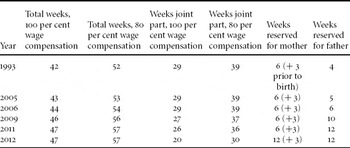
The commission's proposed three-part division implied a reallocation of leave entitlements within the existing leave, i.e. the extension in leave earmarked for the father (and the mother) would be taken from the joint part of the parental leave. According to the then existing scheme, parents could choose total leave of forty-four weeks at 100 per cent wage compensation or fifty-four weeks at 80 per cent (up to a ceilingFootnote 5); the daddy quota was six weeks, while six weeks was reserved for mothers (plus three weeks prior to birth) (Table 1). The father's right to leave is dependent on the economic activity of the mother: to be entitled to the daddy quota, both the mother and the father have to have been in paid work during at least six of the ten months prior to the birth, and the mother in at least 50 per cent employment (this latter requirement was removed in 2010). The father's right to take up parental leave beyond the daddy quota, i.e. the joint part of the leave, is conditional on the mother's economic activity after birth (at least 75 per cent in paid work or education). Mothers who are not entitled to parental leave benefits receive a lump sum.Footnote 6 The commission's proposal meant that depending on the choice between 100 per cent and 80 per cent wage compensation, 14.5 or eighteen weeks would be reserved as an individual entitlement for the mother and the father, while 14.5 or eighteen weeks could be shared as the parents preferred. The mother would thus get a maximum leave of twenty-nine or thirty-six weeks, about seven or eight months.
Paid parental leave in Norway 1993–2012, weeks

The main aim of the proposal was based on a normative idea of gender equality; time out of the labour market in connection with birth and childcare was to be distributed more equally between mothers and fathers (NOU, 2008: 225). This was underpinned by cognitive ideas, i.e. empirical descriptions specifying cause–effect relations between mothers’ uptake of long leave and lower wages and weaker labour market position. First, ‘leave arrangements that can be shared at the parents’ discretion are almost always taken up by mothers, and earmarked daddy quotas have proved effective in getting fathers to take up the leave’ (NOU, 2008: 226). Second, earmarked leave ‘gives fathers stronger rights vis-à-vis their employers . . . fathers may encounter negative reactions in the work place . . . The daddy quota . . . acts as an “already negotiated” boundary against work life demands’ (NOU, 2008: 226). Third, a more equal distribution of parental leave will ‘make women and men more equal in the situation as job seeker. In the future, an employer will have to perceive a young woman and a young man that seek a job in an approximately similar way when it comes to the risk that they will leave on parental leave’ (NOU, 2008: 226).
Objections to the proposal were anticipated by the commission, reflecting opinions expressed in the public debate. One was a concern for mothers’ breastfeeding. The commission maintained: ‘families that wish exclusively to breastfeed the child for the first six months, as recommended by the health authorities, can do so. The mother can . . . take a maximum of eight months . . . provided that the family takes parental leave with reduced wage compensation (80 per cent), like the large majority do today’ (NOU, 2008: 226).Footnote 7 A second was related to family economy. For many, the reform might involve ‘a real loss of income’, ‘when the father – and not the mother – “has to stay” away from work for at least four months’, because the parental leave scheme does not fully compensate lost income and more fathers than mothers have earnings above the ceiling (NOU, 2008: 226).Footnote 8 A third was the role of the state. The reform might be perceived as an ‘exaggerated state intervention in the private sphere of the family’; many think the family knows best how to care for children. One of the commission's experts rejected the majority's proposed three-part division of leave, maintaining that: ‘The measure will imply state intervention in a decision that traditionally has been considered a private matter. Flexibility in private life is reduced and replaced by more state and legislated standardisation’ (NOU, 2008: 247).
Reform reception: political actors and data sources
The parental leave policy-making process is complex and involves multiple actors and stakeholders (Moss and Kamerman, Reference Moss, Kamerman, Kamerman and Moss2009). The public debate about the commission's proposal involved a wide number of actors. However, my analysis concentrates on three important groups of political actors: Members of Parliament (MPs), social partners and state ombudsmen. In Norway, parental leave is legislated by Parliament, thus MPs representing political parties are the main political actors. In 2008, a centre-left majority coalition government was in office, comprising the Labour Party, the Socialist Left Party and the Centre Party, also called the red-green government (Stoltenberg II). The centre-right opposition parties included the Christian Democratic Party, the Liberal Party, the Conservative Party and the Progress Party. The Norwegian corporative model encompasses social partners with considerable political influence on employment-related issues; here representatives of employer and employee federations are included. Moreover, the mandate of the state ombudsman is partly to exert political influence on the public discourse and two central ombudsmen are included in the analysis: one for Children and one for Equality and Anti-discrimination.
The empirical analysis is based on newspaper articles and published remarks from the consultation round following the commission's report. Both the newspaper articles and the written comments vary with respect to breadth and depth of argument. The reception among MPs is covered by newspaper interviews and articles at the time of the launching of the report. A search in the media archive A-tekst was used.Footnote 9 The material for the other political actors comes from written remarks to the then Ministry of Children and Equality.Footnote 10 Included in the analysis are eleven employee federations/associations, six employer federations and two ombudsmen. The employee federations are the LO (the Norwegian Federation of Trade Unions), Unio (the Confederation of Unions for Professionals), YS (the Confederation of Vocational Unions), Akademikerne (the Federation of Norwegian Professional Associations), NITO (the Norwegian Society of Engineers and Technologists) and some of these federations’ national member associations. Associated with LO are NTL (the Trade union for workers in the public sector), the Norwegian Union of School Employees; with Unio the Norwegian Nurses Organisation (NNO), the Norwegian Association of Researchers (NAR), the Norwegian Association of Clergy; and with YS the Librarian's Union in Norway. Employer federations/associations included are KS (the Norwegian Association of Local and Regional Authorities), NHO (the Confederation of Norwegian Enterprises), HSH (the Federation of Norwegian Commercial and Service Enterprises), Spekter (the Employers’ Association Spekter), FA (the Norwegian Employers’ Association for the Financial Sector), and Bedriftsforbundet (the Confederation of Norwegian Industry).
Ideas in the background: ‘equal’ parenthood
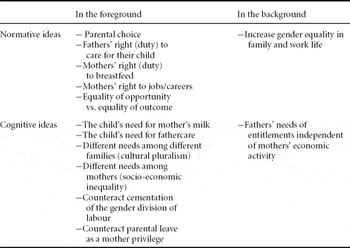
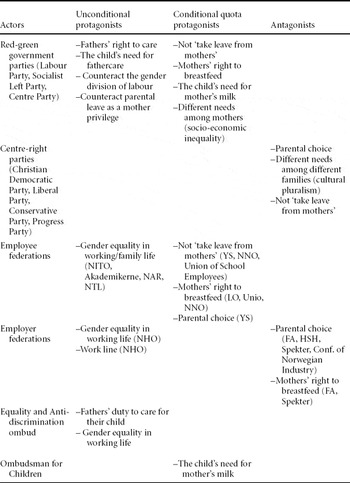
An overview of the many ideas circulating in the debate is presented in Table 2. Ideas are classified as normative versus cognitive, and as residing in the background versus the foreground of the debate. Ideas sorted by political actors are outlined in Table 3.
Ideas in the reception of the proposal of a three-part division of parental leave

Actors and ideas in the reception of the proposal of a three-part division of parental leave

Two ideas residing in the background appeared as consensual. One was the normative aim of increasing gender equality in unpaid caregiving and paid work. Hence ‘equal’ parenthood in the sense of more equal caregiving appears as an undisputed goal. For quota protagonists, the aim of increasing gender equality appeared as a self-evident rationale. For quota antagonists, supporting ‘equal’ parenthood was a legitimate basis for rejecting leave quotas as a policy measure. Quota antagonists for example argued that it was important ‘to facilitate a higher degree of gender equality in the home’ and encourage ‘measures that contribute to a strengthening of women's labour market participation’.Footnote 11 It is quotas or individual leave entitlements as policy measures that are rejected. The strengthening of fathers’ individual entitlements by other measures, e.g. that the father should have a right to the daddy quota independently of the mother's economic activity before birth, appeared as a universal cognitive claim among both protagonists and antagonists.
The controversy over the proposed three-part division generated three main positions: (1) unconditional protagonists: those in favour of a three-part division within the existing leave; (2) conditional quota protagonists: those in favour of an extension of the daddy quota, but not within the existing leave − many suggested other models for dividing leave; (3) antagonists: those who opposed the three-part division of leave and other models for apportioning leave. A few of these wanted an extended daddy quota added to the existing leave, however. In the following section, the main ideas supporting these three positions are examined.
Unconditional reform protagonists: a father's rights paradigm
Unconditional support for the three-part division model was found among MPs belonging to the government parties, some social partners and one state ombud.
Many MPs from the red-green government parties received the proposed three-part division with open arms. The atmosphere was optimistic. It was reported that several MPs in the Labour Party had become protagonists: ‘I am positively surprised over how many are for a three-part division in our party. I hope and believe that the government will go for a three-part division.’Footnote 12 In the Centre Party, several MPs were reported to be ‘on the move’. The MP protagonists were dominated by a normative fathers’ right paradigm: a father's right to be a care person and to have a fair share of the parental leave. This paradigm was associated with a cognitive idea about the child's need for fathercare, anchored in a normative idea about ‘the best interests of the child’. Also, cognitive ideas about the negative long-term effect, the cementation of an unequal gender division of labour in early parenthood and the necessity to counter practices where the joint part of the parental leave is considered a mother privilege were activated in the debate.Footnote 13
The following quotes demonstrate these ideas among the MPs: One maintained that:
The current leave is a parental leave, and it is obvious that the father should have a much larger share of it. Today he is put off with six weeks. I think it is more important to manage to get more leave to fathers than extending the total leave . . . A three-part division is right out of the concern for both the child and the father. In addition, it has an enormously important side-effect, that is to contribute to strengthening mothers’ role in working life.
Moreover,
the father . . . does not get to know his child as well as the mother. This again does something with the division of labour at home. The mother takes the main responsibility for children and is parked in relation to job and career, while the man works more overtime and his career is furthered.
The MP argues further that women see parental leave as their right, but:
It's wrong. If we want equal pay, we must clear a place for the man at home. If women are to use their competence and education, they have to give the man a chance. All women should see that this is a win-win situation for them.
Another stated:
Today it is talk about the equal pay aspect, but I think concern for the child is just as important. It is good for children to be with their father a lot, also in the first year.
A third maintained that:
the current daddy quota works only partially. Often the daddy quota is taken up during the mother's holiday, when the mother often cares for the child . . . The point is that father and child have time together alone. I think that the father will then take more of the ordinary housework. It has to be kept in mind that the parental leave is not mother's leave. If fathers gets one-third of the leave, then they just get more of the leave parents are supposed to share.’
Among social partners, the largest employer federation in the private sector, NHO, was the only employer organisation that supported the proposal unconditionally, based on a normative aim of gender equality supported by a cognitive claim about society's need for labour supply:
NHO supports the proposal to divide the leave after the Icelandic model. In the opinion of the NHO this will support the legitimacy of parental leave for both genders . . . It can help women get back more quickly into working life. One of the reasons why women lag behind in wage levels is that they have longer durations outside working life than men do.’Footnote 14
The NHO rejected an extension of the total leave out of concern for society's total labour supply: ‘The consequence is that 5000 man-years are withdrawn from the labour market’; an extension ‘does not contribute to gender equality and is in conflict with the work line’.Footnote 15 The silence among other actors over concern related to the ‘work line’, incentives to increase employment, guiding all other Norwegian welfare policies, is striking. The largest public employer federation, KS, supported quotas for fathers, but did not comment explicitly on the three-part model, which might be interpreted as a rejection.Footnote 16
Some employee associations were positive, all with members with relatively high levels of education.Footnote 17 Gender equality in working life and family life was the normative rationale, and the cognitive idea of a three-part division as an efficient measure ‘to give a more equal division of parental leave between mothers and fathers’ was predominant. Although a three-part division of leave within the existing leave was first priority, some stated that they would have preferred the total leave to have been extended at the same time.
The Equality and Anti-discrimination ombud was an active proponent of the proposal. The underlying normative idea was first of all gender equality and fathers’ duty, not the right, to care: ‘a more equal sharing of parental leave is important for women to have the same opportunities as men in working life and for men to take a larger responsibility for the care work’.Footnote 18
Conditional quota protagonists: a mother's rights paradigm
Several political actors – in particular from the government parties and employee federations – supported extension of the daddy quota in principle, but not within the existing length of leave. The dominating normative paradigm for this position was mothers’ rights and the ‘best interests of the child’, based on cognitive ideas about the length of leave required for mothers’ needs for physical restitution and breastfeeding, and the child's need for mothers’ milk. The proposed reform was expected to have a negative impact on mothers’ breastfeeding practices and thus infant health. The joint parental leave period was perceived as a customary mummy leave; extending fathers’ individual leave within the existing leave was to ‘take away leave from mothers’. Different needs among mothers were also brought into the debate, referring to socio-economic differences in jobs that could be combined with continued breastfeeding.Footnote 19
There was disagreement about the commission's model within the government parties; not all wanted to ‘push fathers back home’.Footnote 20 The most powerful politicians did not support the commission's proposal. MP and leader of the Socialist Left Party claimed that ‘only six months of leave [would] be scant for many women’; MP and leader of the Centre Party leader stated that ‘it is not sure that we go for a three-part division’.Footnote 21 The Minister of Children and Equality in charge of follow-up of the report, and the Prime Minister, both Labour, were against the proposed model. The Minister of Children and Equality had taken up office only a few days after the commission report was launched. In contrast to two previous ministers who had been supportive of a three-part division, the new minister declared that the commission ‘goes too far’.Footnote 22 She argued for a ‘moderate form of sharing’, but that this
must not lead to women only having a maximum of six months of leave. Many women need rest after giving birth, both for their own restitution and for breastfeeding and taking care of the child. They should have the opportunity to do so. At the same time, the father has to stay more at home.
The Minister claimed that a three-part division would be particularly hard for women with low education and ordinary jobs, because they more often take the shorter leave at 100 per cent pay and have jobs that are more difficult to combine with continued breastfeeding.Footnote 23 The Prime Minister immediately rejected the proposal, claiming that leave should not ‘be taken from mothers’: ‘mothers who take up leave with full wages must return to working life after only a little more than six months, many will experience this as too short a time’.Footnote 24 Red-green protagonists reacted strongly to this ‘demonstrative’ intervention perceived as an attempt to stop the entire debate before it started.Footnote 25
Many actors suggested other ‘quota’ models based on an extension of the total leave. One main premise for all these models was that the health authorities’ breastfeeding recommendation could be accommodated, i.e. exclusive breastfeeding of the child for the first six months, and breastfeeding with supplementary food until the child was at least one year old. The National competence centre for breastfeeding has been influential in defining the implications for the division of parental leave:
Women have to be secured the opportunity to exclusively breastfeed for six months. In addition, a transition period of a couple of months is needed to gradually wean the child on to other food and liquid, that is, at least eight months after birth . . . The proposal of a three-part division in the existing leave will be a clear hindrance for women to breastfeed in accordance with the health authority recommendations.Footnote 26
All alternative quota models suggested implied that leave available for mothers should be at least eight months. The joint part of leave in all these models was thus perceived as belonging to mothers. The LO, the largest and most powerful employee federation, motivated its alternative quota model by the ‘attention to women's need for restitution, [and] give more opportunities for breastfeeding’.Footnote 27 Unio, another federation, maintained that ‘the daddy quota must be extended and this should be prioritised. However . . . one should consider extending the total leave so that women's opportunities for restitution after birth or to follow the national breastfeeding recommendations are taken care of’.Footnote 28 The Ombudsman for Children emphasised that it was important to attend to ‘a child's health needs’ and that women who wished to could breastfeed according to the recommendations, quoting the requirements laid down by the National competence centre for breastfeeding.
Antagonists: a parental ‘choice’ paradigm
The parliamentary opposition – parties at the right and at the political centre – united against the commission proposal. The main normative position of the parties on the right was ‘hard core’ liberalism – emphasising a clear limit for state intervention in the private sphere. MP and leader of the Conservative party considered implementation of the proposal as ‘state encroachment and brutal coercion against families’ freedom to decide for themselves how to organise life’; ‘then we start regulating in detail people's family life in a way I think politicians must stay away from’. In a similar vein, an MP from the Progress Party argued that the family should have freedom to decide who should stay at home with the baby, ‘it is not the role of the state to regulate this in detail’. An MP from the Christian Democratic Party was milder in her rejection, maintaining that when fathers’ get the taste of staying at home, their take up of leave will increase, making regulation unnecessary, while MP and leader of the party evidently supported daddy quota extension, asking for the government's announced extension of the daddy quota, but not by ‘taking mother's leave to give to the father’.Footnote 29
The Conservative Party also argued that
the family should have flexibility to choose what suited them best . . . Different families have different preconditions and needs in the leave period. To force the same solution on all is senseless and expresses distrust in people knowing their own best interests.Footnote 30
This is another idea of parental ‘choice’, based on a cognitive perception of cultural pluralism among families. The idea was not completely unfamiliar to red-green MPs either; one argued that:
a three-part leave would bring the man more forward, but I am more a supporter of flexibility and freedom of choice. For many there may be other solutions that fit better. I am sceptical of locking this into models that do not function for the individual.Footnote 31
Some smaller employer federations rejected the proposal on the basis of a normative liberalist position. One of them warns against the proposal's ‘regulation and bureaucratisation’ and the ‘totally unacceptable encroachment in the private right of labour division in families’; ‘encroachment on what we considered a private matter’.Footnote 32 Other employer federations appeared more ambivalent, weighting parental ‘choice’ against gender equality. One of them maintains that the main focus should be to:
facilitate equal opportunities instead of equality of outcome, and safeguard that both genders can make independent, real and free choices . . . When it comes to the three-part division of leave we find it difficult to balance the concerns of families’ freedom of choice and the degree of state regulation of private life against the need to level off wage differences among women and men.
Some of the employer federations ended up supporting extended daddy quotas, but not within the existing length of leave. Sometimes, the distinction between conditional quota protagonists versus quota antagonists was blurred.
Some employee federations balanced normative ideas of parental ‘choice’ and equality of outcome/gender equality against each other. YS perceived
both advantages and disadvantages of the proposal. On the one hand, such an arrangement could speed up the development toward equal parenthood which otherwise would take a very long time; on the other hand, this could be experienced as a negative encroachment on the family's freedom to organise life as they preferred.
Moreover it is best ‘to extend the total leave without letting it go at the expense of the mother's existing leave opportunities’.Footnote 33
Rivalling ideational paradigms, persisting struggles
Any further advancement of the individual allocation of parental leave in the Nordic countries is followed with great interest in the family policy debates in other countries. The present Norwegian study of the responses from important political actors to an expert commission proposing to divide the existing parental leave into three equal parts broadens our insights into normative and cognitive ideational obstacles furthering advancement of individual parental leave allocation and how cultural ideas interact with power resources. It also demonstrates that national case studies of ideational processes are vital in explaining family policy change and stability.
A wide variety of normative values and cognitive claims were put forward by reform protagonists and antagonists. Ideas figuring in the background of the debate indicated consensus about a normative aim of ‘equal’ parenthood, in the sense that more gender equality in caregiving and in the labour market was seen as desirable. At the forefront of the debate, ideational struggles over how to proceed politically to achieve ‘equal’ parenthood were enacted. Three main rivalling policy paradigms were identified: unconditional reform protagonists promoted ‘fathers’ rights to care’. Conditional quota protagonists, proposing other models for leave division based on an extended total leave, advocated ‘mothers’ rights’ to a long leave and time to breastfeed. Reform antagonists based their rejection on ideas about parental ‘choice’.
The fathers’ rights paradigm's normative claim is for fathers to have the same rights and opportunities to care as mothers. The cognitive claim is that fathers need to establish closer relationships with their children, and that children need fathers’ care. Reducing parental leave as a mother's privilege counteracts cementation of the gender division of labour. Some emphasise fathers’ duty to care in order to strengthen the position of women in the labour market. The mothers’ rights paradigm is founded on the cognitive idea that mothers need long leave, first of all to fulfil the health authorities’ breastfeeding recommendation. The joint part of the leave is considered as customary ‘mummy leave’; the reform proposal was considered ‘taking leave away from mothers’. Mothers’ rights are sometimes positioned in class terms; long leave is necessary for working-class mothers in hard and inflexible jobs that are difficult to combine with continued breastfeeding. The parental ‘choice’ paradigm is based on negative metaphors like coercion, encroachment and detail regulation. Setting limits on the state's intervention in the private sphere was the conception of ‘choice’ mostly activated. This is a normative idea where choice is an aim in itself, and the consequences of individual choices become irrelevant. A cognitive idea of choice was based on cultural pluralism among families. The empirical validity of this idea was not questioned in the debate, although very different families in reality make very similar and traditional choices in dividing parental leave.
Politically most successful was the conditional quota protagonists guided by the mothers’ rights paradigm. The political aim of the red-green majority coalition in office in 2009–2013 was to introduce daddy quota of fourteen weeks, combined with an extension of the total leave to 48 weeks/100 per cent wage compensation or 58 weeks/80 per cent wage compensation. This model allows the mother to stay at home for eight months with full wage compensation, thus accommodating the breastfeeding recommendation. Recent reforms have moved towards this goal (Table 1): In 2009, the daddy quota was extended from six to ten weeks and in 2011 from ten to twelve weeks. Of the six weeks added, three weeks were taken from the joint part of the leave, while three weeks were added to the total leave. From 2012, there is also a mother quota of twelve weeks, the aim being to make it more explicit that the joint part of the leave belongs to both parents.
When stressing the need to reform and promote alternatives, policy entrepreneurs draw on existing ideological repertoires to frame these alternatives (Béland, Reference Béland2005). Public policies can thus be understood as the result of political conflicts in which particular elements of national culture and ideological repertoires are enacted and mobilised into policy (Lieberman, Reference Lieberman2002). Moreover, political outcomes are influenced by the positional advantages and access to resources that competing ideas are embedded in (Hall, Reference Hall1993). Cultural dispositions of incumbents of structurally powerful positions are thus vital (Steensland, Reference Steensland2006).
A main normative divide in the debate followed well-established positions, between the social democratic idea of equality of outcome versus the liberalist idea of limited state ‘intervention’. The first position was supported by political parties left of the political centre, employee federations and the two state ombud, the second by politicians right of the political centre, some employer federations and one employer federation. Some employer and employee federations found it difficult to strike a balance between the two. The other divide, between unconditional and conditional quota protagonists, reflects a new type of conflict over the limits of ‘equal’ parenthood. However, the tension between expanding fathers’ right (or duty) to care and mothers’ right (or duty) to breastfeed has a link to the classical feminist tension between ‘equality’ and ‘difference’; i.e., strategies considering gender differences irrelevant versus strategies assuming that women as a group have common needs and interests (Ellingsæter, Reference Ellingsæter, Scott, Crompton and Lyonette2010). The strong prominence of mothers’ rights and breastfeeding has historical roots in a ‘progressive maternalism’ in Norway, policies upgrading the role of mothers (Hagemann, Reference Hagemann and Hagemann2007). Improving the social conditions of motherhood, especially working motherhood, has been at the core of Scandinavian ‘state feminism’ (Ellingsæter, Reference Ellingsæter, Scott, Crompton and Lyonette2010). The mothers’ right paradigm was most successful because it was advocated by the most powerful actors, by the prime minster and party leaders in a centre-right majority government, and also supported by the main employee federation.
Since the 2008 debate, the parental leave discourse has become even more polarised. While the Progress Party has been the only persistent quota antagonist, the Conservative Party has left its somewhat more pragmatic stance, and now advocates the abolishment of the daddy quota. In contrast, some MPs left of the political centre advocate full individualisation of parental leave. Opinion polls indicate varying popular support for further daddy quota extensions, however, reflecting significant discursive space for parental ‘choice’. Family policies are particularly vital in the competition for electoral support, and future disputes over parental leave reform may be fought along the left–right political divide of quota protagonists and antagonists.