

Introduction
Obsessive-compulsive disorder (OCD) is an often chronic disorder with reported lifetime and 12-month prevalence rates of 2–3% and 1–2%, respectively (Kessler, Petukhova, Sampson, Zaslavsky, & Wittchen, Reference Kessler, Petukhova, Sampson, Zaslavsky and Wittchen2012). OCD is characterised by persistent, time-consuming obsessions, and/or compulsions, which have a debilitating impact on many aspects of daily functioning, including relationships and quality of life (Remmerswaal, Batelaan, Smit, van Oppen, & van Balkom, Reference Remmerswaal, Batelaan, Smit, van Oppen and van Balkom2016). It is now accepted that OCD is not caused by the presence of intrusions per se; rather, it is the way that these intrusions are appraised that leads to, and maintains, OCD symptoms (Grøtte et al., Reference Grøtte, Solem, Vogel, Güzey, Hansen and Myers2015). In fact, studies with non-clinical participants report that around 80–90% experience unwanted and unpleasant thought intrusions at some time in their life making them a common occurrence for most people (i.e., Purdon & Clark, Reference Purdon and Clark1993; Rachman & de Silva, Reference Rachman and de Silva1978). For some people, however, the intrusions are misinterpreted, which leads to the formation and maintenance of the OCD cycle (Grøtte et al., Reference Grøtte, Solem, Vogel, Güzey, Hansen and Myers2015). Frost et al. (Reference Frost, Steketee, Amir, Bouvard, Carmin, Clark and Yaryura-Tobias1997) identified six belief domains important in OCD; inflated responsibility, over-importance of thoughts, excessive concern about the importance of controlling one's thoughts, overestimation of threat, intolerance of uncertainty, and perfectionism.
Despite theoretical and clinical progress in the field, OCD remains challenging to treat effectively (Fisher, Reference Fisher2009; Rees & van Koesveld, Reference Rees and van Koesveld2008). According to expert consensus guidelines for OCD treatment, cognitive-behavioural therapy (CBT), and exposure and response prevention (ERP) are the recommended first-line treatments for mild to moderate OCD, and should be combined with pharmacotherapy for more severe cases (American Psychiatric Association, 2013; National Institute for Health and Clinical Excellence, 2005).
Both CBT and ERP are undoubtedly efficacious: around 70% of those completing ERP treatment in clinical trials show some improvement, with an average pre–post-symptom reduction of 48% (Abramowitz, Franklin, & Foa, Reference Abramowitz, Franklin and Foa2002; Eddy, Dutra, Bradley, & Western, Reference Eddy, Dutra, Bradley and Western2004). However, these figures obscure several limitations: the majority of those treated with ERP remain symptomatic after treatment, its aversive nature leads to high refusal and attrition rates, and there is a large minority of completers who are non-responsive (Olatunji, Deacon, & Abramowitz, Reference Olatunji, Deacon and Abramowitz2009; Ong, Clyde, Bluett, Levin, & Twohig, Reference Ong, Clyde, Bluett, Levin and Twohig2016; Schruers, Koning, Luermans, Haack, & Griez, Reference Schruers, Koning, Luermans, Haack and Griez2005). In their review of OCD long-term outcome (mean follow-up was 4.9 years), Sharma, Thennarasu, and Reddy (Reference Sharma, Thennarasu and Reddy2014) reported a pooled remission rate of 53% (95% CI 42, 65%).
Although aspects of metacognition have been present in models of OCD for a number of years (i.e., Purdon & Clark, Reference Purdon and Clark1993), more recently an explicit focus and investigation of metacognitions has been proposed as a way to enhance the efficacy of traditional cognitive therapy (Fisher & Wells, Reference Fisher and Wells2008). Metacognitive perspectives of OCD emphasise the significance of ‘faulty’ thinking processes and appraisals in the formation and exacerbation of OCD (Fisher & Wells, Reference Fisher and Wells2008). These maladaptive metacognitive beliefs include thought-fusion beliefs (such as: ‘thinking something increases the likelihood of it occurring’), as well as beliefs about the importance and controllability of thoughts. Because of these faulty metacognitive beliefs, a failure to control thoughts may be interpreted as a sign that an intrusion is particularly significant or threatening, thus requiring increased effort to monitor and bring it under control (Fisher & Wells, Reference Fisher and Wells2008). This cycle of suppression attempts meet with inevitable failure, prompt increased suppression attempts, paradoxically increasing the salience, frequency, and distress of the intrusion (Clark, Reference Clark2004).
A metacognitive approach focusses on challenging the relationship clients have with their thoughts, impulses, and beliefs, rather than challenging the specific content (as in standard cognitive therapy) (Wells, Reference Wells2009). This approach enables clinicians to circumvent the time-consuming process of cataloguing and challenging each specific obsession, furthermore, MCT is applicable across OCD subtypes and presentations. Also, MCT does not utilise ERP strategies thereby bypassing the known challenges associated with ERP for clients and therapists (Fisher & Wells, Reference Fisher and Wells2008). As described by Rees and van Koesveld (Reference Rees and van Koesveld2008), the metacognitive approach reshapes clients’ relationships with their thoughts, focussing on the idea that thoughts are not facts, and therefore do not need to be engaged with. To achieve this, MCT utilises psychoeducation to normalise the experience of intrusions and skills such as ‘detached mindfulness’ and behavioural experiments to alter maladaptive metacognitive beliefs (Fisher & Wells, Reference Fisher and Wells2005b).
By addressing the underlying metacognitive beliefs and processes which are maintaining the disorder, it is proposed that MCT can be an effective method for treating OCD. More research has been called for in the application of MCT in clinical settings, to test its viability as an alternative or adjunct to current treatments (Fisher, Reference Fisher2009).
Empirical Support for Metacognition in OCD
There are a growing number of studies supporting the role of metacognition in the development and persistence of OCD. A range of metacognitive beliefs, such as thought-fusion beliefs, and beliefs about the perceived danger of thoughts, have been found to be significantly correlated with OCD symptoms (see Rees & Anderson, Reference Rees and Anderson2013 for a review). In a test of their metacognitive model, Fisher and Wells (Reference Fisher and Wells2005a) compared ERP with brief behavioural experiments — exposure exercises designed to challenge metacognitive beliefs, rather than to habituate anxiety — and reported finding that the behavioural experiments were more effective than ERP in reducing anxiety, including the desire to neutralise thoughts and thought-fusion beliefs. Similarly, Solem, Håland, Vogel, Hansen, and Wells (Reference Solem, Håland, Vogel, Hansen and Wells2009) demonstrated that the therapeutic benefits of ERP were actually explained and predicted by changes in metacognitive beliefs. Furthermore, there is increasing evidence that improvement of OCD symptoms is better explained by underlying metacognitive processes than factors from other dominant theories. Regression analyses from the Solem et al. (Reference Solem, Håland, Vogel, Hansen and Wells2009) clinical study showed that change in metacognitions not only accounted for a large portion (22%) of the variance in post-treatment symptoms, but also that metacognitions emerged as the only independent predictor of symptomatic change, over and above change in cognitive factors (responsibility and perfectionism). Similar studies have shown that metacognitions, such as thought-fusion beliefs are involved in the formation of OCD (Myers et al., Reference Myers, Grøtte, Haseth, Guzey, Hansen, Vogel and Solem2017), as well as mediating the relationship between responsibility and symptoms (Gwilliam, Wells, & Cartwright-Hatton, Reference Gwilliam, Wells and Cartwright-Hatton2004).
Although there is growing theoretical and empirical support for metacognitive theory, most of the literature focuses on exploring and understanding the role of metacognitions in OCD. Empirical evidence for metacognitive therapy (MCT) for individuals with OCD comes from single case series studies (Fisher & Wells, Reference Fisher and Wells2008; Simons, Schneider, & Herpertz-Dahlmann, Reference Simons, Schneider and Herpertz-Dahlmann2006), an open trial (van der Heiden, van Rossen, Dekker, Damstra, & Deen, Reference van der Heiden, van Rossen, Dekker, Damstra and Deen2016) and a pilot randomised trial (Glombiewski, Hansmeier, Haberkamp, Rief, & Exner, Reference Glombiewski, Hansmeier, Haberkamp, Rief and Exner2021). In their small case series study of MCT for OCD, Fisher and Wells (Reference Fisher and Wells2008) reported large treatment gains, with an average improvement of 70% on the Yale-Brown Obsessive-Compulsive Scale (YBOCS). In their pilot study, which was conducted in an OCD outpatient setting, van der Heiden et al. (Reference van der Heiden, van Rossen, Dekker, Damstra and Deen2016) reported that MCT resulted in 74% participants reaching clinically significant improvement based on YBOCS-SR at the end treatment and 80% at follow-up (Baer, Reference Baer2000). Finally, Glombiewski et al. (Reference Glombiewski, Hansmeier, Haberkamp, Rief and Exner2021) examined the efficacy of individual MCT and ERP for OCD in a pilot randomised trial. These researchers reported similar outcomes (with large effect sizes) for the two treatments. Of interest, participants in the MCT condition required less face-to-face time with a therapist than those in the ERP condition.
Group Therapy
There are several potential benefits to delivering OCD treatment in a group format including group dynamics, cost-effectiveness, and utilising a limited resource of skilled therapists in an efficient manner (Himle, van Etten, & Fischer, Reference Himle, van Etten and Fischer2003). The dynamics of a group format can help to foster peer support, encouragement, and modelling from the other members, as well as contributing to the normalisation and destigmatisation of OCD symptoms — a crucial foundation of the MCT approach (Rees & van Koesveld, Reference Rees and van Koesveld2008). Rees (Reference Rees2009) reported that one key component of being in a group is that clients realise they are not alone in their OCD experience, helping to counter feelings of shame and being ‘different’. From a practical perspective, delivering treatment to a group also has the benefit of time-efficiency. Treating several clients at a time not only means clients receive treatment faster, but it also means that the overall contact hours per client is significantly reduced (Himle et al., Reference Himle, van Etten and Fischer2003). This also translates into cost savings, as time-intensive treatment is delivered to multiple clients at one time.
There is increasing evidence of the excellent performance of other group-based therapies for OCD (Anderson & Rees, Reference Anderson and Rees2007; Jónsson & Hougaard, Reference Jónsson and Hougaard2009). A systematic review and meta-analysis of group OCD treatment by Jónsson and Hougaard (Reference Jónsson and Hougaard2009), which included CBT with or without ERP, found an average pre–post-treatment effect size of 1.18 across 13 eligible studies. All of these studies utilised the YBOCS (either clinically rated or self-report version), with an average pre–post decrease of 7.5 points. The authors concluded that more research into the efficacy of group therapy, vis-à-vis individual therapy is needed, however that group-based treatment is certainly effective. A later study by the same authors found that, although the pre–post effect sizes seemed larger for individual treatment (Jonsson, Hougaard, & Bennedsen, Reference Jonsson, Hougaard and Bennedsen2011), the difference was not statistically significant, which is in line with previous findings. In a review of dropout rates and efficacy of group versus individual CBT for OCD, Pozza and Dèttore (Reference Pozza and Dèttore2017) reported that group CBT was as effective as individual CBT.
To date, only a few studies have examined group MCT for OCD. Rees and van Koesveld (Reference Rees and van Koesveld2008) conducted a small study of eight participants with OCD. At follow-up, the average improvement on the YBOCS was 61%. Papageorgiou et al. (Reference Papageorgiou, Carlile, Thorgaard, Waring, Haslam, Horne and Wells2018) reported on a clinical audit conducted in an adult (18 years or older) outpatient service where patients received either group CBT (n = 125) or MCT (n = 95). These researchers reported higher rates of clinically significant improvement in MCT compared to CBT at the end of treatment; response rates were 86% for MCT and 64% for CBT. Therapy was over 12 weeks and the primary outcome measure in this study was the YBOCS (Bayer, Brown-Beasley, Soruce, & Henriques, Reference Bayer, Brown-Beasley, Soruce and Henriques1993). Papageorgiou et al. did not report a follow-up assessment in their study. More recently, Miegel, Demiralay, Moritz, et al. (Reference Miegel, Demiralay, Moritz, Wirtz, Hottenrott and Jelinek2020) conducted a pilot study of metacognitive group training for OCD over a period of 4 weeks. Metacognitive training is one component of MCT and focuses on modifying client's beliefs about the importance of thoughts. Symptom reduction at the end of the session showed medium to large effect sizes (d = 0.061–1.67) across outcome measures which remained stable over a 6-month follow-up. In a further controlled trial of group MCT training compared to a control group with OCD, Miegel, Demiralay, Sure, et al. (Reference Miegel, Demiralay, Sure, Moritz, Hottenrott, Cludius and Jelinek2020) reported a moderate effect (η p2 = 0.078) in the treatment group from baseline to end treatment.
In summary, there is substantial evidence supporting the metacognitive model in OCD, with a few initial studies suggesting that MCT may be an effective alternative treatment for patients with OCD. Given the documented advantages of group treatment, the aim of the current research was to examine the effectiveness of MCT in a clinical adult group setting, at the end of treatment and also at a follow-up 3 months post-treatment. In addition to contributing to the emerging research in this area, we also aimed to improve OCD treatment services by examining an alternative treatment option in a real-world clinical setting.
Method
Design
This study was an open trial of outpatient group MCT for adults with OCD. Participants were assessed at pre-treatment, at the end of group treatment and at the 3-month follow-up.
Participants
All adults with a primary diagnosis of OCD were considered for inclusion in this OCD group treatment study at the Anxiety Disorders Service, an outpatient Specialist Mental Health Service. All potentially eligible participants were assessed to ensure their suitability for group treatment before being invited to join the study treatment group. If eligible participants declined group treatment, they were offered individual treatment consistent with the normal protocol of the Service. The sample size consisted of eligible patients consenting to participate in a group within the study 2.5 year time frame. This time frame was dictated by pragmatic constraints related to service capacity (staff availability).
The diagnostic interview was a standard psychiatric assessment, based on DSM-IV criteria, that is used for all patients referred to the service, and was completed by clinical psychologists, nurse therapists, and psychiatrists who were all experienced in the assessment and treatment of OCD. Participants were not excluded if they were taking prescribed psychoactive medication. Exclusion criteria were: the presence of a significant substance abuse disorder, a significant risk of harm to self or others, or presence of significant cognitive impairment.
Twenty-six adults consented to the group treatment and completed baseline questionnaires. Four participants withdrew early in the treatment phase. Twenty-two participants (14 females; 8 males) completed the treatment programme. Each group consisted of two therapists and between two and six participants (group 1 n = 4, group 2 n = 2, group 3 n = 5, group 4 n = 6, group 5 n = 5 treatment completers). Groups could include up to six participants but treatment groups started with fewer participants due to time passing and the need to deliver treatment in a timely manner. Participants were allocated to the next available group following their assessment and providing signed consent.
Measures
At pre-treatment, clinicians saw each participant individually, completing a detailed diagnosis and behavioural analysis, as well as collecting demographic information (age, gender, ethnicity, education, occupation, relationship status, and medication use). The following measures were self-reported at pre-treatment, post-treatment and at the 3-month follow-up.
Obsessive-Compulsive Symptoms
The YBOCS-SR is a self-report measure of symptom severity (Baer, Reference Baer2000). Each of the 10-items on the severity scale are rated on a 5-point scale from 0 to 4. Total scores range from 0 to 40. Severity rating cut-offs are: 0–7 subclinical, 8–15 mild, 16–23 moderate, 24–32 severe, 33–40 extreme (Steketee, Frost, & Bogart, Reference Steketee, Frost and Bogart1996). The self-report (SR) version of the YBOCS shows good convergent validity with the clinician-administered version, and good internal consistency and test–retest reliability (Steketee et al., Reference Steketee, Frost and Bogart1996). Internal consistency data for the YBOCS-SR in this study were good for the YBOCS-SR total (alpha = 0.78) and the Obsessions subscale (alpha = 0.85), and acceptable for the Rituals subscale (alpha = 0.65).
Padua Inventory–Washington State University Revision (PI-WSUR; Burns, Keortge, Formea, & Sternberger, Reference Burns, Keortge, Formea and Sternberger1996) is a 39-item, self-report scale of obsessions and compulsions, consisting of five subscales: obsessional thoughts to harm self/others, obsessional impulses to harm self/others, contamination obsessions and washing compulsions, checking compulsions and dressing/grooming compulsions. The total score — a sum of all 39 items — ranges from 0 to 156. Burns et al. (Reference Burns, Keortge, Formea and Sternberger1996) reported a mean score of 54.93 (SD = 16.72) for an OCD sample. The PI-WSUR total score has been shown to have excellent test–retest reliability and internal consistency, with the subscale internal consistency ranging from fair (obsessional thoughts to harm self/others) to good (checking compulsions) for a normative sample (Burns et al., Reference Burns, Keortge, Formea and Sternberger1996). Internal consistency data for the PI-WSUR subscales in this study were excellent for the total score (alpha = 0.90) and good for the four subscales: obsessional thoughts to harm self/others (alpha = 0.80), obsessional impulses to harm self/others (alpha = 0.84), contamination obsessions and washing compulsions (alpha = 0.81), checking compulsions (alpha = 0.85), while the dressing/grooming compulsions subscale (which only has three items) had acceptable internal consistency (alpha = 0.70).
The OCD-S (Wells, Reference Wells2009) is a self-report and has four subscales, and is focused on the past week and each subscale item is rated on a 0–8 scale. The OCD-S was included in this study to supplement existing assessment measures. Subscale one consists of one item which measures the level of distress caused by obsessions (0 = ‘not at all’, 8‘extremely, the worst they have ever been’). Subscale two consists of nine items which assess the frequency of OCD coping behaviours, and subscale three consists of six items which assess avoidance behaviours (0 = ‘none of the time’, 8 = ‘all of the time’). Subscale four measures degree of agreement with eight metacognitive belief statements (0 = ‘I do not believe this at all’, 8 = something bad will happen if I do not complete my rituals’). In this study, the score for each item was calculated, creating scores for distress, coping, avoidance, and beliefs. There are no validation data available for this scale. Internal consistency analyses were undertaken for the OCD-S total and for three of four subscales — subscale one (Level of distress caused by obsessions) was a single item so was only included in the total scale analysis. Internal consistency data for the OCD-S total (which included all four subscales) was good (alpha = 0.70). For the three subscales analysed, ratings were good for ‘Agreement with Metacognitive Beliefs’ (Subscale 4; alpha = 0.72), acceptable for ‘Avoidance Behaviours’ (Subscale 3: alpha = 0.63) and poor for ‘Frequency of OCD coping behaviours’ (Subscale 2: alpha = 0.55).
Depressive Symptoms
The Beck Depression Inventory-II (BDI-II; Beck, Steer, & Brown, Reference Beck, Steer and Brown1996) is a 21 item, self-report questionnaire of depressive symptoms experienced over the past 2-week period. The items are summed to give a total score, with higher scores indicating greater severity of depressive symptoms. A total score of 0–13 is considered a minimal range of symptoms, 14–19 is mild, 20–28 is moderate, and 29–63 is severe symptoms (Beck et al., Reference Beck, Steer and Brown1996). The BDI-II is a well-established measure of depression severity, with high test–retest reliability, internal consistency, and agreement with other depression scales (Beck et al., Reference Beck, Steer and Brown1996). Internal consistency for the BDI-II in this study was excellent (alpha = 0.90).
Group Treatment
Treatment consisted of nine 4-h group MCT sessions over 9 weeks. This was followed by three 1-h maintenance sessions for 3 months. The manual for the treatment protocol was based on the rationale and structure of treatment in Rees and van Koesveld (Reference Rees and van Koesveld2008) and Rees (Reference Rees2009), with the latter being based on the prototypical model of MCT developed by Wells (Reference Wells2009). Sessions were conducted by trained clinical psychologists and an experienced psychiatric nurse, and followed this structure:
-
Session 1: Psychoeducation, normalisation, and motivation.
-
Session 2: Connections between thoughts, emotions, and behaviour: introduction to metacognitions.
-
Session 3: Detached mindfulness, attentional training and control of thoughts.
-
Session 4: Behavioural experiments included exposure exercises to test relevant metacognitions.
-
Session 5: Halfway point ‘check in’, review of material and practice of strategies learned to date.
-
Session 6: Exploring OCD metacognitions; intolerance of anxiety, intolerance of uncertainity/perfectionism.
-
Session 7: Exploring and responding to over-estimated threat; thought-action-fusion.
-
Session 8: Exploring and responding to over-importance of thoughts.
-
Session 9: Blueprint and future planning, relapse prevention.
Treatment sessions were comprised of guided learning, goal-setting, discussion and relevant activities to learn and practice key skills, including behavioural experiments. At the start of each session, participants completed the self-report questionnaires. Specific faulty cognitions (see sessions 7 and 8 above) were conceptualised as examples of thought-action-fusion, thought-object-fusion, and thought-event-fusion and were addressed with cognitive and behavioural strategies directed at altering relevant metacognitions and promoting detached mindfulness. Homework was given each session, with the instruction that the skills learned in sessions were to be practiced and implemented by participants outside of the group setting. This included a diary for participants to record their obsessions and compulsions during the week. At the end of each session, there was a summary brainstorm guided by the clinician, with participants taking notes on the main points of that session. The following session would begin with a recap of the previous week's main points, clarification of any concepts not understood by participants, and a review of the homework.
The 3-monthly post-treatment maintenance sessions were designed to review how participants were managing to utilise the skills they learned during treatment; to help to deal with any challenges participants may have been facing; and to anticipate future difficulties, using a relapse prevention framework and review of participants’ individual goals.
Statistical Analyses
Data were analysed using SPSS (IBM SPSS Statistics for Macintosh). Pre-treatment data from all five groups were compared to see whether there were any differences which would prevent the data being analysed together. There were no significant differences between the five groups in terms of age, severity of OCD symptoms (YBOCS-SR and PI-WSUR), or severity of depressive symptoms at pre-treatment. Consequently, the data were analysed as one group to increase power. The data were checked to ensure that they met the assumptions of a paired-sample t-test; which was confirmed statistically through inspection of skew and kurtosis scores as well as checking standardised difference scores for any outliers. The data met the assumption of normality, and no other assumptions about the data were violated. Completer and intention-to-treat analyses have been conducted. Completer status was defined as completing a minimum of 9-weekly sessions. Repeated-measures t-tests were used to analyse the differences between pre, post, and follow-up scores for the outcome measures. Effect sizes were calculated, derived from Morris and DeShons’ (Reference Morris and DeShon2002) method for calculating the effect sizes of repeated-measures data, which takes into account and corrects for the correlations inherent in data which are drawn from dependent samples. This allows the effect sizes to be compared with effect sizes from between-subject designs. Confidence intervals are also reported.
Results
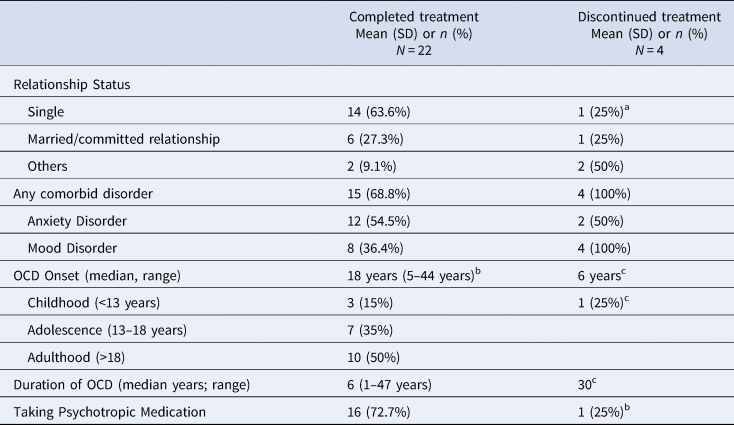
Table 1 contains the demographic information for the treatment completers and the four non-completers. The completer sample consisted of 8 males and 14 females, with ages ranging between 18 and 64 (M = 30.8 years). The majority of participants identified as New Zealand European (n = 18). There were seven students, seven part/full-time workers, five who were unemployed, one retiree and two who declined to answer (others). The education level of the sample ranged from 1 to 4 years of high school (27.7%), 5–6 years of high school (31.8%), trade/technical certificate (4.5%), Bachelor degree or diploma (22.7%), and a postgraduate degree (13.6%). The majority of the sample (64%) reported their relationship status as ‘single’, with a smaller proportion reported being married or in a committed relationship.
Demographics and Pre-Treatment Characteristics for Those Who Completed and Those Who Discontinued Group Treatment

Notes: aOne missing data point. Percentage is of available data; bTwo missing data points. Percentage is of available data; cThree missing data points. Percentage is of available data.
The median age of onset of OCD symptoms was 18 years, with many participants reporting symptoms since childhood (15%) or adolescence (35%), the rest (50%) reporting onset in adulthood. There was considerable variation in the duration of OCD, with the medium length of the disorder being 6.0 years (range 1–47 years). Many participants (69%) were experiencing current psychological comorbidity, with 55% reporting anxiety and 36% reporting depression. The majority of the sample were taking psychotropic medication (73%), with around two-thirds (64%) of the participants taking antidepressants during the treatment. Over a third (36%) of those on psychotropic medication were taking anti-psychotics and 14% were taking anti-anxiety medication.
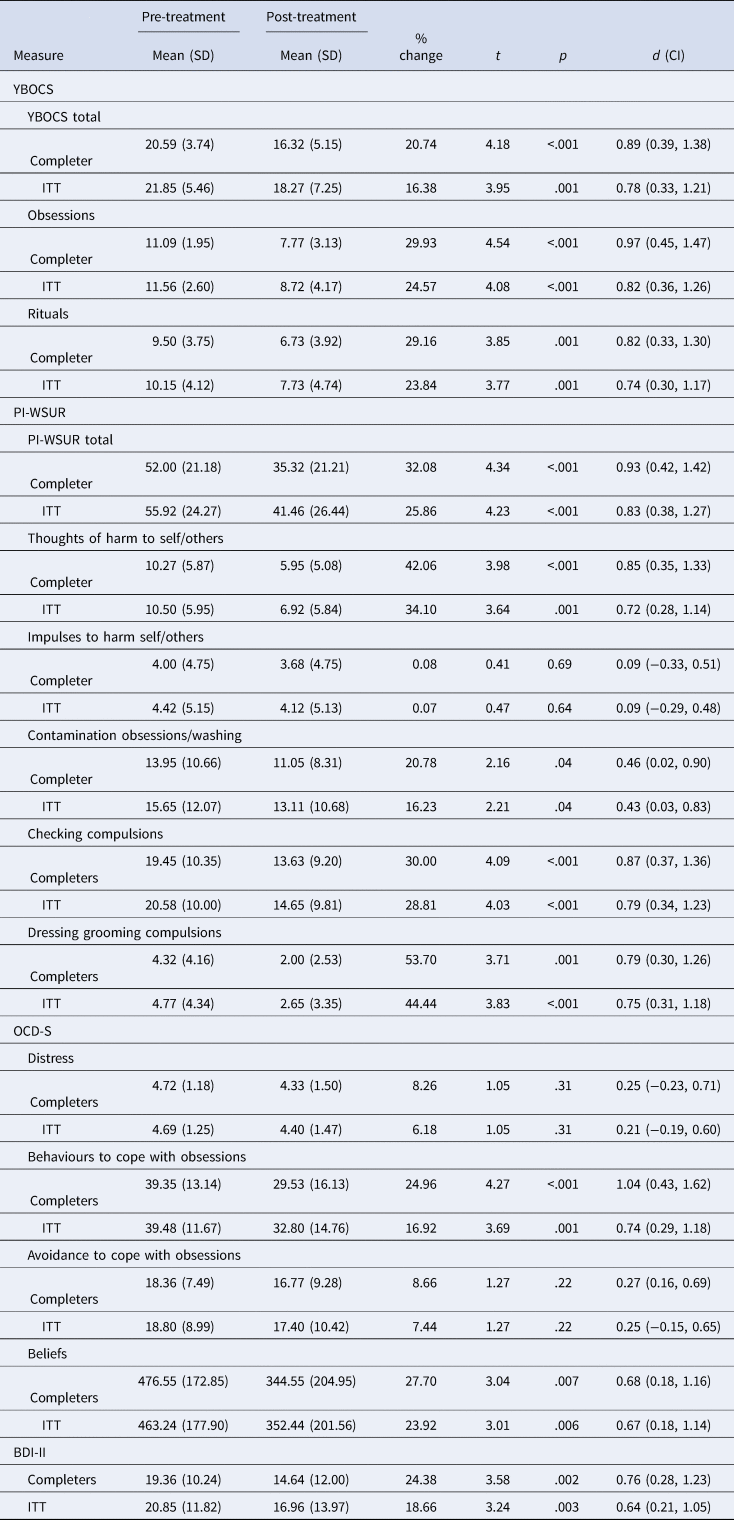
Pre-treatment scores (Table 2) for the completer sample show that the sample had OCD symptoms in the ‘moderate’ severity category (based on YBOCS-SR total score). The sample fell slightly below average severity of clinical OCD samples for the YBOC-SR (M = 20.59 vs. 21.90) and the PI-WSUR (M = 52.00 vs. 54.93; Antony, Reference Antony, Antony, Orsillo and Roemer2001) and fell just below the ‘moderate’ cut-off for depression (M = 19.36), putting the sample at the high end of ‘mild’ depressive symptoms.
YBOCS, Padua and BDI Scores and Change Scores at Pre-Treatment to Post-Treatment Using Completer and Intention-to-Treat Analyses

Note: ‘YBOCS’ =Yale-Brown Obsessive-Compulsive Scale; ‘PI-WSUR’ = Padua Inventory–Washington State University Revision; ‘BDI-II’ = Beck Depression Inventory-II; d (CI) = Cohen's d effect size (confidence interval); Completers = those who completed eight or more of the 12 treatment sessions; ITT = intention to treat (last observation carried forward); CI = 95% confidence interval.
Completers Versus Non-Completers
There was more incomplete data for those who did not complete group treatment. At pre-treatment, demographic data were similar between the non-completers and completers (see Table 1). All of the non-completer group also had a mood disorder diagnoses, in contrast to 36.4% of the completer group. Comparing pre-treatment scores on the self-report measures, the non-completer group had more severe symptoms on most measures. Of note, non-completers had higher OCD symptom scores at pre-treatment than completers, as measured by both the YBOCS-SR [Non-completers: M = 29.00, SD = 8.41; Completers: M = 20.59, SD = 3.74; t(24) = 3.17, p = .004] and PI-WSUR [Non-completers: M = 75.75, SD = 32.13; Completers: M = 52.00, SD = 21.18; t(24) = 2.13, p = .044]. The intention-to-treat data which includes the four non-completers is included in each table. As can be seen from the Table 3, while there is a significant decrease in symptoms for all participants, the percentage change for the intention-to-treat sample was substantially less across all variables.
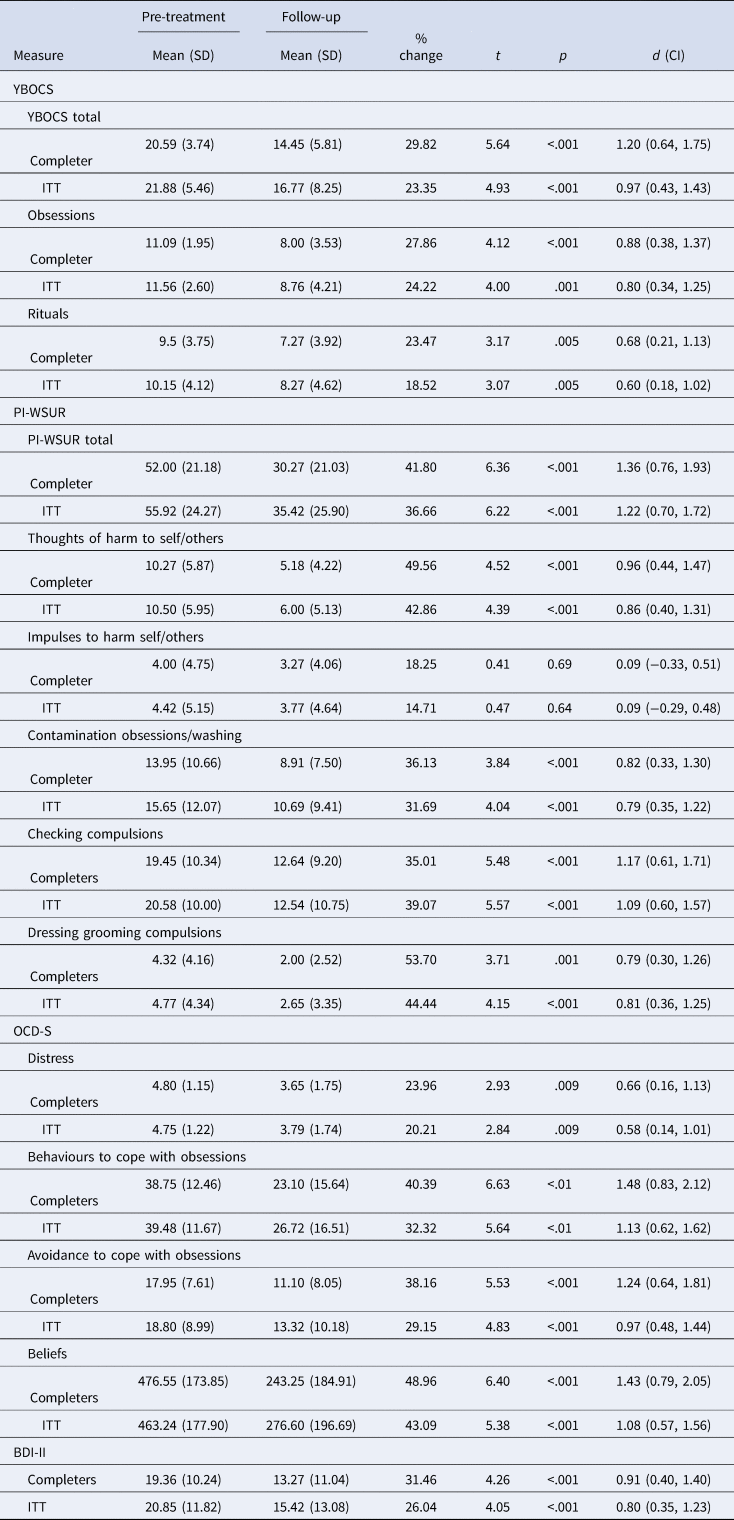
YBOCS, Padua and BDI Scores and Change Scores at Pre-Treatment to Follow-Up Using Completer and Intention-to-Treat Analyses

Note: ‘YBOCS’ = Yale-Brown Obsessive-Compulsive Scale; ‘PI-WSUR’ = Padua Inventory–Washington State University Revision; ‘BDI-II’ = Beck Depression Inventory-II; d (CI) = Cohen's d effect size (confidence interval); Completers = those who completed eight or more of the 12 treatment sessions; ITT = intention to treat (last observation carried forward); CI = 95% confidence interval.
Attendance rates were good for the completer sample, with 40% attending all 12 sessions (nine treatment sessions and three follow-up sessions), and the majority of those who missed sessions only missed one. Average attendance for all participants was 11 of 12 sessions (89.75%).
Outcome
Table 2 shows a comparison of the obsessive-compulsive and depression measures at pre-treatment and post-treatment and Table 3 shows a comparison of the same variables from pre-treatment to follow-up. Both tables present means, (SD), percent change, effect sizes, and 95% confidence intervals. Given the focus is on treatment outcome, the 22 individuals who completed treatment are focused on here.
For the completer sample, there was a marked decrease in obsessive-compulsive symptoms measured by total YBOCS-SR score and subscales scores from pre-treatment to post-treatment (Table 2) and also from pre-treatment to post-treatment (Table 3). The Cohen's d effect size for the pre–post and pre-follow-up were both large; end treatment d = 0.89, p < .001 and follow-up d = 1.20, p < .001. The average YBOCS-SR score for the sample decreased from being in the moderate range at pre-treatment to the mild range at follow-up. Each of the YBOCS-SR subscales also showed significant improvement at end treatment and at follow-up, with symptom reductions of both rituals (d = 0.82, p < .001) and obsessions (d = 0.88, p < .005) reaching large effect sizes (Tables 2 and 3). The percent change in total YBOCS-SR symptoms at end treatment was 21% and by follow-up that had increased to 30%. Another way to establish response rates is to report percentage (n) below the ‘under 16 cut-offs’ (i.e., in the non-clinical range) at each time point on the YBOCS-SR. The percentages of the completer sample scoring under 16 were: at pre-treatment 16.7% (3/18), at end treatment 35.3% (6/17), and at follow-up 43.8% (7/16). Conversely, on the YBOCS-SR, 65% at post-treatment and 56% at follow-up still had symptoms in the clinical range.
There was also a significant decrease in the total PI-WSUR score from pre-treatment to post-treatment (d = 0.93, p < .001) (Table 2), which was further reduced at 3-month follow-up (d = 1.36, p < .001) (Table 3). The percentage change in total PI-WUR was 32% at end treatment and at follow-up was 42%. Large effect sizes were also found at both post-treatment and follow-up for most of the subscales. Significant decreases were evident for obsessional thoughts to harm self/others (end treatment d = 0.85, p < .001, follow-up d = 0.96, p <.001), contamination obsessions and washing compulsions (end treatment d = 0.46, p < .04, follow-up d = 0.82, p < .001), checking compulsions (end treatment d = 0.87, p < .001, follow-up d = 1.17, p < .001) and dressing/grooming compulsions (end treatment d = 0.68, p = .007, follow-up d = 0.79, p < .001). The largest decrease was observed in the dressing/grooming compulsions subscale, with reported symptoms in this category being reduced by more than half from pre-treatment to follow-up (54% change). No significant pre-follow-up change was found for the obsessional impulses to harm self/others subscale at end treatment or follow-up.
At the end of treatment, there was a significant reduction in scores for two of the four OCD-S subscales behaviours to cope with depression (d = 1.04, p < .001) and beliefs (d = 0.68, p = .007). By follow-up, there was a significant decrease evident on all four subscales. Distress (d = 0.66, p < .009), coping behaviours (d = 1.48, p < .01), avoidance (d = 1.24, p < .001), and beliefs (d = 1.08, p < .001) (Tables 2 and 3). The beliefs subscale decreased by almost half between the pre-treatment and follow-up (percentage change 49%).
The sample also experienced decreases in depressive symptoms, with BDI-II scores decreasing significantly from pre-treatment to the end of treatment. This decrease was maintained at follow-up. Large effect sizes were found between pre-treatment and post-treatment (d = 0.76, p < .002) as well as follow-up (d = 0.91, p < .001). At follow-up, the mean BDI-II score put the sample in the ‘minimal’ depression category.
A large correlation was found between OCD severity (YBOCS-SR) and metacognitive beliefs (OCD-S ‘Beliefs’ subscale) at both pre-treatment (r = 0.61, p = .003, n = 22) and at follow-up (r = 0.70, p = .001, n = 20). Similar results were attained with the Padua total score, with a significant correlation with metacognitive beliefs at follow-up (r = 0.56, p = .01, n = 20) although not at pre-treatment. These findings from two separate OCD measures suggest that faulty metacognitive beliefs are strongly associated with OCD severity after treatment, with higher endorsement of metacognitive beliefs being associated with a higher YBOCS-SR score. In addition, utilising change scores between pre-treatment and follow-up at 3 months, the correlation between change in YBOCS-SR and change in metacognitive beliefs indicated that a reduction in faulty metacognitive beliefs was significantly associated with symptom improvement at the follow-up (r = 0.58, p = .007, n = 20). There was also a moderate correlation between metacognitive beliefs and BDI-II at follow-up (r = 0.46, p = .04, n = 20). Together these findings indicate that those with higher faulty metacognitve OCD beliefs at follow-up also experienced higher severity of OCD and depressive symptoms.
Discussion
This study reports the outcome of a group MCT for OCD in a routine outpatient clinical setting. The results are promising, demonstrating that the group MCT was successful in reducing OCD symptom severity, as well as depressive symptoms. The reduction in symptoms from pre-treatment to both post-treatment and follow-up indicated large effect sizes.
A comparison with the existing literature on OCD group treatments (CBT and ERP) shows that the current study's treatment effect sizes are favourable. Jónsson and Hougaards’ (Reference Jónsson and Hougaard2009) meta-analysis of group CBT compared to control conditions for OCD found a pre–post YBOCS-SR effect size (ES) range of 0.78 to 1.89, with a mean of 1.18. The pre–post ES for the YBOCS-SR in the current study was 0.89, and further improvement over the 3-month follow-up period gave a pre-follow-up ES of 1.20. The large effect sizes reported here are in line with those reported by Rees and van Koesveld (Reference Rees and van Koesveld2008) and Papageorgiou et al. (Reference Papageorgiou, Carlile, Thorgaard, Waring, Haslam, Horne and Wells2018). While there was little difference in the pre–post-treatment change on YBOCS-SR between this study and Rees et al. (2008), at follow-up the effect size was significantly greater (d = 2.4) in the Rees et al. study. Papageorgiou et al. (Reference Papageorgiou, Carlile, Thorgaard, Waring, Haslam, Horne and Wells2018) reported within-group effect size at end of treatment of 2.81; unfortunately, no follow-up is reported. It is also noteworthy that both the Rees et al. and Papageorgiou et al. studies had higher pre-treatment OCD severity in their studies compared to the current study — lower severity scores at pre-treatment in this study constrains the magnitude of change possible.
The findings here indicate that MCT can effectively reduce both obsessions and compulsions, with large pre-treatment to follow-up reductions in YBOCS-SR scores. Sixteen or less on the YBOCS-SR is considered to indicate the absence of clinically significant OCD symptoms (Sharma et al., Reference Sharma, Thennarasu and Reddy2014; Steketee et al., Reference Steketee, Frost and Bogart1996). The mean YBOCS-SR for the completer same was close to this cut-off at 16.3 at end of treatment, and under this cut-off, with a mean of 14.5 at the follow-up. The amelioration of OCD symptoms is supported by the PI-WSUR subscale results, showing reductions with large effect sizes for obsession and compulsion-based subscales. The only non-significant result in the study was the obsessional impulses to harm self/others subscale of the PI-WSUR, which did not significantly reduce from pre-treatment to follow-up. However, it is likely that this is due to a ‘floor’ effect — this particular subscale has a possible range of 0–32, with the sample having a low pre-treatment mean of only 4.0; indicating that this sample did not experience these particular impulses to a high degree to start with. It is noteworthy, that although strong effect sizes were evident, using the more stringent cut-off of 16 on the YBOCS-SR indicated that at end treatment 65% of participants and 56% follow-up still had clinically significant symptoms. Further studies, with longer follow-up periods could establish whether the trend for further improvement overtime continued to occur or not.
Another promising result was the significant decrease in depressive symptoms. This is interesting because it demonstrates that the treatment impact may not be limited to just OCD symptoms. At the end of treatment, depressive symptoms in this group had moved from the moderate (M = 19.4) to the mild (M = 14.6) symptom range, and by follow-up to just above the minimal (M = 13.3) symptom range. This is consistent with the finding that depressive symptoms largely develop after OCD symptoms, arguably in response to the debilitating disorder (see Clark, Reference Clark2004 for a discussion). It is also consistent with a transdiagnostic perspective of underlying commonalities between many emotional disorders, particularly faulty metacognitive processing and appraisals (Clark, Reference Clark2009; McHugh, Murray, & Barlow, Reference McHugh, Murray and Barlow2009).
Consistent with metacognitive theory, one of the largest concomitant pre-follow-up changes was the decreasing endorsement of metacognitive beliefs, as measured by the beliefs subscale of the OCD-S (Wells, Reference Wells2009). The mean score for this subscale dropped by almost half (49% change) from pre-treatment to follow-up; which is consistent with the literature emphasising the role of maladaptive metacognitive beliefs in the persistence of OCD symptoms. This finding suggests that the focus on the modification of maladaptive cognitive beliefs in the treatment was linked to decrease in OCD symptoms. Furthermore, metacognitive beliefs at follow-up demonstrated the largest correlation with YBOCS-SR follow-up scores (r = 0.70, p = .01).
Given the application of MCT to OCD is only in the preliminary stages, it is encouraging that these present findings are comparable to well-established, recommended treatment modalities in a regular outpatient clinical setting. It is also encouraging that these results were found in a group treatment format, the implications being that not only were MCT effective, but it can also be delivered in a way that allows many people to benefit at the same time. There was only an average of 13.6 therapist contact hours per participant (which would be 10.5 h if each group had six members). Compared to individual therapy, it therefore represents a potentially time efficient and cost-effective alternative way of delivering OCD treatment.
Clearly future studies, examining the processes of change in OCD are needed to ascertain whether change in MCT (or CBT) is due to shared elements or those that differentiate the treatments. While MCT and CBT contain some similarities the mechanisms of change and many of the associated techniques are either different or utilised differently. For example, CBT addresses thought content and thought fusion, while MCT focuses on the response to cognition more broadly and not on the specific content. MCT does not focus on habituation in exposure exercises, however, behavioural experiments are used to enable clients to address metacognitions.
This study is not without several limitations. It is a small open trial, with no control group against which to compare results. Without a control group, it cannot be ruled out that the significant symptomatic improvement is due to factors other than the treatment — for example, the mere effect of seeking treatment, or natural course across time. However, a spontaneous symptomatic improvement of the magnitude in this study would be unlikely, given the persistent, chronic nature of OCD (Kouzis & Eaton, Reference Kouzis and Eaton2000; Ruscio, Stein, Chiu, & Kessler, Reference Ruscio, Stein, Chiu and Kessler2010). A comparable group study employing a wait-list control design found that OCD symptoms remained quite stable over a 3-month period (McLean et al., Reference McLean, Whittal, Thordarson, Taylor, Söchting, Koch and Anderson2001). Similarly, the large reduction in metacognitive beliefs evidenced by the sample highly aligns with the content and goals of this particular treatment. While these findings support the notion that the change seen here is the product of the MCT treatment, non-specific treatment effects could also have contributed to the response. A large RCT with a control group are needed to confirm the efficacy of MCT for this group. A further limitation is that apart from the initial assessment at pre-treatment, all measures were limited to self-reported data. Use of the OCD-S, a new scale which has yet to be validated, also limits the conclusions that can be drawn from the findings from this particular scale. There was a dropout rate of 15.4%, which although low, could still be detrimental in a group format. The four participants who dropped out did so in the first few sessions, representing a failure to engage. Furthermore, it is problematic, although not an uncommon finding, that those who dropped out in the early stages of the study had significantly more severe symptoms at pre-treatment than those who completed the treatment. Although the group MCT was offered to consecutive patients meeting inclusion and exclusion criteria for the study, we do not have data on those who chose individual therapy. Uptake of group treatment, which prior to this study was CBT, for the past year in the Service was 27% with the remainder electing to have individual treatment. Further research is needed to compare group CBT versus group MCT in this population.
Another limitation is that the size of the groups in the study varied, due to patterns of recruitment and attrition. Due to attrition, one group was left with only two participants, compared to other groups with 4–6. The therapy sessions (4 h) were longer than those in previous MCT studies. Finally, the current sample was an outpatient sample, with OCD severity scores lower than average at pre-treatment that some previous studies and this needs to be taken into account when generalising the results.
The use of a clinical sample is a strength of the current research, with much OCD research being limited by the use of non-clinical samples (Grøtte et al., Reference Grøtte, Solem, Vogel, Güzey, Hansen and Myers2015). As such, this study provides support for the effectiveness of MCT in a real-world clinical setting. The participants were selected consecutively through contact with mental health services, and were representative of the target audience of the treatment. Participants were not excluded on the basis of comorbidities or use of medication. A further strength of this study is a 3-month follow-up, however, in future studies including longer-term follow-up times may provide a better understanding of patterns response over time.
Conclusion
The current study provides empirical support for the utility of the MCT approach for OCD. Taken alongside the small handful of existing studies, the large treatment effect sizes found in the current study show that MCT, delivered in a group format, is effective, and is a promising avenue for future research and practice. Combined with existing studies, there is now sufficient evidence for the viability of MCT for OCD to warrant a controlled, large-scale examination of MCT for OCD.
Funding
This work did not receive any external funding.
Declaration of interest
The authors declare that they have no conflicts of interest.