

Books Discussed in This Review Essay
Abdelal, Rawi. 2007. Capital Rules: The Construction of Global Finance. Cambridge: Harvard University Press.
Barton, John H., Goldstein, Judith L., Josling, Timothy E., and Steinberg, Richard H.. 2006. The Evolution of the Trade Regime: Politics, Law, and Economics of the GATT and the WTO. Princeton, N.J.: Princeton University Press.
Ikenberry, G. John. 2001. After Victory: Institutions, Strategic Restraint, and the Rebuilding of Order After Major Wars. Princeton, N.J.: Princeton University Press.
Newman, Abraham L.2008. Protectors of Privacy: Regulating Personal Data in the Global Economy. Ithaca, N.Y.: Cornell University Press.
Raustiala, Kal. 2009. Does the Constitution Follow the Flag? The Evolution of Territoriality in American Law. New York: Oxford University Press.
The institutional turn in International Relations (IR) has generated a number of robust research programs that have significantly contributed to the discipline's maturation. To a much larger extent than when the fiftieth anniversary issue of International Organization advocated jettisoning the discipline's focus on paradigmatic battles between versions of realism and liberalism,Footnote 1 IR is now characterized by rigorous and common standards of scientific inquiry, a richer empirical foundation, and the use of concepts that are common across the social sciences. These characteristics of disciplinary maturation are the outcome of the discipline's move from debating the merits of general theories of international relations to employing general theories of institutions to account for trends in international affairs.Footnote 2 As it did in the subdisciplines of American and Comparative Politics, the institutional turn in IR has drawn special attention to the rational choice and sociological institutionalist traditions and to the contributions that other social sciences can make to the study of politics.Footnote 3 However, unlike other subfields, IR has devoted no sustained attention to the third major tradition in contemporary Political Science, namely historical institutionalism.
Historical institutionalism is a distinct tradition in the American and Comparative Politics subfields where it features extensively in theoretical and substantive debates alongside rational choice and sociological institutionalism.Footnote 4 In the former, it is at the core of a distinct field known as American political development (APD), while it has acquired great prominence in Comparative Politics. But in IR, historical institutionalism has remained at the sidelines.Footnote 5 Given the frequent affinity between state-centric IR and rational choice institutionalism on the one hand, and between sociological institutionalism and international society approaches on the other, it is perhaps only natural that the institutional turn in IR should begin by debating theories of institutions that often speak to the rival logics of realism and idealism. However, as IR's institutionalist turn progresses, there is good reason to ask whether the same tripartite division of institutional theories that characterize other subfields of Political Science should also inform IR. The books at the center of this review underscore that the absence of historical institutionalism in IR entails some significant analytical and empirical opportunity costs to the discipline, especially when it comes to studying patterns of change and continuity in international institutions.
Given the contributions that historical institutionalism has made to a greater understanding of domestic politics in the American and Comparative Politics subfields, it is surprising that IR has omitted a serious engagement with this tradition when IR scholars have issued extensive calls for bridging the divide between the study of domestic and international politics.Footnote 6 Also, historical institutionalism stresses the type of processes that often characterize international relations, including the legacies of founding moments in shaping long-term power relations and whether new ideas become consequential, the ubiquity of unintended consequences, and especially the prevalence of incremental reform over stasis and fundamental transformations.
Engagement with history itself has of course not been lacking in IR. The discipline owes a great deal to its exchange with the discipline of History.Footnote 7 Overall, however, IR has looked to History primarily to provide the empirical foundation on which to test and develop its own theories.Footnote 8 Given the small-N challenge that faces many IR scholars, the historical archive is also frequently seen as a resource that expands the number of cases to include in comparative case studies. Both the empirical and methodological attention to history mirrors the manner in which other subfields have engaged it.Footnote 9 In other subfields, however, there has been a gradual move away from being solely interested in History for its empirical and methodological value toward theorizing the conditions under which temporal processes matter.Footnote 10
Outside IR, the emphasis in historical institutionalist scholarship is no longer on determining whether history matters, but on when and how historical processes shape political outcomes. Pierson characterizes this new engagement with history by political scientists as a “theoretical turn” and argues that it will help redress the “decontextualized revolution” that has marked much contemporary work in the discipline. The theoretical turn, Pierson concludes, will contribute to “[striking] a more effective and satisfying balance between explaining the general and comprehending the specific.”Footnote 11 In an article examining the conditions under which a discipline matures, Lake embraces the same general criteria and argues that IR matures when scholars promote shared standards of scientific inquiry, enhance empirical knowledge, and use concepts that are common across social sciences.Footnote 12
Can historical institutionalism help IR scholars strike the sort of balance that Pierson sees emerging in other subfields? Is it a tradition that meets the standards set by Lake and that can further disciplinary maturation in IR? This article answers these questions through a review of recent books that explicitly or implicitly employ analytical concepts from historical institutionalism to address fundamental questions in the study of international politics, including the evolution of national sovereignty, international cooperation, and the international system. Covering multiple domains of international relations—war and peace, finance, trade, development, law, and the digital world—the books share a substantive focus on long temporal processes ranging from multiple centuries to several decades. Though not all the authors describe themselves as historical institutionalists, they all underscore the value of that tradition's core, including the role of founding moments in shaping later developments, how institutional legacies affect the degree to which power resources can be harnessed, and the ways in which varied patterns of incremental adaptation shape institutions over time.
This article proceeds in three parts. It presents an overview of historical institutionalism and asks how it aids the books under review in resolving important empirical puzzles. It then inquires whether more attention to historical institutionalism is merited and examines its potential contributions to new research agendas on the form and evolution of international institutions. A final section concludes that historical institutionalism holds significant potential for IR, especially in anchoring the substantive study of international political development—that is, the processes that shape, reproduce, and alter international political institutions over time. When informed by historical institutionalism, the study of international political development, or IPD, can occupy a similar position in IR as does APD in the American Politics subdiscipline. In that role, prolonged meta-theoretical debates between dueling perspectives are avoided and historical institutionalism instead directs scholars to a set of analytical concepts to resolve specific empirical puzzles. It is also in that role that historical institutionalism may most effectively help IR scholars strike the sort of balance between accounting for general patterns and specific developments that it has facilitated in other subfields of Political Science.
Concepts, Issues, and Contributions
Historical institutionalism is neither a theory of politics, nor a general theory of institutional development. Like rational choice and sociological institutionalism, it is better characterized as a theoretical tradition that gives particular attention to a discrete set of substantive themes that are analyzed with a distinct combination of analytical concepts and methods.Footnote 13 The most distinguishing mark of historical institutionalism is the primacy it accords to temporality—the notion that the timing and sequence of events shape political processes. In more specific terms, historical institutionalism suggests that timing and sequence contribute to unpredictability (outcomes may vary greatly), inflexibility (the more time passes, the more difficult it is to reverse course), nonergodicity (chance events may have lasting effects), and inefficiencies (forgone alternatives may have been more efficient).Footnote 14 These are neither controversial nor new assertions, but taking them seriously in substantive and analytical terms contributes to a distinct approach to the study of institutions within Political Science.
To historical institutionalists, attention to the timing and sequence of political events is important because the evolution of constraints and opportunities in the multiple institutions that shape human interaction often create a different type of political game over time. In particular, the calculations of political actors (for example, their understanding of their stakes in the current setting), and the nature of the constraints under which they operate (for example, some options may not really exist due to the sequence of prior events) may change significantly over time. In other words, historical institutionalism considers attention to temporality crucial for analytical reasons, since later events are conditioned by earlier ones (not simply the constellation of interests and constraints at the moment), but also in substantive terms because it redefines the disciplinary object from one directed at the study of stationary outcomes to one focused on explaining diverse and dynamic processes of institutional development.Footnote 15
Though analytical and substantive differences between historical institutionalism and other traditions are widely acknowledged in other subfields, IR scholars have expressed skepticism about whether historical institutionalism merits the status of a distinct tradition. Ironically, such skepticism is often bundled with claims that historical institutionalism should be subsumed under the skeptic's own approach.Footnote 16 But the fact that concepts central to historical institutionalism are occasionally employed by other traditions (and vice versa) is not the appropriate metric by which to judge if a theoretical tradition deserves greater attention. Moreover, the notion that some conceptual openness is a liability seems misplaced; both rational choice and sociological institutionalism employ analytical categories and methods that originate in other traditions and have demonstrated that this has served them and the broader discipline well.
What distinguishes alternative approaches to the study of institutions is not the use of a set of proprietary concepts or methodologies, but rather a tradition's substantive scope and, in particular, the claims it makes about human agency and the role of institutions in shaping political processes. On these dimensions, as Table 1 summarizes, historical institutionalism differs in important ways from rational choice and sociological institutionalism. The substantive profile of historical institutionalism is characterized by attention to large questions with an explicit temporal scope that concern the creation, reproduction, development, and structure of institutions over time.Footnote 17 Thus, while the books by Ikenberry and Raustiala are focused on accounting for the evolution of the institutions that defined international political orders and the nature of national sovereignty over more than two centuries, the books by Newman, Abdelal, and Barton, Goldstein, Josling, and Steinberg examine how the timing and sequence of political bargains over specific international rules in the latter half of the twentieth century produced unexpected and in some cases unintended consequences for the nature of international relations in the early twenty-first century.Footnote 18 The substantive focus of the five books, then, differs both from the typical rational choice institutionalist study where an institution is understood as an exogenous constraint and as a largely time-invariant rule of the game,Footnote 19 as well as from the typical sociological institutional study where there is a strong emphasis on normative orders and encompassing institutional “environments” that have structural qualities.Footnote 20
Dominant features of three institutional traditions
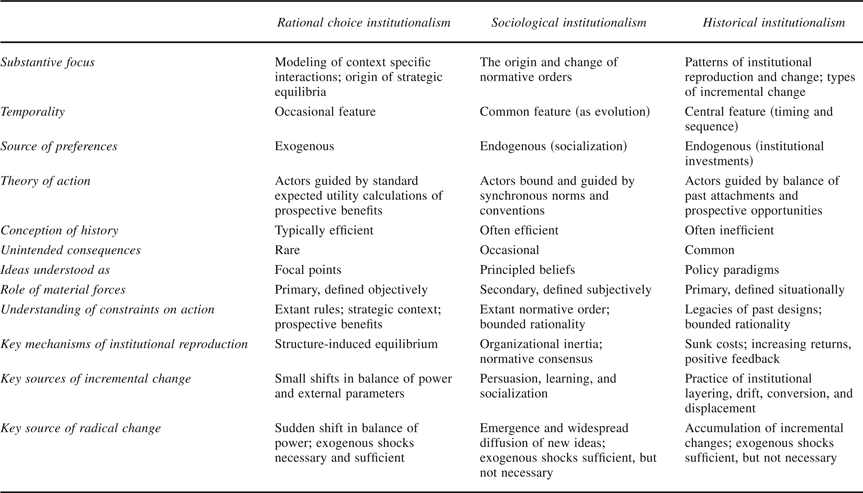
But while the substantive scope of historical institutionalism departs from the standard rational choice and sociological institutionalist studies in IR, it is the answers historical institutionalists give to second-order questions that give the tradition its distinct theoretical identity.Footnote 21 Second-order theorizing refers to how an analytical tradition understands the structure and origin of actors' preferences, its conception of human action, and the principal constraints on human behavior. As such, second-order questions concern issues such as the role played by ideas and material forces, the relationship between interests and institutions, as well as the mechanisms foregrounded in accounting for varied patterns of institutional development.
The Issue of Microfoundations
Second-order differences between the historical, rational choice, and sociological institutional traditions originate in alternative understandings of human preferences and action. Preferences, in the words of Katznelson and Weingast, “signify propensities to behave in determinate circumstances by people who discriminate among alternatives they judge either absolutely or relatively.”Footnote 22 The three traditions make different assumptions about how people judge alternatives, which in turn influences their theories of action. In the rational choice tradition, the primary consideration in preference orders and what motivates action are end-point comparisons.Footnote 23 Whatever feasible prospective alternative is superior (less costly, more efficient, etc.) will be ranked highest and guide action. If an alternative to the status quo is feasible and marginally superior, actors experience preference transformations. By contrast, historical institutionalists see action as a function of preferences informed by point-to-point comparisons, that is, individuals are thought to balance evaluations of the costs and benefits of adapting to new circumstances with the costs and benefits of maintaining or losing their investments in past arrangements.
The focus in recent historical institutionalist studies on point-to-point comparisons holds the key to identifying the conditions under which past decisions and designs shape individual's preferences over the structure of current and prospective institutions.Footnote 24 Unlike rational choice models in which sunk costs and other legacy effects are immaterial in evaluating the benefits of adopting one of two prospective alternatives, the degree of change from an historical reference point is a key factor in shaping preference orders in historical institutionalism. Such changes affect the extent to which people gain or lose access to the advantages (or disadvantages) they associate with past designs, including those that confer positions of privilege that translate into forms of enduring influence as well as those that generate increasing returns, positive externalities, and other benefits over time. By contrast to a rational choice model where the emergence of a marginally better alternative transforms preferences, this occurs in historical institutionalist models only when the benefits of a prospective alternative outweigh the losses associated with giving up access to past designs. Since the nature (and understanding) of such losses is contingent upon the institutional context in which individuals are embedded, exposure to the same external parameters typically generates diverse responses. An important implication is that external developments, including major crises, may cause groups in some countries to experience preference transformations over national designs if they do not value historic institutions highly, while in other countries the same events may serve to strengthen preferences for extant designs if groups value historic institutions.Footnote 25
Though historical institutionalism is often associated with punctuated equilibrium models and attention to critical junctures, scholars in that tradition treat the evolution of preferences as an endogenous process.Footnote 26 Like sociological institutionalism, historical institutionalism acknowledges that ideas and processes of learning, persuasion, and socialization may play important roles in shaping preferences over institutional designs. But historical institutionalism attributes a smaller role to social collectives, including international organizations, in shaping the identities and preferences of domestic groups. Thus, what is known as the logic of appropriateness in sociological institutionalism is not thought to be the dominant aspect of what informs preferences. In fact, historical institutionalists often reverse the causal story told by sociological institutionalists from one in which shared understandings are the source of new institutions to one in which the presence of particular institutions is key to whether new ideas matter. For that reason, their studies of the role of ideas have focused on the conditions under which ideas get embedded within institutions in politically consequential ways and they often give more attention to ideas as policy paradigms than as principled beliefs.Footnote 27
The adoption of methodological individualism in most recent contributions to historical institutionalism is a major reason that this tradition is distinct from macrohistorical studies often associated with historical sociology, a discrete and well-established tradition in IR.Footnote 28 For example, unlike historical sociology that tends to highlight antecedent structural conditions when explaining continuity after critical historical junctures, historical institutionalism stresses the microlevel processes that create incentives for individuals to reproduce (or not) designs during and after such junctures.Footnote 29 Historical institutionalism also tends to be more focused on how the behavior of political actors shapes the nature of diverse forms of incremental change than on the type of large structural transformations at the center of much work in historical sociology.Footnote 30 By way of illustration, Ikenberry's After Victory differs from IR studies in the historical sociology vein in that it accounts for why international orders have taken their particular form over time with reference to microlevel mechanisms such as increasing returns rather than to, say, the nature of technology or the world system.
Historical Efficiency and Path Dependence
How historical institutionalists understand the origin and structure of preferences is central to their explanations of patterns of institutional change. Because investments in past designs may feature heavily in the calculations that individuals make when confronted with new realities and the decision of whether to incrementally reform or fundamentally transform designs, historical institutionalism has a more skeptical perspective about what March and Olsen term historical efficiency than do standard rational choice models of international relations.Footnote 31 While rational choice institutionalism assumes that history is efficient in the sense that sunk costs do not matter, historical institutionalists point to such costs and other legacy effects as key factors that shape the evolution of designs. Thus, for example, historical institutionalists note that because interest groups frequently owe their position of power to the strategic position occupied at the founding moment of an institution or because designs have distinct positive externalities, interest groups often see greater benefits from reproducing extant arrangements than from embracing radical change. The outcome is that patterns of adaptation that would ensure greater collective efficiency often do not occur, that positions of privilege and divisions of labor regularly persist though relative balances of power shift, and that institutions frequently outlive their original rationale.Footnote 32
Historical inefficiency is central to path dependence, a notion that is commonly associated with historical institutionalism, though by no means its proprietary concept. Path dependence refers to a process in which the structure that prevails after a specific moment in time (often a critical juncture)Footnote 33 shapes the subsequent trajectory in ways that make alternative institutional designs substantially less likely to triumph, including those that would be more efficient according to a standard expected utility model.Footnote 34 While early studies in the historical institutionalist traditions invoking path dependence were criticized for having a deterministic understanding of institutional developments,Footnote 35 it is now a tradition deeply invested in accounting for the microlevel mechanisms that contribute to or undermine path-dependent trajectories.Footnote 36
Recent studies have played particularly close attention to four causes for why developments along a particular path are reinforced.Footnote 37 Institutions may lock in balances of power or policy paradigms for lengthy periods of time and thus give those in privileged positions (a greater stake in protecting extant designs than would have been the case had designs been established de novo) a stake in protecting extant designs, especially nonmajoritarian ones. In such cases, institutions have a structural quality and only broad agreement among those with veto power will ensure a stable new arrangement. When lock-in effects are present, collectively suboptimal designs may prevail for long periods of time because rules once adopted give some stakeholders the power to block fundamental change. Much early work in historical institutionalism focused on lock-in effects, which feature also in some rational choice and sociological institutional models. However, in recent historical institutionalist work, three other mechanisms by which particular pathways are reproduced have gained more attention. Over time, institutions may create new stakeholders or strengthen the incentives of existing constituencies to support extant arrangements through positive feedback effects. These exist when the choice of multiple individuals generate positive externalities such as network and coordination effects. So-called increasing returns are similar to positive feedback effects, but entail not simply small bonuses from employing particular designs but a steady increase in returns relative to once-feasible alternatives.Footnote 38 Finally, an institution may have self-reinforcing qualities when it creates complementary relationships with other institutions and thus enhance the value associated with specific designs. In each of the last three causes, designs once adopted strengthen the potential for continuity by creating more intense support among new and existing constituencies for incremental over fundamental reform.Footnote 39
In general terms, when any of the four causes is present, historical institutionalists expect patterns of institutional development to be incremental, slower, and less extensive than anticipated by standard rational choice and sociological institutional models. The more extensive are these causes (in combination or by themselves), the less radical institutional developments are expected to be over time.Footnote 40 More specifically, three hypotheses follow from the four causes that contribute to path dependence. First, major reversals in policy or changes in institutions become less likely over time when any of the four causes are present, but especially when they exist in combination. Next, because the benefits that groups gain from some institutions grow over time, institutional stability is possible even if the original rationale (or sponsor) of an arrangement is no longer present. Finally, actors that enjoy positive returns from extant designs tend to incorporate new institutions and policies in ways that are compatible with the existing structure so as not to disturb the functioning of institutions that are the source of tangible benefits. Conversely, in the absence of the four causes—in particular when there are no positive feedback effects or when existing constituencies do not enjoy increasing returns or positive externalities—institutional designs are susceptible to radical change.
Few studies have distinguished between and operationalized the causes that contribute to path dependence in international affairs. A major exception is Ikenberry's After Victory, which is the first book in IR to describe itself as historical institutionalist.Footnote 41 Ikenberry asks how states deal with power asymmetries when constructing international political orders. States can enhance stability in the wake of wars either by promoting a balance of power among themselves, by opting for a system in which a hegemonic power enforces rules, or by establishing a constitutional order based in the rule of law. Ikenberry finds that while bargains between the major and secondary states were a feature of all the postwar arrangements following the Napoleonic wars, the two world wars, and the Cold War, the institutional character of these arrangements varied considerably. States have increasingly favored constitutional orders and the level of rule-based governance has grown considerably in scope over time.
Ikenberry's account of the contemporary system is based neither on assertions of enlightened leadership by U.S. policymakers who deemed multilateralism more appropriate than its alternatives, nor on a timeless situational logic that sought to maximize U.S. power. For example, he argues that the construction of a new constitutional order after the Cold War was constrained by sunk costs and increasing returns associated with old designs. While Ikenberry acknowledges the role played by ideas of liberal internationalism in U.S. foreign policy, he foregrounds the vested interests of political factions in the United States and points to the gradual transformation of preferences and how past arrangements created stakeholders in designs that originated in the early post–World War II period.
Ikenberry's attention to the microlevel mechanisms that contribute to high levels of institutional continuity despite major historical junctures helps resolve significant puzzles, such as why those who predicted the collapse of the multilateral order when the Cold War ended were mistaken,Footnote 42 and also why the institutional core of the international system remained highly resilient after September 11, 2001.Footnote 43 Studies of the persistence of international organizations such as the North Atlantic Treaty Organization (NATO) after the end of the Cold War reach similar conclusions that highlight how institutional investments made in an earlier era gradually reconfigured states' stakes in sustaining such organizations after the original impetus for designs was no longer present.Footnote 44
The Evolution of the Trade Regime by Barton, Goldstein, Josling, and Steinberg also brings attention to how a set of international institutions adopted in the early postwar period reinforced support among domestic constituencies for greater multilateralism over time. Barton and colleagues attribute both the underlying logic that brought a steady expansion in the scope of multilateralism and periods of slow change to processes at the center of the historical institutionalist research program. The former pattern is explained with reference to positive-feedback effects within the largest trading states where support for greater levels of multilateralism increased over time as domestic constituencies supporting free trade grew larger and politically stronger because of earlier multilateral agreements. Meanwhile, periods of multilateralism's slow expansion and stalled trade negotiations are attributed to regulatory disagreements between large states. Such regulatory disputes, Barton and colleagues argue, were also the product of positive-feedback effects. However, because their manifestations were distinct in national and sectoral terms due to variations in the sequence by which market economies evolved, governments had difficulties in quickly reaching agreement on international market liberalization. While trade agreements progressively moved in a more liberal direction, historical variations in national regulatory systems contributed to a trajectory that was slow and far from linear.
The substantive scope of Raustiala's Does the Constitution Follow the Flag? is broader than that of Barton and colleagues but it too highlights the relationship between domestic and international regulatory politics in shaping the nature of international relations. Contributing to a rich and historically oriented literature on the evolution of the modern territorial state, and often focused on the role of warmaking and trade,Footnote 45 Raustiala foregrounds the role of domestic and international legal diversity in the evolution of the modern state system. Studying the United States, Raustiala pays particular attention to attempts by U.S. judicial, governmental, and commercial interests to preserve domestic legal and regulatory traditions. In his account, such interests were the product of domestic developments, but the ability of U.S. governments to protect these interests were contingent on external events. In the case of antitrust provisions, for example, which had a profound effect on the evolution of the U.S. economy in the twentieth century, Raustiala documents how the rise in U.S. power internationally enabled American governments to protect national economic interests and institutions by gradually regulating the effects of corporate practices beyond their own borders through domestic law. In this way, the United States “regulated the world,” preserved a nationally distinct legal and regulatory system, but also reinforced an international system characterized by great legal diversity. However, to Raustiala this outcome was not fore-ordained or locked in with the 1648 treaties of Westphalia but contingent upon historical events over the course of the twentieth century that increased U.S. power as the world became more interdependent. Raustiala thus holds a skeptical view that greater levels of international interdependence will significantly change the character of the modern state or transform the international state system.
Unintended Consequences
The factors that contribute to historical inefficiencies and to path dependence are also central to the study of unintended consequences, which are as common in international affairs as in any other political arena.Footnote 46 Institutional designs with unexpected consequences are typically attributed to the cognitive limitations of those with power to shape designs during founding moments or to complex interaction effects that emerge later.Footnote 47 While historical institutionalists recognize these factors, they find that unintended consequences are also evident when states have complete information, act transparently, and do not face major time constraints.Footnote 48 In addition, while they agree with scholars working in other traditions that unintended consequences may be inevitable, they note that there is frequently little inevitability about their reproduction over time. They stress that if the reproduction of designs is about more than lock-in effects, especially those that have negative consequences for some, then it is a political act that merits explanation.
Historical institutionalists have highlighted several reasons that unintended consequences can persist although information was plentiful during a founding moment. For example, what may have proved politically efficient at the founding moment of an organization may not prove efficient at a later stage because the nature of the challenges an organization is supposed to resolve may have a different character. Barton, Goldstein, Josling, and Steinberg find that the designs that signatories to the General Agreement on Tariffs and Trade (GATT) adopted in 1947 over time had some negative and unintended consequences for the membership as a whole as well as for some specific member-states. Because GATT permitted the construction of preferential trade agreements to encourage growth in international trade, it later proved very difficult to limit these despite the fact that they undercut the most-favored nation principle that was the foundational element of the trade regime. Economic groups in states that had taken advantage of such agreements now had large investments in sustaining them and thus significantly slowed the construction and scope of a fully multilateral trade regime. Paradoxically, the 1995 World Trade Organization (WTO) agreement that was to reduce enduring forms of economic discrimination also had unintended consequences for some member-states. Notably, designs aimed to enhance the ability of developing countries to hold wealthy countries accountable often had the opposite effect because the wealthy were able to exploit their more abundant resources to take advantage of a new legal process in ways that protected their stakes.Footnote 49
Despite the ubiquity of unintended consequences, it is difficult to make generalizable statements about when these occur or when they are positive or negative. Identifying unintended consequences involves selection on the dependent variable; such outcomes are observed only when they occur—their absence cannot be reliably identified. Nevertheless, there is good reason to examine such outcomes because their effects are often highly material for the course of history. Historical institutionalists make important contributions in this context with their nuanced and contextual understandings of why particular unintended consequences prevail, and whether these were anticipated or not. Answers to what explains such outcomes, recent studies suggest, turn less on identifying chance events, cognitive limitations, or bureaucratic pathologies than on a careful analysis of what the historical archive reveals about the actual preferences of and constraints faced by those most directly involved in negotiations over international designs and what that archive reveals about complex interaction effects over time.
The Role of Sequence
In addition to the role of timing in shaping later trajectories, historical institutionalists underscore how the sequence of political events can have a causal effect for later developments. For example, ideas that are embedded within organizational structures before other ideas gain greater support sometimes serve to preserve practices even as new ideas appear to become more legitimate.Footnote 50 Whether policymakers opt to integrate their economies with the global economy may make them more likely to reject the acquisition of nuclear weapons at a later point despite growing security threats.Footnote 51 Whether a polity has undertaken significant reforms to political institutions such as the rule of law and free media before democratizing also can have lasting consequences for a state's propensity to go to war.Footnote 52
The role of historical sequence features in all the books under review, but it is particularly significant in how empirical puzzles are resolved in Newman's Protectors of Privacy and Abdelal's Capital Rules. Although Newman explicitly characterizes his work as historical institutionalismFootnote 53 and Abdelal calls his sociological analysis,Footnote 54 the two studies examine a similar puzzle: how European countries that were less powerful by any military or economic measure than the United States were able to exercise disproportionate influence over global regulatory structures. Focused on data privacy and financial regulation, respectively, the two books resolve the puzzle of European influence with reference to the domestic political processes in key European countries in the 1970s and 1980s that made governments support deeper levels of cooperation in these domains. Both Newman and Abdelal stress the role of historical sequencing and find that the construction of European-wide regulatory designs enabled a group of comparatively small economies to shape international regulatory standards despite U.S. opposition in later decades. They show that the comparatively early emergence of national and regional regulatory capacity in Europe (Newman) and the confluence of new policy priorities and strategically placed individuals in multilateral organizations (Abdelal) enabled Europe to “punch above its weight” in many areas of the digital and financial services domains. This allowed Europe to prevail over the United States in setting several standards in these areas even as the United States was widely considered to be an ascendant hegemon in the 1990s. The broader implication of these studies is that as the density of the world's multilateral fabric increases, Europe will enjoy steady influence despite the emergence of potentially larger economies such as China.
The sequence of events merits attention not simply as a way of documenting history, but because the order in which things happen can affect the interests of political actors, their ability to shape outcomes, and thus also the direction of history. For these reasons, historical institutionalists are reluctant to isolate events in time without accounting for the extent to which earlier events shape the particular interest and contexts that impact present and future political battles. The analysis of sequence is also the means by which scholars can endogenize specific explanatory variables and identify the conditions under which particular causes are more likely to be apparent.Footnote 55 In other words, attention to sequence can provide answers to when the necessary and/or sufficient conditions are present that cause a specific type of outcome and thus can establish when and how history matters.
The Balance
A comprehensive review of historical institutionalism or its similarities to and differences from the rational choice and sociological institutionalism traditions can be readily acquired elsewhere.Footnote 56 Yet, even the brief discussion here of second-order differences between historical institutionalism and the other traditions underscores that the distinct microfoundations of the former have important implications for how empirical puzzles are resolved. The explanation of discrete historical events found in the studies by Ikenberry, Raustiala, Barton and colleagues, Newman, and Abdelal are in most cases, though not always, at odds with the type of explanations found in rational choice and sociological institutionalist accounts. More importantly, their attention to temporality complements their nuanced explanations of specific events with general explanations of broader developments in international relations that pertain to state sovereignty and power, the design of international institutions, and to the evolution of international cooperation. As such, the five studies offer strong illustrations of how concepts central to historical institutionalism can help IR scholars strike the type of balance between accounting for specific events and general patterns that this tradition has facilitated in other subfields of Political Science.
Contributions to Present Research Agendas
Unlike IR's earlier engagement with history, historical institutionalism is less about drawing lessons from or documenting the past than it is about identifying the conditions under which and mechanisms by which the past affects the present and the future. While attention to substantive themes and central concepts associated with historical institutionalism has played a productive role in a set of recent books in IR, its future depends on how successfully it can contribute to new research agendas. An area of research that has garnered growing attention across IR is the nature of change and continuity in contemporary international institutions. Yet, as Keohane remarks, “although we are living in a period of unprecedented change, our understanding of change is very inferior to our understanding of fundamental long-term regularities.”Footnote 57
To ascertain the potential promise that historical institutionalism holds for the study of change and international institutions, this section examines its contributions to the study of state preferences at the microlevel, to middle-range theorizing in the area of governance gaps, and finally to a general understanding of institutional development in the international system. This list of research agendas is necessarily selective and the cases highlighted only illustrative, but they nevertheless suggest the potential value that historical institutionalism holds for IR as the discipline devotes more attention to developments in international political institutions.
State Preferences
Though international organizations over time have gained some autonomy and nongovernmental organizations have become more apparent in world politics,Footnote 58 there remains a broad consensus in IR that states are the key players in shaping the most consequential international institutions. As a result, what motivates states to pursue particular foreign policies and why they support specific international institutions has remained a major question in IR. However, the institutional turn in IR has pushed the discipline from treating states as relatively undifferentiated units with largely static preferences to thinking of the origin, evolution, and variation in state preferences as central.Footnote 59 Much work involves closer study of the domestic processes that shape governments' multilateral preferences. Contributions to this literature rest on pluralist models of politics in which the preferences of domestic groups and public officials and their respective ability to shape government policy are key in accounting for state preferences. Beyond underscoring how long-standing institutions affect the aggregation of societal preferences into government policy,Footnote 60 historical institutionalism also brings attention to how historically contingent national designs shape the interests of domestic groups and thus the positions governments are likely to adopt in international settings.
Historical institutionalists posit that the structure of groups' institutional preferences is shaped heavily by their investments in existing and past designs, especially when these are the source of increasing returns and positive externalities.Footnote 61 Since the extent to which particular national institutions that have such effects vary across states, historical institutionalists are more skeptical that the proliferation of new international rules and norms will lead to a convergence in states' national policy and institutional choices than are standard rationalist and sociological institutionalist accounts. Because the European Union (EU) is an international organization in which member states face similar external constraints, it has served as an incubator for testing alternative hypotheses derived from historical institutionalism and other traditions.Footnote 62 For example, adding to a substantial literature in comparative political economy that documents national responses to economic globalization, studies anchored in historical institutionalism have found that differences in national varieties of capitalism play a key role in accounting for why governments support alternative forms of international cooperation. These studies refine the more common approach in political economy that derives state preferences from the material profile of economic groups, and instead traces governments' support for different multilateral designs to the stakes that domestic interest groups have in sustaining the national designs that are the source of increasing returns, positive externalities, and institutional complementarities.Footnote 63 Among other things, these studies help explain both why there are significant continuities in the designs promoted by specific states as the partisan nature of governments change, as well as why there are persistent variations across states over time.
Gilpin remarks that “it has become increasingly clear that the role of domestic economies and differences among these economies have become significant determinants of international economics affairs.”Footnote 64 Yet, the IR field has only a preliminary understanding of how the evolution of national economic systems shapes international institutions.Footnote 65 Historical institutionalist studies of the EU offer one way to address this lacuna, namely by examining how forms of international cooperation affect the investments that domestic constituencies have in those national designs associated with distinct competitive advantages.Footnote 66 From such an approach follow several hypotheses. For example, the greater the value domestic groups attach to national designs that are the foundation of their competitive advantage, the more likely these groups are to promote international designs that preserve the integrity of domestic institutions.Footnote 67 Further, in those domains where domestic groups have particularly significant investments, the room for international agreement among states with diverse models of governance is expected to be significantly smaller than in new domains where historical investments are not as deeply entrenched.
The hypotheses derived from historical institutionalism require systematic empirical research beyond Europe, but the books discussed offer some preliminary support. In areas at the very center of alternative economic systems, such as the antitrust provisions discussed in Raustiala's study and the financial regulation examined in Abdelal's book, states have been more reluctant to accept enforceable international regulatory standards than in some of the information technology issues discussed by Newman where domestic interests were not as deeply entrenched. The study by Barton and colleagues also lends support to historical institutionalist hypotheses when the authors find that compromises in domains such as agriculture, where positive feedback effects are well documented, have been more difficult to reach than in other domains characterized by greater technological advances.
In recent years, a large number of national regulatory agencies in the world's largest economies have seen their authorities enhanced: they now play significant roles in shaping international agreements through transgovernmental networks.Footnote 68 While such networks may potentially be responsible for socializing regulators into similar views on appropriate rules and norms as suggested by a sociological institutionalist approach,Footnote 69 historical institutionalists are skeptical that denser forms of transgovernmental cooperation will generate similar adjustment patterns at the national level. Among other factors that militate against convergence are historically contingent matters such as whether national regulatory systems are fragmented or centralized, which affect the ability of interest groups to capture the policymaking process, as well as how quickly and successfully diverse agencies can come to an agreement.Footnote 70 Thus, historical institutionalists do not expect that the recent proliferation of new forms of international coordination based on peer-review will fundamentally alter national designs, though such forms do promote socialization and learning. In fact, they see such forms of coordination, which have proliferated in the EU and also recently been introduced to the Group of 20 (G20), as manifestations of the difficulties states have had to come to agreements on enforceable international standards due to historic variations in national forms of regulation.Footnote 71
A historical institutional approach to state preferences is not as parsimonious as approaches that stress strong logics of consequence or appropriateness. But this approach holds a valuable key to theorizing finer variations in how states engage international institutions, the conditions under which states are willing to compromise, and why they readily embrace some and reject other international designs over time. The approach thus promises at the same time to provide more nuanced and more comprehensive explanations for why states respond differently to the same international challenges and also to explain when they exhibit continuity in their views on the structure of international institutions.
Governance Gaps
The international system in the early twenty-first century is characterized by a governance paradox. While organizations governing international affairs have never been so plentiful and as well endowed with resources and mandates, there has also been no point in history in which the same organizations have been as heavily criticized for not living up to expectations. This paradox can be understood in terms of the emergence and persistence of various governance gaps. These are instances in which there are long-term discrepancies between what an organization is supposed to deliver and what it actually achieves, or where there is a widespread perceived need for common designs but none exist.
The rational choice institutionalist literature suggests that governance gaps are the purposeful construction of powerful states or oversights that are the consequence of bounded rationality conditions,Footnote 72 while recent sociological inquiries have attributed such gaps to organizational pathologies in international bureaucracies.Footnote 73 These traditions are less skeptical than historical institutionalism that suboptimal outcomes like governance gaps will endure. Rational choice institutionalist accounts suggest that states will expand the number and mandates of international organizations in order to resolve the larger number of coordination problems that emerge with greater levels of international interdependence. As the number of unfulfilled tasks increases (as gaps grow), states are expected to construct more institutions or grant more resources to existing ones. Standard rationalist models thus anticipate a close relationship between the number of international organizations (or their resources) and the nature of governance gaps: as the former increases, the latter is expected to decline. Though expecting some lags, sociological institutionalism also anticipates that governance gaps will narrow over time as greater numbers of international rules and norms serve to socialize governments and domestic and international interest groups to agree on the best way to close such gaps.
While historical institutionalism recognizes policymakers' cognitive limitations and socialization's effects, its practitioners are more skeptical that such gaps will be closed quickly or that the largest ones are the first to be filled. There are three primary reasons why governance gaps are expected to be relatively persistent and even more numerous over time. First, founding moments tend to lock in the relative power of states within international organizations and establish high thresholds for change that allow states with privileged positions to resist major reforms as the international balance of power changes. For example, not only do some of the original members of the UN Security Council (Great Britain, France) enjoy more influence over the trajectory of the UN than do states with larger economies and populations (for example, Japan, Germany, India), but the original arrangement has had a “cascade effect” throughout the UN system that has reinforced the power balance of 1945.Footnote 74 As a consequence, gaps in accountability are not closed but potentially grow over time, as those states that already occupy privileged positions reproduce existing practices in a growing number of settings.
Second, governments and their domestic constituencies have vested interests in existing designs and thus resist the closure of gaps. Notable examples are found in the global public health regime and the environmental domain. In the former, resources are not rationally divided according to disease burdens, nor according to some global norm that favors investments in fighting a particular disease. Rather, the distribution of resources in the public health regime reflects the vested interests of donor states who have become highly specialized in particular types of programs.Footnote 75 Though the potential costs of the status quo are great, the reallocation of resources when new diseases emerge has often been slower in the international context than within donor states because of the specialized nature of donor assistance.Footnote 76 Similar processes are at play in the environmental domain where the international community has long struggled to reach encompassing and enforceable agreements on how to combat climate change although the costs of inaction have steadily increased.Footnote 77 Economic interest groups in industrialized states and increasingly also governments and economic groups in emerging market economies have resisted ambitious international regulations in this domain for fears that such regulations will undermine the competitive advantage of their industrial strategies. Paradoxically, such resistance causes the international compromises that governments must accept to close governance gaps, and thus the domestic political costs they confront, to become larger over time than they would have been had agreements been made earlier.
Historical institutionalists do not argue that governance gaps are never closed, but that the speed and extent to which they are is highly contingent on national regulatory histories and the past decisions and nondecisions that characterize international negotiations. Ironically, historical institutionalism points to the manner in which the world community has attempted to fill past gaps to explain how governance gaps may grow more common before they are closed. Vivid illustrations are found in the international development regime. For example, the parallel efforts by states and international organizations to limit corruption in countries that receive international aid have served to exacerbate what has been described as development unilateralism.Footnote 78 This is a situation in which economic development strategies are poorly coordinated and the administrative capacity of poor countries is taxed very hard because of the large number of actors involved, most of whom have a vested interest in having their programs monitored in particular ways. The explosion of nongovernmental organizations, many of which have become deeply embedded within the development regime and oversee and monitor the local delivery of services, has at least initially served to exacerbate development unilateralism.
Historical institutionalism suggests that the reasons governance gaps persist rest not in the absence of shared norms such as the importance of combating climate change or enhancing economic development aid, but in the distinct and varied interests that large states often have in reproducing established practice, especially if they are characterized by specialized investments. In other words, what for historical reasons may be in the individual interests of multiple states may paradoxically be to their collective detriment in the future, even as crises loom larger. All too often, states' failure to close governance gaps is explained with generic reference to incompatible national interests. What is typically missing from such accounts are explanations for why such interests vary and why states find it so hard to close governance gaps despite growing collective costs from inaction and broader agreement on the importance of common action. With its explanations for why states have diverse interests and preferences, historical institutionalism offers a strong foundation on which to introduce greater nuance into why governance gaps emerge and why they take their particular form over time.
Institutional Change in the International System
There is broad agreement in IR that the institutional character of the modern international system has undergone major and profound changes since its founding after World War II. The number, scope, and importance of international institutions at the beginning of the twenty-first century are considerably greater than in any previous era. International institutions are now more numerous in a larger set of areas, including the security, economic, human rights, and environmental domains. A substantial degree of authority migration has taken place from the national to international level, new forms of governance are proliferating, and national and international organizations increasingly share governance functions.Footnote 79
Yet recent developments in the international system do not add up to a fundamental systemic shift in which governing authority has been transferred to supranational bodies.Footnote 80 Moreover, the modern international system is far from rationally designed, and its normative cohesion is not as widespread or deep as some accounts suggest. The international system is more akin to outcomes that historical institutionalists point to when distinguishing between alternative forms of incremental reform. That tradition has long looked beyond political development as a dichotomous variable (stasis versus fundamental change) and examines the conditions under which variations in incremental patterns of reform create complex configurations that reproduce the basic structure of political authority while simultaneously entailing a novel institutional reality. Specifically, studies have distinguished between incremental reform patterns involving layering processes in which new designs are added to existing ones, cases where existing designs are displaced, and cases where designs are converted, or gradually disappear.Footnote 81
Institutional layering is evident in numerous contexts in the international setting. Rather than meeting the challenges of growing international interdependence by more fully transferring political authorities traditionally vested in the national level to a small number of international organizations, states with stakes in existing designs have dealt with new problems by creating new subsidiary organizations within existing arrangements and by adding new institutional forms with limited authority alongside these existing arrangements. The former practice is evident in susidiaries produced by existing international organizations after 1945,Footnote 82 and the latter is apparent in the many new and diverse institutions that have been added next to designs that have long histories.Footnote 83 One outcome of institutional layering is an international system characterized by numerous “regime complexes” in which organizations have overlapping mandates.Footnote 84 Historical institutionalists attribute such realities to the fact that institutions at the center of specific organizations evolve at different speeds and that layering is a politically attractive practice for policymakers (it reduces opposition by those who would confront larger losses if major reforms were implemented instead).Footnote 85 With layering, radical change in major institutions generally gets more difficult over time and shifts in the international balance of power may do little to alter the basic architecture of international governance. A second implication is that the practice of layering in the international setting may strengthen the position of the most powerful states.Footnote 86
While layering may be politically efficient in the short run and can enhance the performance of specific institutions by creating new complementary relationships with other designs,Footnote 87 it may also contribute to more fragmentation in the international system than might have occurred had governments been less invested in protecting their interests in old designs or were all designs established at one occasion. An illustration is the manifestation of what international organizations have termed policy incoherence, which concerns the fragmented nature of the responsibilities and work of the world's largest international organizations.Footnote 88 Because these organizations were given specific tasks when they were established after 1945, the international community's or even individual organizations' abilities to resolve challenges that transcend the responsibilities of single organizations has been heavily constrained. This has contributed to policy incoherence in several areas, including the development regime where separate international organizations address specific issues with little coordination. Organizations have sought to remedy policy incoherence both internally, as did the Organization for Economic Cooperation and Development (OECD) when it launched a separate initiative to enhance coordination among its assistance, trade, migration, and security portfolios, as well as across organizations, as was the case with the UN Millennium Development Program when it identified better interorganizational coordination as a key means by which to meet its goals.Footnote 89
The reality of policy incoherence, historical institutionalism suggests, is neither efficient and purposefully created, nor caused by the absence of a normative consensus on addressing such incoherence. Rather, the paucity of adaptation in extant designs (due to earlier patterns of specialization) and the comparatively lower political costs of addressing emerging challenges by creating new international institutions with limited authority rather than fundamentally reforming extant ones cause policy incoherence.
Historical institutionalists expect patterns of incremental reform to endure after most major crises—excepting world wars. Reforms in the wake of the 2008 global financial crisis offer a vivid illustration of a second pattern of incremental reform that historical institutionalists term conversion and that occurs when old designs are redeployed for new purposes.Footnote 90 Despite universal agreement that the 2008 crisis was the most serious one to have confronted the world since the Great Depression and that it severely tested the institutional foundations of global economic governance, the world's leading economies opted to respond by expanding the scope of the G20 over other suggested alternatives, including the creation of a UN “economic security council” and the expansion of the tasks performed by the International Monetary Fund (IMF) and other universal membership organizations. Originally established in the aftermath of the Asian financial crisis in the late 1990s, the G20 had been a largely dormant organization for the better part of a decade. Yet, had it not existed, it is unlikely that it would have been created in 2008. The crisis demanded a quick and coordinated response and thus foreclosed the creation of a new organization. The G20 presented a flexible instrument that could be converted to address the sudden crisis.
Moreover, the G20 enabled the advanced industrialized states to shape regulatory cooperation in ways that limited domestic adjustment costs and that also protected their positions of power within other global economic organizations. Thus, though the G20 reform agenda encouraged greater international coordination and more oversight, it entailed no significant transfer of regulatory authority to the supranational level.Footnote 91 Instead, new forums for intergovernmental regulatory cooperation were established and the scope of existing ones expanded. The Group of 7 (G7) countries also retained control over the most important posts in the key coordinating bodies of the G20, such as the Financial Stability Board. Given how significant the crisis was,Footnote 92 the incremental reforms to global economic governance that followed the crisis fell far short of speculations of a “new Bretton Woods” and corresponded closely to patterns of incremental reform that historical institutionalists find to be common within national polities during and after crises.
A narrow understanding of historical institutionalism sees it as a tradition in which chance events produce major and enduring developmental paths that are not reversed. A more accurate description is one that recognizes that historical institutionalism is focused on accounting for diverse patterns of incremental reform anchored in nuanced theories of the institutional interests of states as these are configured over time. Like rational choice and sociological institutionalism, historical institutionalism neither attempts, nor will it be able, to account for all major patterns associated with the international system. Nevertheless, by bringing attention to how historical legacies condition the interests of and options available to contemporary states, whether in moments of crisis or relative calm, it plausibly explains why the institutional character of the international system in the twenty-first century has taken its particular form, including why layering is a dominant feature and why institutional conversion is a defining practice.
Conclusion
Theoretical exchange in the IR field has long been characterized by dueling perspectives, whether in the form of the paradigmatic battle between realism and its alternatives, or more recently in the rationalism and constructivism debate. Such debates have enlarged the understanding of empirical phenomena and broadened the conceptual toolbox of IR. But debates structured around dueling perspectives often exclude serious attention to alternative traditions—with significant substantive and analytical opportunity costs for the discipline. This article suggests that such opportunity costs are evident when IR excludes serious consideration of the contributions that historical institutionalism can make to the study of enduring puzzles and new developments in international relations.
Rather than judging whether historical institutionalism acquires the status of one side in a debate of dueling perspectives, its usefulness should be judged by whether it can meet the empirical and disciplinary standards identified in the introduction to this article. With respect to the empirical standard, the books reviewed amply illustrate that historical institutionalism helps scholars achieve a sound balance between accounting for specific and general patterns of institutional development in international affairs. Historical institutionalism offers new answers to central empirical puzzles in IR, including why international orders and economic regimes take different forms over time and the conditions under which weaker states prevail over stronger ones. It also responds to newer questions such as why particular forms of incremental reform have become manifest in the modern international system and why governance gaps persist despite growing stakes and a normative consensus that they should be closed.
Historical institutionalism also meets the standard associated with disciplinary progress. Beyond enhancing empirical knowledge, it promotes shared standards of scientific inquiry and creates new opportunities for dialogue across the social sciences as well as across the subfields of Political Science. However, openness to such dialogue should not be mistaken for the lack of a discrete theoretical core. Historical institutionalists offer distinct answers to important questions such as the origin of preferences, the nature of human action, and the relationship between interests and institutions. Moreover, openness to other traditions and disciplines has been key in helping the rationalist and sociological institutionalist research programs make significant contributions to IR. Historical institutionalism should be considered in the same light.
Nevertheless, because the theoretical core of historical institutionalism is intuitive and its practitioners tend to eschew meta-theoretical debates, its long-term contributions to IR are more likely to be found in the substantive study of processes of international political development than in concept innovation. Understood as the construction, evolution, and distribution of governing authority through the international formal and informal rules and norms that shape relations within and between states and other actors, the documented history of international political development is relatively short.Footnote 93 By bringing attention to the many and evolving dimensions of that history, historical institutionalism's most lasting contribution in IR may be analogous to that which it has made to the subfield of American Politics known as APD.Footnote 94 APD is heavily, though far from exclusively, informed by historical institutionalism—“the modifier ‘American’ is substantively but not theoretically limiting.”Footnote 95 In similar ways, the study of international political development (IPD), may be thought of as a substantive area of inquiry focused on the origin, structure, and consequences of political processes that led to the creation, reproduction, and adaptation of international institutions over time. Although IPD's early and primary theoretical identity can be found in historical institutionalism, it also employs complementary theoretical and methodological tools from other institutional traditions in ways similar to what historical institutionalists have recently done elsewhere.
At a time when many scholars lament the paucity of nuanced empirical studies of how international institutions evolve,Footnote 96 IPD can contribute to IR's substantive research agenda in four ways. First, with recent methodological innovations in the study of comparative historical institutional analysis, it may renew scholars' attention to the richest source of knowledge, namely the historical archive. Among other areas, such research might help account for the finer dimensions of trends in the evolution of international political institutions, such as the nature of representation and accountability in global organizations, the conditions under which founding moments shape power cascades or give ideas lasting effect, and how practices of institutional layering and conversion affect the ability of international organizations to close governance gaps.
Detailed work in the historical archive is also crucial for determining the validity of alternative claims about the preferences and strategies of actors and how these shape the origin and evolution of institutions. Thus, a second way in which historical institutionalism can make lasting contributions to IR is to help ascertain the extent to which the motives attributed to political actors by alternative theories are correct. Such research is critical for sorting out the origin of international institutions when theories predict observationally equivalent outcomes. More important for the long-term prospects of the institutional turn in IR, documenting the preferences and strategies of political actors and how these evolve with time can ensure that theories of international institutions are anchored in sound microfoundations.
Like other institutional traditions, historical institutionalism is better suited to accounting for some outcomes than others, and some of its lasting contributions to IR may lie in explaining specific outcomes in a sequence of events.Footnote 97 Thus, historical institutionalism could expand the substantive research agenda of IPD by complementing other theoretical traditions. For example, it might inform traditional realist or liberal interpretations of states' institutional preferences to create more nuanced accounts of why international institutions take their particular form. Historical institutionalism's findings on the role of sequencing may also prove valuable to the literature on nested and overlapping regimes by identifying the conditions under which the strategic context in which states find themselves takes on different properties over time.
Finally, IPD may serve to expand the substantive scope of IR by bringing attention to new areas of research. New knowledge is not produced merely or even primarily as a consequence of novel answers to old questions, but often by raising new questions and answering them. As Keohane notes, human nature and the reality of anarchy in the international system have not fundamentally changed in recent centuries, but the substantive nature of international relations has changed significantly in the same period. “If we fail to ask the right questions,” he adds, “there is no hope of getting the answers we need.”Footnote 98 Conceived in terms of IPD, historical institutionalism avoids engaging in lengthy theoretical debates with alternative traditions and is focused instead on bringing attention and offering nuanced answers to new questions. For example, with its attention to diverse patterns of incremental reform, historical institutionalism can move IR to a finer understanding of the institutional patterns that fall between stasis and fundamental transformation.
The books reviewed here offer an early road map of what IPD may entail, but IPD's scope can be significantly larger. The IPD research agenda on institutional development could focus on why institutions in some domains see their scope grow more rapidly, why political authority is redistributed more in some areas, why some organizations are characterized by layering and others are reformed in more radical ways, why and which institutions are redeployed for new purposes, and why the speed by which institutions wither away varies. In this context, scholars may do well to focus beyond a few big organizations in high-politics areas and give greater attention to a broader variety of organizations. Though many of the latter—for example, international courts, regional assemblies, development banks, public-private networks—may not by themselves determine the evolution of the international political order, closer scrutiny to what explains variations in patterns of institutional development within and across them may be the fountain from which springs a better understanding of the general processes that shape the evolution of international institutions. Research in that direction is also an effective way to sustain dialogues with other disciplines and thus to ensure that IR continues to be characterized by disciplinary progress in the future.