Introduction
The diathesis–stress model of schizophrenia posits that psychosocial stress may contribute to the development or exacerbation of positive symptoms in vulnerable individuals (Nuechterlein & Dawson, Reference Nuechterlein and Dawson1984; Walker & Diforio, Reference Walker and Diforio1997). Stress is assessed in terms of exposure (major life events) and sensitivity (impaired tolerance to normal stress or increased sensitivity to daily hassles). In schizophrenia, self-reported exposure to life events is related to psychosis relapse and fluctuations in psychotic symptom severity (Corcoran et al. Reference Corcoran, Walker, Huot, Mittal, Tessner, Kestler and Malaspina2003), specifically paranoia (Raune et al. Reference Raune, Bebbington, Dunn and Kuipers2006). However, impaired stress tolerance, or the close equivalent of ‘hassles’, is related more broadly in schizophrenia to delusions, hallucinations and mood disturbance, in both adolescents (Lee & Schepp, Reference Lee and Schepp2009) and adults (Malla & Norman, Reference Malla and Norman1992; Norman & Malla, Reference Norman and Malla1994; Goldstone et al. Reference Goldstone, Farhall and Ong2011), even controlling for life events.
The relevance of stress exposure and experience to symptoms is less clear in adolescents and young adults at heightened clinical risk for schizophrenia and related psychotic disorders, who have subthreshold psychotic-like symptoms that occur in the context of intact reality testing, and are clinically significant but not disorganizing or dangerous. In a cross-sectional study of an Australian clinical high-risk (CHR) cohort, life events were unrelated to symptoms or endocrinological measures whereas perceived hassles were related to poor functioning, elevated cortisol secretion and total score on the Brief Psychiatric Rating Scale (although not to its psychosis subscale) (Thompson et al. Reference Thompson, Phillips, Komesaroff, Yuen, Wood, Pantelis, Velakoulis, Yung and McGorry2007). In an American CHR cohort, impaired stress tolerance was also associated in cross-section with elevated cortisol, and both impaired stress tolerance and cortisol were further associated with suspiciousness (Corcoran et al. Reference Corcoran, Smith, McLaughlin, Auther, Malaspina and Cornblatt2012). In a cross-sectional study of a Canadian CHR cohort, both psychotic-like and depressive symptoms were correlated with ‘chronic stress’, as assessed by the Trier Inventory for the Assessment of Chronic Stress (Pruessner et al. Reference Pruessner, Iyer, Faridi, Joober and Malla2011).
There are few longitudinal studies of stress measures as potential correlates of symptoms and predictors of outcome in CHR cohorts. In a British cohort of 74 CHR patients followed prospectively for 1 year, baseline life events did not independently predict psychosis outcome (Mason et al. Reference Mason, Startup, Halpin, Schall, Conrad and Carr2004). In an American cohort of schizotypal adolescents, life events and daily stress were associated at baseline with concurrent symptoms (positive, negative, disorganized and general) but only daily stress predicted an increase in psychotic-like (but not negative) symptoms in the ensuing year (Tessner et al. Reference Tessner, Mittal and Walker2011). Additionally, impaired stress tolerance was predictive of transition to psychosis in an Australian CHR cohort, more so than severity of attenuated psychotic symptoms (Yung et al. Reference Yung, Yuen, McGorry, Phillips, Kelly, Dell'Olio, Francey, Cosgrave, Kilackey, Stanford, Godfrey and Buckby2005). Despite basic research suggesting that stress sensitivity is core to the development of schizophrenia (Moghaddam, Reference Moghaddam2002; Grace, Reference Grace2012), little is known about the co-evolution of symptoms and stress sensitivity in patients at heightened risk for psychotic disorder. Understanding this relationship has potentially profound implications as stress sensitivity might be targeted with cognitive behavioral therapy (CBT; Morrison et al. Reference Morrison, French, Walford, Lewis, Kilcommons, Green, Parker and Bentall2004) and medications other than antipsychotics, such as anxiolytics and antidepressants (Cornblatt et al. Reference Cornblatt, Lencz, Smith, Olsen, Auther, Nakayama, Lesser, Tai, Shah, Foley, Kane and Correll2007).
We build on this existing literature through the prospective quarterly evaluation not only of psychotic-like and other symptoms and but also of stress measures because interval exposures to life events and changes in stress sensitivity may be relevant to symptom expression and function. We examined the dynamic relationships over time (measured quarterly for up to 4 years) between clinical symptoms and stress measures (life events and impaired stress tolerance) in a prospective CHR cohort. Our group have used this methodology previously to demonstrate that self-reported cannabis use fluctuated in tandem with anxiety and perceptual disturbances in CHR patients (Corcoran et al. Reference Corcoran, Kimhy, Stanford, Khan, Walsh, Thompson, Schobel, Harkavy-Friedman, Goetz, Colibazzi, Cressman and Malaspina2008). In the current study we used this same repeated-measures approach, which emphasizes within-subject comparisons, to test the hypotheses that impaired stress tolerance has baseline and longitudinal associations with severity of depressed mood (Malla & Norman, Reference Malla and Norman1992; Norman & Malla, Reference Norman and Malla1994; Pruessner et al. Reference Pruessner, Iyer, Faridi, Joober and Malla2011), anxiety (Malla & Norman, Reference Malla and Norman1992), functional impairment (Thompson et al. Reference Thompson, Phillips, Komesaroff, Yuen, Wood, Pantelis, Velakoulis, Yung and McGorry2007) and subthreshold psychotic symptoms (Norman & Malla, Reference Norman and Malla1994; Pruessner et al. Reference Pruessner, Iyer, Faridi, Joober and Malla2011; Tessner et al. Reference Tessner, Mittal and Walker2011), specifically unusual thought content (attenuated delusions) (Norman & Malla, Reference Norman and Malla1994; Goldstone et al. Reference Goldstone, Farhall and Ong2011) and suspiciousness (attenuated paranoia) (Corcoran et al. Reference Corcoran, Smith, McLaughlin, Auther, Malaspina and Cornblatt2012). Exposure to major life events was expected to be associated with symptoms at baseline and prospectively, although these hypotheses are tentative given the mixed results from prior studies.
Method
Participants
This study was conducted at the Center of Prevention and Evaluation (COPE), a psychosis-risk clinical research program at the New York State Psychiatric Institute at Columbia University Medical Center. Patients were help-seeking youths considered at CHR for non-affective psychosis, referred from schools and clinicians, or self-referred from the program website (www.copeclinic.org). Eligibility is determined based on consensus-rated clinical interviews, prior history and collateral information from family and clinicians. Patients have a comprehensive baseline evaluation and quarterly assessments of stress experience, clinical status, global function, medications, substance use and potential transition to psychotic disorder. Healthy controls, evaluated only at baseline, were recruited from the same source population using web advertising, brochures and fliers. All adult participants provided written informed consent. Participants under the age of 18 years provided written assent, with written informed consent provided by a parent. Data were collected over an 8-year period from May 2003 to May 2011. This study was approved by the Institutional Review Board at the New York State Psychiatric Institute at Columbia University.
Inclusion and exclusion criteria
All participants were between the ages of 12 and 30 years, and English-speaking. CHR patients met criteria for at least one of three psychosis-risk states, as assessed with the Structured Interview for Prodromal Syndromes (SIPS; Miller et al. Reference Miller, McGlashan, Rosen, Cadenhead, Ventura, McFarlane, Perkins, Pearlson and Woods2003): (1) attenuated positive symptoms syndrome; (2) genetic risk and deterioration syndrome; and/or (3) brief intermittent psychotic symptoms syndrome. Attenuated positive symptoms could not have occurred solely in the context of substance use, or have been better accounted for by another disorder. Exclusion criteria for all participants included history of psychosis, serious risk of harm to self or others, major medical or neurological disorder, and mental retardation (IQ <70, with functional impairment). Additional exclusion criteria for controls included adoption, family history of psychosis (first-degree), Axis I disorder within the past 2 years (except for substance abuse), and any Axis II disorder.
Measures
Demographic information was recorded at time of enrollment, including self-reported age, gender, ethnicity and employment/education status (full-time, part-time or none). Stress measures, symptoms and global function scores were evaluated at baseline in all participants and quarterly for up to 4 years in patients. Current medications and recent substance use were assessed at baseline and quarterly. Longitudinal data for patients were censored if and when they developed threshold psychosis.
The sum of recent major life events was assessed using an adaptation of Coddington's Life Events Record (Reference Coddington1972) . Fifty major life events are listed, and participants are queried as to whether these occurred in the previous 3 months; they may also list life events not otherwise queried. The total number of life events reported was used, consistent with a prior longitudinal study of life events in a CHR cohort (Tessner et al. Reference Tessner, Mittal and Walker2011). ‘Impaired tolerance to normal stress’ was assessed through a semi-structured interview as an item on the Scale of Prodromal Symptoms (SOPS; Miller et al. Reference Miller, McGlashan, Rosen, Cadenhead, Ventura, McFarlane, Perkins, Pearlson and Woods2003). This is rated from 0 (absent) to 6 (extreme) and is assessed using four probes: (1) Are you feeling more tired or stressed than the average person at the end of a usual day? (2) Do you get thrown off by unexpected things that happen to you during the day? (3) Are you finding that you are feeling challenged or overwhelmed by some of your daily activities? Are you avoiding any of your daily activities? (4) Are you finding yourself too stressed, disorganized, or drained of energy and motivation to cope with daily activities? ‘Impaired tolerance to normal stress’ is identified as a ‘general symptom’ on the SOPS scale, and does not load on positive or negative symptom factors based on prior principal components analysis of SOPS assessments (Hawkins et al. Reference Hawkins, McGlashan, Quinlan, Miller, Perkins, Zipursky, Addington and Woods2004). Anchors in the CHR range (scores of 3–5 on a scale of 0–6) consist respectively of ‘thrown off by unexpected happenings in the usual day’, ‘increasingly challenged by daily experiences’ and ‘avoids or is overwhelmed by stressful situations that arise during the day’. Impaired stress tolerance was associated at baseline with scores on the Perceived Stress Scale (Cohen et al. Reference Cohen, Kamarck and Mermelstein1983), collected for an early subset (n = 21) of our cohort (Spearman's ρ = 0.85, p < 0.001), supporting the concurrent validity of this measure in a CHR cohort.
Subthreshold psychotic symptoms were rated using the SOPS and include unusual thought content, suspiciousness, grandiosity, perceptual abnormalities and conceptual disorganization, all rated from 0 (absent) to 6 (psychotic), with a prodromal range of 3–5. The range for total positive symptoms (five items) is 0–30 and the range for total negative symptoms (six items) is 0–36. Reliability for the SIPS/SOPS was established by C.M.C. at the Recognition and Prevention (RAP) psychosis-risk research group at Hillside Hospital in New York [intraclass correlation coefficients (ICCs) >0.70 for individual scale items and 1.00 for syndrome ratings]. Inter-rater reliability is excellent to near-excellent for individual SOPS items, both in our program and in others (Miller et al. Reference Miller, McGlashan, Rosen, Cadenhead, Ventura, McFarlane, Perkins, Pearlson and Woods2003). The SIPS/SOPS was administered by clinicians certified in administration by investigators at Yale University, and ratings were achieved by consensus with the program director (C.M.C.). Anxiety and depression symptoms were evaluated using Beck inventories (Beck et al. Reference Beck, Ward, Mendelson, Mock and Erbaugh1961, Reference Beck, Brown, Epstein and Steer1988). Global functioning was measured using the modified global assessment of function (GAF-m) component of the SIPS/SOPS.
Medication status was documented at each assessment and considered as yes/no for the two major classes of medications prescribed at COPE (antidepressants and antipsychotics). Substance use was self-reported as number of days of use over the prior month using timeline follow-back procedures. Substances other than alcohol and cannabis were excluded from analysis due to negligible base rates of use among our cohort (Corcoran et al. Reference Corcoran, Kimhy, Stanford, Khan, Walsh, Thompson, Schobel, Harkavy-Friedman, Goetz, Colibazzi, Cressman and Malaspina2008).
Potential transition to psychotic disorder was ascertained using the SIPS/SOPS to determine ‘Presence of Psychotic Syndrome’. Questions focused on conviction as to unusual beliefs and sources of perceptual disturbances; effects of symptoms on behavior and function, especially if they were dangerous and/or disorganizing; frequency of symptoms; in-patient hospitalization or emergency room visits related to symptoms; and any prescription of antipsychotics. This evaluation was carried out by telephone for patients who had minimal follow-up assessments, with the patients themselves, their family members and/or their treating clinicians.
Data analysis
Baseline
CHR and healthy control participants were compared at baseline using Student's independent samples t tests and χ2 tests (with Yates correction for continuity) for demographics, clinical symptoms and function, substance use, and for life events and impaired stress tolerance. CHR patients were hypothesized to have greater symptom severity, including impaired stress tolerance, but an equivalent number of recent life events (Norman & Malla, Reference Norman and Malla1993). t tests and Spearman's rank correlations (ρ) were used to test associations of stress measures with demographic variables in both patients and controls, and with medication (antipsychotics, antidepressants) in patients. For these analyses, α was set at 0.05.
For the CHR cohort, Spearman's rank correlations (ρ) were estimated for associations of impaired stress tolerance and life events with symptoms and global function. We hypothesized that impaired stress tolerance would be associated in cross-section with total positive symptoms, suspiciousness, unusual thought content, depression, anxiety and global function. Exploratory analyses were conducted for life events with all six symptom domains. Other specific positive symptoms (grandiosity, perceptual abnormalities and conceptual disorganization) and total negative symptoms were tested for associations with both stress measures in an exploratory fashion. α for significance was modified with Bonferroni correction for all baseline correlations (10 symptoms with two stress measures) within the CHR group, set at 0.05/20 = 0.0025. For linear regression, a standard α of 0.05 was used to determine which correlated variables were entered into the models.
Logistic regression was used to examine baseline stress measures as predictors of transition to psychotic disorder (α = 0.05), with all participants having at least 1 year of exposure to risk.
Longitudinal
Longitudinal analyses were conducted for the cohort of CHR patients but not healthy controls as we did not expect sufficient variance in psychotic-like symptoms among controls to detect an association. Temporal relationships between impaired stress tolerance and symptoms, and also life events and symptoms, were analyzed using generalized estimating equation (GEE) regression models. GEE models are appropriate for a longitudinal study of CHR patients (Corcoran et al. Reference Corcoran, Kimhy, Stanford, Khan, Walsh, Thompson, Schobel, Harkavy-Friedman, Goetz, Colibazzi, Cressman and Malaspina2008) as they account for correlations of repeated measures within subjects, do not make precise distributional assumptions, and enable the inclusion of all participants regardless of missed assessments (Liang & Zeger, Reference Liang and Zeger1986). Intra-individual correlation over time for each model was examined by a correlation matrix; we used an ‘exchangeable’ correlation matrix as it accounts for correlations within subjects but not changes in the strength of those correlations over time. Time-lag analyses were not performed as subsequent assessments were spaced at least 3 months apart.
Each GEE crude model tested the relationship of the two stress measures to a specific clinical feature. Predictor variables for the separate models were impaired stress tolerance and life events, based on the preceding 3-month period. Time enrolled in the study (for each assessment) was included in all GEE models as an independent variable to control for the overall trajectory of symptoms over time. The GEE analyses were conducted a second time as full models, including potential confounders (demographics: age, sex, race; current medications: antipsychotics yes/no, antidepressants yes/no; substance use within the past month: days of alcohol use, days of cannabis use). Ethnicity was treated as a dichotomous variable of Caucasian versus non-Caucasian in longitudinal analyses as the sample size was insufficient for more specific categorization.
Impaired stress tolerance was hypothesized to be associated longitudinally with total positive symptoms, suspiciousness, unusual thought content, depressive symptoms, anxiety and global function. Associations between symptoms of primary interest and life events were considered exploratory, given inconsistent findings in prior studies. There were eight additional exploratory GEE analyses, testing associations for each stress measure with one of four symptoms: grandiosity, perceptual disturbances, conceptual disorganization and negative symptoms. As there were 20 GEE analyses, α was modified using Bonferroni correction for all longitudinal analyses, including those hypothesized, and set at 0.05/20 = 0.0025.
Results
Baseline
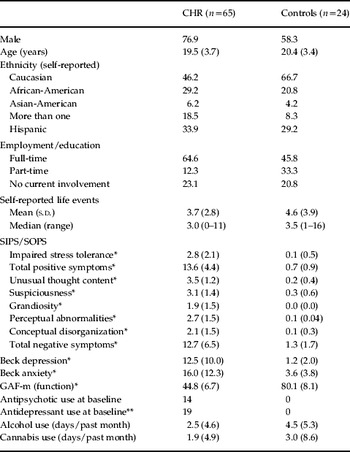
There were 65 CHR patients and 24 healthy controls. All CHR patients met criteria for the attenuated positive symptom syndrome, and three also met criteria for genetic risk and deterioration syndrome, and one for the brief intermittent psychotic symptom syndrome. Patients and controls did not differ by sex, age, race/ethnicity or education/employment status (Table 1). As expected, patients had greater symptom severity across domains, including impaired tolerance to normal stress, and worse function, but were similar to controls in life event exposure (Table 1). Only patients were on psycho-active medications (Table 1). Age, sex, race and education/employment status were unrelated to impaired stress tolerance or life events in the full cohort. Among patients, medication and substance use were unrelated to the stress measures (data not shown).
Baseline demographics, stress measures and symptoms

CHR, Clinical high risk; s.d., standard deviation; SIPS, Structured Interview for Prodromal Syndromes; SOPS, Scale of Prodromal Symptoms; GAF-m, modified global assessment of function.
Values given as percentage, mean (s.d.) or median (range).
* p < 0.001, ** p < 0.05.
As hypothesized, impaired stress tolerance in CHR patients was associated with suspiciousness (ρ = 0.26, p = 0.04), depression (ρ = 0.44, p = 0.004) and anxiety (ρ = 0.32, p = 0.05); however, none of these survived Bonferroni correction. Although hypothesized, there was no association of impaired stress tolerance with total positive symptoms (ρ = 0.07, p = 0.61), unusual thought content (ρ = −0.02, p = 0.86) or poor function (ρ = −0.12, p = 0.37). When significant correlations were examined using multiple linear regression, impaired stress tolerance was only significantly predicted by depression (β = 0.09, s.e. = 0.03, p = 0.005) and not by suspiciousness (β = 0.32, s.e. = 0.19, p = 0.11).
Total life events in the prior 3 months was not associated with any baseline symptoms (data not shown). Neither impaired stress tolerance nor life events was related to grandiosity, perceptual abnormalities, conceptual disorganization or total negative symptoms at baseline (data not shown). Impaired stress tolerance and self-reported life events were unrelated to one another (ρ = 0.15, p = 0.23). Neither impaired stress tolerance nor life events was related to risk for transition to psychosis (18/65 = 28%), with all participants having at least 1 year of risk exposure (baseline impaired stress tolerance: β = 0.06, s.e. = 0.14, p = 0.65; baseline life events: β = −0.06, s.e. = 0.10, p = 0.56).
Longitudinal
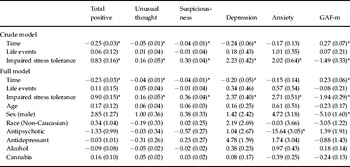
Sixty-five CHR patients completed a total of 285 assessments, for a mean of 4.4 (s.d. = 2.9) assessments per patient. The number of assessments per patient ranged from 1 to 13 [1 (n = 11), 2 (n = 13), 3 (n = 6), 4 (n = 5), 5 (n = 8), 6 (n = 6), 7 (n = 6), 8 (n = 4), 9 (n = 3), 10 (n = 2), 13 (n = 1)]. Separate GEE regression models were constructed for each symptom of interest as an outcome variable, with life events and impaired stress tolerance as predictor variables. The temporal associations of these stress measures with each symptom of interest was examined, first in a crude model and then in a full model that included demographic variables, medication exposure and substance use. For each symptom of interest, both crude and full models showed a significant association (correcting for multiple comparisons) of the symptom with impaired stress tolerance as hypothesized but not with total life events reported (Table 2). Antipsychotic use was associated with reduced anxiety, and males had more impaired function (Table 2).
Longitudinal data for crude and full models for symptoms hypothesized to be related to stress sensitivity in CHR participants

CHR, Clinical high risk; GAF-m, modified Global Assessment of Function.
Values represent β (standard error).
α modified using Bonferroni correction.
* p < 0.0025.
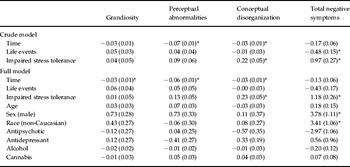
Exploratory analyses of other symptoms using GEE models showed a significant temporal association (accounting for multiple comparisons) of impaired stress tolerance with both conceptual disorganization and total negative symptoms, associations that remained significant even when age, sex, ethnicity, medication status and substance use were included in full GEE models (Table 3). Negative symptoms were more severe among males and non-Caucasian patients (Table 3). Life events were unrelated to all symptoms over time, except for an inverse association with negative symptoms only in a crude model (i.e. fewer life events reported with increasing severity of negative symptoms), an effect no longer evident once demographics, medications and substance use were entered into the model.
Exploratory longitudinal analyses for symptoms not hypothesized to be related to stress sensitivity in CHR patients

CHR, Clinical high risk.
Values represent β (standard error).
α modified using Bonferroni correction.
* p < 0.0025.
Time enrolled in the study was significantly associated with symptom severity for every symptom studied except for anxiety and negative symptoms. That is, over time, positive symptoms, depression and global function had a general trajectory toward improvement but anxiety and negative symptoms remained relatively stable. This is consistent with correlational analyses that demonstrated a significant association of time and severity of symptoms (data not shown). There was also an association of time with reduction in impaired stress, but not life events, suggesting a general trajectory of concurrent improvement in a broad array of symptoms and stress tolerance.
Discussion
In this study, youths at heightened clinical risk for schizophrenia and related psychotic disorders were found to have a significant burden in terms of stress sensitivity (i.e. impaired stress tolerance), as measured with the SOPS. This impaired stress tolerance was associated in cross-section with suspiciousness and depression, consistent with previous studies in other CHR cohorts (Thompson et al. Reference Thompson, Phillips, Komesaroff, Yuen, Wood, Pantelis, Velakoulis, Yung and McGorry2007; Pruessner et al. Reference Pruessner, Iyer, Faridi, Joober and Malla2011; Tessner et al. Reference Tessner, Mittal and Walker2011; Corcoran et al. Reference Corcoran, Smith, McLaughlin, Auther, Malaspina and Cornblatt2012), and also with anxiety, an association previously shown in schizophrenia (Malla & Norman, Reference Malla and Norman1992). By contrast, CHR patients had self-reported stress exposure equivalent to that of healthy individuals similar in demographics, as both groups reported a comparable number of life events over the prior 3 months.
This study built on prior work by prospectively examining stress sensitivity and exposure rather than assessing stress solely at baseline, and by observing how stress and symptoms covary over time. Longitudinal analysis with correction for multiple comparisons showed that impaired stress tolerance was associated over time, as hypothesized, with a range of ‘prodromal’ symptoms, including positive symptoms, specifically unusual thought content and suspiciousness, and depression and anxiety (both measured with Beck scales) and poor function. Impaired stress tolerance was also associated over time with conceptual disorganization and negative symptoms but not with grandiosity or perceptual disturbances. These associations of impaired stress tolerance with symptoms could not be accounted for by demographics or reported exposure to medications, alcohol or cannabis. By contrast, life events were unrelated to symptoms or function both in cross-section and over time. Neither impaired stress tolerance nor life events predicted transition to psychosis, with all patients having at least 1 year of exposure to risk. This is in contrast to a prior study demonstrating that impaired stress tolerance is predictive of the development of psychosis in a similarly ascertained CHR cohort (Yung et al. Reference Yung, Yuen, McGorry, Phillips, Kelly, Dell'Olio, Francey, Cosgrave, Kilackey, Stanford, Godfrey and Buckby2005), although the current study may have been underpowered to detect a relationship given its lower conversion rate.
Taken together, these data suggest that impaired stress tolerance is a core feature of the psychosis risk syndrome related to its characteristic attenuated psychotic symptoms, negative symptoms, poor function and depression and anxiety (Moghaddam, Reference Moghaddam2002; Corcoran et al. Reference Corcoran, Walker, Huot, Mittal, Tessner, Kestler and Malaspina2003; Grace, Reference Grace2012). This constellation of ‘prodromal’ symptoms, including impaired stress tolerance, had a trajectory of general improvement over time (except for the persistence of anxiety and negative symptoms), consistent with findings in other help-seeking CHR cohorts who receive treatment (Cannon et al. Reference Cannon, Huttunen, Dahlstrom, Larmo, Rasanen and Juriloo2002; Morrison et al. Reference Morrison, French, Walford, Lewis, Kilcommons, Green, Parker and Bentall2004; Cornblatt et al. Reference Cornblatt, Lencz, Smith, Olsen, Auther, Nakayama, Lesser, Tai, Shah, Foley, Kane and Correll2007; Walker et al. Reference Walker, Cornblatt, Addington, Cadenhead, Cannon, McGlashan, Perkins, Seidman, Tsuang, Woods and Heinssen2009). This trajectory of improvement may be related to a large prevalence of remission and functional recovery in CHR cohorts (Schlosser et al. Reference Schlosser, Jacobson, Chen, Sugar, Niendam, Li, Bearden and Cannon2011). In addition, patients in the study typically received psychological treatments such as CBT, which focuses on interpretation and management of stress and symptoms, and for which there is evidence for efficacy for prodromal symptoms (McGorry et al. Reference McGorry, Yung, Phillips, Yuen, Francey, Cosgrave, Germano, Bravin, McDonald, Blair, Adlard and Jackson2002; Morrison et al. Reference Morrison, French, Walford, Lewis, Kilcommons, Green, Parker and Bentall2004; Kimhy & Corcoran, Reference Kimhy and Corcoran2008). Impaired stress tolerance may be a potential target for early intervention, as it is related to other prodromal symptoms and to poor function, and has been identified as a potential predictor of psychosis (Yung et al. Reference Yung, Yuen, McGorry, Phillips, Kelly, Dell'Olio, Francey, Cosgrave, Kilackey, Stanford, Godfrey and Buckby2005). Future studies can examine potential intervention strategies in clinical trials, including CBT, antidepressants and anxiolytics, for their efficacy in improving stress tolerance and related symptoms and functional impairment.
Candidate biomarkers of impaired stress tolerance include endocrinological indices and functional imaging markers, observed either basally or in response to a stress paradigm. Impaired stress tolerance and related prodromal symptoms have been associated with elevated basal cortisol secretion in CHR cohorts (Thompson et al. Reference Thompson, Phillips, Komesaroff, Yuen, Wood, Pantelis, Velakoulis, Yung and McGorry2007; Walker et al. Reference Walker, Brennan, Esterberg, Brasfield, Pearce and Compton2010; Corcoran et al. Reference Corcoran, Smith, McLaughlin, Auther, Malaspina and Cornblatt2012), consistent with dysregulation in the hypothalamic–pituitary–adrenal (HPA) axis underlying stress sensitivity in the psychosis risk state. Impaired stress tolerance is also associated with the increased hippocampal metabolism characteristic of the psychosis risk state (Schobel et al. Reference Schobel, Lewandowski, Corcoran, Moore, Brown, Malaspina and Small2009), and so may be consequent to abnormal glutamatergic transmission, as posited by Moghaddam (Reference Moghaddam2002), or to loss of inhibitory feedback, as glucocorticoid receptors are decreased in the hippocampus in schizophrenia (Webster et al. Reference Webster, Knable, O'Grady, Orthmann and Weickert2002). Functional imaging of the hippocampus (along with endocrinological and autonomic assay) in the context of a stress paradigm in CHR patients, as has been reported in normal controls (Khalili-Mahani et al. Reference Khalili-Mahani, Dedovic, Engert, Pruessner and Pruessner2010), could clarify the neural circuitry that underlies this stress sensitivity, which seems to be core to the psychosis risk state.
In the current study, life events were unrelated to symptoms, as has been reported in other studies (Mason et al. Reference Mason, Startup, Halpin, Schall, Conrad and Carr2004; Thompson et al. Reference Thompson, Phillips, Komesaroff, Yuen, Wood, Pantelis, Velakoulis, Yung and McGorry2007). This is consistent with studies in schizophrenia that have similarly demonstrated that stress sensitivity (perceived stress and daily hassles) are more predictive of symptoms and outcome than self-reported exposure to life events (Norman & Malla, Reference Norman and Malla1993). A limitation of our study is that stress was assessed retrospectively, despite quarterly assessments, such that participants were asked to recall life events or instances of poor stress tolerance in the prior 3 months. This limitation may be more significant for life events, assessed using a self-report checklist, than for impaired stress tolerance, assessed through semi-structured interview. Life event checklists also have the problem of intracategory variability, in which events that vary widely in valence, magnitude or relevance are all coded equivalently (Dohrenwend, Reference Dohrenwend2006), regardless of personal significance or subjective impact. Checklists are also subject to recall errors, as evidenced by their low test–retest reliability (Steele et al. Reference Steele, Henderson and Duncan-Jones1980), which may be exacerbated by psychiatric conditions (Dohrenwend, Reference Dohrenwend2006). Finally, clinical improvement may increase exposure to life events, consistent with the apparent inverse association of life events and negative symptom in this current study. Together, these limitations could potentially obscure an association of life events with symptoms and lead to a Type II error. A better methodology may be to use structured interviews, which are more valid and reliable than checklists (Monroe, Reference Monroe2008), albeit more time-consuming. However, even with a structured interview, a previous study failed to find an association of life events with symptoms in a CHR cohort (Thompson et al. Reference Thompson, Phillips, Komesaroff, Yuen, Wood, Pantelis, Velakoulis, Yung and McGorry2007).
A further limitation is that impaired stress tolerance, positive symptoms and negative symptoms were all assessed using the same instrument; however, each of these weigh as distinct factors in the SIPS/SOPS (Hawkins et al. Reference Hawkins, McGlashan, Quinlan, Miller, Perkins, Zipursky, Addington and Woods2004). Furthermore, impaired stress tolerance was also associated with depression and anxiety assessed using the Beck scales, and in an early subgroup of the cohort of n = 21 was highly associated with ratings from Cohen's Perceived Stress Scale (Cohen et al. Reference Cohen, Kamarck and Mermelstein1983), suggesting concurrent validity of the measure. There are new methods for measuring psychological stress developed specifically for individuals experiencing positive symptoms that may have utility for future studies examining stress and symptoms in CHR youths (Tso et al. Reference Tso, Grove and Taylor2012). In addition, the causal direction of associations between stress sensitivity and other ‘prodromal’ symptoms can be examined using time-lag analysis with greater frequency of assessment, using experience sampling or daily diary methodology (Collip et al. Reference Collip, Nicolson, Lardinois, Lataster, van Os and Myin-Germeys2011).
In summary, impaired tolerance to normal stress seems to be a core feature of the psychosis risk syndrome related to other characteristic symptoms of attenuated positive symptoms, affective symptoms, negative symptoms and poor function. It is a potential treatment target that may have endocrinological and neural correlates that can act as biomarkers in clinical trials.
Acknowledgments
C.M.C. received support for this work from the National Institutes of Mental Health (NIMH K23MH066279 and R21MH086125-02), the National Alliance for Research on Schizophrenia and Depression (NARSAD), the Sackler Foundation and the Florence T. Irving Award.
Declaration of Interest
None.