Introduction
Caring for a relative with dementia has been associated with negative consequences for the caregiver's mental and physical health (Mausbach et al., Reference Mausbach, Chattillion, Roepke, Patterson and Grant2013). Within the caregiving relationship, many factors have been identified as sources of stress for the caregiver. Among these, the presence of BPSD is particularly important, to the extent that when other stressors are present, such as physical disabilities, they take on secondary importance in predicting caregivers’ psychological distress (Pinquart and Sörensen, Reference Pinquart and Sörensen2003). BPSD are also a significant predictor of hospitalizations (Voisin et al., Reference Voisin, Andrieu, Cantet and Vellas2010) and institutionalization in nursing homes (Finkel and Burns, Reference Finkel and Burns2000), and they moderate the effectiveness of psychological interventions in caregivers’ levels of depression and burden (Hatch et al., Reference Hatch, DeHart and Norton2013). BPSD have been defined as a heterogeneous range of psychological reactions, psychiatric symptoms, and behaviors that occur in people with dementia of any kind (Finkel and Burns, Reference Finkel and Burns2000). Examples of BPSD are memory problems, aggression, and wandering.
The prevalence and variability of BPSD in the dementia population is high (e.g. Canevelli et al., Reference Canevelli2013), with estimations of between 42% and 86% living both in nursing homes and in the community (Allen et al., Reference Allen2003). Therefore, BPSD constitute a crucial component in the assessment of people with dementia and their caregivers (Finkel and Burns, Reference Finkel and Burns2000; Canevelli et al., Reference Canevelli2013), and one for which conceptually and psychometrically appropriate assessment methods must be developed (Teri et al., Reference Teri, Truax, Logsdon, Uomoto, Zarit and Vitaliano1992). Furthermore, although there are over 100 instruments for measuring BPSD (Zaudig, Reference Zaudig1996), few scales have been adapted and validated for the Spanish-speaking population (Hinton et al., Reference Hinton, Haan, Geller and Mungas2003).
The RMBPC (Teri et al., Reference Teri, Truax, Logsdon, Uomoto, Zarit and Vitaliano1992) is one of the most widely used instruments in the assessment of BPSD. It permits the simultaneous assessment of frequency and reaction (caregiver's subjective burden or reactivity) in relation to three relevant domains of behaviors in the person with dementia (memory-related problems, disruptive behaviors, and depressive behaviors) (Weiner et al., Reference Weiner2000). The questionnaire focuses only on observable behaviors that are potentially modifiable (Teri et al., Reference Teri, Truax, Logsdon, Uomoto, Zarit and Vitaliano1992). Since its publication, this questionnaire has been the subject of a good deal of research attempting to analyze its reliability, validity, and applicability. Fuh et al. (Reference Fuh, Liu, Wang, Wang and Liu1999) assessed the applicability of the questionnaire to the Taiwanese population, obtaining good reliability indices for both the frequency and reaction scales. They concluded that the RMBPC was a useful questionnaire for measuring the frequency of behavioral problems and the reactions associated with those problems. Johnson et al. (Reference Johnson, Wackerbarth and Schmitt2001) obtained, through exploratory factor analysis (EFA), the same three dimensions set out in the original frequency scale (Teri et al., Reference Teri, Truax, Logsdon, Uomoto, Zarit and Vitaliano1992). Furthermore, they obtained good or excellent reliability indexes for all the subscales. However, despite its widespread use, few studies have addressed the matter of confirming the instrument's factor structure using CFA. Allen et al. (Reference Allen2003) used a version of the RMBPC adapted for professional caregivers, consisting of 42 items, and carried out CFA analysis with one-, three-, and four-factor solutions. The three-factor model, replicating the factor structure of the original RMBPC, provided the best fit to the data. Roth et al. (Reference Roth2003) conducted an EFA and a CFA using a modified version of the RMBPC in which they changed frequency of behavior problems for occurrence. They concluded that although the fit of the original three-factor model was not perfect, there were no alternatives that substantially improved the model.
While the RMBPC has also been used with Hispanic population, to our knowledge no studies have confirmed the factor structure of this scale in a Spanish-speaking population of family caregivers of people with dementia and, specifically, in a population from Spain. Losada et al. (Reference Losada, Puente, González and Cigarán2008) found that the Spanish version of the RMBPC showed adequate reliability indexes for the frequency and reaction scales, but they did not analyze the factor structure of the scale or the reliability and validity of the specific subscales. Harwood et al. (Reference Harwood, Barker, Ownby, Bravo, Aguero and Duara2001) assessed 27 Latino caregiver-recipient dyads in English-speaking countries and Coon et al. (Reference Coon2004) translated and adapted the scale so as to measure the occurrence rather than the frequency of problem behaviors in Spanish-speaking caregivers. Both studies indicated that the reliability and validity of the questionnaire was acceptable. González-Salvia et al. (Reference González-Salvia2011) evaluated, with a sample of 92 Argentinian caregivers, the psychometric properties of the Spanish version of the RMBPC, finding through EFA a structure similar to that of the original scale with adequate or good internal consistency rates. Although this questionnaire was adapted for poorly-educated caregivers from Argentina, it is unclear to what extent it is understandable by other Spanish-speaking caregivers, and specifically from Spain, and this has been suggested as a limitation of the study (González-Salvia et al., Reference González-Salvia2011).
To our knowledge, there have been no studies to confirm the factor structure of the questionnaire in its Spanish version. The objectives of the present study are: (a) to conduct a CFA of the Spanish version of the RMBPC (Losada et al., Reference Losada, Puente, González and Cigarán2008) in order to see whether the factor structure proposed in the original questionnaire holds in a Spanish sample of family caregivers of people with dementia, and (b) to study the reliability and validity of the Spanish version of the scale.
Method
Participants
Participants in this study were 361 family caregivers of people with dementia. Inclusion criteria were: (a) being at least 18 years old; (b) considering oneself to be the principal caregiver; (c) have been a caregiver for at least three consecutive months; and (d) devoting at least 1 h per day to caring for the family member.
The sample included adults aged 28–87 years (M = 59.21. SD = 12.68) who resided in Madrid (Spain). Most of the participants included in the sample were women (79.89%). A total of 71.76% were living with the care-recipient, and most were looking after a parent (55.1%), while 38.6% were caring for their partner and 6.3% were related to the dementia patient in some other way. Average educational level (n = 176) was 11.36 years of formal education received (SD = 6.13). Average hours of caring per day were 11.01 (SD = 7.8, range 1–24), and mean time since caring began was 52.95 months (SD = 43.32, range 3–312). A total of 58.6% of the care-recipients had Alzheimer's disease. Of those with dementia, 58.5% were women and their mean score in functional ability was 67.04 (SD = 30.13, range 0–100).
Procedure
Caregivers were contacted through social and healthcare centers in Madrid, Spain. In an initial telephone interview, the inclusion criteria described above were corroborated. Those caregivers who met the criteria were given an appointment for a face-to-face interview with a trained interviewer lasting approximately 90 minutes. The interview covered the following main topics: background characteristics of the dyad (gender, age, educational level, kinship), characteristics of care (time caring, hours per day devoted to care, and diagnosis), problem behaviors and functional capacity of the person with dementia, and caregiver's anxiety, depression, and burden. All participants provided informed consent before joining the study, which was approved by the Spanish Ministry of Science and Innovation and by the Ethics Committee of the University Rey Juan Carlos (Madrid).
Variables
care-recipient variables
Frequency of behavior problems in the person with dementia:
The Spanish version (Losada et al., Reference Losada, Puente, González and Cigarán2008; see Appendix) of the RMBPC (Teri et al., Reference Teri, Truax, Logsdon, Uomoto, Zarit and Vitaliano1992) was used. It consists of 24 items (e.g. “Asking the same question over and over”). Each item has two measures: frequency of problem behavior in the person with dementia and caregiver's reaction to the problem. The items are classified in three subscales: memory-related problems (seven items), disruptive behaviors (eight items), and depressive behaviors (nine items). Frequency is measured on a Likert-type scale ranging from 0 (never occurred) to 4 (occurs daily or more often). For the original scale (Teri et al., Reference Teri, Truax, Logsdon, Uomoto, Zarit and Vitaliano1992), the internal consistency (Cronbach's α) of the frequency total scale was 0.84, and 0.79, 0.67 and 0.80 for the subscales of memory, disruptive, and depressive behaviors, respectively.
Functional ability:
Care-recipient's level of independence in ten basic daily living skills was measured with the Barthel Index (Mahoney, Reference Mahoney1965). Scores range from 0 (totally dependent) to 100 (fully independent). This questionnaire has shown adequate psychometric properties (Mahoney, Reference Mahoney1965), and for the present study an internal consistency (Cronbach's α) of 0.92.
caregiver variables
Reaction to behavior problems:
The caregiver's reaction to behavior problems of the person with dementia was measured by the Spanish version (Losada et al., Reference Losada, Puente, González and Cigarán2008) of the RMBPC (Teri et al., Reference Teri, Truax, Logsdon, Uomoto, Zarit and Vitaliano1992). Reaction is measured on a Likert-type scale ranging from 0 (not at all) to 4 (extremely). For the original scale (Teri et al., Reference Teri, Truax, Logsdon, Uomoto, Zarit and Vitaliano1992) internal consistency (Cronbach's α) of the reaction scale was 0.90 for the total scale, and 0.88, 0.84, and 0.89 for the subscales of memory, disruptive and, depressive behaviors, respectively.
Depressive symptomatology:
The Center for Epidemiologic Studies Depression scale (CES- D) (Radloff, Reference Radloff1977) was used. It comprises 20 items (e.g. “I felt lonely”) assessing the frequency of depressive symptoms during the previous week. Each item was measured using a Likert-type scale, ranging from 0 “less than once a week” to 3 “every day.” The internal consistency (Cronbach's α) in this study is 0.90.
Anxiety:
The Tension subscale of The Profile of Mood States Scale (POMS; McNair et al., Reference McNair, Lorr and DroppLemn1971) was used. It is made up of nine items (e.g. “How often have you felt nervous?”) assessing the caregiver's level of anxiety for the previous week. Response options on the Likert-type scale range from 1 “not at all” to 4 “extremely.” The internal consistency (Cronbach's α) is 0.85 in the present study.
Burden:
Caregiver burden was measured with the Burden scale (Zarit et al., Reference Zarit, Reever and Bach-Peterson1980), consisting of 22 items (e.g. “I feel that my social life has suffered because of my involvement with my spouse”) rating the degree of caregiver distress caused by problems related to different areas, such as caregiver's health, social life. . .. The scale has a Likert-type response format ranging from 0 “not at all” to 4 “extremely.” The internal consistency (Cronbach's α) of the scale in this study is 0.88.
Data analysis
Following the criteria of Fidell and Tabachnick (Reference Fidell and Tabachnick2006), we conducted an analysis to assess the normality of the variables and univariate and multivariate outliers. A CFA was performed in order to evaluate the fit of the data to the original three-factor model (memory problems, disruptive behaviors, and depressive behaviors) (Teri et al., Reference Teri, Truax, Logsdon, Uomoto, Zarit and Vitaliano1992). For the analysis of the fit, the following indexes were considered: χ2 degrees of freedom, and p-values (e.g. Hu and Bentler, Reference Hu and Bentler1999), where the non-significance is indicative of good fit. Also, the χ2 has some disadvantage, for example, including sensitivity to the sample size, so it is important to interpret results with caution and assess the model as an approximation rather than an exact representation. Further the information should be complemented with other indices; the comparative fit index (CFI) and the incremental fit index (IFI), where values close to 0.95 are indicative of good fit (e.g. Hu and Bentler, Reference Hu and Bentler1999); and the root mean square error of approximation (RMSEA), where values of up to 0.08 are representative of reasonable errors of approximation in the population (Browne et al., Reference Browne, Cudeck, Bollen and Long1993). To analyze the modification indexes (MI), MIs higher than 10 were taken into account (Perdrix et al., Reference Perdrix, de Roten, Kolly and Rossier2010). Following the recommendations of Byrne (Reference Byrne2013), only those items whose corresponding errors were similar in their theoretical content were covaried. Analyses for frequency and reaction variables were performed separately. The validity of the frequency and reaction scales was analyzed through the association between these measures and other assessed variables (functional ability, depressive symptoms, anxiety, and burden). For the data analysis, the IBM SPSS 19.0 and AMOS 17.0 software were used.
Results
Outliers, normality, and multicollinearity
In relation to the analysis of univariate outliers, three extreme cases (z score greater than 3.29, p < 0.001) were obtained in the frequency of and reaction to disruptive behaviors variables. Two of the univariate outliers coincided as extreme multivariate analysis outliers (Mahalanobis distance, p < 0.001). It was decided to remove these three participants, resulting in a final sample of 358 participants. The skewness and kurtosis of the variables were within the expected values.
Confirmatory factor analysis (CFA)
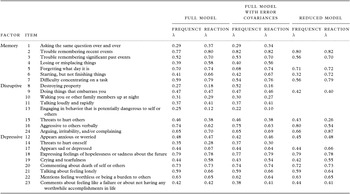
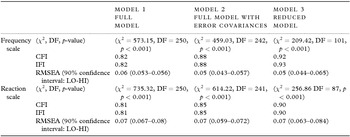
A CFA of the behavioral problems frequency scale, following the original three-factor structure (24 items), was carried out. The factor weights obtained are shown in Table 1 (model 1; full model). As can be seen in Table 2, the fit of the data to model 1 was poor. Based on the analysis of the MI, we tested the model including error covariances (model 2; full model with error covariances). Specifically, eight covariations were considered, of which seven involved items belonging to the same factor (memory: 1 and 3, 2 and 6 and 6 and 7; disruptive: 8 and 13; depression: 12 and 19, 14 and 23, 18 and 23), so that the relationship and its theoretical interpretation were not compromised. We also included one error covariance between a memory item and a depression item (1 and 12). These items, despite belonging to different subscales of the RMBPC, are both symptoms of depression, which explains their covariance. The factor loadings of this second model are shown in Table 1. As can be seen in Table 2, the model obtained showed a marginally acceptable fit.
Factor loadings for the analyzed models

Note: λ = standardized validity coefficient.
Fit indexes for the analyzed models. (N = 358)

Note. χ2: Chi square; Df: degrees of freedom; p: p-value; CFI = comparative fit index; IFI = incremental fit index; RMSEA = root mean square error of approximation.
A final model (model 3; reduced model), from which those items whose frequency factor loading was under 0.40 in model 1 had been deleted, was tested. Also, errors with MI larger than ten were covariated (items 6 and 7 and 12 and 19). The results for this model show a better fit of the data to the model (Table 2). For the reaction scale, 4 error covariations of items belonging to the same factors were included (2 and 6; 15 and 16;17 and 19 and 22 and 23). The fit indexes obtained for the reaction scale (Table 2) are also acceptable.
Descriptive data
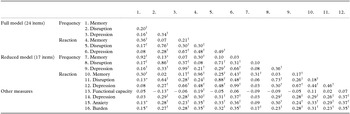
Correlations between the subscales of the full 24-item scale and the subscales of the reduced model with 17 items are shown in Table 3. Almost all the correlations between the scales and subscales of the full and reduced models were significant; the exceptions were the frequency of memory problems and reaction to depressive behaviors in both scales (full and reduced) and the frequency of disruptive behaviors and reaction to memory problems in both scales (full and reduced). Finally, while in the full model frequency scale, the three subscales showed significant associations, in the reduced model, the memory subscale in the frequency scale does not correlate with the depression and disruption subscales.
Correlations between RMBPC scales and subscales and other assessed variables

Note: *p < 0.05; † p < 0.01.
Correlations between the full and reduced models and other variables of interest (anxiety, burden, depression, and functional ability of the person with dementia) are shown in Table 3. Significant positive associations were found between the frequency and reaction subscales (for both the full and reduced models) and caregiver's depressive symptomatology, anxiety and burden, except in the cases of the memory problems (frequency) and caregiver's depressive symptomatology subscales. Regarding functional ability, significant associations were found only with the memory problems and disruptive behavior subscales in the full model.
Reliability
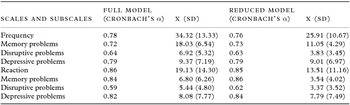
Internal consistency (Cronbach's α) for the total scales (frequency and reaction) and the subscales (memory problems, depressive behavior, and disruptive behavior) of the models 1 and 3 is shown in Table 4.
Reliability, mean and standard deviations of the RMBPC scales and subscales for the full model and the reduced version

Discussion
To our knowledge, this is the first study in which the Spanish version of the RMBPC has been analyzed through CFA. Specifically, three CFAs were performed with three different models: the full structure identified in the original study by Teri et al. (Reference Teri, Truax, Logsdon, Uomoto, Zarit and Vitaliano1992), with 24 items (model 1); the full structure of 24 items with error covariates (model 2); and the reduced structure of 17 items (model 3). While the results suggest that the model 2 showed a marginally acceptable fit to the data, a reduced model with fewer items (from 24 to 17, model 3) shows a better fit, maintaining the original structure of three factors (memory, depressive, and disruptive behaviors) for both the frequency and reaction scales. Therefore, the results of this study support the original structure of the RMBPC (Teri et al., Reference Teri, Truax, Logsdon, Uomoto, Zarit and Vitaliano1992), and this is consistent with the results of previous studies (González-Salvia et al., Reference González-Salvia2011; Roth et al., Reference Roth2003).
The results of the present study suggest that the reduced model is the one that best fits the data; the advantage of this is that the RMBPC is simplified, but at the same time maintains the multidimensionality of the variable (the original three dimensions of memory, disruptive and depressive behaviors). Johnson et al. (Reference Johnson, Wackerbarth and Schmitt2001), who interviewed 952 caregivers, described the RMBPC as a questionnaire in which families could easily tell the difference between most of the items but, for some cases, overlaps were reported (e.g. between item 6 “Starting, but not finishing things” and 7 “Difficulty concentrating on a task”). This study found similar results, with significant covariance between the two highlighted items. Johnson et al. (Reference Johnson, Wackerbarth and Schmitt2001) also found overlaps between items 13 “Engaging in behavior that is potentially dangerous to self or others,” 14 “Threats to hurt oneself” and 15 “Threats to hurt others.” We did not obtain the same result in this study, though our results do suggest other possible overlaps – for example, between items 8 “Destroying property” and 13, and between items 14 and 23 “Comments about feeling like a failure or about not having any worthwhile accomplishments in life.” Items 8, 13, and 14 (but not 23) showed factor loadings under 0.40, so it was decided to delete them in the reduced model.
Two items with factor loadings of under 0.40 in model 3, were retained: item 6, in the frequency scale, and item 15, in the reaction scale. Considering that each of these items presents a loading higher than 0.40 in the frequency scale in model 1, and that good fit indexes were obtained for the reduced model, no further deletions of items were considered necessary.
Analysis of the internal consistency of the overall frequency and reaction scales and their subscales indicates that the reliability obtained for the original 24-item scale is maintained in the reduced model, suggesting that the internal consistency of the total scale and subscales has not been affected by the reduction in the number of items.
It is interesting to note that while memory problems are the most frequent in both our study and the studies by Teri et al. (Reference Teri, Truax, Logsdon, Uomoto, Zarit and Vitaliano1992) and Fauth and Gibbons (Reference Fauth and Gibbons2013), they do not appear to be the problems that generate most reaction in the caregiver; rather, it is depressive behaviors that cause the greatest reaction in family caregivers. In line with the conclusions of Fauth and Gibbons (Reference Fauth and Gibbons2013), this data suggests that the most frequent symptoms are not necessarily the most distressing.
Regarding the associations obtained between variables, we found some differences between our results and those of other studies. For example, while in the study by Teri et al. (Reference Teri, Truax, Logsdon, Uomoto, Zarit and Vitaliano1992), the frequency subscale for memory problems correlated with caregivers’ depression, in our study this association is not significant. Moreover, whereas in the present study all subscales correlated positively with each other (except for frequency of memory problems and responding to disruptive behaviors on the one hand, and frequency of depressive behaviors and reaction to memory problems, on the other), Fuh et al. (Reference Fuh, Liu, Wang, Wang and Liu1999) only found positive correlations between frequency of disruptive problems and frequency of memory problems; this could be due to cultural differences (Fuh et al., Reference Fuh, Liu, Wang, Wang and Liu1999). In our study, the functional ability of the person with dementia only correlates negatively with the frequency of disruptive behaviors scale and with memory problems in the reaction scale, whereas in Johnson et al. (Reference Johnson, Wackerbarth and Schmitt2001) functional ability correlated with all three frequency subscales. This difference may be explained by the use of different scales to measure functional ability in both studies. Regarding the reaction scale, significant relationships between the different subscales and depressive symptoms, anxiety, and caregiver burden were found. These results are similar to those from other studies, which found significant relationships between behavioral problems of the person with dementia and depression (e.g. Fauth and Gibbons, Reference Fauth and Gibbons2013; Roth et al., Reference Roth2003), burden (Ornstein and Gaugler, Reference Ornstein and Gaugler2012), or anxiety (García-Alberca et al., Reference García-Alberca, Lara and Berthier2011; Romero-Moreno et al., Reference Romero-Moreno2011).
Given the important relationship between the BPSD and caregivers’ distress, the modification of problem behaviors is a major goal in psychological interventions with caregivers (see, e.g. Logsdon et al., Reference Logsdon, McCurry and Teri2007). The RMBPC assesses which behavioral problems are most frequently reported by caregivers and which ones generate a greater reaction in them. In addition, this scale has frequently been used to compare changes in the behavior of the person with dementia and the caregiver's reaction before and after a therapeutic intervention (see, e.g. Kajiyama et al., Reference Kajiyama2013). Despite this, authors such as Johnson et al. (Reference Johnson, Wackerbarth and Schmitt2001) argue that this scale should not be used as the sole guide for planning an intervention. Despite providing information on possible salient areas of intervention, there are clinical situations in which it would be more appropriate to use structured interviews or behavioral observation (Teri et al., Reference Teri, Truax, Logsdon, Uomoto, Zarit and Vitaliano1992). These techniques provide information about the factors that may be contributing to the occurrence of behavioral problems (antecedents and consequences), or about the role of the behavior by relating it to the context, avoiding an explanation based solely on the topography of the behavior.
The present study has several limitations. First, the cognitive ability of the people with dementia was not evaluated. Second, the sample was made up of volunteer caregivers recruited through health and social centers, which limits its generalizability to the general caregiver population. Frequency of behavioral problems was rated by caregivers, and no objective measure of this variable is available. In addition, most of the deleted items corresponded to the disruptive subscale. The deleted items (e.g. “Engaging in behavior that is potentially dangerous to self or others”) have face validity, so future studies should confirm the obtained results or analyze alternative or additional dimensions of disruptive behaviors.
Despite the above limitations, the results obtained permit us to suggest that the RMBPC Spanish version, especially in its reduced version (model 3), is a useful and reliable tool for assessing frequency and reaction in relation to behavioral problems and memory problems in Spanish population diagnosed with Alzheimer's disease or related dementias.
Conflict of interest
None.
Description of authors’ role
Celia Nogales-González: designed the study, collected the data, carried out the statistical analysis, and wrote the paper.
Rosa Romero-Moreno: collected the data, carried out the statistical analysis, and supervised the writing.
Andrés Losada: designed the study, carried out the data collection and the statistical analysis, and wrote the paper.
Acknowledgments
This work was carried out in the framework of the Project PSI2009-08132, funded by the Spanish Ministry of Science and Innovation, and Project PSI2012-31293, funded by the Spanish Ministry of Economy and Competitiveness.
APPENDIX
Appendix: RMBPC- Spanish version
The following is a list of problems patients sometimes have. Please indicate if any of these problems have occurred during the past week. If so, how much has this bothered or upset you when it happened? Use the following scales for the frequency of the problem and your reaction to it. Please read the description of the ratings carefully.

-
1. Asking the same question over and over. [Repite la misma pregunta una y otra vez].
-
2. Trouble remembering recent events (e.g., item in the newspaper or on tv). [Tiene dificultades para recordar acontecimientos recientes].
-
3. Trouble remembering significant past events. [Tiene dificultades para recordar acontecimientos del pasado].
-
4. Losing or misplacing things. [Pierde objetos o no recuerda donde los dejó].
-
5. Forgetting what day it is. [Olvida el día en el que vive].
-
6. Starting but not finishing things. [No finaliza las cosas ni las actividades que comienza].
-
7. Difficulty concentrating on a task. [Tiene dificultades para concentrarse en una tarea].
-
8. Destroying property. [Rompe y estropea objetos propios o ajenos].
-
9. Doing things that embarrass you. [Realiza acciones embarazosas para usted].
-
10. Waking you or other family members up at night. [Se levanta durante la noche y despierta a otros].
-
11. Talking loudly and rapidly. [Habla demasiado alto y deprisa].
-
12. Appears anxious or worried. [Se muestra ansioso o preocupado].
-
13. Engaging in behavior that is potentially dangerous to self or others. [Realiza actividades que resultan peligrosas para él mismo o para otras personas].
-
14. Threats to hurts oneself. [Amenaza con causarse daño a sí mismo].
-
15. Threats to hurt others. [Amenaza con causar daño a otras personas].
-
16. Aggressive to others verbally. [Se muestra verbalmente agresivo con otras personas].
-
17. Appears sad or depressed. [Tiene aspecto triste o deprimido].
-
18. Expressing feelings of hopelessness or sadness about the future (e.g. “Nothing worthwhile ever happens,” “I never do anything right”). [Expresa sentimientos de desesperación o tristeza acerca del futuro (Ej: “nada merece la pena”; “nunca me salen bien las cosas”)].
-
19. Crying and tearfulness. [Llora o se muestra lacrimoso].
-
20. Commenting about death of self or others (e.g., “Life isn't worth living” “I’d be better off dead.”) [Realiza comentarios acerca de la muerte de él mismo o de los demás (Ej: “sería mejor que me muriera”)].
-
21. Talking about feeling lonely. [Expresa sentimientos de soledad].
-
22. Comments about feeling worthless or being a burden to others. [Expresa sentimientos de inutilidad y se acusa de ser una carga para los demás].
-
23. Comments about feelings like a failure or about not having any worthwhile accomplishments in life. [Expresa sentimientos de fracaso y de no haber realizado nada valioso durante su vida].
-
24. Arguing, irritability, and/or complaining. [Discute, protesta o se muestra irritable].
Note: The Spanish items are presented in square brackets.