Although writing systems represent spoken language, they are not mere transcriptions mirroring phonological sequences; they encode various aspects of the language system such as its morphology and syntax. This means that learning to read involves knowledge about the relationship between a writing system and the language it encodes (Perfetti, Reference Perfetti2003), and specifically, about its morphology. Morphology is an important linguistic domain that interacts with phonology and grammar and participates in the organization of the mental lexicon in both spoken and written language (Baayen, Reference Baayen, Jarema and Libben2007; Bybee, Reference Bybee1985; Derwing, Reference Derwing, Downing, Lima and Noonan1992). Languages differ in the extent to which they encode linguistic information within the word: that is, the range and means whereby semantic, lexical, and grammatical information is expressed by internal morphological structure (Anderson, Reference Anderson1992). This generates the hypothesis that the role of morphology in word recognition should be enhanced in languages with rich word-internal structure and semantics (McQueen & Cutler, Reference McQueen, Cutler, Spencer and Zwicky1998; Seymour, Reference Seymour, Joshi and Aaron2005). Early and extensive exposure to a morphology rich language should help create stable and coherent morphological categories in children's cognitive systems. Children acquiring a language with a rich morphology can thus be expected to look for the same categories and relationships in written language as those they have mapped out for spoken language. Moreover, the intersection between morphology and reading should serve to deepen and enhance their attention to word-internal structure (Carlisle, Reference Carlisle2003; Karmiloff-Smith, Reference Karmiloff-Smith1992; Ravid & Schiff, Reference Ravid and Schiff2006). Thus, beyond phonological decoding, readers would rely heavily on morphoorthographic representations in single word recognition.
A range of new studies in different languages and orthographies testify to the contribution of morphology to reading acquisition and processing (Deacon & Kirby, Reference Deacon and Kirby2004; Frost, Kugler, Deutsch & Forster, Reference Frost, Kugler, Deutsch and Forster2005; Reichle & Perfetti, Reference Perfetti2003; Schreuder & Baayen, Reference Schreuder and Baayen1997; Verhoeven & Perfetti, Reference Perfetti2003; Verhoeven, Schreuder, & Baayen, Reference Verhoeven, Schreuder and Baayen2003). The current study is anchored in this cross-linguistic framework, examining the role of morphology in learning to read single Hebrew words. Semitic languages such as Hebrew and Arabic constitute an instructive window on how morphology factors in learning to read. One particular aspect of these languages is dense morphological structures, specifically, that most content words are at least bimorphemic and are often more complex because of widespread inflection (Schwarzwald, Reference Schwarzwald2002). Therefore, Semitic orthographies are geared toward the representation of morphology not less than phonology (Frost, Reference Frost, Downing, Lima and Noonan1992; Ravid, Reference Ravid, Joshi and Aaron2005). In addition, the dual nature of Semitic orthographies dictates early reliance on morphological considerations. Both Hebrew and Arabic rely on two orthographic versions: a transparent version supplying readers with full phonological information about the word, and a deeper, more opaque version lacking much information about vowel representation (Abu-Rabia, Reference Abu-Rabia2001; Shimron, Reference Shimron1993). Morphology compensates for the sparse phonological representation by assisting in the retrieval of the full lexical information about most written words. Consequently, learning to read in these Semitic orthographies involves morphological processes at earlier stages than in a language such as English, where the core lexicon is mostly monomorphemic (Mann, Reference Mann2000; Saiegh-Hadad & Geva, Reference Saiegh-Haddad and Geva2008). Moreover, nonlinear Semitic morphology plays a particular role in word decomposition, which is essentially different from the concatenative structures that have occupied so much of the non-Semitic word processing literature (Bolozky, Reference Bolozky1999; Frost, Deutsch, & Forster, Reference Frost, Deutsch and Forster2000).
Hebrew has a rich and varied morphology, with the bulk of its content vocabulary (nouns, verbs, and adjectives) made up of a consonantal root and associated morphological pattern of affixes.Footnote 1 For example, the root k-l-d “type” is shared by the nouns miklédet Footnote 2 “keyboard,” haklada “typing,” and kaldanit “typist, Fm.” The pattern miCCéCet relates nouns with different roots such as miklédet “keyboard,” miktéret “pipe,” and mivréshet “brush.” An important feature of Hebrew is the rich morphophonological facets of its word structure, especially the extended allomorphy exhibited by irregular morphemes and words that may change form, yet systematically retain the same meaning. For example, roots containing historically low, pharyngeal consonants, may incur changes in the surface form of words constructed out of them: compare miklédet “keyboard” from the canonic root k-l-d with mikláxat Footnote 3 “shower,” with the historical pharyngeal ħ, both based on pattern miCCéCet.
These facets of Hebrew morphological complexity affect children's acquisition of oral language (Berman, Reference Berman1985; Ravid, Reference Ravid1995). Also, and more pertinently to the current context, they impact various aspects of children's knowledge of the written language, such as spelling (Ravid, Reference Ravid2001, Reference Ravid, Joshi and Aaron2005), word recognition (Frost et al., Reference Frost, Deutsch and Forster2000), reading comprehension (Kaplan, Reference Kaplan2007), and text production (Berman, Reference Berman2008; Ravid & Berman, Reference Ravid and Berman2009). The goal of the present paper is to show that morphology plays a major role in learning to overcome challenges in reading single nonpointed words in Hebrew.
POINTED AND NONPOINTED READING
The Hebrew orthography has three graphemic componentsFootnote 4: 18 letters denoting consonants, the AHWY  letter set denoting both consonants and vowels, and the nikud pointing diacritics, which mainly denote vowels and stop/spirant alternation (e.g., k/x). Hebrew has two orthographic versions, pointed and nonpointed, differing in the amount of phonological information they supply to readers via these components.
The transparent or shallow pointed version supplies full phonological information by using both letter types as well as the nikud diacritics (Shimron, Reference Shimron1993). This enables readers to identify the written string as representing a unique spoken word. For example, pointed MSKYMH  “she agrees” exactly corresponds to the phonemic transcription maskima, with the first vowel a represented only by nikud, and the two others (i and a, respectively) by both nikud and the vowel letters Y and H. The diacritic in
 signifies that K should be read as k rather than x.
The pointed orthography is mainly used for beginner reading instruction in first grade, where it is critical to systematically detect and convert all graphemes into phonemes and so achieve precise lexical identification. Thanks to the transparent nature of this orthographic version, Hebrew-speaking children reach 80% accuracy in reading by the end of first grade (Share, Reference Share2004; Share & Levin, Reference Share, Levin, Harris and Hatano1999). School texts for second and third grade are still pointed. The pointed version is not used, however, beyond these initial learning stages.Footnote 5 Young learners thus need to learn how to shift into the universally used non-pointed version of written Hebrew.
The opaque or deep nonpointed orthography, the default version among nonnovice Hebrew readers, relies on letters alone to designate both consonants and vowels, with no nikud diacritics. Orthographic conventions dictate that consonantal representation of nonpointed words is full, except for stop/spirant distinctions. In contrast, vowels are only partially and ambiguously represented by the dual-function letters AHWY  AHWY letters are used for representing all vowels at word-final positionFootnote 6; however, they never designate word-internal a and e, whereas word-internal representation of i, u, and o by AHWY is governed by complex conditions. Moreover, each AHWY letter represents more than one vowel, and vowels can be represented by more than one letter. These orthographic conventions are learned concurrently with the acquisition of pointed reading in first and second grade (Ravid & Haimowitz, Reference Ravid and Haimowitz2006). Young learners consequently face two major challenges in the transition into reading nonpointed words (Bar-On, Reference Bar-On2009): identifying the word encoded in the written string (Perfetti, Reference Perfetti, Gough, Ehri and Treiman1992, Reference Perfetti2007), and overcoming homography.
To illustrate the problem of word identification, consider reading nonpointed MSKYMH  as maskima “she agrees.” Following the orthographic conventions described above, there are, in principle, many possible phonological, nonlexical readings of this written string in addition to the correct one, for example, masakima, misxime, mesekima, and so forth. To prevent such erroneous readings of nonword sequences, children should acquire a mechanism that would guide them toward lexical identification. The point we would like to make in this paper is that morphology is the constraining factor that eliminates such multiple illegal readings. The first experiment described in this paper was thus designed to probe the morphological knowledge necessary for correctly reading noncontextualized nonpointed Hebrew words.
To illustrate the problem of homography, consider reading a string such as BNW  in context. This homographic string can be interpreted as three legal words: banu “they built,” bánu “we arrived,” bnu “build, Pl, IMP,” or bno “his son.” Such homographic strings, which are pervasive in nonpointed Hebrew, challenge novice and even experienced readers. In general, both morphosyntactic and semantic–pragmatic contexts are used to disambiguate homography—but may also mislead readers, as in the case of so-called garden path sentences (Bar-On, in press; Ferreira, Christianson, & Hollingworth, Reference Ferreira, Christianson and Hollingworth2001; Friedman & Novogrodsky, Reference Friedmann and Novogrodsky2007). The second experiment described here aimed to examine the morphosyntactic knowledge necessary for eliminating the contextually inappropriate options and arriving at the desired unique lexical identification of homographic nonpointed Hebrew words.
Most current reading models explore word recognition in light of the regular/irregular split characterizing the English orthography (Share, Reference Share2008). As a result, the major controversy between dual-route and single-route models focuses on the way phonology and orthography are each involved in reading. Connectionist models do take the context into consideration (Harm & Seidenberg, Reference Harm and Seidenberg2004), yet focus on monomorphemic words (Reichle & Perfetti, Reference Perfetti2003). The analysis of Hebrew reading processes sheds light on the inherent contribution of morphology to word identification and context to word disambiguation.
READING MORPHOLOGY
In order to understand how morphology features in Hebrew reading processes, we extend the analysis of roots and patterns beyond spoken Hebrew to their morpho-orthographic representations. The spoken root is an unpronounceable discontinuous morpheme, providing the core lexical meaning and basic consonantal skeleton relating a morphological family (Ravid & Bar-On, Reference Ravid and Bar-On2005; Shimron, Reference Shimron2003). For example, root g-d-l “grow” relates verbs, nouns and adjectives: gadal “grow,” gidel “raise,” gudal “be raised,” higdil “enlarge,” hugdal “be enlarged,” gdila “growing,” gidul “growth,” hagdala “magnification,” gdula “eminence,” gódel “size,” migdal “tower,” megadel “grower,” magdélet “magnifying glass,” gadol “big,” and megudal “grown.” It is the assignment of different patterns to the same root that enables the derivation of such a morphological family from a single root (Bolozky, Reference Bolozky1999; Schwazwald, Reference Schwarzwald2002).
To derive a word, patterns complement roots with vowels. Like the root, the morphological pattern is a discontinuous unpronounceable morpheme. It is a prosodic template specifying a vowel pattern into which root radicals are inserted at designated slots, and which may be preceded and/or followed by consonantal affixes. For example, pattern CéCeC (e.g., zémer [song]) provides the penultimately stressed é-e template, with no external affixes. In contrast, pattern miCCéCet (e.g., miklédet “keyboard”) consists of the vocalic pattern i-é-e preceded by m- and followed by -t. Pattern semantics is categorial rather than lexical, classifying words in much the same way as English derivational suffixes.
The structure of the nonpointed written word reflects to what extent orthographic conventions interact with morphological structure. Although the consonantal root is fully represented in writing as a continuousFootnote 7 internal core, patterns, being composed mostly of vowels, have lesser orthographic representation. Cues for pattern identification in reading are peripheral function letters standing for pattern prefixes or suffixes, as well as those pattern-internal vowels that are allowed written representation:  and
 For example, in reading nonpointed MSKYMH
 the cues to the identification of pattern maCCiCa are the peripheral M and H and the internal Y. Coupled with the root letters SKM, pattern identification leads to word recognition.
What we have delineated is the highway to reading single nonpointed Hebrew words by readers who have gained command of orthographic conventions. This involves the identification of the morphological pattern via the discontinuous cues described above, and the subsequent activation of the target word when pattern cues are mapped onto the specific root letters. However, this process is necessary but not always sufficient in achieving full lexical identification in Hebrew. This is because not all morphemes are regularly and transparently expressed in the Hebrew word: massive allomorphy renders many roots and patterns irregular and opaque, requiring further activation of specific morphophonological knowledge. To take up a previous example, to correctly read MQLĦT  as mikláxat “shower” it is necessary to evoke the regular pattern miCCéCet; however, to achieve word identification, vowel lowering from e to a must be inferred from the pharyngeal letter Ħ.
Another example of how morphophonological knowledge contributes to reading success in cases of irregularity is stop/spirant alternation. The homographic letters BKP  denote stops b, k, p, and corresponding spirants v, x, f, distinguished in pointed spelling by a special diacritic. In order to know how to identify the nonpointed word MSKYMH
 as maskima rather than incorrect masxima, readers need to know that as K follows a consonant, it should be read as k (Ravid & Bar-On, Reference Ravid and Bar-On2005).
The current study aimed to trace how Hebrew-speaking gradeschool children, having acquired the graphophonemic code and orthographic conventions, learn to rely on morphological knowledge in reading nonpointed words. To this end, we devised two experiments testing reading of morphologically based nonpointed pseudo words. We chose to employ pseudowords for the purpose of this study so as to be able to tease apart morphological from lexical processes (Ravid & Schiff, Reference Ravid and Schiff2006). Given that roots are the lexical core of Hebrew words (Berman, Reference Berman1987; Nir, Reference Nir1993; Ravid, Reference Ravid2006), our pseudowords contained a pseudoroot and a genuine pattern, for example, TQLWMT  based on pseudoroot q-l-m and genuine pattern
 (cf.
 “orchestra”).Footnote 8
The main task of our participants was to reach pattern identification. We made this task harder by employing roots that require additional, morphophonological, decoding in two domains. First, roots with BKP  letters, which can be read as either stops or fricatives; for example, P
 can be read as either p or f. Second, we also included roots with letters such as Ħ
 , standing for guttural/pharyngeal consonants which by lowering the neighboring vowels, typically from e or i to a. For example, MQLĦT
 “shower” (pattern miCCéCet) is read as
 rather than canonical but incorrect mikléxet. Because nonpointed words involve considerable homography, we further tested homographic pseudowords in sentential context. This was in order to find out to what extent participants relied on the morphosyntactic context identify the context-appropriate pattern and so eliminate possible alternative readings.
Our general predictions were as follows. First, we predicted that morphological knowledge as expressed by correct pattern identification would improve with participants’ age and schooling level. Second, we predicted that morphophonological factors such as stop-spirant alternation and vowel lowering would make tasks harder for younger participants. Third, we expected participants to increase reliance on morphosyntactic context with age and schooling, with correct reading facilitated by more transparent syntactic contexts.
EXPERIMENT 1: MORPHOLOGICAL DECODING IN ISOLATED PSEUDOWORDS
The morphological decoding task focused on the development of morphological processes involved in completing missing phonological information while decoding unfamiliar words. The task required reading aloud nonpointed pseudowords based on real patterns and pseudoroots. Two morphological processes involved in reading nonpointed Hebrew were targeted here. The first was morphological pattern identification, which is the activation of morphological patterns invoked by the orthographic composition of the pseudowords. For example, reading target KLSN  as kalsan based on pattern CaCCan. The second target process was morphophonological decoding, which is expressed in the choice of phonologically conditioned alternants. In KLSN it involved decoding the initial K as stop k rather than as spirant x.
Method
Population. The 171 male and female participants were children and adolescents: 2nd graders (two groups), 3rd graders, 4th graders, 7th graders, 11th graders, and a group of adults. Participants attending school were recruited on a voluntary basis by parental permission. At each grade level, 5 to 8 children declined to participate. The population initially consisted of 153 school children and a group of 21 adults. Of these, 3 schoolchildren failed to complete the tasks and were thus excluded from the final school going population of 150. This study population reflects a developmental progression of reading abilities, as follows: the youngest groups attended second grade and represented two initial phases of nonpointed readingFootnote 9 (Share & Shalev, Reference Share and Shalev2004); the younger second grade group (27 participants) of novice readers was tested in September at the very beginning of the school year (termed beginning-G2), whereas the older second graders (26 participants) were tested in June at the end of the school year (end-G2). These were followed by third graders (26 participants), where knowledge of nonpointed reading is consolidating, and fourth graders (28), who have already gained command of it (Ravid, Reference Ravid1996; Shimron, Reference Shimron1999). The three oldest groups consisted of 7th-grade proficient Hebrew readers (26), followed by experienced 11th-grade (21) and adult readers (17). The school going groups beyond second grade were tested at the same time in the year in April and May. The adults were tested throughout the year.
All participants were monolingual Hebrew speakers, all attending a regional school in the same prosperous suburb in the center of Israel; however, at least one-third were bussed in from other villages and towns. Participants were not screened for reading level, and students designated by their teachers as “poor readers” were not excluded from the study. Each group thus represented the full range of grade-level reading performance in a typical school of the National System and portrays a comprehensive picture of how reading abilities are acquired and evolve across the school years. Nevertheless, because participants volunteered, children with severe reading disabilities may have naturally avoided involvement by declining to participate or by failing to complete the tasks.
Materials. The morphological decoding task consisted of reading aloud 20 nonpointed pseudowords. Each item consisted of a written string such as HTRZP (Hebrew  ), representing a pseudo word (in this case hitrazef) constructed of a pseudo root (r-z-f) and a real morphological pattern (in this case, verb pattern hitCaCeC).
ROOT CHOICE. Using pseudo- rather than genuine roots reflected our interest in the morphological rather than lexical abilities necessary for reading nonpointed words. To reduce the degree of resemblance to words containing real roots, target items differed from real words in at least two root radicals and thus never constituted part of a minimal pair with a real word. To adhere as much as possible to Hebrew phonotactic constraints such as the obligatory contour principle, the first two root radicals did not share the same place of articulation (Berent & Shimron, Reference Berent and Shimron1997).
ROOT MORPHOPHONOLOGY. Ten of the 20 target items reflected the pervasive morphophonological process of stop/spirant alternation (Ravid, Reference Ravid1995; Schwarzwald, Reference Schwarzwald1981). They included the letters  standing forb / v, p / f, or k / x, respectively, as in KLSN
 or MBĦST
 . In addition, three words contained letters standing for historically guttural or pharyngeal root radicals, which attract lower vowels (a instead of default e), such as the Ħ in MCŢGĦT
 .
PATTERN CHOICE. Because most Hebrew content words are based on nonlinear morphological patterns (Schwarzwald, Reference Schwarzwald2002), task items represented the three major lexical classes of nouns, verbs, and adjectives. To focus on the basic root-and-pattern structure, we avoided inflections, which are mostly expressed by linear affixation to a stem (Ravid, Reference Ravid2006). Patterns selected for testing were productive in the sense of relating large morphological families (Avineri, Reference Avineri1976).
PATTERN HOMOGRAPHY. Fifteen of the 20 task items each targeted a single pattern. Thus, the string HTRZP  can only target the pseudo verb hitrazef. The other five items were homographs; that is, each targeted two patterns. For example, KLSN
 could be read either as noun kalsan, based on pseudo root k-l-s and pattern CaCCan (cf. safran “librarian”); or as verb kilsen, based on quadrilateral pseudo root k-l-s-n combined with verb pattern CiCeC (cf. pirsem “advertised”).
Procedure. The task was administered individually by the first author in a quiet room at school. The 20 target items were presented in print as a randomized list in nonpointed orthography. Each participant was instructed as follows: “The words on this sheet are words that you have never seen before, invented words. Please read each word aloud.”
Analysis. Participants’ oral reading was recorded and transcribed into broad phonemic transcription. Each response was classified into one of three categories: pattern identification, nonpattern identification, and graphophonemic error.
PATTERN IDENTIFICATION RESPONSE. This involved correct pattern identification. In the case of homographs, both patterns were considered as correct (e.g., kalsan or kilsen for KLSN  ). Pattern responses could be either (a) morphophonologically accurate regarding stop/spirant and vowel lowering or (b) morphophonologically inaccurate.
NONPATTERN IDENTIFICATION RESPONSE. These responses consisted of graphophonemic decoding rather than pattern identification. This consisted of multiple nonpattern readings such as kalesan, kalésan, or xalesan for correct kalsan.
GRAPHOPHONEMIC ERROR RESPONSE. This was the poorest kind of response, consisting of partial or erroneous graphophonemic decoding rather than word reading. For example, in the case of KLSN these could be kalas, which does not represent the final n, or kalasana, which violates orthographic conventions of final vowel representation.
Results
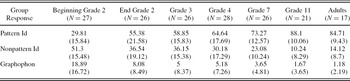
We start by presenting the distribution of the three response types by (age/schooling level) group in Table 1. Where it was required, we conducted post hoc Bonferroni pairwise comparisons at the 0.05 level for simple effects and for interactions.
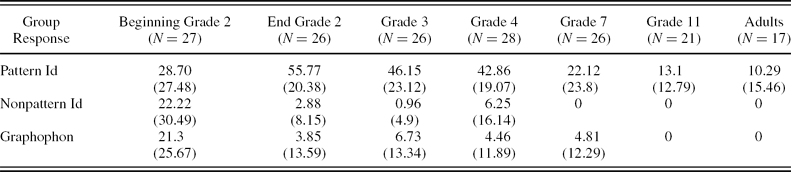
Experiment 1: Mean percentages (standard deviations) of response types by group (N = 171)

Note: Pattern Id, pattern identification; Nonpattern Id, nonpattern indentification; Graphophon, graphophonemic error.
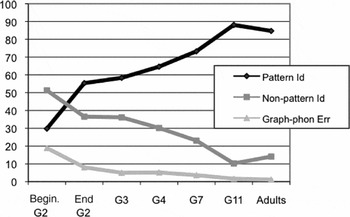
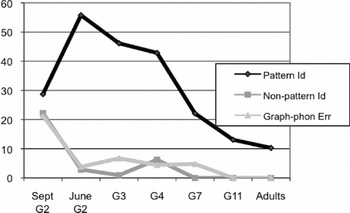
We conducted a two-way analysis of variance (ANOVA) of Group (7: beginning-G2, end-G2, G3, G4, G7, G11, adults) × Response Type (3: pattern identification, nonpattern identification, graphophonemic error) on the data in Table 1. Because the responses represented the distribution of 100%, no group effect was possible. There was an effect for response type, F (12, 328) = 536.94, p < .001, with each type distinct from the others: the most frequent were pattern identification responses (M = 63.04%), followed by nonpattern identification (M = 30.26%), and finally graphophonemic errors (M = 6.7%). Most important, there was a Group × Response Type interaction, F (12, 328) = 27.37, p < .001, shown in Figure 1.
The Group × Response Type interaction in Experiment 1; Pattern Id, pattern identification; Non-pattern Id, nonpattern identification; Graph-phon Err, graphophonemic error; G, grade.

The interaction derives from the following significant differences: beginning-G2 differed from all other groups on all three response types; end-G2 and G3 differed from three oldest groups on both pattern and nonpattern Identification, whereas G4 and G7 differed from the two oldest groups on these two response types. Moreover, nonpattern identification was greater than pattern identification and graphophonemic errors in the youngest (beginning-G2) group in contrast to pattern identification was greater than nonpattern identification that was greater than graphophonemic errors in all other groups.
Morphophonological accuracy in pattern identification responses. Of the 20 words in this task, 13 required morphophonological accuracy. Ten words required the correct choice of either a stop or a spirant; 3 additional words required vowel lowering. Table 2 presents the proportion of morphophonological accurate responses. For example, reading KLSN with erroneous x as xalsan or xilsen, and MĦWL9T  as nonlowered mexulé’et. Note that the total number of participants is only 163 here, excluding 8 of the youngest second grade group who did not succeed in identifying the morphological pattern on all 13 items.
Experiment 1: Mean percentages (standard deviations) of morphophonological errors by group (N = 163)

Note: Stop/spirant, stop/spirant alternation.
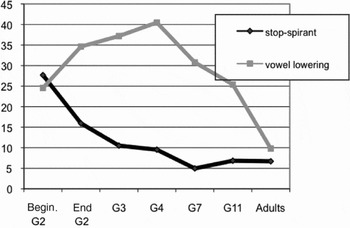
We conducted a two-way ANOVA of Group (7) × Morphophonological Error in pattern identification (2: stop/spirant alternation, vowel lowering) on the data in Table 2. There was an effect for group, F (6, 156) = 2.6, p < .05, showing a decrease in such errors with age and schooling. The effect for error type was also significant, F (1, 156) = 31.28, p < .001, as stop/spirant errors (M = 11.46%) were fewer than vowel lowering errors (M = 30.47%). In addition, there was a Group × Error Type interaction, F (6, 156) = 2.26, p < .05, which is shown in Figure 2.
The Group × Morphophonological Error interaction in Experiment 1; G, grade.

The interaction derives from the following significant differences: stop/spirant errors were more numerous in the youngest (beginning-G2) group than in the three oldest groups; on vowel lowering, we see a U-shape: the older G2 group, as well as G3, G4, and G7 had more errors than the adults. The two error types differed only in G4 and G7.
Initial stop/spirant in nonpattern identification response. Stop/spirant alternation frequently derives from morphological considerations such as pattern type. However, three of our task items entailed BKP  stops rather than spirants based on the purely phonological factor of word-initial position (Bolozky, Reference Bolozky and Kaye1997; Schwarzwald, Reference Schwarzwald2002). We conducted a further analysis on these task items in the nonpattern identification response category in order to examine sensitivity to this constraint on native Hebrew words. Table 3 presents the proportion of correct stop-initial reading in nonpattern identification responses. Again, note that there were only 133 participants, including only those participants who had such responses on at least one of the three words.
Experiment 1: Mean percentages (standard deviations) of nonpattern identification responses with correct initial stop rather than spirant by group (N = 133)

We conducted a one-way ANOVA of group (7) on the data in Table 3. There was no effect for group: all age or schooling levels showed the same high amount of successful stop-initial decoding.
Discussion
The morphological decoding task focused on isolated word identification. It investigated the development of two morphological processes involved in the retrieval of missing phonological information while reading nonpointed Hebrew words: pattern identification and morphophonological accuracy. Participants were tested by reading aloud a set of nonpointed pseudowords consisting of pseudoroots and real morphological patterns. Across the age groups, nearly two-thirds of the responses involved pattern identification and one-third did not involve pattern identification, whereas graphophonemic errors were few, mostly in the youngest group. This indicates that by the end of second grade, Hebrew readers have already mastered the graphophonemic link in nonpointed words.
The transition from phonological to morphological reading. Despite a larger prevalence of nonpattern responses (50%) and graphophonemic errors (20%) in beginning-G2 novice readers, they had a surprising 30% success rate on pattern identification. This was an unexpected finding, because novice Hebrew readers typically convert consonant–vowel (CV) graphemic units into phonological units, with heavy reliance on nikud diacritics (Ravid, Reference Ravid1996; Share & Levin, Reference Share, Levin, Harris and Hatano1999). Thus, the activation of morphological patterns by orthographic cues in these readers testifies to some emergent ability of whole-word reading (Share, Reference Share2008) even at this young age. Given the multiple decoding options for each pseudoword when unconstrained by morphological limitations, this finding cannot be attributed to statistical coincidence. One possible explanation points at individual differences among these novice readers: although most beginning-G2 children still decode phonologically, pattern identification may already be present in a minority at a more advanced reading level. However, note that pattern responses occurred in most beginning-G2s, albeit in different amounts.
A second account regards such responses as a process whereby the linear decoding of one graphemic unit would statistically predict the next one (Saffran, Reference Saffran2003). In these young readers, this process follows an increasingly narrow path fed by knowledge about orthographic and phonotactic constraints (Schwarzwald, Reference Schwarzwald2002). For example, in reading MBĦST  the first graphemic unit M
 is likely to be decoded as the CV unit mi, ma or me, given the absence of an adjacent vowel letter. This start-off point is guided by morphological frequencies, morphophonological syllabic configurations, and conditions on stop/spirant alternation. It led in some cases to the morphological reading of MBĦST
 as mivxéset by beginning-G2 students hesitantly stringing along miv. . .xe. . .set.
According to this account, such early, often hesitant, linear responses reflect a transitional process in learning to read Hebrew, where novice readers gradually decrease their heavy reliance on phonological decoding and nikud diacritics (Ravid, Reference Ravid1996; Share & Shalev, Reference Share and Shalev2004) in favor of larger (more than CV) graphemic units on the way to morphological identification.
Morphological pattern identification. Morphological responses increased dramatically during second grade, from September to June: by the end of the school year, morphological pattern identification reached 55%, significantly more than nonmorphological responses at this time (37%). Beyond second grade, morphological responses increased gradually to about 75% in seventh grade and 85%–90% in experienced, older readers. This finding points at second grade as a “watershed” period in the development of reading in Hebrew, in the sense of learning to smoothly map phonological and morphological patterns onto orthographic ones. These findings are consistent with a series of studies by David Share, indicating that Hebrew-speaking children's ability to learn orthographic patterns, based on reiterative phonological encoding, is greatly enhanced during second grade (Share, Reference Share1999; Share & Shalev, Reference Share and Shalev2004). Moreover, second graders (but not first graders) were able to correctly encode final AHWY vowel letters, a critical requirement to constructing the orthographic pattern of the Hebrew word (Hermann, Reference Hermann2005).
This dramatic change is attributed to second graders’ gradual shift from accurate phonological decoding of pointed words to identification of larger sublexical components and enhanced sensitivity to the form of the whole word. This is enabled by increased knowledge about specific orthographic patterns through repeated exposures to the same words (Share, Reference Share1995, Reference Share1999). It is also facilitated by increase in the ability to extract generalizations about how morphological information is encoded in written Hebrew as a result of exposure to different words sharing the same morphological patterns. Given the nonadjacent structure of the written Hebrew word, with patterns signaled by peripheral function letters enveloping the root letters, this means readers learn to generalize morphological patterns across variable roots, along the lines suggested by Gómez regarding toddlers’ analysis of spoken words (Reference Gómez2002). Because most Hebrew words are morphologically constructed, reliance on morphological structure is a critical step in reading the whole word, especially when novel and nonpointed, that is, phonologically incomplete.
Errors in morphophonological decoding. In addition to knowledge about the morphological pattern of the pseudowords in our study, accurate reading required attention to two morphophonologically conditioned domains: stop/spirant alternation and vowel lowering.
STOP/SPIRANT ALTERNATION. Participants were extremely successful in correctly decoding BKP  letters as either stops or spirants from early on with 70% accuracy in beginning-G2, reaching about 85% accuracy by end-G2, and 90%–95% scores in all older groups. This early success derives from several factors. One is early learning about the set of three homographic letters, each of which denoting both a stop and a spirant; for example, B ב standing for both b (as in baxsay, spelled BĦSAY (
 ) or v (as in mivxéset, spelled MBĦST
 ). Learning the graphophonemic link takes place early on, but success on our task required choice of the correct alternant in the context of the whole word. This was based on robust knowledge about oral Hebrew morphophonemic patterns, which even the youngest group of readers in this study could recruit as soon as they were able to partially identify the pattern. For example, once children identified pattern miCCéCet in MBĦST (or even the sublexical component miC), they were able to read the B as v, because the preferred alternant in the coda of Hebrew closed CVC syllables is a spirant. When the three items with word-initial letter position were tested, success was even higher (86% in beginning-G2, running between 90% and 100% in all other groups, with no significant age difference). This impressive success is because native Hebrew words do not start with the spirant alternants of the bkp set.
However, the BKP  homographic set is not uniform, as shown by differences in accurate morphophonological identification of stop/spirant alternants in our study words. For example, several adults read PWNCT
 as fonécet rather than correct ponécet due to the competition from loan words with initial f such as fantasti (fantastic) or fishalti (I blew it).
Vowel lowering. Three words with letters standing for the historical pharyngeals ‘and ħ required vowel lowering of the canonical pattern ending -éCet to -áCat. For example, compare the two pseudowords MBĦST  and MRDĦT
 both based on pattern miCCéCet (cf. miktéret “pipe”). Although both pseudowords contain Ħ, its position as the last root radical is what determines vowel lowering. Thus, MBĦST, with Ħ as second root radical, adheres to the canonical pattern and should be read as mivxéset; whereas in MRDĦT, as the last root radical, Ħ fulfills the requirement for vowel lowering, and the word should thus be decoded as mirdáxat. Vowel lowering proved to be more challenging (30% errors across the age groups) compared to stop/spirant alternation (11%), and it also showed a U-shaped curve rather than a decrease in errors: the ratio between vowel lowering errors and correct pattern identification was the same in beginning-G2s and G-11s. Note, however, that because the younger group had only 30% correct pattern identification responses, and vowel lowering was tested by only three words, there were only 22 correct pattern identification responses in this group compared to 60 responses in G-11s. Gradeschoolers and middle highschoolers had more vowel lowering errors. This is because the morphophonological status of the type of vowel lowering tested in this study is less stable than basic stop/spirant alternation, and thus requires more experience with written Hebrew. Specifically, we account for second graders’ overreliance on a as the syllabic core as the most frequent and salient vowel in Hebrew morphophonology (Ravid, Reference Ravid1990; Segall, Nir-Sagiv, Kishon-Rabin, & Ravid, Reference Segall, Nir-Sagiv, Kishon-Rabin and Ravid2008) and in reading acquisition (Ravid & Haimovitch, 2005). Grade schoolers, in contrast, often identified the fully correct canonical pattern miCCéCet while ignoring the pharyngeal segment, whereas reliance on written cues increased in the oldest age groups.
The first experiment demonstrated the role of pattern identification and morphophonological decoding in completing missing phonological information while decoding unfamiliar words. However, reliance on these cues alone is not enough in cases of homography, where accurate reading requires additional support from the syntactic context. This issue is investigated in the second experiment.
EXPERIMENT 2: MORPHOSYNTACTIC DECODING OF HOMOGRAPHIC PSEUDOWORDS IN CONTEXT
The second experiment (morphosyntactic decoding task) focused on the role of the syntactic environment in providing cues for morphological decoding. Although the first experiment focused on pattern identification of context-free pseudowords representing different roots and patterns, this second experiment made use of reading aloud a single homographic nonpointed pseudoword MŠGP  Footnote 10 in sentential context. This word can be assigned four different morphological patterns as required by different syntactic contexts and thus can be read as four different words—all based on the same pseudoroot š-g-f.
Method
Population and procedure. The same 171 participants were administered this second task on the same day and in the same manner as the first task. They were presented with a set of written nonpointed sentences that they had to read. The younger groups (second graders) received assistance on reading the sentence (but not the target word) when necessary. Each participant was instructed as follows: “Each of the sentences you see here contains an invented word, marked in red. Please read the sentences aloud with the red word as you see fit. In each sentence the word can be read differently.”
Materials. The idea for the morphosyntactic decoding task was taken from a paper by Hebrew linguist Emanuel Allon (Reference Allon1988). The task consisted of reading four sentences containing a single homographic word that could be read in several different ways evoked by the morphosyntactic environment. The word was MŠGP  which can be interpreted as based on the pseudoroot š-g-f. This string has the potential for multiple morphosyntactic interpretations, because it starts with the letter M: as a function letter, M is a prefix typical of a number of different morphological patterns and it also represents the preposition me- (from); as a root letter, it can participate in root structure in a large number of Hebrew words.Footnote 11
Analysis. Participants’ oral reading of the four sentences was recorded, and the MŠGP words were transcribed into broad phonemic transcription. This time, each response was classified into one of four categories: morphosyntactic identification, pattern identification, nonpattern identification, and graphophonemic error.
MORPHOSYNTACTIC IDENTIFICATION RESPONSE. Responses in this category involved correct morphological pattern, based on the specific syntactic context, as elaborated below for each of the four sentences (presented in their original order). The correct response is given in brackets after each sentence.
(1) etmol Ya'akov MŠGP et kol ha-kis'ot [mishgef]
Yesterday Ya'akov MŠGP Acc. all the-chairs
In this case MŠGP was targeted as past-tense verb mishgef based on quadrilateral (usually denominal) root m-š-g-f, CiCeC verb pattern, analogous to forms such as mixzer “recycled” from maxzor “cycle” (Ravid, Reference Ravid1990).
(2) ka'asher hu pogesh et xavero, hu MŠGP yaxad ito [meshagef]
When he meets his friend, he MŠGP together with-him
In this case MŠGP was targeted as present-tense verb meshagef, based on the canonic trilateral root š-g-f, meCaCeC verb pattern (CiCeC present tense), analogous to forms such as mesaxek “plays/is playing” (Ravid, Reference Ravid1990).
(3) kaniti MŠGP xadash, aval hu nishbar [mashgef, mishgaf, meshagef]
I-bought (a) new MŠGP, but it broke
In this case correct morphosyntactic identification of MŠGP could be based on three different patterns indicating instruments, all deriving from canonic root š-g-f: we targeted the nominal instrument pattern maCCeC, yielding mashgef (compare macpen “compass”); but we also accepted as correct two more versions, based on the nominal pattern miCCaC, yielding mishgaf (compare mishkal “weight” as applying to the instrument), and also the present-tense verb form meCaCeC, yielding meshagef, as such forms frequently serve to designate instruments, for example, mekarer “refrigerator.”Footnote 12
(4) ha-rakévet ha-axarona higia MŠGP lifney sha'a [mi-shégef, mi-ŠGP]
The-last train arrived MŠGP an hour ago
This last sentence required readers to reanalyze MŠGP as consisting of two morphemes: the preposition me “from,” written in Hebrew as attached to the next word (Ravid, Reference Ravid, Joshi and Aaron2005), as in mi-Téfen “from Tefen.” Because ŠGP was interpreted as a proper noun indicating a place name, we accepted as correct all versions that did not violate Hebrew photactics, such as shégef, shagaf, shagef, and shegaf.
PATTERN IDENTIFICATION RESPONSE. Responses in this category involved correct pattern identification without reliance on the specific syntactic context. For example, for sentence (1), etmol Ya'akov meshagefet kol ha-kis'ot “Yesterday Ya'akov [present tense meCaCeC pattern, root š-g-f’] Acc. all the-chairs”—where the syntactic context required the past-tense pattern CiCeC.
The next two response types (nonpattern identification and graphophonemic error) were identical to those described above for Experiment 1.
Results
We start by presenting correct morphosyntactic identification responses. Where required, we conducted post hoc Bonferroni pairwise comparisons at the 0.05 level for simple effects and for investigating interaction sources.
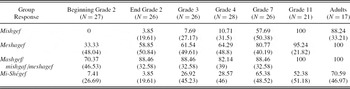
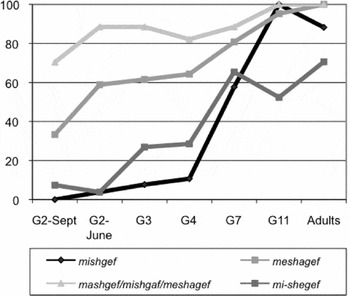
A two-way ANOVA of Group (7: beginning-G2, end-G2, G3, G4, G7, G11, adults) × Syntactic Context (4: mishgef; meshagef; mashgef/mishgaf/meshagef; mi-Shégef) was conducted on the data in Table 4. There was an effect for group, F (6, 164) = 32.4, p < .001, with an increase on morphosyntactic identification responses with age and schooling. The post hoc analyses found three distinct groups: adults, 11th and 7th graders > 4th, 3rd, and June-2nd graders > September-2nd graders. Syntactic context also had an effect, F (3, 492) = 84.23, p < .001, with instrument patterns mashgef/mishgaf/meshagef having the highest morphosyntactic scores (M = 87.13%), followed by present-tense meshagef (M = 67.25%). The two other contexts—quadrilateral root with past tense pattern mishgef and preposition me + place name Shégef—had the lowest scores (M = 33.33% and 33.92%, respectively). Most important, there was a Group × Syntactic Context interaction, F (18, 492) = 4.68, p < .001, shown in Figure 3.
Experiment 2: Mean percentages (standard deviations) of four syntactic contexts by group (N = 171)

The Group × Syntactic Context interaction in Experiment 2; G, grade.

The interaction derives from different developmental patterns in each syntactic context.
1. quadrilateral root with past tense pattern mishgef: adults and 11th > 7th graders > 4th, 3rd, June-2nd and September-2nd graders.
2. present-tense meshagef: adults, 11th and 7th graders > September-2nd graders; adults and 11th graders > June-2nd graders.
3. instrument patterns mashgef/mishgaf/meshagef: adults and 11th graders > June-2nd graders.
4. preposition me followed by place name Shégef: adults, 11th and 7th graders > June-2nd and September-2nd graders; adults and 7th graders > 4th and 3rd graders.
Erroneous responses. Beyond morphologically and syntactically correct responses, participants gave three other response types, which were all erroneous, that are enumerated in Table 5. We conducted a two-way ANOVA of Group (7: beginning-G2, end-G2, G3, G4, G7, G11, adults) × Erroneous Response Type (3: pattern [but not syntactic] identification, nonpattern identification, and graphophonemic error) on the data in Table 5. There was an effect for group, F (6, 164) = 32.41, p < .001, with a decrease on erroneous responses with age and schooling. Response type also had an effect, F (2, 328) = 104.19, p < .001, with more pattern identification responses (M = 33.04%) than the other two erroneous response types: nonpattern identification (M = 5.12%) and graphophonemic errors (M = 6.43%). These findings were mitigated by a Group × Erroneous Response Type interaction, F (12, 328) = 7.38, p < .001, as presented in Figure 4.
Experiment 2: Mean percentages (standard deviations) of the three types of erroneous responses across all four syntactic contexts by group (N = 171)
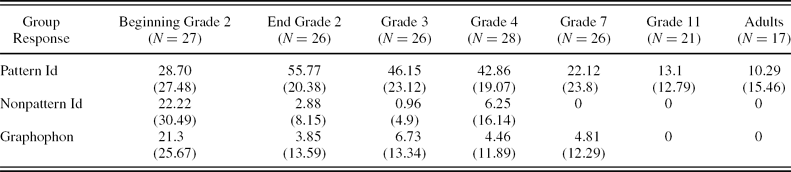
Note: Pattern Id, pattern identification; Nonpattern Id, nonpattern identification; Graphophon, graphophonemic error.
The Group × Erroneous Response Type interaction in Experiment 2; Pattern Id, pattern identification; Non-pattern Id, nonpattern identification; Graph-phon Err, graphophonemic error; G, grade.

The interaction mainly derives from a U-shaped pattern in pattern identification: 4th, 3rd, June-2nd graders > September-2nd graders, and also adults, 11th and 7th graders. In addition, September-2nd graders had more of the other two response types than all other groups.
Discussion
Experiment 1 required participants to reach pattern identification in isolated pseudowords. The second experiment made a further requirement that pattern identification of the pseudoword should match a given morphosyntactic context. The overall success on pattern identification in Experiment 2 words was much higher (almost 90%) than in the previous experiment, and even beginning-G2 students achieved 60% pattern responses (compared with only 30% in isolated words). This 90% proportion consists of 56% morphosyntactically correct and 33% incorrect pattern responses. For example, “Yesterday Ya'akov MŠGP Acc. all the-chairs” required past-tense morphosyntactically correct mishgef; whereas present-tense response meshagef certainly involves identification of the participle pattern meCaCeC but is morphosyntactically incorrect. We attribute this higher success in pattern decoding in Experiment 2 to several factors. The sentential context within which the MŠGP words were embedded provided the full semantic proposition, except for the meaning of the pseudo word (as in Lewis Carroll's famous Jabberwocky). The context served to identify the morphosyntactic role of the pseudoword, such as past-tense transitive verb, direct object, or locative phrase. These clues rendered the MŠGP words closer to real words and thus facilitated the identification of the major Hebrew categorizing construct: the pattern. Moreover, the very homographic nature of the short string MŠGP facilitated pattern identification, pinpointing three productive and highly frequent patterns with large morphological families sharing the orthographic form MXXX: CiCeC past (denominal) and present (regular) tense verbs, miCCaC designating abstract and place nominals, and maCCeC denoting instrument nouns.
The developmental trajectory in morphosyntactic identification was nonetheless longer and more complex than in isolated words, with two cutoff points: one, as before, between beginning-G2 and end-G2, and another one between G4 and G7. This finding testifies to the integrative nature of morphosyntactic identification, collating bottom-up pattern identification learned in the early stages of Hebrew reading acquisition with top-down higher level syntactic processes necessary for efficient word recognition (Perfetti, Reference Perfetti2007).
The analysis of MŠGP responses in the four sentences (Figure 3) demonstrates the critical importance of morphology in reading Hebrew words. Participants based their readings on two morphoorthographic expectations: one, that MŠGP is a Hebrew word constructed of morphological components; and two, that it is composed of M as a function letter signaling pattern and word onset, followed by the three root letters ŠGP. Two morphosyntactic contexts supported these expectations and facilitated correct identification: sentence (3) mashgef/mishgaf/meshagef, and sentence (2) meshagef. The easiest context for all age groups was sentence (3), requiring an instrument noun as a direct object. Not only did it fulfill the expectations for Hebrew word structure, but it also provided no less than three possible pattern fits for the MŠGP nonpointed homograph: nominal patterns maCCeC and miCCaC (or maCCaC), and the ubiquitous present-tense verb pattern meCaCeC, which serves as a productive source of agent and instrument nouns. Sentence (2), which required a present-tense verb to express a habitual activity, also fulfilled morphological expectations; however, there was only a single fit: pattern meCaCeC. This constraint entailed a longer and more gradual developmental trajectory, challenging younger age groups more than the noun in sentence (3).
The two contexts that violated morpho-orthographic expectations were in sentence (1) mishgef, and sentence (4) locative phrase mi-shegef. The steepest trajectory emerged for past-tense mishgef (the only possible option) with virtually no correct responses in all four younger age groups, climbing dramatically between G4 and G7 and between G7 and G11. This is because reading mishgef correctly requires the understanding that the initial m- is not a function letter signaling pattern onset, but rather part of denominal rootFootnote 13m-š-g-f expressing the action associated with noun MŠGP (Berman, Reference Berman and Shimron2003). Quadriliteral roots usually pose no particular difficulty even to young learners (e.g., kilkel [spoiled]); however, denominal roots are more difficult to analyze, because they reflect the derivational history of the word, containing both an original root and a function letter converted into a root letter. For example, mixzer “recycled” is based on the denominal root m-x-z-r derived from noun maxzor “cycle,” which in turn is based on root x-z-r ([re]turn). Participants’ extreme difficulty in correctly identifying the structure of past-tense mishgef reflects their ambiguity in analyzing the morphological function of the initial m, which is expected to signal pattern onset, but must be reanalyzed as a root letter. Only by seventh grade have participants encountered and analyzed an adequate number of verbs from this special set to be able to read Sentence 1 with 60% success.
The locative phrase mi-Shégef (from-Shégef) challenged the process of identifying word structure from a different perspective. Figure 3 shows that sentence (4) is the only context where even adults did not achieve more than 70% correct responses at the end of a gradual learning curve. Moreover, the typical correct response to this sentence involved a slight pause or disfluency before the target item, testifying to some sort of conscious processing. In contrast, the fluent reading of the previous sentences testified to their automatic decoding. We account for this difficulty as follows: morphoorthographic expectations pinpoint M as the signaling word onset; however, the actual word here is represented by ŠGP, whereas the M should be interpreted as the preposition “from.” Hebrew readers generally find no difficulty in analyzing written words into these components from early on (Koriat & Greenberg, Reference Koriat and Greenberg1996; Koriat, Greenberg, & Goldshmid, Reference Koriat and Greenberg1996; Lubstein & Kozminsky, Reference Lubstein and Kozminsky1999; Ravid, Reference Ravid, Joshi and Aaron2005), but in this case the task was rendered particularly difficult due to two factors: (a) MŠGP with the initial M reflects so many possible patterns, as elaborated above, and therefore the expectation is for this string to reflect a whole word; and (b) this expectation has been reinforced by the first three task sentences that have taught our participants the full range of such possible words.
Although these results reflect findings from a task based on a single letter string, we have no reason to believe that the morphosyntactic processes involved in identifying the specific word in its context are unique to this particular pseudoroot (and see Note 11). Rather, this analysis has general applications beyond this specific homographic combination of a pseudoroot and a real pattern.
GENERAL DISCUSSION
Novice Hebrew readers are taught the transparent pointed orthography, reaching an accuracy level of 80% by the end of first grade (Share & Levin, Reference Share, Levin, Harris and Hatano1999). This involves the linear conversion of CV graphemic units into phonological segments, with heavy reliance on nikud diacritics. Beyond this point, children have to achieve reading fluency in the default nonpointed system, which necessitates reliance on morphological cues. The current paper described two experiments focusing on morphological identification in reading nonpointed pseudowords, highlighting the critical role of morphology in learning to read Hebrew. Taken together, our results pinpoint the developmental milestones on the way to efficient Hebrew word recognition, a critical ability underlying proficient reading (Perfetti, Reference Perfetti2007).
Bottom-up processes
One challenge of reading Hebrew words presented in the introduction was accurate nonpointed word recognition. This is especially problematic for young readers who frequently encounter novel or unfamiliar written words. Our study traced the early transition from phonological decoding to emerging nonpointed Hebrew word identification. By the beginning of second grade, knowledge about consonantal and AHWY vowel representation, coupled with probabilistic (morpho)phonological expectations, leads children to gradually abandon nikud diacritics and convert larger, sublexical units. This emerging ability to create links between orthography and morphophonology drives second graders to pay attention to morphoorthographic patterns in written words. In the absence of full phonological representation, these patterns have a crucial role in Hebrew word reading and foster the transition from sublexical to lexical identification.
By the end of second grade, Israeli children have crossed a threshold in the ability to use morpho(phono)logical pattern cues in order to fill in missing phonological information, an important step toward lexical identification of the nonpointed word. Although proficient pattern recognition and morphophonological decoding skills continue to develop and hone across the school years, our results indicate that second grade is an important “watershed” period in learning to read Hebrew.
Top-down processes
Morphological pattern recognition is necessary for novel word identification; however, it is not sufficient for efficient Hebrew reading, which often involves resolving homographic words. Overcoming this second challenge requires taking account of the various contextual cues in discourse segments larger than the single word (Shimron, Reference Shimron1999). The second experiment of our study underscored the role of morphosyntactic processing in selecting the syntactically appropriate pattern out of a number of morphologically possible options. We have shown that this ability develops more gradually and over a longer period than pattern recognition. This is because morphosyntactic identification constitutes an integrative top-down process of pulling out morphological and syntactic information from the context surrounding the homographic word. Moreover, the difficulty of homographic resolution may be exacerbated by complex morphology (such as denominal roots), higher register, low-frequency options, morphosyntactic complexity (such as passive voice), and “garden-path” contexts (Ravid & Berman, Reference Ravid and Berman2009). Readers thus need to readily access advanced linguistic knowledge about spoken and written words and constructions to achieve proficient reading involving both accuracy and fluency.
Finally, this paper has demonstrated the contribution of lexical and syntactic morphology in Hebrew word identification. Because many languages and orthographies are fraught with multimorphemic words and various types of homography and ambiguity, these factors are thus likely to play an important role in reading processes beyond Semitic languages.