INTRODUCTION
Roads constructed through pristine tropical rain forest typically provide newly created habitats such as sunlit forest edges, open soil, puddles, ponds or dammed-up streams (Laurance et al. Reference LAURANCE, Goosem and Laurance2009). Together with their linear and connected character, these habitats can act as dispersal corridors (Brown et al. Reference BROWN, PHILLIPS, WEBB and SHINE2006) and as starting points for the establishment of non-native or non-resident species. Both can lead to a local rearrangement of species (Laurance Reference LAURANCE2004) and functional communities (Ernst et al. Reference ERNST, LINSENMAIR and RÖDEL2006). However, in general it is difficult to disentangle the impact of altered habitat caused by logging from the impact of roads alone.
This study makes use of rather unusual circumstances, in which road construction through lowland mixed dipterocarp tropical rain forest was not linked to timber harvesting. In November 2008, a 5-km-long dirt road was built through the buffer zone of the Ulu Temburong National Park (UTNP), Brunei Darussalam, to connect a tourist resort to the regional water and power supply. This road now cuts through pristine tropical lowland rain forest and traverses several small- to medium-sized streams within the area. These circumstances provided the basis for analysing the influence of the altered habitat on the local frog community.
Several non-mutually exclusive hypotheses have been proposed to explain the high vulnerability of rain-forest biota to the disturbance caused by road construction and other linear clearances such as pipelines, canals or power lines (Goosem Reference GOOSEM2007, Laurance et al. Reference LAURANCE, Goosem and Laurance2009). Animals and plants can be subject to the direct disturbance via edge effects, road-related mortality, barriers to dispersal, human invasions and exotic species invasions (Goosem Reference GOOSEM2007, Laurance et al. Reference LAURANCE, Goosem and Laurance2009).
In this study we investigate the hypothesis that the invasion of exotic species will impact the local fauna, in particular, directly affect a resident frog population. Our focus is on the new additions to the local anuran community instead of tracking the melt-down of species, because a decline in species richness was not to be expected shortly after road construction, especially considering the longevity of some adult frogs. Furthermore, the intact surrounding forest of the impacted streams will still provide suitable habitat for adults of many stream-breeding species, although reproduction might no longer be possible. Finally, the vast majority of the area of the UTNP is still pristine and will most likely act as a source for constant re-immigration of the resident anuran fauna.
The aims of this study were first, to investigate which anuran species took advantage of the altered habitat and immigrated into the area along the road and the adjacent forest. Comprehensive baseline data of the amphibian fauna of the UTNP in recent years facilitated the identification of newly immigrated species (Das Reference DAS1995, Grafe & Keller Reference GRAFE and KELLER2009). Second, to identify which habitat was used by the immigrant species and try to clarify which habitat features were used for the immigration process. Third, to test whether the immigration of new frog species into the area led to neutral additions to the resident anuran community or whether new functional roles were occupied. To address this last question we used a comparative approach by contrasting the largest immigrant species, the greater swamp frog (Limnonectes ingeri), to a similar-sized resident congener, the giant river frog (L. leporinus). Both were by far the largest non-bufonid anurans in the area and regularly grow up to 130 mm snout–vent length (SVL) or more (Inger & Stuebing Reference INGER and STUEBING2005).
METHODS
Study area
The study took place in the UTNP (Figure 1a), located in the Sultanate of Brunei Darussalam from December 2008 to April 2010. Brunei Darussalam is located on the north-west coast of the island of Borneo, surrounded by the Malaysian state of Sarawak. The UTNP, including the buffer zone, is known to be inhabited by 68 amphibian species. These consist of 67 species of anuran and one species of caecilian (Grafe et al. Reference GRAFE, GOUTTE, AHMADSAH, KONOPIK, SCHARMAN and BAUER2010). The majority of these species can be found in small or medium-sized, rocky streams. The national park has an area of 488 km2 and covers an altitudinal range from under 50 m to more than 1500 m asl. It is located at the south-eastern end of the Temburong district and links the two biogeographical regions of east Sarawak and the hilly central Borneo (Grafe & Keller Reference GRAFE and KELLER2009). The vegetation is lowland mixed-dipterocarp rain forest, replaced by submontane rain forest at higher elevations. The relief is mainly characterized by many hills and ridges with steep slopes. Larger flat areas can only be found on gravel sediments in the river valleys of the Temburong River and to some extent in the Belalong River valley. This results in a virtual absence of natural ponds and lakes. Apart from rocky stream-side pools, rare and ephemeral pig wallows and phytotelms, which are known to be used by a certain group of more or less specialized species (Malkmus & Dehling Reference MALKMUS and DEHLING2008), the park area does not provide habitat for frog species that breed in standing water. Exceptions are some water tanks at the tourist resort and the KBFSC, from where a limited set of synanthropic species is known. The steep terrain also results in a lack of swamps in the park, despite the regular and high precipitation. The climate in the region is typical for the inner tropics with a mean annual rainfall ranging from about 2300 mm to more than 4000 mm in hilly areas. The mean air temperature during the study was around 26°C. Even though the north-western coast of Borneo has a constant humid climate there is a wet season between September and November and a drier period in February and March (Cranbrook & Edwards 1994).
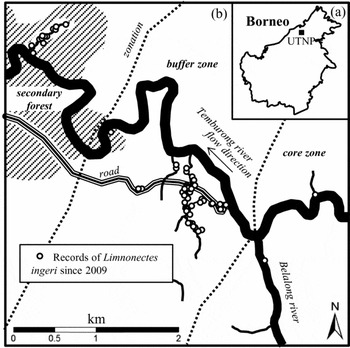
Map of the study site, including the position of the newly built dirt road and the distribution of the immigrant greater swamp frog (Limnonectes ingeri) after its construction. The Ulu Temburong National Park is located at the north-western coast of Borneo, approximately 35 km away from the coast (a). The dirt road originates in a nearby village and leads about 5 km through pristine lowland mixed dipterocarp rain forest, both outside the national park and inside the buffer zone (b). Other tributaries of the Temburong River and the Belalong River other than the studied small streams are not shown. Dotted lines represent the borders of the park zonation.

We sampled six forest streams and the recently constructed road (Figure 1b), including two streams that were traversed by the road and three streams located around the impacted area. This set of streams had been surveyed in previous studies (Grafe & Keller Reference GRAFE and KELLER2009, Keller et al. Reference KELLER, RÖDEL, LINSENMAIR and GRAFE2009) and hence, we had detailed information on the composition of the resident anuran community before road construction. Additionally, we included a stream located in secondary forest, outside the park borders, to investigate the status of possible source populations. All surveyed streams were of comparable size and covered an altitudinal range between 50 m and 100 m asl.
Tracking techniques
To obtain continuous movement data of individuals we radio-tracked frogs via implantable transmitters (Grafe Reference GRAFE, Das, Haas and Tuen2011). Tracking took place between January and April 2010. We used a portable radio receiver (TRX-1000WR, Wildlife Materials® Inc.) and a three-element folding antenna (Yagi) to detect the individuals. Each frog was located maximally once every day. Most of the time, we tracked the frogs between 18h00 and 1h00. On the very few days of heavy flooding, we could not track the frogs during the night. Instead, we had to locate them on the subsequent morning. To obtain natural movement behaviour we tried not to disturb the frogs. If the individuals were hidden or in very steep terrain, we tried to locate the position of the individuals as accurately as possible, even if visual contact was not made. We recorded the location of the frogs via a GPS device (GPSmap 60CSx, Garmin®) supported by matching the position with a detailed map of the area. The GPS accuracy obtained was highly influenced by the topographic surroundings, the crown cover and the weather conditions, but was typically around 12 m (95% likelihood). We only included waypoints that could be safely assigned to a living frog. Data collected after the last proven sighting of an individual were excluded from our analyses.
We used implantable transmitters for the radio-tracking study following guidelines for use of live amphibians in field studies (Beaupre et al. Reference BEAUPRE, JACOBSON, LILLYWHITE and ZAMUDIO2004). The weight of the transmitters (SOPI 2190 and 2070, Wildlife Materials® Inc.), ranged between 1.58–3.59 g. Frogs were caught during the night and kept in buckets until the next morning. Subsequently, they were tranquillized in a starting solution of 0.25% MS222 (tricaine methanesulphonate) following Madison et al. (Reference MADISON, TITUS, LAMOUREUX and Dodd2010). The concentration typically had to be individually adjusted because sensitivity to the drug varied considerably. Thus, we started with a low concentration and slowly increased it until buccal pumping was hardly visible. We then implanted the transmitters into the coelomic cavity. Incisions were sewn together using a self-degradable linen thread. When the wound was properly sealed, we immediately washed the drug out until the buccal pumping returned to normal. Finally, the frogs were released at night at the exact point where they were caught 24 h before.
Trophic niche analyses
Stomach contents of individual frogs were obtained by stomach flushing, as described in Solé & Rödder (2010). All frogs were flushed immediately after having been caught to prevent further digestion. Our flushing equipment was a 50-ml Romed® syringe, two different silicon tubes (one with outer diameter 6 mm and inner diameter 3 mm, the other with 4 mm outer diameter and 2 mm inner diameter), a very close-meshed sieve with 20 cm diameter, a spatula, forceps and several containers with 75% ethanol. The tube was fixed to the syringe. As a flushing solution we used clean water from the closest stream or pond, as proposed by Solé et al. (Reference SOLÉ, BECKMANN, PELZ, KWET and ENGELS2005). Finally, the sampled individuals were sexed and measurements of SVL and gape width were taken before they were released at the point of capture. Radio-tracked individuals were not used for trophic analyses.
Stomach content samples were analysed using a stereo microscope and prey items were identified to order level, apart from anurans, which were determined to species level, where possible. Hymenopterans were separated into ants and non-ants to account for their distinct ecological differences. We also measured the length and the width of each prey item, to calculate an estimated volume by using the formula for an ellipsoid body, following Colli & Zamboni (1999). For the comparison of the general diet, we used the frequency of occurrence and standardized index of relative importance values (Hart et al. Reference HART, CALVER and DICKMAN2002). Hence, we calculated specialization indices and the dependence of prey groups, respectively (Blüthgen et al. Reference BLÜTHGEN, MENZEL and BLÜTHGEN2006). Analyses were done using R package bipartite (Dormann et al. Reference DORMANN, GRUBER and FRÜND2008).
For the stable isotope analysis of 15N we used the toe tips from at least 29 randomly selected individuals per species. Toe tips were transferred into containers with 95% ethanol. The clean samples were subsequently desiccated over silica gel for 1 wk. The dry samples were then cut into several pieces weighing 1 to 2 mg. Finally, two of these were randomly selected and stored airtight and were analysed at the Cornell Isotope Laboratory (COIL; Ithaca, NY, USA) that used a Thermo Delta V isotope ratio mass spectrometer (IRMS) interfaced to a NC2500 elemental analyser.
For some Limnonectes species, it is well known that they are capable of capturing and eating large prey, such as small vertebrates (Dehling Reference DEHLING2009, Inger Reference INGER2009, McLeod Reference MCLEOD2009). Hence, we analysed the spatial and trophic ecology of the immigrant species L. ingeri in detail. Especially in the view of the fact that predation of (resident) anuran species would be a first sign of an impact of the immigrated species on the resident anuran community, directly. To put the features of the new member of the local frog community into perspective, we made use of the co-occurrence of L. ingeri with its resident congener L. leporinus in the impacted sections of the traversed streams. Therefore, we used this as a basis for a comparison.
RESULTS
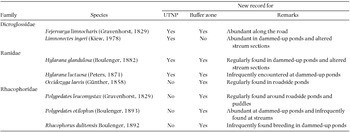
During our study we found three anuran species (Fejervarya limnocharis, Hylarana glandulosa and Hylarana luctuosa) that were new records for the UTNP, including the buffer zone (Table 1). Additionally, we recorded L. ingeri in the core zone of the UTNP for the first time. Furthermore, we recorded new populations of another four anuran species in the two surveyed streams that are traversed by the road. These were previously only known from the surroundings of research and recreational facilities. This totals in eight species of frog being added to the resident anuran fauna of the traversed streams and its surroundings after road construction. Two of these species (H. glandulosa, L. ingeri) were also found in high densities along a stream in secondary forest in the close vicinity of the UTNP.
List of anuran species that immigrated into the area impacted by the construction of a dirt road through the buffer zone of the Ulu Temburong National Park (UTNP). Note that the previous records of Polypedates leucomystax and P. otilophus were from a research centre within the UTNP only. The only recorded individual of Limnonectes ingeri in the buffer zone before the road construction was a single adult male in 2007.

The immigrant anuran fauna can be divided into three groups according to their habitat: (1) species that directly inhabit the road and road-side habitat, (2) a group of species using the dammed up ponds and (3) species that benefit from altered habitat along the traversed streams. The first group consists of Fejervarya limnocharis and Polypedates leucomystax. These species were always found in the close vicinity of the road. Especially during rainy periods, they were frequently seen migrating along the road. They were typically the only species found on the road. The second group of species, which inhabits or breeds in dammed-up ponds, was more diverse. This habitat was used by most immigrant species, namely: Hylarana glandulosa, H. luctuosa, Occidozyga laevis, Polypedates otilophus, Rhacophorus dulitensis and, to some extent, Limnonectes ingeri. Different to the habitat of group one, the dammed-up ponds were not exclusively used by the new arrivals. Some species of the resident anuran fauna also made use of the new breeding opportunities. For example, Hylarana cf. megalonesa, Polypedates macrotis, Rhacophorus nigropalmatus and R. pardalis were frequently observed breeding in these ponds. Group three is mainly represented by L. ingeri and to some extent H. glandulosa. The increased sediment load of the stream led to accumulations of mud and to a general slow-down of the former rocky and fast-flowing stream. Limnonectes ingeri was particularly abundant at these stream sections and co-occurred with the (remaining) resident anuran fauna, including its resident congener, L. leporinus. The two frog species of the third group were the only immigrants that were recorded a considerable distance beyond the traversed streams and their immediate surroundings. On two occasions we found adult individuals of L. ingeri up to 2 km upstream from the impacted area in pristine habitat, inside the core zone of the UTNP. Hylarana glandulosa was also present in the core zone, where we recorded several males calling from the banks of large streams.
Comparison – spatial distribution
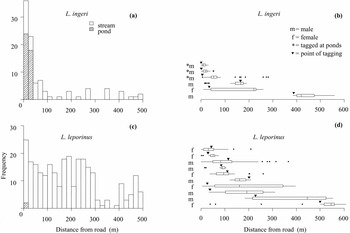
Whereas L. leporinus proved to be widespread in streams inside the UTNP, we found L. ingeri only in areas directly impacted by the road and some scattered localities nearby (Figure 1b). The visual-encounter surveys, performed inside the two surveyed streams that were traversed by the road, revealed distinct differences in the distribution of L. ingeri compared to L. leporinus (Figure 2). The total number of observations for L. ingeri and L. leporinus was 96 and 272, respectively. Almost 44% (N = 42) of the observations of L. ingeri were made at ponds (Figure 2a), compared with less than 1% (N = 2) for L. leporinus (Figure 2b). For L. ingeri, the likelihood of encounter decreased rapidly with distance from the road, whereas the distribution of L. leporinus was clearly less biased towards the road.
Comparison of the distribution pattern and the migration range between the immigrant Limnonectes ingeri and the resident L. leporinus. Shown are encounter records of the L. ingeri in relation to the distance from the dirt road (a) and its native, resident congener L. leporinus (b). Note the different pattern-coding for individuals encountered in streams and ponds, respectively. Accordingly, the individual-based distance data for all six radio-tracked specimens of L. ingeri (c) and all ten L. leporinus (d) are presented, including their movement range, sex and respective points of capture, which differ between individuals.

In total, six L. ingeri (5 males, 1 female) and 10 L. leporinus (5 males, 5 females) were successfully tracked over a period of 13–71 d (mean = 41 d). The L. ingeri males measured 116 mm (SD = 8.1 mm) SVL and weighed 159 g (SD = 37 g). The males of L. leporinus averaged 126 mm (SD = 7.3) SVL and 205 g (SD = 35). The only successfully tracked female L. ingeri measured 100 mm SVL and weighed 100 g, compared with the five tracked female L. leporinus measuring 101 mm (SD = 2.8 mm) and weighing 103 g (SD = 7.6). The weight of the implanted transmitters corresponded to 0.7–2.7% of the frog body mass. None of the frogs died during the surgery or before they were released. Six frogs were lost during the period of tracking, of which two cases could safely be assigned to transmitter failures, because the frogs were found several days later, alive and still in good condition. Another three individuals were eaten by large snakes of 3–4 m in length, namely Ptyas carinata (Günther, 1858) and P. fusca (Günther, 1858). The signal of one individual was lost due to unknown reasons and the frog could not be found anymore.
The tracking data revealed more continuous and detailed information on the habitat use and in particular the stream sections used by the two frog species. Both Limnonectes species can safely be characterized as riparian, with L. ingeri also tolerating dammed-up ponds. None of the tracked frogs was found more than 15 m away from water. All of the tracked L. leporinus made use of wide sections of the stream (Figure 2d). Those L. ingeri caught and tracked inside the streams behaved similarly and roamed inside the stream (Figure 2c). One specimen of L. ingeri, inhabiting the downstream section of the stream migrated up to 559 m away from the road, before it returned. Three L. ingeri were tagged at dammed-up ponds, but only one left the pond and migrated into the stream network during the tracking period. Although stream sections in the close vicinity of the road were the preferred habitat of L. ingeri, at least the adults did not use the road as a dispersal corridor. In summary, there was no species-specific difference in broad-scale habitat use within individuals inhabiting streams. However, the ponds were nearly exclusively colonized by L. ingeri.
Comparison - trophic niche
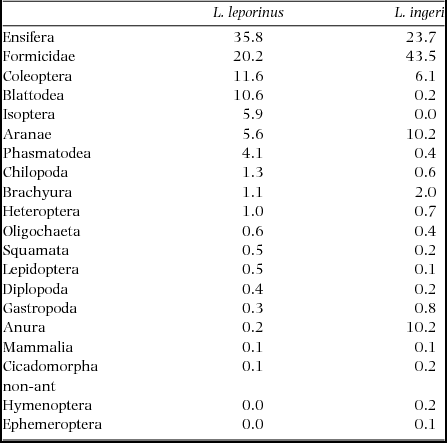
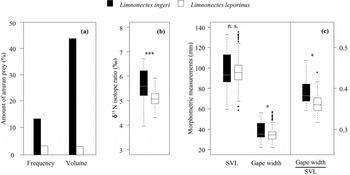
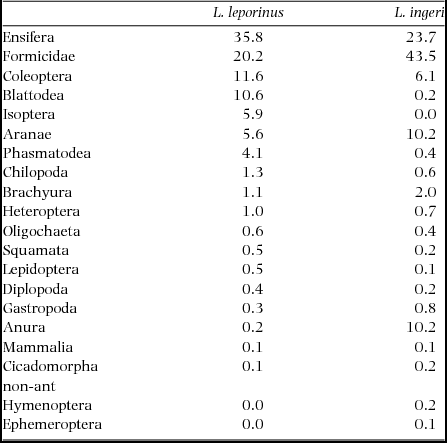
Overall we analysed 152 and 65 stomach contents of L. leporinus and L. ingeri, respectively. The general diet composition did not differ significantly between the two species (H2obs = 3.35, H2ran = 3.36, SDran = 0.0056, n. s.). It consisted mostly of ground-dwelling arthropods with crickets, ants and beetles showing the highest frequencies. Nevertheless, we found major differences regarding vertebrate prey and in particular other frogs. Whereas the native L. leporinus fed only occasionally on other frogs, L. ingeri preyed more frequently on other anurans (Fisher's exact test, one-tailed: P = 0.011), even including L. leporinus. Remains of at least 12 anuran individuals were recovered from the 65 stomach content samples of L. ingeri. These anurans contributed 51% of the total volume of all prey items. Mostly, these were large specimens, representing bufonids, dicroglossids and even rhacophorid tree frogs. In contrast, only five, relatively small ground-dwelling bufonid frogs could be recovered from the 152 stomach samples of L. leporinus. These represented only 2.5% of the total prey-volume of all sampled L. leporinus (Figure 3a). Combined, the higher volume, total number and frequency of occurrence of frog prey, results in a 42 times higher dependence on other anurans in L. ingeri (Appendix 1).
Comparison of morphometric measurements, diet and stable nitrogen isotope data between the immigrant Limnonectes ingeri and the resident L. leporinus. Snout–vent length (SVL) in the sampled individuals does not differ significantly (t-test: t = −0.55, df = 214, n. s.) between species, but both the gape width (ANCOVA: F = 4.83, df = 177, P < 0.05) and the relation of gape width to SVL (ANCOVA: F = 6.32, df = 177, P < 0.05) were significantly bigger in L. ingeri (a). Furthermore, the frequency of other anurans as prey and the respective volume percentages are presented for both species (b). Stable nitrogen isotope signatures were significantly higher in L. ingeri (c). This immigrant species showed an on average 0.5‰ higher δ15N value (ANCOVA: F = 23.8, df = 73, P < 0.001) compared with syntopic specimens of its resident congener L. leporinus.

We analysed the stable isotope ratios of a total of 48 (SVL: 95.9 ± 16.2 mm) and 28 (SVL: 94.3 ± 19.7 mm) tissue samples of L. leporinus and L. ingeri, respectively. The analysis of stable isotope ratios revealed significantly higher δ15N values for L. ingeri (ANCOVA: F = 23.8, df = 73, P < 0.001). The average δ15N ratio of L. ingeri was about 0.5 delta units (10%) higher, compared with its native congener (Figure 3b).
Morphometric comparisons between all sampled individuals of the two Limnonectes spp. revealed no differences in SVL (t-test: t = −0.55, df = 214, n. s.), but significantly larger gapes (ANCOVA: F = 4.83, df = 177, P < 0.05) and higher gape-body length ratios in L. ingeri (ANCOVA: F = 6.32, df = 177, P < 0.05). A total of 121 different L. leporinus and 59 different L. ingeri were measured (Figure 3c).
DISCUSSION
The high number of eight newly recorded anuran species along the new dirt road and in traversed streams can without doubt be interpreted as a direct result of this major habitat alteration, particularly, considering the available detailed, pre-construction baseline data (Das Reference DAS1995, Grafe & Keller Reference GRAFE and KELLER2009). Nevertheless, all of the immigrant frogs are native to Borneo. Mostly occurring in and originating from forested areas of different quality, only two immigrant species (F. limnocharis, P. leucomystax) can clearly be characterized as confined to open and disturbed habitat associated with the activities of humans (Inger & Stuebing Reference INGER and STUEBING2005). The remaining species are typical inhabitants of swamps, muddy streams and forests with ponds (Inger Reference INGER2009, Inger et al. Reference INGER, STUEBING, ZAINUDDIN, Tuen and Das2005), a set of habitats that is also typical for many secondary forests across Borneo, even in hilly terrain.
Immigration routes and occupied habitat
The construction of the dirt road clearly made the establishment of the greater swamp frog (Limnonectes ingeri) in the core and buffer zone of the UTNP possible. The increased sediment load of the stream created suitable breeding habitat for this species. Additionally, the dammed-up streams were also used for breeding and foraging. Surprisingly, the dirt road did not turn out to be a major direct route for the immigration for L. ingeri but instead provided and created suitable breeding sites along its verges that were colonized by frogs migrating large distances within riparian forests, not along the road itself. This migration and colonization pattern stands in clear contrast to other immigration processes caused by road construction, such as the range expansion of the cane toad (Bufo marinus) in tropical Australia. Brown et al. (Reference BROWN, PHILLIPS, WEBB and SHINE2006) showed that the cane toad preferentially used forest roads for migration. Thus, roads facilitated the range expansion of this alien species by acting as highways for dispersal. In our study we have no evidence to suggest that adults or subadults of L. ingeri migrated via roads. However, migration of juveniles via roads cannot be ruled out completely. Instead, adult dispersal was exclusively via the streams. This is in line with the results of Inger (Reference INGER2009), who characterized both L. ingeri and L. leporinus as strictly riparian species. In L. ingeri, invasion of primary forest habitat seems to work rather by means of stepping stones. Suitable habitat along the road is colonized by individuals from nearby source populations. The ability of L. ingeri to reach far-off potential breeding sites is remarkable as demonstrated by a single individual in 2007 that reached the, at that time undisturbed, buffer zone when the nearest potential breeding site was at least 3 km downstream.
The sources and pathways of the other immigrants remain partly speculative. An immigration of H. glandulosa and L. ingeri from the nearby secondary forest into the UTNP seems obvious. In contrast, Fejervarya limnocharis and Polypedates leucomystax must have followed the linear opening of the forest while the road was being constructed. Source populations of these species can be found in villages at the starting point of the road, approximately 5 km away. Sources for the remaining species can also be assumed in the lowland areas surrounding the hilly UTNP.
Highly anurophagous immigrant
We could show the exceptional high importance of anuran-prey and possible adaptations for large prey in L. ingeri. In fact, we could not find any significant difference in diet composition between the two Limnonectes spp., apart from the percentage and, in particular, the volume of anuran prey. This difference is supported by the stable nitrogen isotope data and can be attributed to a higher amount of prey, belonging to higher trophic levels, such as other frogs. A higher trophic level of L. ingeri becomes especially evident, taking into account that L. leporinus also belongs to the diet spectrum of L. ingeri. Kupfer et al. (Reference KUPFER, LANGEL, SCHEU, HIMSTEDT and MARAUN2006) studied the trophic ecology of a tropical food web using stable nitrogen isotopes and the studied frogs were classified as second-order carnivores. Since only one trophic level was analysed in our study and within-region comparisons are not possible, we could not classify these frogs. However, we can say that the difference in nitrogen signatures we found does not qualify L. ingeri as a higher-order carnivore than L. leporinus.
Both relatively and absolutely larger gapes of L. ingeri can be seen as an adaptation for subduing larger prey items (Kramek Reference KRAMEK1972) in gape-limited predators such as anurans. This further supports the conclusion that L. ingeri prefers or even specializes on large prey, like small vertebrates. Apart from L. leporinus, the only species comparable in size to L. ingeri are the large river toads (Phrynoidis) and the horned frog (Megophrys nasuta) that are assumed to be ant specialists (Inger Reference INGER2009) or inhabit the leaf litter, respectively. Hence, L. ingeri can safely be described as the only species being specialized and highly dependent on other anurans as prey in this part of the UTNP.
Consequences and conservation
At sites that are newly colonized by the immigrants encounters with the resident anuran assemblage are inevitable. The resulting competition for resources, including the larval habitats, and predation of the resident L. leporinus may further threaten local populations. Limnonectes leporinus, as many other Asian large-bodied species of the dicroglossid family, is harvested for local consumption (pers. obs.) as well as exported to several Asian and western countries, most notably France and the USA (Kusrini & Alford Reference KUSRINI and ALFORD2006, Warkentin et al. Reference WARKENTIN, BICKFORD, SODHI and BRADSHAW2009). In part, due to its wide distribution in Borneo, the IUCN lists L. leporinus as a species of least concern. However, localized over-hunting and habitat loss are mentioned as potential threats. In this study we showed that the immigration of L. ingeri may pose an additional threat to populations of L. leporinus. Taking into consideration that human-introduced habitat alteration, hunting pressure and the immigration of L. ingeri are usually co-occurring, this combined effect might have negative consequences for local L. leporinus populations.
So far the extent of the immigrant's impact on the remaining anuran community remains difficult to quantify. Nevertheless, the presence of L. ingeri in several temporary ponds along the road may act as an ecological trap for several anuran species adapted to breeding in these kinds of water bodies. Surprisingly, stomach content data revealed that L. ingeri is capable of catching and swallowing even large tree frog species of the rhacophorid family breeding above temporary ponds. Many species of this family, including the charismatic Wallace's flying frog Rhacophorus nigropalmatus, depend on predator-poor pig wallows or similar water bodies in the forest. Nonetheless, these species are readily attracted to ponds along the road, where L. ingeri is present and preys on the arriving individuals. Battin (Reference BATTIN2004) identified a high ratio of trap to source habitat as well as a high rate of exotic species invasion as two major characteristics of landscapes with increased vulnerability of animal populations to ecological traps. Judging from the fact that natural standing water bodies are extremely rare in a hilly landscape and the considerable population size of immigrants, the ponds along the road might qualify as sink habitat for pond-breeding resident anuran denizens. For example, this would affect Rhacophorus kajau and R. rufipes that are breeding within the research area.
The big picture
Despite the considerable number of individuals and rapid immigration of L. ingeri into the affected area, one has to keep in mind that L. ingeri is not a true exotic or alien. In other parts of Borneo, co-occurrence of this species with elements of the hilly primary forest is possible or even common (Inger & Greenberg Reference INGER and GREENBERG1966, Inger et al. Reference INGER, STUEBING, ZAINUDDIN, Tuen and Das2005). This indicates that the coexistence of at least some of the residents with the immigrant species is possible in those particular habitats. However, the addition of new species with entirely new ecological traits, directly affecting other anuran species (e.g. predation), will inevitably alter the native anuran community composition and most likely other taxa as well. It seems possible that the high species richness in the UTNP is the result, at least in part, of its undisturbed character and that the lower species richness reported in similar habitats on Borneo (Grafe & Keller Reference GRAFE and KELLER2009) is a result of past immigration by synanthropic or pioneer species facilitated by logging roads.
Although the immigrant L. ingeri was able to migrate more than 500 m into the adjacent pristine forest areas, so far this species is unlikely to experience a range expansion as has occurred in the cane toad elsewhere (Phillips et al. Reference PHILLIPS, BROWN, GREENLEES, WEBB and SHINE2007). However, even a more localized expansion into pristine rain-forest fragments must be seen critically. At a time of massive deforestation and biodiversity loss in South-East Asia (Sodhi et al. Reference SODHI, KOH, BROOK and NG2004) primary forests with their original species assemblages are irreplaceable for sustaining tropical biodiversity (Gibson et al. Reference GIBSON, LEE, KOH, BROOK, GARDNER, BARLOW, PERES, BRADSHAW, LAURANCE, LOVEJOY and SODHI2011). Thus, the preservation of original species compositions should have highest conservation priority.
In summary, this forest road acted as an invasion corridor introducing a new top anuran predator to one of the species-richest anuran hot spots in Borneo (Grafe & Keller Reference GRAFE and KELLER2009). We showed that the impact of this invasion extended at least 500 m into the primary rain forest suggesting a spill-over process, as previously documented for frogs and other taxa in numerous rain-forest environments (Gascon et al. Reference GASCON, LOVEJOY, BIERREGAARD, MALCOLM, STOUFFER, VASCONCELOS, LAURANCE, ZIMMERMAN, TOCHER and BORGES1999, Goosem Reference GOOSEM2007).
ACKNOWLEDGEMENTS
We gratefully acknowledge the support of the Kuala Belalong Field Studies Centre (KBFSC) staff, its director Dr Kamariah Abu Salim and supervisors Md. Salleh Abd. Bat and Rodzay Bin Abd. Wahab. Furthermore, we thank Hanyrol Ahmadsah, Sandra Goutte, Niko Knapp, Tobias Menig, Doris Preininger and Razit Anak Sapoh for assistance in the field. We would like to thank Nico Blüthgen, Christopher Conrad and Thomas Hovestadt for statistical and GIS support. O. K. thanks the German Academic Exchange Service (DAAD) for financial support. This research was supported by a grant from Universiti Brunei Darussalam (URG 105).
Dependence of Limnonectes leporinus and L. ingeri on the different prey categories (%).