Introduction
Laryngeal dystonia, or spasmodic dysphonia, is a chronic neurological disorder of central motor processing. Like other forms of dystonia, it is characterised by task-specific, action-induced, abnormal muscle spasm. Aronson and Hartman identified two subtypes of laryngeal dystonia.Reference Aronson and Aronson1, Reference Aronson and Hartman2 Approximately 80 per cent of affected individuals have adductor spasmodic dysphonia, which manifests as strangled breaks in connected speech due to irregular hyperadduction of the vocal folds, causing inappropriate glottal closure. Conversely, abductor spasmodic dysphonia causes inappropriate glottal opening due to intermittent vocal fold abduction, resulting in a weak, breathy voice.Reference Blitzer, Brin, Fahn and Lovelace3, Reference Blitzer and Sulica4 Patients may also have a true mixed adductor–abductor type, in which there is an admixture of breathy breaks and tight, harsh sounds. Sometimes this is seen with compensatory behaviour; however, when one form is treated with botulinum toxin, the other gets much worse. Therefore, in these individuals, both adductor and abductor muscles require treatment.Reference Blitzer, Brin and Stewart5 Cannito and JohnsonReference Cannito and Johnson6 proposed that both adductor and abductor abnormalities exist in all patients and that the symptoms depend on whether there is more adductor or abductor activity.
The diagnosis of spasmodic dysphonia is clinical and is based on examination of the larynx during a variety of laryngeal tasks. Examination during connected speech is most likely to reveal the involuntary laryngeal motion that causes symptoms.Reference Sulica7 Vocal fold spasms are concurrent with voice breaks and are associated with increased electromyographic (EMG) activity in the thyroarytenoid muscles.Reference Ludlow8 There is no single pathognomonic feature of the history or the examination, and the diagnosis can be challenging.
Historically, spasmodic dysphonia was thought by many to be psychogenic in origin, as patients often used proprioceptive manoeuvres or sensory tricks such as chewing or laughing to improve speech. The current opinion is that the condition is primarily a neurological disorder. Treatment modalities for adductor spasmodic dysphonia originally included unilateral recurrent laryngeal nerve sectioning.Reference Dedo9 Initial results were promising, but the recurrence rate of spastic voice symptoms has been reported to be as high as 64 per cent at three years,Reference Aronson and De Santo10 most likely due to continued peripheral nerve regeneration. There is no evidence that voice therapy or psychotherapy can ameliorate symptoms. However, behavioural treatment approaches may enhance the effectiveness of other therapies by reducing hyperfunctional vocal behaviours.Reference Murry and Woodson11
Over the past two decades, injection of botulinum toxin type A has become the pre-eminent approach for treatment of adductor spasmodic dysphonia. This treatment involves direct injection of commercially prepared botulinum toxin type A (Botox, Allergan Inc., Irvine, California) into the thyroarytenoid muscle.Reference Sheppert, Spirou, Berrebi and Garrnet12 Botulinum toxin is a protease that blocks the release of acetylcholine from nerve terminals, resulting in muscular relaxation. Its effects are transient and non-destructive, and largely limited to the area in which it is administered. These effects are also graded according to dose, allowing for individualised treatment of patients and disorders. Botulinum toxin A treatment is not curative, and repeated injections over time are required for continued therapeutic benefit.
In over 20 years of use in humans, botulinum toxin has accumulated a considerable safety record, and in many cases represents relief for thousands of patients unaided by other therapy.Reference Blitzer and Sulica4
The collective literature has provided ample evidence to support the effectiveness of botulinum toxin A for treatment of adductor spasmodic dysphonia. However, due to the scarcity of randomised, controlled trials, we cannot draw conclusions regarding injection dose, type, site or method of delivery.
A number of injection strategies are available for the treatment of spasmodic dysphonia. To date, no single protocol has demonstrated a clear benefit over others.Reference Sulica7
Ford et al. Reference Ford, Bless and Lowery13 reported an indirect laryngoscopic technique for injecting the vocal folds. The onset of the response to toxin appears delayed (>9 days) but the degree of benefit and the duration of efficacy appear comparable to the EMG-guided technique. Rhew et al. Reference Rhew, Fiedler and Ludlow14 described toxin administration using a needle placed through the operative channel of a flexible fibre-optic laryngoscope; they reported satisfactory results.
In the largest published series of botulinum toxin A injections for adductor spasmodic dysphonia, Blitzer et al. Reference Blitzer, Brin and Stewart5 used the percutaneous technique of thyroarytenoid muscle injection under EMG guidance. This was also the standard treatment for patients with adductor spasmodic dysphonia at our centre.
During intramuscular injection, the EMG signals can display inter-patient disparity, because of such factors as interfering signal from neighbouring muscles, difficulties in needle placement and inter-operator subjectivity. In the present study, we examined the relationship between the strength of the EMG signal during botulinum toxin injection and the patient outcome in terms of duration of symptom control and adverse effects.
Materials and methods
Patient selection
Over a 10-year period, 14 patients referred to our centre with dysphonia were diagnosed as having adductor spasmodic dysphonia and treated with botulinum toxin A. Only patients with adductor spasmodic dysphonia were included in the study. These patients were first evaluated with a standard history and physical examination, including direct fibre-optic laryngoscopy and video stroboscopy. All patients were reviewed independently by a neurologist. A total of 151 botulinum toxin A injections were performed.
Toxin preparation and administration
Botulinum toxin A was obtained from Allergan (Irvine, California, USA). It was received as frozen, lyophilised toxin and reconstituted with normal saline (without preservative) to a final concentration of 2.5 U/0.1 ml.
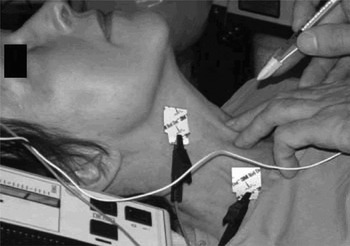
The toxin was injected via a monopolar, hollow-bore, Teflon-coated EMG needle connected to an EMG recorder. The patient was placed in the supine position with the neck extended. The needle was curved slightly to allow for a more anterior placement, and then inserted through the neck skin and cricothyroid membrane into the thyroarytenoid muscle under EMG guidance (Figure 1). The patient was asked to phonate, and when the needle was in a very active area of the muscle, the toxin was injected. The patient was instructed to try not to cough or swallow when the needle was in the airway or in the thyroarytenoid muscle. Anaesthetic was not routinely given because it diminished the EMG interference pattern, making identification of the most active muscle area more difficult. All botulinum toxin A injections were administered by the same clinician over the 10-year period.
Injections
Subjects were not specifically randomised by injection type. All patients initially received 2.5 U botulinum toxin A bilaterally. Decisions about the subsequent type and dose of injections were based upon previous treatment response. At each visit, patients reported the duration of benefit and the duration of side effects. In all subjects, symptoms returned prior to the next injection.
Electromyography signal
A good EMG signal was determined as being 10–15 vs on the EMG recorder.
Outcome
A good response was determined as comprising three months or more of benefit, with side effects of breathiness and dysphagia lasting two weeks or less. All responses falling outside these criteria were recorded as poor outcomes. At each visit, the patient's response to their last injection was recorded in the medical notes, both by a member of the ENT team and by the speech and language therapist. Patients were asked whether they felt the injection had been successful, for how long their voice quality had improved and whether they had experienced any unacceptable side effects (specific questions enquired about a history of dysphagia or breathy voice lasting more than two weeks).
Analysis
Each injection was treated as an independent variable in the data analysis. Statistical analysis was performed using chi-square analysis. Where n < 5, Fisher's exact test was used to confirm statistical significance.
Results
One hundred and fifty-three injections were received by 14 patients (nine women and five men). Data regarding EMG signal and outcome were available for 136 injections. Patients' ages ranged from 32 to 78 years, with a mean of 55.14 years (standard deviation (SD) 15.33 years). Ten patients were diagnosed and managed entirely at our centre; two had received prior treatment (Dysport®) at another centre. Patients' duration of symptoms before diagnosis and treatment ranged from 18 months to 13 years. Patients received between one and 4.5 injections per year (mean 2.88, SD 1.02). Three patients had other neurological involvement (i.e. head and right hand tremor, spasmodic torticollis, and benign essential tremor).
Overall, 121 injections were documented as having a good EMG signal. Of these, 78 per cent (n = 94) had a good outcome, 17 per cent (n = 21) had a poor outcome and 5 per cent (n = 6) had no outcome recorded. All injections with a good signal and a poor outcome were categorised as such, due to either the duration of response being less than three months or to the patient's reporting of subjectively unacceptable post-injection dysphagia. Eleven injections had a poor EMG signal; 64 per cent (n = 7) of these had a poor outcome, and (despite the poor EMG signal) 36 per cent (n = 4) had a good outcome. A good EMG signal significantly (p < 0.01) affected overall outcome.
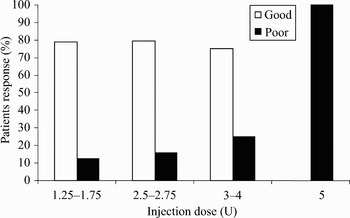
We then examined other variables to determine whether the EMG signal correlated with outcome in a uniform manner. Dose and site of injection were analysed. Botulinum toxin A injection doses were compared in four categories: 1.25–1.75 U, 2.5–2.75 U, 3–4 U and 5 U. Respective to these dose categories, there were 24, 87, eight and two injections with a good EMG signal. Respective to the same dose categories, a good outcome was seen in 79 per cent (n = 19), 79 per cent (n = 69), 75 per cent (n = 6) and 0 per cent. Again respective to the same dose categories, a poor outcome was seen in 12.5 per cent (n = 3), 16 per cent (n = 14), 25 per cent (n = 2) and 100 per cent (n = 2) (Figure 2). The differences between the first three groups were not significant (p > 0.1). All injections of 5 U were recorded as having a poor outcome due to an unacceptable side effect profile. Five-unit injections were used in the early stages of botulinum toxin administration in our centre and were discontinued after one year due to patient dissatisfaction with prolonged breathy voice and dysphagia.
Percutaneous botulinum toxin A injection.

Effect of good electromyographic signal on the outcome of botulinum toxin A injection, for different injection doses.

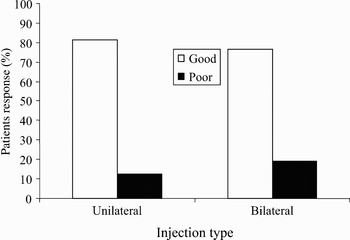
All patients initially received 2.5 U botulinum toxin A bilaterally. Subsequent injections were tailored according to the response to prior injections. If patients reported a prolonged or unacceptable side effect profile, the dose was decreased bilaterally or a similar dose was given unilaterally. No patient received unilateral injections alone throughout the course of their treatment. We examined whether injection site (unilateral or bilateral) influenced the effect of EMG signal on outcome. Thirty-five injections were given unilaterally and 101 bilaterally; good EMG signals were recorded for 32 and 89 injections, respectively. Considering the numbers of these injections with a good EMG signal, 81 per cent (n = 26) of unilateral injections had a good outcome and 76 per cent (n = 68) of bilateral injections had a good outcome (Figure 3). This was not significant (p > 0.1).
Effect of good electromyographic signal on the outcome of botulinum toxin A injection, for unilateral and bilateral injections.

The presence or absence of other neurological involvement did not alter the effect of EMG signal on outcome; 76 and 82 per cent of injections with a good EMG signal had a good outcome in patients with and without other neurological involvement, respectively.
Discussion
Spasmodic dysphonia is an extremely disabling speech disorder. It is a disorder of the central nervous system rather than of the larynx, and, as in other forms of dystonia, interventions at the end organ have not offered a cure.Reference Sulica7 Dedo first performed recurrent laryngeal nerve section as treatment of this disorder in 1976.Reference Dedo9 The initial success of the treatment in many patients proved temporary, with a return of symptoms despite continued vocal fold paralysis. In 1984, Blitzer et al. were the first to inject botulinum toxin into the vocal folds, creating a chemical neuronectomy and successfully relieving symptoms.Reference Blitzer, Brin, Fahn and Lovelace3 Since then, the uses of botulinum toxin A in the field of otolaryngology have been ever expanding, and now also include treatment of oromandibular dystonia, blepharospasm, vocal tics and stuttering, cricopharyngeal achalasia, various tremors and tics, hemifacial spasm, temporomandibular joint disorders, and a number of cosmetic applications.Reference Blitzer and Sulica4
Botulinum toxin exists as eight different serotypes. All are proteases with a similar structure, but each is antigenically distinct and has a different site of action within the neuron.Reference Blitzer and Sulica4 Botulinum toxin A is marketed in the USA as Botox (Allergan Inc., Irvine, California) and in the UK as Dysport (Ispen Ltd., Wrexham, England). Injected into muscle, botulinum toxin A causes flaccid paralysis by preventing acetylcholine release from nerve terminals. The toxin cleaves the synaptosome-associated protein of 25 kD molecular mass, which renders the synaptic fusion complex inactive and the nerve terminal incapable of releasing acetylcholine.Reference Blitzer and Sulica4 After approximately 28 days, the terminal recovers its ability to release acetylcholine, most likely due to the de novo synthesis of synaptosome-associated protein of 25 kD molecular mass. After 90 days, recovery is essentially complete. This correlates well with the clinically observed duration of botulinum toxin A effect.
The effectiveness of botulinum toxin A injections has been assessed using acoustic, aerodynamic, endoscopic, electromyographic, stroboscopic, perceptual and subjective rating measures, amongst others.Reference Rubin, Wodchis, Spak, Kileny and Hogikyan15–Reference Rodriguez, Ford, Bless and Harmon19 Each of these measured variables has confirmed the benefit of botulinum toxin A in the treatment of adductor spasmodic dysphonia. However, we and othersReference Blitzer, Brin and Stewart5, Reference Benninger, Gardiner and Grywalski20, Reference Tisch, Brake, Law, Cole and Darveniza21 believe that patients' subjective rating of function is especially important, as the aim of botulinum toxin A treatment is to provide symptomatic relief, not cure. Rubin et al. demonstrated continued effect in adductor spasmodic dysphonia patients across multiple treatment sessions, using the voice-related quality of life questionnaire (a standardised, patient-based outcome measure).Reference Rubin, Wodchis, Spak, Kileny and Hogikyan15 In the current study, we found that patients' subjective opinion, based on simple history-taking and medical record documentation, was a valid indicator of treatment success and future treatment strategy.
One hundred and twenty-one injections had a good EMG signal; of these, 94 had a good outcome. Patients receiving the 21 injections which had a good EMG signal but a poor outcome did respond to botulinum toxin A treatment in terms of symptomatic relief, but were documented as having a poor outcome due to prolonged adverse side effects. Adductor spasmodic dysphonia is not a stereotyped disorder with identical clinical features in all patients. The physician must tailor the treatment to each individual patient. This includes selecting and adjusting the dose and frequency of injections.Reference Blitzer and Sulica4 The majority of injections with a poor EMG signal had an unfavourable outcome in terms of persistence of voice symptoms. However, 36 per cent of such injections were followed by a good outcome. In terms of actual numbers (n = 4), this accounts for relatively few injections, and was due to a technical EMG fault during one session of botulinum toxin A injection.
• This study examined the reliability of electromyography (EMG) signal in determining the efficacy of botulinum toxin A injections for the treatment of adductor spasmodic dysphonia
• Signal strength, dose of botulinum toxin and site of injection were all compared with outcome
• The EMG signal was a reliable predictor of favourable outcome of botulinum toxin injection in this debilitating condition; EMG-guided injections can be undertaken safely on an out-patient basis
Published protocols involve the injection of botulinum toxin A into one or both thyroarytenoid muscles. A recent review of the literatureReference Boutsen, Cannito, Taylor and Bender22 concluded that neither the unilateral nor the bilateral injection technique had been consistently associated with a better outcome, in terms of symptom relief or better voice function. In spite of this, evidence suggests that the unilateral technique may minimise adverse side effects such as breathiness and dysphagia.Reference Bielamowicz, Stager, Badillo and Godlewski23 In our series, we found no optimal injection protocol in terms of symptomatic relief; however, bilateral injections were associated with more adverse effects. Eight adverse effects were recorded for bilateral injections and two for unilateral injections. We used unilateral vocal fold injection in patients who reported adverse effects to a prior, low dose, bilateral injection. However, the standard initial treatment at our centre was bilateral injection using equal amounts of botulinum toxin A. We did not revert to bilateral injections if the patients reported an acceptable result with unilateral injections. However, if the patient reported a poor voice quality following unilateral injections, a subsequent bilateral injection was administered. Injection protocols were tailored specifically to each patient's response.
In some centres, unilateral injection is the standard treatment for adductor spasmodic dysphonia, and satisfactory results have been achieved. In most patients, the disorder is observed to be bilateral and symmetrical. This suggests that, in addition to causing muscle weakness, botulinum toxin A has an effect on afferent neural symptoms. It has been observed that patients with other neurological problems related to their dystonia developed an improvement in these other symptoms following botulinum toxin A injection for adductor spasmodic dysphonia.Reference Blitzer, Brin, Fahn and Lovelace3 This indicates that botulinum toxin A has more than a local effect. In our series, three patients with adductor spasmodic dysphonia had other neurological involvement. There was no difference between this group and the patients with focal laryngeal dystonia alone, in terms of response to treatment. Local injection of botulinum toxin A into the thyroarytenoid muscles did not have any effect on other neurological findings.
Treatments for AdSD are often less than satisfactory. Medical management of AdSD continues to evolve, along with the realization that, at the present time, there is no definitive cure, and treatment must be based on each individual patient and their symptoms.Reference Pearson and Sapienza24
Conclusion
Currently, the preferred treatment strategy for adductor spasmodic dysphonia is symptomatic management with botulinum toxin A chemodenervation. This treatment is supported by a large body of work attesting to its efficacy in many different hands,Reference Sulica7 using different injection protocols, means of administration and outcome measures. Laryngeal dystonia is not a primary disorder of the larynx and so interventions at this level are not likely to offer a cure, but they can provide symptomatic relief until treatment directed at the underlying neurological disorder can be found. We conclude that EMG signal is a good predictor of outcome in patients with adductor spasmodic dysphonia, and that subjective outcome rating by the patients is a simple but effective means of tailoring treatment protocols for this debilitating condition.