INTRODUCTION: ANTHROPOLOGY, CIVILIZATION, AND SOCIALISM
Much of the history of anthropology has been predicated on distinctions taking the form of “us versus them,” civilized versus savage, or Kulturvölker versus Naturvölker. The basic binary has often been illustrated with regard to time, notably in the structuralist opposition between diachrony and synchrony, and between progressive and “reversible” time (Lévi-Strauss Reference Lévi-Strauss1966). Such great divide theories have coexisted uneasily with the relativist postulate of a world of equivalent but incommensurable units, usually termed “cultures.” However, some parts of the world pose intractable problems. The populations of the eastern shatter zones of Europe were closely related to those that gave birth to the Enlightenment. Some shared variants of Western Christianity, while others were affiliated to this religion's Byzantine variant. Neither the binaries of Montesquieu or Lévi-Strauss nor the relativism of Herder or Benedict are adequate for grasping commonalities and differences in this interstitial region. These “people in between” are still relatively invisible in the literature of Western anthropology, though they have received loving attention from their own “native ethnographers” (Bošković and Hann Reference Bošković and Hann2013).
Often in conscious emulation of the established nation-states of the West, ethnographers working in the spirit of Herder played a significant role in the differentiation and consolidation of national identities in Eastern Europe. Even within the German-speaking world, intellectuals proud of their new collective identities retained a consciousness of lagging behind. I term this backwardness civilizational, emphasizing material conditions and techniques but without neglecting ideas and representations. In the approach of Durkheim and Mauss, a civilisation is understood not as a more advanced stage or Hochkultur but as a “family of societies” (Mauss Reference Mauss and Schlanger2006 [1929–1930]: 62). This was readily applicable to the case of Australia, but the situation in early-modern Eastern Europe was very different. Some societies of the West had embarked on rapid growth and seemingly irreversible changes affecting almost all of their members, while their close neighbors were patently not developing in the same way. This is the context in which socialism, theorized by its founders as the movement of the advanced workers of the West, came to be implemented to overcome the problems of agrarian backwardness in the East. In the words of Eric Hobsbawm, “The Soviet system was designed to industrialize a very backward and underdeveloped country as rapidly as possible” (Reference Hobsbawm1994: 350). Soviet socialism can be construed as a civilization in both the relativist sense of civilisation in the French sociological school and the universal material sense foregrounded in the German concept of Zivilisation.Footnote 1 Yet overall, as I shall show, Hungarian villagers did not evaluate this socialist civilization positively.
Though contemporary anthropologists recoil from the normative connotations of such words, Hobsbawm has no hesitation in using “backward,” and even “inferior.” Western researchers had restricted access to socialist societies, especially the Soviet Union. Conditions were more favorable after the Soviet bloc collapsed, but new ethical and epistemological issues presented themselves, including the question of whether socialism ever constituted a coherent alternative to capitalism, the fundamental premise of the Cold War. Arguing within the paradigm of “multiple modernities” theory, historical sociologist Johann Arnason (Reference Arnason and Eisenstadt2002) concluded that Soviet socialism represented a “failed modernity.”Footnote 2 The collapse that took place between 1989 and 1993 was prima facie evidence of failure, yet by this time most societies of the “second world” were, according to standard measures such as urbanization and industrialization, no longer backward at all. Judged by some commonly accepted indicators of a putatively universal yardstick of progress, such as female participation in the labor force, the German Democratic Republic was ahead of the capitalist Federal Republic.
Indeed, many East Germans rapidly developed a strong nostalgia for the modern world they had lost, though this was shaped more by resentment toward Western domination than an intrinsic preference for the ancien régime (Berdahl Reference Berdahl2010). Dominic Boyer goes further, arguing that West Germans colonized and allochronized the co-ethnics they absorbed into the Federal Republic (Reference Boyer, Todorova and Gille2010). According to this provocative account, the phenomenon of Ostalgie is symptomatic of a more general “manic” determination on the part of the West to maintain Eastern Europe as the backward, past-fixated reference point for its own palpably failing global hegemony. Perhaps, but the fact remains that a large majority of eastern Germans voted for (re)unification, implicitly endorsing the allochronizing narrative of the West. Two decades later, despite clear evidence of being disadvantaged in a variety of domains vis-à-vis Western regions, the number of east Germans who support the successor to the Communist Party remains rather small. Boyer attributes this to a betrayal on the part of “small castes of social elites” (Reference Boyer, Todorova and Gille2010: 21). But can the charges of allochronization and “nostomania” be sustained when the majority appears to endorse the hegemonic capitalist temporalization according to which socialism was irredeemably backward, rather than the “alternative modernity” thesis?
The German Democratic Republic is the only socialist state that disappeared in this way. The more common scenario was a protracted transition in which elites negotiated compromises and new visions of society with each other and the rest of the population within unchanged political boundaries. In this article I focus on the case of Hungary, where social memory has developed in ways quite different from Germany (Nadkarni Reference Nadkarni, Todorova and Gille2010; Hann Reference Hann, Angé and Berliner2015). To explain why nostalgia for socialism has been displaced in the public sphere by yearnings for earlier eras of which few contemporaries have direct experience, it is necessary to take that past seriously. Much attention has been lavished on the postsocialist contestations of elites in the capital city and in the media, but we must also be attentive to the politics and economics of time and space in the more remote rural places traditionally privileged by ethnographers. In what follows, I do so with reference to a settlement in Hungary that I have known for almost four decades.
My periodization follows the familiar macro-societal turning points of Hungarian history, each of which had consequences at the local level. Throughout the analysis I connect the materialities of political economy with the subjective experiences of inhabitants. By the former I mean agricultural production, but also rural infrastructure such as roads and water supplies, housing, and settlement patterns. Some of these material realities can be grasped via statistical data and the construction of demographic and economic indicators to measure “development.” I distinguish such development from the myths, symbols, and values of the subjective dimension, which I call the “social imaginary.”Footnote 3 I am interested in both spatial and temporal aspects of this imaginary and examine how these coalesce in each of the three periods investigated (cf. Munn Reference Munn1992).
Space concerns me at multiple levels: the local settlement pattern, integration into a nation-state, affiliation to external empires, and ultimately globalization. Similarly, I approach time in different registers. Elites invoke myths and symbols to activate rooted collective representations, which play out at village level in the ways individuals imagine their lives in the flux of events. But I am also interested in how individuals experience and “budget” their time. This leads me to supplement culturalist perspectives on the politics of temporal consciousness with attention to the economics of time, particularly its opportunity costs (Gell Reference Gell1992). Both the changing costs of time and resilient imaginaries of the past are shaped by multiscalar integration, first into the Soviet bloc and then into the European Union, with their very different moral charges. I argue that the present constellation has specific political implications: when time costs fall due to economic marginalization following a period of prosperity and rising expectations, the spatiotemporal imaginary of postsocialist villagers renders them particularly susceptible to reactionary populism.
THE TÁZLÁR PROJECT
Despite disclaimers, anthropologists commonly interpret the communities of their fieldwork (especially their first fieldwork) as microcosms. I confess I have approached Tázlár in this way since my first extended stay there in 1976–1977. This settlement is located about 130 kilometers southeast of Budapest, midway between the rivers Danube and Tisza. Its population in 2014 is a little over 1700, down by half from its peak in the 1940s. I selected this region for my doctoral fieldwork because it was characterized by a peculiar form of agricultural collectivization. I argued in my early work that the “specialist cooperative” exemplified the flexibility of Hungary's agricultural policies, and that flexibility in this sector in turn exemplified and contributed strongly to the overall dynamism of the Hungarian economy (Hann Reference Hann1980). Developments in the rural sector were crucial, since Hungarian society before collectivization was predominantly agrarian. To both villagers and academics in the capital I sometimes explained my choice of Tázlár in terms of the greater continuity with old forms of peasant farming made possible by the specialist cooperative. This made sense to those for whom the main subject of the discipline of ethnography was the pre-industrial peasantry.Footnote 4 But in fact I was less interested in documenting those traditions than in exploring contemporary political economy and the larger issues of institutionalizing “feasible socialism” (see Nove Reference Nove1983; Swain Reference Swain1992).
My early research thus focused on a distinctive variant of cooperative farming in the context of Hungarian market socialism. After 1990 it was no less gripping to analyze postsocialist transformation in the same rural setting (Hann Reference Hann2006). My more recent interest in the history of this settlement reflects a shift on the part of villagers themselves, who when I got to know them in the 1970s did not seem too bothered about their past because they were preoccupied with other activities.Footnote 5 The centenary of the community in 1972, shortly before my first fieldwork, passed unnoticed. In the era of the efflorescence of household farming (see also Lampland Reference Lampland1995; Vasary Reference Vasary1987) the villagers of Tázlár were looking to the future: to building a new house in the village center, or adding a bathroom to their existing house, or, if they already had such comforts, to ordering a Moskvitch or a Lada automobile. The purchase of such a vehicle did not necessarily lead villagers to sell their horse, which remained useful in smallholder farming. However, after 1990 farming declined rapidly; most people worked less, and rural unemployment was statistically recorded for the first time. The 125th anniversary of the community was marked in 1997 by the publication of a chronicle, compiled by a villager with no training in historical research. I have relied heavily on this work and other recent local publications, the very existence of which expresses the increased salience of the past in the present village.Footnote 6
I have also drawn, as in all my work on Tázlár, on the works of Ferenc Erdei (1910–Reference Erdei1971), a major populist politician of the early decades of socialism who was determined to remedy the causes of the backwardness that he also analyzed with originality as a scholar.Footnote 7 When still in his twenties, Erdei traveled around the countryside to gather first-hand documentation of peasant life in settlements such as Tázlár, in an age marked by economic depression as well as geopolitical uncertainties. Futóhomok (Drifting sand), published in 1937, is a classic of the genre of sociography, more literary reportage than conventional social science. Erdei deepened the historical and theoretical aspects of his analysis in several later publications and in a fragmentary, posthumously published study of “Hungarian society during the interwar years” (Reference Erdei1976). Here he developed an original, critical account of how “quasi-feudal” structures had persisted within Hungary's embryonic urban capitalism. According to Erdei, embourgeoisement (polgárosodás) had long been stymied by reactionary politics, which continued in the interwar decades. The peasants were the most numerous social group and the principal casualties of the country's anomalous dual social structure. The solution, he wrote, was not to mimic the bourgeois society of the West but rather to ameliorate material conditions while retaining the essence of Hungarian popular culture and recovering “civic” traditions. The latter were especially significant in the market towns of the Great Plain that had maintained a high degree of autonomy under the Ottoman occupation. This analysis of Hungarian backwardness, shaped by local field research as well as journeys in Western Europe, dictated Erdei's vision of the agenda to be implemented in the new political conditions that prevailed after 1945. Tázlár is as good a microcosm as any for reconstructing longue durée history, including social imaginaries of place and temporality, and for assessing the results of the socialist experiment to overcome backwardness, in which Ferenc Erdei himself was a key player.
“ASIAN CONDITIONS” ON THE PUSZTA
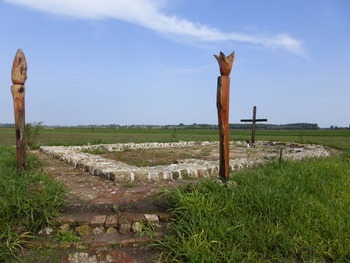
Shortly after his election in 1994, as a sign of his determination to create jobs, especially for young villagers, the new mayor of Tázlár drew up plans for an industrial estate on the outskirts of the village center. These had to be abandoned when skeletal remains were discovered in preparing the site. In several phases of excavation, archaeologists from the county capital, Kecskemét, uncovered hundreds of bodies. Finally, in 2012, they distinguished the foundations of two distinct medieval churches. This was no surprise to local inhabitants, who have always known this spot as Church Hill (Templomhegy). The name had mystified me since the 1970s, because there is no sign of any building and the fields in the vicinity are unremittingly flat.
Church Hill: the reconstructed foundations of Tázlár's medieval churches on the outskirts of the current village center. Author's photo, 2014.

According to the archaeologists, human settlement in these central areas of the Danube-Tisza interfluve, beyond the eastern boundary of the Roman Empire, dates back to the era of the Sarmatians (1–5 CE) (Wicker and Gallina Reference Wicker and Gallina1997). Traces of Sarmatian and Avar material culture were found at the Church Hill dig, along with abundant evidence that a significant village settlement existed here during the centuries following the Hungarian conquest in 896 (Árpád kor). This settlement was presumably destroyed in the Tatar invasion of 1241, though there may have been some population continuity. After this disaster, King Béla IV invited another nomadic tribe, the Turkic-speaking Cumanians, to settle down in this territory. The name Tázlár, first mentioned in documents from 1279 and 1429, probably derives from the name of a Cumanian leader (Szabadi Reference Szabadi1997: 38). It seems likely that this was the name of the settlement at Church Hill, and that a permanent village flourished here in the centuries preceding Ottoman conquest in 1526.
Depopulation was more complete during the Ottoman occupation, when the pasture of Tázlár was rented by the market towns of the region. Resettlement of rural districts began in the eighteenth century following the withdrawal of the Turks. Tázlár, together with vast tracts of land to the north, became the property of feudal nobility, the Wattay. The land was described as puszta, a Slavic loanword that means empty or uninhabited. With the support of the Habsburg rulers, in 1718 the Wattay family invited Lutheran Slovaks from the north of the kingdom to colonize Kiskőrös, 25 kilometers from Church Hill. These immigrants rented the pasture of Tázlár, where taverns did good business in the summer months but were locked up or abandoned in the winter (Hann Reference Hann1980: 5; Szabadi Reference Szabadi1997: 43). Other locations in the vicinity were resettled by ethnic Germans. The entire region was notorious for cattle rustling and violent assaults on travelers. Drawing on the classical theories of Frederick Jackson Turner, the Dutch geographer Arie den Hollander (Reference Den Hollander1960–1961) compared the gradual re-population of these empty post-Ottoman spaces in the Carpathian basin with the later penetration of the North American frontier by European colonists.
Apart from the mysterious name Church Hill, the local social imaginary has retained virtually nothing from the feudal era, at the end of which the territory of today's community was still largely devoid of permanent inhabitants. In the course of the nineteenth century, this puszta was gradually appropriated to serve new forms of economy and society. With all-year-round occupation, property boundaries were drawn with increasing precision. The Wattay estates were broken up and sold to the gentry and to prosperous members of other strata, who built manor houses and managed large-scale farms. The abolition of serfdom in 1848 had little immediate impact on these processes. More intensive colonization of this internal frontier began after the 1867 Compromise (Hungarian Kiegyezés, German Ausgleich) with Vienna, which promoted the Hungarians to be partners of the Austrians (though hardly equal ones) for the last half-century of Habsburg imperial rule. Following legislation in 1871 to reform the institutions of local government, Tázlár was formally constituted as an administrative entity in 1872 together with its northern neighbor Bócsa.
Between 1872 and 1907, successive waves of immigrants arrived (particularly from the eastern agrarian towns of Csongrád and Szeged following a catastrophic flood of the River Tisza in 1879). Following the completion of a cadastral survey in 1879, precisely demarcated plots were parceled out as private property by banks, which also extended loans to finance the building of farmhouses known as tanya. Previously, tanya had denoted an outlying building, which might be inhabited during the agricultural season but was not the family's main residence. The main house was in a nuclear settlement, typically a small market town. Makó, where the family of Ferenc Erdei circulated between town house and tanya, exemplified this pattern. However, those who bought property in Tázlár generally gave up their claims to inherit elsewhere. The isolated tanya was henceforth their sole residence; their symbolic consolation for being uprooted was to see their names in the new land registry as “landowner” (földbirtokos).
For some, this internal frontier was doubtless an alternative to emigration to North America, which peaked in these same decades around the turn of the twentieth century. These immigrants gambled that a large acreage in Tázlár offered better prospects than the smaller plot they stood to inherit in their overcrowded native settlements. Many were disappointed in this expectation, especially the later arrivals. Soil quality in the area around Church Hill was quite good, but large expanses of the Danube-Tisza interfluve are so sandy that grain production is impossible, or the yields are so low that even a large acreage does not suffice for household self-sufficiency. A few manors, including forest estates, persisted into the twentieth century; the share of Magyar gentry owners fell, while that of non-gentry Magyars, sváb Germans, and also Jews, steadily rose.
Institutional consolidation on the former puszta proceeded very slowly. Outlaw bands were suppressed after 1867 (though romantic literature ensured that their deeds would survive in the national imaginary) but effective protection of property in frontier conditions was impossible. The local administration contributed to the salary of a doctor in a neighboring village, but failed to implement national directives to establish basic educational provision. Most newcomers had large families and were too poor to meet the costs of supporting a teacher and school buildings (Szabadi Reference Szabadi1997: 69–71). During these early decades, religious activities (and the recording of births, marriages, and deaths) took place in the older towns and nuclear villages of the vicinity. The institutionalization of the modern community began in earnest as a result of the rivalry between the two major denominations of the new settlers, Roman Catholic and Calvinist.Footnote 8 In 1906 a former manor house was converted to serve as a Catholic church in what became known as the upper hamlet (Felsőtelep). These congregations soon proceeded to establish elementary schools in the lower hamlet (Alsótelep), 3 kilometers to the east. Close to Church Hill, this cluster grew rapidly as a result of the mass parcellization of a manor in 1906. Together with a few windmills and taverns (privately owned but strictly regulated by the community), these were the main central institutions when Tázlár split from Bócsa in 1907 to form an autonomous administrative unit. The great majority of the population still lived and worked in isolated tanya. A weekly market was initiated from 1911, but most residents continued to look to older nuclear centers in various directions for the services they needed and for the sale of their main products. When the administrative boundaries were redrawn, the name Tázlár was dropped in favor of Prónayfalva, for reasons that remain unclear (ibid.: 77).Footnote 9
The Habsburg Empire disintegrated in 1918–1919. The Treaty of Trianon in 1920 reduced the territory of the Hungarian Kingdom by two-thirds and left millions of ethnic Magyars outside the boundaries of this “mutilated Hungary” (csonka Magyarország). Under the regency of Admiral Miklós Horthy, conservative irredentist governments dominated the interwar decades. The ideology of smallholders’ private property, which had underpinned the conquest of the puszta, ensured that few peasants sympathized with the workers’ revolution defeated by Horthy. Communists had to keep their views to themselves in post-revolutionary Prónayfalva as everywhere else in the country.Footnote 10 Poverty levels became acute following the Great Depression. Subsistence aid was granted to 331 persons in 1932, most of who were required to undertake community service (közmunka) (ibid.: 109). Law and order improved following the establishment of a gendarmerie post in the lower hamlet. In 1941, a new street was built here to provide simple housing for poor families with at least five children (ibid.: 114). Elementary education was extended into even the most remote corners. By the end of the Second World War the population had swollen to over three thousand, the vast majority still resident on a more or less isolated tanya.
Sources for accessing the spatiotemporal imaginaries of these generations are fragmentary. Pál Szabadi's chronicle provides suggestive insights into the conquest of the frontier. For example, he quotes a reference in the community records for 1912 to “Asian conditions” (ázsiai állapotok) (1997: 80).Footnote 11 We should not over-interpret this phrase, since to invoke Asia in this way was a common means of labeling reprehensible disorder. We do not know to what extent, if at all, the settlers of this puszta imagined themselves to be living on the edge of one continent (Europe) while hindered in their struggle to better their lot by the legacy of another (i.e., the Turkish occupation). Interpretation is complicated by the rise of Hungarian national consciousness during this period, which emphasized a thousand years of Magyar presence in the Carpathian basin (the millennium was celebrated with massive pomp throughout the country in 1896). These Hungarian conquerors soon converted to Christianity under King Stephen and Christian religious institutions were crucial in the reconstruction of community life in communities such as Prónayfalva a millennium later. However, the national imaginary also left space for the myths and symbols of an erstwhile nomadic, non-European people. One symbol beloved of the populist-nationalist right in this period was a kind of falcon called the turul, usually represented carrying a sword in its claws. After the Treaty of Trianon, the map of the former Kingdom of Hungary itself became a prominent symbol, defiantly pinned up on tanya walls by peasants who deplored the “mutilation” of their state. Pressure was exerted upon non-Hungarians within the new boundaries to communicate in that language and to change their foreign surnames for similar-sounding Hungarian names. The father of the community chronicler was one of many who bowed to this pressure.Footnote 12
Temporal subjectivities in Prónayfalva were shaped by a range of factors, from the atomized settlement pattern to ressentiments on the scale of the nation after Trianon. We can assume that most settlers were pragmatically oriented to the future. Far removed from their native communities, they were obliged to cut previous economic links and face the challenge of making a living on the inauspicious puszta (Juhász Reference Juhász and Juhász1997; Szabadi Reference Szabadi1997: 63–64). There was scope for innovation in these conditions, and some newcomers accumulated capital and expanded their acreage. Yet the natural endowment was not conducive to profitable arable farming. It was better suited to extensive animal breeding, with its low demands on labor and capital, which had been the mainstay of the regional economy in the past. Those with larger holdings could thus afford to distance themselves from the new technologies that were spreading in established agricultural settlements via the mechanisms of the market and interpersonal emulation. Some planted acacia forests to counter desertification. Some smallholders developed innovative techniques to plough sandy soils, and many invested in small vineyards to take advantage of the opportunity presented when the phylloxera disease destroyed vines in the country's established wine-producing regions. Many others, though, opted neither to specialize nor to intensify cultivation. The forward-looking temporalities of some immigrants did not prevent the Danube-Tisza interfluve from becoming known nationally for backwardness (elmaradottság). One visitor commented that some zones of tanya settlement gave the impression of not having changed since “ancient times” (Für Reference Für1983: 245). Building on the work of Den Hollander, I argued in my early work that these conditions were the product of uneven capitalist development on the internal frontier (Reference Hann1979).Footnote 13
Ferenc Erdei explored this region on a motorbike in the summer of 1937. He reported dire social conditions and noted that Prónayfalva still lacked “any seed of a village” (Reference Erdei1957: 174). It thus differed radically from its historic market town Kiskőrös, where agriculture was more advanced and the socially divisive impact of technological development was countermanded by the sense of community that had grown up over many generations. According to Erdei, that sense of community inhibited the formation of class relations appropriate to the changing forces of production. By contrast, Prónayfalva, where hundreds worked as farm servants and day laborers, was highly stratified yet economically underdeveloped. Its scattered settlement pattern inhibited collective action, and unlike Erdei's hometown of Makó, the tanya world of Prónayfalva lacked any civilized center. He wrote that the population needed to be rescued from “Asian conditions,” by which he meant poverty and overwhelming backwardness (ibid.: 177–78).
SOCIALISM: CIVILIZATION COMES FROM THE EAST
By 1940 there was a growing feeling that the change of name to Prónayfalva had been a mistake, and a petition was sent to the Minister of the Interior requesting in its place Dózsafalva, to honor a peasant military hero long established in the national pantheon.Footnote 14 After permission was refused, in 1947 a village assembly voted to revert to the old name Tázlár, and this time permission was granted (Szabadi Reference Szabadi1997: 120). Changes in other domains were forward-looking. Denominational schools were nationalized at the end of 1948. All the previous staff remained at their posts, but they were prohibited from teaching religion and pressured to cease practicing their faith. The strongest of the populist parties, the Independent Smallholders’ Party, won a large majority of rural votes in the last free elections, but was unable to prevent communist domination. In 1949 Tázlár peasants were summoned to a special assembly to celebrate Stalin's seventieth birthday. A congratulatory telegram was dispatched to the county committee of the Hungarian Communist Party:
The workers of the community of Tázlár salute the wise leader and teacher of the workers of the world Comrade Stalin with affectionate love and gratitude on the occasion of his seventieth birthday. May he continue, in good health and robust resilience, to spread the socialism that serves to benefit us all, and to defend the world's eternal treasure: peace.
After reproducing this telegram in full to convey the local political climate in the early socialist years, Pál Szabadi notes laconically in the next line of his chronicle that, in that same year, after decades of prevarication, villagers laid the foundation stone of the large new Catholic church in the Alsótelep, which was now definitively confirmed as the nuclear center of the socialist village.
From the viewpoints of most households, especially in comparison with the prior two decades of socialism, the 1950s were grim and repressive. Nonetheless, following the suppression of the 1956 uprising, which had little impact on the community, the village center grew impressively. New church buildings for both the Catholics and the Calvinists were completed soon after János Kádár came to power at the end of 1956. These were harbingers of conciliatory policies to come on the macro level. The churches were followed in 1961 by the opening of a large new school and a nearby Culture House, which doubled as a cinema, and in the next year a kindergarten was opened. The religious and secular spheres were now separated, though religious instruction by priests and pastors continued in school buildings until the 1970s. Electricity and piped water (enabled by a high water tower in the center of the settlement, visible from many miles around), together with new cooperative stores and a bisztró, were among the incentives to abandon the tanya in favor of a house in the center. These were also years of rapid industrialization in Hungary. Many villagers departed for industrial jobs in locations such as Csepel, south of the capital. Between 1950 and 1970, the population of Tázlár declined by about one-third. Some of those who stayed began commuting to wage labor jobs at factories in nearby Kiskunhalas, while others found jobs with the state forestry service or the Kiskőrös State Farm.
Given the absence of any industrial development in Tázlár itself, the most important new institutions of the postwar era were those introduced to transform private property in land. In the course of democratic land reform, plots were allocated to those in need and the last remaining manors were nationalized. This era was short-lived. It was followed after 1948 by heavy-handed campaigns against wealthier peasants (kulák). The imposition of compulsory deliveries alienated almost everybody. Local conditions were distinctive: an acreage indicative of a rich peasant in other parts of the country might not be enough to support a family in Tázlár. But the national indicators were implemented inflexibly. Early initiatives to form “cooperative groups” failed because they were unattractive both materially and ideologically to established smallholders. Those who joined these groups lacked experience and capital, and the principle of remuneration according to “work unit” led to endless contestation and bickering (ibid.: 122–23).
Under political pressure from Moscow to implement mass collectivization, the regime of János Kádár faced a particular dilemma in the Danube-Tisza interfluve, where almost every tanya was surrounded by a patchwork of orchards and vineyards. Crude measures to create large fields for mechanized cultivation would have entailed considerable economic losses. The solution was to allow the smallholders of this region to form looser cooperative groups, later restyled “specialist cooperatives” (szakszövetkezet). This implied a diminution of private property rights—for even this cooperative was expected in the long run to consolidate collective farming on all the lands of its members—and an obligation to work for the collective. These prospects, given deeply engrained ideological opposition, led most villagers to resist these cooperatives for as long as possible.
Eventually, at the end of 1960, under enormous pressure “from above,” almost every Tázlár smallholder signed up to join one of three new groups. They were pleasantly surprised to find that they were able in practice to carry on farming on their old plots on the same household basis. The number of days they had to work for the collective was low, and even this became negotiable as the institution formed its own socialist brigades, composed of employees from poorer strata who lacked viable farmland of their own. The collective sector absorbed the lands of those who moved away from the village. When plot rationalization required the appropriation of land under cultivation by a member, he or she was offered compensatory plots elsewhere. In 1974 the cooperatives united to form the Peace specialist cooperative, which remained the dominant economic institution of the community until after the demise of socialism. Henceforth, the cooperative was led by professionally qualified leaders from outside the community, some of whom did not take up residence in Tázlár.
The specialist cooperative was politically closer to the “production cooperative,” the Hungarian variant of the Soviet kolkhoz, than to the voluntary cooperatives visited by Ferenc Erdei in Western Europe in the 1930s. Yet it provided many services to facilitate the household farming of its members, from ploughing and sowing to the marketing of produce (milk and grapes or wine, as well as grain). The symbiosis of socialist cooperative and peasant household was epitomized by the raising of hogs, which was generally reckoned to be the most profitable branch of the economy in the 1970s. The cooperative provided cheap feed, some of it produced by the expanding collective sector within the community, and guaranteed the purchase of the mature animals by state entities. The labor-intensive work in the sty was undertaken by households in the traditional manner (often by their female members). In addition to supporting household accumulation strategies based in agriculture and animal husbandry, in the 1980s the specialist cooperative invested in “sideline” activities manufacturing plastic products and shoe uppers. The jobs these provided, especially for women, were highly appreciated.
During the last socialist decades this local variation of János Kádár's epochal “social compromise” brought unparalleled prosperity to Tázlár (Hann Reference Hann1980). The technologies of household production remained simple, even backward, but thanks to the cooperative they sufficed to permit rapid advances in the sphere of consumption. Some who had left the village in the early years of socialism began to question their decision, since wages and housing in the cities were inferior to what was now attainable in the village. Some emigrants were supported financially by their village relatives. Young people who stayed in the village received help in establishing their new households not only from their parents but from wider circles of kin and friends in the community, whose gifting practices culminated at the “bride's dance” during the wedding party (Sárkány Reference Sárkány1983). Collective work parties played a significant role in defraying the costs of house building. These exchanges of money and labor between households were creative adaptations rather than survivals of past practice. Participation was not disinterested: although birth rates had fallen significantly, one participated in the solidary economy because one assumed that one's own children and grandchildren would have similar needs in future.
The specialist cooperative, which supplied fodder and fertilizer to its members, took care of their marketing, and provided a job for almost every local inhabitant who wanted one, was not particularly efficient in farming the acreage it controlled directly; but this was not a problem so long as it benefited from state subsidies for regions with poor natural endowment. In the 1980s, the Peace cooperative initiated innovative schemes to harness household labor alongside mechanized technologies in the wine sector. These public-private partnerships invited individuals to look to the future: instead of the drudgery of the old, small-scale vineyard work, they could take up forty-year leases on new tracts of vines established by the cooperative and profit from a greatly simplified labor process based on the cooperative's mechanical services. Through such forms of partnership, villagers were supposed to see the futility of the old ideology that privileged private property as the basis of social order and economic value, and in its place adopt new, forward-looking social imaginaries.
Socialist ideology had originally promised Hungarian society a radically different, classless, secular future, but these promises were thoroughly discredited in the first decade. What Kádár built up after 1956 was quite different. His compromise was based on a more pragmatic, even economistic orientation to a future for oneself and one's family. In the towns as well as the countryside, spaces were opened up for a very broad range of economic activities and hence accumulation “beyond the plan” (Vasary Reference Vasary1987). The nationalist imaginary was not abandoned during these years, but it had to be toned down in favor of observing socialist holidays and international solidarities. Above all, the ignominious outcome of the 1956 revolution required silence. No one could publish about this period, and it was inadvisable even to talk about it outside your intimate family. Young people were raised in a relatively liberal atmosphere, which allowed easy access to the popular culture of the West and the emancipatory movements of the age. But they were deprived of their own immediate national history, except in ideological registers rejected by the great majority. The temporal consciousness of most citizens, except among the oldest generation, was formed by this mixture of amnesia and pragmatic accumulation through labor. It was not heroic, especially in the context of repeated rebellions in Poland, or that of 1968 in Czechoslovakia, but given the course events had taken in Hungary, those who reflected on such matters tended to agree that Kádár's modification of Soviet-style socialism had much to commend it.
With postsocialist hindsight, we may reach a different verdict on this Hungarian variant of socialist civilization. Could Kádár's market socialist reformers have done more to engage with problematic historical legacies? I prefer to dwell on what was actually accomplished in these decades and the subjective ramifications. The new spatial configuration in Tázlár—the rapid decline of the tanya with the consolidation of a nuclear center—is emblematic of the integration into the national society for the first time of millions of peasants previously excluded due to the country's quasi-feudal dual structure. Within the peasantry, the longstanding link between acreage and social status was finally broken. The gap between town and countryside narrowed dramatically, and in some domains it was the latter that seemed to profit most from the rule of the Hungarian Socialist Workers’ Party. Mechanization reduced rural drudgery and freed millions to take up industrial employment. At the same time, flexible collectivization allowed rural households to transform their economics of time and, by means of punishing but voluntary work schedules, to reap the consumer benefits.
This revolutionary transformation of the countryside was accomplished piecemeal by atomized households (Rév Reference Rév1987). It adapted the old peasant work ethic and made it the basis for unparalleled accumulation (Lampland Reference Lampland1995). If the peasants who profited from this conjuncture had an advocate-cum-intellectual spokesman, it was Ferenc Erdei. The key concept of his early books was polgárosodás, usually translated as embourgeoisement. Sociologists revived this term in the 1980s to make sense of the processes that were taking place throughout the country, as rural entrepreneurs accepted the invitation to enrich themselves. The word polgár took off in another context at the same time: polgári társadalom is the standard Hungarian rendering of civil society. The ambiguities between the civic and the bourgeois rendered this word hopelessly problematic for socialist ideologists, and Erdei himself was obliged to abandon it.Footnote 15 But if one looks sympathetically at his later work (e.g., Reference Erdei1971), it is clear that his core interests did not change. His overriding aim was to redress the historic imbalance between town and countryside, to ensure that the people with whom he identified so strongly could live on an equal footing with the urban bourgeoisie. Far from pursuing a “proletarianization” model for the countryside, Erdei recognized the importance of household production and economic incentives.Footnote 16
The concept of polgárosodás is thus slippery. It is more accurate to say that Erdei was committed throughout his adult life to a civilizing of the rural sector, which could only be achieved by catching up with the advanced forces of production of Western countries.Footnote 17 Yet Erdei was unsympathetic to foreign models of capitalism, including those of the non-Hungarian ethnic groups prominent in pre-socialist Hungary's distorted adaptation to market capitalism. Instead, backwardness could be overcome by consolidating the civilizing institutions that Hungarian peasants had begun to develop for themselves historically, notably in the larger settlements where they had congregated as a result of the Ottoman occupation. We might say that Ferenc Erdei stood for the extension of an urbane culture into the backward countryside. From this perspective, the history of Tázlár is exemplary. In the early socialist decades the tanya-dwellers migrated in large numbers, either to distant towns or to the newly designated village center. In that center the state built roads and pavements; it made running water and electricity available at low cost to all inhabitants; it replaced the old schools in outlying tanya-hamlets with a well-staffed modern institution; and it built a large Culture House, later augmented by a library and a well-equipped gymnasium. All of this is consistent with paradigms of secular rural development to overcome backwardness all over the world. But in the case of Tázlár a Marxist-Leninist régime also made bricks available for the construction of large new churches. Despite awkward moments in the 1950s, those churches were completed before the large new secular investments, with the complicity of the local socialist power holders. At the same time, this socialist state suppressed democratic politics, including the populist parties. It imposed agricultural cooperatives that, though they promoted economic development, contradicted villagers’ values, above all the commitment to private property. The material civilizational accomplishments were thus tarnished and unable to displace older imaginaries.
EUROPE AND THE POSTSOCIALIST PRESENT
It is impossible here to detail the changes of the last quarter of a century.Footnote 18 Some were initiated piecemeal in the last socialist decade, as the Hungarian economy began to grow more slowly and struggled to meet international debts. The compromises of market socialism seemed increasingly inadequate and new tensions were experienced at every level of society. Despite the socialist goals to which the Peace cooperative was still ostensibly committed, its leaders cut back their collective activities. Land and machines were leased out to individuals and some employees were made redundant. A decline in the level of state subsidies affected production in both the collective and private sectors. The house-building boom of the 1960s and 1970s came to an end, as did large wedding parties. With the ignominious departure of the long-serving council chairman in 1987 (after he was found guilty of accepting bribes to authorize tanya electrification projects), and with the reestablishment in August 1989 of the Independent Smallholders’ Party, it became obvious that major political changes were underway, in Tázlár as throughout Eastern Europe.
Despite these elements of continuity, the impact of the “system change” (rendszerváltás) sealed in 1990 was considerable, especially in the rural sector.Footnote 19 In Tázlár as everywhere else in Hungary, land was re-privatized. The rural wealth accumulation facilitated by Kádár's social compromise had not significantly dented historic commitments to an imaginary based on the nation and private property, now once again vociferously articulated by the Smallholders’ Party. Other parties, including the reformed communist party (now known as the Hungarian Socialist Party), accepted that the privatization of the land was a key component of “rejoining Europe.” The mechanism chosen was not a straightforward restitution of plots according to pre-socialist boundaries but rather a complex scheme for “compensation.” This left much room for grassroots democratic negotiation, but also for confusion and abuse. In Tázlár, not even members of the key committees felt they had an adequate overview. The cooperative abandoned its remaining collective agricultural activities, none of which could have remained profitable following the elimination of subsidies. However, many older residents refused to recognize that smallholding without financial subsidies and institutional supports would not be viable; they did their utmost to regain full ownership rights over the plots farmed by their forebears (Hann Reference Hann1993).
By the time plot boundaries had been clarified, the collapse of the old agricultural symbiosis was complete. Two recent immigrants to the village have taken advantage of low land prices to buy tanya and build up successful businesses in wine and poultry, and the mayor has expanded his private vineyards. But these are the exceptions. The subsidies now paid in the frame of EU agricultural policies have not compensated for the loss of more generous socialist subsidies to the rural sector.Footnote 20 In the absence of a central institution to provide support and coordination, large areas are no longer cultivated at all. Some of the vines planted with cooperative support in the 1980s have been prematurely abandoned. Unemployment is rife, especially since the cooperative was obliged to close its shoe workshop. The workfare initiatives introduced in a nationwide scheme since 2010 are reminiscent of the közmunka schemes of the 1930s. A few tanya have been acquired by unemployed ex-workers, whose dreams of a rural idyll invariably come to grief. Despite the efforts of the volunteer “civil patrol” (polgárőrség), property and persons outside the village center are felt to be less secure than in the socialist decades. Inequalities are striking; dilapidated conditions in some clusters have revived the old association between tanya residence and the ancient backwardness of the puszta.
The Peace cooperative survived on paper until 2006, when its last remaining assets were sold to meet the claims of its erstwhile leaders. It is not widely mourned, though some of those principally opposed to cooperatives in the past admit privately that today there is an urgent need for a new institution to coordinate production and marketing. Its main legacy is the plastics workshop, which was bought out by the three cooperative members who had managed it since its inception in the 1980s.Footnote 21 Most of the other institutions created during what I have described as a rural socialist civilizing process are still in place today. The local self-government (formerly the council) has no funds for large-scale investments. Major tasks, such as the recent renovation of the Culture House, can only be undertaken with state help, usually following a competitive grant-application process. As I noted above, the mayor's efforts to attract new businesses to the community in the 1990s were undermined by the discovery of the archaeological site.Footnote 22 The major difference from the pre-socialist years is that most households have at least one secure source of transfer income, mainly pensions and child allowances. Subsistence is not an issue, especially since most households continue to produce a significant proportion of their food supply in their gardens. Yet there are no effective incentives to produce for the market, and to pass time slowly, “vegetating” according to the old peasant rhythms, is particularly unappealing to youth. Those with skills, or the networks to help them find unskilled work, have taken advantage of their freedom as citizens of the European Union to migrate to countries such as Britain or Ireland. The large number of houses now up for sale in the village center, including some that were constructed in the market socialist boom years, is the most visible sign that this rural economy has once again become thoroughly peripheral to Western capitalism.Footnote 23
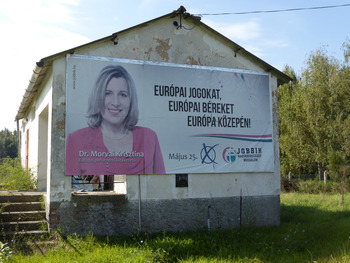
The only political poster displayed in Tázlár in 2014 covered the entire roadside wall of a crumbling, unoccupied house and featured the candidate of the right-wing Jobbik party for the European Parliament. The text reads: “European Rights, European Wages, in the Center of Europe.” Author's photo.

The most remarkable change of recent years has been the return of the village school and its associated kindergarten to ecclesiastical control. Facilitated by the dominant Fidesz party at the national level, this took place very quickly in 2012 after minimal consultation with teachers and parents. The institution is now affiliated to a regional educational consortium named after the late Pope John-Paul II, under the general management of the Bishop of Kalocsa. After functioning under local management until 2007, the Tázlár school and kindergarten were briefly subordinated to a state association based in Kiskőrös (Balogh et al. Reference Balogh2000; Reference Balogh2010; Horváth Reference Horváth2011). However, the school headmaster, supported by his teaching colleagues and the mayor, feared for the institution's long-term survival,Footnote 24 and transferring education back into ecclesiastical hands was the best guarantee of avoiding closure. While the buildings remain the property of the community, all running expenses, including teachers’ salaries, are now the responsibility of the Roman Catholic Church. The teaching staff have retained their jobs under the new regime. They are no better paid than before and, no longer working officially for the state, they have lost certain privileges, but the change has brought them more long-term employment security. Not all teachers attend church services on a regular basis, but at present they are not required to. The most visible signs of the change are crucifixes on classroom walls, prayers at the start of the school day, and a grace said before meals. Two lessons of religious instruction per week, delivered by clergy inside the school, are compulsory.Footnote 25
The Tázlár primary school, now named after Pope John-Paul II. Author's photo, 2014.

The ceremonies of the school year used to be held in the adjacent Culture House. The parents of first-graders still gather here with their children at the beginning of the year to hear a speech by the headmaster, following which everyone sings the national anthem (Himnusz). The main celebration for the entire school is now held in the Catholic church.Footnote 26 Catholic clergy lead these rituals, though the Protestant pastors are invited to deliver short ecumenical exhortations at the end of the mass. After attending the mass that opened the school year in 2013, I visited an old friend who had vivid memories of the Catholic elementary school he attended in the 1930s. (This building now houses the plastics business noted above.) He belonged to a poor family, and his father had to conceal his communist sympathies in order to keep his post at the village administration. My friend was raised to deride the compulsory prayers and the ringing of the Angelus bells at midday. Now, eighty years later, he was scornful of the fact that elementary education is again thoroughly imbued with religion, and that few parents have the means to transport their children daily to a school in one of the region's towns where the state still has a foothold.
The rituals to open the school year are concluded in an appropriate national way: with the singing of the Szózat, a patriotic “appeal to the nation” that dates from the romantic era and functions as a second national anthem. The rendition concludes with a sentimental evocation of attachments to the homeland, “This is where you must live and die,” but unlike all previous school generations, many of these pupils are likely to become transnational migrants. The inculcation of both the Himnusz and the Szózat continued throughout the socialist years. Now that Europe (Brussels) has replaced the Soviet Union as the nation's principal Other, national sentiment seems even more pervasive. Well-known symbols of the pre-socialist past have been revived: turul sculptures are again common, and village boundaries are marked with signs in the runic script associated (erroneously) with the early Hungarians. The ritual calendar has been thoroughly re-nationalized. Particularly lavish is television coverage of the celebrations on 20 August at St. Stephen's basilica, when the sacred relic of King Stephen's right hand is carried around the streets of central Budapest. Costumes recalling the Habsburg cavalry, or the gendarmes of the Horthy era, add elements of color and fantasy on these occasions, which are imitated in less spectacular fashion in towns and villages across the country. New media now complement the continuing influence of the print media emphasized by Anderson (Reference Anderson1983) in his account of the emergence and propagation of nationalism. Thus the Internet homepage of Prime Minister Viktor Orbán is carefully cultivated to propagate his cult via idioms of traditional folkloric heroes well known to all Hungarians (Povedák Reference Povedák and Povedák2014).
The consolidation of a populist-nationalist imaginary has far-reaching consequences in both ritual and everyday spheres. Every year brings new local and regional festivals for consumption by tourists and locals alike. Whether the focus is wine, salami, or smoked fish, the organizers invariably emphasize the authenticity of traditions dating back to the pre-socialist period (Pusztai and Martin Reference Pusztai and Martin2007). The range of commodities marketed with national colors is similarly expanding. Fruit brandy may be produced in neighboring states, but the apricot pálinka of Kecskemét is classified as a Hungaricum, alongside the paprika of Szeged, the wine of Tokaj, and the sausage of Gyula. Branding trends evocative of the past have intensified in the course of what Zsuzsa Gille (Reference Gille and Caldwell2009) calls “Euro-globalization,” in which the future of familiar national products is threatened by international competition that drives prices down and simultaneously by the strict standards the EU has imposed. This combination undermines the authentic value of the Hungarian product and the autonomy of its producers. Nostalgic emotions for the socialist decades run deep, but they are constrained by the privatized, ostensibly depoliticized political subjectivities put in place after 1956. Hungarians appreciate ironic, humorous, and wistful movies about that past era, and respond to clever advertising spots (Nadkarni Reference Nadkarni, Todorova and Gille2010). But according to a tacit public consensus, the most vital national traditions were neglected under socialism, and post-imperial trumps postsocialist in the Hungarian social imaginary. Power holders today orient citizens not to cosmopolitan futures in and beyond Europe, but toward a proud national past and the infamy of the Treaty of Trianon, the centenary of which beckons (Hann Reference Hann, Angé and Berliner2015).
THEORIZING THE CURRENT SPATIOTEMPORAL IMAGINARIES
How is an anthropologist to theorize all these changes? For the earlier periods treated in this article, I drew on the work of the left-wing populist Ferenc Erdei. Like the villagers I knew in the 1970s, his writings conveyed a strong sense that the arrow of time was pointing forward and that the accumulation of wealth in the countryside was an indication of civilizational progress. Twenty years after the restitution of agricultural land via a scheme based on the promise of compensation for the wrongs suffered under socialism, many young people face a choice between workfare and transnational migration. Handing state schools back to the Roman Catholic Church also calls progress into question: is something significant being reversed in postsocialist Hungary? In conditions of modernity religion is commonly supposed to become a “sub-system,” separated from politics and invisible in the public sphere. The trend in Hungary today is just the opposite and many perceive this as a regression.
In attempting to specify what is going on here, any anthropologist writing since Johannes Fabian published Time and the Other in 1983 must tread cautiously. The keyword of that study was “coeval.” Many early anthropologists were guilty of denying coevalness to the people they wrote about, who were depicted as altogether “out of time” (Thomas Reference Thomas1989), or, if they were admitted to Western diachronic time, as not coeval with the time of the anthropologist, but rather inherently backward and inferior. Fabian rejected this ethnocentrism, arguing that temporal processes were everywhere a matter of cultural construction, of which the Western focus on “linear,” cumulative time was but one variation.
Fabian is an Africanist and his critique was advanced primarily with reference to Western representations of non-literate societies. But he also drew explicitly on Edward Said's Orientalism (Reference Said1978), in which similar arguments were put forward concerning Western authors’ distortions of Asian (especially Muslim) societies in order to emphasize their own superiority. More recently, historians and anthropologists have brought the critique even closer to the West, for example with reference to the “otherness” of Byzantium and eastern Christianity generally, and to the polarities of the Cold War and the postsocialist era that followed (Bakić-Hayden and Hayden Reference Bakić-Hayden and Hayden1992; Bakić-Hayden Reference Bakić-Hayden1995; see also Hann Reference Hann1996a; Schneider Reference Schneider1998). I referred in my introduction to Dominic Boyer's critique of the allochronization of the former East Germany by the West (Reference Boyer, Todorova and Gille2010). In Poland, distinguished sociologists have invoked backwardness, in the form of a “civilizationally incompetent” population, to explain the traumatic social costs of conforming to the standards of the West, sole arbiter of human flourishing (Buchowski Reference Buchowski2001: 16).
Ferenc Erdei, for his part, also had a sense of the backwardness of the East. His populist proposal was not to emulate Western capitalism but rather to build on specifically Hungarian civilizing traditions. Within the constraints of socialist institutions and ideology, he was eventually rather successful in implementing his goals. When all is said and done, Hungarian rural transformation in the last decades of socialism was a remarkable success story, at least in material terms. In postsocialist Eastern Europe, however, there is less room for such innovation. The constraints of neoliberal capitalism in the form of Euro-globalization are more rigid than those of socialism. The rural sector has been penalized heavily and the gap between town and countryside has widened again. It is no wonder, then, that after two decades the anti-urbane, anti-cosmopolitan forces are ascendant. They dominate in the smaller towns as well as in the countryside (now significantly less populous). The new populists have no vision of progress comparable to that of Erdei. What they have instead is a backward-looking, “integral” agenda that has no respect for pluralist politics and blames all difficulties on alien others both inside and outside of the country.Footnote 27
In the view of Fidesz and the media sympathetic to the dominant party, academic and journalistic coverage in the West, especially in the German-speaking world, is distorted. These Hungarians—and I know many, in Budapest as well as in Tázlár—are dismayed by what they see as unwarranted interference and exaggeration of government measures deemed in the West to be “anti-liberal” and incompatible with European laws and conventions. According to their politics of history, socialist civilization was an Asian imposition and a shameful failure. In their interpretation, after the tragic distortion of their national history by almost half a century of secularist social engineering, the country finally returned to its “proper” course, but now the European Union is posing new threats through its unwarranted interference. Rituals, at every level between the village church in Tázlár and St. Stephen's Basilica in Budapest, provide Fidesz supporters with confirmation that the world is once again in order, that Hungarians embrace the Christian values that the rest of the EU has largely abandoned. Yet simultaneously they continue to cultivate the mythical legacies of their shamanic ancestors in Asia. Is it a denial of coevalness on the part of Westerners to critique and poke fun at this bizarre nationalist imaginary, including all the efforts of the prime minister to conjure up an era when Hungary was the grande nation of the region?Footnote 28
Unlike some anthropologists who have written about time, I hold a conventional view of its physics and metaphysics. The metaphor of the arrow is unfashionable but appropriate for my purposes. Governments may reverse the measures of previous generations, such as the collectivization of farmland and the nationalization of schools, but no one seriously entertains the idea of a return to the society of the pre-socialist era. Not even the most elaborate restaging of St. Stephen's Day rituals, or the most potent turul, can achieve the suppression, let alone reversibility, of time. History marches on; it is cumulative and inexorable. Moreover, actors at all levels understand this. None of the behavior described above is inconsistent with future-oriented strategies. Viktor Orbán's self-insinuation in Internet folklore is a significant component in his determination to hold on to power; so too is his manipulation of the churches (Jakab Reference Jakab2014). In an age of accelerating globalization, entrepreneurial exploitation of national symbols and nostalgia is driven by astute business plans. Nor do Tázlár villagers wish to turn their clocks back to the 1930s. Rather, the local elite decided to place an institution that is vital for the community in the hands of the Catholic Church because this is what they pragmatically consider prudent for the future. Even those who spend a lot of their time watching television programs saturated in soft nationalism and welcome the prominence of cassocks in school classrooms have to keep at least one eye firmly on the future. At both individual and collective levels, these villagers are looking ahead. It is just that today they do so by embracing the backward-oriented imaginary, in contexts of renewed political and economic vulnerability that differ radically from the confident teleology of the socialist grand narrative.
CONCLUSION
How can a country move so quickly from a pragmatic, economistic, future-oriented temporalization to indulgent fascination with the glories and traumas of its national history? Why is deep nostalgia for many aspects of socialism confined to largely privatized emotions, while in the public sphere that era is rejected and attention is focused instead on a more distant past, with its proud myths and ressentiments? I have rooted my answers to these questions in the chronology of one settlement on the Great Hungarian Plain. The shatter zone of Eastern Europe is an instructive location for reflection on the concepts available to anthropologists to investigate the complex connections between subjective imaginings and material transformations.
Like all human beings, those who lived in Tázlár when it was a puszta and its postsocialist residents today live in the real history (Realgeschichte) of political economies as well as the symbolic time of social imaginaries. The two are tightly connected, and of course the latter are no less real in their consequences. The postsocialist period has witnessed both an efflorescence of Hungarian nationalist symbolism and a reversal to the status of underdeveloped periphery, a condition of backwardness from which socialism had seemingly offered an escape. Today the village of Tázlár is still dominated by the landmark water tower constructed by the socialists in the new village center in the 1960s. But crucifixes and maps of the historic kingdom have returned to the walls of classrooms, and these smaller symbols evidently possess greater potency. The dismantling of the specialist cooperative demonstrated the victory of an earlier imaginary, set in place during the generations that recreated this settlement in the late Habsburg era. When people look around their village today, there is no denying the material progress of Zivilisation in the socialist decades, in both public and private sectors. But those power holders failed to legitimate their rule. They could not displace evolved post-imperial imaginaries. It seems today that little has been retained from the socialist era, which functions in historical consciousness only to heighten the diametrically opposed values of a Christian nation that has managed to retain elements of its pre-Christian traditions to form a unique national culture. Hungarians who in the past asserted their national identity against Ottoman Turks, Habsburg Austrians, and Soviet Russians now rail in the language of the new “integral” populism against the domination of liberal-cosmopolitan Brussels-Europe.
The politics of time, central to my macro-level discussion of culture and civilization, depend crucially on the changing economics of time at individual and household levels. Lack of space has prevented me from showing how the dialectics of future and past orientations play out in individual biographies and social generations. A fuller theoretical treatment would require closer engagement with the anthropological literature on time and memory, including “temporalizations of past time” (Munn Reference Munn1992). I agree with Munn, as well as with Fabian (Reference Fabian1983) and Boyer (Reference Boyer, Todorova and Gille2010), that past, present, and future spatiotemporalizations must be analyzed together. In tracing shifts in all three in the rural Hungarian case, I found the most resilient feature to be a social imaginary grounded in the values of the nation and private property. This proved much stronger than the material successes (in private consumption as well as in public infrastructure) of a forward-looking socialist, civilizing project. When Ferenc Erdei toured the region in 1937, the population of Tázlár (Prónayfalva) was made up predominantly of poor peasants, many of them unable to approximate self-sufficiency, let alone dispose of a surplus on a market. They were locked into relations of dependency, mostly with richer peasants in their own community. Paid work was highly seasonal. For much of the year, although there was always something to be done around the tanya for both men and women, people had “time on their hands” in the sense that its opportunity costs were very low.
Fast forward to the 1970s, when I spent a year in this village, and it has changed almost beyond recognition. Most of the population now lives in one central location containing an array of secular and religious institutions. To build, furnish, and improve their houses most people work incredibly hard, often combining family farming with wage labor employment. Time has accelerated and its opportunity costs have become high. This has negative implications for the anthropologist, who prefers his informants to have very low time-opportunity costs so they are free to answer his endless questions.
Fast forward again, and I think if I were beginning doctoral fieldwork today my task would be easier because most villagers have time on their hands once again. They have televisions, fridges, and washing machines that render their lives physically much easier than those of their grandparents. It makes no sense for them to work long hours and put up with the stench of pigs in their backyards if there is no profit at the end. They point out that to prepare their traditional winter sausages and salami it is nowadays cheaper to buy the meat they need from German-owned supermarket chains in nearby towns than to raise a pig for slaughter. Few young people see any prospects in the village.Footnote 29 Unemployment, a phenomenon that hardly existed as such in the premodern rural economy of the 1930s, is a major social issue. Compared to the dual social structure of the past, today's unemployed and underemployed are hardly poor in absolute terms. Subsistence is assured, most watch a lot of television, and many have access to the Internet. But they also have expectations, based on the progress made by their parents under socialism. They have aspirations to work and to accumulate that, in the postsocialist era, they cannot fulfill because they face what Gell (Reference Gell1992) terms high resource costs. It is the combination of these high resource costs with low opportunity costs of time that renders large sections of the contemporary population susceptible to past-fixated, populist rhetoric. The post-imperial social imaginary is all they have left.