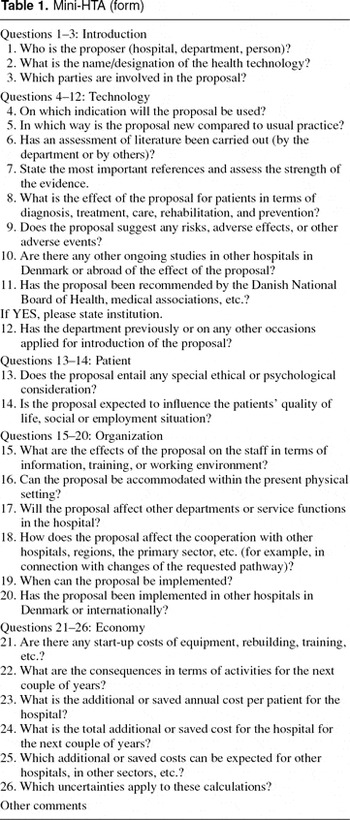
The Danish seven-step strategy for health technology assessment (HTA) envisions that the HTA shall become an integral part of the day-to-day management and planning processes at all levels in the healthcare sector (10). In 1994, the HTA Working Group of the Danish National Board of Health (a forerunner of the present Danish Centre for Evaluation and Health Technology Assessment [DACEHTA]) issued a pamphlet recommending the use of a form upon application for hospital devices or equipment (9). This form captured the HTA philosophy and contained questions about the technology, the patient, the organization, and financial aspects. The idea was to provide local decision makers with a tool to incorporate HTA in daily practice, and answering the questions (filling in the form) would give a short and rapid assessment. The recommendation was repeated in 2000 in another publication, which, as something new, contained a CD with different forms that could be used when acquisitioning equipment either locally or regionally (3).
The name, a mini-HTA, was “invented by” the Copenhagen University Hospital (Rigshospitalet), which was the first institution in Denmark to use such a form to support decisions to approve new treatments (12). Today, the use of the mini-HTA has spread to many Danish hospitals, and it is being used both for applications for equipment and for introduction of new treatments (both for making priorities and for administrative purposes such as budgeting).
PURPOSE
On this background, the DACEHTA launched a project with the principal purpose of describing and assessing decision support tools used locally in the hospital sector both empirically and theoretically (5). The project focused on local mini-HTAs, but it also included examples of similar “HTA-like decision support tools” and an example of a “similar decision support tool” used in private sector organizations (the so-called business case method). A secondary project purpose was to make a proposal for a new national mini-HTA form (see the DACEHTA mini-HTA from 2005 in Table 1).

METHODS
Danish experience with the mini-HTA was analyzed using three different questionnaires mailed, respectively, to (i) all county healthcare authorities, (ii) all hospital management sections, and (iii) all clinical department management teams at departments of anesthesiology, cardiology, and orthopedic surgery. The questionnaires aimed to elucidate the use of and the attitudes toward use of the mini-HTA and other types of decision support tools when making decisions about the introduction of new health technologies. The respondents were asked to submit their forms used for mini-HTA or any other decision support tools used. The response rate for the three groups was 87 percent (n=13/15), 94 percent (n=33/35), and 85 percent (n=93/109), respectively. The results of a study analyzing attitudes to the use of mini-HTAs conducted at the Copenhagen University Hospital in 2004 was also included (unpublished study by Folkersen and Pedersen).
International experience with the mini-HTA was reviewed in a literature study of routine production and use of HTA-like decision support tools for budgeting and planning procedures in hospitals and local healthcare authorities. On the basis of articles, home pages, as well as personal knowledge, we contacted eleven local/regional HTA organizations as well as fourteen individuals abroad.
Comparison with the business case method (formalized procedures including the use of a form or checklist for drawing up investment proposals (1;13)) was achieved through literature studies of journal articles, books, reports, Internet searches, and so on. Interviews were conducted with financial managers from two of the Danish business companies. The theoretical (14) decision-making analysis consisted of conceptual clarification and description of the theoretical impact of a mini-HTA on decision-making and implementation processes.
RESULTS
The presentation features ten selected results.
Mini-HTAs Are Much Used in the Danish Hospital Sector
The questionnaire study showed that mini-HTAs were being used by 55 percent of the hospital authorities, 66 percent of the hospital management sections, and 27 percent of the department management teams. Analysis of the use of mini-HTAs showed that 45 percent of the hospital authorities, 41 percent of the hospital management sections, and 16 percent of the department management teams used mini-HTA for purposes other than applications for hospital devises and equipment. In total, the respondents submitted twenty different decision-making protocols and sixty different forms used in Danish hospitals. Among the latter, forty-nine were classified as different versions of mini-HTA.
The Study Showed Only Few Examples of Use of Similar Local Decision Support Tools in Hospital Sectors in Other Countries
We only located two foreign hospital authorities (Southern Sweden and an Australian territory) where decision support tools resembling the Danish mini-HTA were being used. In both instances, the tools were a form or checklist containing questions about the consequences of introducing new health technology, and it was used to produce local HTA in local decision-making processes. (In many countries, however, efforts have been made to involve local decision makers in drawing up the HTA reports; for example, by making it possible for decision makers to requisition small-scale, quick HTA reports from national HTA organizations or by setting up local HTA units at hospitals.)
Mini-HTAs Are Used for All Forms of Health Technology
The study showed that mini-HTAs today are used for assessment of all kinds of health technology, including new treatments, diagnosis, care and rehabilitation methods, medicine, implants, equipment, organizational changes, and so on. For comparison, the business case method, in principle, can also be used for assessment of all kinds of investment.
Mini-HTA Is Used for Many Different Purposes
The mini-HTA is used for supporting different types of decisions. The questionnaire study points to the use of mini-HTAs for purposes related to purchases of new devices and equipment, approval of new treatments, and budget planning. There are also examples of use of mini-HTAs for technology utilization agreements between counties and for other purposes.
Mini-HTA Is Used by Different Staff Groups
The questionnaire study showed that mini-HTA is today used as a decision support tool at all decision-making levels within the Danish hospital sector (i.e., healthcare authorities, hospital management sections, and department management teams). Mini-HTAs are often drawn up by a single person (the form is often filled in by the clinician or the head of department proposing the introduction of the new technology), but other health professionals, for example, nurses and financial managers, may also help fill in the form, depending on the circumstances.
Decision Makers in the Hospital Sector Believe That There Are Both Advantages and Disadvantages in Using Mini-HTAs for Decision Support Purposes
The questionnaire study showed that the respondents saw different advantages of using mini-HTAs. These advantages concern the very HTA principles (i.e., they rest on evidence-based knowledge, interdisciplinary overall assessments oriented toward decision-making problems); the form of the tool, be it a tabular form or a checklist (the collection of information and standardization of decision-making premises); as well as the way the form or checklist is being used (flexibility, openness, and timing).
Disadvantages mentioned typically centered on insufficiency of the evaluation of the evidence base and the lack of quality control. The study of attitudes toward mini-MTAs at the Copenhagen University Hospital showed that the majority of the responders believed that the mini-HTAs increased the administrative burden of introducing new health technology.
Local Participation in Making an Analysis Can Also Enhance the Probability That the Analysis Is Actually Brought to Use
Evaluation research shows that different situational factors are important for the direct instrumental use of assessments and other types of policy analysis (14). The likelihood that an analysis will be brought to use augments if the study is planned with the decision makers in mind (and preferably with their participation). A similar effect may be obtained if work is performed “close to the scene,” which means that the focus and interest of decision makers often change during the analysis stage, and if you want decision makers to use the analysis, it is important to keep track constantly of what is being considered important and urgent and what is on the agenda. The likelihood of the mini-HTA being brought to use also increases if it is clearly laid out, well-written, and well-timed and if there is personal contact between its future users and the individuals influencing the decision making. In these ways, the advantages of drawing on local support for making the mini-HTA theoretically may outnumber the advantages of having assessments made by external experts.
Research identifies other conditions with a direct instrumental bearing on the use of assessments and policy analyses, even if they do not necessarily suggest local participation in drawing up the report. Among such factors are decision-makers' wishes to obtain high-quality assessments and to compare the results with those of other assessments (i.e., to see the large picture).
Local Participation in Making an Analysis Can Be Important to the Implementation Process
Research shows that the matter of assessments and policy analysis extends far beyond the direct instrumental use of the results and the recommendations of the report (14). Through their participation, decision makers and staff build up more knowledge in a range of areas than they would have done if they had just read the reports. Analyses of implementation processes show that the course of the decision-making process affects the implementation process. Particularly crucial to successful implementation is that key stakeholders have the requisite understanding, will, and capabilities to carry out the implementation. Through local participation in the drawing up of an analysis, the stakeholders often come to a better understanding of the new technology and they may also acquire relevant competences in the process. Finally, participation may be accompanied by a higher degree of “ownership” and, hence, willingness to implement the new technologies.
In the questionnaire study the majority of the decision makers stated that the mini-HTA eased implementation to a considerable or fair degree. The remaining respondents stated that the mini-HTA only had little influence on implementation.
The Study Showed a Need for Quality Control Where Decision-Making Takes Place Locally
Experience from the Copenhagen University Hospital shows much variation in the quality of mini-HTAs presented during the first year. Many questions were not answered properly or not at all. Sufficient quality was not obtained until management returned the forms demanding that they be filled in properly. This finding allows us to conclude that a quality standard is achieved not by virtue of the questions of the mini-HTA, but through continual dialogue between staff and manager in the process of providing deep and qualified answers to the questions. Business experience similarly shows that companies apply a multitude of different controls for ensuring the quality of locally drawn up bases for decision making. Such initiatives include strong management commitment and specific management demands to quality, different forms of control measures (controlling), interdisciplinary cooperation across different functional and organizational boundaries, as well as corporate culture development (including internal staff training).
The questionnaire study showed that no decision makers based their decisions exclusively on mini-HTAs (but always use them as a supplement). However, in hospital management sections, the mini-HTA is often the principal basis for decision making.
The Study Demonstrates a Need for Adaptation of the Mini-HTA to Local Requirements
We found variation in especially the economic questions among the 49 different variants of the mini-HTA analyzed. Experience from the Copenhagen University Hospital, where the mini-HTA (the form) has changed over the years, also showed that demands for information varied from year to year.
DISCUSSION
Is There a Local Need for HTA Tools?
The study demonstrates a considerable need for local HTA tools at hospitals. This need has also been demonstrated before, both in Denmark and in other countries (2;7;8;12), and meeting this need could also strengthen the implementation of the national HTA strategy. The proliferation of the mini-HTA in Denmark over the past 5–10 years reflects a “demand pull” situation, where the use of forms for supporting decision making spread “all by itself” within the hospital sector. The recommendations from the Danish National Board of Health (9) and the DACEHTA (3) from 1994 and 2000, respectively, have only addressed the acquisitioning of hospital equipment. Also, purchase of X-ray equipment for examination of patients is subject to a particular, formal legislative requirement of an analysis based on HTA (11). But these requirements cannot explain the proliferation of mini-HTAs for nonequipment purchase (e.g., for prioritizing among new treatments, making intercounty agreements, budgeting, and so on).
We were surprised to find only a few foreign examples of decision support tools resembling the Danish mini-HTA. Our study has included countries where we assumed that such tools were being used. However, we do not know if we have included all international instances of local HTA usage, and if this is not the case, whether those included actually make up a representative fraction. All-inclusiveness would also require that all information was available in English, which is hardly to be expected. Hospitals prioritize management, not dissemination of management tool usage through publication.
Moreover, it cannot be excluded that similar decision support tools simultaneously drawing on interdisciplinary information are being used outside the HTA domain. The Danish HTA model generally has a wider scope and tends to have more focus on patient-related and organizational dimensions than international HTAs (4) and, therefore, may enjoy greater appeal as an instrument for local decision support.
How Should a Local HTA Tool Be Designed?
This study has not aimed to establish norms for the design of HTA questions; nor did we compare the questions of the mini-HTA with the questions of the business case form. We performed no quality analysis of the mini-HTA (neither of its ability to produce a basis for decision making nor of the different variants of the tabular formats).
More importantly, the results very clearly demonstrate that the quality dimension rests not on the form used but on the process and circumstances in which the mini-HTA is drawn up. The Copenhagen University Hospital found that the mini-HTA did not become a quality instrument until management made demands. This finding clearly drives home the above point and makes the possibilities for influencing the local process in which the basis for decision making is established a candidate for future attention.
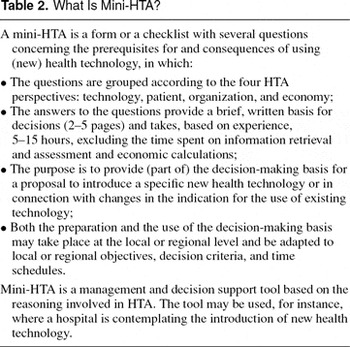
The existence of many variants of decision support tools used at hospitals (sixty different forms, among which forty-nine were variants of the mini-HTA) also shows that there is a need for a flexible tool—perhaps for different tools. The conclusion must be, therefore, that the mini-HTA is a concept as well as a line of thought, which can inspire local decision makers (see Table 2). A national mini-HTA format should also be open for local adaptation to meet local needs. The mini-HTA will always be qualitatively inferior to the HTA, and it will rarely reach the same quality level as the HTA proper.

The process of drawing up a mini-HTA, however, may enjoy advantages over the process of performing a HTA. The purpose of all HTA reports is to improve the basis for assessing the premises of a given technology and its consequences. For the HTA to achieve its intended objective, it must be used in the actual decision-making process and the decision must be carried out. This is precisely where the mini-HTA can be an important supplement to HTA. The mini-HTA may have the advantage that it can be used directly in the decision-making and implementation processes in close collaboration with the decision makers and with those who will be affected by the decision.
Is It Possible to Issue Good Advice for Drawing up Local Mini-HTAs?
The possibility for formulating fixed directions for how to draw up mini-HTAs at the local level should of course be contemplated. However, the present study does not show exactly how HTAs are used in the decision-making processes. HTAs customarily are held to be instruments creating the basis for making decisions about the introduction of new health technology, but this study clearly shows that mini-HTAs may also serve as instruments supporting dialogue or as tools for aiding different administrative procedures. This diversity and the different nature of the processes where the mini-HTA is being used hamper the possibilities of formulating precise recommendations.
Still there is reason for some concern if the mini-HTA is being used without due consideration for the need for quality control. Mini-HTAs occasionally are drawn up by a single individual, they are rarely subject to peer review, and the possibility that they may be shaped by someone's own interest certainly cannot be excluded. Inspiration for such control dimensions may be obtained from the experience with quality control obtained in business and in other institutional domains. Of particular interest in this context is the advantage of strong management commitment, control measures, interdisciplinary cooperation, and development of organizational culture (including internal staff training). Further studies of the quality of mini-HTAs should be performed.
The issuing of the DACEHTA mini-HTA has been paralleled by publication of a guideline for practitioners and an introduction to the mini-HTA (6). The mini-HTA is presented as a proposal for a flexible and dynamic tool adaptable to local conditions and the particular needs of local decision makers. Hence, it can be incorporated easily into local budget and planning processes. However, the mini-HTA cannot replace the HTA proper where the issue addressed or the technology in question extends beyond the local level.
POLICY IMPLICATIONS
The value of doing mini-HTA in hospitals potentially is very large. Mini-HTA represents a flexible tool, which can help increase the use of the principles of HTA in decision making at the hospital level. Also, it can serve as an instrument supporting dialogue and transparency or as a tool for aiding different administrative procedures.
Furthermore, there are a potential number of derived advantages at the regional and national level. Doing mini-HTAs in hospitals could point out areas where a full HTA should be done. Also, a national database of mini-HTAs could promote transparency and support national applications.
CONTACT INFORMATION
Lars Ehlers, MSc, PhD (le@ag.aaa.dk), Associate Professor, Department of Health, Aarhus University, Vennelyst Boulevard 6, DK 8000 Aarhus C, Denmark; HTA Adviser, HTA Unit, Aarhus University Hospital, Olof Palmes Allé 17, DK 8200 Aarhus N, Denmark
Malene Vestergaard, MD (mve@sst.dk), Staff Specialist, Danish Centre for Evaluation and HTA, National Board of Health, Islands Brygge 67, DK 2300 Copenhagen S, Denmark
Kristian Kidholm, MSc, PhD (kristian.kidholm@ouh.fyns-amt.dk), Acting Chief HTA Consultant, Department of Applied Research and HTA, Odense University Hospital, Sdr. Boulevard 29, DK 5000 Odense C, Denmark
Birgitte Bonnevie, MHSc (bmb@sst.dk), HTA Consultant, Danish Centre for Evaluation and HTA, National Board of Health, Islands Brygge 67, DK 2300 Copenhagen S, Denmark
Poul Holt Pedersen, MSc (pp12@bbh.hosp.dk), Chief Economist, Department of Psychiatry, Bispebjerg Hospital, Bispebjerg Bakke 23, DK 2400 Copenhagen NV, Denmark
Torben Jørgensen, Medical Engineer (torbenjoergensen@orangenet.dk), HTA Consultant, Gurrevej 89, DK 3000 Elsinore, Denmark
Malene Fabricius Jensen, DB (mfj@sst.dk), Head of Library Services, Unit of Knowledge and Documentation, National Board of Health, Islands Brygge 67, DK 2300 Copenhagen S, Denmark
Finn Børlum Kristensen, MD, PhD (fbk@sst.dk), Adjunct Professor, Faculty of Health Science, University of Southern Denmark, Campusvej 55, DK 5230 Odense M, Denmark; Director, Danish Centre for Evaluation and HTA, National Board of Health, Islands Brygge 67, DK 2300 Copenhagen S, Denmark
Mette Kjølby, DDS, PhD (mjk@ag.aaa.dk), Associate Professor, Department of Public Health, Aarhus University, Vennelyst Boulevard 6, DK 8000 Aarhus C; Head of Unit, HTA Unit, Aarhus University Hospital, Olof Palmes Allé 17, DK 8200 Aarhus N, Denmark