I. INTRODUCTION
The application of electropulsing to metallic materials and its effects on the microstructure and mechanical properties have been studied extensively in past decade. It has been reported that electropulsing can improve the corrosion behaviorReference Ye, Lingsheng, Tse, Tang and Song1 and remove detrimental inclusion such as MnS and Al2O3 from metal matrix.Reference Zhang and Qin2 The treatment has also been applied to various aspects of materials processing, e.g., to generate plasticity,Reference Guan, Tang and Chu3 to refine microstructure,Reference Barnak, Sprecher and Conrad4 and to expedite structural relaxation.Reference Conrad5,Reference Zhou, Qin, Xiao, He and Zhou6
Studies have shown that the effect of electropulsing on both substitutional and interstitial precipitations is complex and depends on various factors such as the alloy system, the solutionizing time and temperature, the aging time and temperature, the magnitude of the current density and its frequency.Reference Conrad5 Since precipitation is a diffusion-controlled phase transformation, it is expected that electromigration may play a significant role when considering the effect of electric current pulses. The atomic drift flux due to the application of electropulsing to a metal can be expressed by the modified Nernst–Einstein equation asReference Conrad5:
 $${\phi _i} = {{{n_i}{D_i}} \over {kT}}\left( {kT{{\partial {\rm{ln}}{N_i}} \over {2x}} - \Omega {{\partial \sigma } \over {\partial x}} + {Z^*}{\rm{e}}\rho j} \right)\quad ,$$
where N is the atomic density, D the pertinent diffusion coefficient, Z ∗ an effective valance, e the charge on an electron, ρ the resistivity, and j the current density. The second term in the right hand side of the equality is related to the back force due to an opposing chemical potential gradient generated by the application of electropulsing in which Ω is the atomic volume and  $- {{\partial \sigma } \over {\partial x}}$ the stress gradient. The first term in the right-hand-side is added because there usually is a composition gradient in diffusion-controlled phase transformation.
The generally observed linear effect of current density on the precipitation rate in previous researchesReference Onodora, Sakuma and Hirano7 indicates that electron wind force Z ∗eρj has a profound influence on the diffusion-controlled transformation. Furthermore, it is well-known that electropulsing enhances the vacancies mobility and thus reduces the amount of nucleation sites for carbide precipitates.Reference Onodora, Maruyama and Hirano8 The electric field generated by the passing current pulses may also affect the energy barriers which require to be surpassed for a solute atom moving from the matrix and attaching to the precipitates.
Niobium is an important alloying element in production of modern steels. Being a strong carbide forming element, niobium is used in steel industry to control the austenite grain size through the formation of grain boundary pinning precipitates during thermomechanical processing.Reference Fujita and Bhadeshia9 Moreover, dissolved niobium plays a key role in retarding recrystallization, recovery during thermomechanical rolling as well as in affecting the hardenability of the steel.Reference Yan and Bhadeshia10
It has been reported previously that electropulsing treatment induces microstructure evolution in a ferritic-pearlitic 0.14% carbon steel at room temperature. Experimental observation in this study has shown that the lamellar structure forms in a direction parallel to that of the electric current flow.Reference Rahnama and Qin11 In a separated study, the authors have reported that electropulsing treatment affects the distribution of niobium carbide and hence the formation of precipitation free zones (PFZs).Reference Rahnama and Qin12 In the present work, the experiments have been carried out at an elevated temperature (800 °C) to explore the effect of electric current pulses on the microstructure evolution at a higher temperature by which the diffusion is much easier for both substitutional and interstitial atoms. In contrast to the experiment at ambient temperature, the observations for the results at the elevated temperature reveal that the sample underwent electropulsing possesses a smaller degree of PFZs compared to that of the sample without undergoing electropulsing. Tensile test shows that the electropulsed sample benefits from higher yield strength and ultimate tensile stress (UTS).
II. EXPERIMENT
A. Materials
The composition of the steel is demonstrated in Table I. The steel was produced by a conventional ingot metallurgical routine and then hot rolled at 800 °C to a sheet with a thickness of 2.64 mm. Flat samples were cut to 20 mm long, 3.5 mm wide, and 2.64 mm thick to be electropulsed.
Chemical composition of the steel.

To understand the effect of electropulsing on the microstructure evolution of the steel at the elevated temperature, two samples are heated at 800 °C in a furnace simultaneously, annealed for 1 min and then air cooled to ambient temperature. In the meantime, the first sample underwent electropulsing treatment while the second sample was exposed to the same thermal environment but without connecting to the electropulse-generator.
B. Electropulsing device
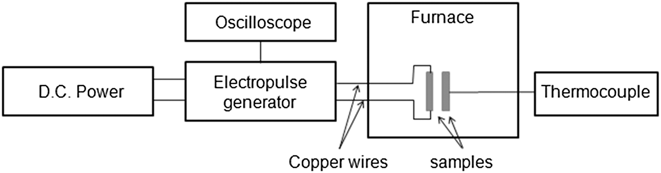
The electropulsing is provided by an electropulse-generator linked to a direct current power. The direct current power source has standard output power of 80 W and standard output electric potential of 20 V. The pulse width, peak current intensity, pulse frequency, and pulse trigger mode are programmable. Copper wires were used to connect the sample and electropulse-generator. An oscilloscope was used to monitor the shape of the current pulses. The temperature is measured by a K-type thermocouple (0.08 mm) attached to a sample. The embedded electrical feed-back system in the pulse generator enables to fix either the electric current or the electric potential. The pulse duration, pulse frequency, and current density are adjustable in a wide range of values. A furnace is connected to the device so that the temperature can be chosen to various values. The setting of the experimental facilities is schematically demonstrated in Fig. 1. All the pulses applied in this work were chosen to have 20 μs pulse width and 1.018 × 10⁷ A/m2 peak current density. The frequency of electropulse was 1 Hz.
Schematic diagram of experimental setting.

III. MICROSTRUCTURE CHARACTERIZATION
The microstructure of all the samples with and without electropulsing treatment was characterized by optical microscope and a LEO Gemini 1525 high resolution field emission gun scanning electron microscope (LEO, Cambridge, UK) operated at 5 kV fitted with Oxford instruments INCA energy dispersive and wave length dispersive x-ray spectrometers (Oxford Instruments, Abingdon, UK). The samples for scanning electron microscopy (SEM) observations were prepared by the conventional method using diamond pastes and etched in 2% nital etching solution.
IV. RESULTS AND DISCUSSION
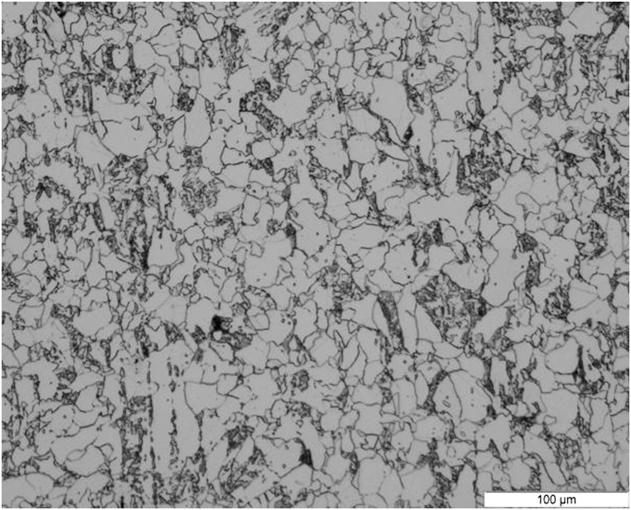
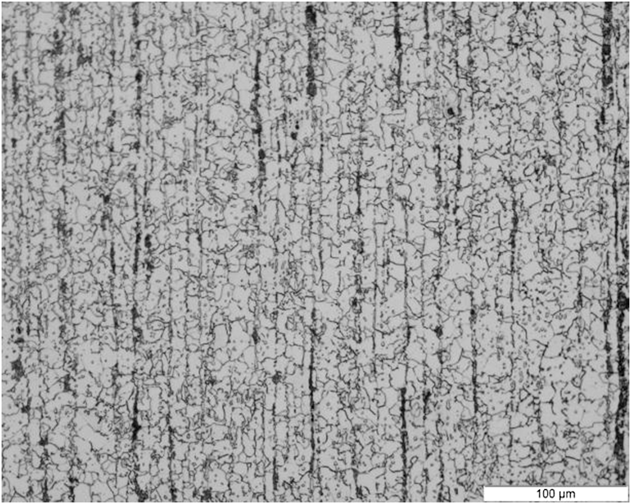
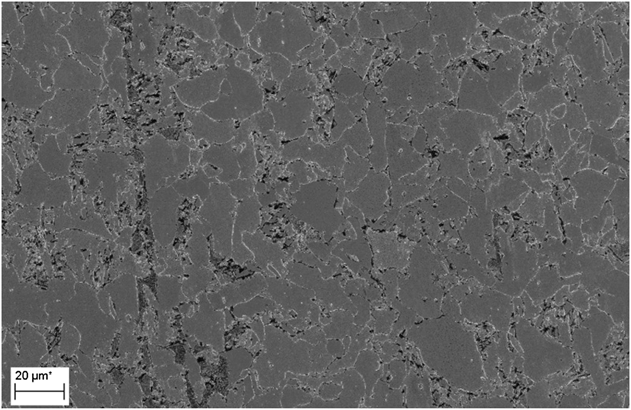
Figure 2 shows optical microscope images of the unelectropulsed sample. The microstructure consists of ferrite and semitransformed plates of cementite (darker grains). EDX (Energy-dispersive X-ray spectroscopy) analysis shows that the darker grains are richer in carbon. These grains are randomly distributed into the ferrite matrix and the direction of plates does not show any preference. The ferrite grain size was measured to be in average 35 μm. Figure 3 demonstrates the optical microscope micrograph for electropulsed sample. As it is clear from this image, electropulsing has caused a remarkable change in the microstructure that produces ferrite matrix with smaller grain size and semitransformed pearlite aligned with the current direction. This is in line with the observation identified in room temperature application of the electropulsing.Reference Rahnama and Qin11 The average grain size of ferrite has reduced to 13 μm after electropulsing. Figures 4 and 5 illustrates the SEM micrographs of unelectropulsed and electropulsed samples, respectively. From these figure, it is evident that grains are oriented toward the direction of electric current flow for the sample underwent the treatment during annealing. In addition, the grains in the electropulsed sample are elongated toward the current direction. These differences in the microstructures of unelectropulsed and electropulsed samples are shown in Figs. 6 and 7, respectively.
Optical microscope micrograph for sample without electropulsing.
Optical microscope micrograph for sample with electropulsing.
SEM image for sample without electropulsing.
SEM image for sample with electropulsing (red arrow shows the direction of electric current).
SEM image for sample without electropulsing.
SEM image for sample with electropulsing.
In elegant thermodynamics calculations, Dolinsky and Elperin showed that electropulsing tends to re-configure the structure toward a state that electrical conductivity of material can be increased. Basically, the application of electropulsing to a material adds a free energy due to the electric current pulses to the total free energy of the system. The total bulk free energy of the steel includes two terms which are the chemical free energy of the bulk phases (ΔG chem), and the free energy associated with the passing electric current pulses (ΔG EP). The free energy change due to electric current pulse can be determined byReference Rahnama and Qin11,Reference Dolinsky and Elperin13,Reference Lu, Zhang and Qin14 :
 $$\Delta {G_{{\rm{EP}}}} = {\mu \over {8\pi }}\mathop \int\!\!\!\int \nolimits {{\overrightarrow {{j_1}} \left( r \right)\overrightarrow {{j_1}} \left( {{r^'}} \right) - \overrightarrow {{j_2}} \left( r \right)\overrightarrow {{j_2}} \left( {{r^'}} \right)} \over {\left| {r - {r^'}} \right|}}{d^3}r{d^3}{r^'}\quad ,$$
where r and r ′ are two different positions in space,  $\vec j(r)$ and
 $\vec j({r^'})$ are the current densities at position r and r ′, respectively. μ is the magnetic permeability. Equation (2) has been used to explain the significant role that ΔG EP plays in inclusion segregation.Reference Wang, Wang, Guo, Wang, Wu and Wang15 In that study, the authors show that the effect of electropulsing treatment could significantly reduce the diffusion activation energy of lead in brass, while remarkably accelerate the lead diffusion in the matrix. The same theory can also be used to explain the electripulse-induced microstructural evolution in the steel under study. According to Eq. (2), the configuration of the microstructure will, therefore, have a profound influence on the distribution of electric current and subsequently on the free energy change because of electropulsing. For the unelectropulsed sample we have ΔG EP = 0. The evolution in microstructure occurred by passing electric current is schematically shown in Figs. 8(a) and 8(b). The streamline of electric current distribution is different in these two figures since the semitransformed pearlite grains are richer in carbon than the bulk material and therefore have higher resistivity. Before the treatment, the grains are randomly oriented and have a shape similar to that shown in Fig. 8(a).
Schematic representation of the streamline of electric current distribution (a) before electropulsing, (b) after electropulsing.
Since the pearlite structure due to its higher carbon concentration is one of the main microstructural factors contributing toward the total resistivity, the current pulses tend to orient the grains and elongate them toward a state where there is the least collision between drifting electrons and pearlite plates to decrease the resistance of the material. When a grain, thus, elongates itself in the direction of the current flow, the distribution changes from  $\vec j(r)$ to
 $\vec j({r^'})$. This alteration of the electric current distribution, therefore, decreases the free energy associated with electropulsing. Thus, the free energy of the system in Fig. 8(a) is remarkably different from that in Fig. 8(b).
The electropulsed sample consists of a microstructure with finer grain sizes. This phenomenon has been also observed and reported previously for several different systems of alloys.Reference Liu, Fan, Zhang, Jin, Dong and Xu16,Reference Zheng, Tang, Kuang and Zheng17 The finer grain sizes are mainly due the higher nucleation rate caused by the electropulsing treatment during the recrystallization. According to classical nucleation theory, the nucleation rate (I e) can be approximated as followsReference Qin and Zhou18:
 $${I_{\rm{e}}} = {I_0}\left( {{D \over {{\lambda ^2}}}} \right){\rm{exp}}\left( { - {{\Delta {G^0} + \Delta {G^{{\rm{EP}}}}} \over {RT}}} \right)\quad ,$$
where I 0 is a constant, and λ, D, R, and T denote the jump distance, diffusivity, Boltzman constant and absolute temperature, respectively. Equation (3) can be rewritten as:
 $${I_{\rm{e}}} = {I_{\rm{r}}}{\rm{exp}}\left( { - {{\Delta {G^{{\rm{EP}}}}} \over {RT}}} \right)\quad ,$$
where I r refers to the nucleation rate when there is no electropulsing performed. According to Eq. (4), it can be understood that the nucleation rate is increased by the electropulsing treatment.
Furthermore, nucleation rate of this process is mainly controlled by the movement of dislocations. During electropulsing, the drift electrons impose an extra pushing force on dislocations (electron wind force).Reference Conrad, Karam and Mannan19 This is sometimes referred to as athermal effect of electropulsing. Such a force is proportional to the current density. This force can considerably promote the gliding and climbing rate of dislocations toward certain areas. The nucleation rate is, thus, enhanced by the treatment. From a mathematical point of view, the athermal effect of electropulsing can be expressed asReference Xiao, Zhou, Guo, Wu, Yao, Li, He and Zhou20:
 $${F_{{\rm{ew}}}} = \left( {{{{\rho _{\rm{D}}}} \over {{N_{\rm{D}}}}}} \right){\rm{e}}{n_{\rm{e}}}\,j\quad ,$$
where F ew is the electron wind force per unit dislocation length,  $\left( {{{{\rho _{\rm{D}}}} \over {{N_{\rm{D}}}}}} \right)$ is the specific resistivity per unit dislocation length, N D is the dislocation density, e is the charge on an electron, and n e and j are electron density and the current density, respectively. This equation clearly demonstrates that the athermal effect of electropulsing can remarkably increases the atomic diffusion flux, and the activity of vacancies as well as altering the sliding behavior of dislocations. In the work reported by Xiao et al.,Reference Xiao, Zhou, Guo, Wu, Yao, Li, He and Zhou20 the current-induced stress (e.g., the magnetic pinch) was found to play a more important role than that of the electron wind force. It is worth to point out that stress is proportional to
 $j_{\rm{m}}^2$ while electron wind force is proportional to j m. The electric current density implemented in Xiao et al.'s work is around 106 A/cm2 (1010 A/m2) but that of in the present work is around 107 A/m2. The difference is 3 orders of magnitude. It is obviously that electron wind force plays more significant role than stress in the current work.
Figure 9 shows the EDX analysis for unelectropulsed sample. Dark areas formed along the grain boundaries are PFZs. In these zones, niobium carbide is depleted. The formation of PFZs greatly affect the mechanical properties of the sample reducing the values of yield stress and UTS. Comparing the microstructure of electropulsed sample with the specimen without the treatment (Figs. 4 and 5) clearly demonstrates that the fraction of PFZs in the microstructure of the sample underwent electric current pulses has significantly decreased. The reduction of PFZs after electropulsing can be also rationalized through its athermal effect. The growth of niobium carbide includes the diffusion of both niobium and carbon. These elements diffuse at very different rates. Since the mobility of substitutional elements such as Nb is extremely low at room temperature which prevents the precipitation from occurring, the experiment has been carried out at the elevated temperature to investigate whether electropulsing can be manipulated to produce a uniformly distributional of NbC.
EDX analysis for unelectropulsed sample showing the existence of PFZ in the microstructure (the dark areas around grain boundaries).
Generally, electric current enhances solute diffusion, dislocation migration, and interface kinetics.Reference Conrad5,Reference Qin, Samuel and Bhowmik21,Reference Jiang, Tang, Shek, Zhu and Xu22 The NbC precipitate has a different electrical conductivity from the steel matrix under the study. As mentioned earlier, the various configurations of the precipitates can also affect the electric current distribution in the whole system.
It is believed that different current distribution corresponds to different system free energies.Reference Dolinsky and Elperin13 It is now known for sometimes that electropulsing has a profound influence on the formation of any object within the microstructure with different electrical conductivity from that of the matrix. Electric current pulse with a high energy input method can greatly affect the precipitation process, grain boundary migration, and phase transformation in various steels.Reference Rahnama and Qin11,Reference Qin, Samuel and Bhowmik21 It is well-known that the drift electrons induced by the electrical potential are scattered unevenly around defects.Reference Ho and Kwo23 This generates an uneven distribution of electrons resulting in anisotropic shielding effect against the electromagnetic forces between any atom and its neighbors. This phenomenon causes the kinetic barrier of transformation to reduce. In general, the mobility of a substitutional atom can be written as:
 $$M = {M_{\rm{a}}}{\rm{exp}}\left( { - {{\Delta {E_{\rm{k}}}} \over {kT}}} \right)\quad ,$$
where M and M a refer to the mobility and the preexponential factor dependent on the frequency of atom hopping and lattice distance, respectively, and ΔE k is the kinetic barrier. The reduction of ΔE k will result in an increase in the mobility of the substitutional atom. Through such an effect, electric current pulses could provide the kinetics requirements for the movement of niobium within the matrix. Furthermore, the acceleration effect of electric current pulses contributes to the faster microstructure evolution of the steel. This enhanced mobility aids the niobium carbide precipitate to evolve and distribute evenly through the microstructure of the alloy. This has happened while the previous experiment at room temperatureReference Rahnama and Qin12 had showed that the electropulsing might results in the formation of PFZs.
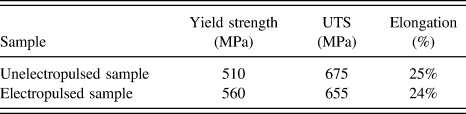
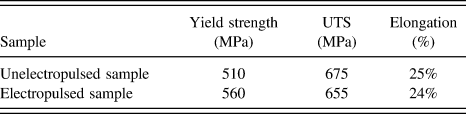
Table II illustrates the mechanical properties of both samples. As is evident from this table, the electropulsed sample has higher values of yield stress and UTS while its elongation does not differ greatly from the unelectropulsed sample. The production of stronger microstructure after electropulsing can be anticipated to be due to the formation of finer grain sizes and the elimination of PFZs. The study of the anisotropic structure and property relationship is not within the scope of the present work.
Mechanical properties of unelectropulsed and electropulsed samples.
V. CONCLUSION
Electropulsing treatment has resulted in the production of finer grain sizes and therefore enhanced the mechanical properties. This is thought to be because of increase in nucleation rate for the electropulsed sample. The semitransformed pearlite structure has been observed to be parallel to the direction of the electric current flow. The tendency of electric current pulses toward the re-configuration of the structure with lower electrical resistivity is anticipated to play a key role in this phenomenon. This observation is in agreement with the previous experiment performed at room temperature. A relatively even distribution of precipitation produced after electropulsing which is believed to be due to the enhanced mobility due to decrease in the kinetics barrier.
ACKNOWLEDGMENT
The authors wish to acknowledge the financial support from POSCO and the Royal Academy of Engineering at United Kingdom.