Introduction
The sexual and reproductive health of young people is currently a scientific and programmatic priority in Africa, within a permanently changing socioeconomic and cultural context (Hindin et al., Reference Hindin, Sigurdson and Ferguson2012). The growing emphasis on the sexual and reproductive health of young people reflects their significant contribution to the continent’s demographic dynamics and their vulnerability to sexual and reproductive health risks (Hindin et al., Reference Hindin, Sigurdson and Ferguson2012).
In Cameroon, the onset of the HIV/AIDS epidemic in the mid-1980s was addressed by the National AIDS Control Committee (CNLS) through HIV prevention plans beginning in 1987 and continuing to 2000 (Salla Ntounga, Reference Salla Ntounga1993; Tsala Tsala, Reference Tsala Tsala2004). The initial plans had limited results (Tsala Tsala, Reference Tsala Tsala2004). Research, policies and programmes focused primarily on students and prostitutes, because these two groups had been formally identified as high-risk groups (Tsala Tsala, Reference Tsala Tsala2004). During that time, adolescents and young people did not appear to be concerned about HIV/AIDS. By 1998, according to DHS data, the rates of having multiple sexual partners remained quite high among single male and female youth, and few reported using condoms at last sexual intercourse (31.1% and 17.2%, respectively) (Fotso et al., Reference Fotso, Ndonou, Libité, Tsafack, Wakou and Ghapoutsa1999).
The reorganization of the CNLS in 2001 and implementation of the 2000–2005 and 2006–2010 national HIV/AIDS programmes aimed to improve the lives of the entire population living with HIV/AIDS, including children, adolescents, young people and orphans. The programmes used a multi-sectoral approach (MINSANTE, 2000, 2006) and led to appreciable results. Rates of condom use at last sexual intercourse increased among single male youth, from 31.1% in 1998 to 57.3% in 2004 and 72% in 2011; and among female youth, from 17.2% in 1998 to 52.2% in 2004 and 59.5% in 2011 (Fotso et al., Reference Fotso, Ndonou, Libité, Tsafack, Wakou and Ghapoutsa1999; INS & ORC Macro, 2004; INS & ICF International, 2012). However, since 2011, condom use has decreased significantly among single male youth, from 72% in 2011 to 66.3% in 2018, and single female youth, from 59.5% to 50.9% (INS & ICF International 2012, 2020). Such declines in condom use may be contributing to an increase in HIV prevalence among male youth from 0.4% in 2011 to 0.7% in 2018 among those aged 15–19, and from 0.6% in 2011 to 1.5% among those age 20–24 (INS & ICF International, 2012, 2020).
As yet, there is limited information on factors associated with current condom use among Cameroonian single youth. Nevertheless, studies in other countries indicate that youths’ sexual behaviours are determined by both social and individual factors. In the first case, sexual behaviours are considered to be the outcome of social norms and values that are internalized by youths from their family socialization (Tsala, Reference Tsala2010; Wamoyi et al., Reference Wamoyi, Wight and Remes2015), and the influence of schools (Lloyd, Reference Lloyd and Malarcher2010), media (Kwankye & Augustt, Reference Kwankye and Augustt2007; Oladeji & Ayangunna, Reference Oladeji and Anyangunna2017), religious groups (Cerqueira-Santos & Koller, Reference Cerqueira-Santos and Koller2016) and peers (Yode & LeGrand, Reference Yode and LeGrand2008; Tsala, Reference Tsala2010; Bingenheimer et al., Reference Bingenheimer, Asante and Ahiadeke2015; Fearon et al., Reference Fearon, Wiggins, Pettifor and Hargreaves2015). In the second case, youths’ sexual behaviours are considered to be the outcome of their own initiative and decisions (Guiella, Reference Guiella2012).
For example, some studies on youths’ sexual behaviours indicate that living with both parents is more protective than living in single-parent families or step-families (Guiella, Reference Guiella2012; Pop & Rusu, Reference Pop and Rosu2015; Steele et al., Reference Steele, Simmons, Sutton and Gibbons2020). Others highlighted the positive role of school attendance and high level of education (Lloyd, Reference Lloyd and Malarcher2010), peer group attendance (Bingenheimer et al., Reference Bingenheimer, Asante and Ahiadeke2015; Fearon et al., Reference Fearon, Wiggins, Pettifor and Hargreaves2015) and media exposure (Bessinger, Reference Bessinger, Katende and Gupta2004, Muli & Lawoko, Reference Muli and Lawoko2014; Oladeji & Ayanganna, Reference Oladeji and Anyangunna2017; Ntshiqa et al., Reference Ntshiga, Musekwa, Mlotshwa, Mangold, Reddy and Williams2018). Finally, individual factors that have been highlighted include: personal risk perception (Estrin, Reference Estrin1999; Haley, Reference Haley, Puskar, Terhorst, Terry and Charron-Prochownik2012); self-efficacy – the belief that one can design and execute a specific behaviour (Estrin, Reference Estrin1999; Haley et al., Reference Haley, Puskar, Terhorst, Terry and Charron-Prochownik2012); perceptions about condoms – that they are effective, decrease sexual pleasure and suggest untrustworthiness of a partner (Peltzer, Reference Peltzer2000); knowledge of HIV/AIDS (Rwenge, Reference Rwenge2012; Rugigana et al., Reference Rugigana, Birungi and Nzayirambaho2014); testing for HIV (Barrere, Reference Barrere2012) and delaying entry into sexual activity, occurrence of consensual sex and occurrence of non-casual sex (Tsala, Reference Tsala2010; Rwenge, Reference Rwenge2012).
The above-mentioned studies show that several factors may influence condom use, but a systemic approach, i.e. one that takes into account social and individual factors and their inter-relationships in the same model, has not been used in most previous studies. In the African context, where the family plays an important role in the socialization of children, the question should be whether HIV/AIDS prevention policies among youth that focus on media and peers are effective, and what, if any, factors should be given more attention. Hence, there is a clear need for comprehensive studies on the factors affecting protective behaviour.
This study responded to this need by focusing on the prevalence of, and factors associated with, condom use among single males and females age 15–24 in Cameroon, using data from the 2018 Cameroon Demographic Health Survey (CDHS). The study was designed to: identify social and individual factors associated with condom use among single youths living in Cameroon; identify the characteristics of youths who were less likely to use condoms; and highlight gender differences in factors associated with condom use among single youths.
Methods
Data
The data for this study came from the 2018 DHS conducted in Cameroon (CDHS) by the National Institute of Statistics (INS), in collaboration of the Ministry of Public Health (MSP). Among its specific objectives, two explicitly dealt with knowledge and attitudes about STIs and AIDS, sexual behaviours and HIV testing.
The 2018 CDHS survey was nationally representative, household-based and designed to provide population and health indicator estimates at the national, urban–rural and regional levels. For more details about the sampling and technical assistance for the 2018 CDHS survey, see the final report (INS & ICF International, 2020).
The study sample included 1464 single female youths and 989 single male youths aged 15–24 who answered the question about condom use during the last sexual intercourse that occurred in the 12 months before the survey. Single female or male youths were those who declared during the survey that they were never married or were not currently living with a partner.
Variables
The outcome or dependent variable was ‘condom use at last sexual intercourse’. Predictor or independent variables covered family environment, extra-familial characteristics and media exposure at the social level, and knowledge, attitudes and practices relating to HIV/AIDS at the individual level.
Family environment
The variable ‘family composition’ was based on the kinship combination of the household head. This was a qualitative variable with five categories: nuclear; extended; household head with children; household head with children and others; and other. A nuclear family is a family group consisting of two parents and their children. An extended family is a family group that extends beyond the nuclear family, consisting of two parents and their children, aunts, uncles, grandparents, cousins and persons unrelated to the household head. The ‘other’ category included complex or neither-parent-present families.
‘Household size’ was the number of household members, taking the values: 1–3; 4–6; 7–8; and 9 or more.
‘Sex of household head’ was a dummy qualitative variable indicating whether the household head was male or female.
‘Education level of household head’ indicated the highest educational attainment of the household head. This was a qualitative ordinal variable with the categories: no education; primary; secondary; and higher.
‘Household wealth index’ was a wealth index built using data on a household’s ownership of assets, such as televisions, and bicycles; materials used for housing construction; and types of water access and sanitation facilities. It placed households on a continuous scale of relative health, and was transformed to a qualitative ordinal variable with five roughly equal-sized groups: highest; fourth; middle; second; and lowest.
‘Ethnicity’ (determines cultural models; see Sala-Diakanda, Reference Sala-Diakanda1980 and Evina, Reference Evina1989 for details) included: North; Beti-Boulou; Bassa; Bamileke; Mbo; North-West/South-West; and other.
Extra-familial characteristics
‘Youth’s education level’ was based on youths’ highest educational attainment and had four categories: no education and primary; first cycle of secondary; second cycle of secondary; and higher.
‘Youth’s religion’ (beliefs, feelings, dogmas and practices that define their relationship with the sacred or higher entities) had the categories: Catholic; Protestant; Muslim; other Christians; and other. The ‘other’ category included no religion and animist.
The variable ‘youth’s occupation’ captured peer influence. Contact with peers and other persons should be more frequent among youths who work in modern or informal sectors of the economy than among those who work in isolated areas such as farms. It had five categories: not working; modern and services; sales; agriculture; manual. Occupations considered as ‘modern’ were professional, technical and managerial occupations.
Media exposure
‘The degree of media exposure’ was an index built using the youths’ frequency of: watching TV, listening to the radio and reading newspapers/magazines. This had four categories: not exposed; low exposure; moderate exposure; and high exposure.
Individual characteristics
The variable ‘in-depth knowledge of AIDS’ was built using the youths’ knowledge of the means of prevention and transmission of HIV/AIDS. Youths considered to have an in-depth knowledge of AIDS were those who knew that regular condom use reduced the risk of getting HIV, having only one sex partner who had no other partners reduced this risk and that a healthy looking person can have HIV, and rejected two false ideas about AIDS transmission: an individual can get HIV from 1) mosquito bites or 2) supernatural means. The variable had two categories: 1) had an in-depth knowledge of AIDS (yes); 2) did not have an in-depth knowledge of AIDS (no).
‘Perception of gender inequalities’ was a composite variable of youth’s opinions on a man beating his wife, i.e. whether they thought it was justified if a wife: goes out without telling her husband; neglects the children; argues with her husband; refuses to have sex with her husband; burns food. This had three categories: not favourable; less favourable; and very favourable.
‘Agree that women can ask their partners to use a condom’ was a dummy variable with a value of ‘1’ for those who agreed and ‘0’ if not.
‘Age at first sex’ (at coital debut) had the following categories: <15 years; 15–19 years; and 20 years or more.
‘Number of sex partners in last 12 months’ was a dummy variable taking the value ‘1’ for youths who only had one partner and ‘2’ for those who had at least two partners.
‘HIV test already done’ was a dummy variable that equalled ‘1’ for youths who had had an HIV test and ‘0’ if not.
‘Relationship with last sexual partner’ covered the casualness of youths’ last sexual relationship, with those whose last sexual partner was a boy/girlfriend not living with him/her coded ‘1’ and those whose last sexual partner was a casual partner coded ‘2’.
‘Number of children’, or whether youths had any children to raise, equalled ‘1’ if a respondent had no children and ‘2’ if he/she had at least one child.
Statistical analysis
Descriptive statistics, frequencies and percentages were computed to describe the social and individual characteristics of the respondents, as well as variation in the percentages of respondents who used condoms at last sexual intercourse in the 12 months before the survey. Logistic regression analyses were used to identify the determinants of condom use at last sex and the characteristics of youths who were least likely to use condoms.
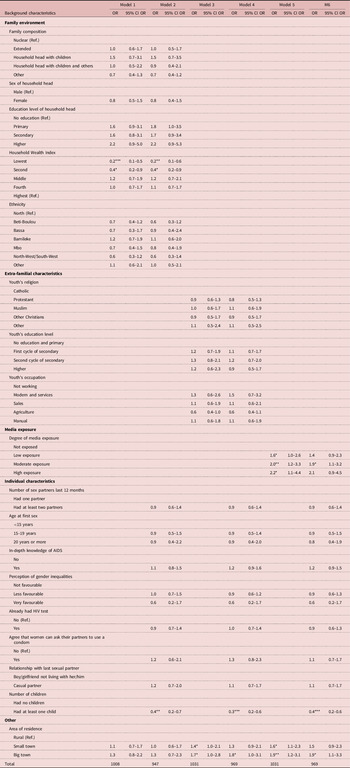
As family and extra-familial characteristics and media exposure may be associated with condom use through their individual characteristics, seven logistic regression models were used among single male youths and the same models among female youths. This included the full model (see Table 3) and other six models, which were produced by controlling each of the three types of social characteristics by individual ones.
Models 1, 3 and 5 showed the effects of social characteristics in the presence of place of residence. Model 1 included the family environment variables, Model 3 extra-familial environment variables and Model 5 media exposure with the addition of place of residence. Models 2, 4 and 6 showed the effects of social characteristics in the presence of place of residence and individual characteristics. Model 2 included family environment variables, Model 4 extra-familial environment variables and Model 6 media exposure with the addition of the individual characteristics and place of residence. The full model included all independent variables.
In all analyses, sampling weighting was used to account or adjust for disproportionate sampling and non-response. The multi-stage sampling design was also taken into account. The analyses were conducted with Stata 16 software. The probability thresholds were p<0.001, p<0.01 and p<0.05.
Results
Background characteristics of respondents
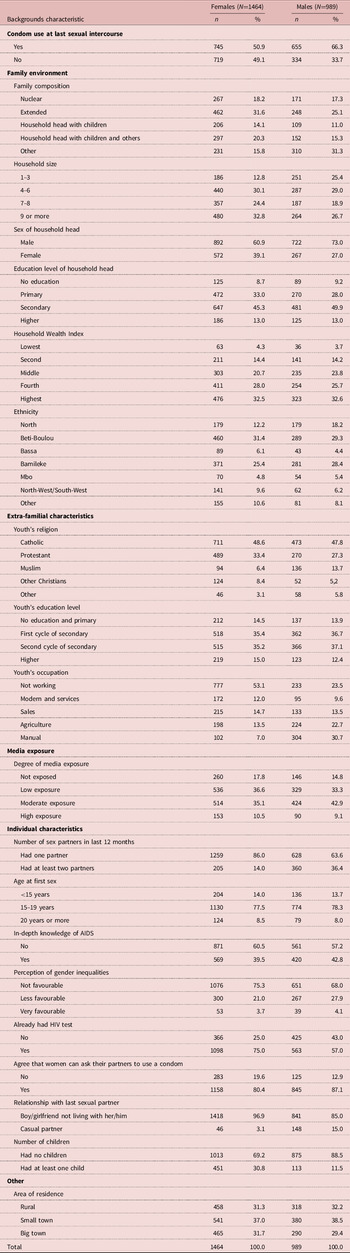
Table 1 presents the percentage distribution of the sample youths by background characteristics. Overall, 51% of female youths and 66% of male youths reported that they used condoms at their last sexual intercourse. Most female youths lived in extended family households (32%) or in single-parent households with children and others (20%). Most of the male youths lived in extended family households (25%) or in other types of households with neither parent present or with a complex structure (31%). More than two-fifths of youths lived in households with at least seven members (57% of females and 46% of males). The percentage of youths living in a female-headed household was higher for female (39%) than male youths (27%). The majority of female and male youths lived in households with heads who had attained secondary or tertiary education (58% and 63%, respectively), were Bamileke (25% and 28%, respectively), Beti-Boulou (31% and 29%, respectively) or from the Northern ethnic groups (12% and 18%, respectively).
Percentage distribution of single females and males aged 15–24 who had had sexual intercourse within the 12 months before the 2018 CDHS by selected background characteristics

The majority of youths were Catholic (49% of females and 48% of males) or Protestant (33% of females and 27% of males). Level of education did not vary by sex, with the proportions being approximately the same at the ‘no education and primary’ levels (15% of females and 14% of males), at the first cycle of secondary level (35% and 37%), the second cycle of secondary level (35% and 37%) and the higher level (15% and 12%). About 53% of female youths were not working at the time of the survey, with 15% working in the sales sector, 14% in agriculture, 12% in the modern or services sectors and 7% being manual workers. Among male youths, these proportions were 24%, 14%, 23%, 10% and 31%, respectively.
The proportion of youths with no or low exposure to the media was higher among female than male youths (54% and 48%, respectively). Forty per cent of female and 43% of male youths had an in-depth knowledge of HIV/AIDS. The proportion of female youths who had been tested for HIV/AIDS (75%) was higher than that of males (57%). The majority of individuals did not approve of wife beating (75% of females and 68% of males) and 80% and 87%, respectively, agreed that women could ask their partners to use condoms. About 14% of male and female youths had their first sexual intercourse before the age of 15. This proportion was 78% at ages 15–19 and 8% at ages 20–24. About 14% of female and 36% of male youths had had multiple sexual partners in the 12 months before the survey; fewer female (3%) than male youths (15%) had sex with casual partners during this period; and 31% and 12%, respectively, reported that they had already had at least one child born alive at the time of the survey.
Bivariate associations of social and individual factors with condom use
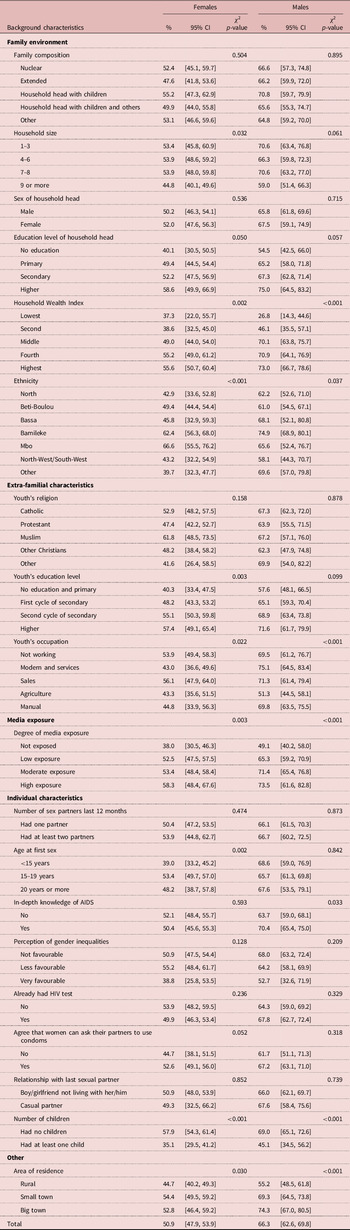
Table 2 presents the associations between each independent variable and condom use at last sex among sample youths. For both sexes, all social factors, with the exception of family composition, sex of household head and youth’s religion, and having at least one child were significantly associated with condom use. For both sexes, number of sexual partners, perception of gender inequalities, relationship with last sexual partner, being supportive of women requesting condom use by their partner and being tested for HIV were not significantly associated with condom use. Household size, household head’s education level, youth’s education level and age at first sexual intercourse were associated with condom use among female youths only, and having an in-depth knowledge of HIV was only associated with condom use among the male youths.
Proportion of single youths aged 15–24 who used a condom at last sexual intercourse during the 12 months before the 2018 CDHS by gender and selected background characteristics

Among female youths, at the family level, the proportion of condom use was lower than the national average (51%) in households with nine or more members (44.8%). The head of household’s educational level was positively associated with condom use. For example, the proportion of condom use was higher than the national average in households headed by someone with higher education (59%) and lower in those whose heads had no education (40%). For both sexes, a similar association was observed between household wealth index and condom use. At the same level, among female youths, ethnicity was associated with condom use. The proportion of condom users was higher among the Bamileke (62%) and Mbo (67%) ethnic groups than the ‘other’ ethnicity group. The same was observed among male youths (75% and 66%), although for males these two ethnic groups did not differ significantly from Bassa (68%) and ‘other’ (70%).
At the extra-familial level, the educational level of female youths was positively associated with condom use. The rate of condom use increased from 40.3% for those with no education or primary education to 57.4% for those with higher education. As for occupation, the proportion of condom use was higher among female youths who worked in the sales sector (56%) or were not working (54%) than among those who worked in other professions (between 43 and 45%). Among male youths, only those who worked in the agricultural sector (51%) differed from other categories (between 70% and 75%) by their low rate of condom use.
For both sexes, the percentage condom use increased with degree of media exposure, being higher than the national average among youths who were highly exposed (58% among females and 74% among males) and lower among those who were not exposed (38% and 49%, respectively).
At the individual level, among female youths, the proportion of condom use was lower for those who began sexual activity at 15 or younger (39%) than among those who began at older ages (48% at 20 or over and 53% at 15–19). Among male youths, in-depth knowledge of HIV/AIDS was positively associated with condom use – 70% for those who had in-depth knowledge versus 64% for those who did not. For both sexes, having at least one child was negatively associated with condom use: condom use rates were 35% and 45%, respectively, for females and males with at least one child, and 58% and 69% respectively for those with no children.
Finally, the proportion of condom use was greater in large towns (53% among female and 74% among male youths) and small towns (54% and 69%) than in rural areas (45% and 55%).
Results of the multivariate analyses
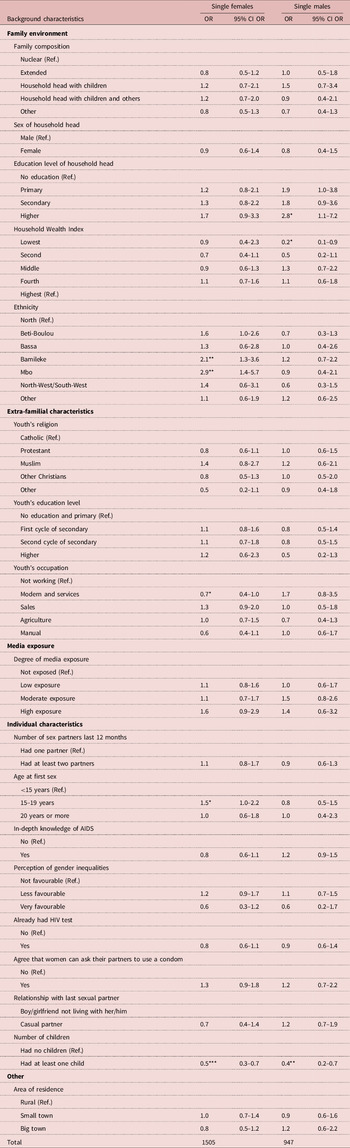
This section highlights the factors associated with condom use (the ‘determinants’ of condom use), the groups most at risk (where the odds ratios [ORs] of using condoms were lower than the reference group) and those at least risk (where the ORs were higher) (Table 3). Tables 4 and 5 shows the mechanisms of action of social factors. Of the independent variables, just one (household size) was eliminated to avoid multicollinearity problems as the different VIFs (variance inflation factors) showed that household size was strongly correlated with family composition.
Logistic regression on condom use at last sexual intercourse among single females and males aged 15–24, 2018 CDHS

*p≤0.05; **p≤0.01; ***p≤0.001.
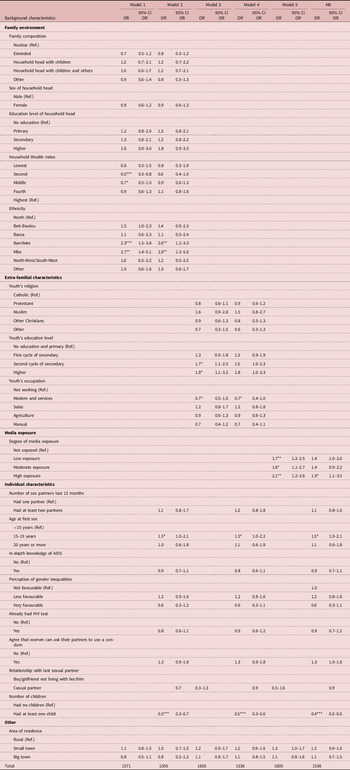
Logistic regression models on condom use in which each type of social factors are controlled by individual ones (Single females age 15-24, 2018 CDHS)

*p≤0.05; **p≤0.01; ***p≤0.001.
Logistic regression models on condom use in which each type of social factor is controlled by individual factors, single males aged 15–24, 2018 CDHS

*p≤0.05; **p≤0.01; ***p≤0.001.
‘Determinants’ of condom use
The full models in Table 3 show that, for both sexes, the ‘determinant’ of condom use at last sexual intercourse was number of children ever born. The sex differences in the determinants of condom use are important. The following variables only acted as determinants among females: ethnicity, occupation and age at first intercourse. Among males, the variables that acted as determinants were head of household’s education level and household wealth index.
Characteristics of at-risk groups
Among males, those living in households whose heads attained higher education (OR=2.8) were more likely to use condoms than those living in households with heads with no education. Young men living in households in the lowest wealth index quintile (OR=0.2) were less likely to use condoms than those living in households in the highest wealth index quintile. Among females, individuals from the Bamileke (OR=2.1) or Mbo (OR=2.9) ethnic groups were more likely to use condoms than those from the Northern ethnic groups. Finally, for young women, being employed in the modern or service sectors (OR=0.7) was negatively associated with condom use, compared with non-working individuals.
Youths with at least one child were less likely to use condoms than those with no children (OR=0.5 among females and 0.4 among males). Among females, individuals who had their first sexual intercourse at age 15–19 were more likely to use condoms (OR=1.5) than those who began sexual activity at a younger age. There was no significant difference in condom use between female youths who had their first sex at age 20 or over and those who started sexual activity at 15 or younger.
Mechanisms of action of social factors
Table 4 shows the results of the logistic regression analysis of the association between condom use and social factors controlled by individual factors for female youths. Among females, the effect of household wealth index was nullified and that of ethnicity was attenuated when individual characteristics were included (see ORs in Models 1 and 2, Table 4). Further analyses showed that in-depth knowledge of HIV/AIDS attenuated the effect of ethnicity and age of first intercourse, and number of children born alive nullified that of the household wealth index (results not presented). This last individual factor nullified the effect of HIV test (results not presented). The effect of youth’s education level was nullified, and that of the degree of media exposure was attenuated, in the presence of individual characteristics (see ORs for youth’s education in Models 3 and 4 in Table 5 and ORs for media exposure in Models 5 and 6 in Table 4). In-depth knowledge of HIV/AIDS and perception of gender inequalities nullified the effect of youth’s education level, and youth’s education level and age at first intercourse attenuated that of degree of media exposure (results not presented).
Table 5 shows the results of the logistic regression analysis of the association between condom use and social factors controlled by individual factors for male youths. The effect of household wealth index was attenuated (see Models 1 and 2 in Table 5) by the age of first intercourse and the effect of degree of media exposure was attenuated (Models 5 and 6 in Table 5) by in-depth knowledge of HIV/AIDS, the perception of gender inequalities and the number of children born alive (results not presented).
Discussion
One of the important results from the descriptive analyses was that the proportion of young adults in Cameroon in 2018 who used condoms at their last sexual intercourse was 51% among females and 66% among the males. In 2011, these proportions were respectively 60% and 72%. These findings highlight a relaxation of preventive HIV/AIDS practices among youths in Cameroon over time. This has been observed in other developing countries. In Cameroon, Billong et al. (2020) suggested that this was due to expenditure on the fight against HIV/AIDS being re-directed towards antiretroviral treatment. In 2017, for example, the expenditure on HIV/AIDS prevention measures directed at out-of-school youth accounted for only 1.9% of total expenditure, and that on communication for social and behavioural change in the general population accounted for 14.5% (Billong et al., Reference Billong, Messeh, Penda, Anoubissi, Fokam and Moutapam2020). Thus, HIV/AIDS programmes for young adults received the lowest prevention funding of all age groups and this could have caused the problem of condom shortage. There was an annual growth of 24% in the number of condoms distributed in 2010–2014 in Cameroon, and then an annual decrease of 10%, which could have been due to funding constraints (MINSANTE, 2016).
The study’s multivariate analyses highlighted the family, extra-familial and individual ‘determinants’ of condom use among male and female youths in Cameroon in 2018. The results highlight the role of household human and financial capital in improving male youths’ sexual behaviours. The positive influence of the household head’s educational level occurred only at its highest level, and this can be understood when the sexual education of children in the family setting is taken into account. Good child sexual education requires parents to be well-informed about youth sexual and reproductive health (Pop & Rusu, Reference Pop and Rosu2015; Breunar et al., Reference Breuner and Mattson2016). At a higher level of education, parents develop the capacity to communicate more easily with their sons about sexual and reproductive health matters. Another possible explanation is that educated parents invest more than others in the quality of their children, and may be more motivated to communicate with their children about subjects related to the prevention of pregnancies and STI/HIV/AIDS. This could be an important area for future research.
The positive association observed among male youths between household wealth index and condom use reflects the fact that parental financial support plays an important role in improving HIV/AIDS preventive practices. Those living in households with a wealth index quintile higher than the second quintile are less likely to be vulnerable to economic pressures that could expose them to high-risk behaviours, and are also more likely to have access to the good health care services that encourage healthy lifestyle practices. Parental financial support was not a significant factor for condom use among women, probably because in the study context men make most decisions about sexual intercourse.
For female youths, ethnicity, occupation and age at first intercourse were associated with condom use, so effective interventions to promote condom use should be differently packaged for females and males. The fact that, among female youths, individuals from Bamileke and Mbo ethnic groups were more likely to use condoms than those from other groups suggests that interventions are less important for the West and Littoral regions where the Bamileke and Mbo live, than in the North, East and other regions. This concurs with previous findings by Rwenge (Reference Rwenge2004). As for the effect of youth economic activity on condom use, in the Cameroonian context, the results do not confirm the hypothesis that economic activity increases condom use. Instead, young females who worked in the modern/service sectors or who were manual workers were less likely to use condoms than those who were not working. Bankole et al. (Reference Bankole, Biddlecom, Guiella and Singh2007) and Gavin et al. (Reference Gavin, Maughan-Brown, Beckett, Evans, Cawood and Khanyile2018) observed that the age difference between partners is a major determinant of condom use among youths in developing countries, and this could explain the observed negative effect of female economic activity on condom use: the age difference between partners may have been higher among females working in the modern/service sectors or in manual work than among those who were not working. Indeed, as the latter are mostly still at school, they tend to find partners of the same age. This highlights the importance of the problem of unbalanced power relationships: most female youths working in the modern/service sectors or in manual work had sexual intercourse with older men and therefore their ability/capacity to negotiate safe sex, or to influence the behaviour of their partners was low.
Among female youths, the positive relationship between age at first sexual intercourse and condom use corroborates observations made in other contexts, notably in Mali (Boileau, Reference Boileau2006) and in Burkina Faso (Yode & LeGrand, Reference Yode and LeGrand2012). As younger adolescents have more limited, and often inadequate, knowledge about sexuality, first sex at an early age is more likely to be unprotected by a condom. Condom use is thus a practice that is cultivated early. Individuals who are most resistant to codom use have probably developed the habit of having sexual relations without a condom since they first became sexually active. This suggests that delaying the onset of sexual activity could be a safer way to protect sexual and reproductive health. In the case of the number of children ever born, its negative association with condom use observed among female and male youths is an expression of trust between partners and intimacy, which will be stronger in relationships solidified by the birth of a child. Amon et al. (Reference Amon, Lutambi, Mubyazi, Kweka, Mbaruku and Masanja2011) found no evidence of an association between multiple sexual partners and condom use, but the problem of under-estimation of number of sexual partners among female youths, and over-estimation among male youths, means that this result should be treated with caution.
Other important results were highlighted with the logistic regression models, where each type of social factor was controlled by individual factors. These models showed that the influence of some social factors was attenuated or nullified in the presence of individual factors, and that social factors had significant direct and indirect effects on youths’ condom use. For example, among female youths, in-depth knowledge of HIV/AIDS explained some of the influence of ethnicity and delaying first sexual intercourse, and not having children to raise explained totally that of household wealth index. In other words, female youths living in households in the second and middle wealth index quintiles were less likely to use condoms than those living in the highest wealth index quintile households, because a good proportion of the former started sexual activity at a younger age (33% and 22% versus 6%) and had at least one child (41% and 40% versus 21%). Furthermore, female youths delaying first sexual intercourse and having a negative perception of gender inequalities may explain the influence of media exposure. Among young males, the latter factor, as well as in-depth knowledge of HIV/AIDS and not having children to raise, played the same role in the case of media exposure. Thus, positive changes in youths’ family, extra-familial and media environments should lead to an improvement in their sexual behaviours, if they play the same role in the case of their knowledge, attitudes, perceptions and practices about STDs/HIV/AIDS.
The study has one important limitation. The cross-sectional nature of the DHS data does not allow for establishing temporal priority of independent variables and for evaluation of casual implications. Thus, the results are simple associations among variables. Because the study highlighted that social factors are associated with youths’ condom use via their individual characteristics, longitudinal or biographical studies of youths’ sexual behaviours are needed to show how changes over time in the youths’ social environment (familial environment, extra-familial environment, and media exposure) affect behavioural changes through perceptions and attitudes, and are either directly or indirectly related to HIV/AIDS prevention.
In conclusion, ‘determinants’ of single youths’ condom use were found at the family, extra-familial and individual levels, and degree of media exposure was not associated with the condom use by either male or female youths, the study findings support Cameroon’s multi-sectoral approach to HIV/AIDS prevention among youths, and emphasize the importance of involving parents, teachers and youths.
Acknowledgments
The authors would like to thank Shireen Assaf and Juan Christina as mentors, and Aninditya Flora and Wayack Madeleine as co-mentors, of the 2020 DHS Fellows Programme for providing technical support and insights on the analyses undertaken in the study. They also would like to thank Shireen Assaf and Sara Riese for their useful comments. The DHS Fellows Programme is funded by USAID and implemented by ICF International.
Funding
This research received support from the 2020 DHS Fellows Programme, funded by USAID.
Conflicts of Interest
The authors have no conflicts of interest to declare.
Ethical Approval
The authors assert that all procedures contributing to this work comply with the ethical standards of the relevant national and institutional committees on human experimentation and with the Helsinki Declaration of 1975, as revised in 2008.