INTRODUCTION
Anthropogenic transformation of natural habitats and subsequent habitat loss is considered to be one of the most important threats to biological diversity (Sala et al. Reference Sala, Chapin, Armesto, Berlow, Bloomfield, Dirzo, Huber-Sanwald, Huenneke, Jackson, Kinzig, Leemans, Lodge, Mooney, Oesterheld, Poff, Sykes, Walker, Walker and Wall2000; Rands et al. Reference Rands, Adams, Bennun, Butchart, Clements, Coomes, Entwistle, Hodge, Kapos, Scharlemann, Sutherland and Vira2010). The resulting fragmentation of natural vegetation has consequences for ecosystem health and stability (Saunders et al. Reference Saunders, Hobbs and Margules1991; Chapin et al. Reference Chapin, Zavaleta, Eviner, Naylor, Vitousek, Reynolds, Hooper, Lavorel, Sala, Hobbie, Mack and Diaz2000), with both direct and indirect effects on wildlife populations (Bolger et al. Reference Bolger, Alberts, Sauvajot, Potenza, McCalvin, Tran, Mazzoni and Soulé1997; Wolff et al. Reference Wolff, Schauber and Edge1997; Rodríguez and Peris, Reference Rodríguez and Peris2007; Mortelliti et al. Reference Mortelliti, Amori, Capizzi, Cervone and Fagiani2011). Fragmentation directly influences habitat characteristics like patch structure and size and resource availability, while indirect influences include edge effects, decreased genetic diversity and increased competition at both the inter- and intraspecific levels (Soulé, Reference Soulé1991). The consequence is usually a loss in plant and animal diversity due to generalist species out-competing specialists in fragmented habitats (de la Penã et al. Reference de la Penã, Butet, Delettre, Paillat, Morant, Le Du and Burel2003; Krasnov et al. Reference Krasnov, Stanko, Miklisova and Morand2006; Rodríguez and Peris, Reference Rodríguez and Peris2007; Manor and Saltz, Reference Manor and Saltz2008) often resulting in biotic homogenization.
The effect of habitat fragmentation on vertebrate and free-living invertebrate taxa are well studied but only recently has research focussed on host-parasite systems (see Goüy de Bellocq, Reference Goüy de Bellocq, Morand and Feliu2002; Allan et al. Reference Allan, Keesing and Ostfeld2003; Wasserberg et al. Reference Wasserberg, Abramsky, Kotler, Ostfeld, Yarom and Warburg2003; Nieberding et al. Reference Nieberding, Morand, Libois and Michaux2006; Vaz et al. Reference Vaz, D'andrea and Jansen2007; Püttker et al. Reference Püttker, Meyer-Lucht and Sommer2008; Mbora and McPeek, Reference Mbora and McPeek2009; Wright et al. Reference Wright, Arrigo-Nelson, Hogg, Bannon, Moreli, Wyatt, Harivelo, Ratelolahy, Huffman and Chapman2009; Cottontail et al. Reference Cottontail, Wellinghausen and Kalko2009; Friggens and Beier, Reference Friggens and Beier2010). The majority of these studies examined the influence of fragmentation on parasite infection in mammals, providing evidence for increased parasite abundance, prevalence and richness, primarily mediated by changes in host density. However, the response was not uniform across parasite taxa, which may be linked to differences in parasite life history. For example, Cottontail et al. (Reference Cottontail, Wellinghausen and Kalko2009) showed that the prevalence of a host-restricted nematode species, Litomosoides, was less affected by host density and diversity, which was linked to fragmentation, compared to generalist trypanosome species in bats. Parasites differ in host specificity and level of host association (Poulin, Reference Poulin1996, Reference Poulin2007), which will result in species-specific responses to fragmentation (Johnson and Thieltges, Reference Johnson and Thieltges2010). Generalist parasites, especially those that have direct life cycles (Mbora and McPeek, Reference Mbora and McPeek2009), usually benefit from changes in biotic and abiotic conditions associated with fragmentation (Friggens and Beier, Reference Friggens and Beier2010). At present, however, the generality of these results is still uncertain, particularly with regards to parasite morphology and fitness.
Parasites are influenced strongly by both their host and the surrounding environment. Depending on a species’ life-history, environmental and host factors will be of variable importance in controlling parasite populations (Poulin, Reference Poulin1996; Krasnov and Matthee, Reference Krasnov and Matthee2010). Specifically, the effect of environmental conditions will be more pronounced for parasite taxa that have one or more free-living stages and/or that spend a longer proportion of their lifetime away from a host (Poulin, Reference Poulin1996). For example, microclimatic conditions, such as air temperature, humidity and specially substrate texture, have a significant effect on flea reproduction and development (Krasnov et al. Reference Krasnov, Khoklova, Fielden and Burdelova2001a,Reference Krasnov, Khoklova, Fielden and Burdelovab).
A diversity of host characteristics are known to be related to parasite performance, including host identity, age, body size, sex and reproductive state (Poulin, Reference Poulin1996; Krasnov et al. Reference Krasnov, Shenbrot, Medvedev, Vatschenok and Khoklova1997, Reference Krasnov, Shenbrot, Khoklova, Medvedev and Vatschenok1998, Reference Krasnov, Khokhlova, Arakelyan and Degen2005, Reference Krasnov, Stanko, Miklisova and Morand2006; Matthee et al. Reference Matthee, McGeoch and Krasnov2010a). Host species identity can have a significant effect on parasite development and fecundity, with even generalist parasites exhibiting a level of host preference. Indeed, studies have recorded improved engorgement time, rate of blood digestion, time of survival (Krasnov et al. Reference Krasnov, Sarfati, Arakelyan, Khokhlova, Burdelova and Degen2003) and larger body size (Haukisalmi et al. Reference Haukisalmi, Henttonen and Batzli1995) for parasite species that fed on preferred species in comparison to less preferred host species, possibly reflecting a longer co-evolutionary history between the parasite and the preferred host (Haukisalmi et al. Reference Haukisalmi, Henttonen and Batzli1995; Poulin, Reference Poulin1996; Krasnov et al. Reference Krasnov, Sarfati, Arakelyan, Khokhlova, Burdelova and Degen2003; Krasnov, Reference Krasnov2008). Host age is another important factor and is linked to aspects such as parasite accumulation rate (Hawlena et al. Reference Hawlena, Abramsky and Krasnov2005), host immune response (Quinnell, Reference Quinnell1998), and body size (Hawlena et al. Reference Hawlena, Khokhlova, Abramsky and Krasnov2006). With respect to host body size, this factor can facilitate higher species richness and abundance for parasite taxa and also larger body size (Haukisalmi and Henttonen, Reference Haukisalmi and Henttonen1994; Arneberg et al. Reference Arneberg, Skorping and Read1998; Haukisalmi et al. Reference Haukisalmi, Heino and Kaitila1998; Arneberg, Reference Arneberg2002; Moore and Wilson, Reference Moore and Wilson2002; Poulin, Reference Poulin2007). This is mainly due to larger surface areas, more space and other resources. Parasites benefit through increased fecundity, competitive ability and longevity (Peters, Reference Peters1983; Skorping et al. Reference Skorping, Read and Keymer1991; Poulin, Reference Poulin2007). Aspects pertaining to the reproductive state of the host also influence parasites. Reproductively active hosts are normally larger than non-active hosts, which should result in the same size effect. In addition, testosterone acts as an immune suppressor and has been linked with higher parasite infestations especially in mammals (Klein, Reference Klein2000; Hughes and Randolph, Reference Hughes and Randolph2001; Krasnov et al. Reference Krasnov, Khokhlova, Arakelyan and Degen2005). Testosterone can also have an additional benefit for parasites through improved feeding. One such example is the study done by Khokhlova et al. (Reference Khokhlova, Serobyan, Degen and Krasnov2010) that found that fleas parasitizing male rodent hosts are able to consume a larger amount of blood. In addition, controlled studies on fleas and rodents recorded that fleas benefit from feeding on well-fed hosts (Krasnov et al. Reference Krasnov, Khokhlova, Arakelyan and Degen2005). It can therefore be suggested that if habitat fragments harbour larger and or better quality host individuals, then their parasites will also benefit.
Rodents are often associated with pristine natural areas and remnant fragments (Zhang et al. Reference Zhang, Zhang and Liu2003), showing altered abundances in response to fragmentation (Bolger et al. Reference Bolger, Alberts, Sauvajot, Potenza, McCalvin, Tran, Mazzoni and Soulé1997; Laakkonen et al. Reference Laakkonen, Fisher and Case2001). Studies examining the effect of fragmentation on the body size of small mammals have documented a variety of responses (Schmidt and Jensen, Reference Schmidt and Jensen2003; Lomolino and Perault, Reference Lomolino and Perault2007; Fietz and Weis-Dootz, Reference Fietz and Weis-Dootz2012), possibly due to differences in fragment characteristics, including size, connectivity and resource availability. Nonetheless, fragments within an agricultural mosaic are often associated with a higher abundance of food, water and shelter (Nupp and Swihart, Reference Nupp and Swihart1998; Friggens and Beier, Reference Friggens and Beier2010), and a lower density and diversity of predators (Nupp and Swihart, Reference Nupp and Swihart1998; Wilcox and Gubler, Reference Wilcox and Gubler2005). Resident animal populations may benefit adequately from these characteristics to offset the negative effects of fragmentation (Terborgh et al. Reference Terborgh, Lopez, Nuñez, Rao, Shahabuddin, Orihuela, Riveros, Ascanio, Adler, Lambert and Balbas2001; Schmidt and Jensen, Reference Schmidt and Jensen2003; Chapman et al. Reference Chapman, Wasserman, Gillespie, Speirs, Lawes, Saj and Ziegler2006; Püttker et al. Reference Püttker, Meyer-Lucht and Sommer2008; Friggens and Beier, Reference Friggens and Beier2010; Fietz and Weis-Dootz, Reference Fietz and Weis-Dootz2012).
The rodent Rhabdomys pumilio (Muridae) has a wide geographical range in southern Africa and is able to adapt to anthropogenic (urban and agricultural) environments (Skinner and Chimimba, Reference Skinner and Chimimba2005). It is evident from previous studies that R. pumilio is a good study species for assessing the response of a generalist rodent to modifications of natural habitat (Schradin and Pillay, Reference Schradin and Pillay2005; Mugabe, Reference Mugabe2008). To date, no studies have examined the level of R. pumilio sociality in the Western Cape Province (WCP) of South Africa, but it seems that these rodents exhibit a more communal social system in this area relative to some other areas (unpublished observation). This is supported by the fact that the fynbos vegetation in the WCP is more similar to the xeric vegetation of the succulent Karoo (where the mice are more social) compared to the mesic grassland of KwaZulu Natal (where the mice are less social; Mucina and Rutherford, Reference Mucina and Rutherford2006). Rhabdomys pumilio harbours a diverse assemblage of ecto- and endoparasite species (see references in Matthee et al. Reference Matthee, Horak, Beaucournu, Durden, Ueckermann and McGeoch2007, Reference Matthee, Horak, van der Mescht, Ueckermann and Radloff2010b; Froeschke and Sommer, Reference Froeschke and Sommer2005; Froeschke et al. Reference Froeschke, Sommer and Matthee2010) of which several are vectors of pathogens (De Meillon et al. Reference De Meillon, Davis and Hardy1961; Walker, Reference Walker1991), including the plague bacterium (Yersinia pestis; Shepherd and Leman, Reference Shepherd and Leman1983; Shepherd et al. Reference Shepherd, Hummitzsch, Leman and Hartwig1983). Rhabdomys pumilio populations can reach high densities in transformed habitats; however, it is uncertain if there are any other positive effects of fragmentation on this species or its parasites. If fragmentation benefits the host and its fleas then these habitats may be regarded as potential disease foci (Friggens and Beier, Reference Friggens and Beier2010).
In the present study the commensal broad-niche rodent species, Rhabdomys pumilio, was used as model host to establish the relationship between host and parasite body size in agricultural fragments and equivalent non-fragmented areas. Thus our aims were to compare (1) relative density, average body size and body condition of an opportunistic rodent species and, (2) body size (head length, vertical length, horizontal length and body size index) of its two most abundant fleas between extensive pristine natural localities and remnant fragments surrounded by agricultural activities. It was predicted that hosts in agricultural fragments would record larger body size and better body condition, and that flea body size will follow a concurrent trend with that of their hosts.
MATERIALS AND METHODS
Study areas
The study was conducted in the Cape Floristic Region (CFR) of the Western Cape Province (WCP), South Africa (Table 1). This region has a Mediterranean-type climate, characterized by warm dry summers and cold wet winters (Midgley et al. Reference Midgley, Hannah, Millar, Thuiller and Booth2003). It is a biodiversity hotspot due to a high level of plant species richness and endemism (Cowling and Hilton-Taylor, Reference Cowling, Hilton-Taylor and Huntley1994; Goldblatt and Manning, Reference Goldblatt and Manning2000). Agriculture (including plantation forestry) is the major contributor to the transformation and resulting fragmentation of natural habitats, already covering 25·9% of the CFR (Rouget et al. Reference Rouget, Richardson, Cowling, Lloyd and Lombard2003).
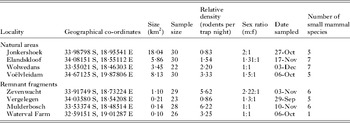
Locality information, number of Rhabdomys pumilio examined, sex ratio, relative density and small mammal species richness at each of the localities

Sampling of R. pumilio and its ectoparasite community comprised paired trapping at 4 large and continuous pristine natural areas and 4 habitat fragments within a matrix of agricultural activities (vineyards or crop fields). All localities were below 400 m a.s.l. and less than 200 km apart. Habitat fragments and their paired natural areas consisted of remnant lowland fynbos/renosterveld vegetation (following the classification of Mucina and Rutherford, Reference Mucina and Rutherford2006; Table 1). Locality sizes were estimated using the polygon tool in Google Earth Pro 5.2.1.
Rodent trapping and measurement
Rhabdomys pumilio individuals were trapped using Sherman-like live traps that were baited with a mixture of peanut butter and oats. The number of traps used per locality ranged from 100 to 200 and 22–30 R. pumilio individuals were trapped once at each of the 8 localities during austral spring and summer (October to December 2009; Table 1). Although the initial aim was to catch 30 individuals at each site within each trapping period, this was not possible due to low rodent abundance at certain localities. All R. pumilio individuals were removed and euthanized with 2–4 ml of sodium pentobarbitone (200 mg/kg) depending on individual weights, while other rodent species were identified and released at their capture site. Relative trap density (Rd) was calculated for each locality as:
 $$eqalign{Rd = (100 \times {\rm total}\;{R}{\rm.} {pumilio\;{\rm catches})/\cr \quad\times({\rm total}\;{\rm number}\;{\rm of}\;{\rm traps} {\rm total}\;{\rm number}\;{\rm of}\;{\rm trap}\,{\rm nights}),} $$
where 1 trap night is 12 h.
Each R. pumilio was placed in a separate pre-marked plastic bag, frozen at -20 °C, and examined at the laboratory. Body weight and measurements of the hind foot, tail and total length of each rodent were recorded following parasite removal (see methods below). Trapping and handling of rodents was approved by the Ethical Committee of Stellenbosch University and the Western Cape Nature Conservation Board (Ethics no: 2006B01007; Cape Nature permit no: AAA004-00221-0035).
A body condition index (‘BCI’ hereafter) was calculated for each R. pumilio individual as the residual from a regression of body mass on body size (total length; following Díaz and Alonso, Reference Díaz and Alonso2003; Schulte-Hostedde et al. Reference Schulte-Hostedde, Millar and Gibbs2004; Püttker et al. Reference Püttker, Meyer-Lucht and Sommer2008). Pregnant females and individuals with damaged tails were excluded from the regression and subsequent analyses because of their different body proportions and resulting body condition index.
Flea removal, identification and measurement
Frozen rodents were removed from the freezer the night before the animals were examined in the laboratory. Thawed individuals were removed from their plastic bags after which both the bag and the animal were systematically examined under a stereoscopic microscope. Two flea species, Listropsylla agrippinae and Chiastopsylla rossi were selected for examination based on their abundance on R. pumilio. Listropsylla agrippinae has a preference for host species that make above-ground nests, while C. rossi may prefer small mammal species that use complex borrow systems (Segerman, Reference Segerman1995). Fleas were placed into specimen tubes filled with 70% ethanol before being mounted for identification following the technique of Segerman (Reference Segerman1995). To prevent biases in total vertical and horizontal length measurements care was taken not to put any pressure on the cover slide when mounting specimens. The sex of each flea was determined and 3 body size measurements (horizontal and vertical length of the whole body and head length) were recorded in both species. A flea body size index was calculated as the product of horizontal and vertical length, and was used as an integrated measure of flea size in preference to length or height which only examines 1 dimension of an individual's body size. A stereoscopic microscope and a compound microscope (Leica Microsystems GmbH, Wetzlar, Germany) were used to identify and measure large (typically L. agrippinae) and small (C. rossi) fleas, respectively. A camera was mounted on both microscopes and Leica software V 3·1·0 used to record the measurements.
Data analysis
Pregnant female rodents and individuals with damaged tails were removed from the data before any analyses were performed on body measurement data. Data from the remaining 186 rodents and the 2 most abundant fleas were approximately normally distributed, and thus generalized linear models (GLZ; assuming a Gaussian distribution of errors and implementing an identity link function) were used for all analyses. Preliminary analyses showed that R. pumilio sex had no significant influence on rodent or flea size or condition and was thus excluded from further analysis. Male and female fleas are known to differ in size (Krasnov et al. Reference Krasnov, Sarfati, Arakelyan, Khokhlova, Burdelova and Degen2003) and were thus analysed separately. Location was included as a covariate in all analyses to account for possible differences between pairs of sites. Mean measurements of male and female fleas from each R. pumilio individual were averaged in analyses to prevent pseudo-replication (Hulbert, Reference Hulbert1984). All analyses were performed in R version 2.14.2 (R Development Core Team, 2011, Austria). No significant spatial autocorrelation was detected in the residuals of any models (assessed using the moran.mc function in the spdep package; Bivand, Reference Bivand2011), suggesting that no further examination of spatial structure in the data was necessary.
RESULTS
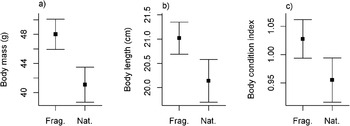
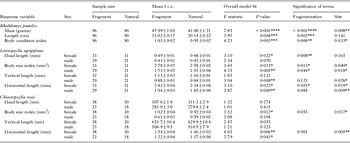
A total of 218 mice were trapped of which 125 were males and 93 females. Most of the mice (94·95%) were reproductively active. Two of the 4 paired localities had a higher relative density of R. pumilio in fragments surrounded by agricultural activity (Table 1). Total length, body mass and body condition index (BCI) values were all significantly larger for R. pumilio individuals from the fragments than the natural localities, with mass and BCI also differing significantly between pairs of sites (Fig 1; Table 2).
Mean (a) body mass, (b) body length, and (c) body condition index of Rhabdomys pumilio (n = 186) trapped in fragments (‘Frag.’) and natural areas (‘Nat.’).

Generalized linear model results testing for the effect of habitat transformation status (fragment vs natural area) on the body size of Rhabdomys pumilio (sexes combined) and the two most common flea species (sexes analysed separately)

*P < 0·05; ** P < 0·01; *** P < 0·005; **** P < 0·001.
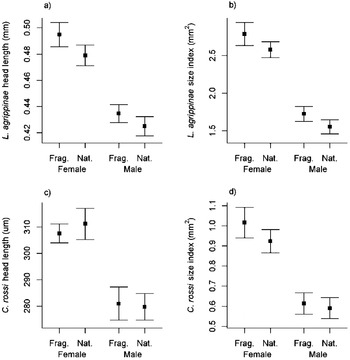
Total ectoparasite count was 8116 individuals of which 416 were fleas. The 2 most abundant fleas were L. agrippinae (n = 114) and C. rossi (n = 109), comprising more than 50% of all fleas collected. Head length, body size index and horizontal length of female L. agrippinae fleas had significantly larger values on R. pumilio trapped in fragments compared to natural localities (Table 2; Fig. 2a, b). In addition, head length, body size index and vertical length of male L. agrippinae fleas were also significantly larger on mice trapped in fragments than in natural localities (Table 2; Fig. 2a, b). In contrast, fragmentation had no significant effect on head length, body size index, vertical length or horizontal length for male and female C. rossi fleas (Table 2; Fig. 2c, d).
Mean (±95% C.I.) head length and size index of Listropsylla agrippinae (a and b) and Chiastopsylla rossi (c and d) in fragments (‘Frag.’) and natural areas (‘Nat.’).

DISCUSSION
Our results indicate that within remnant fragments in agricultural landscapes (1) R. pumilo is significantly larger and in better body condition and (2) that its associated flea species may be larger than in nearby natural areas.
Rhabdomys pumilio was the dominant rodent species in both the remnant fragments and extensive natural habitat, supporting the notion that R. pumilio is a habitat generalist (Pretorius, Reference Pretorius1993; Skinner and Chimimba, Reference Skinner and Chimimba2005; Matthee et al. Reference Matthee, Horak, Beaucournu, Durden, Ueckermann and McGeoch2007; Mugabe, Reference Mugabe2008; Froeschke et al. Reference Froeschke, Sommer and Matthee2010). The data support our prediction that mice trapped in fragments are larger and in better body condition than individuals in continuous natural areas, and are in agreement with some previous studies (e.g. Schmidt and Jensen, Reference Schmidt and Jensen2003; Fietz and Dootz, Reference Fietz and Weis-Dootz2012). Interestingly, the observed pattern also concurs with the insular theory for small mammals (Lomolino, Reference Lomolino1985; Laurance, Reference Laurance2008). In particular, the observed increase in body size that was recorded for R. pumilio supports Van Valen's rule in that smaller mammal species (<100 g) grow larger on islands (Van Valen, Reference Van Valen1973; Lomolino, Reference Lomolino1985; Morand et al. Reference Morand, Bouamer, Hugot, Morad, Krasnov and Poulin2006). Along the same lines, our study recorded higher rodent densities in some of the fragments compared to extensive natural areas. Increased host densities have been reported previously for insular small mammals, together with an increase in adult survival (potentially due to a decrease in predation risk) (Adler and Levins, Reference Adler and Levins1994). However, the above-mentioned findings are in contrast to the common prediction that animal populations within small isolated patches will encounter resource-related stress (Martínez-Mota et al. Reference Martínez-Mota, Valdespino, Sanchez-Ramos and Serio-Silva2007) and reduced immunocompetence (Anderson and May, Reference Anderson and May1978). It is probable that the benefit obtained by rodents living in the fragments is a direct result of the specific habitat characteristics of agricultural fragments, including the presence of water (farm dams and or natural streams), food (e.g. seasonal wheat surrounding the fragments) and cover (vegetation that was chopped and left in situ). These findings corroborate with previous studies that have suggested that increased levels of food intake by rodents (Püttker et al. Reference Püttker, Meyer-Lucht and Sommer2008) and the availability of water (Friggens and Beier, Reference Friggens and Beier2010) within an agricultural matrix may counter the negative effect that disturbance or fragmentation have on small mammal populations.
In this study, male and female L. agrippinae fleas were larger on rodents in habitat fragments compared to extensive natural habitats. As fleas, and other parasite taxa, depend on their host's body for food and shelter, it is expected that larger hosts can provide parasites with more space, a greater abundance of resources and potentially a more permanent habitat to utilize (Peters, Reference Peters1983; Morand, Reference Morand1996; Moore and Wilson, Reference Moore and Wilson2002; Morand and Poulin, Reference Morand and Poulin2002; Valero et al. Reference Valero, Panova, Comes, Fons and Mas-Coma2002; Poulin, Reference Poulin2007). In addition, longer-lived hosts (which are generally larger in body size) favour delayed maturation to adult stages in parasites (Sorci et al. Reference Sorci, Morand and Hugot1997). This in turn will result in a larger body size when the parasite reaches sexual maturity and higher fecundity (Sorci et al. Reference Sorci, Morand and Hugot1997; Morand et al. Reference Morand, Bouamer, Hugot, Morad, Krasnov and Poulin2006). In support of the latter, increased body size of adult female L. agrippinae fleas, in the present study, may be due to the production of larger eggs (Poulin and Morand, Reference Poulin and Morand1997), or larger egg batches (Khokhlova et al. Reference Khokhlova, Serobyan, Krasnov and Degen2009) and/or offspring (Khokhlova et al. Reference Khokhlova, Serobyan, Degen and Krasnov2010) which could all contribute to a longer body length during oviposition. Surprisingly, in the present study host sex was not a significant predictor of flea body size, despite previous results showing that fleas consume larger meals, reach a larger size and lay more eggs when feeding on male hosts (Khokhlova et al. Reference Khokhlova, Serobyan, Krasnov and Degen2009, Reference Khokhlova, Serobyan, Degen and Krasnov2010). Another factor that may have benefited L. agrippinae is the fact that R. pumilio individuals were also in better body condition in fragments compared to extensive natural areas. Indeed, controlled studies have shown that fleas benefit from feeding on well-fed rodents, resulting in improved quality and quantity of offspring (Krasnov et al. Reference Krasnov, Khokhlova, Arakelyan and Degen2005) and a shorter time to hatch and time to pupation of flea larvae (Krasnov, Reference Krasnov2008). From this study it is evident that the resources provided to the rodents in the fragments potentially buffered adverse host effects (e.g. immune response) on flea development and body size. Previous studies have noted that host immunity can influence age and size at maturity and parasite fecundity (Sorci et al. Reference Sorci, Morand and Hugot1997; Stear et al. Reference Stear, Bairden, Duncan, Holmes, McKellar, Park, Strain, Murray, Bishop and Gettinby1997; Viney, Reference Viney2002).
In contrast to L. agrippinae, C. rossi did not differ in body size between fragments and natural habitats. Although the total abundance and prevalence of the two flea species were comparable on R. pumilio, there may be life-history factors and morphological characteristics that contributed to these differences. The two flea species differ in terms of host range, preference and geographical range (Segerman, Reference Segerman1995), with C. rossi recorded from many species, including those that use complex burrow systems (e.g. Parotomys brantsii) and those with aboveground nests (e.g. Otomys irroratus and R. pumilio; Segerman, Reference Segerman1995; Skinner and Chimimba, Reference Skinner and Chimimba2005). This is in contrast to L. agrippinae that has a narrower host range and a preference for hosts that are limited to aboveground nests (R. pumilio and Otomys unisulcatus; Segerman, Reference Segerman1995; Skinner and Chimimba, Reference Skinner and Chimimba2005). It is therefore possible that the positive response recorded in L. agrippinae may be, at least partly, due to the flea being more strongly adapted to R. pumilio over evolutionary time. This suggestion is supported by a previous study that recorded a faster engorgement and blood digestion time and improved survival in a flea (Parapulex chephrenis) that feeds on a preferred rodent host (Acomys cahirinus) compared to a less preferred rodent host (Gerbillus dasyurus; Krasnov et al. Reference Krasnov, Sarfati, Arakelyan, Khokhlova, Burdelova and Degen2003). Similarly, length and width of a cestode, Paranoplocephala omphalodes, was longer and wider, respectively, in a preferred host species (Microtus miurus) compared to a less preferred host species (M. oeconomus) (Haukisalmi et al. Reference Haukisalmi, Henttonen and Batzli1995).
Differences in the level of association between the two flea species and R. pumilo may also contribute to their contrasting body size responses to fragmentation. The geographical distribution of C. rossi does not extend the full range of its preferred host species, but is rather confined to more temperate regions (Segerman, Reference Segerman1995; Skinner and Chimimba, Reference Skinner and Chimimba2005). Moreover, since C. rossi prefers hosts that use both burrows and aboveground nests, this flea may be strongly dependent on the micro-habitat provided by a host's nest (Krasnov et al. Reference Krasnov, Stanko, Miklisova and Morand2006 and references therein) and/or specific climatic conditions. This is in agreement with a previous study that noted that host-opportunistic flea species are frequently habitat- rather than host-dependent (Krasnov et al. Reference Krasnov, Shenbrot, Medvedev, Vatschenok and Khoklova1997). In contrast, the distribution of L. agrippinae does not appear to be strongly governed by climatic conditions as it occurs from hot and arid habitats to cold and misty mountainous regions (Segerman, Reference Segerman1995). These observations suggest that L. agrippinae fleas spend more time on their hosts (i.e. a ‘fur flea’) than C. rossi (a ‘nest flea’). Differences in the morphological features of the two flea species lend support to the theory that L. agrippinae is more specific to R. pumilio and spends more time on the host's body. Compared to C. rossi, L. agrippinae, have more sclerotinized spines and setae on the body and legs and a large number of ctenidia on the pronotum (30 compared to 12 for C. rossi; Segerman, Reference Segerman1995). These morphological adaptations improve the flea's attachment capability to the fur of the host and enables L. agippinae to withstand being dislodged during host grooming events (Traub, Reference Traub and Kim1985; Krasnov, Reference Krasnov2008). It is therefore possible that a closer host association (more time spent on the host's body and stronger host species preference) may explain why a positive body-size relationship was recorded for L. agrippinae but not for C. rossi. Indeed, studies have recorded positive across-species correlations between host and parasite body size for host-specific parasites (Poulin, Reference Poulin2007), this was particularly common in groups of parasites, such as lice (Harvey and Keymer, Reference Harvey and Keymer1991), fleas (Kirk, Reference Kirk1991) and nematodes (Harvey and Keymer, Reference Harvey and Keymer1991), that exhibit strong host preference and spend a larger proportion of time on the host.
It is evident from the study that fragments in agricultural landscapes can provide favourable conditions for generalist rodent species, like R. pumilio, to grow larger and improve their body condition. Consequently, closely associated ectoparasites may benefit from feeding on these better quality host individuals, especially where the host is from a preferred species. This may have consequences for parasite fecundity, burden and disease risk in agricultural fragments. This study highlights an additional adverse effect related to habitat fragmentation and provides evidence that the effect of habitat fragmentation on parasite-host relationship needs further investigation.
ACKNOWLEDGEMENTS
Financial support for the project was provided by the National Research Foundation (Grant no. FA2007031200001) and Stellenbosch University. We would like to thank Casper Crous, Jannie Groenewald, Martina Treurnicht, JV Smit, and Kira McCarthy for providing support in the field. Henk Geertsema and Joyce Segerman helped with flea mounting and identification techniques. The landowners and reserve managers are thanked for allowing us to conduct the fieldwork on their properties.