Introduction
Wheat is a staple food in Pakistan and plays a vital role in the country’s economy. It occupies 41% of the total cultivated area among the cereal crops (MINFAL 2011). The area in which wheat is cultivated consists of 9.2 million hectares with a total grain production of 25.5 million tonnes. Wheat contributed 9.9% in added value and 2% of Pakistan’s GDP during 2015 to 2016 (GOP 2015–2016).
Weed plants compete with crop plants in many ways, largely through allelopathy, acting as hosts for large number of insects, and competing for light, soil moisture, nutrients, and space (Gupta Reference Gupta2004; Qasim and Foy Reference Qasim and Foy2001). Weed interference reduces global wheat yield by 13.1% (Oerke et al. Reference Oerke, Dehne, Schönbeck and Weber1994) and may go beyond this to 17% to 50% in severe cases (Anonymous 1998). In Pakistan, yield losses are mostly attributed to intensive cropping systems, insect pests, imbalanced nutrients, low soil organic matter, poor seed quality, and weed interference. However, in the wheat crop, yield reduction is mainly due to weed interference and is dependent upon weed type, biomass, density, and duration of weed competition (Blackshaw et al. Reference Blackshaw, Lemerle, Mailer and Young2002). Moreover, the critical weed-free period for wheat plants usually ranges from 12 to 24 d after wheat seedling emergence (Agostinetto et al. Reference Agostinetto, Rigoli, Schaedler, Tironi and Santos2008).
Blessed milkthistle is a winter annual or biennial plant belonging to the Asteraceae family (Groves and Kaye Reference Groves and Kaye1989) and is widespread in cool regions of the world (Chambreau and Maclaren Reference Chambreau and MacLaren2007). It is becoming a troublesome weed, not only flourishing on roadsides, but also invading arable lands (Parsons Reference Parsons1973). Blessed milkthistle is mainly spread by seed, thus, uncleaned or poorly cleaned crop seeds could be the main source of weed seed dispersal. It tends to grow in tall dense patches that remove other plants by imposing shade or by competing for soil nutrients, moisture, and space. In addition, the vigorous and large rosette of blessed milkthistle makes this weed highly competitive in crops and pastures. However, it grows sluggishly during the seedling phase and becomes a horizontal rosette in early winter.
For effective weed management practices, knowledge about weed–crop competition period and weed threshold level for specific crops is necessary and helpful in deciding how to implement weed control measures (Cousens Reference Cousens1987; Martin et al. Reference Martin, Van Acker and Friesen2001). The specific growth stage(s) of crops at which weeds should be controlled to avoid serious yield reduction is known as the critical period of weed control (Knezevic et al. Reference Knezevic, Evans, Blankenship, Van Acker and Lindquist2002). It is a fact that weed control systems depend on critical time for weed removal (CTWR). The CTWR provides information about the maximum weed damage duration to the crop yield (Knezevic et al. Reference Knezevic, Evans, Blankenship, Van Acker and Lindquist2002). Due to abrupt changes in climatic conditions, area-specific weed control recommendations must take CTWR and weed type and intensity into consideration (Knezevic et al. Reference Knezevic, Evans, Blankenship, Van Acker and Lindquist2002; Rajcan and Swanton Reference Rajcan and Swanton2001). To our knowledge, no information about the CTWR of blessed milkthistle is available for wheat. Therefore, the present study was planned to determine the CTWR of blessed milkthistle in wheat for better management without compromising wheat crop yield.
Materials and Methods
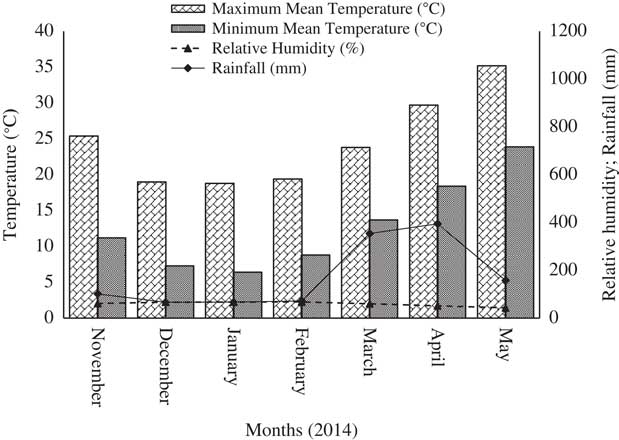
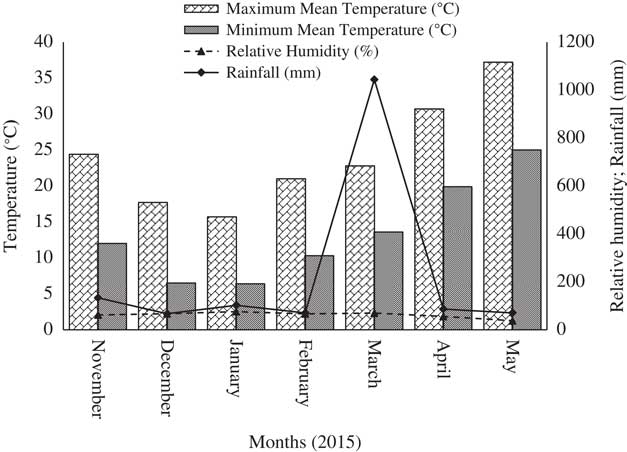
The present study was conducted at the Agronomy Research Area of the College of Agriculture at the University of Sargodha, Punjab, Pakistan, during the winter seasons of 2014 and 2015. The Agronomy Research Area is situated at 32.08°N, 72.67°E at an altitude of 193 m. In the Sargodha region, climatic conditions are subtropical semiarid with an annual rainfall of 400±5 mm. Almost 70% of the total rainfall is concentrated within the monsoon season between July and September (Agro-Metrological Lab, University of Sargodha). Average low temperatures are about 10 C in the winter. The summary of weather data during the entire crop growth period is shown in Figures 1 and 2 (2014 and 2015). In 2015, the mean maximum and minimum temperatures at the time of plant germination and tilling during December were 7% and 11% lower, respectively, than in 2014. Relative humidity in December was 1% higher in 2015, which favored the wheat growth. In 2015, the mean maximum temperature in January was 15% lower than in 2014, while the mean minimum temperature remained the same. Furthermore, relative humidity in January was 11% higher in 2015. During the crop season, monthly rainfall was lower in 2014 (795 mm) compared with 2015 (1,138 mm). Most of the rainfall occurred during the months of January, February, and March in 2015, but only in February and March in 2014. Maximum rainfall occurred in March 2015 (974 mm) and April 2014 (343 mm). Average relative humidity was lower during 2014 than 2015.
Meteorological data recorded at the College of Agriculture, University of Sargodha, Sargodha, Punjab, Pakistan, during 2014.

Meteorological data recorded at College of Agriculture, University of Sargodha, Sargodha, Punjab, Pakistan, during 2015.

The soil series of this region is Hafizabad series, and the soil texture is loam-clay loam (Khan Reference Khan1986). Other presowing physicochemical properties of the soil were recorded as electrical conductivity 2.19±0.3 dS m−1, pH 7.8±0.1, organic matter 0.72%, total N 600 mg kg−1, available P 60 mg kg−1, and exchangeable K 80 mg kg−1.
Field experiments were carried out in randomized complete block design (RCBD) with three replications and net plot size of 7 m by 3 m. The wheat (‘Punjab 2011’) was sown with a hand-operated drill using 100 kg seed ha−1 and maintaining a row–row distance of 22.5 cm. The treatments consisted of seven different competition periods of blessed milkthistle in wheat crop, including weed free, 2 wk after crop emergence (WAE), 3 WAE, 4 WAE, 5 WAE, 6 WAE, and a weedy check. The weed competition period was maintained by allowing the blessed milkthistle plants to complete with the wheat crop for 2, 3, 4, 5, and 6 wk. In addition, all weeds except blessed milkthistle were removed manually from the wheat plots during the weed competition period.
Nutrients (N:P:K) were applied at the rate of 120:100:60 kg ha−1 in the form of urea, diammonium phosphate, and muriate of potash. A full dose of phosphorus and potash and a one-third dose of nitrogen were applied at the time of planting, while the remaining nitrogen was applied in two equal doses at the stem elongation and heading stages. Wheat experimental plots were irrigated four times during the whole growing season with 7.5 cm at each irrigation. The four irrigations were applied at the crown root initiation, stem elongation, heading, and grain-filling stages.
At physiological maturity, wheat plant height was determined by averaging the height of 10 randomly selected plants from each plot. Number of productive tillers per square meter and spikes per square meter were recorded from a 1-m2 area at three different locations in each plot. Number of grains per spike was recorded by harvesting 10 spikes from each plot when crop was fully matured, and then by counting the number of wheat kernels in each spike, after which the average number of grains per spike was calculated. Each plot was manually harvested using a sickle on May 12, 2014, and May 9, 2015. After the whole plot was threshed, the 1,000-grain weight was recorded by manually counting the number of seeds. Grain yield per plot was converted into megagrams per hectare. Similarly, the vegetative yield of wheat plants was measured on a per-plot basis at the crop harvesting stage and then converted into megagrams per hectare.
Data were statistically analyzed using Fisher’s ANOVA technique, and variation among the treatment means was compared using LSD at a 5% probability level (Steel et al. Reference Steel, Torrie and Dicky1997). The MSTAT-C statistical package (Freed et al. Reference Freed, Eisensmith, Goetz, Reicosky, Smail and Wolberg1991) was used to analyze the 2 yr of data (2014 and 2015) in RCBD combined over years. As the effects in different years were found to be significant, as shown by year by weed period for competition interaction, the data are presented for individual years. Graphs were created using SigmaPlot software (Systat Software 2008). To measure the effect of prolonged blessed milkthistle competition period on relative grain yield of wheat, a three-parameter logistic equation was used. By the iterative use of the NLIN procedure in SAS (SAS Institute 2008), in line with the Knezevic et al. (Reference Knezevic, Evans, Blankenship, Van Acker and Lindquist2002), parameters of nonlinear regression were as follows
 $$Y{\equals}\left( {\left( {1\,/\,\left( {{\rm EXP}\left( {{\rm K}{\times}\left( {{T}{\minus}{X}} \right)} \right){\plus}{\rm F}} \right)} \right){\plus}\left( {\left( {{\rm F}{\minus}1} \right)\,/\,{\rm F}} \right)} \right){\times}{\rm }100 $$
where Y is the relative wheat grain yield (percent season-long weed-free control) and T is time in weeks after crop emergence (WAE), while K and F are constants, and X is the point of inflection (WAE) (Knezevic et al. Reference Knezevic, Evans, Blankenship, Van Acker and Lindquist2002).
Results and Discussion
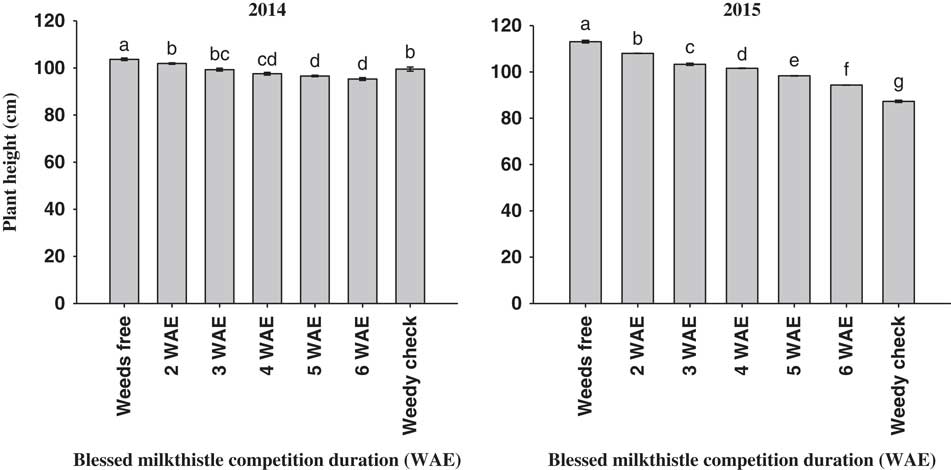
Blessed milkthistle competition affected (P<0.05) wheat plant height (Figure 3). Plant height was reduced each year in 2014 and 2015 as the duration of competition increased. The maximum wheat plant height was observed in weed-free plots, which may be attributed to greater availability of water and nutrients to plant roots resulting in vigorous plant growth. Among the weed competition period treatments, maximum tall plants (104 cm) were recorded at 2 WAE compared with other treatments. Minimum plant heights were observed in weedy check and 6 WAE treatments. This might be due to more competition for nutrients, space, light, and water. Our findings conflict with the results of Alford et al. (Reference Alford, Stephen and Jack2004), who stated that plant height was not influenced by duration of weed competition. These opposing results might be due to differences in agroecological conditions. Similar results were observed in the 2015 wheat crop growing season, but the plants in 2015 were taller compared with the plants in 2014. A possible cause may have been higher rainfall and lower mean maximum and minimum temperatures in the month of January (Figures 1 and 2) compared with 2014.
Plant height of wheat as influenced by different blessed milkthistle competition duration at 5% probability. Means separated by lowercase letters in each bar are significantly different among WAE at P ≤ 0.05. WAE, weeks after crop emergence.

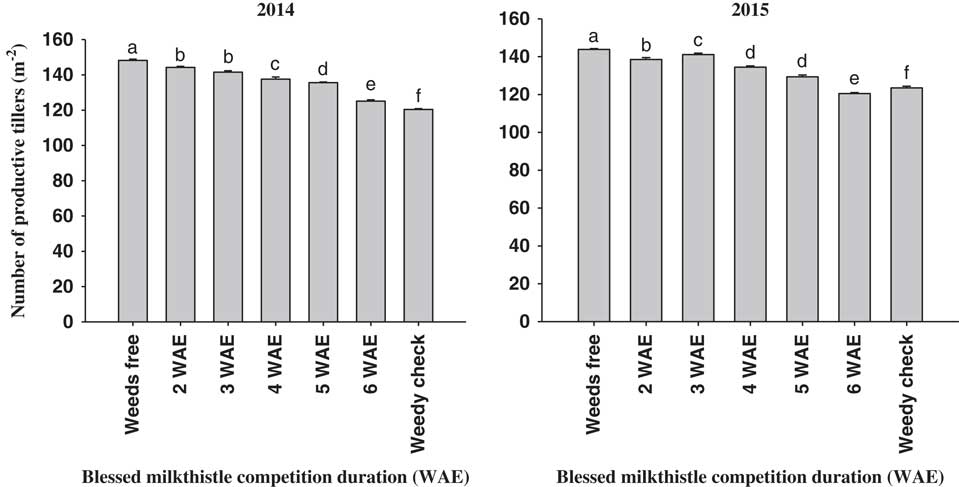
The number of productive tillers per square meter is the crucial yield-determining factor and is influenced by available resources, presence of weed plants, and environmental conditions. Data related to productive tillers per square meter in the 2014 wheat growing season (Figure 4) indicated that the number of productive tillers per square meter varied with change in duration of crop–weed competition (P<0.05). The results of both wheat growing years (2014 and 2015) showed that the number of productive tillers per square meter decreased as the blessed milkthistle competition period in wheat crop increased. Hence, the maximum number of productive tillers per square meter (144 and 148 in 2014 and 2015, respectively) were attained in weed-free treatments but significantly reduced at 2 WAE of blessed milkthistle competition period in wheat crop plants. Similarly, the minimum number of productive tillers per square meter (124 and 120 in 2014 and 2015, respectively) was found in weedy check plots. Moreover, wheat and blessed milkthistle coexistence throughout the wheat growth period (weedy check) reduced the number of tillers by 14% and 19% compared with weed-free plots during the first and second year of the study, respectively. The increase in the number of productive tillers with decreasing competition period supports the fact that weed existence in wheat crop plants deprived wheat plants of vital inputs and resources from early wheat growth phases, resulting in poor crop growth and development (Irshad Reference Irshad2000). Our results supported the findings of Coleman and Gill (2003), who reported that the increase in competition duration resulted in a 15% to 20% reduction in the number of productive tillers per square meter.
Number of productive tillers per square meter of wheat as influenced by different blessed milkthistle competition duration at P<0.05. Means separated by lowercase letters in each bar are significantly different among WAE at P ≤ 0.05. WAE, weeks after crop emergence.

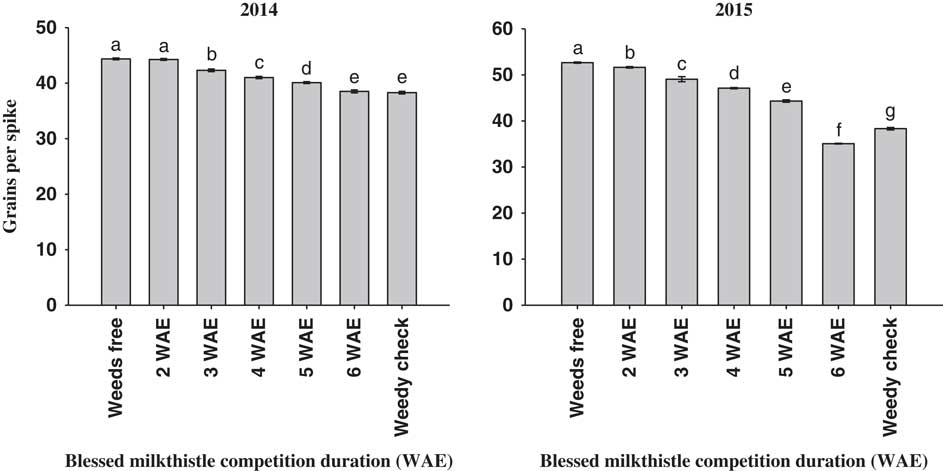
The number of grains per spike has a key role in grain yield of wheat. Competition duration of wheat with blessed milkthistle affected (P<0.05) the number of grains per spike (Figure 5). A decrease in grains per spike was observed with an increase in competition duration with blessed milkthistle in both years of the study. Wheat produced the highest number of grains per spike in the weed-free environment (44 and 53 in 2014 and 2015, respectively), results that were 16% and 42% higher than the weedy check treatment in 2014 and 2015, respectively. However, 2 wk of weed competition did not reduce the number of grains per spike compared with the weed-free treatment in 2014, while in 2015, significant reduction in this parameter started to occur from blessed milkthistle competition duration of 2 WAE.
Grains per spike of wheat as influenced by different blessed milkthistle competition duration at P<0.05. Means separated by lowercase letters in each bar are significantly different among WAE at P≤0.05. WAE, weeks after crop emergence.

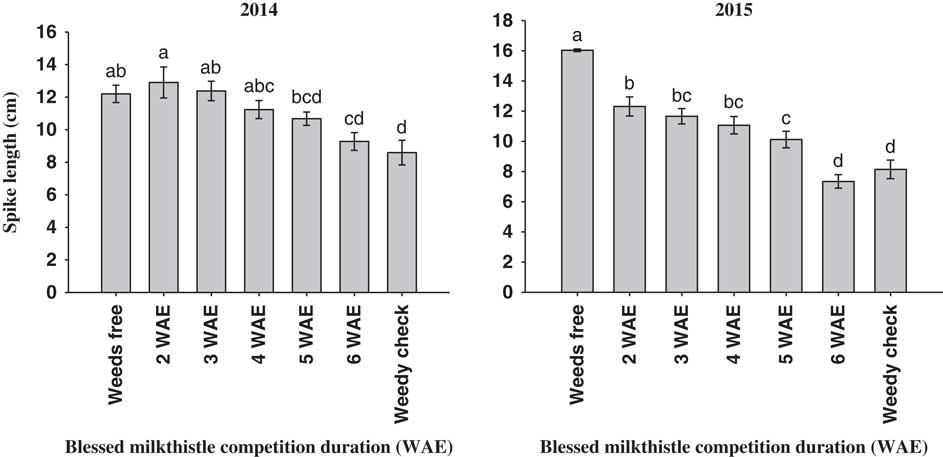
An increase (P<0.05) in spike length was recorded with a decrease in competition duration in both years of the study (Figure 6). Averaged over years, the longest spikes (14.5 cm) were recorded where there was no weed competition. Weed competition throughout the growth period (weedy check) reduced the spike length by 43% compared with the weed-free treatment. Continuously favorable temperatures and rainfall (Figure 2) during 2015 may have improved the fertilization and spike length compared with 2014.
Spike length (cm) of wheat as influenced by different blessed milkthistle competition duration at P<0.05. Means separated by lowercase letters in each bar are significantly different among WAE at P≤0.05. WAE, weeks after crop emergence.

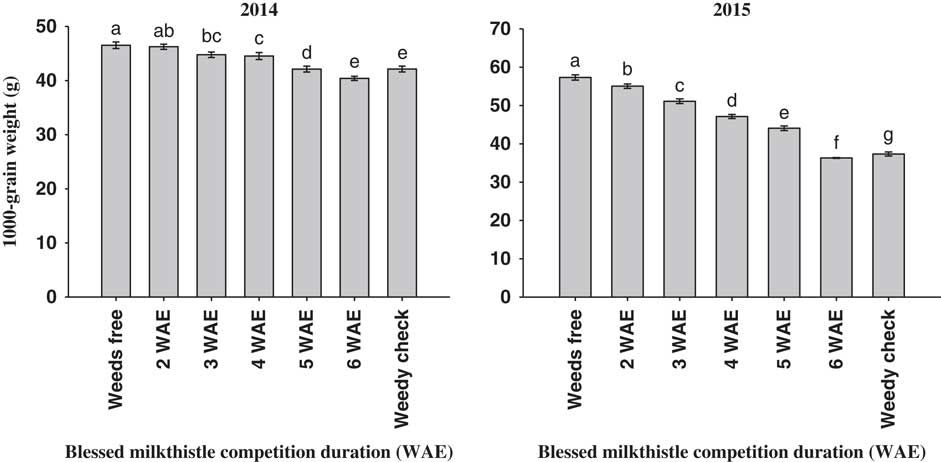
In addition to all other yield components, the final grain production of a grain crop relies on 1,000-grain weight. Any change in the 1,000-grain weight will affect the grain yield. The 1,000-grain weight decreased as the weed remained in the field for a longer time (Figure 7). Heaviest (P<0.05) 1,000-grain weights (47 and 57 g in 2014 and 2015, respectively) were recorded from the weed-free treatment, although competition duration of 2 WAE did not statistically reduce 1,000-grain weight (46 and 55 g in 2014 and 2015, respectively). On average, weed competition for 6 WAE reduced the 1,000-grain weight by 27% from that produced under weed-free conditions. The decreasing trend in 1,000-grain weight with increase in competition duration might be due to competition for nutrients, water, light, and so on. Our results support the findings of Khan et al. (Reference Khan, Hassan and Ihsaullah2007), who also found a similar competitive effect on 1,000-grain weight in competition with different weeds. Decrease in leaf area index and crop growth rate could be the reason for low 1,000-grain weight in treatments where weeds competed with wheat for a longer duration. Reduction in wheat seed weight due to weed infestation was also reported by Johnson et al. (Reference Johnson, Hoverstad and Greenwald1998). Maximum rainfall and lower mean maximum temperature (Figure 2) in 2015 may have improved the grain weight compared with 2014 (Figure 1).
The 1,000-grain weight (g) of wheat as influenced by different blessed milkthistle competition duration at P<0.05. Means separated by lowercase letters in each bar are significantly different among WAE at P≤0.05. WAE, weeks after crop emergence.

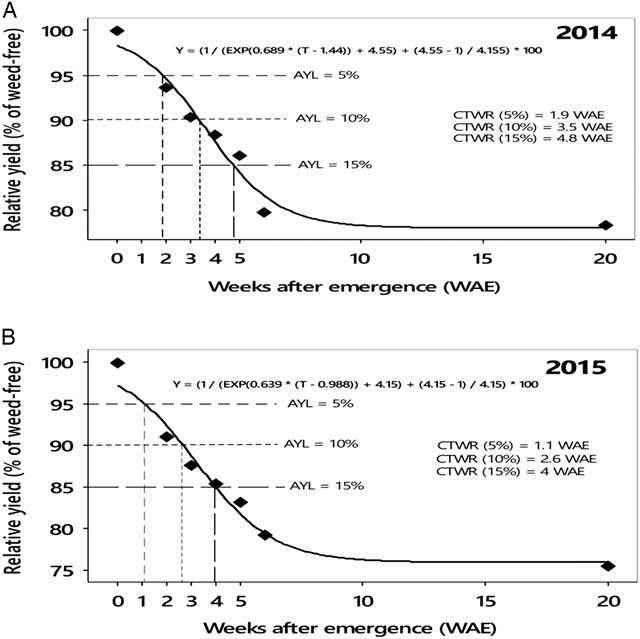
Data related to grain yield (Figure 8A and B) indicated an effect based on the competition duration of wheat with blessed milkthistle. Like yield contributing parameters, grain yield was decreased (P<0.05) by blessed milkthistle. Weed-free treatments produced the highest grain yield, 5 Mg ha−1, in both 2014 and 2015. However, a significant decline in grain yield of wheat did not occur with blessed milkthistle competition up to 3 WAE (P<0.05). This fact is of importance in blessed milkthistle management strategies. The maximum wheat grain yield losses of 22% and 25% during the years 2014 and 2015, respectively, were recorded by imposing a blessed milkthistle competition period throughout the crop growing period. Our findings corroborate the results of Ansar et al. (Reference Ansar, Shahzad, Nasim, Musa and Shahid1996); Kumar and Sundari (Reference Kumar and Sundari2002) recorded linear decline in grain yield of maize (Zea mays L.) with prolonged weed competition period and attributed the reduction to yield-determining traits. Coleman and Gill (2003) also reported that yield losses increased with the increase in competition duration, which was associated with reduced crop plant density.
Logistic model showing relative grain yield of wheat at different blessed milkthistle competition durations during 2014 (A) and 2015 (B). The critical time for weed removal (CTWR) to achieve 5%, 10%, and 15% of acceptable yield loss (AYL) are provided.

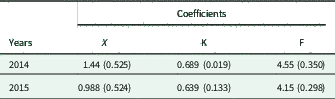
The logistic model showed that relative grain yield of wheat was the best fit for blessed milkthistle competition period during both years (Figure 8A and B), which means that there was significant effect of weedy periods on wheat grain yield. Table 1 presents the coefficients for three parameters that have been used for fitting the logistic model. The model depicted the CTWR of blessed milkthistle in wheat to avoid 5%, 10%, and 15% losses in its grain yield to be 1.9, 3.5, and 4.8 WAE in 2014; and 1.1, 2.6, and 4 WAE in 2015. Safdar et al. (Reference Safdar, Tanveer, Khaliq and Maqbool2016) estimated that CTWR of ragweed parthenium (Parthenium hysterophorus L.) to prevent 5% and 10% grain yield reduction in autumn-sown maize was 8 to 13 and 13 to 23 d after emergence, respectively.
Coefficient estimates used to determine the effect of timing of weed removal on relative wheat yield using a logistic model.a

a Data fit to equation, where X is the point of inflection (weeks after crop emergence), and K and F are constants.
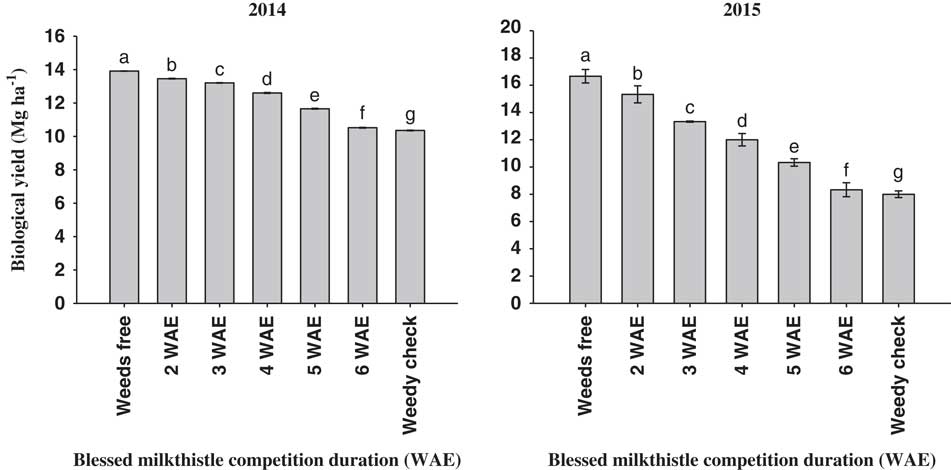
Stalk yield and grain yield are collectively called “biological yield” and vary with environmental conditions and crop management practices. Data revealed that biological yield was affected by competition period (Figure 9). A significant (P<0.05) increase in biological yield was recorded with decreased competition duration with blessed milkthistle in both years. On an average over both years, blessed milkthistle coexistence decreased the wheat yield by 38%. However, competition of 2 WAE did not reduce the biological yield of wheat significantly compared with weed-free wheat. Blessed milkthistle started decreasing biological yield when coexistence exceeded 2 wk. Our results are similar to the findings of Armin et al. (Reference Armin, Noormohammadi, Zand, Baghestani and Darvish2007), who stated that increase in weed competition duration shows a negative effect on biological yield. During 2015, favorable weather conditions (Figure 2) and timely rainfall lowered the mean maximum temperature, which may have improved crop growth and development compared with 2014 (Figure 1).
Biological yield of wheat as influenced by different blessed milkthistle competition duration at P<0.05. Means separated by lowercase letters in each bar are significantly different among WAE at P≤0.05. WAE, weeks after crop emergence.

The consolidated results of 2 yr of research showed that duration of competition of blessed milkthistle with wheat could reduce wheat yield by 21% to 24%. The logistic model prescribed a period of 1 to 5 wk to be the CTWR of blessed milkthistle in wheat to avoid 5% to 15% losses in given yield of wheat, which means wheat growers should control this weed during this period. Blessed milkthistle at its later growth stages offered more competition to crop. However, based on the outcome of this experiment, we concluded that control measures against blessed milkthistle should be adopted during 1 to 5 wk of crop emergence to prevent substantial grain yield reduction.
Acknowledgments
The authors of this article are thankful to the Higher Education Commission, Islamabad, Pakistan, for their funding for this study. No conflicts of interest have been declared.