Introduction
In what is now regarded as a classical text, Wilensky (Reference Wilensky1975) argued that economic growth is an overriding source of social policy development. Although Wilensky did not refer to the global and economic South, his argument becomes pertinent for revisiting explanations to welfare development in countries located in Southeast Asia. For the last two decades, arguments highlighting the distinctiveness of the ‘productivist’ welfare regime (Holliday, Reference Holliday2000) and the ‘developmental’ welfare state (Kwon, Reference Kwon2005), attempted to conceptually express how achieving high economic growth (1970-97) in East and Southeast Asia coincided with an intense development of social protection policy. These accounts, however, were soon tested by the 1997-Asian financial crisis (AFC), which revealed how far economic growth and economic austerity influenced social policy development in East and Southeast Asia. Several studies, (e.g. Croissant, Reference Croissant2004; Gough, Reference Gough, Gough, Wood, Bevan, Barrientos, Davis and Room2004a; Kwon, Reference Kwon2005; Sumarto, Reference Sumarto2017) identified the AFC as a predominant driver of welfare regime change in East and Southeast Asia.
This article aims at complementing Gough’s (Reference Gough, Gough, Wood, Bevan, Barrientos, Davis and Room2004a) work on ‘East Asia: the limits of productivist regimes’, through a comparative and historical exploration of welfare regime change in the cases of Indonesia, Malaysia and Thailand, as they similarly experienced high economic growth and were correspondingly affected by the AFC. However, their response to the AFC differed leading to different forms of political-economic instability. To understand the development path of these welfare regimes, the article utilises the path dependence approach, which explores the importance of sequence and timing (Pierson, Reference Pierson2000), such as historical-colonial legacy in the development of welfare regimes.
The article also intends to complement Gough’s understanding of security by revisiting the concept of ‘ontological security’ coined by Giddens (Reference Giddens1984, Reference Giddens1991) to demonstrate how the concept of security is interconnected with welfare regime development and can constitute a very meaningful loop for explaining welfare regime change. The article argues that to understand welfare regime change in these three cases, we need to consider the different experiences of colonisation, their legacies, economic austerity and political-economic stability as influential and determining factors of welfare regime development and security. Reflecting upon the analytical findings, the article then concludes with how each welfare regime experienced a change in their welfare development path and how far the regime change effectively represents new forms of welfare regime typologies.
In the next section, I briefly present a theoretical overview of Gough’s (Reference Gough, Gough, Wood, Bevan, Barrientos, Davis and Room2004a) approach and identify how an extended notion of security can help us better capture welfare regime change.
Welfare regime change and security – a conceptual discussion
The discussion of welfare regime in the Global South, covering Africa, Asia, and Latin America is highly indebted to Gough et al.’s publication (Gough et al., Reference Gough, Wood, Bevan, Barrientos, Davis and Room2004), which provides a holistic global map of welfare regimes in these continents. The term ‘welfare regime’ refers to a set of policies, institutional arrangements, and practices which affect welfare outcome and stratification in society (Gough, Reference Gough, Gough, Wood, Bevan, Barrientos, Davis and Room2004b). In the Global South, the welfare mix relies excessively on family and community instead of state and private corporations, the latter a characteristic of welfare state regimes in the Global North. In turn, the regime in the Global South can be divided into two categories: informal-security and insecurity welfare regimes (Gough, Reference Gough, Gough, Wood, Bevan, Barrientos, Davis and Room2004b).
The informal-security regime refers to an institutional arrangement where community and family play an important role in welfare provision (Wood and Gough, Reference Wood and Gough2006), while the insecurity regime demonstrates significant levels of tension and conflict which generate insecurity and impede the emergence of informal arrangements to counter social risk and insecurity. The ‘informal security regime’ comprises the productivist and liberal-informal regime (Gough, Reference Gough, Gough, Wood, Bevan, Barrientos, Davis and Room2004b). The central characteristics of the productivist welfare regime is the subordination of social policy to economic objectives, including economic growth (Holliday, Reference Holliday2000) where government’s spending for social programmes is intended to support industrialisation (Croissant, Reference Croissant2004). The main feature of liberal-informal regimes is that the delivery and funding mechanisms of welfare provision often comprise methods recommended by liberal-global institutions giving precedence to market actors and prescribing public programmes to alleviate poverty and stark inequalities (Wood and Gough, Reference Wood, Gough, Gough, Wood, Bevan, Barrientos, Davis and Room2004).
Gough (Reference Gough, Gough, Wood, Bevan, Barrientos, Davis and Room2004a) argued that productivist welfare regimes such as those identified in Indonesia, Malaysia, Thailand, and South Korea would be likely to more or less follow a similar development path and gradually shift to a regime which combines ‘liberal’ and informal characteristics (hereafter termed as liberal-informal regime). Gough also believed that there was another potential trajectory of change, i.e. toward a more-universalist social investment state with Gough suggesting that the highest likelihood of the trajectory was on the liberal-informal regime.
This bifurcated path offers the opportunity to explore how far historical and recent welfare regime developments in Indonesia, Malaysia and Thailand followed any of these two paths. Gough (Reference Gough, Gough, Wood, Bevan, Barrientos, Davis and Room2004b) put both the productivist and liberal-informal regime under a wider welfare regime classification, which concerns how ‘security’ can be achieved highlighting the importance of informal practices. The classification of ‘informal security’ was thus an attempt to distinguish between advanced welfare state regime and insecurity welfare regimes. There was however, limited explanation on the implication of welfare regime change towards ‘security’.
The concept of security is closely interconnected with the term risk (Giddens, Reference Giddens1991; Beck, Reference Beck, Adam, Beck and Loon2005, Reference Beck2009). Risk, which represents a transitional condition between security and destruction, occurs when trust in security and belief in progress in society does not exist any longer (Beck, Reference Beck, Adam, Beck and Loon2005). Risk denotes potential threats and uncertainty for which society mobilises its resources to cope (Beck, Reference Beck2009). Risk can be divided into two categories: old and new risks in which the former can relate to industrial accidents and wars, and the latter can relate to global financial crises, climate change and suicide attacks (Beck, Reference Beck2009).
In this context, efforts to reduce risk are seen as an important element to achieve security (Giddens, Reference Giddens1991). To do this, it is not just at the level of providing minimum guarantees of welfare provision but to what Giddens (Reference Giddens1984: 375) describes as ‘ontological security’, i.e. the ‘[c]onfidence or trust that the natural and social worlds are as they appear to be’. An important measure to achieve security is labour market access, and, conversely, obstruction to labour market entry may cause insecurity (Gough, Reference Gough, Gough, Wood, Bevan, Barrientos, Davis and Room2004b). Concurrently, disruption, instability, and attack may cause routine social life to become unpredictable and lead to increasing insecurity (Giddens, Reference Giddens1984).
The increasing levels of serious risk poses significant challenges to economic and political institutions and how the latter can reduce risk to avoid exposure and generation of insecurity. The regime change in the Global South is more complicated than the change in the welfare state regime, as the welfare mix in the Global South involves more intricate elements. This therefore requires us to explore path dependence (Pierson, Reference Pierson2000) and institutional change (Mahoney and Thelen, Reference Mahoney, Thelen, Mahoney and Thelen2015; Beland and Powell, Reference Beland and Powell2016) not only in the role of public welfare provision but also in the role of the family and community as an informal-collective welfare provider and economic actor (see Papadopoulos and Roumpakis, Reference Papadopoulos and Roumpakis2017).
Determining factors of welfare regime development and security
The next sections explore the determining factors of welfare regime development and how risk and security are sizably affected by historical institutional legacies, economic crisis and political-economic stability.
Historical institutional legacies: the impact of colonisation
Historical institutional legacies, particularly for the selected cases the importance of colonial inheritance, considerably affected social-economic policies and national politics (Rock, Reference Rock2017; Croissant and Lorenz, Reference Croissant and Lorenz2018; Ruland, Reference Ruland2018). State and welfare institutional building is a process that is paramount for offering protection from social-economic risks and often little has been offered in the relation between welfare regime and colonisation legacies and practices (Ruland, Reference Ruland2018).
The Dutch colonial government, which colonised Indonesia for about three-and-a-half centuries, did not equip Indonesia with state institutions and governing capacity to facilitate economic development and political stability. To build a functional state mechanism and government, Indonesian leaders rushed in writing a short constitution (Croissant and Lorenz, Reference Croissant and Lorenz2018) without any assistance from the Dutch colonisers (Rock, Reference Rock2017). Due to this rush, some important issues including social policy, were not covered by the constitution.
Unlike Indonesia, Malaysia which got independence from the British colonial government in 1957, experienced a less exploitive colonial government as the latter facilitated economic growth (e.g. agriculture, rubber) and even trained Malay aristocrats for public services (Rock, Reference Rock2017). The British colonial forces facilitated a transition to an independent Malaysia by assisting state and institutional development. In 1956, the British colonial regime assisted Malaysia in drafting their constitution (Croissant and Lorenz, Reference Croissant and Lorenz2018) which is much more comprehensive than the Indonesian constitution. The British colonial forces also helped Malaysia in drafting a development plan, which focused on welfare policy, infrastructure, and industrialisation (Lee and Chew-Ging, Reference Lee and Chew-Ging2017). The stark differences in state and institutional development between Indonesia and Malaysia need to be taken into account especially as the latter had already institutionalised and enshrined a list of key, albeit fragmented, public welfare provision in its constitution.
Thailand did not experience any colonisation but, like Malaysia, Thailand developed a healthcare system, learning from the West. Prior to the bloodless coup in 1932, which brought Thailand to a constitutional monarchy, Thailand was an absolute monarchy (Rock, Reference Rock2017; Croissant and Lorenz, Reference Croissant and Lorenz2018). The fundamental historical legacy which influenced the development of Thai healthcare arose during the absolute monarchy, as King Chulalongkorn (1868–1910) developed Western-style healthcare (McGuire, Reference McGuire2010). In Thailand, the driver for welfare expansion was not thus driven by colonial forces but by an authoritarian regime which echoed similar accounts of early welfare state development in Continental Europe (Ebbinghaus, Reference Ebbinghaus and Palier2010). This took place at the same time as a politico-economic revolutions conducted by the King in 1870 aimed to secure the sovereignty of the monarchy from a threat of Western imperialism, i.e. Britain and France (Croissant and Lorenz, Reference Croissant and Lorenz2018). Soon, after entering the constitutional monarchy, the King consistently legislated several important health policies, such as doctor schemes, disease control, and rural health facility construction. These provided key technical and institutional bases for a series of healthcare reforms with scholars identifying their long-lasting importance in respect to citizens’ social rights in the 1997-Thailand constitution (e.g. McGuire, Reference McGuire2010). With this constitution, Thailand embedded the legislation for Universal Health Coverage (UHC) in 2001.
Economic development and crisis: the importance of timing
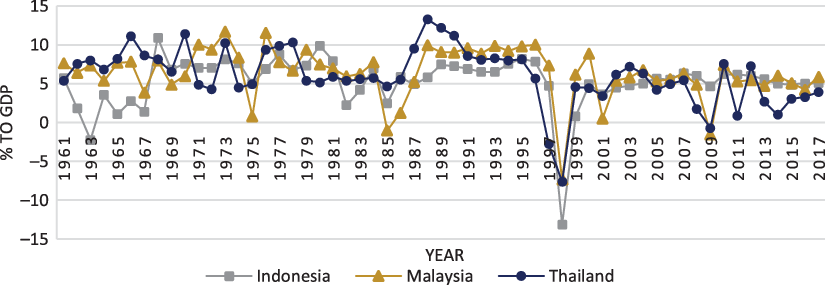
During the post-colonial period, Indonesia, Malaysia, and Thailand experienced a ‘miracle economy’ as they achieved flourishing economic development, shown by high economic growth. Figure 1 shows that Indonesia enjoyed economic growth from 1968 to 1997, while both Malaysia and Thailand experienced growth acceleration from the 1950s, fifteen years earlier compared to Indonesia. This high economic development performance rendered these countries as part of the nine fastest growing economies (Rock, Reference Rock2017). However, this economic performance came to an abrupt end for all three cases included here due to the AFC.
GDP trend in Indonesia, Malaysia, and Thailand, 1961-2017 (annual per cent).

The AFC was an important critical juncture of welfare regime development for the region partly as it exposed the social-economic vulnerability of the productivist welfare regime but also because it acted as a trigger of welfare reforms. The AFC started in Thailand in May 1997 and caused the collapse of Thai Baht, Malaysian Ringgit and Indonesian Rupiah. This led to an economic decline of 16 per cent in Indonesia, 10 per cent in Malaysia, and 12 per cent in Thailand (Gough, Reference Gough, Gough, Wood, Bevan, Barrientos, Davis and Room2004a). These economic difficulties caused bankruptcy to enormous private corporations leading to complicated problems of unemployment and poverty. Consequently, from 1996 to 1998, the poverty rate in Indonesia almost doubled (from 11.3 per cent to 20.3 per cent), while increases in Malaysia and Thailand were up 2.2 percentage points (from 8.2 to 10.4 per cent) and 1.5 percentage points (from 11.4 per cent to 12.9 per cent) respectively (Ramesh, Reference Ramesh2009). The AFC demonstrated how important was the historical legacy of institutionalising and enshrining public commitment to welfare provision in constitutions (or the lack of it in Indonesia) as evidenced by the disproportionate differences in poverty increases in Indonesia vis-a-vis Malaysia and Thailand in the aftermath of the AFC.
Given the extent of the economic downturn and increase of poverty rates, the responses of the three welfare regimes differed. Indonesia, which suffered the most problematic economic downturn, entered a loan agreement with the International Monetary Fund (IMF) and the World Bank (WB). Similar to Indonesia, Thailand went to the IMF and the WB to receive loan payments, while Malaysia did not opt for any financial support. The different responses caused different consequences in political-economic reforms and the provision of social safety nets. Both of these aspects are discussed in the next two sections.
Political-economic stability
The AFC and the dramatic economic austerity that followed, led to political instability and significant welfare reforms, which resulted often in social unrest. Prior to the AFC, Indonesia coped with political instability particularly during the President Soekarno period as the nation was just founded and had to deal with war to defend from the Dutch re-colonisation. In comparison to Indonesia, Thailand and Malaysia were more stable. Between the end of the Second World War and the AFC, Malaysia did not experience any war or political turmoil. Thailand underwent a series of coups since it entered constitutional monarchy in 1932.
In Indonesia, the AFC caused severe political turbulence which was triggered by two events, i.e. radical political-economic reform under the structural adjustment programme and the chaotic fall of President Soeharto (1966-98). Under the adjustment programme, as a conditionality for borrowing from IMF and WB, Indonesia introduced a series of big-bang reforms comprising liberalisation, privatisation, banking reforms and decentralisation (Sumarto, Reference Sumarto2017). From 1998-2004, the government privatised state-owned enterprises at a fast pace and magnitude. Concurrently, Indonesia closed and merged forty-one banks. A significant decentralisation reform was accompanied by chaotic student demonstrations, violence against minority groups, and riots calling for Soeharto’s resignation which resulted in numerous deaths, missing persons and infrastructure damages (O’Rourke, Reference O’Rourke2002).
Malaysia suffered from less-complicated political turmoil (Ramesh, Reference Ramesh2009). In 1998, the Malaysian government merged thirty-nine banks into six anchored banks (Cook, Reference Cook2003). The reforms were not a requirement of any loan agreement and soon sparked domestic political rivalry amidst social tension, for the future of country’s economic and political direction. The turmoil started when Prime Minister Mahathir fired Anwar Ibrahim from his position of deputy prime minister and minister of finance. Anwar’s fall attracted a series of chaotic protests from civil society organisations and opposition parties (Croissant and Lorenz, Reference Croissant and Lorenz2018). Anwar’s wife founded a new political party, organising political movement against Mahathir. However, these all were not able to bring Mahathir’s rule to an end; even in 1999, Mahathir won national elections (Haggard, Reference Haggard2000).
Similar to Indonesia, Thailand signed a loan agreement and, consequently, implemented a structural adjustment programme, which occurred simultaneously with constitutional reform leading to a political-economic uncertainty. Under the adjustment programme, the Thai government closed fifty-six banks. The government planned to conduct privatisation but this did not occur due to limited government commitment for privatisation (World Bank, 2006). At the time, a serious debate was taking place on a complicated constitutional reform. Army, judges and senators refused the constitutional change, but civil society organisations and reformist groups supported the reform. The constitution draft was disseminated to get feedback from the public when the AFC began and was approved by the National Assembly in September 1997 (Haggard, Reference Haggard2000). Soon after the constitution was declared at the height of the AFC, in October, Prime Minister Chavalit stepped down. The 1997-constitutional reform along with the AFC brought a democratic regime to office, where Chuan Leekpai served as the prime minister (Croissant and Lorenz, Reference Croissant and Lorenz2018).
It is important to note here that the AFC was a critical juncture for the development of welfare regimes in the region. The AFC cannot only be reduced to economic measures and reforms but also extends to the political sphere and in particular exposed the different responses to economic and social insecurity. The role of international actors, especially those who were able to exercise power over the direction of economic and social reform such as the IMF and the WB meant that there would be even less room for national governments to extend and expand the role of public welfare provision. However, as the next section shows, there were important reforms that aimed to address the increasing levels of risk and insecurity.
The development of social protection programmes
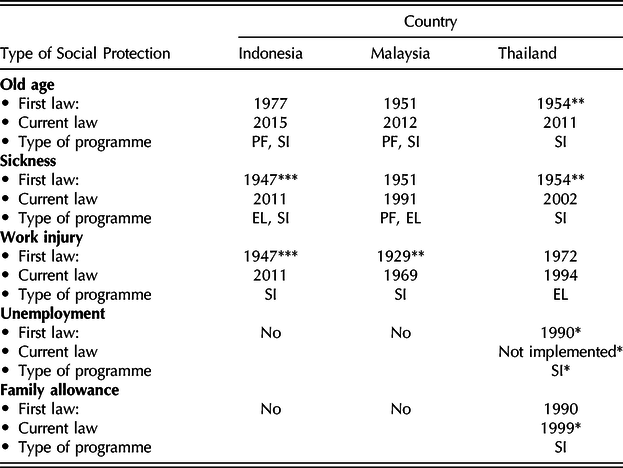
In order to better grasp and fully account the diversity and complexity of welfare provision available in the selected countries, we need to focus on three welfare reform categories, i.e. formal sector, informal sector, and ‘for all’. Table 1 and Figure 2 provide a general picture of the development of social protection programmes. The Table is also important to comparatively show the enactment years of the first laws of the social protection to understand the importance of historical legacies and the contemporary and most recent reforms that have taken place.
Origins, types, and legal basis of social protection programmes

Notes: EL : employer liability; PF : provident fund; SI : social insurance.
Source: Social Security Administration, 2017: 100-252; *: Croissant, Reference Croissant2004; **: Hort and Kuhnle, Reference Hort and Kuhnle2000; ***: Sumarto, Reference Sumarto2017.
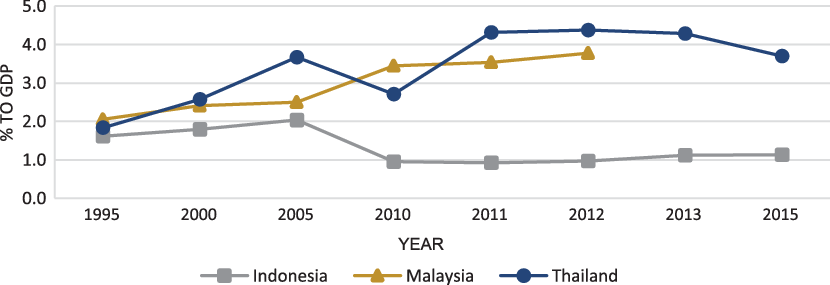
Government social protection expenditure (per cent of GDP).

Indonesia introduced the first social protection, i.e. injury and sickness benefits for formal workers working in state-owned enterprises and private corporation, during the Soekarno presidency, in 1947. This was followed by the initiation of health insurance for both private and public workers and other schemes specifically for civil servants. The risk of insecurity and poverty was high at the time but the Indonesian government was not able to bring the programme into existence as the Soekarno administration was constrained by serious economic austerity. Most of Soekarno’s plans for social protection policy were materialised by his successor Soeharto and only once Indonesia experienced economic growth (Sumarto, Reference Sumarto2017; Sumarto and Kaasch, Reference Sumarto and Kaasch2018).
Malaysia’s British style of social protection institution is more advanced than that of Indonesia. The Malaysian government introduced the first social protection, i.e. employment injury insurance in 1929, under the guidance of colonial administration (Hort and Kuhnle, Reference Hort and Kuhnle2000). This insurance programme was renewed in 1969, under a government agency called Social Security Organisation, which provided an injury scheme (Chua and Cheah, Reference Chua and Cheah2012). In 1951, the government enacted the Employee Provident Fund Act which mandated both employer and employee to finance an old-age pension provident fund for public and private workers. In 1991, the Act was replaced with the new Provident Fund Act. The new Act provided an authority for the employee provident fund, which serves as a federal statutory body, to manage the contributory retirement scheme (Hort and Kuhnle, Reference Hort and Kuhnle2000).
Thailand introduced the first law in social protection, i.e. Social Security Act during Khuang administration in 1954 but this has not been implemented in practice. The current legislation was replaced by the new one in 1990. The implementation of the 1990-social security act, however, was postponed until 1998 (Hort and Kuhnle, Reference Hort and Kuhnle2000). The act provides relatively comprehensive benefits covering free medical care, pension, child, and death benefits (Hort and Kuhnle, Reference Hort and Kuhnle2000; Gough, Reference Gough, Gough, Wood, Bevan, Barrientos, Davis and Room2004a). These efforts put Thailand as the harbinger of social protection policy in Asia (Hort and Kuhnle, Reference Hort and Kuhnle2000).
Moving aside from formal social protection, the informal sector is a key area for both Indonesia and Thailand as the percentages of the informal labour force remain until recently about 76.47 per cent and 51.42 per cent respectively (World Bank, 2019b). Indonesia and Thailand initiated a social safety net programme for the poor, most of whom were working in the informal sector, in 1998, to mitigate the economic shock caused by the AFC and structural adjustment programme. The Indonesian social safety net covered health insurance, subsidised rice, scholarship, labour-intensive public work programme, grants for selected communities targeted on the poor (Sumarto, Reference Sumarto2017). Thailand’s social safety net initiative comprised job creation programme, training for the unemployed, low income health insurance, scholarship for the poor and subsidised bus and rail fares. Concurrently, Malaysia provided a social safety net covering training for the unemployed citizens (Haggard, Reference Haggard2000), food and fuel price subsidies, micro-credit for small entrepreneurs and education funds (Ramesh, Reference Ramesh2009). However, unlike those of Indonesia and Thailand, the Malaysian safety net was not a response to structural adjustment programme, and was not the first social protection for the poor, as the Malaysian government initiated the UHC in the 1980s.
Health coverage ‘for all’ represented one of the main priorities for all three countries explored in this article. Indonesia initiated the social protection ‘for all’ through the UHC programme in 2014. The programme covers four types of memberships. The first and second members represent public and private sector workers, while the third and the last members cover the poor and individuals, most of whom are non-poor informal workers and self-employed workers. The first and the third members’ premium payment are covered by the government while the contribution of the second members is paid by corporations. The last member’s payment is covered individually by the members (i.e. self-employed). The Indonesian UHC was planned to achieve universal coverage in 2019 but it failed to manage it. By 2019 the UHC programme covered about 88.24 per cent of the population and has been dealing with a problematic financial deficit since 2014 (Sumarto, Reference Sumarto2017; Sumarto and Kaasch, Reference Sumarto and Kaasch2018).
Malaysia’s UHC is much more successful than that of Indonesia. Malaysia is reported achieving the UHC in the 1980s. Malaysia started building government healthcare services during the British colonial period in the early 1950s and the private health services in 1970s, which led to a dual health system (Rannan-Eliya et al., Reference Rannan-Eliya, Anuranga, Manual, Sararaks, Jailani, Hamid, Razif, Tan and Darzi2016). Under the dual system, the government acts as the main healthcare provider and the private sector as the complementary one with contribution rate ratio in 2008, for instance, 53.8 per cent from government and 46.2 per cent from the private sector (Chua and Cheah, Reference Chua and Cheah2012). The public health services provide free health preventive care for all Malaysian families, while the private sector focuses on curative services, which rely heavily on family spending (Rannan-Eliya et al., Reference Rannan-Eliya, Anuranga, Manual, Sararaks, Jailani, Hamid, Razif, Tan and Darzi2016).
Same as Malaysia, Thailand is recognised as the successful case in UHC. Thailand started the UHC in 2001 and achieved the universal coverage only in one year, in 2002 (Hsu and Yang, Reference Hsu and Yang2017; Tangcharoensathien et al., Reference Tangcharoensathien, Witthayapipopsakul, Panichkriangkrai, Patcharanarumol and Mills2018). Prior to the initiation of the UHC, the Thai government introduced some healthcare schemes (Hsu and Yang, Reference Hsu and Yang2017) but this left 30 per cent of the population uncovered by the schemes (Tangcharoensathien et al., Reference Tangcharoensathien, Witthayapipopsakul, Panichkriangkrai, Patcharanarumol and Mills2018). Under the UHC, all Thai people can access health service with a charge of less than thirty Baht (equal to about US$ 1) per visit for in-patient or out-patient cares.
Once more the importance of institutional legacies and the responses to the AFC allow us to expose the diversity of government responses to welfare provision. While Indonesia and Thailand faced severe economic pressures from international actors for the loan agreements, the move towards extending coverage and provision indicated a clear attempt to break away from insecurity. That push alone, however, was not always politically justifiable, partly as Southeast Asian welfare regimes have been historically relying on informal and often family based and organised welfare provision, either as part of a cultural resilience of family ties or simply because public welfare provision is still far away from providing a comprehensive network of support.
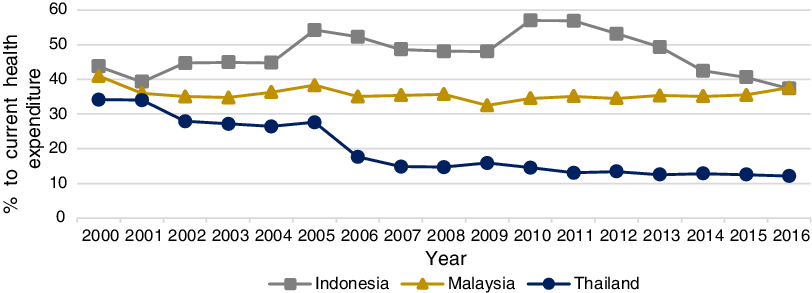
The rolling out of the UHC indicates governments’ intentions to establish statutory welfare provisions for ‘all citizens’, boosting thus the state’s role in social protection. However, the magnitude of the social protection expenditure (see Figure 2) is still under 5 per cent of the GDP, signalling that there are significant more steps towards establishing a welfare state regime (Savedoff, Reference Savedoff2007). This unavoidably means that the family’s role remains important. As Figure 3 shows, out-of-pocket spending payments are relatively high in Indonesia and Malaysia while in Thailand they remain lower. The fluctuating trends of the out-of-pocket expenditures in the Figure reflect that the impact of health reform, such as provision of health insurance under the safety net programme, and UHC may vary (Hsu and Yang, Reference Hsu and Yang2017). The limited financial capacity of the government also requires the participation of the community in welfare provision. For example, the local community in Indonesia makes a sizable contribution in providing several types of informal social protections for community members (see Sumarto, Reference Sumarto2017).
Out-of-pocket expenditure (per cent of current health expenditure).

Welfare regime change and insecurity
Comparative studies on welfare regimes in East and Southeast Asia (e.g. Hort and Kuhnle, Reference Hort and Kuhnle2000; Croissant, Reference Croissant2004; Gough, Reference Gough, Gough, Wood, Bevan, Barrientos, Davis and Room2004a) clearly argue that, prior to the AFC, all the welfare regimes examined here were categorised as productivist. Gough (Reference Gough, Gough, Wood, Bevan, Barrientos, Davis and Room2004a) predicted that the welfare regimes in Indonesia, Malaysia, and Thailand would move from productivist to liberal-informal welfare regime. This expectation is based on two arguments. First, the change was directed by liberal-global institutions, i.e. IMF and WB, and second, because informal welfare provision is expected to continue to play an important role.
Gough’s argument on welfare regime change is applicable to the Indonesian regime but less convincing for Malaysia and Thailand. The Indonesian productivist regime changed to the informal-liberal, shown by the fact that the main driver of the change was the WB and its role and power in shaping the political-economic liberalisation of the Indonesian economic institutions (Sumarto, Reference Sumarto2017). It is well-documented that Soeharto’s government did not have any plan to allocate any budget for the social protection of the poor (Sumarto and Kaasch, Reference Sumarto and Kaasch2018). The informal aspect of the welfare regime continues to be shown by the high reliance on the informal welfare provision as the capacity of the government to cover its population is still very limited (Sumarto, Reference Sumarto2017).
Malaysia and Thailand underwent a different path of welfare regime change. Unlike the Indonesian case, Malaysia institutionalised a social safety net and achieved universal coverage about two decades prior to the AFC. Thailand introduced some social safety nets for the poor when the AFC struck but not long after Thailand initiated the UHC and managed to achieve universal coverage only for one year.
Both the Malaysian and Thai welfare regimes thus are more inclusive than that of Indonesia. However, their social expenditure is still low and insufficient enough to warrant a move towards a welfare state regime. The low social spending levels mean that the role of community and family is still important. From an institutional point of view, the Malaysian and Thai welfare regimes are slightly moving away from the liberal-informal welfare regime and are moving closer to what can be tentatively described as an informal-inclusive regime. The regime thus reflects a growing role of the state in welfare provision through an inclusion of the previously excluded population, particularly in health insurance, and a thriving complementary support of community and family to the state’s role. After transforming into the informal-liberal regime, Indonesia wanted to enter the informal-inclusive regime but it has not been able to achieve it as Indonesia failed in the universalisation of healthcare. Thus, the Indonesian regime can be classified as an informal-quasi inclusive welfare regime or in transition to an informal-inclusive regime (Sumarto, Reference Sumarto2017).
The limited capacity of the state in welfare provision implies that welfare regime changes bring problematic social stratification. The stratification occurs because the government allows a group of families, particularly those under poor category, to get free access to healthcare but at the same time, enforces the other groups to pay the healthcare, leading to a division of families in different social strata.
Upon reflection of these cases, the concept of ‘universal’ used for social programmes in the global South, including UHC and universalist social investment states, which was coined by Gough (Reference Gough, Gough, Wood, Bevan, Barrientos, Davis and Room2004a), should be reconsidered to include adequacy of support. Even when the Indonesian government introduced the ‘universalist social investment state’, as argued by Gough (Reference Gough, Gough, Wood, Bevan, Barrientos, Davis and Room2004a), this was in truth a programme aimed not to provide basic social services universally but to mitigate the poor from the social risk caused by the AFC. Perhaps using the term ‘inclusive’ is more appropriate rather than ‘universal’, as the latter is often linked to extensive and comprehensive welfare provision which chronically underfunded welfare regimes cannot (yet) achieve.
The regime changes are accompanied by insecurity, which can be divided into two aspects. First, the regime change took place due to external economic shock (e.g. AFC) which severely affected economic performance with the latter causing political-economic uncertainty, instability, and disruption. Once this level of instability and disruption is magnified to the societal level then Giddens’ (Reference Giddens1984) approach on ‘ontological security’ becomes more pertinent to explore and explain welfare regime change. When the WB urged the borrowers to provide a social safety net during the AFC, it aimed to tame social disruption (Sumarto, Reference Sumarto2017). Concurrently, it become a first important intervention, especially in Indonesia though in the end social tensions were not avoided. And while the level of instability and disruption was not embedded in the politico-economic system (as e.g. Sub-Saharan Africa) there was only a ‘transient insecurity’ accompanying political and welfare regime change. Indonesia coped with the most problematic transient insecurity, followed by Thailand and Malaysia. The harmful events during the Indonesian structural adjustment program covering harmful demonstrations, violence against minority groups and riots show the transient insecurity.
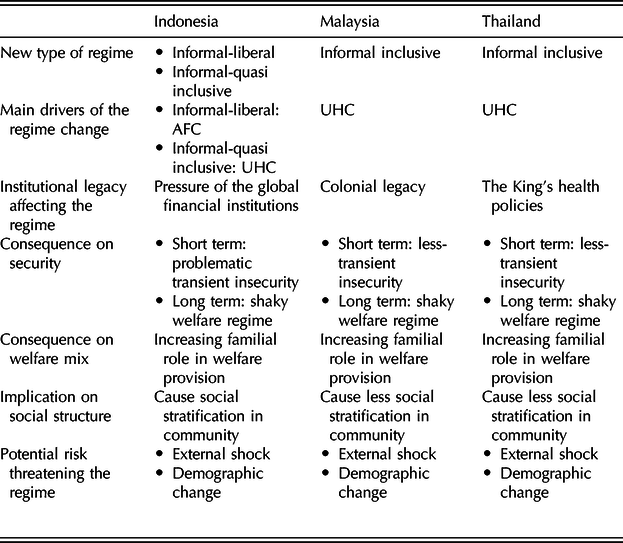
Second, the regime change in all cases explored here resulted in less-secure regimes against severe external shock but more inclusive regimes internally. The Southeast Asian welfare regime transformed into a more inclusive one through a growing role of the state and family in welfare provision. However, the magnitude of the state’s increased role is not sizable, and the capacity of the family to take part in the social protection policy is not completely sufficient to serve as a complementary source of social protection, as many still work in the informal sector. Under this situation, the demand for more of the state’s holistic social protection, mainly due to demographic change, which takes shape in the increasing proportion of elderly due to the higher life expectancy, is getting higher. This means that the less-sizable growing contribution of the state is followed by the greater demand for a more-established social policy. The characteristics of the welfare regimes in Indonesia, Malaysia, and Thailand elaborated above are summarised in Table 2.
Characteristics of welfare regimes in Indonesia, Malaysia, and Thailand

It has been suggested that in order to historically capture the driver and content of welfare reforms, we need to look back at the historical legacies but also account for the responses to the AFC. What is really interesting is that without the external pressure, particularly from the IMF and the WB, it would be less likely that the Indonesian government would introduce social protection legislation in 1998 (Sumarto and Kaasch, Reference Sumarto and Kaasch2018). This is mainly because the Indonesian government has never learned about the importance of social protection from the developed countries, unlike the Malaysian and Thai governments which learnt from European (and ex colonial) countries. In both Malaysia and Thailand, welfare reforms predated the AFC and the legislation for UHC was also introduced before Indonesia due to the impact that colonial powers had over their constitution. Thus, it is logical that the Malaysian government and the Thai administration introduced the UHC far earlier than the Indonesian UHC. This resulted in more stability for the Malaysian and Thai regimes compared to the Indonesian one, filtering thus the pressures and insecurity caused by the AFC.
Conclusion
The article concludes that all the welfare regimes explored here experienced a change in their welfare development path and effectively represent new forms of welfare regime typologies. These new types comprise informal-quasi inclusive and informal-inclusive to account for the increasing reliance on family in welfare provision.
Indonesia’s regime changed from productivist to informal-liberal, due to a pressure of global financial institutions, driven mostly by ideological premises of IMF and WB. The regime changed to informal-quasi inclusive regime soon after the Indonesian government introduced the UHC: thus, the regime can be seen as in transition towards an informal-inclusive one. Conversely, Malaysia and Thailand, underwent a change from productivist to informal-inclusive – though in their case this transition seems to be anchored more firmly. The welfare insecurity, however, remains embedded in the Southeast Asian regime as the new regime is under a threat of potential demographic change and serious external-economic shock. The different path of the changes, which cause different consequences on insecurity, happens mainly because of different historical institutional legacies of colonisation. This shows that path dependence, particularly in historical-colonial legacy, is an important conceptual framework to understand welfare regime development and its interrelation with security in the Southeast Asia.
Under this less-secure regime, the family role is very important as a supplementary welfare provider to support the state’s function in welfare provision. The state inevitably pushes family to take part in social policy, as the capacity of the government in welfare provision is very limited. The question thus becomes how far families can absorb these risks and responsibilities considering their increased exposure to credit (Papadopoulos and Roumpakis, Reference Papadopoulos and Roumpakis2017). Interestingly, the tendency of the growing familial role is getting higher even when the state promotes ‘inclusive’ provisions. The inclusive regime thus is built under an assumption that economic performance is high and the labour market works pervasively; otherwise, the family may not be able to earn sufficient income, to pay insurance membership and other out-of-pocket payment costs. This leads to a problematic social stratification as families are expected to make their payments based on their own material resources, thus dividing families into different social strata; one accessing free but basic healthcare services and one that affords premiums.